Aave Whale "Midnight Pump" Drains Borrowers of $6 Million Every Night, Who's Behind This?

marsbitОпубликовано 2026-07-29Обновлено 2026-07-29

Введение

A "whale" is repeatedly causing interest rate spikes on Aave's USDC pool by temporarily withdrawing nearly $190 million in liquidity every night around 23:30 UTC and returning it within an hour. This action, tracked to a specific Ethereum address, spikes the pool's utilization above its 92% target, sharply increasing variable borrowing rates for all users in the pool during that window. Analysis suggests this is likely a fund performing a daily compliance ritual—withdrawing funds to prove ownership for a snapshot before redepositing them. While the time window for these withdrawals has tightened from June to July, the practice imposes a significant cost. Calculations show this activity costs borrowers in the pool an extra $1.7 million per year. For context, a single $1 million loan incurs about $3,280 in extra annual interest. The transparency of DeFi exposes how traditional financial compliance processes can create a hidden tax for decentralized finance users, highlighting a need for adapted regulatory frameworks.

Author: Cooper Duschang

Compiled by: Deep Tide TechFlow

Deep Tide Guide: Someone is draining $190 million in liquidity from Aave's USDC pool every night and returning it half an hour later—this operation is forcing all borrowers to pay an extra $6 million in interest annually. Deep Tide tracked the on-chain flow of funds and found this is most likely a mandatory daily process for a certain fund to prove to its investors that "we indeed hold this money." The transparency of DeFi has exposed the invisible tax that traditional financial compliance processes impose on on-chain users.

Core Discovery

Since May, the utilization rate of Aave's USDC pool has been spiking daily during the midnight UTC period. The reason is that someone withdraws $190 million USDC around 23:30 and deposits it back within an hour. This affects the interest rates for all lenders and borrowers in the pool.

By tracing the fund flow from this wallet, we found the behavior most consistent with the explanation: a certain institution needs to withdraw funds from the DeFi pool daily to take a snapshot proving asset ownership, and then deposit them back.

This "pump-and-dump" time window has become increasingly tight in July, consistently centered around midnight UTC. Compared to a scenario with no liquidity withdrawal, this operation is causing all USDC borrowers to pay an extra $6 million per year.

How Does Aave's Utilization Mechanism Work?

Aave's dual-interest rate model incentivizes borrowing and lending based on a target utilization rate. When utilization is below the target, the interest rate increases slowly; when it exceeds the target, the rate spikes sharply. The utilization formula is (Total Borrowed / Total Deposited). For example, the more assets borrowed, the closer the utilization gets to 100%.
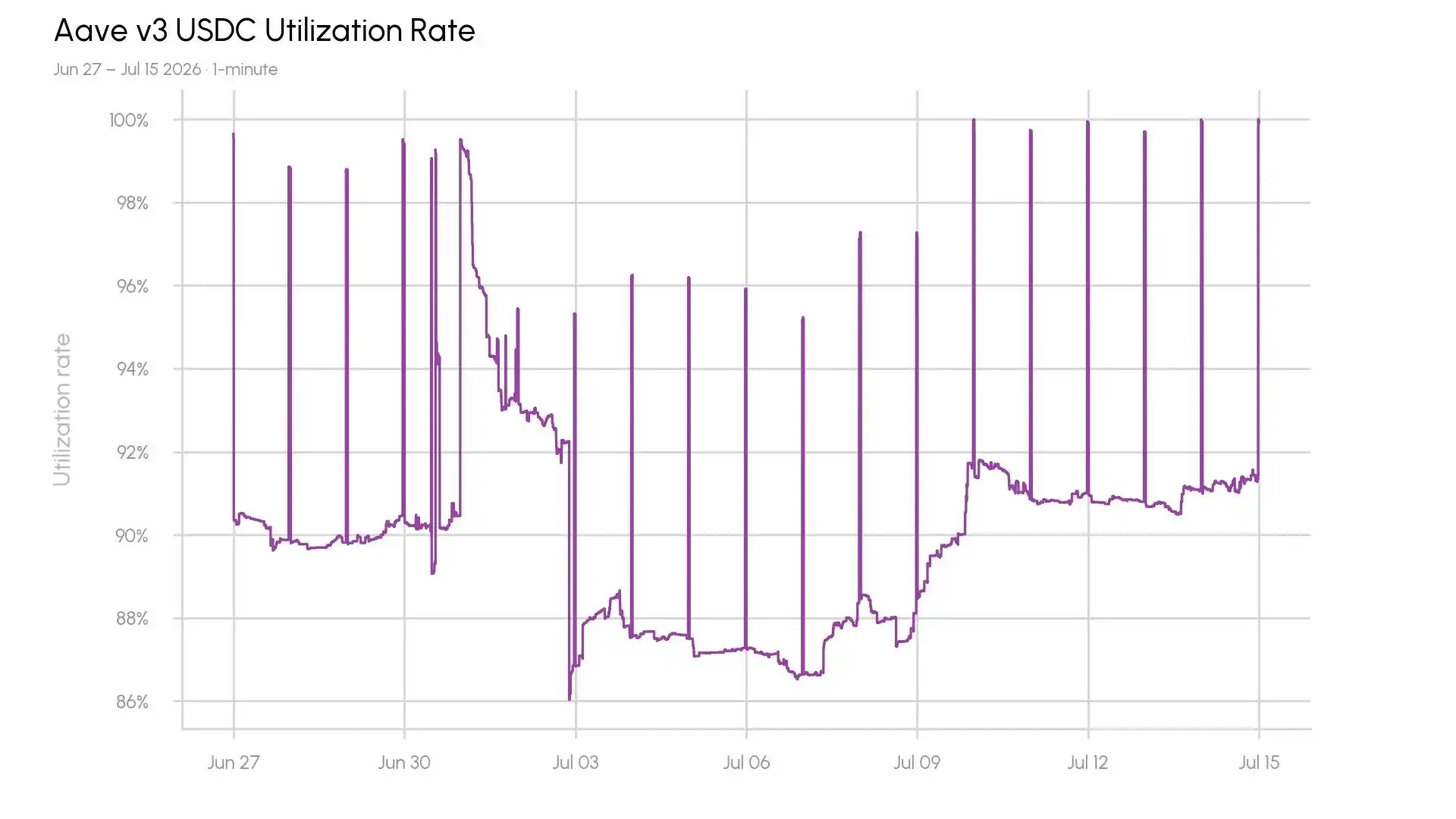
Figure: Aave's dual-interest rate model—the borrowing rate curve steepens sharply after exceeding the target utilization rate (e.g., 92%). Source: Coin Metrics / Talos

The target utilization rate for the USDC market on Aave's Ethereum main instance is 92%. After exceeding the target, the interest rate curve becomes very steep—from 92% to 100% utilization, the borrowing rate skyrockets from 4% to 14%. This discourages borrowing demand or encourages more people to deposit USDC to meet the demand.

The utilization rate in Aave's USDC market typically fluctuates around 90%. However, since May, minute-level data shows repeated sharp spikes in utilization.
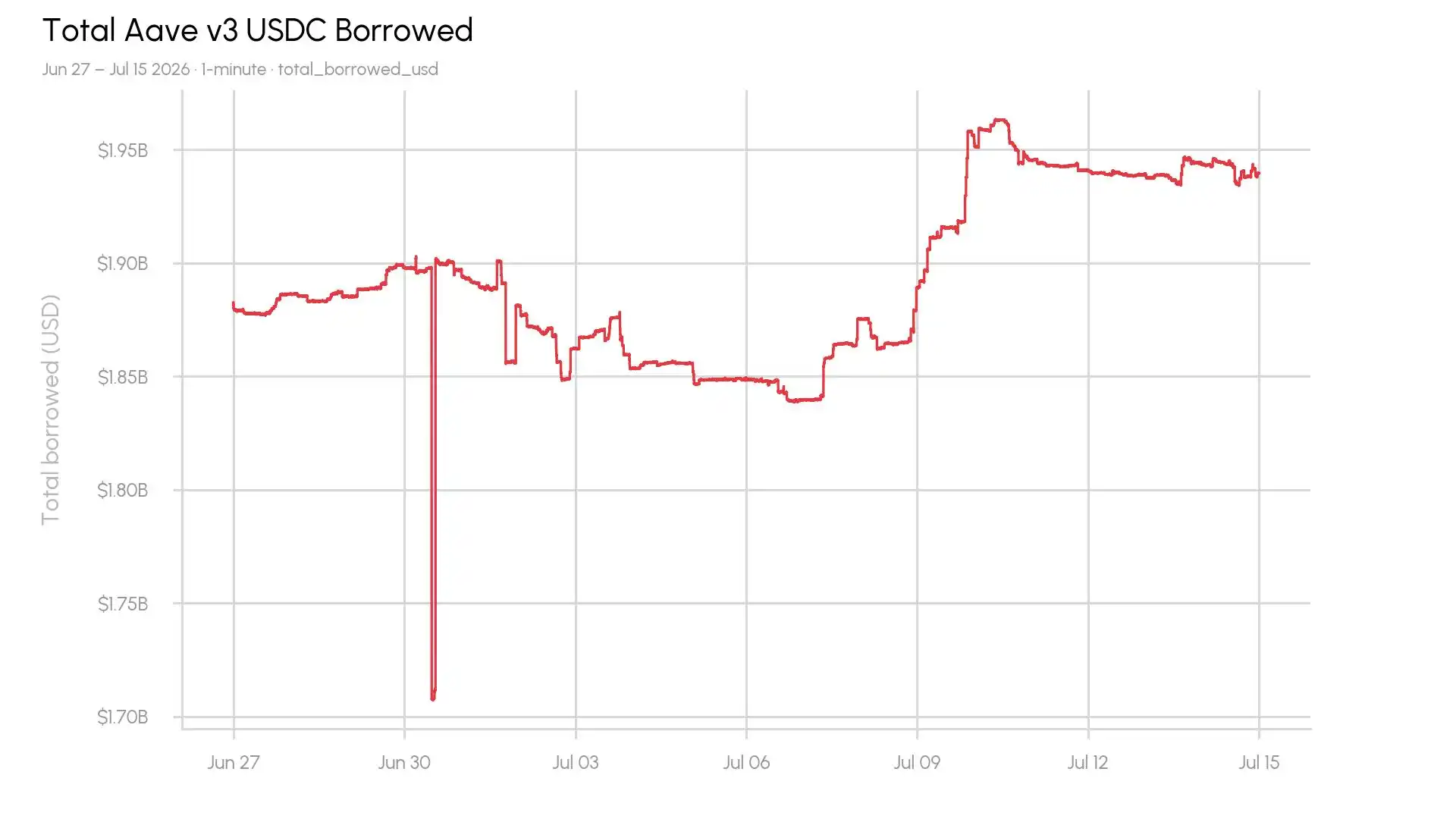
Figure: Minute-level data of Aave USDC market utilization, showing regular midnight spikes since May. Source: Coin Metrics / Talos

Why Do These Spikes Occur?

Excluding governance adjustments or oracle manipulation, only two variables affect the utilization rate: the amount of USDC deposited and the amount borrowed.

Apart from a brief dip in borrowing, the total borrowed amount has averaged $1.89 billion since June 27th. If borrowing hasn't consistently surged—which would push utilization higher—then the amount of USDC deposited must be plummeting.

Between 23:30 UTC and latest 00:30 UTC, over $150 million in USDC deposits are withdrawn and redeposited. The available borrowing liquidity plummets from about $210 million to as low as $33,000.
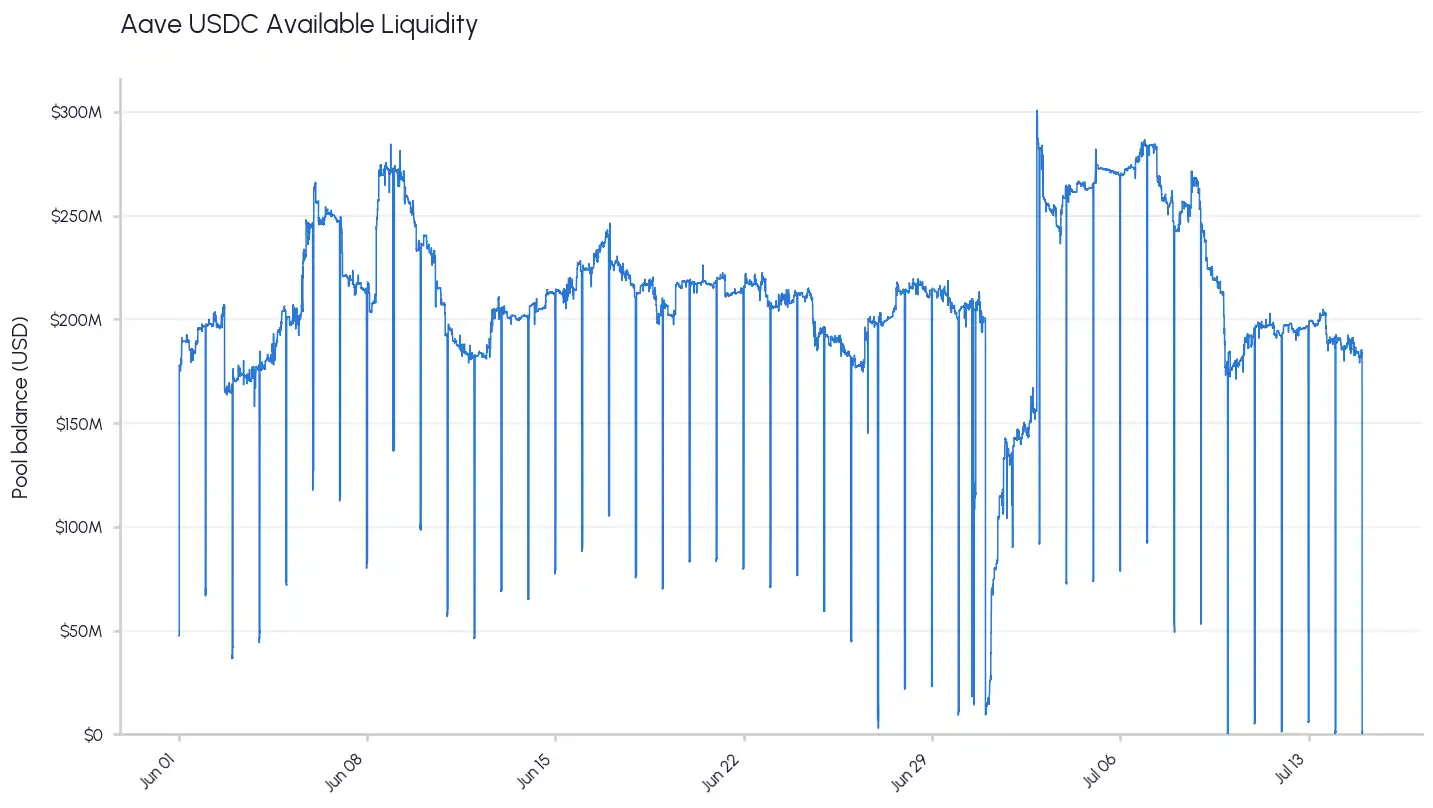
Figure: Over $150 million USDC withdrawn and redeposited daily between 23:30–00:30 UTC, available liquidity crashes from ~$210 million to a low of $33k. Source: Coin Metrics / Talos

Who Is Creating These Spikes?

Ethereum's pseudonymity allows us to publicly track addresses and transactions without exposing the user or intent. We found the address moving $190 million every night: 0x56957E411Ea83a0B4A0689C1fB0D1e5eA0d20149.
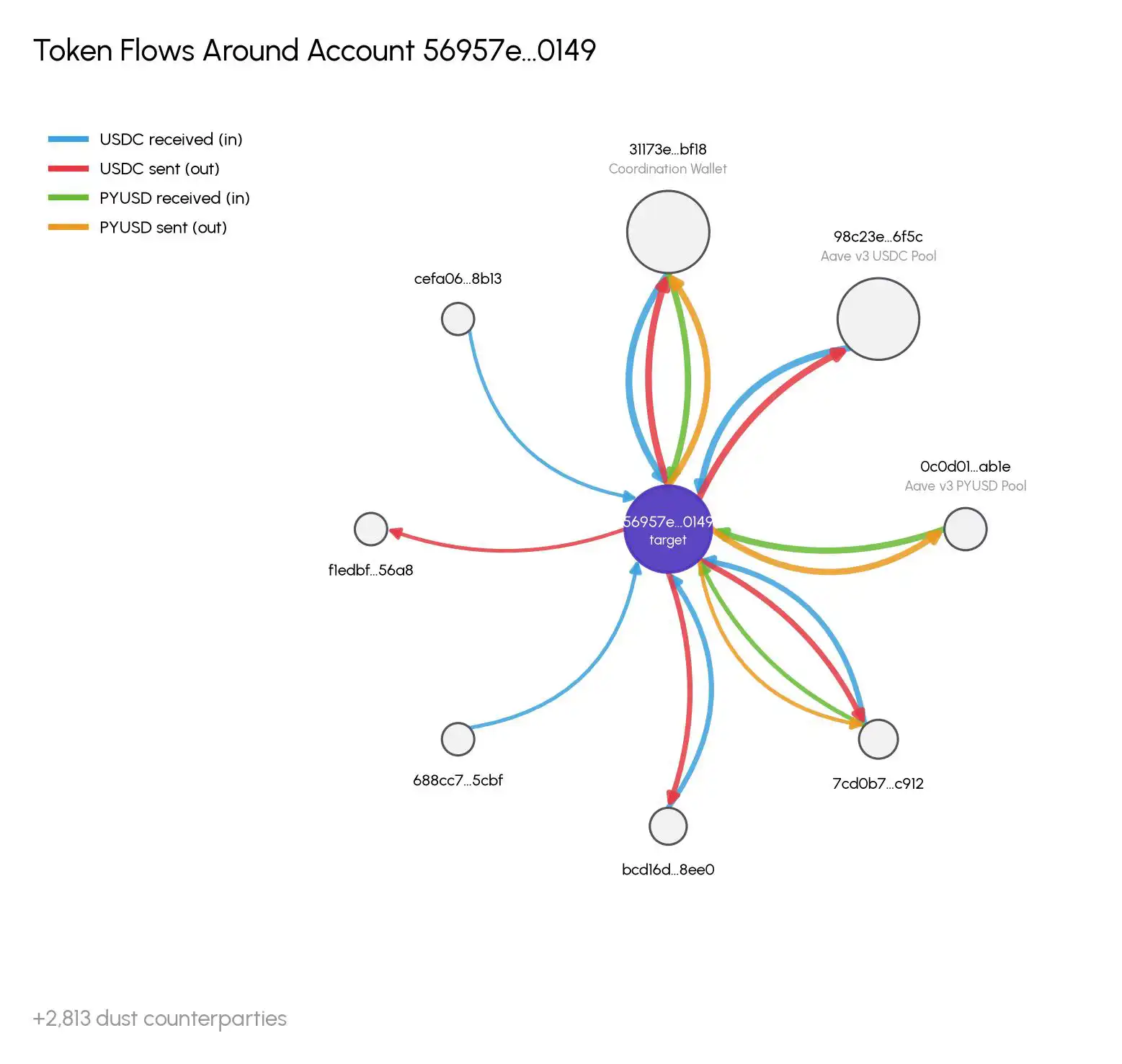
Figure: Fund flow path of the involved address 0x5695...0149, withdrawing liquidity from Aave for a snapshot each night before returning it. Source: Coin Metrics / Talos

This account received funds on December 5th, 2025. Examining balance changes and fund flows, we traced that the target address performed similar operations on Aave's PYUSD pool in December and January. The target address receives USDC, deposits it into the Aave pool, withdraws around 23:30 UTC, and sends it to 0x31173Ed183e5a9450C3671018ec4d770c8A8bF18 a few minutes later. The USDC is then returned shortly after 00:00 UTC and redeposited into the Aave pool.

This "coordinating wallet" 31173e...bf18 receives funds from the target address and another address holding sUSDS by depositing USDC to earn yield. This combined capital is sent nightly to a third, upper-level wallet: 0xf1edbf98dda764ec51de3776371f0f7d6f6156a8.

This is likely a process where an investor is required to prove their holdings daily by withdrawing liquidity from DeFi pools for snapshot purposes.

From June to July, the average time window for pumping and dumping has tightened. The withdrawal time shifted from 23:20 to 23:34, and the return time shortened from 00:34 to 00:09. The average interval between withdrawal and return was 259 blocks in June, shrinking to 177 blocks in July.
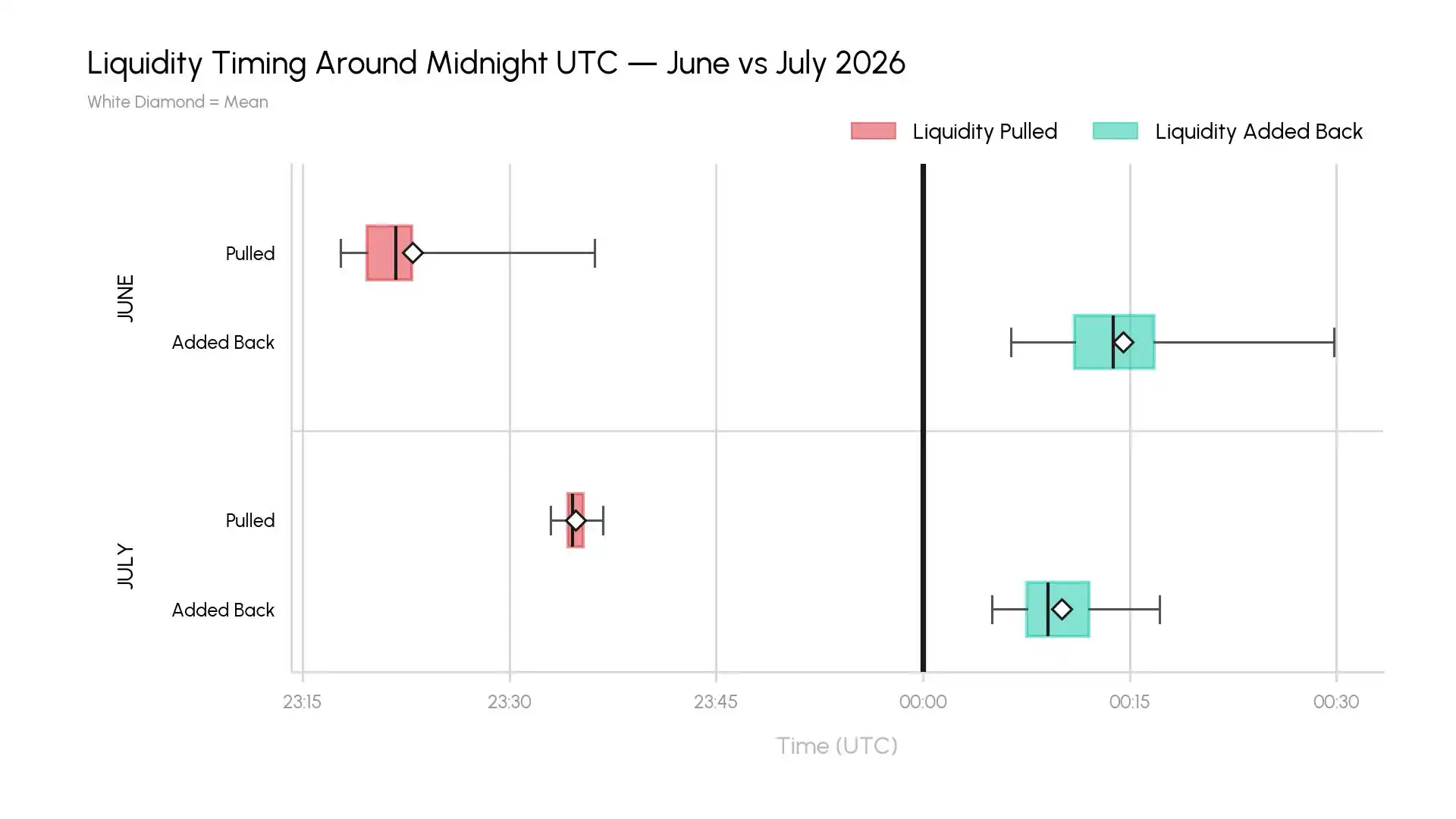
Figure: The withdrawal and return time window tightened from June to July, with the interval shortening from an average of 259 blocks to 177 blocks. Source: Coin Metrics / Talos

What Is the Impact on Borrowers?

The utilization spikes caused by liquidity withdrawal benefit depositors but harm borrowers. When utilization spikes, the floating borrowing rate also spikes, leading to temporarily higher repayments calculated per block.

Yield or interest on Aave is streamed per block. With an average Ethereum block time of 12 seconds, about 5 blocks are produced per minute. We decomposed the floating borrowing APR to simulate how a $1 million borrowing position is affected by minute-by-minute changes in the borrowing rate.
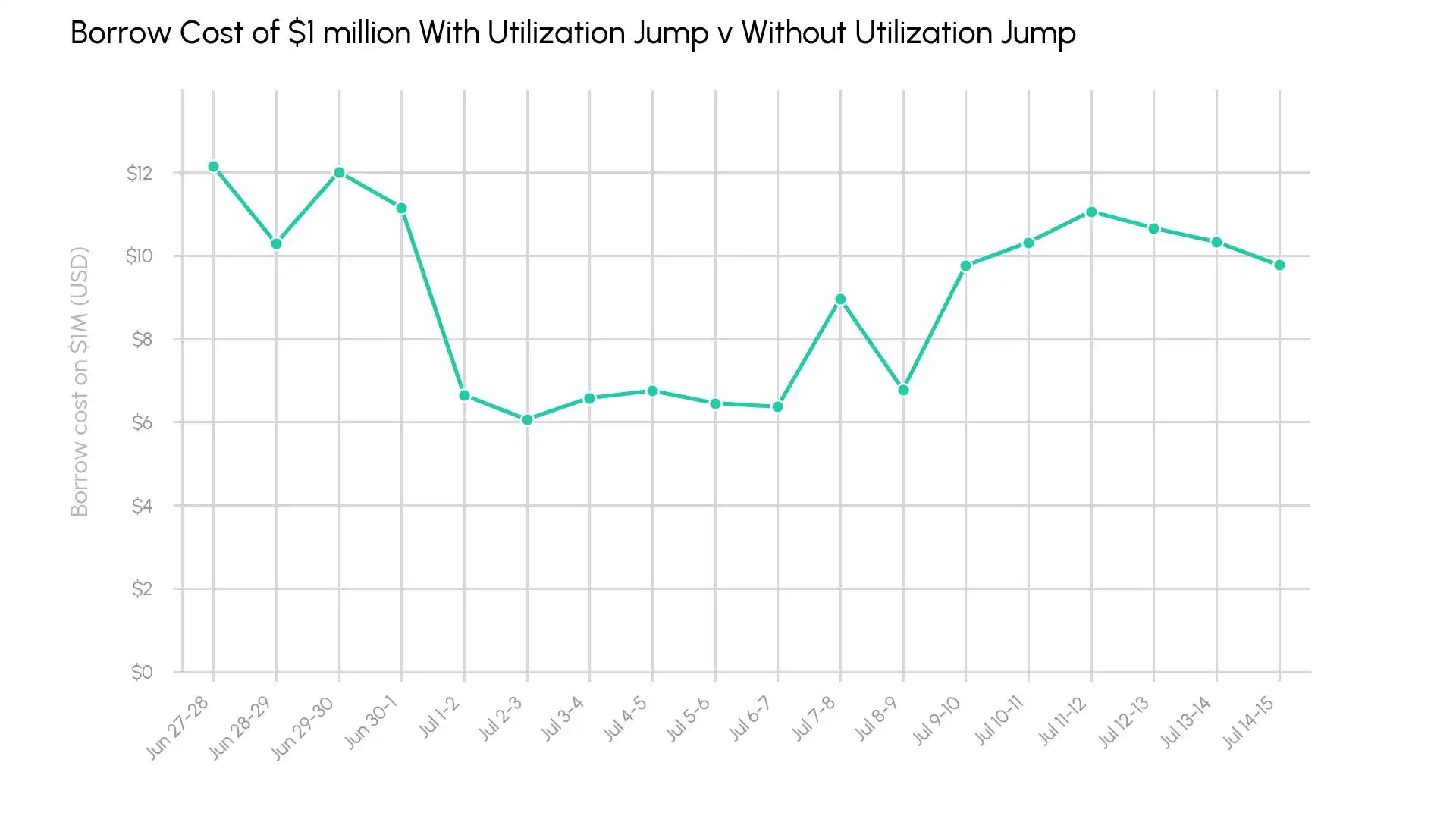
Figure: Minute-by-minute borrowing rate changes for a $1 million borrowing position during liquidity withdrawal, costing an extra ~$9 per night over 18 days. Source: Coin Metrics / Talos

Over 18 days, when liquidity was withdrawn, a borrower with a $1 million position paid an average of $9 more per day compared to a simulated scenario where liquidity was not temporarily altered. This would amount to a loss of about $3,280 annually. For the total $1.89 billion borrowed in the USDC pool, this costs all borrowers an extra $17,000 per night, or $6 million per year. Borrowers are paying more for activities unrelated to their own loans.

Why Does This Matter?

We believe these consistent utilization spikes most closely align with an explanation of a fund proving its holdings. Establishing regulations and improving workflows around DeFi investments could help reduce these negative impacts on lending pools. The transparency of blockchain can aid in tracking fund flows within blockchain protocols without needing to send funds to a designated address to prove they exist and are under the control of approved parties.

Today, lenders and borrowers must monitor not only the health of their own positions but also those in the entire pool. Tracking funds and deciphering their intent can help assess new risks and predict liquidity and interest rate changes.


Трендовые криптовалюты

Связанные с этим вопросы

QWhat is the primary impact of the 'midnight liquidity draining' phenomenon described in the article?

AThe primary impact is that it costs all USDC borrowers on Aave an estimated $6 million extra in interest payments annually. This occurs because withdrawing $190 million in liquidity from the USDC pool temporarily spikes the utilization rate, triggering Aave's steep interest rate curve and increasing borrowing costs for everyone until the funds are redeposited.

QAccording to the article, what is the most likely explanation for the consistent nightly withdrawals and redeposits of funds on Aave?

AThe most likely explanation is that a fund or institutional investor is required to prove its asset holdings daily for compliance or reporting purposes. The process involves withdrawing funds from the DeFi pool (like Aave) to take a 'snapshot' proving ownership and control, before quickly returning the funds.

QHow does Aave's interest rate model respond when the utilization rate of a pool exceeds its target (e.g., 92% for USDC)?

AAave uses a dual interest rate model. When the utilization rate exceeds the target (like 92%), the borrowing interest rate curve becomes very steep. For the USDC pool, this means rates can jump sharply from around 4% at 92% utilization to as high as 14% at 100% utilization, designed to discourage further borrowing or incentivize more deposits.

QWhat specific wallet address was identified as being responsible for the nightly liquidity movements, and what pattern did its activity show over time?

AThe wallet address identified is 0x56957E411Ea83a0B4A0689C1fB0D1e5eA0d20149. Analysis showed that from June to July, the time window for its 'withdraw-and-redeposit' operation became more compact. The average interval between withdrawal and redeposit shortened from 259 blocks in June to 177 blocks in July, indicating a faster process.

QWhy does the article suggest that DeFi's transparency is a double-edged sword in this context?

ADeFi's transparency allows for the public tracking of these fund flows and the identification of the systemic issue, exposing how traditional financial compliance processes can impose a hidden cost (the 'invisible tax' of extra interest) on other protocol users. However, it also means lenders and borrowers must now monitor not just their own positions but also the health and activity of the entire pool to anticipate such risks.

Похожее

Выручка Coinbase упала во втором квартале на фоне замедления рынка, но неторговые услуги расширяются

Криптобиржа Coinbase сообщила о снижении выручки во втором квартале на фоне общего замедления активности на рынке цифровых активов. Общий доход компании составил 1,22 миллиарда долларов, что на 14% меньше, чем в предыдущем квартале. Чистый убыток за период достиг 359 миллионов долларов. Основное давление на финансовые показатели оказало падение доходов от торговых операций, которые сократились на 21% до 599 миллионов долларов. Общий объем торгов на платформе упал на 24% до 146,4 миллиарда долларов. Несмотря на это, Coinbase увеличила свою долю рынка до рекордных 10,3%, что свидетельствует о сохранении пользовательской базы. Значительную роль в структуре доходов начинают играть неторговые сервисы. На них, включая подписки и услуги, пришлось 48% чистой выручки. Особенно ярким драйвером роста стал сегмент прогнозных рынков, выручка которого выросла на 106% по сравнению с первым кварталом и превысила 100 миллионов долларов в годовом исчислении. Компания также отмечает стабильный спрос на услуги, связанные со стейблкоином, о чем говорит средний баланс USDC на платформах в размере 20 миллиардов долларов. Компания продолжает инвестировать в развитие различных продуктов, чтобы адаптироваться к рыночным условиям. Вопрос о том, смогут ли растущие неторговые направления компенсировать возможную дальнейшую слабость транзакционных доходов, остаётся открытым.

TheNewsCrypto3 мин. назад

Выручка Coinbase упала во втором квартале на фоне замедления рынка, но неторговые услуги расширяются

TheNewsCrypto3 мин. назад

Россиянин создал сеть из девяти тайных криптоферм

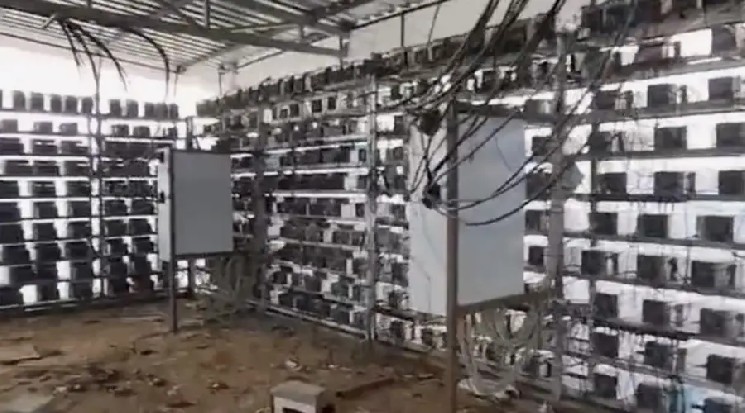
Россиянин организовал сеть из девяти тайных криптоферм в Нижнем Новгороде для незаконного майнинга. Силовики обнаружили одну из ферм в гараже возле железнодорожной станции «Починки». Оборудование было подключено к электросетям без договора, а в работу счетчиков электроэнергии было вмешано для занижения реальных объемов потребления. Аналогичные незаконные подключения были выявлены на восьми других объектах: на автомойке, в подвалах жилых домов и даже в закопанном в землю контейнере. В ходе обыска у подозреваемого изъяли 120 майнинговых устройств, телефоны, ноутбук и банковские карты. В отношении него возбуждено уголовное дело по статье о причинении имущественного ущерба путем обмана. До суда он остается под подпиской о невыезде. Отметим, что в Нижегородской области майнинг криптовалюты не запрещен. Ранее аналогичная нелегальная ферма была обнаружена в лесополосе в Иркутской области.

cryptonews.ru4 мин. назад

Россиянин создал сеть из девяти тайных криптоферм

cryptonews.ru4 мин. назад

U Today: пятница — худший день для биткоина

Статистика показывает, что биткоин чаще всего дешевеет по пятницам, со средним снижением недельной доходности более 1%. Негативная динамика также наблюдается по понедельникам и средам, тогда как уверенный рост обычно происходит во вторник, а выходные чаще завершаются в плюсе. Однако прошлые результаты не гарантируют повторения, так как динамика зависит от состояния рынка, экономических событий и действий крупных инвесторов. Пятничное снижение часто объясняется разницей в режимах работы: крипторынок работает круглосуточно, а традиционные биржи и банки закрываются на выходные. Институциональные инвесторы перед уик-эндом часто фиксируют прибыль, снижают плечо и закрывают позиции, особенно после волатильной недели. Дополнительное давление создает рынок деривативов, так как по пятницам часто истекает срок недельных фьючерсов и опционов. Трейдеры закрывают или переносят контракты, что усиливает волатильность. К концу недели также снижается ликвидность — в стаканах меньше крупных заявок, поэтому даже умеренные продажи сильнее влияют на цену. При достижении критических уровней это может запустить цепную реакцию ликвидаций маржинальных позиций.

cryptonews.ru5 мин. назад

U Today: пятница — худший день для биткоина

cryptonews.ru5 мин. назад

Банк Японии сигнализирует о повышении процентных ставок, несмотря на сохранение их на уровне 1%

Банк Японии 31 июля оставил ключевую процентную ставку на уровне 1%, как и ожидалось. Единственный член правления, Хадзиме Таката, проголосовал за повышение до 1,25%. Несмотря на сохранение ставки, центробанк сохранил жесткую риторику, предупредив об ускорении базовой инфляции выше целевого уровня 2% во второй половине финансового года. Прогноз инфляции на 2026 финансовый год был несколько снижен, но в Банке Японии выразили уверенность в ее долгосрочном росте из-за слабой иены, корпоративной ценовой политики и последствий энергетического шока. Перед решением по ставкам Банк Японии провел валютную интервенцию, впервые за три месяца поддержав иену, которая опустилась до 40-летнего минимума к доллару. Слабость иены вызвана разницей в ставках с США, высокой стоимостью топлива и ожиданиями дальнейшего ужесточения политики. Цена 10-летних облигаций свидетельствует, что рынки ждут новых шагов по нормализации. Задача главы Банка Японии Уэды — балансировать между правительством, не желающим ужесточения, и рынками, которые на него рассчитывают.

cryptonews.ru13 мин. назад

Банк Японии сигнализирует о повышении процентных ставок, несмотря на сохранение их на уровне 1%

cryptonews.ru13 мин. назад

Торговля

Спот

Популярные статьи

Король мемов PUMP: создание инновационной платформы Web3 SocialFi

Pump.Fun - это инновационная социально-финансовая (SocialFi) платформа, начавшаяся с запуска мемкоинов и теперь стремящаяся создать экосистему, где можно торговать различными видами контента.

2.5k просмотров всегоОпубликовано 2025.09.18Обновлено 2025.09.18

Король мемов PUMP: создание инновационной платформы Web3 SocialFi

Популярные токены: Учебная неделя 19 — RWA и инфраструктура остаются в центре внимания; дневной объём торгов на платформе Pump возвращается к недавним максимумам

Дневной торговый объём платформы pump.fun вернулся к высоким уровням: еженедельная выручка составляет миллионы долларов, что обеспечивает обратный выкуп токенов PUMP.

691 просмотров всегоОпубликовано 2026.07.22Обновлено 2026.07.24

Популярные токены: Учебная неделя 19 — RWA и инфраструктура остаются в центре внимания; дневной объём торгов на платформе Pump возвращается к недавним максимумам

Обсуждения

Добро пожаловать в Сообщество HTX. Здесь вы сможете быть в курсе последних новостей о развитии платформы и получить доступ к профессиональной аналитической информации о рынке. Мнения пользователей о цене на PUMP (PUMP) представлены ниже.

活动图片