Court Suspends Effect of Prediction Market Ban in Minnesota Before Its August 1st Start

cryptonews.ruОпубликовано 2026-07-28Обновлено 2026-07-28

Введение

A Minnesota court has temporarily blocked the state's ban on prediction markets from taking effect on August 1. The ruling, secured by companies Kalshi and Polymarket, allows these fast-growing platforms to continue operating. The case has significant implications for the crypto sector, as these markets are deeply intertwined with digital assets. Polymarket settles trades using blockchain stablecoins, and crypto-related contracts form a substantial portion of trading on both platforms. The legal fight will test how far states can go in regulating markets that increasingly involve digital assets, while regulators debate whether prediction markets fall under derivatives or gambling laws. The prediction market sector has grown dramatically, with monthly trading volumes reaching tens of billions of dollars in 2026. Crypto is a major trading category, accounting for roughly 20% of Polymarket's volume. The Minnesota case could determine whether these platforms develop under federal derivatives oversight or a patchwork of state gambling laws, shaping their future integration with blockchain-based financial infrastructure. While Kalshi, a CFTC-regulated exchange, currently leads in trading volume, Polymarket is reportedly seeking broader U.S. regulatory approval. The preliminary court order is a temporary reprieve; the broader legal question remains unresolved. The outcome will influence not only prediction markets but also how institutional investors view blockchain-based finance...

Companies Kalshi and Polymarket have obtained a preliminary court injunction that prevents the enforcement of a prediction market ban in Minnesota, allowing the two fastest-growing trading services to continue operating amid record sector growth.

This ruling will have broader implications for cryptocurrencies. Polymarket settles margin transactions on-chain using stablecoins. Furthermore, cryptocurrency-related trades constitute a significant portion of the trading operations for both mentioned companies.

Thus, a statewide ban would affect not just two companies but also determine how far states can go in regulating markets that are increasingly intertwined with digital assets, while regulators are still trying to determine whether prediction markets fall under derivatives legislation or gambling laws.

Why the State Court Decision Affects Cryptocurrencies

Prediction markets allow people to trade via contracts linked to future events. The contract value reflects the probability of the prediction coming true, as noted in a Pew Research Center study.

Cryptocurrencies have become one of the largest trading categories in the industry. According to Pew estimates, digital asset-related contracts account for roughly 20% of Polymarket's trading volume and about 7% of Kalshi's, second only to sports and politics.

This clearly shows that the Minnesota lawsuit is important not only for these two companies. Polymarket's development of a high-performance centralized limit order book (CLOB v2) and the launch of a new USDC-backed token called pUSD demonstrate a trend of leading prediction markets evolving into more sophisticated infrastructure for crypto-oriented trading.

As these platforms become faster, more liquid, and better integrated with blockchain-based settlement systems, court rulings in Minnesota are gaining greater significance for the entire digital asset ecosystem. By blocking the enforcement of the Minnesota ruling, the court allows a significant portion of crypto trading in the state to continue.

A Sector That Has Outgrown Its Niche

The industry's rapid growth explains why this case has attracted more attention. Artemis data shows that prediction market trading volume fluctuated between $25 and $30 billion monthly in the first five months of 2026, then reached a historic record of $52.8 billion in June.

In July, trading volume from the month's start reached $50.9 billion, indicating high trading activity even after the FIFA World Cup, which was one of the year's largest trading events.

Unlike previous years, which focused on political events and trends, this year's development of prediction markets has been driven by sports events, macroeconomic expectations, central bank activity, and developments in cryptocurrency markets.

According to Galaxy Research data, the all-time cumulative volume of prediction markets has exceeded $150 billion. Analysts at Bernstein, cited by Galaxy, believe that with improved regulation, prediction market volume could reach $1 trillion by 2030.

However, whether this happens depends on a crucial question currently being examined in Minnesota and several other states: market access.

Kalshi Pulls Ahead While Polymarket Considers Bringing Production Back to the US

Competition has also shifted in favor of Kalshi. According to Token Terminal data, over the last five years, the regulated exchange has captured 61.1% of the cumulative notional volume, reaching $159.5 billion against Polymarket's $101.7 billion. In the last 30 days, Kalshi generated $39.5 billion in notional volume compared to Polymarket's $8.7 billion, highlighting the recent surge in the exchange's popularity.

The key difference lies in regulation. Kalshi is a regulated contract market overseen by the Commodity Futures Trading Commission (CFTC), whereas Polymarket's international platform is not under CFTC supervision.

According to Galaxy estimates, Polymarket's U.S. operations generated about $1.3 billion in April, while the international platform generated about $9 billion. Additionally, Polymarket is reportedly seeking broader regulatory approval in the U.S. for its flagship platform.

Thus, the dispute that began in Minnesota has implications beyond the state. If judges persist in favoring federal regulation of prediction exchanges over state-level gambling regulation, prediction markets could become a key area where cryptocurrencies gain widespread acceptance by leveraging existing market regulation rules rather than bespoke crypto laws. However, if states ultimately prevail, the market may face numerous hurdles operating under conflicting rules.

What Traders Should Watch Next

The court's decision is preliminary, and the broader question of whether states are allowed to restrict federally regulated prediction markets remains open. Traders will be interested to see what Minnesota's next move will be, whether other states adopt similar restrictions, and how Polymarket manages to expand its regulatory footprint in the U.S.

The outcome of the case could impact more than just prediction markets. As stablecoins and digital asset contracts become increasingly integrated into these platforms, this case could affect how institutional investors view blockchain-based financial infrastructure. The dispute in Minnesota may ultimately help define what will define the next phase of development for this rapidly expanding market: federal derivatives oversight or state gambling laws.


Трендовые криптовалюты

Связанные с этим вопросы

QWhat was the immediate impact of the Minnesota court's ruling regarding the ban on prediction markets?

AThe court issued a temporary injunction that prevents the state of Minnesota from enforcing its ban on prediction markets, allowing the companies Kalshi and Polymarket to continue operating in the state beyond the intended enforcement date of August 1st.

QWhy does the legal case in Minnesota have significant implications for the cryptocurrency sector?

AThe case is significant because Polymarket uses blockchain and stablecoins for margin settlements, and cryptocurrency-related contracts make up a substantial portion of trading volume on these platforms. The ruling will influence how far states can go in regulating markets that are increasingly intertwined with digital assets and whether these markets are treated as financial derivatives or gambling under the law.

QAccording to the article, what was the estimated trading volume for prediction markets in June 2026?

AAccording to data from Artemis cited in the article, trading volume on prediction markets reached a historical high of $52.8 billion in June 2026.

QWhat is a key regulatory difference between the companies Kalshi and Polymarket mentioned in the article?

AA key regulatory difference is that Kalshi is a regulated marketplace, supervised by the U.S. Commodity Futures Trading Commission (CFTC), whereas Polymarket's international platform currently operates without CFTC oversight.

QWhat are the two potential regulatory outcomes highlighted by the article for the future of prediction markets?

AThe article highlights two potential regulatory paths: federal oversight under derivatives regulations, which could provide a clear framework and wider legitimacy, or state-level regulation under gambling laws, which could create a fragmented market with conflicting rules and obstacles.

Похожее

Топливный кризис в России идет на спад: регионы начинают отменять лимиты на АЗС

Топливный кризис в России, вызвавший в конце июня 2026 года дефицит бензина и дизеля и введение лимитов на заправках в более чем 20 регионах, начал спадать. В конце июля власти ряда субъектов объявили о смягчении или отмене ограничений. В Забайкальском крае с 30 июля полностью отменили систему QR-кодов на АЗС. В Омской области сняли все лимиты, ранее составлявшие до 40 литров бензина и 80 литров дизеля. В Саратовской области суточный лимит на бензин увеличен с 30 до 40 литров. В Самарской области действующие ограничения продлили без ужесточения. Кризис возник из-за атак украинских беспилотников на объекты топливно-энергетического комплекса, что нарушило логистику и вывело из строя значительную часть мощностей нефтепереработки. Лимиты вводились как мера против ажиотажного спроса. Несмотря на текущую стабилизацию розничной торговли, коренная проблема — повреждение перерабатывающих мощностей — не решена. Существует риск нового витка ограничений осенью, если ремонтные работы не компенсируют выпадающие объемы к началу отопительного сезона.

cryptonews.ru1 мин. назад

Топливный кризис в России идет на спад: регионы начинают отменять лимиты на АЗС

cryptonews.ru1 мин. назад

Число сторонников закона CLARITY достигло 1 миллиона за 7 дней до перерыва в работе Сената

Некоммерческая организация Stand With Crypto объявила, что её сторонники обратились к законодателям США миллион раз с призывом принять закон CLARITY Act до ухода Сената на каникулы 7 августа. Законопроект, который поддерживают крупные финансовые компании, призван создать регулирование для цифровых активов, распределяя полномочия между федеральными агентствами. Однако его критики, включая генерального прокурора Нью-Йорка, опасаются, что он ограничит возможности штатов по борьбе с мошенничеством. Также возникли споры по вопросам этики, связанным с криптовалютными активами политиков, в частности Дональда Трампа. Несмотря на общественную и институциональную поддержку, аналитики снизили оценку вероятности принятия закона в 2026 году с 50% до 30% из-за разногласий и сжатого графика работы Сената, где для прохождения законопроекта требуется 60 голосов.

cryptonews.ru1 мин. назад

Число сторонников закона CLARITY достигло 1 миллиона за 7 дней до перерыва в работе Сената

cryptonews.ru1 мин. назад

Сэйлор и компания Strategy официально поддержали законопроект CLARITY Act, касающийся криптовалют в США

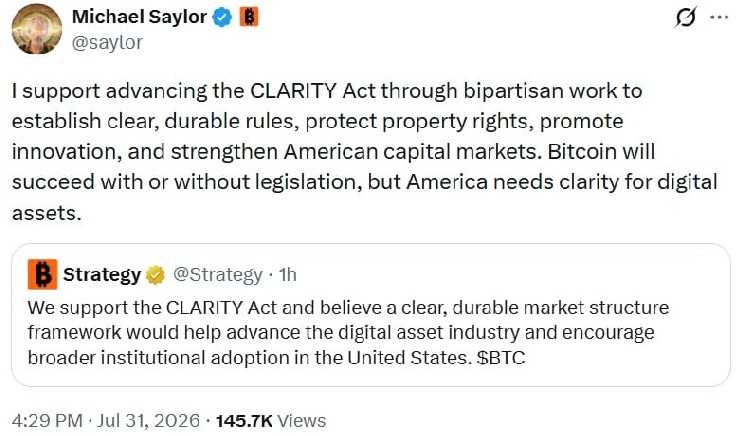
Компания Strategy Inc. (Nasdaq: MSTR), крупнейший корпоративный держатель биткойна, объявила о поддержке двухпартийного законопроекта CLARITY Act (Digital Asset Market Clarity Act). Компания заявила, что закон создаст четкую нормативную базу для рынка цифровых активов, привлечет институциональных инвесторов и защитит права потребителей. Исполнительный председатель Strategy Майкл Сэйлор подчеркнул необходимость ясного регулирования в США для поощрения инноваций и укрепления рынков капитала, хотя отметил, что биткойн будет успешен и без него. Поддержка Сэйлора прозвучала на фоне продвижения законопроекта в Сенате, который распределяет полномочия между SEC и CFTC и устанавливает правила для бирж. Банковский комитет Сената уже одобрил документ. Параллельно Strategy сообщила о чистых убытках за второй квартал, включая значительные нереализованные потери по биткойну, но продолжила наращивать свои резервы криптовалюты. Компания связывает свою долгосрочную стратегию как с регуляторной определенностью, так и с сохранением технической нейтральности протокола биткойна. В то время как сторонники усилили давление на Конгресс, аналитики Galaxy Research снизили вероятность принятия закона с 50% до 30%, ссылаясь на сложности в Сенате. Однако опросы показывают, что позиция кандидатов по криптовопросам может повлиять на итоги предстоящих выборов, создавая дополнительный стимул для законодателей.

cryptonews.ru11 мин. назад

Сэйлор и компания Strategy официально поддержали законопроект CLARITY Act, касающийся криптовалют в США

cryptonews.ru11 мин. назад

Оценка потерь от инцидента с Coldcard возросла до 70 млн долларов после анализа Galaxy

Исследовательское подразделение Galaxy Digital, Galaxy Research, обнаружило 1196 адресов, связанных с инцидентом кошелька Coldcard, в результате которого было потеряно 1082,65 биткойна (примерно $70,2 млн на момент транзакций). Анализ перемещений средств, проведенный 30 июля, показал характерный паттерн атаки: идентичные комиссии и отсутствие выходов для сдачи. Ранее предварительная оценка ущерба составляла около $38 млн. Соучредитель Coinkite Родольфо Новак заявил, что компания берет на себя ответственность за ошибку в прошивке и работает над определением полного масштаба проблемы. Выпущенное обновление устраняет уязвимость, но не защищает сид-фразы, созданные на уязвимой прошивке. Пользователям советуют перевести средства на новый сид.

cointelegraph16 мин. назад

Оценка потерь от инцидента с Coldcard возросла до 70 млн долларов после анализа Galaxy

cointelegraph16 мин. назад

Пятитриллионный момент Apple: лучшая отчетность, худший ИИ

Компания Apple достигла исторического рубежа, временно преодолев капитализацию в $5 трлн на фоне рекордных квартальных результатов. Во втором квартале 2026 года выручка компании составила $109.42 млрд (рост 16.4%), а чистая прибыль — $29.79 млрд (рост 27%), чему способствовали высокие продажи iPhone и Mac. Однако реакция рынка была сдержанной, и акции упали, в то время как бумаги компаний, связанных с ИИ, выросли. Это подчеркивает обеспокоенность инвесторов медленным развитием ИИ-стратегии Apple. Apple отстает в гонке искусственного интеллекта. Ключевые улучшения Siri и Apple Intelligence неоднократно откладывались, что заставило компанию заключить партнерства с Google для базовой модели ИИ и с Alibaba и Baidu для китайского рынка. Несмотря на недавнее включение Apple Intelligence в список одобренных в Китае сервисов, это показывает, что Apple, контролируя аппаратное обеспечение, частично уступила контроль над интеллектуальным уровнем. Впереди компанию ждут серьезные вызовы: высокий базовый уровень продаж iPhone 17, который будет сложно превзойти; давление из-за роста цен на компоненты, особенно память, из-за спроса со стороны центров обработки данных ИИ; растущая конкуренция на рынке «ИИ-смартфонов» от Google, Samsung и китайских производителей; и смена генерального директора. С 1 сентября Тим Кук перейдет на пост председателя совета директоров, а его сменит глава отдела аппаратного обеспечения Джон Тернус. Эта рекордная квартальная отчетность стала последним достижением Кука и одновременно первой задачей для нового руководителя, который должен будет доказать, что Apple может сохранить контроль над основными точками входа для пользователей в эпоху ИИ.

marsbit50 мин. назад

Пятитриллионный момент Apple: лучшая отчетность, худший ИИ

marsbit50 мин. назад

Торговля

Спот

Популярные статьи

Как купить BAN

Добро пожаловать на HTX.com! Мы сделали приобретение Comedian (BAN) простым и удобным. Следуйте нашему пошаговому руководству и отправляйтесь в свое крипто-путешествие.Шаг 1: Создайте аккаунт на HTXИспользуйте свой адрес электронной почты или номер телефона, чтобы зарегистрироваться и бесплатно создать аккаунт на HTX. Пройдите удобную регистрацию и откройте для себя весь функционал.Создать аккаунтШаг 2: Перейдите в Купить криптовалюту и выберите свой способ оплатыКредитная/Дебетовая Карта: Используйте свою карту Visa или Mastercard для мгновенной покупки Comedian (BAN).Баланс: Используйте средства с баланса вашего аккаунта HTX для простой торговли.Третьи Лица: Мы добавили популярные способы оплаты, такие как Google Pay и Apple Pay, для повышения удобства.P2P: Торгуйте напрямую с другими пользователями на HTX.Внебиржевая Торговля (OTC): Мы предлагаем индивидуальные услуги и конкурентоспособные обменные курсы для трейдеров.Шаг 3: Хранение Comedian (BAN)После приобретения вами Comedian (BAN) храните их в своем аккаунте на HTX. В качестве альтернативы вы можете отправить их куда-либо с помощью перевода в блокчейне или использовать для торговли с другими криптовалютами.Шаг 4: Торговля Comedian (BAN)С легкостью торгуйте Comedian (BAN) на спотовом рынке HTX. Просто зайдите в свой аккаунт, выберите торговую пару, совершайте сделки и следите за ними в режиме реального времени. Мы предлагаем удобный интерфейс как для начинающих, так и для опытных трейдеров.

868 просмотров всегоОпубликовано 2024.10.27Обновлено 2026.06.02

Как купить BAN

Обсуждения

Добро пожаловать в Сообщество HTX. Здесь вы сможете быть в курсе последних новостей о развитии платформы и получить доступ к профессиональной аналитической информации о рынке. Мнения пользователей о цене на BAN (BAN) представлены ниже.

活动图片