Data Review: How Much Profit Did Prediction Markets Reap from a Single World Cup?

Odaily星球日报Опубликовано 2026-07-27Обновлено 2026-07-27

Введение

**How Much Did the 2026 World Cup Boost Prediction Markets? A Data Review.** The 2026 World Cup provided a major, temporary boost to leading prediction markets, according to an analysis of Kalshi, Polymarket, and predict.fun. During the tournament, total nominal trading volume reached $543.38 billion on Kalshi, $209.88 billion on Polymarket, and $10.92 billion on predict.fun. While Kalshi maintained an overall lead, Polymarket narrowed the gap significantly in World Cup-specific markets. All platforms saw daily trading volumes roughly double or more during the event compared to pre-tournament levels, but activity largely retreated to baseline shortly after the final. Fee revenue also surged. Kalshi's weekly fees peaked at over $100 million in the fourth week, totaling $473.2 million for the tournament. Polymarket's weekly fees stabilized around $20 million, totaling $111.4 million. Predict.fun saw its weekly fee income rise from a pre-tournament $159k to a peak of $755k, with a six-week total of $3.48 million. Post-tournament, daily fee income declined for all three. Analysis of Total Value Locked (TVL) showed Polymarket's deposits remained flat around $4.4-$4.8 billion during the World Cup and later fell, suggesting the event spurred high-frequency trading but not long-term capital commitment. In contrast, predict.fun's TVL saw a clear inflow during the tournament's knockout stages, rising to a peak near $25 million before easing. The data confirms that mega-sports even...

Original | Odaily Planet Daily (@OdailyChina)

Author | Asher (@Asher_ 0210)

The 2026 World Cup has concluded, and prediction markets are undergoing a phased review.

Over the past six weeks, many users engaged in trading predictions on match outcomes, qualification scenarios, and championship winners, adding a layer of real-time interaction to viewing. Now that the tournament is over, Odaily Planet Daily will review the performance of leading prediction market platforms Kalshi, Polymarket, and predict.fun before, during, and after the World Cup from three dimensions: trading volume, fee revenue, and TVL.

World Cup Drove Prediction Market Trading Volume to New Highs, But the Momentum Didn't Last

Kalshi Maintains Lead, Polymarket Narrows Gap, predict.fun Breaks Through with World Cup

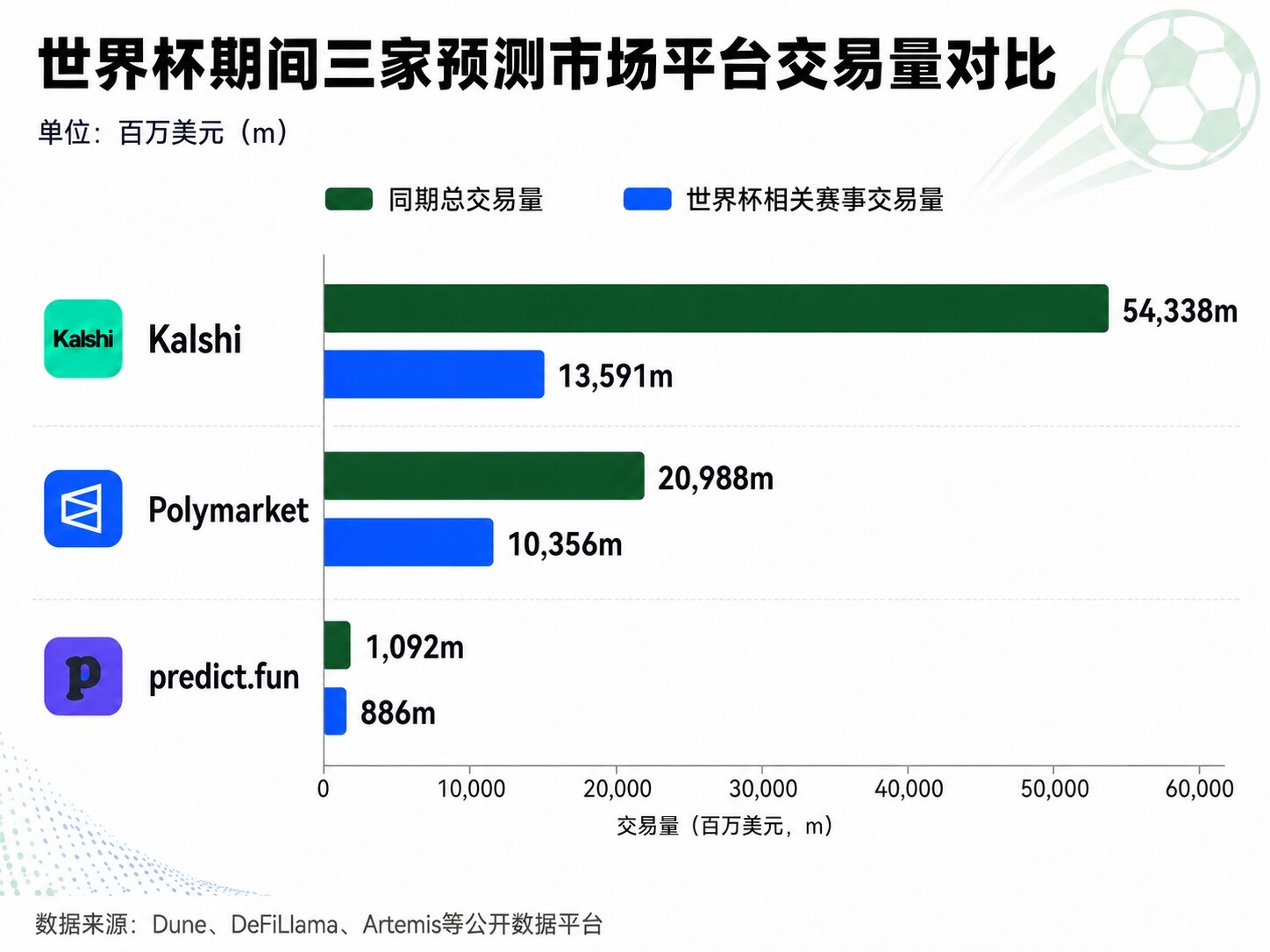
Looking at total platform trading volume during the World Cup period, Kalshi still maintains a clear lead. During the same period, Kalshi's total trading volume reached $54.338 billion, while Polymarket's was $20.988 billion, the former being about 2.6 times the latter. However, considering only World Cup-related events, the gap between the two narrows significantly. Kalshi's related trading volume was $13.591 billion, while Polymarket reached $10.356 billion, the former being only about 1.3 times the latter.(Note: Trading volume discussed in this article is nominal trading volume.)

In the past, Polymarket's representative markets were more concentrated in US elections, cryptocurrency, and geopolitical events. The World Cup further elevated the importance of sports markets on the platform, shifting them from a supplementary category to a core trading segment. Kalshi's advantage lies in its more dispersed trading structure; besides the World Cup, other sports events, politics, and macro markets continue to contribute trading volume, providing more scenarios to sustain activity after the tournament ends.

predict.fun's total platform trading volume during the World Cup reached $1.092 billion, with World Cup-related markets contributing $886 million. Although the overall scale still shows a clear gap compared to Kalshi and Polymarket, for a platform launched just over half a year ago, achieving nearly $900 million in trading volume from this World Cup has made predict.fun one of the most prominent new platforms benefiting from this round of tournament gains.
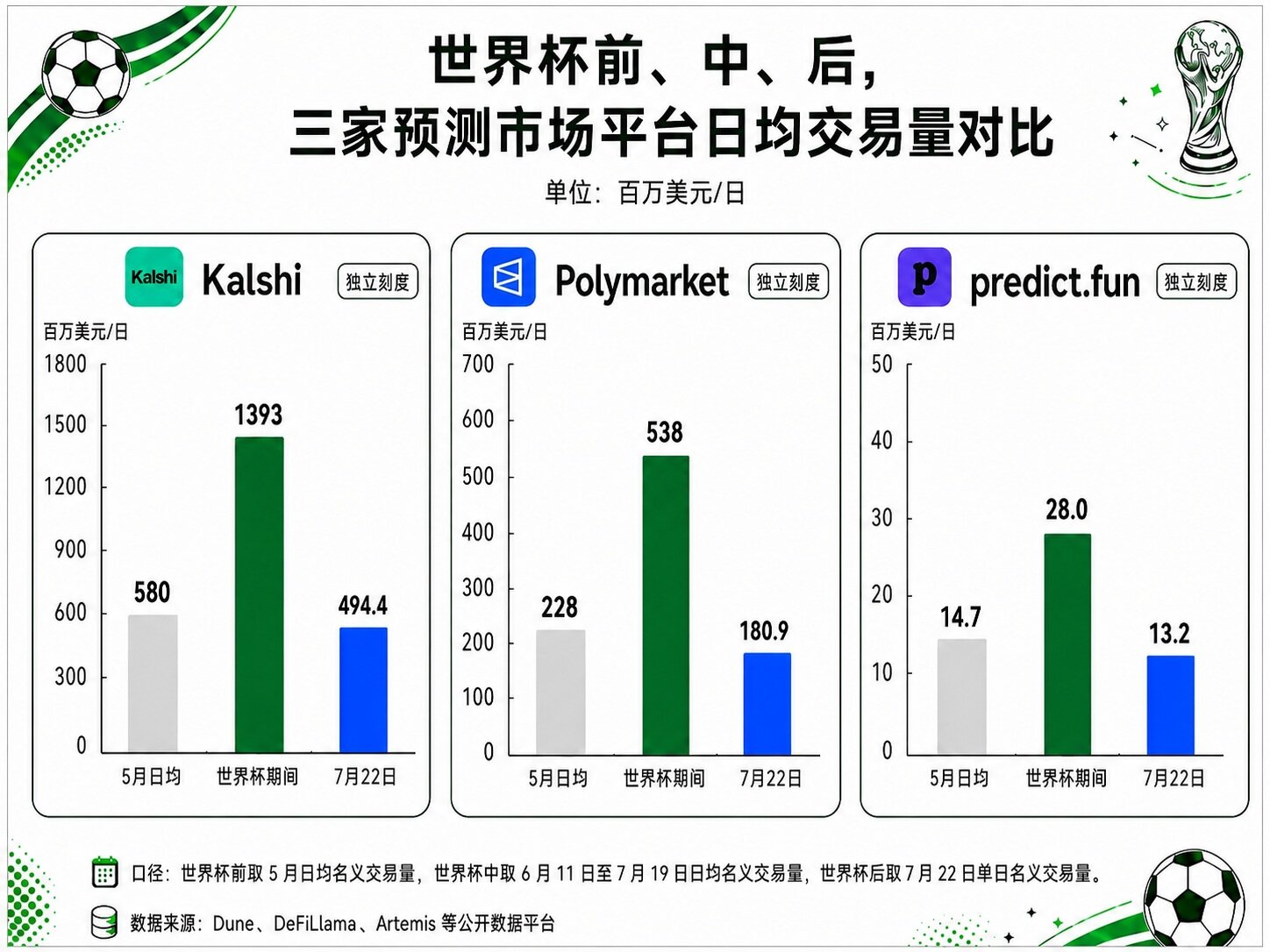
Changes in Average Daily Trading Volume for the Three Prediction Market Platforms Before, During, and After the World Cup

Kalshi's increase in trading volume during the World Cup was the most significant. Its average daily nominal trading volume in May was $580 million, rising to $1.393 billion during the tournament, an increase of about 140%. By July 22nd, trading volume fell back to $494.4 million, already below the May average daily level.

Polymarket's change magnitude was similar to Kalshi's. Its average daily nominal trading volume in May was $228 million, rising to $538 million during the World Cup, an increase of about 136%. By July 22nd, trading volume dropped to $180.9 million, also below pre-tournament levels.

predict.fun had a lower base, but the boost from the World Cup was still clear. Its average daily nominal trading volume in May was $14.7 million, rising to $28 million during the tournament, nearly doubling. By July 22nd, trading volume was $13.2 million, basically returning to pre-tournament levels.

Taking just one day's trading volume after the World Cup for comparison, the growth brought by the World Cup appears more like a concentrated release of event traffic, rather than elevating the platform's daily trading volume to a permanently higher level. Whether it can rise again in the future depends on whether other sports events and non-sports markets can capture the trading demand left after the World Cup.
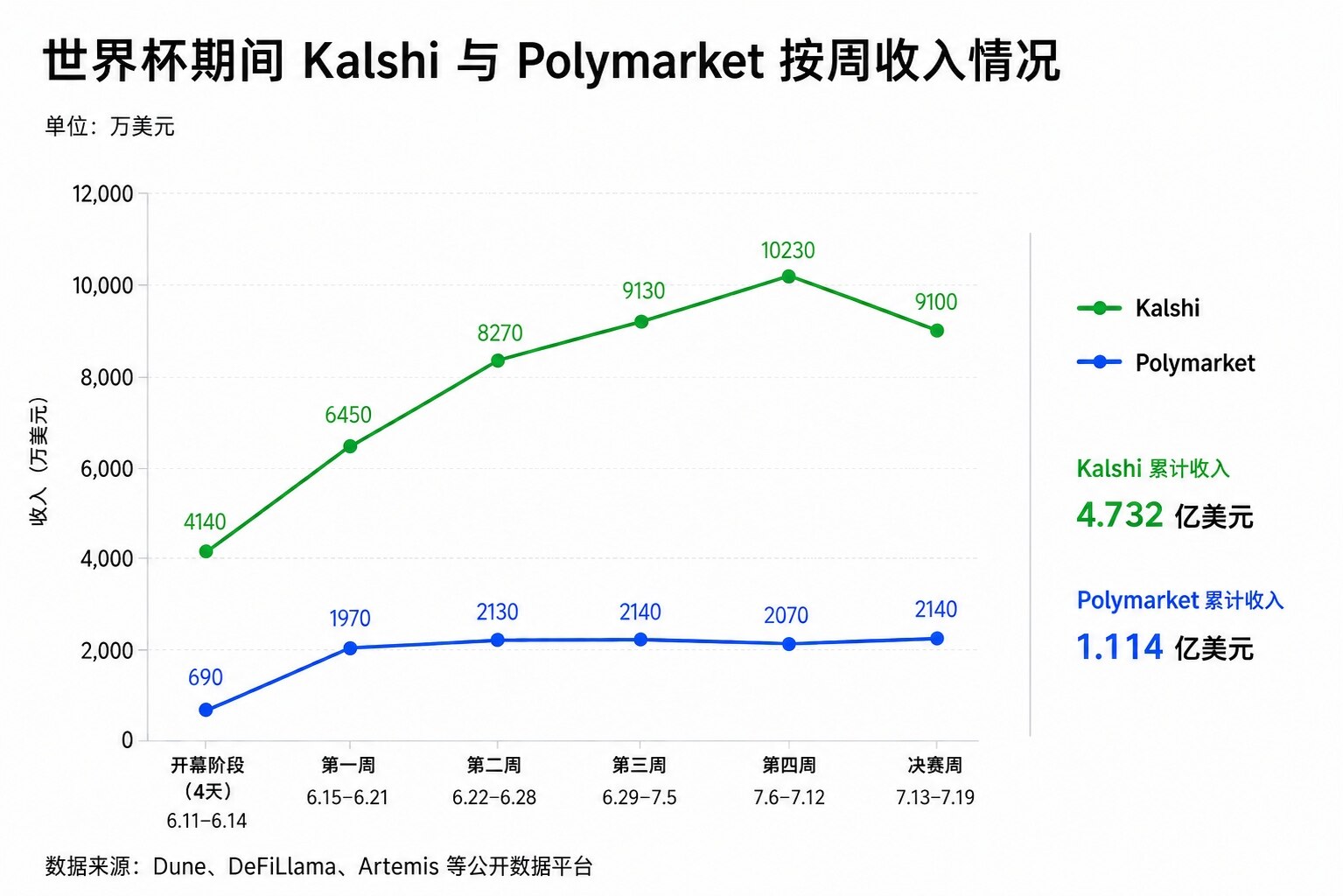
How Much Fee Revenue Did the World Cup Generate for the Three Prediction Market Platforms?

Kalshi's Fee Revenue Rose Continuously as the Tournament Progressed, Exceeding $100 Million in a Single Week in Week 4

Kalshi's fee revenue curve showed a strong overall upward trend. Revenue for the opening four-day period was $41.4 million, rising to $64.5 million in the first week, further increasing to $82.7 million in the second week, reaching $91.3 million in the third week, and rising another step in the fourth week with single-week revenue reaching $102.3 million, the highest point during the entire World Cup period. The final week saw a slight drop to $91 million. Throughout the World Cup, Kalshi's cumulative fee revenue reached $473.2 million.

The World Cup's impact on Kalshi not only brought initial attention at the start but, more importantly, sustained trading heat into the latter stages of the tournament. Single-week revenue exceeding $100 million also means Kalshi not only benefited from World Cup gains in trading volume but also successfully converted this wave of traffic into platform revenue at the monetization level.

Polymarket's Fee Revenue Was More Stable, But Didn't See Accelerated Volume Growth Like Kalshi in the Latter Stages

Polymarket's fee revenue trend was noticeably flatter. Revenue for the opening four-day period was $6.9 million, rising to $19.7 million in the first week. Subsequent weeks two, three, four, and the final week were $21.3 million, $21.4 million, $20.7 million, and $21.4 million respectively. Throughout the World Cup, Polymarket's cumulative fee revenue reached $111.4 million.

Starting from the first week, Polymarket's weekly fee revenue remained largely stable around $20 million. The World Cup did elevate Polymarket's fee revenue to a higher level, but from the second week onward, the platform did not continue to amplify gains as the tournament progressed like Kalshi did, instead operating within a relatively stable range.
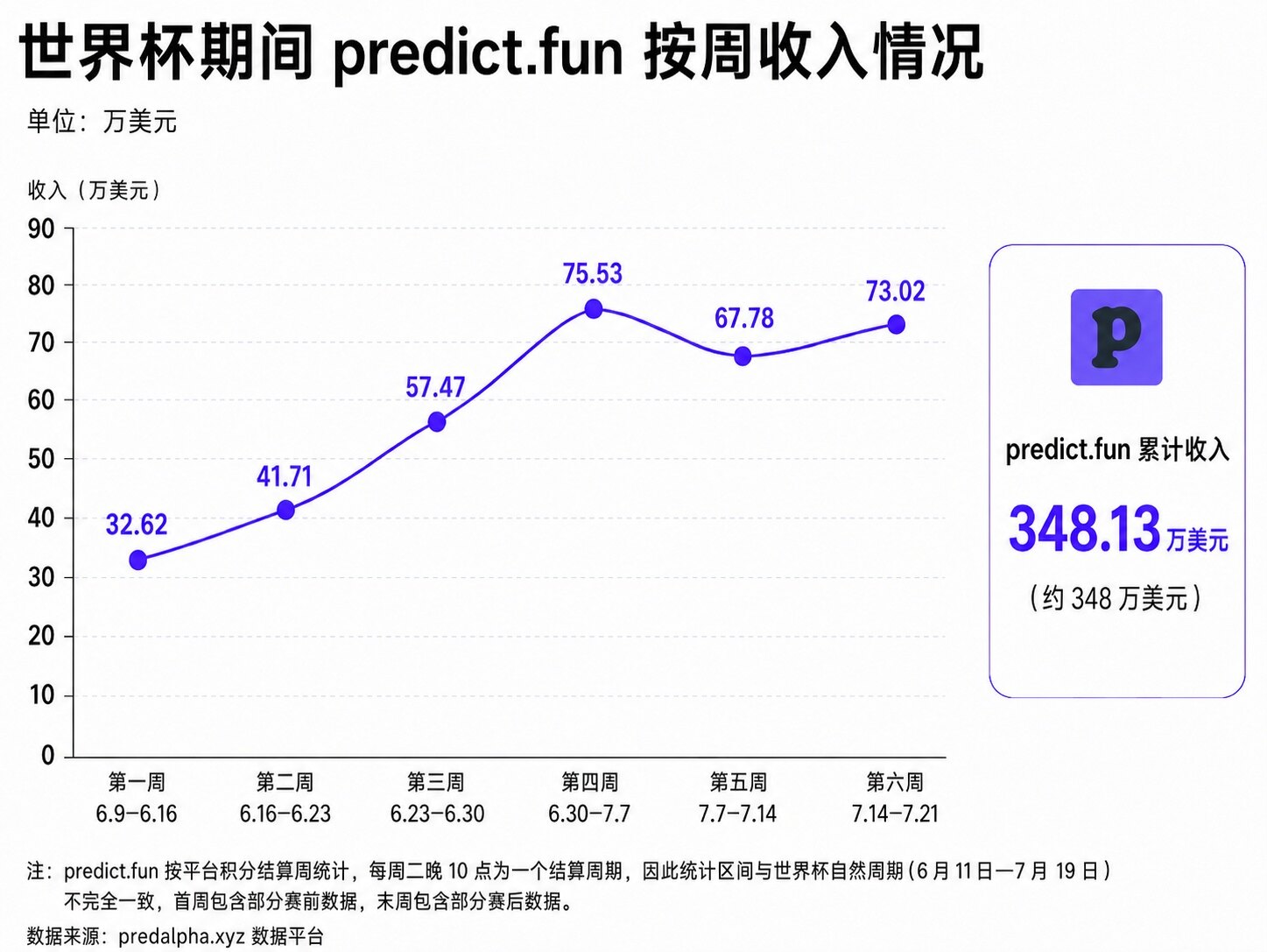
predict.fun's Fee Revenue Gradually Increased as the Tournament Progressed, Cumulative $3.481 Million Over Six Settlement Weeks

predict.fun's fee revenue is counted by platform settlement weeks, switching cycles every Tuesday at 10 PM, so it does not perfectly align with the natural World Cup schedule from June 11th to July 19th. The first settlement week was June 9th to June 16th, including two days of pre-tournament data; the last settlement week was July 14th to July 21st, also incorporating two days of post-tournament data.

Looking at the revenue trend, predict.fun's fee revenue for the first settlement week was $326.2 thousand. It then increased for three consecutive weeks, reaching $755.3 thousand from June 30th to July 7th, setting the single-week high during the World Cup period. The subsequent two weeks recorded $677.8 thousand and $730.2 thousand respectively. Although not setting new highs, these were still significantly higher than early in the tournament. The cumulative fee revenue for the six settlement weeks during the World Cup reached $3.4813 million.

The settlement week before the World Cup, June 2nd to June 9th, predict.fun's fee revenue was only $159.4 thousand. Entering the World Cup period, revenue for the first week rose to $326.2 thousand, an increase of about 105%. Subsequently, most settlement weeks further increased to over $500 thousand. Even though the first and last periods included some pre- and post-tournament data, the World Cup's boost to predict.fun's fee revenue remained significant.
After the World Cup, Fee Revenue Generally Declined Across Platforms, with Kalshi Experiencing the Smallest Drop

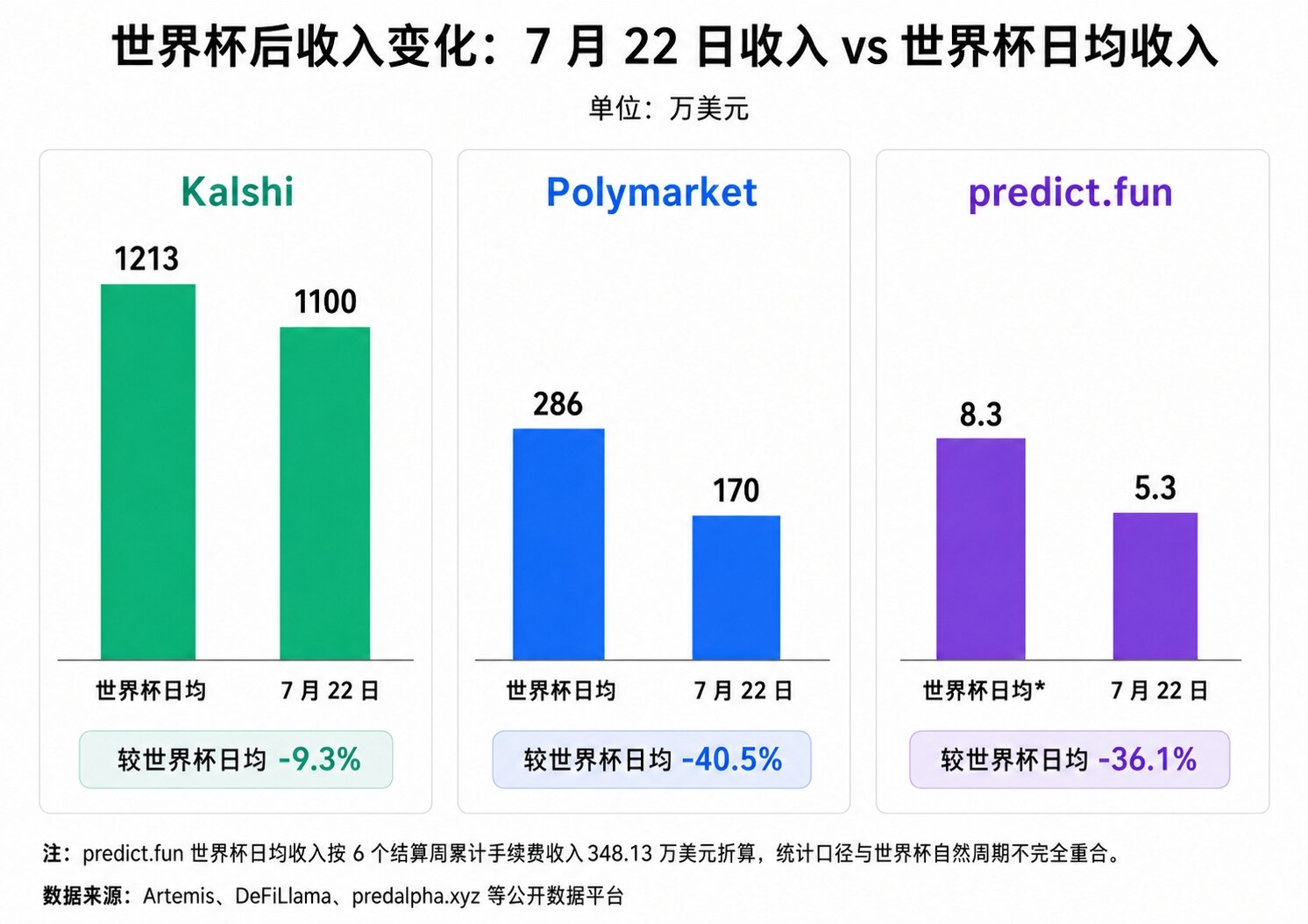
Kalshi's average daily fee revenue during the World Cup was $12.13 million, dropping to $11 million on July 22nd, a decrease of 9.3%. Among the three platforms, Kalshi's post-tournament decline was the smallest. Although fee revenue fell from the peak levels during the tournament, it remained close to the World Cup daily average.

Polymarket's drop was more pronounced. Its average daily fee revenue during the World Cup was $2.86 million, dropping to $1.7 million on July 22nd, a decrease of 40.5%. The revenue increment the World Cup brought to Polymarket was relatively concentrated, and as the tournament ended, this increment quickly dissipated.

predict.fun's average daily fee revenue during the World Cup was approximately $83 thousand, dropping to $53 thousand on July 22nd, a decrease of 36.1%, similar in magnitude to Polymarket's decline. Although the statistical method differs slightly from the first two, the post-tournament trend is clear. The World Cup also provided a significant boost to predict.fun's fee revenue, which similarly receded relatively quickly after the event.
World Cup Didn't Elevate Polymarket's TVL, While predict.fun Saw Capital Inflow in the Latter Stages

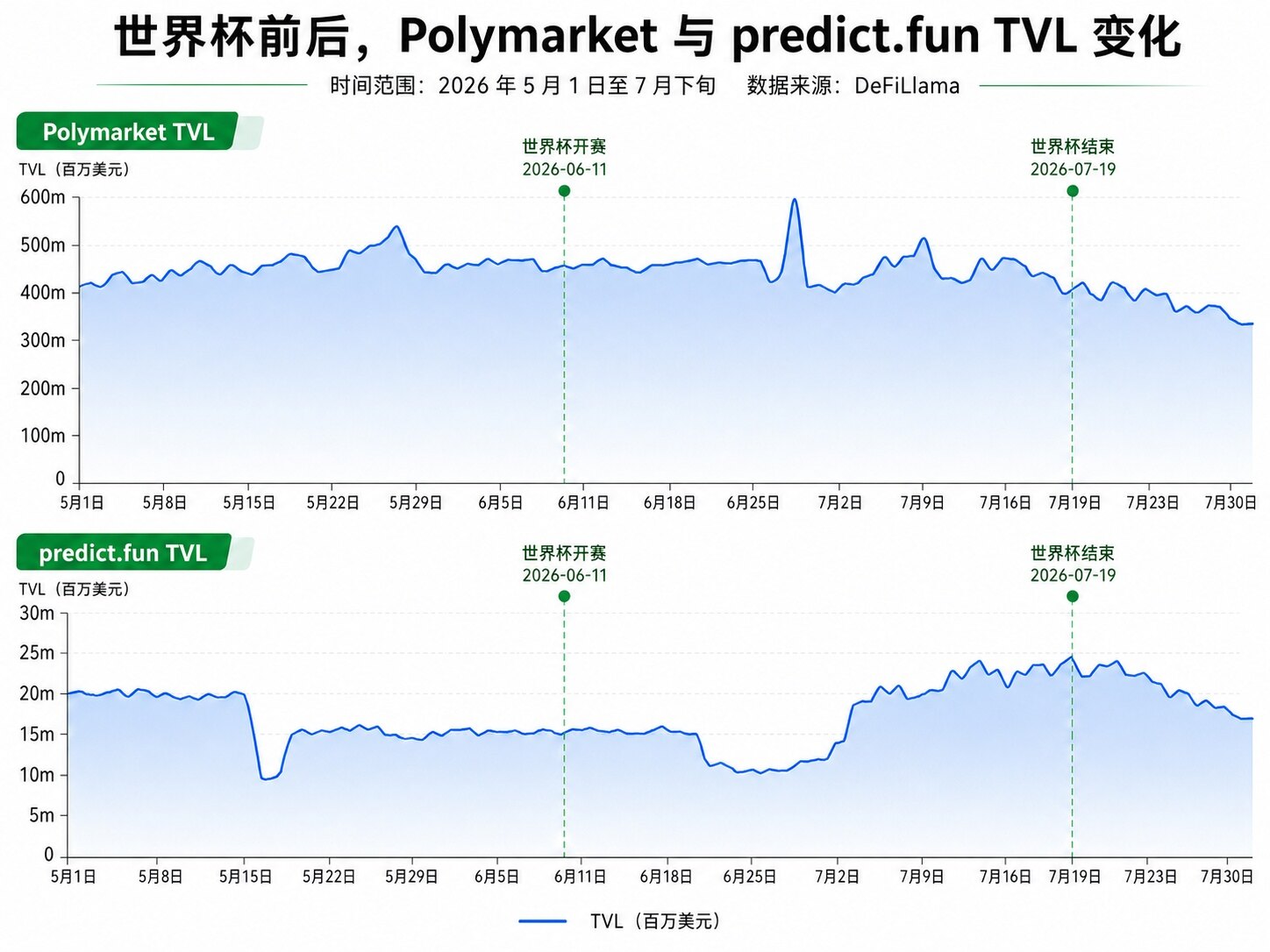
Polymarket's TVL did not rise in sync with trading volume during the World Cup. In early May, the platform's TVL was around $410 million, and for most of the subsequent period, it remained in the range of $440 million to $480 million. After the World Cup began, TVL continued to fluctuate mainly around this level. Although it briefly spiked in late June and early July, it did not form a sustained upward trend.

After mid-July, TVL began to decline noticeably, dropping to around $400 million by the end of the World Cup, and has since fallen further to about $340 million. While trading volume significantly expanded during the tournament, the platform's settled capital did not correspondingly convert into long-term retained funds, indicating that the World Cup brought more high-frequency trading demand rather than simultaneously translating into persistent capital.

predict.fun's trend was more phased. In early May, its TVL was around $20 million. By mid-May, it had dropped to about $10 million, then maintained around $15 million until mid-June. At the start of the World Cup, TVL did not immediately rise. It wasn't until early July that it began to rebound quickly, reaching the $20-25 million range during the latter half of the tournament and hitting a phase high around the end of the World Cup.

After the tournament, TVL gradually declined, currently at about $17 million, but still higher than the low point in late June. Compared to Polymarket, predict.fun's capital changes were more closely linked to the World Cup's progress, especially with more noticeable capital inflows during the knockout stages.

(Note: As Kalshi's TVL data is not available on-chain, this section only discusses Polymarket and predict.fun.)
Summary

The World Cup indeed brought substantial trading volume and fee revenue to prediction markets, but post-tournament data also shows that this growth did not naturally continue. The average daily trading volume and fee revenue for all three platforms declined after the event, and Polymarket's TVL continued to fall. Mega-events can concentrate and amplify trading demand in the short term but may not directly elevate a platform's long-term activity level.

However, the World Cup benefits are not confined to short-term data alone. It at least validated that sports events can provide prediction markets with continuous, high-frequency, short-cycle trading scenarios and helped more users develop the habit of repeated trading across consecutive matches.

The World Cup has ended, but the competition around user retention, market supply, and normalized trading is just beginning.


Трендовые криптовалюты

Связанные с этим вопросы

QAccording to the article, which prediction market platform achieved the highest total nominal trading volume during the 2026 World Cup?

AKalshi achieved the highest total nominal trading volume during the 2026 World Cup, reaching $54.338 billion.

QWhat was the key difference between Kalshi's and Polymarket's fee income trends during the World Cup, as highlighted in the article?

AKalshi's fee income showed a strong upward trend throughout the tournament, peaking at over $100 million in a single week. In contrast, Polymarket's fee income was more stable, leveling off after an initial rise and not showing the same accelerated growth in the latter stages of the tournament.

QThe article mentions that the post-tournament transaction volume data indicates the World Cup growth did not 'naturally extend'. Which platform's data is used to illustrate a significant drop in daily fee income after the event?

APolymarket is used to illustrate a significant post-tournament drop. Its daily fee income fell from $2.86 million during the tournament to $1.7 million on July 22nd, a drop of 40.5%. Predict.fun also saw a 36.1% drop in daily fee income.

QHow did the Total Value Locked (TVL) on predict.fun change during the World Cup, according to the article's analysis?

APredict.fun's TVL showed a delayed but clear correlation with the World Cup. It did not rise immediately at the start but began a rapid increase in early July, peaking between $20-25 million during the tournament's knockout stages (the latter half). After the event, it gradually declined but remained above its pre-tournament lows.

QWhat positive long-term effect did the article suggest the World Cup had on the prediction market space, beyond just short-term data?

AThe article suggested that the World Cup validated that major sports events can provide high-frequency, short-cycle trading scenarios for prediction markets. It also helped more users develop a habit of repeated trading across consecutive matches, which is beneficial for the industry's long-term growth.

Похожее

Передайте это кривой, не боритесь с циклом: 10-летний инвестиционный обзор криптовалюты от мастера макроанализа Рауля Пала

**Криптовалютное десятилетие Рауля Пала: уроки и убеждения** Макроаналитик Рауль Пал размышляет о своем 13-летнем опыте в криптовалютах. Главный урок: постоянные трейдинг и попытки предсказать время рынка разрушают богатство. Его ошибка — продажа биткойна по $2000 в 2017 году и упущенная прибыль в десятки миллионов — подтверждает правило: «Увеличьте масштаб, устраните шум и держитесь». **Биткойн — это сейф.** Это защита от неизбежной девальвации фиатных валют. Его фиксированное предложение (21 млн) и независимость делают его идеальным хранилищем стоимости, конкурентом золоту с потенциалом занять долю на рынке в триллионы долларов. **Смарт-контракт-платформы — это пути для новой экономики.** Эфириум, Solana, Sui — это не просто «альткойны». Это фундамент для машинной экономики в «Эпоху экспоненты». ИИ-агенты и роботы потребуют программируемых, мгновенных платежных рельсов. Их потенциал в управлении транзакциями глобальных активов (акции, долги, недвижимость) на порядки превышает потенциал рынка сбережений, на который претендует биткойн. Это не компании, а целые экономики, и их ценность определяется совокупной активностью в них. **Почему сейчас спад и что делать?** Текущий пессимизм вызван задержкой, а не отменой цикла. Деловой цикл уже разворачивается вверх (по данным ISM), и это — среда для роста рисковых активов, включая криптовалюты. Стратегия не изменилась: это долгосрочная игра. Победят те, кто понимает суть активов, верит в неизбежность внедрения и способен пережить неизбежные периодические падения на 50%. Контролируйте «сейф» (биткойн) и «рельсы» (смарт-контракт-платформы), и позвольте экспоненциальной кривой делать свою работу.

marsbit23 мин. назад

Передайте это кривой, не боритесь с циклом: 10-летний инвестиционный обзор криптовалюты от мастера макроанализа Рауля Пала

marsbit23 мин. назад

Повышать ли ставку сегодня вечером: экономисты непреклонны, рынок дает 30% вероятность

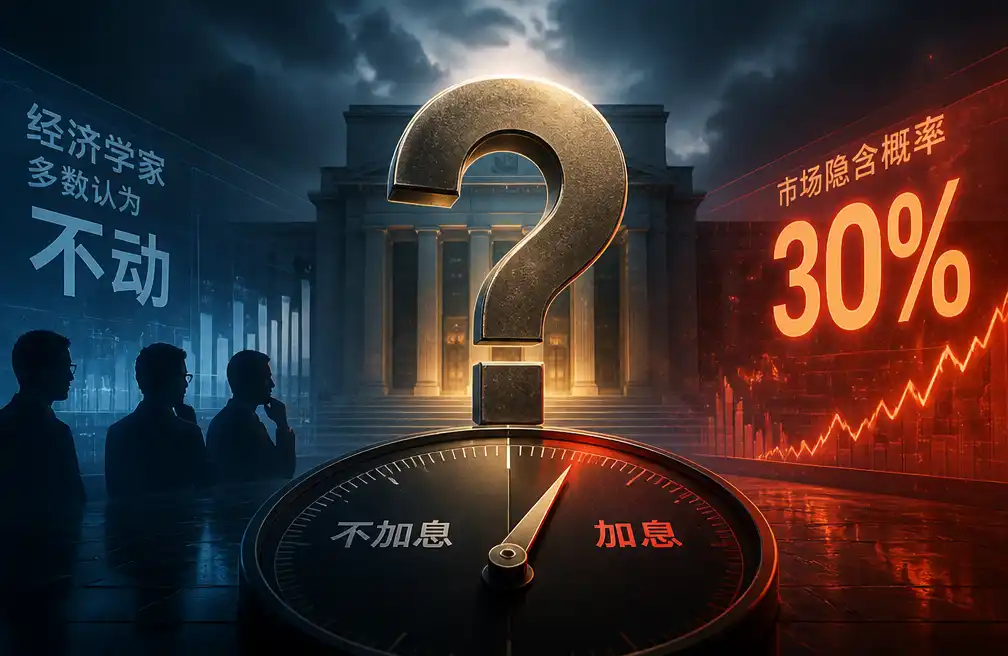
Фьючерсы на федеральные фонды перед решением ФРС в июле переоцениваются, трейдеры начинают закладывать более высокие риски неожиданного повышения ставок или более агрессивных сигналов. Хотя опрос Reuters показывает единодушное мнение 104 экономистов о сохранении ставки на уровне 3,50–3,75%, рынок оценивает вероятность повышения в 25 базисных пунктов примерно в 30%. Ключевой вопрос для инвесторов — как новый глава ФРС Кевин Уорш отреагирует на шок от роста цен на нефть из-за ближневосточной ситуации. Если он воспримет это как временный дисбаланс спроса и предложения, ставки могут остаться неизменными. Если же он увидит риск вторичной инфляции, это может открыть путь к повышению в сентябре. Рынок фьючерсов страхуется от хвостовых рисков: рост открытых позиций указывает на высокую неопределенность и хеджирование. Вероятность в 30% отражает не ожидание повышения, а дороговизну страховки против двух сценариев — прямого повышения ставок или намёков на возможность повышения в сентябре. Это поддерживает доллар и давит на иену, акции с высокой оценкой и криптоактивы. Разногласия между аналитиками (например, BofA и Citi) касаются не факта роста цен на нефть, а того, как ФРС должна на это реагировать. Сторонники жёсткой линии опасаются подрыва доверия к борьбе с инфляцией, а сторонники мягкой линии считают рост нефти временным шоком предложения, не требующим повышения ставок. Новизна в том, что Уорш ещё не сформировал чёткого стиля коммуникации, поэтому каждое его заявление будет тщательно анализироваться. Рынкам придётся адаптироваться к меньшей определённости и более широкому диапазону потенциальных сценариев по ставкам. Итоговое влияние на активы будет зависеть не столько от самого решения в июле, сколько от того, оставит ли Уорш возможность повышения в сентябре, особенно если он подчеркнёт риски распространения инфляционного давления.

marsbit34 мин. назад

Повышать ли ставку сегодня вечером: экономисты непреклонны, рынок дает 30% вероятность

marsbit34 мин. назад

Акции связанного с Celsius майнера Bitcoin Ionic Digital подорожали на 26% при дебюте на Nasdaq

Акции майнера биткоинов Ionic Digital, связанного с обанкротившимся кредитором Celsius, выросли примерно на 26% в первый день торгов на Nasdaq во вторник в результате прямого листинга. Акции открылись по цене $50 и закрылись на отметке $62.90, что дало компании рыночную капитализацию около $2,8 млрд. Согласно данным Renaissance Capital, подразумеваемая стоимость Ionic в $2,4 млрд по референтной цене Nasdaq в $53 сделала это крупнейшим прямым листингом в США с 2021 года. Компания была создана в 2024 году для приобретения активов Celsius Mining в ходе реструктуризации и с тех пор расширила свою деятельность на инфраструктуру для искусственного интеллекта и высокопроизводительных вычислений. В послеторговой сессии акции скорректировались, упав на 6,5% до $58.80.

cointelegraph1 ч. назад

Акции связанного с Celsius майнера Bitcoin Ionic Digital подорожали на 26% при дебюте на Nasdaq

cointelegraph1 ч. назад

Ранний инвестор в компании Unitree вкладывает в компанию по интерфейсу мозг-компьютер

Ориентируясь на сцену из фильма «Аватар», основатель компании WaBo Technology Чжан Синчжи более десяти лет занимался изучением взаимодействия человека и машины. В конце 2025 года, с перспективным планированием интерфейса «мозг-компьютер» (BCI) в рамках 15-го пятилетнего плана и развитием соответствующих технологий, он основал WaBo Technology. Компания позиционирует себя как модельная, сосредоточившись на создании фундаментальной «модели нейронных намерений человека». Эта система предназначена для преобразования нейронных сигналов, поведения и контекстной информации в стандартизированные «векторы намерений», понятные машинам, для точного понимания целей, тенденций к действию и намерений пользователя, таких как подтверждение, исправление или остановка. Ядро команды сформировалось быстро. После начального раунда финансирования от Source Capital последовал ангельский раунд с участием Vertex Ventures (дочерней компании Temasek), фонда Hongtai, Future Industry Fund Chengdu и Huifengda Capital. Инвесторы высоко оценили системные возможности компании в сборе данных, обработке сигналов и инженерной реализации. Особый интерес вызвало сотрудничество WaBo Technology с Тяньцзиньским университетом в области космических интерфейсов «мозг-компьютер». В планах компании — создание двух штаб-квартир: в Шанхае (передовые исследования, модель нейронных намерений) и в Чэнду (аппаратное обеспечение, производство, поставки). По оценкам Чжан Синчжи, в ближайшие три года отрасль BCI ожидает консолидация, и выживут те компании, которые смогут создать устойчивый цикл «данные — модель — сценарии применения». Футуристическое видение, вдохновленное «Аватаром», постепенно становится реальностью.

marsbit1 ч. назад

Ранний инвестор в компании Unitree вкладывает в компанию по интерфейсу мозг-компьютер

marsbit1 ч. назад

ChangXin Technology: Циклическая акция на вершине цикла

Компания Changxin Technology (长鑫科技) достигла рыночной капитализации в 3,28 трлн юаней, возглавив список компаний на бирже А в Китае. Всего за два года она смогла преодолеть убытки в 163 млрд юаней и прогнозирует чистую прибыль в 50-57 млрд юаней за первое полугодие 2026 года. Этот стремительный рост обусловлен ажиотажным спросом на память DRAM, вызванным бумом в сфере искусственного интеллекта и импортозамещением. Однако корни этой трансформации лежат в циклической природе отрасли DRAM. Продукция стандартизирована, а расширение мощностей занимает годы, что ведет к регулярным циклам дефицита и перепроизводства. Рост прибыли Changxin в основном обусловлен резким скачком цен на DRAM, связанным с перераспределением мощностей мировых гигантов (Samsung, SK Hynix, Micron) в пользу более прибыльной памяти HBM для AI. Несмотря на текущий успех, в отрасли уже намечаются признаки замедления роста цен и начинается масштабная волна инвестиций в новые мощности. Аналитики прогнозируют, что пик цен может прийтись на 2026-2027 годы, а к 2028 году возможно избыточное предложение. Ключевым вызовом для Changxin является преодоление отставания в производстве HBM, чтобы обрести устойчивость к следующему спаду цикла. Таким образом, Changxin Technology является одновременно и важным национальным достижением в области полупроводников, и классической циклической компанией. Ее долгосрочная ценность основана на повестке импортозамещения и росте доли рынка, но текущая рыночная капитализация, по всей видимости, уже учитывает многолетний рост. Инвесторам следует тщательно оценивать риски, связанные с инвестированием в циклическую акцию на пике её цикла.

marsbit1 ч. назад

ChangXin Technology: Циклическая акция на вершине цикла

marsbit1 ч. назад

Торговля

Спот

Популярные статьи

Как купить DATA

Добро пожаловать на HTX.com! Мы сделали приобретение DATA Network (DATA) простым и удобным. Следуйте нашему пошаговому руководству и отправляйтесь в свое крипто-путешествие.Шаг 1: Создайте аккаунт на HTXИспользуйте свой адрес электронной почты или номер телефона, чтобы зарегистрироваться и бесплатно создать аккаунт на HTX. Пройдите удобную регистрацию и откройте для себя весь функционал.Создать аккаунтШаг 2: Перейдите в Купить криптовалюту и выберите свой способ оплатыКредитная/Дебетовая Карта: Используйте свою карту Visa или Mastercard для мгновенной покупки DATA Network (DATA).Баланс: Используйте средства с баланса вашего аккаунта HTX для простой торговли.Третьи Лица: Мы добавили популярные способы оплаты, такие как Google Pay и Apple Pay, для повышения удобства.P2P: Торгуйте напрямую с другими пользователями на HTX.Внебиржевая Торговля (OTC): Мы предлагаем индивидуальные услуги и конкурентоспособные обменные курсы для трейдеров.Шаг 3: Хранение DATA Network (DATA)После приобретения вами DATA Network (DATA) храните их в своем аккаунте на HTX. В качестве альтернативы вы можете отправить их куда-либо с помощью перевода в блокчейне или использовать для торговли с другими криптовалютами.Шаг 4: Торговля DATA Network (DATA)С легкостью торгуйте DATA Network (DATA) на спотовом рынке HTX. Просто зайдите в свой аккаунт, выберите торговую пару, совершайте сделки и следите за ними в режиме реального времени. Мы предлагаем удобный интерфейс как для начинающих, так и для опытных трейдеров.

214 просмотров всегоОпубликовано 2026.07.01Обновлено 2026.07.01

Как купить DATA

Обсуждения

Добро пожаловать в Сообщество HTX. Здесь вы сможете быть в курсе последних новостей о развитии платформы и получить доступ к профессиональной аналитической информации о рынке. Мнения пользователей о цене на DATA (DATA) представлены ниже.

活动图片