Misjudged A-Shares: Resilience, Expectations, and Confidence

marsbitОпубликовано 2026-07-22Обновлено 2026-07-22

Введение

China's A-share market recently faced selling pressure, especially in tech sectors, initially triggered by a global tech sell-off that began in South Korea. However, the article argues this is a case of "mistaken injury" and highlights the market's underlying resilience. This resilience stems from three main pillars: **1) Tech Sector Fundamentals:** Unlike Korea's market dominated by a few memory chip stocks, China's tech sector is diversified across computing, communications, electronics, and semiconductors, supported by dual narratives of global AI supply chains and domestic substitution. Core areas like optical modules and fiber optics continue to show strong earnings growth. **2) "National Team" Support:** State-backed institutions and large corporations have made significant market purchases and announced buybacks, providing liquidity and signaling confidence. This is seen as a stabilizing policy signal, often associated with market bottoms. **3) Broader Market Pillars:** Other major sectors are showing endogenous recovery momentum. Consumer stocks benefit from stabilizing CPI and signs of sector recovery (e.g., liquor price hikes). Cyclical sectors like aluminum have high earnings, potential price increases due to tight supply, and low valuations. The financial sector offers stable dividends and low valuations. The conclusion is that the sell-off was driven by external contagion, not a collapse in fundamentals. With strong policy support and recovering momentum across k...

By Market Cap Observation

Entering July, global tech stocks suddenly weakened. Korea's leading memory chip manufacturers faced concentrated selling first, which quickly spread to markets like the US and Japan. Subsequently, A-share tech sectors came under pressure, with the STAR 50 and ChiNext indices declining successively.

However, under external shocks, A-shares have not lost their support. The underlying logic of prosperity for the tech industry has not reversed, and long-term funds and market stabilizing forces have begun to step in. Meanwhile, consumption, cyclical, and financial sectors are also accumulating momentum for repair.

This round of adjustment is both a release of risk and a test of the true resilience of A-shares.

01 Tech Adjustment and Resilience

From April to the end of June this year, A-share tech sectors experienced a remarkable rally. This rise was anchored by two major logics. The first was reflecting high earnings growth. In the first half of the year, net profit growth for core tech tracks like optical modules, chip manufacturing, packaging & testing, and optical fiber & cable mostly exceeded 50%.

National Bureau of Statistics data corroborates this in the first five months, profits in the computer, communication, and other electronic equipment manufacturing industry increased by 103.9% year-on-year, contributing 43% to the growth of industrial profits.

The second was the spillover effect from the surge in overseas tech stocks. Particularly, the rise and fall rhythms of A-share tech and Korean tech stocks were highly synchronized.

But the tone changed abruptly since July, with A-share tech stocks adjusting continuously. The core reason was not a deterioration in their own fundamentals, but rather the transmission of external risks such as deleveraging in the Korean stock market.

However, the market resilience of A-share tech and Korean tech is not on the same level. A-shares do not have the foundation for a systemic decline. The most core difference lies in their vastly different tech sector structures.

Samsung Electronics and SK Hynix account for about 50% of the total market capitalization of the KOSPI index. Moreover, about 60% of the total market's leveraged funds are betting on these two stocks. Thus, the entire Korean stock market is deeply tied to the memory chip super cycle narrative. Any withdrawal of leveraged funds or any flaw in earnings growth expectations could trigger violent selling.

In contrast, A-share tech encompasses numerous sectors like computers, communications, electronics, etc. Even narrowed down to the semiconductor sector, the industrial chain covers multiple segments like materials, equipment, design, manufacturing, and packaging & testing.

More importantly, A-share tech follows a dual narrative logic. One anchors to the global tech giants' supply chain — "Yizhongtian" is bound to chain leaders like NVIDIA, trading on the massive global AI capital expenditure. The other anchors to domestic substitution, where leading companies like Hygon Information, SMIC, and Cambricon target domestic computing infrastructure.

One internal, one external — this provides greater risk resistance than Korea's single narrative centered on the memory super cycle.

At the same time, the fundamental earnings logic for core areas of the tech sector has not been disproven.

For example, in the optical module sector, Suzhou Everbright's H1 net profit attributable to shareholders reached 7-8 billion yuan, nearly doubling again on a high base of 235% growth in the same period last year. In the optical fiber & cable sector, Yangtze Optical Fibre and Cable's net profit attributable to shareholders reached 2.4-3 billion yuan, up 711% to 914% year-on-year.

Thus, this round of A-share tech decline is directly related to the transmission of external risks, and the risk has been released to a considerable extent. Notably, Citi issued a report on July 20 downgrading Korean equities and upgrading Chinese equities, also indicating significant differences in the resilience of the two markets.

In fact, after continuous adjustments, A-share tech stocks staged a recovery on July 21 — the STAR 50 surged 10.7%, and the ChiNext Index jumped 7%.

02 The "National Team" Sets the Tone

Facing market volatility, the "National Team" (state-backed institutions) decisively stepped in again to support the market.

Specifically, China Reform Holdings announced that its subsidiary, Guoxin Investment, has invested over 50 billion yuan into the market. China Chengtong and its platforms have cumulatively purchased nearly 10 billion yuan and stated they will continue to use their own funds, stock buybacks, and special relending facilities to increase holdings of state-owned central enterprise and tech company stocks and ETFs.

At the listed company level, central SOEs like Aluminum Corporation of China and CRRC announced buybacks. A new wave of buyback tides also started among securities firms like Huaan Securities and Guolian Minsheng.

On the institutional level, quantitative private equity firms with tens of billions under management like Lingjun Investment and Square Sum announced self-purchases. Insurers like Ping An, China Pacific Insurance, PICC, New China Life Insurance, and China Life successively voiced support for the capital market, stating they will continue to increase their equity allocation ratio.

Among them, China Life Asset Management recently made active allocations, with net purchases of A-share and on/off-exchange fund market equity assets exceeding 10 billion yuan in a single day.

The "National Team" taking the lead, followed by other market participants, can easily form a powerful upward force. Especially, the heavyweight move by the "National Team" holds very positive significance for the market, mainly reflected in three aspects.

First, genuine capital injections through share purchases help alleviate part of the market's liquidity pressure through concrete actions.

Second, guiding market expectations is more crucial. The "National Team" holds strong influence in A-shares. Acting counter-cyclically at this time sends a signal of a potential bottoming phase, providing a strong example for a market dominated by institutions.

Currently, major funds like active equity public funds, passive ETFs, insurance capital, northbound, and QFII hold over 3 trillion yuan each, with a combined scale exceeding 15 trillion yuan, accounting for about 40% of free-float market capitalization. Compared to the 2015 market and earlier periods dominated by retail investors, these institutional investors pay more attention to market pricing factors like macro policies, fundamentals, and monetary liquidity.

Generally speaking, "National Team" intervention is seen as counter-cyclical adjustment for the stock market, often having a quasi-stabilization fund effect. The movements of these large funds tend to have a stronger exemplary effect on institutional investors (with less emotionalism), making it easier to drive long-term funds like social security, insurance capital, and SOE buybacks to resonate.

Third, historical experience shows that the market is often at a stage bottom after the "National Team" enters.

Since 2008, in multiple counter-cyclical interventions by the "National Team", although short-term trends varied, looking at longer cycles, the win rate of following the National Team's rhythm hasn't been poor. Particularly after the interventions on September 24, 2024, and April 7, 2025, the market stabilized quickly and embarked on sustained trending rallies.
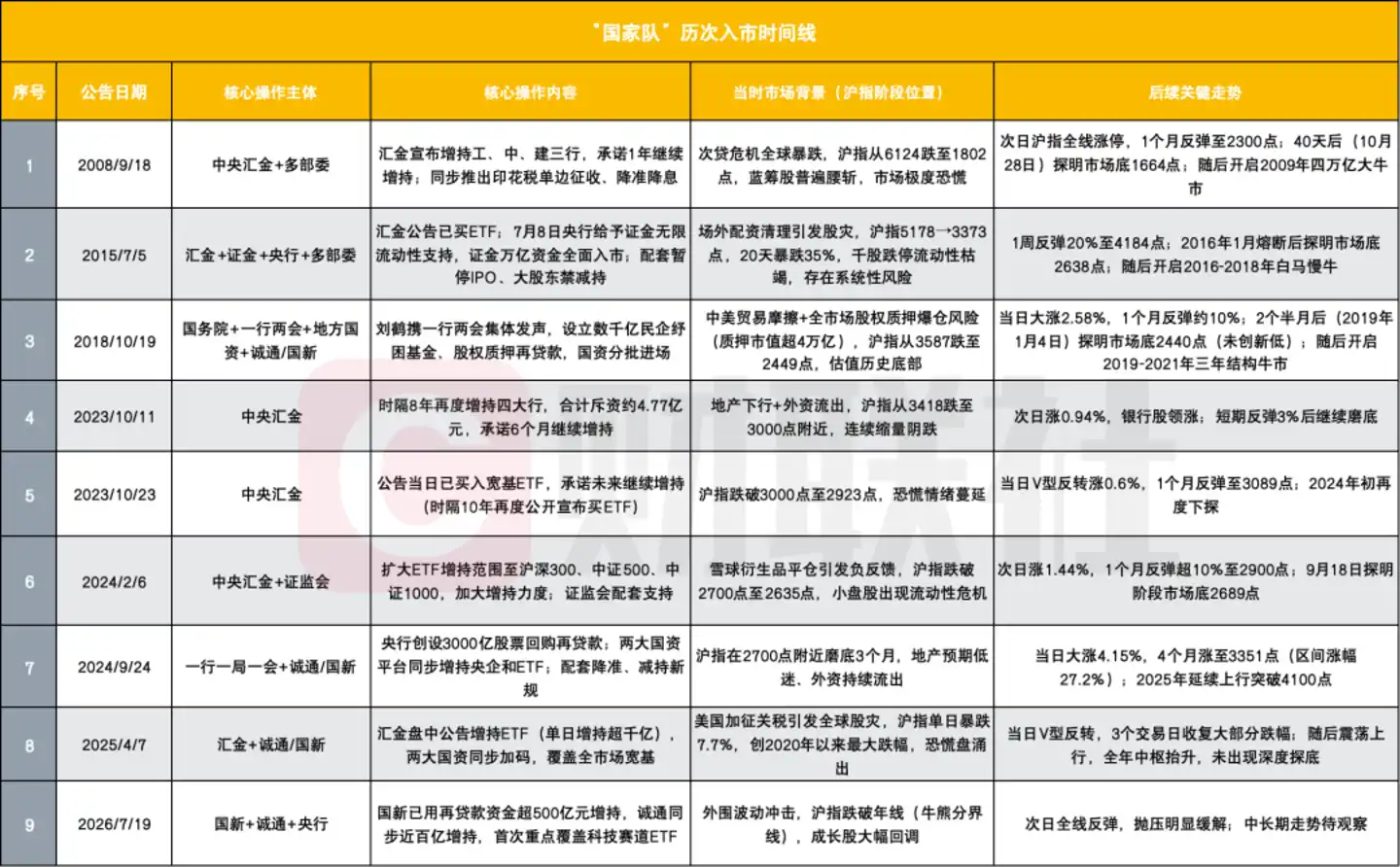
Source: Cailian Press

Notably, another innovative tool has been added to the policy toolkit for stabilizing the capital market — the Special Relending Facility for Stock Buybacks and Shareholding Increases (established in September 2024, first phase 300 billion yuan), integrating capital market stability into the macro-policy regulatory framework.

This facility, combined with the 500 billion yuan swap line quota, brings the total available pool to 800 billion yuan. Currently, the actual utilization rate is not high; collectively, hundreds of billions of yuan in backup funds remain available.

Therefore, this intervention is not simple market-propping, but a clear signal of policy intent.

03 Three Lines Supporting the Market: Where Does the Confidence Come From?

Beyond the capital logic, A-shares have sufficient resilience, and intrinsic upward momentum is not lacking.

Strategically categorized, A-shares can be divided into four core types: finance, consumption, cyclical, and tech. Their combined force determines the market's direction. Not just tech, but consumption, cyclical, and financial lines all possess strong intrinsic recovery momentum.

First, consumption. From a macro perspective, the CPI has stabilized above 1% for five consecutive months, whereas it fluctuated between -0.8% and 0.8% for nearly three years prior. Continuous price increases for consumer goods indicate marginal improvement in the profit predicament of consumer stocks. For consumer stocks that have fallen for five years, with valuations at absolute lows over the past decade, this could be a beam of light illuminating the darkness.
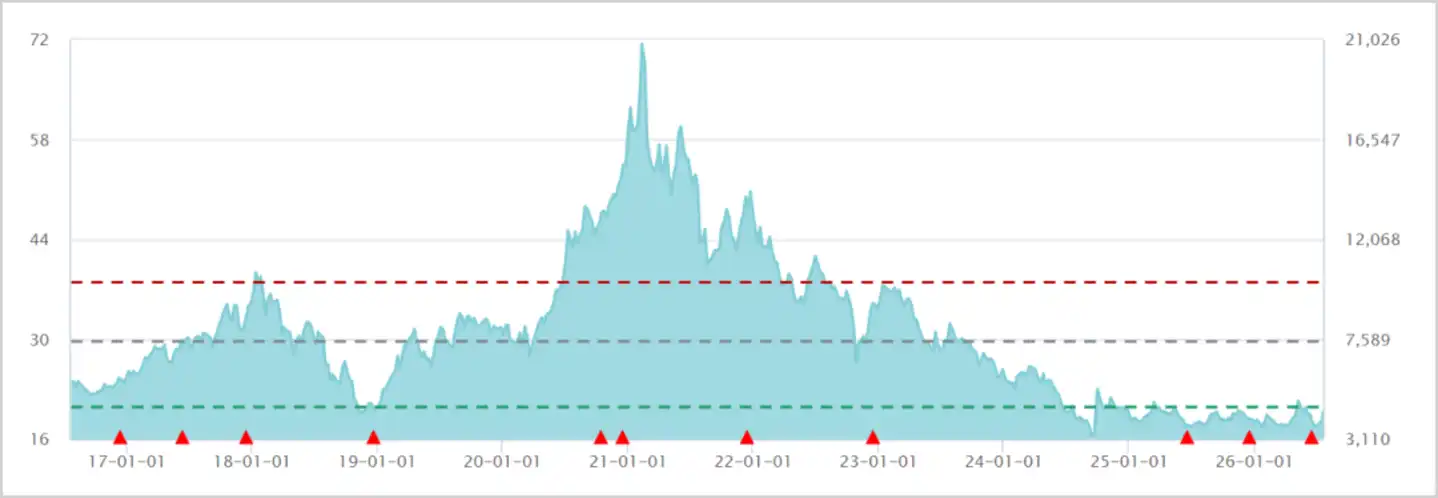
CSI Liquor Index PE Chart, Source: Wind

From a corporate perspective, Kweichow Moutai, as a bellwether for the baijiu and even the entire food & beverage sector, has raised prices twice consecutively this year, with a cumulative increase exceeding 10%. This action indicates that after years of continuous inventory destocking, channel inventories have largely normalized. The deep adjustment in baijiu may be nearing its end, with signs of recovery emerging.

In the first half of this year, retail sales of tobacco and alcohol performed strongly, reaching a cumulative 354.7 billion yuan, up 13.2% year-on-year. This also supports the view that the most difficult period for baijiu consumption may be over.

Next, look at cyclical sectors led by aluminum, which may be facing a triple resonance.

First, high earnings momentum. In the first five months, non-ferrous metal profits grew 117% year-on-year, even faster than tech sectors like computing. Looking at specific companies, Yunnan Aluminium and Tianshan Aluminium saw net profit attributable to shareholders grow 171%–182% and 101.5% year-on-year, respectively.

Second, there may still be price increase expectations in the second half of the year. On one hand, the global aluminum market remains in tight balance — demand continues to grow at 3%-5% overall driven by new energy vehicles, power, and "aluminum for copper" substitution in home appliances. On the supply side, China firmly maintains the 45-million-ton capacity ceiling. Against this backdrop, global aluminum inventories continue to decline, with LME aluminum stocks hitting multi-year lows.
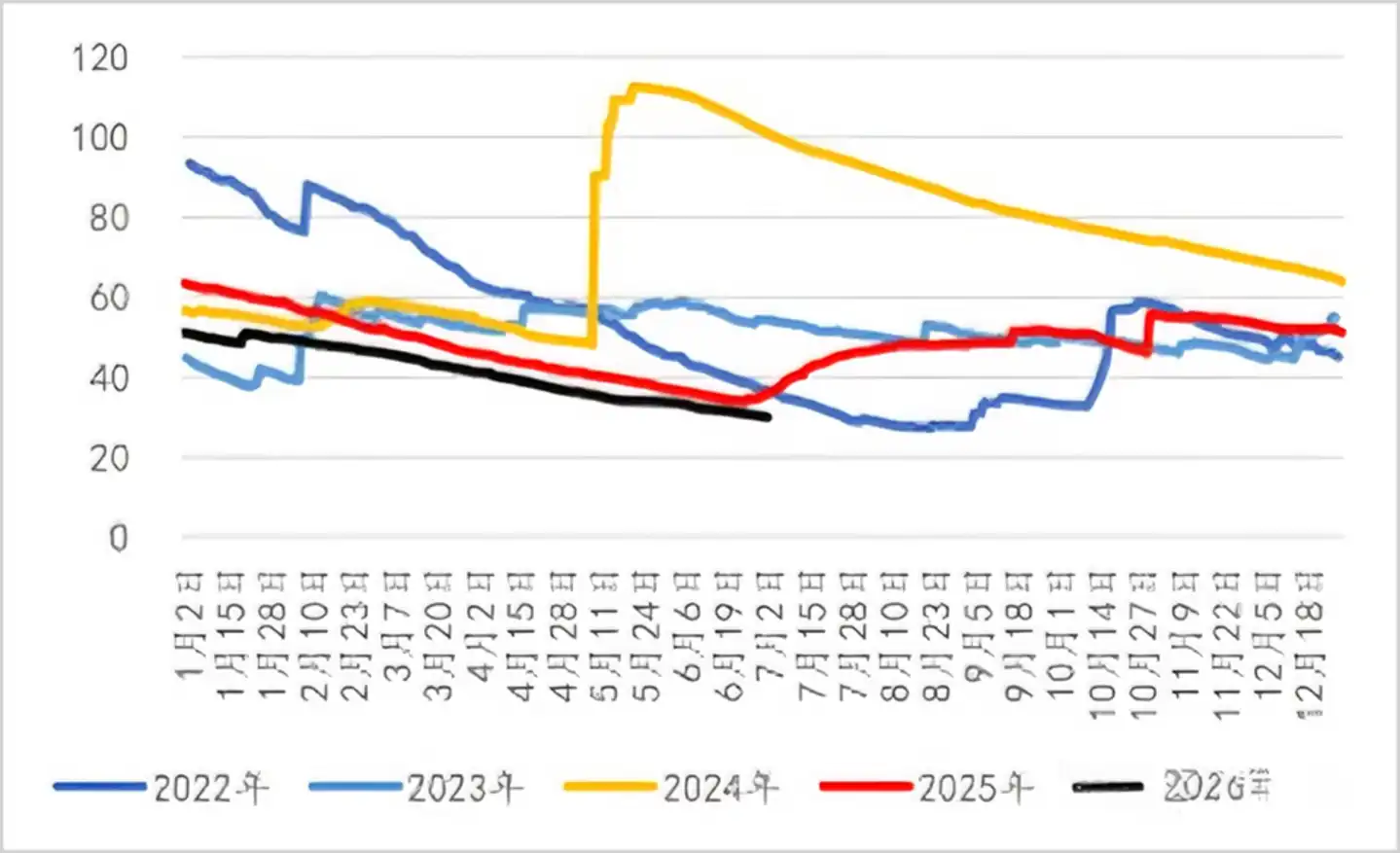
LME Total Aluminum Inventory Chart, Source: Wind

On the other hand, there is significant uncertainty regarding the previously aggressive expectations for Fed rate hikes. For example, June's non-farm payroll and CPI data both came in below expectations, suggesting the pace of hikes may be delayed.

Third, since the end of January, aluminum companies have generally experienced maximum drawdowns of around 40% or more. Currently, the forward PE (2026E) for leading companies like Aluminum Corporation of China, Yunnan Aluminium, and Tianshan Aluminium is only 6-7 times. High earnings momentum, coupled with price increase expectations and low valuations, naturally provides recovery momentum for the future.

In fact, besides aluminum, metals like gold, silver, copper, and lithium share similar underlying logics.

Finally, look at the financial sector. Banks, as typical dividend assets, have stable fundamentals and relatively high dividend yields. Meanwhile, securities firms and insurers, benefiting from capital market activity, generally see high earnings growth, yet their valuations remain at multi-year lows.

Certainly, the rapid development of China's tech industry, especially continuous technological breakthroughs in the semiconductor, AI, and other industrial chains, achieving domestic substitution across multiple fields and expanding exports to capture overseas market share, leads to continuously improving earnings fundamentals and solid long-term value. Coupled with the intrinsic recovery momentum of the three major lines — consumption, cyclical, and financial assets, A-shares possess a fairly strong foundation for resilience.

Overall, this round of tech adjustment stems from external risk transmission, not a collapse in the growth cycle. The "National Team" decisively intervened to stabilize the bottom line of expectations. As the intrinsic momentum of consumption, cyclical, and financial sectors gradually takes over, the market may not be far from regaining stability.


Трендовые криптовалюты

Связанные с этим вопросы

QWhat are the two main reasons that support the resilience of A-shares in the face of external shocks, as discussed in the article?

AThe article highlights two key reasons for A-share resilience: 1) Strong fundamentals in key sectors like technology, where industries such as optical modules and chips maintain high profitability and growth (e.g., profit in the computer and electronic equipment manufacturing sector grew over 100% year-on-year in the first five months). 2) The 'national team' (state-backed institutions) actively intervened to stabilize the market by making substantial purchases (e.g., over 500 billion RMB by Guoxin Investment) and providing policy support, which boosted market confidence and liquidity.

QHow does the structure of China's technology sector differ from South Korea's, making it potentially more resilient according to the article?

AThe article explains that South Korea's stock market is heavily concentrated in a few memory chip giants (Samsung and SK Hynix account for about 50% of the market cap), making it vulnerable to sector-specific risks and leverage unwinding. In contrast, China's A-share technology sector is more diversified, spanning computers, communications, electronics, and within semiconductors, covering the entire supply chain from materials to design and manufacturing. It also has dual growth narratives—participating in the global AI supply chain and driving domestic substitution—making it less dependent on a single segment and more resilient to external shocks.

QWhat specific actions did the 'national team' take to support the A-share market during the recent volatility?

AThe 'national team' took several concrete actions: 1) State-owned institutions like Guoxin Investment announced market purchases exceeding 500 billion RMB, and China Chengtong bought nearly 100 billion RMB. 2) Central state-owned enterprises (e.g., China Aluminum, CRRC) announced share buybacks. 3) Major insurers (Ping An, CPIC, etc.) pledged to increase equity allocations, with China Life Asset Management alone making net purchases of over 100 billion RMB in a single day. 4) The policy tool of 'stock repurchase and增持 special relending' (with a total potential scale of 800 billion RMB) was also mentioned as a stabilizing measure.

QBeyond technology, what other major sectors in the A-share market does the article identify as having endogenous recovery momentum?

AThe article identifies three other major sectors with strong endogenous recovery momentum: 1) Consumer: Indicated by a stabilizing CPI (above 1% for five months) and leading companies like Kweichow Moutai raising prices, signaling easing inventory pressure and a potential end to the downturn. 2) Cyclicals (e.g., aluminum): Supported by high profit growth, potential price increases due to tight supply-demand balance, and low valuations after significant corrections. 3) Finance: Banks offer stable fundamentals and high dividends, while brokers and insurers benefit from capital market activity but trade at low valuations.

QWhat is the article's overall conclusion regarding the recent adjustment in A-shares, particularly the technology sector?

AThe article concludes that the recent adjustment in A-shares, especially in technology, was primarily caused by the spillover of external risks (like deleveraging in South Korean stocks) and not by a collapse in fundamental industry prosperity. It argues that with the 'national team' stepping in to stabilize expectations and provide a floor, and with the inherent recovery momentum in consumer, cyclical, and financial sectors, the market possesses strong resilience and is likely to return to a steady state in the near future.

Похожее

После трёх кварталов падения: получится ли у крипторынка стабилизироваться в третьем квартале?

Криптовалютный рынок пережил худший квартал с 2022 года, общая капитализация упала на 12,6% до $2,1 трлн, а дневные объемы торгов снизились на 20,9%. Впервые за три года сократилась и капитализация стейблкоинов. Основные факторы спада — отток средств из биткоин-ETF, распродажа биткоинов корпоративным казначейством Strategy и ужесточение монетарной политики ФРС. Второй квартал завершился чистым оттоком $46,7 млрд из ETF, при этом в июне отток достиг рекордных $45 млрд. Ключевым событием третьего квартала станет заседание ФРС 28–29 июля. Мягкий сигнал может поддержать биткоин в диапазоне $68 000–84 000 и вернуть приток в ETF, тогда как жесткая риторика способна сместить торговый диапазон к $50 000–56 000. Законодательная неопределенность также давит на рынок: прогресс по закону CLARITY Act, определяющему регуляторные границы, замедлился, и вероятность его принятия в 2026 году упала до 40–45%. Несмотря на общий спад, два сегмента показали рост: объемы на рынках предсказаний выросли на 48,7%, а торговля токенизированными коллекционными предметами увеличилась на 143%. Сектор RWA продолжает стабильно развиваться, достигнув $28,1 млрд. Рынок, вероятно, миновал фазу острой распродажи, но для устойчивого восстановления необходимы ясность от ФРС и регуляторный прогресс.

marsbit12 ч. назад

После трёх кварталов падения: получится ли у крипторынка стабилизироваться в третьем квартале?

marsbit12 ч. назад

BIT Торговые часы: BTC по-прежнему под давлением 200 EMA на недельном графике, после отскока возможен перезапуск нисходящего движения; секторы хранения данных и полупроводников, выросшие ночью, начали падение в вечерней сессии

**Краткий обзор рынка: BTC под давлением, коррекция на рынке акций, внимание к данным и событиям** Рынок криптовалют демонстрирует осторожное восстановление. Bitcoin торгуется около $66 000, сталкиваясь со значительным сопротивлением в районе $68 000, где сосредоточены объемные "застрявшие" позиции. Ключевые технические уровни — 200-недельная скользящая средняя (~$63 333) и 200-недельная EMA (~$68 328). Аналитики отмечают низкую ликвидность, характерную для летнего периода. На фондовом рынке после сильного роста во вторник наблюдается коррекция. Фьючерсы на основные индексы США снижаются. Акции полупроводниковой и памяти, которые резко выросли накануне, падают в ночных торгах. Исключением стал SMCI, который вырос более чем на 15% после оптимистичного прогноза. На общий настрой негативно влияют рост цен на нефть (более $91 за баррель Brent) и доходности государственных облигаций США (10-летние — около 4,64%), что возрождает инфляционные опасения. Азиатские рынки показали нестабильную динамику. Индекс KOSPI в Корее вырос на 0,74%, а японский Nikkei 225 снизился на 0,18%. Основной риск для региона — ослабление японской иены до минимумов с 1986 года, что повышает вероятность вмешательства властей. **Ключевые события для наблюдения:** * **24 июля:** Финансовые отчеты Alphabet (Google), Tesla, IBM. Событие AMD, посвященное ИИ. * **25 июля:** Решение по процентной ставке ЕЦБ и пресс-конференция Кристин Лагард. Финансовые отчеты Intel, American Airlines, Honeywell и других. Данные по числу первичных заявок на пособие по безработице в США.

marsbit12 ч. назад

BIT Торговые часы: BTC по-прежнему под давлением 200 EMA на недельном графике, после отскока возможен перезапуск нисходящего движения; секторы хранения данных и полупроводников, выросшие ночью, начали падение в вечерней сессии

marsbit12 ч. назад

Бывший глава CFTC и президент Circle Тарберт: призывает к долгосрочной стратегии, но сам выводит $30 млн

Бывший председатель CFTC и президент Circle Хит Тарберт, публично пропагандируя долгосрочное видение компании для инвесторов на фоне падения акций на 70% с пиковых значений, сам активно распродавал свои акции CRCL. С момента IPO Circle он по плану 10b5-1 продал более 360 тысяч акций, выручив около 30 миллионов долларов, и при этом ни разу не докупал акции на открытом рынке. Эта разница между его публичными заявлениями и личными действиями вызвала критику. Карьера Тарберта демонстрирует классическое использование «вращающейся двери» между регулирующими органами и частным сектором. Уйдя с поста председателя CFTC в 2021 году, через 27 дней он занял должность главного юрисконсульта в маркет-мейкере Citadel Securities, который в тот момент находился под пристальным вниманием из-за скандала с акциями GameStop. Позже, уже работая в Citadel, Тарберт выступал за расширение полномочий CFTC на крипторынок, в то время как его работодатель планировал выход на этот рынок. В 2023 году Тарберт присоединился к Circle, где его опыт и связи сыграли ключевую роль в успешном проведении IPO компании в 2025 году. Однако его последующие массовые продажи акций, совпавшие с падением котировок и его же призывами к долгосрочным инвестициям, ставят под сомнение искренность его уверенности в будущем компании. Критики видят в его карьере образец превращения регуляторного опыта и политических связей в личную выгоду, в то время как риски несут обычные инвесторы, верящие его нарративам.

marsbit13 ч. назад

Бывший глава CFTC и президент Circle Тарберт: призывает к долгосрочной стратегии, но сам выводит $30 млн

marsbit13 ч. назад

Gate Research: Взлет «уолл-стритизации» криптофинансовых продуктов — это конкуренция или интеграция?

**Аналитический обзор Gate Research Institute: Волна "уолл-стритизации" криптофинансовых продуктов — конкуренция или интеграция?** Создание биткоина в 2009 году было ответом на финансовый кризис и стремлением построить децентрализованную систему без доверенных посредников. Однако к 2026 году значительная часть биткоинов (около 7,14%) хранится через ETF таких гигантов, как BlackRock. Это символизирует глубокую интеграцию традиционных финансов (TradFi) и крипторынка. С появлением биткоин-ETF, фьючерсов, RWA (токенизированных реальных активов) и государственных облигаций на блокчейне, традиционные институты получают всё больше влияния на выпуск, ценообразование, кастодию и дистрибуцию криптоактивов. Однако это не одностороннее поглощение, а взаимодополняющая конвергенция. Криптосфера приносит TradFi глобальную 24/7 ликвидность и программируемость, а TradFi предоставляет криптосфере регулируемые каналы, институциональное доверие и массовый доступ. Яркий пример — две противоположные, но ведущие к одной цели траектории: * **Путь А:** Криптобиржи, такие как Gate, начинают с токенизированных акций и CFD, а затем напрямую подключаются к инфраструктуре традиционных брокеров, предлагая реальную торговлю акциями США, Гонконга и Кореи за стейблкоины. * **Путь Б:** Традиционные брокеры, такие как Robinhood, интегрируют криптоактивы, а затем создают собственные Layer 2 для токенизации своих акций, стремясь к круглосуточной торговле. Обе стратегии нацелены на создание **универсального финансового аккаунта будущего** — единой точки доступа к акциям, криптовалютам, ETF, токенизированным облигациям и другим активам. Ключевой конкурентной борьбой становится не между CEX и брокерами, а между этими "супераккаунтами". Параллельно, слой RWA и токенизированных гособлигаций растёт даже на медвежьем рынке, становясь "прослойкой" для объединения капиталов. Хотя этот рынок (около $150 млрд токенизированных казначейских облигаций) ещё мал по сравнению с традиционным ($30 трлн), он демонстрирует устойчивый структурный тренд, привлекающий крупнейшие финансовые институты (JPMorgan, DTCC и др.). **Вывод:** "Уолл-стритизация" — это не поражение идеалов децентрализации, а формирование новой гибридной модели. Децентрализованные протоколы продолжают работать на базовом уровне, в то время как на уровне приложений и пользовательского опыта формируется более эффективный, глобальный и свободный объединённый рынок капитала, где активы TradFi и DeFi торгуются бок о бок в одном интерфейсе. Уолл-стрит не завоевала криптосферу, а криптосфера не обошла Уолл-стрит — они совместно строят новые финансовые рельсы.

marsbit13 ч. назад

Gate Research: Взлет «уолл-стритизации» криптофинансовых продуктов — это конкуренция или интеграция?

marsbit13 ч. назад

S&P Dow Jones и Pantera выпускают криптоиндекс, биткоин оставлен за бортом из-за «отсутствия прибыли»

Стандард энд Пурс (S&P Dow Jones Indices) совместно с Pantera Capital запускает индекс S&P Pantera Digital Asset Index. Новый индекс включает 18 токенов, но исключает биткоин, XRP и мем-токены. Критерием отбора послужила «финансовая жизнеспособность», по аналогии с S&P 500: протокол должен демонстрировать положительный доход в течение нескольких кварталов и распределять стоимость среди держателей токенов. Это первое применение фундаментального подхода к оценке криптоактивов со стороны крупнейшего в мире провайдера индексов. В первую пятерку активов вошли Ethereum (ETH), BNB, Solana (SOL), TRON (TRX) и Hyperliquid (HYPE). Pantera отмечает, что совокупный годовой доход всех протоколов индекса превышает $30 млрд. Биткоин был исключен по трем причинам: он рассматривается как монетарный актив, доступный через отдельные ETF; он не генерирует доход протокола; а смешивание его в индексе с доходными активами затрудняет фундаментальный анализ для институциональных инвесторов. Пока индекс является эталонным, но Pantera ведет переговоры о создании на его основе ETF и других инвестиционных продуктов. Компания также отмечает значительный разрыв на рынке: многие институциональные инвесторы готовы к аллокации в криптоактивы, но им не хватает структурированных продуктов, фокусирующихся на активах с реальной экономической деятельностью.

marsbit13 ч. назад

S&P Dow Jones и Pantera выпускают криптоиндекс, биткоин оставлен за бортом из-за «отсутствия прибыли»

marsbit13 ч. назад

Торговля

Спот

Популярные статьи

Как купить CAP

Добро пожаловать на HTX.com! Мы сделали приобретение Cap (CAP) простым и удобным. Следуйте нашему пошаговому руководству и отправляйтесь в свое крипто-путешествие.Шаг 1: Создайте аккаунт на HTXИспользуйте свой адрес электронной почты или номер телефона, чтобы зарегистрироваться и бесплатно создать аккаунт на HTX. Пройдите удобную регистрацию и откройте для себя весь функционал.Создать аккаунтШаг 2: Перейдите в Купить криптовалюту и выберите свой способ оплатыКредитная/Дебетовая Карта: Используйте свою карту Visa или Mastercard для мгновенной покупки Cap (CAP).Баланс: Используйте средства с баланса вашего аккаунта HTX для простой торговли.Третьи Лица: Мы добавили популярные способы оплаты, такие как Google Pay и Apple Pay, для повышения удобства.P2P: Торгуйте напрямую с другими пользователями на HTX.Внебиржевая Торговля (OTC): Мы предлагаем индивидуальные услуги и конкурентоспособные обменные курсы для трейдеров.Шаг 3: Хранение Cap (CAP)После приобретения вами Cap (CAP) храните их в своем аккаунте на HTX. В качестве альтернативы вы можете отправить их куда-либо с помощью перевода в блокчейне или использовать для торговли с другими криптовалютами.Шаг 4: Торговля Cap (CAP)С легкостью торгуйте Cap (CAP) на спотовом рынке HTX. Просто зайдите в свой аккаунт, выберите торговую пару, совершайте сделки и следите за ними в режиме реального времени. Мы предлагаем удобный интерфейс как для начинающих, так и для опытных трейдеров.

196 просмотров всегоОпубликовано 2026.06.26Обновлено 2026.06.26

Как купить CAP

Обсуждения

Добро пожаловать в Сообщество HTX. Здесь вы сможете быть в курсе последних новостей о развитии платформы и получить доступ к профессиональной аналитической информации о рынке. Мнения пользователей о цене на CAP (CAP) представлены ниже.

活动图片












