Founder of Baixing.com: The Notion That Large Language Models Will Devour Everything, I Believe Half of It

marsbitОпубликовано 2026-07-07Обновлено 2026-07-07

Введение

Founder of Baixing.com: I Only Half-Believe the Saying “Large Language Models Will Devour Everything” Author: Wang Jianshuo, Founder of Baixing.com Many proclaim that large models are everything, but the author is skeptical. He argues that such sweeping claims often stem from a limited understanding of the future. Drawing parallels to past technologies like electricity and the internet—which were predicted to “devour everything” but didn’t—he suggests that large language models (LLMs) are better seen as a foundational base. Like electricity, this base is essential for modern development, but its real value emerges only when applied to specific scenarios through various “machines” or “tools” (e.g., Claude Code for programming, Claude Design for design). The author acknowledges that LLMs may indeed replace many existing software systems built on rigid rules, workflows, and forms (e.g., CRMs, SaaS tools), as these are precisely what LLMs excel at processing. However, he emphasizes that beyond software, elements like customer data, execution capabilities (e.g., booking a flight), trust, and physical-world interactions will not be “devoured.” Instead, he foresees that after streamlining existing software, LLMs will open up a larger space for innovative, next-generation applications. These new tools will likely feature fluid interfaces and rely less on fixed rules, unleashing greater creativity. The author cautions against short-sightedness, recalling how in 2004 many believed ...

Author: Wang Jianshuo, Founder of Baixing.com

Many people readily proclaim, "Large models are everything." I don't quite buy it.

Every time I hear phrases like "devour everything," I feel it's mostly because our understanding of the future hasn't reached that level, hence we casually throw out such a broad statement. Otherwise, how could one thing devour everything? Take the internet—it's been shouting about devouring everything for years, has it truly devoured everything now? So which one is it, the internet devours everything, or large models devour everything? Both are devouring, leaving nothing behind?

So I'd rather put it differently: it is a very important foundation. Without this foundation, the whole world can't develop, just like the internet without its underlying backbone network, or like using electricity without power plants. That, I acknowledge.

But after the foundation is in place, that's where the real excitement happens above.

Take electricity. As soon as electricity was generated, what was the first application people saw? The light bulb. Thomas Edison lit the first one, and it just kept shining, shining, shining. If the world stopped there, with only a light bulb, then I could completely say: the power plant is the core of the whole world, the power plant devours everything.

But that's not how things went. Later came motors, to drive machines; and then you find that once a fundamental thing like electricity exists, countless appliances grow on top of it to utilize it. Washing machines are for washing clothes, televisions are for watching TV, vacuum cleaners are for vacuuming—they are all applications of electricity. Without electricity, none of these things would exist. But if you say "electricity devours everything," I don't believe it.

It's the same with large models. They provide foundational intelligence. But this intelligence must be placed into a specific, scenario-oriented "machine" or "device" before it can play its role and truly change the world.
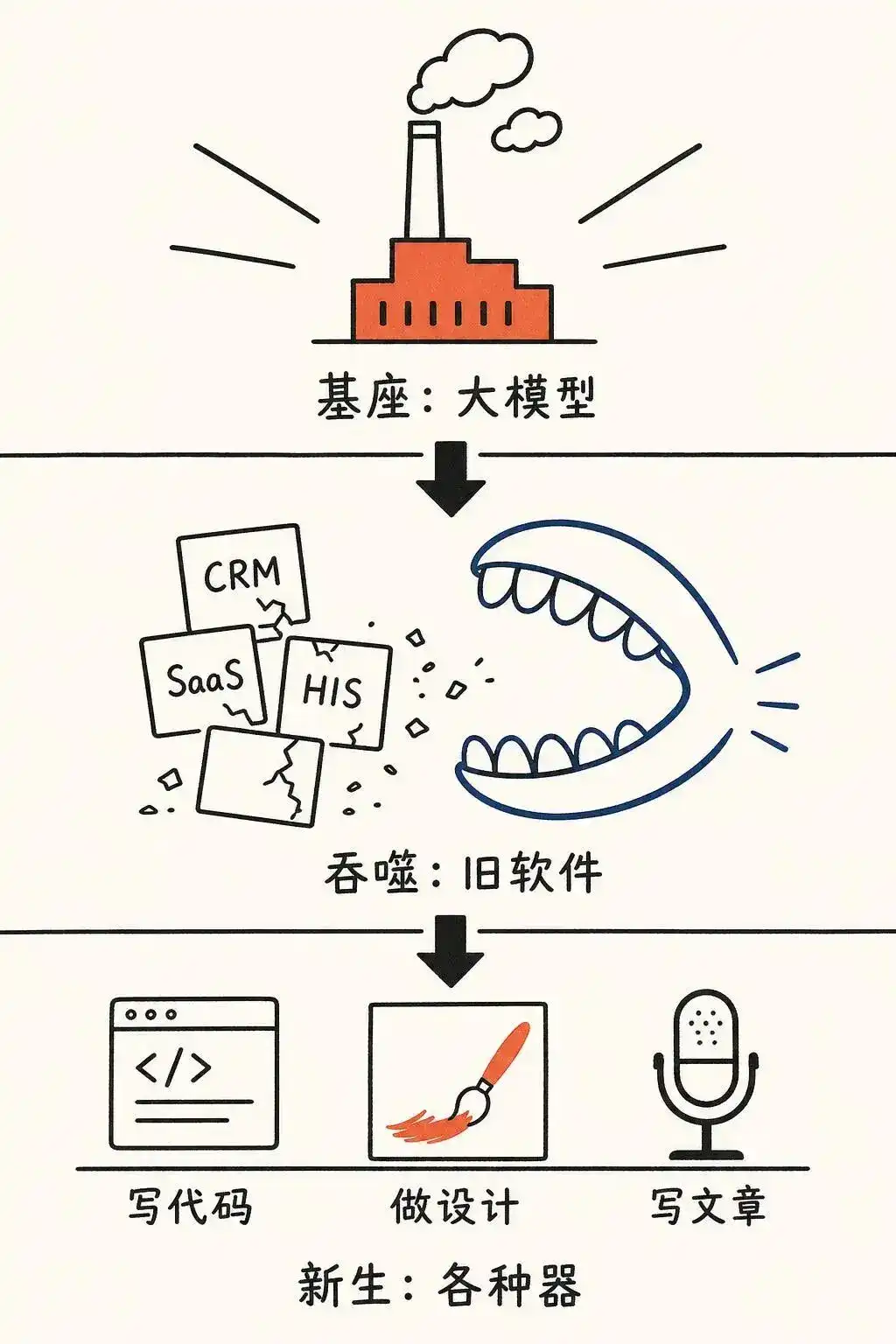
Claude Code is for writing code, Claude Design is for design, VoiceDrop is for writing articles. Using the same large model, placed into different devices, solves completely different problems.

With only electricity, only water, without a washing machine, clothes still can't be washed. Imagine, a power plant produces a massive amount of electricity, electricity is very powerful, and then what? Without a washing machine, can this pile of electricity wash clothes by itself?

Intelligence is great, but most things in the world require the combination of multiple elements to work, just as a washing machine needs to combine elements like electricity, water, and even a tub; large models might be able to replace a lot in the field of software, but application scenarios in the world that require only one element are not many.

Here's a current example. Now we have large models, but having just a large model isn't enough. There needs to be a layer above it called Harness—this layer has only recently emerged—it interacts with code, and finally forms something truly usable. A large model by itself can't write code. Of course, the core of Claude Code, frankly, I could write it with a little over fifty lines; a bit longer with a few more lines, and it can run and write programs. But you have to see: with only a large model and without this outer layer, it's still not easy to use—that is, the intelligence of a large model, if not combined with the code execution capabilities provided by the operating system, relying on the large model for calculations isn't economical, and sometimes even impossible.

The core value of this interface layer is to help us put that intelligence, which is like electricity or water, into a specific application scenario, turning it into a machine that can solve specific problems.

Now, of course, the logic behind "devour everything," I don't completely disbelieve it either.

What it primarily refers to is existing software. So far, we have built up a very, very large layer of software—things pieced together by many rules, forms, buttons, workflows, a lot of it. Massive numbers of filters, fixed templates, a bunch of backend operations, many SaaS detection features. And all the various things we used to know as "M" systems, whether CRM, or HIS (hospital information system), all sorts of so-called "systems," "software," and the like, a whole pile.

This layer, I believe large language models will indeed devour quite a bit of.

Why? Because these original software programs were, by nature, clear, computer-executable instructions, solidified and repeatedly executed—we call this software. And this is precisely what large language models are most adept at chewing through.

But.

Within this layer, besides software, there are many other things. Customer information. Execution capabilities—like when you book a flight ticket, the actual capability to move a plane, to transport a person from here to there. Also trust. Many things in the physical world. These, I don't think will be devoured.

After devouring that layer, it actually opens up a much larger space—the new type of software on top of it.

The interface of the new software will certainly be flow-based, it likely won't solidify as many rules as before. After handing all those rules to AI, think about it, the CRM we could achieve like Salesforce before, that was already the pinnacle of human effort, using all possible strength. But if this part becomes relatively easier to solve, then what everyone will do next is to unleash even more imagination and possibilities on top of it—and that part is precisely what we haven't seen yet.

This is where we often make mistakes. When a new technology arrives, because we can't see the bigger road beyond it, we can only stare at the part in front of us. The leaf blocks the view, obscuring the mountain.

Let alone this kind of trend judgment. I remember back in 2004, a group of friends were complaining, saying that the entire internet could no longer produce companies bigger than Sina, Sohu, and NetEase, that the internet was nearly over, and they would monopolize everything. And look how many years have passed since then? The world turned upside down. We would be crying at our own shortsightedness back then.

So my proposition is this: Are large models important? Yes, they are the foundation, the main driving force in recent times. But once they become stable, continuously provided things, then various kinds of "machines" and "devices" on top are needed to solve specific problems. That thick layer—where it's used, how it's used—is precisely the mainstream of the second wave of this trend.

The phrase "devour everything" is too imprecise. In this world, which thing, which social form, which technology has ever truly devoured everything?

Finding opportunities in the places it does devour—that's the truly important thing.

Трендовые криптовалюты

Связанные с этим вопросы

QWhat is the core viewpoint of the author, the founder of Baixing.com, regarding the statement 'Large language models will devour everything'?

AHe believes it only half. He views large language models as a crucial foundational platform, like electricity or the internet, but argues that they alone cannot 'devour everything.' True value and transformation come from applying this foundational intelligence to specific scenarios through various 'machines' or applications built on top of it.

QHow does the author use the analogy of electricity to explain the role of large language models?

AThe author compares large language models to electricity. Electricity itself is a foundational utility (like a power plant), but it doesn't 'devour everything.' Its real-world impact comes from the diverse array of appliances (like washing machines, TVs) built on top of it to solve specific problems. Similarly, LLMs provide base intelligence, but they need to be integrated into specific applications (like Claude Code for programming) to be truly useful and transformative.

QAccording to the article, what specific layer of existing technology does the author believe large language models are likely to 'devour' or replace?

AThe author believes large language models are likely to replace a significant portion of existing, rule-based, fixed-template software systems, such as many CRM, HIS, and various SaaS applications. These systems are composed of clear, computer-executable instructions, which is precisely what LLMs are good at handling and generating.

QWhat does the author identify as elements that will NOT be 'devoured' by large language models, even as software systems change?

AThe author identifies several elements that will not be devoured: customer information, execution capabilities (like physically moving people or goods), trust, and many aspects of the physical world. These components are essential and exist alongside or beyond the software logic that LLMs might replace.

QWhat is the 'second wave' of the AI浪潮 (wave/tide) that the author predicts will follow the establishment of large language models as a stable foundation?

AThe author predicts the 'second wave' will be focused on the thick layer of applications built *on top* of the large language model foundation. This involves creating the various 'machines' and 'tools' that leverage the base intelligence to solve concrete, specific problems in different domains. This application layer is where the next major phase of innovation and opportunity lies.

Похожее

GPT-5.6 скоро будет запущен, скорость рассуждений взлетела до 750 токенов в секунду, подозревается работа на 100 кремниевых пластинах

По данным утечек, OpenAI готовится к запуску GPT-5.6 Sol — новой высокоскоростной версии своей модели. Как утверждается, она будет работать на оборудовании Cerebras с феноменальной скоростью генерации в 750 токенов в секунду, что позволит выполнять сложные задачи почти мгновенно. Ключевым техническим прорывом, по мнению экспертов, является архитектура развертывания, при которой каждый слой нейронной сети размещается на отдельной пластине (wafer) чипа Cerebras. Это позволяет масштабировать модель до 3 триллионов параметров, используя от 70 до 100 таких пластин. Для преодоления ограничений памяти также применяются оптимизированные, облегченные методы кэширования KV, возможно, в сочетании с гибридными архитектурами, подобными Mamba. OpenAI параллельно развивает собственную экосистему, представив свой первый специализированный чип для вывода ИИ — Jalapeño. Это демонстрирует стратегию компании по созданию полного стека технологий: от проектирования моделей и чипов до оптимизации развертывания. Цель — построить масштабируемую инфраструктуру для следующего поколения сверхбыстрого и мощного искусственного интеллекта.

marsbit1 мин. назад

GPT-5.6 скоро будет запущен, скорость рассуждений взлетела до 750 токенов в секунду, подозревается работа на 100 кремниевых пластинах

marsbit1 мин. назад

Цукерберг начинает делать ставки на рынок прогнозов, в то время как азиатские страны все еще считают это азартной игрой

Прогностические рынки, превратившись в индустрию с ежемесячным объемом торгов в 140 млрд долларов, привлекают внимание крупных технологических компаний, таких как Meta с ее проектом «Arena». Их механика проста: контракты на основе событий (например, исход выборов) рассчитываются как 1 доллар в случае реализации и 0 долларов в противном случае, а рыночная цена отражает вероятности в реальном времени. Западные страны, следуя судебным решениям, интегрируют такие рынки в регулируемую финансовую систему. В Азии же к ним часто относятся как к азартным играм, что приводит к трем основным проблемам: оттоку капитала на офшорные платформы, потере суверенитета над информационными данными (например, более точными, чем опросы, прогнозами выборов) и отсутствию защиты пользователей. Автор призывает к смене парадигмы в регулировании — не блокировать эти рынки, а найти способы ответственно использовать генерируемые ими ценные данные в рамках законной системы, превращая их в актив для общества, а не отдавая инициативу иностранным игрокам.

Foresight News7 мин. назад

Цукерберг начинает делать ставки на рынок прогнозов, в то время как азиатские страны все еще считают это азартной игрой

Foresight News7 мин. назад

Не только приватный ключ: от кошельков и L2 до цепочек поставок — как защитить границы безопасности Web3?

Прошедший июнь стал месяцем серьезных атак в криптомире, нанесших общий ущерб на сумму около 75,9 млн долларов. Эти инциденты затронули несколько ключевых уровней безопасности Web3, выходящих далеко за рамки защиты лишь приватного ключа. Во-первых, на примере кошелька SecondFi в экосистеме Cardano выявилась важность корректной реализации подписи на уровне самого кошелька. Ошибка в коде позволила злоумышленникам восстановить приватные ключи из публичных подписей транзакций, не похищая сид-фразы. Это подчеркивает необходимость использования проверенных, по возможности, открытых решений для ключевых компонентов и разделения активов между «холодным» хранилищем и «горячим» кошельком для повседневных операций. Во-вторых, атаки на устаревшие развертывания Aztec Connect и Taiko продемонстрировали сложность и уязвимости инфраструктуры Layer 2 (L2). Проблемы варьировались от недостатков в логике доказательств с нулевым разглашением (ZK) до компрометации ключей доверенной среды выполнения (SGX). Безопасность L2 — это не только дешевые транзакции, но и надежность консенсуса, мостов и механизмов аварийного выхода. В-третьих, инцидент с Polymarket показал, как атака на стороннего поставщика услуг (цепочка поставок) может скомпрометировать безопасный фронтенд, внедрив вредоносный скрипт. Это напоминание, что «безопасный контракт» не гарантирует безопасность всего пути взаимодействия пользователя. Для защиты рекомендуется использовать отдельные кошельки для DApp, внимательно проверять детали транзакций перед подписанием и быть осторожным при аномалиях на сайте. В целом, современная безопасность Web3 — это защита всей цепочки: от генерации ключей и подписи транзакций до их верификации и финального расчета. Эффективная стратегия для пользователя включает разделение активов по уровню риска, использование небольших сумм для повседневных операций, минимальные разрешения для незнакомых DApp и дополнительную проверку рискованных действий. Защита должна эволюционировать от хранения секретной фразы к комплексным привычкам.

marsbit1 ч. назад

Не только приватный ключ: от кошельков и L2 до цепочек поставок — как защитить границы безопасности Web3?

marsbit1 ч. назад

Сможет ли OpenAI в конечном итоге стать прибыльной?

Открытие OpenAI и Anthropic IPO с оценкой в триллионы долларов отражает оптимизм инвесторов, но прибыльность крупных языковых моделей (ИИ) остается под вопросом. Несмотря на быстрый рост выручки, ни одна компания пока не вышла на устойчивую прибыль в этом сегменте. Анализ рынка API-вызовов показывает, что он имеет структуру монополистической конкуренции: множество игроков, низкая концентрация, высокая ценовая эластичность спроса и ограниченные возможности для удержания клиентов. Технологические барьеры оказались ниже ожидаемых из-за доступного финансирования, открытых моделей и мобильности кадров. Хотя некоторые компании могут получить краткосрочную сверхприбыль за счет дифференциации, в долгосрочной перспективе конкуренция, вероятно, приведет к исчезновению сверхдоходов. Рынок может эволюционировать в сторону олигополии, но и тогда прибыльность не гарантирована — она будет зависеть от стратегии конкурентов (ценовая или количественная конкуренция). Таким образом, бизнес-модель, основанная исключительно на продаже токенов ("API-вызовы"), может не обеспечить устойчивой прибыльности. Инвесторам следует критически оценивать высокие оценки компаний, а самим компаниям — тщательно выбирать бизнес-модель. Наиболее перспективными для устойчивой прибыли могут стать модели "ИИ+" (встраивание ИИ в существующие продукты) и контрактная работа, которые создают более высокие барьеры для ухода клиентов и дают больше ценообразования. При этом агрегаторы API (как OpenRouter), использующие сетевые эффекты, могут оказаться в выигрышном положении.

marsbit1 ч. назад

Сможет ли OpenAI в конечном итоге стать прибыльной?

marsbit1 ч. назад

Robinhood Chain привлекает внимание за неделю: Meme-токены привлекают трафик, стейблкоины поддерживают TVL

За первую неделю после запуска основной сети Robinhood Chain наблюдался резкий рост активности, в значительной степени вызванный ажиотажем вокруг мем-токенов, интеграцией с платформой Pump.fun и переходом приложения World из экосистемы Solana. Однако основным драйвером роста общего объема заблокированных средств (TVL), который достиг 234 миллионов долларов, стал не спекулятивный трейдинг, а крупный депозит в размере около 50 миллионов долларов в стейблкоин USDG (Ethena) через кредитный протокол Morpho. Этот вклад обеспечивает высокую доходность через продукт Robinhood Earn. В то время как мем-токены, такие как CASHCAT, привлекают пользователей и генерируют высокие торговые объемы, заявленная изначально основная специализация цепи — токенизация реальных активов (RWA) — все еще находится на начальной стадии, с объемом всего около 12,8 миллиона долларов. Цепь развивается по двум направлениям: стабильный институциональный капитал в DeFi и розничный спекулятивный ажиотаж.

Foresight News1 ч. назад

Robinhood Chain привлекает внимание за неделю: Meme-токены привлекают трафик, стейблкоины поддерживают TVL

Foresight News1 ч. назад

Торговля

Спот

Популярные статьи

Как купить PEOPLE

Добро пожаловать на HTX.com! Мы сделали приобретение ConstitutionDAO (PEOPLE) простым и удобным. Следуйте нашему пошаговому руководству и отправляйтесь в свое крипто-путешествие.Шаг 1: Создайте аккаунт на HTXИспользуйте свой адрес электронной почты или номер телефона, чтобы зарегистрироваться и бесплатно создать аккаунт на HTX. Пройдите удобную регистрацию и откройте для себя весь функционал.Создать аккаунтШаг 2: Перейдите в Купить криптовалюту и выберите свой способ оплатыКредитная/Дебетовая Карта: Используйте свою карту Visa или Mastercard для мгновенной покупки ConstitutionDAO (PEOPLE).Баланс: Используйте средства с баланса вашего аккаунта HTX для простой торговли.Третьи Лица: Мы добавили популярные способы оплаты, такие как Google Pay и Apple Pay, для повышения удобства.P2P: Торгуйте напрямую с другими пользователями на HTX.Внебиржевая Торговля (OTC): Мы предлагаем индивидуальные услуги и конкурентоспособные обменные курсы для трейдеров.Шаг 3: Хранение ConstitutionDAO (PEOPLE)После приобретения вами ConstitutionDAO (PEOPLE) храните их в своем аккаунте на HTX. В качестве альтернативы вы можете отправить их куда-либо с помощью перевода в блокчейне или использовать для торговли с другими криптовалютами.Шаг 4: Торговля ConstitutionDAO (PEOPLE)С легкостью торгуйте ConstitutionDAO (PEOPLE) на спотовом рынке HTX. Просто зайдите в свой аккаунт, выберите торговую пару, совершайте сделки и следите за ними в режиме реального времени. Мы предлагаем удобный интерфейс как для начинающих, так и для опытных трейдеров.

823 просмотров всегоОпубликовано 2024.04.12Обновлено 2026.06.02

Как купить PEOPLE

Обсуждения

Добро пожаловать в Сообщество HTX. Здесь вы сможете быть в курсе последних новостей о развитии платформы и получить доступ к профессиональной аналитической информации о рынке. Мнения пользователей о цене на PEOPLE (PEOPLE) представлены ниже.

活动图片