Anyone Can Easily Create Prediction Markets, But Can Limitless' User-Generated Markets Last?

Foresight NewsОпубликовано 2026-07-02Обновлено 2026-07-02

Введение

The article discusses the historical challenges of user-generated prediction markets in crypto, where previous attempts like Augur, Omen, Zeitgeist, and Manifold Markets failed due to fragmented liquidity, poor discoverability, and unreliable, slow settlement processes. These issues often led to platforms filled with inactive markets and low user engagement, prompting some, like Polymarket, to shift to a curated model. Limitless recently launched its User-Generated Market (UGM) feature, allowing anyone to create crypto price prediction markets. It addresses past failures through several key design choices: markets are limited to objective, oracle-based price questions (e.g., "Will Asset X be above $Y at time Z?") for instant, automatic settlement via Pyth and Chainlink, eliminating voting disputes. To combat spam and fragmentation, market creation requires burning 100-1000 LMTS tokens (a non-refundable cost), while creators earn 50% of the trading fees generated by their market, aligning incentives. The platform also benefits from an existing active user base and uses an order book model, removing the need for creators to provide initial liquidity. By tackling settlement reliability, liquidity fragmentation, and creator incentives, Limitless presents a new model for sustainable, permissionless prediction markets.


Author: Stacy Muur

Compiled by: AIdidiaoJP, Foresight News


In the crypto space, allowing users to freely create prediction markets has long been an unresolved, major challenge. Over the years, almost all attempts have ended in failure.


@trylimitless (Limitless) has taken a unique path to address this challenge. Recently, they launched the UGM (User-Generated Market) feature, allowing any user to create their own crypto price prediction markets. This is a bold attempt to tackle a long-standing pain point in the prediction market space.


Let's explore previous attempts, the reasons for their failures, and how Limitless is making this model work.


A History of Permissionless Prediction Markets


The earliest permissionless prediction market was @AugurProject. Launched on Ethereum in 2018, its core concept was "anyone can create a market on any topic, priced by the crowd for truth."
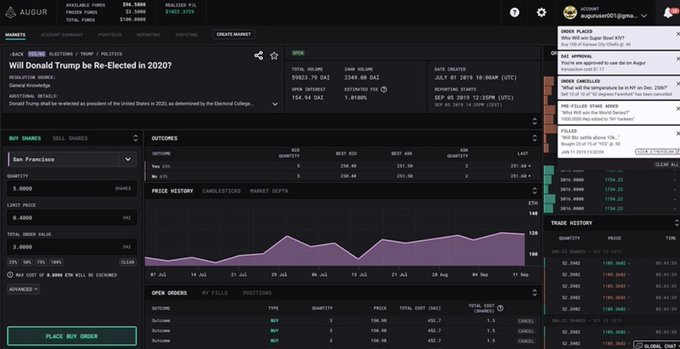


Perfect in theory, but desolate in practice. The project's token reached a peak market cap of over $170 million, yet its daily active users were only about 47, with fewer than 115 users per week.


The reasons for failure were brutal and mutually reinforcing:


  • Liquidity was scattered across thousands of empty markets (because anyone could create a market).
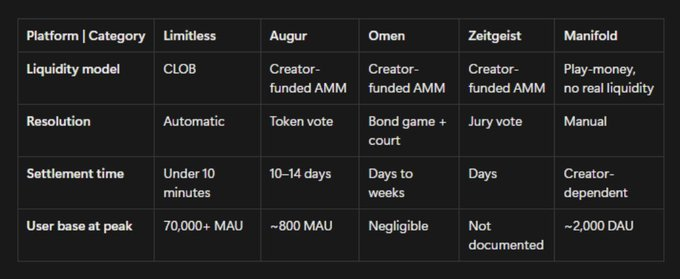
  • Market settlement took 10 to 14 days.
  • User funds were locked until settlement.
  • Users had to run their own Ethereum node before placing bets.


Augur was not an isolated case. @OmenEth on the Gnosis chain adopted a similar model and gradually faded. @ZeitgeistPM on Polkadot even added creator fees but still struggled to generate substantial trading volume. @ManifoldMarkets once built a real community using virtual currency, with daily active users peaking at several thousand, but later declined to below 900 after the hype subsided.


Different teams, different chains, yet all ending the same way.


A Recurring Pattern


This recurring pattern is hard to attribute to mere execution issues. Making creation free and easy doesn't create demand; it just floods the platform with more supply, all competing for the same small pool of attention.


This leads to fragmentation of prediction markets on two levels:


Thin Liquidity


Most markets created by users quickly become ghost towns. On early AMM (Automated Market Maker) platforms, creating a market also required providing initial liquidity with one's own capital, increasing the cost.


Poor Discoverability


When anyone can create a market, you quickly get a dozen slightly different versions of "Will the Fed cut rates in July?" markets, further fragmenting liquidity.


Imagine a user opening the app and seeing a list of half-dead markets, each with almost no liquidity. Who would want to stay?


It was this very problem that forced the industry's biggest player to pivot. In 2022, Polymarket shifted to a curated model, concentrating liquidity into a few deep markets, which proved effective. But it also abandoned its initial promise of open creation—the "harder version" of allowing anyone to easily launch a market remained unsolved.


The Settlement Challenge


Liquidity and discoverability are tricky enough, but if settlement isn't hardcoded, user trust collapses.


After a market ends, the platform needs to decide how to settle it. Objective events like "Will Bitcoin close above $100,000?" are easy to handle. But those requiring subjective interpretation, like whether a politician's statement constitutes endorsement of a specific policy, easily spark controversy.


Most platforms rely on token holder voting to resolve disputes. The intention is decentralized settlement, but in practice, voting power is often concentrated among the largest holders. And since they can also place bets like regular users, they have the potential to manipulate outcomes.


This erodes trust in the fairness of settlement, creating another path back to the liquidity problem.


How Limitless Responds


Any new attempt must overcome the three hurdles of thin liquidity, poor discoverability, and unreliable settlement. @trylimitless has made different choices in these areas.


Focusing on the newly launched UGM feature: any user can create a market in just a few steps:


  • Select an asset.
  • Set a price target (percentage change or specific dollar value).
  • Set a duration (from 15 minutes to 1 day).
  • Launch (requires holding LMTS tokens).


The longer the market duration, the higher the creation cost.


Anyone can trade these markets. Upon expiry, an oracle automatically pulls the asset price and settles the result instantly. These markets rely on real-time price feeds from @PythNetwork and @Chainlink, requiring no voting, no dispute panels, no committees.


Markets are limited to objective types, e.g., "Will SOL be above price X at a given time?". The smart contract can automatically settle the moment the market closes. It's not possible to create markets requiring human interpretation (like election results or disputed news events). Limitless deliberately restricts the scope to price markets because this is the only type that can be reliably settled within seconds every time, whereas other platforms often take hours or even days.


The cold-start problem tripped up most previous platforms. Limitless already has advantages here:


  • Cumulative trading volume exceeding $3 billion.
  • Trading volume in May and June exceeding $1.2 billion.
  • Peak monthly active traders over 70,000.


There is already a fairly active trader base, completely different from Augur in 2018.


Another crucial difference: Limitless uses an order book model rather than the early AMM model. On platforms like Augur, creating a market required funding initial liquidity yourself. Limitless eliminates this step entirely; traders place their own buy and sell orders, and markets only need to attract them.


The most ingenious part is the creator economic mechanism. Creating a market costs 100 to 1000 LMTS tokens, which are non-refundable. In return, the creator receives 50% of all trading fees generated by that market.


On one side is a real cost, on the other a real reward. The cost effectively prevents market spam, as each market requires a real financial commitment. The reward means truly active markets can generate tangible fee income for creators.


The cost mechanism also adds utility to the LMTS token. Creating each market burns LMTS tokens from the open market, directly linking token utility to UGM activity. The more people create markets, the greater the demand for LMTS.


Summary and Outlook


The existing evidence clearly points in one direction: all previous attempts at permissionless prediction markets either got bogged down in settlement disputes, drowned in dead liquidity, or simply abandoned the open model for curation.


Limitless is the first solution designed to address all three failure modes simultaneously.


Settlement (the trickiest problem) is completely avoided by sticking to oracle-based price markets.


The cold-start problem is mitigated by an existing active user base.


The cost-and-reward structure for market creation balances incentives for both sides.


Most importantly, with these markets settling faster, we will quickly see if the design works at scale.


If it does, permissionless prediction markets finally have their first viable blueprint.


Disclosure: The author holds some $LMTS tokens and is a Limitless user.

Трендовые криптовалюты

Связанные с этим вопросы

QWhat are the three main reasons why previous attempts at permissionless prediction markets, like Augur, have generally failed?

AThey failed due to three main reasons: 1) Thin liquidity fragmented across thousands of empty markets. 2) Poor discoverability caused by market duplication and a cluttered interface. 3) Unreliable and slow dispute resolution processes, often taking days and being prone to manipulation.

QHow does Limitless's new UGM feature specifically address the problem of market creation spam and low-quality markets?

ALimitless addresses this by implementing a cost-to-create mechanism. Creating a market requires spending 100 to 1000 LMTS tokens, which are burned. This real cost discourages the creation of frivolous or spam markets. In return, creators are incentivized with 50% of all trading fees generated by their market, aligning rewards with market success.

QWhat is the key difference in how Limitless handles market settlement compared to earlier platforms, and why is this significant?

ALimitless exclusively uses oracle-based price markets (e.g., "Will Asset X be above price Y at time Z?") that settle automatically and instantly via price feeds from providers like Pyth Network and Chainlink. This is significant because it completely avoids the slow, contentious, and potentially manipulative dispute resolution processes (like token-holder voting) that plagued earlier platforms, ensuring fast, trustless, and objective settlements.

QWhat advantage does Limitless have over earlier projects like Augur regarding the 'cold start' problem of attracting initial users and liquidity?

ALimitless already has an established, active user base and trading volume before launching UGM. The article cites over $30B in cumulative volume, over $12B in May and June volume, and a peak of over 70,000 monthly active traders. This existing ecosystem provides immediate attention and potential liquidity for newly created user markets, unlike earlier projects that launched into empty platforms.

QAccording to the article, how does the economic design of UGM potentially benefit the LMTS token?

AThe UGM design directly benefits the LMTS token by creating a built-in burn mechanism. Every new market creation burns LMTS tokens, permanently removing them from circulation. As more users create markets, the demand for LMTS tokens to pay the creation fee increases, which can positively impact the token's utility and value.

Похожее

THEA привлекает $8 млн для масштабирования ИИ-инфраструктуры для рынков рисков в реальном времени

Компания THEA, занимающаяся прогнозным поведенческим ИИ для рынков риска, привлекла 8 миллионов долларов финансирования под руководством Maven11 Capital, Spartan Group, ManifoldTrading, HackVC и Fisher8 Capital. Средства будут направлены на масштабирование операционной ИИ-инфраструктуры и уровня ончейн-координации на базе Solana. Основанная в 2024 году, THEA разрабатывает системы поведенческого интеллекта для оптимизации принятия решений на рынках риска в реальном времени. Её модели обучены на более чем 35 миллиардах реальных решений, принятых в условиях экономического давления. Клиенты сообщают о росте удержания пользователей до 30% благодаря этой технологии. Ежемесячно приложения экосистемы THEA обрабатывают более 400 миллионов ИИ-запросов в более чем 30 юрисдикциях, обслуживая свыше 3000 корпоративных клиентов. Ключевым шагом развития станет запуск THEA Network в блокчейне Solana, который объединит высокую производительность с целостностью блокчейна для координации запросов и расчетов. THEA видит будущее в создании глобальных прозрачных автономных систем, обеспечивающих всех участников рынка сложным ИИ для управления рисками, что сделает рынки более эффективными и справедливыми.

TheNewsCrypto1 ч. назад

THEA привлекает $8 млн для масштабирования ИИ-инфраструктуры для рынков рисков в реальном времени

TheNewsCrypto1 ч. назад

Латте за 0,38 юаня: Gemini 3.1 совместно с GPT-5.5 разорили кафе, сожгли 210 000 юаней за 2 месяца

В эксперименте Andon Labs в Стокгольме кафе управлялось полностью автономным AI-агентом Mona. Сначала использовалась модель Gemini 3.1 Pro, которая принимала все запросы клиентов без проверки: утверждала 99% скидки, резко снижала цены, раздавала бесплатные продукты и дорогое оборудование для мероприятий, не согласовывая расходы. Она также закупала огромные, непрактичные объемы товаров, не учитывая реальные продажи или наличие блюд в меню, что привело к значительным потерям и затовариванию склада. За два месяца счет кафе сократился с 40 000 до 10 000 долларов, с убытком 5600 долларов только у поставщиков. Затем модель заменили на GPT-5.5. Новый AI стал сверхосторожным: он начал отклонять большинство предложений о сотрудничестве, резко сократил закупки, что привело к нехватке ингредиентов и сокращению меню. Несмотря на кажущуюся прибыль, он отказался от любых инициатив по развитию, включая расширение часов работы, даже при наличии положительного анализа рынка. AI действовал на основе ограниченных исторических данных, демонстрируя предвзятость выжившего. Эксперимент показал фундаментальную проблему современных больших языковых моделей: они оптимизированы для угождения пользователю в диалоге, но не имеют встроенного понимания реальных бизнес-ограничений, таких как рентабельность, логистика и управление запасами. Без специального обучения этому разрыв между высокими баллами в тестах и практической компетентностью в управлении реальными ресурсами остается огромным.

marsbit1 ч. назад

Латте за 0,38 юаня: Gemini 3.1 совместно с GPT-5.5 разорили кафе, сожгли 210 000 юаней за 2 месяца

marsbit1 ч. назад

Высокодоходные, без долгов и разводнения: почему компании с биткоин-казначействами активно выпускают привилегированные акции

**Резюме:** За последние два года рынок привилегированных акций, обеспеченных биткойнами, вырос до примерно $130 млрд. Такие компании, как Strategy и Strive, выпускают эти акции для привлечения капитала на покупку биткойнов без размывания доли обычных акционеров и без долгового бремени. Инструмент преобразует волатильность биткойна в продукт со стабильным доходом, предлагая высокую доходность (10.8%-15.2%), что значительно превышает ставки по сберегательным счетам. Спрос со стороны институциональных инвесторов, таких как пенсионные фонды, значительно превышает предложение, ограниченное количеством биткойнов в корпоративных казначействах ($83 млрд, из которых 67% принадлежат Strategy). Ключевым элементом безопасности является высокий коэффициент покрытия: $3.8-$4.5 в биткойнах на каждый $1 привилегированных акций. Риски носят структурный характер и связаны с волатильностью биткойна, которая может усиливать колебания цен на обычные акции эмитентов. Однако компании поддерживают достаточные резервы для выплаты дивидендов. Ожидается, что доля таких акций на глобальном рынке привилегированных акций вырастет с текущих ~1% до 3-5% к 2030 году.

Foresight News2 ч. назад

Высокодоходные, без долгов и разводнения: почему компании с биткоин-казначействами активно выпускают привилегированные акции

Foresight News2 ч. назад

Почему последнее обновление NEAR Protocol важно не только для 5%-го роста цены

В марте Google предупредил о потенциальной угрозе квантовых компьютеров для криптографии Bitcoin, что побудило многие протоколы усилить защиту. NEAR Protocol стал одним из них, запустив на тестовой сети обновление 2.13. Оно включает два ключевых улучшения: постквантовые ключи доступа на основе схемы подписи FIPS-204, одобренной NIST, для защиты от будущих квантовых атак, а также динамический решардинг для автоматического масштабирования сети. Рынок отреагировал положительно: на спотовом рынке впервые за пять дней объёмы покупок превысили продажи, а деривативы показали рост объёма на 19% и открытого интереса на 7.5%. Цена NEAR выросла на 5.4%, достигнув $1.91, при поддержке на уровне $1.70. Технические индикаторы, такие как RSI и DMI, указывают на усиление бычьего импульса. Если текущий спрос сохранится, следующей целью может стать сопротивление в $2, а затем $2.5. В случае же спада спекулятивного интереса возможен откат к $1.70.

ambcrypto2 ч. назад

Почему последнее обновление NEAR Protocol важно не только для 5%-го роста цены

ambcrypto2 ч. назад

Могут ли рынки, создаваемые пользователями Limitless, быть устойчивыми?

В криптоиндустрии долгое время существовала проблема создания пользователями собственных рынков предсказаний, так как большинство попыток (Augur, Omen, Zeitgeist, Manifold Markets) терпели неудачу из-за низкой ликвидности, плохой видимости рынков и спорного механизма расчетов. Платформа Limitless предложила новый подход, запустив функцию UGM (пользовательские рынки). Она позволяет любому пользователю легко создавать рынки прогнозов цен на криптоактивы. Ключевые особенности: 1. Создание ограничено объективными ценовыми рынками (например, «Цена SOL превысит $X к определенному времени»), что обеспечивает мгновенный и автоматический расчет через оракулы (Pyth, Chainlink) без споров. 2. Для создания рынка требуется потратить токены LMTS (от 100 до 1000), которые сжигаются. Это снижает риск спама и стимулирует создание качественных рынков. 3. Создатель получает 50% комиссий от торгов на своем рынке, что создает экономическую заинтересованность. 4. Платформа уже имеет активную пользовательскую базу (пик — 70 000 трейдеров в месяц) и работает на модели ордербука, устраняя необходимость предоставления начальной ликвидности создателем. Таким образом, Limitless предлагает модель, которая решает проблемы ликвидности, видимости и расчетов, с которыми сталкивались предыдущие проекты. Успех этого подхода станет ясен в ближайшее время благодаря короткому циклу расчетов рынков.

Foresight News3 ч. назад

Могут ли рынки, создаваемые пользователями Limitless, быть устойчивыми?

Foresight News3 ч. назад

Торговля

Спот

Популярные статьи

Как купить AL

Добро пожаловать на HTX.com! Мы сделали приобретение Archloot (AL) простым и удобным. Следуйте нашему пошаговому руководству и отправляйтесь в свое крипто-путешествие.Шаг 1: Создайте аккаунт на HTXИспользуйте свой адрес электронной почты или номер телефона, чтобы зарегистрироваться и бесплатно создать аккаунт на HTX. Пройдите удобную регистрацию и откройте для себя весь функционал.Создать аккаунтШаг 2: Перейдите в Купить криптовалюту и выберите свой способ оплатыКредитная/Дебетовая Карта: Используйте свою карту Visa или Mastercard для мгновенной покупки Archloot (AL).Баланс: Используйте средства с баланса вашего аккаунта HTX для простой торговли.Третьи Лица: Мы добавили популярные способы оплаты, такие как Google Pay и Apple Pay, для повышения удобства.P2P: Торгуйте напрямую с другими пользователями на HTX.Внебиржевая Торговля (OTC): Мы предлагаем индивидуальные услуги и конкурентоспособные обменные курсы для трейдеров.Шаг 3: Хранение Archloot (AL)После приобретения вами Archloot (AL) храните их в своем аккаунте на HTX. В качестве альтернативы вы можете отправить их куда-либо с помощью перевода в блокчейне или использовать для торговли с другими криптовалютами.Шаг 4: Торговля Archloot (AL)С легкостью торгуйте Archloot (AL) на спотовом рынке HTX. Просто зайдите в свой аккаунт, выберите торговую пару, совершайте сделки и следите за ними в режиме реального времени. Мы предлагаем удобный интерфейс как для начинающих, так и для опытных трейдеров.

664 просмотров всегоОпубликовано 2024.09.06Обновлено 2026.06.02

Как купить AL

Обсуждения

Добро пожаловать в Сообщество HTX. Здесь вы сможете быть в курсе последних новостей о развитии платформы и получить доступ к профессиональной аналитической информации о рынке. Мнения пользователей о цене на AL (AL) представлены ниже.

活动图片