Author: Deep Tide TechFlow
As early as 2015, institutions including the World Economic Forum (WEF) and Barclays predicted:
Blockchain holds immense transformative potential within the high-friction global trade system.
Previously, a cross-border trade transaction typically involved 30 stakeholders, 36 documents, and 240 paper copies circulating over weeks; now, flowers exported from Kenya to Europe can have their trade documents obtained in less than 5 minutes.
This is the efficiency being progressively achieved by the blockchain protocol project IOTA through TWIN, a global trade digital collaboration infrastructure.
Since its launch in May 2025, TWIN has made breakthrough progress across three continents: in Africa, processing over 184,000 invoices through TLIP; piloting within UK border infrastructure; and currently negotiating pilot projects with government and enterprise in Asia.
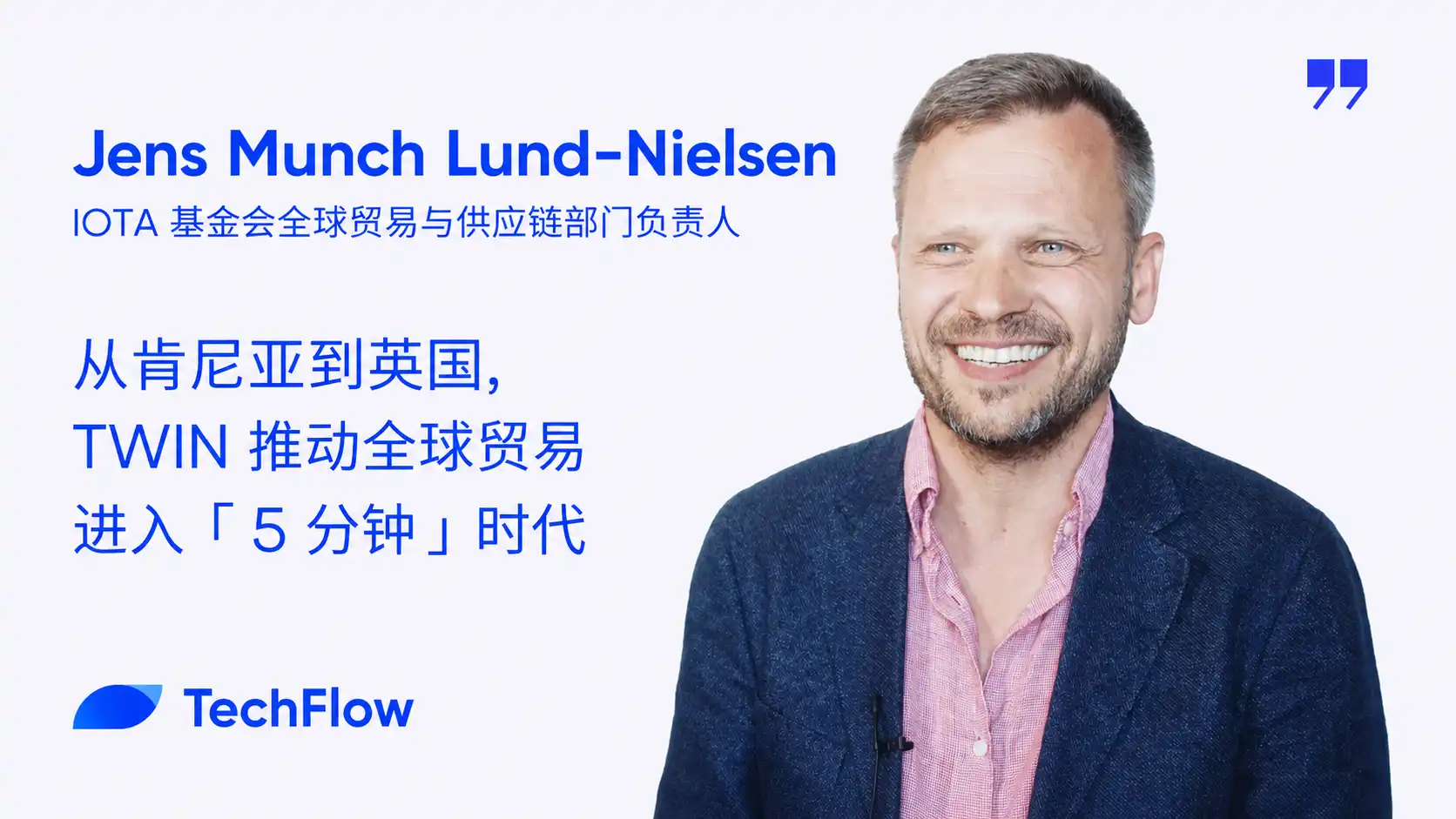
On the occasion of TWIN's first anniversary, we had an in-depth conversation with Jens Munch Lund-Nielsen, Head of Global Trade & Supply Chain at the IOTA Foundation.
Before joining the IOTA Foundation, Jens worked in the strategy office of Maersk, one of the world's largest shipping companies, focusing on digital trade and public-private partnerships. There, he witnessed firsthand how the global trade system truly operates: vast but inefficient, high-friction and fragmented, with no single party able to truly coordinate everyone.
This experience gave Jens a clearer realization: global trade needs an open, neutral, decentralized infrastructure that supports multiple participants—governments, enterprises, ports—to exchange trusted data in real-time within the same system. This also became the core reason Jens chose to join the IOTA Foundation:
To drive TWIN's development, to move global trade from paper-based, siloed processes towards truly real-time, trusted, and interconnected digital collaboration workflows.
In this content, let's follow Jens's insights to see what, in the eyes of this seasoned trade professional, the real answer has been for the over-decade-long stagnation of global trade digitalization.
From Paper to Chain: Building a Global Trade Digital Collaboration Infrastructure
Deep Tide TechFlow: Before delving into TWIN, could you first briefly introduce yourself, including your background in global trade, and what was the opportunity that led you to join the TWIN project?
Jens:
Hello everyone, I am Jens Munch Lund-Nielsen, currently serving as Head of Global Trade & Supply Chain at the IOTA Foundation.
My background is primarily focused on technology, trade facilitation, and digital trade, with a particular emphasis on building digital products and supporting their global rollout and implementation.
Before joining IOTA, I served as Head of Digital Trade within Maersk's strategy office, focusing on integrating trade facilitation, public-private partnerships, and digital solutions into global supply chains.
The opportunity to work on TWIN appealed to me because I saw it as a unique chance to address long-standing structural inefficiencies in global trade through trusted digital systems and interoperable technology.
Deep Tide TechFlow: For those unfamiliar with the project, how would you describe TWIN? What is its core essence?
Jens:
At its essence, TWIN is a neutral digital infrastructure for global trade.
Today's trade system operates on fragmented systems and paper-based processes because no single party can coordinate all participants.
TWIN changes this: it provides a common foundational layer where businesses, governments, and various organizations can exchange data, documents, and assets in real-time and securely.
TWIN is an open, interoperable network that connects existing systems, reinforces trust through verifiable data, and enables cross-jurisdictional compliance without relying on a centralized owner.
Built on IOTA, TWIN combines distributed ledger technology with decentralized identity systems, ensuring each participant always retains control over their own data while enabling global collaboration.
Simply put:
TWIN is the infrastructure that moves global trade from paper-based, siloed operations towards real-time, trusted, and interconnected digital collaboration workflows.
Deep Tide TechFlow: What specific problem in global trade is TWIN dedicated to solving? Why has this problem remained unsolved for so long?
Jens:
Fundamentally, TWIN addresses a core coordination problem in global trade: the lack of a common, trusted infrastructure that all participants can use to seamlessly exchange data.
Today, trade still heavily relies on paper documents and fragmented systems. Information is repeatedly entered, delayed, and often inconsistent as it moves between exporters, importers, banks, ports, and customs authorities. This creates inefficiencies, increases risks, and limits supply chain transparency.
This problem has persisted, not due to a lack of technology, but due to a lack of 'neutrality'.
Most previous attempts at trade digitalization have essentially involved building permissioned platforms, often driven by specific companies, regions, or interest groups. While these solutions may be technically viable, they face a structural issue:
Other participants are often reluctant to adopt infrastructure perceived as 'controlled by others.' Without widespread trust and adoption, these systems fail to achieve the network effect scale required for global trade.
TWIN takes a different path. It offers an open, neutral, decentralized infrastructure where no single party owns or controls the entire system. This allows all participants to share data while retaining their sovereignty and meeting their respective regulatory requirements.
Scalable, Low-Cost, Decentralized: IOTA Underpins the TWIN Architecture
Deep Tide TechFlow: Why was IOTA chosen as the underlying infrastructure for TWIN?
Jens:
IOTA was chosen as the underlying infrastructure for TWIN because it meets the core requirements of a global trade system: scalability, cost-efficiency, and neutrality.
Built on a DAG architecture, IOTA offers high scalability, capable of processing a massive volume of transactions and data exchanges in parallel, which is crucial for global trade where millions of events, documents, and updates occur continuously across supply chains.
It also provides extremely low transaction costs, which is vital in trade scenarios due to the high-frequency interactions involved. If every document update, verification, or data exchange incurred a significant fee, costs would quickly become prohibitive at scale.
Beyond the technology itself, IOTA brings over a decade of experience building real-world infrastructure and a solid track record of delivery through collaboration with governments, enterprises, and standardization bodies.
Furthermore, and importantly, IOTA is designed as an open, neutral infrastructure, not controlled by a single corporate entity. This aligns perfectly with the fundamental needs of global trade, where trust and sovereignty are key prerequisites for adoption by diverse stakeholders.
Deep Tide TechFlow: How should we understand the relationship between TWIN and IOTA? Is TWIN an application layer, an ecosystem, or something more macro?
Jens:
The most appropriate way to understand TWIN is as a digital public infrastructure for global trade—a shared data and coordination layer connecting governments, businesses, and existing platforms.
Simply put, TWIN enables parties to exchange verified, immutable data across borders in real-time without relinquishing control.
IOTA sits underneath as the underlying infrastructure layer. It provides the decentralized trust layer, ensuring data integrity, auditability, and interoperability at scale.
From African Flowers to European Poultry: TWIN's Real-World Trade Scenario Implementations
Deep Tide TechFlow: What are the most concrete, real-world application scenarios currently being explored or implemented through TWIN?
Jens:
TWIN is already deployed in multiple real-world trade scenarios, effectively demonstrating how shared digital infrastructure reduces friction, increases transparency, and enhances efficiency in global supply chains.
The Trade and Logistics Information Pipeline (TLIP) project connects East African exporters, logistics service providers, and government agencies to a shared data pipeline. In pilot projects covering flower, coffee, and tea exports, document retrieval time for inspection purposes reduced from 6-7 hours to about 30 minutes, administrative workload decreased by 50%-60%, and exporters saved approximately $400 monthly on document processing costs.
TWIN was also tested in the UK government's 'Ecosystem of Trust Trials', involving around 2000 consignments of chilled poultry meat shipped from Poland to the UK. Border agencies gained earlier visibility of arriving goods (port health officials received data up to 20+ hours earlier than standard processes), enabling more effective resource allocation.
The UK's 'Digital Trade Testbed' will also trial TWIN to support the exchange of digital international trade information between UK ports and key border agencies.
Other implementation scenarios include:
The RESULD (Responsible Supply Chain and Logistics Due Diligence) project integrates TWIN for tracing fruit and vegetable supply chains between Kenya, the Netherlands, and the UK;
The MISSION (Maritime Instantaneous Optimisation) project is trialing TWIN to improve port operational efficiency;
Salus leverages TWIN to bring traceability to critical mineral supply chains, turning shipping and trade documents into verifiable digital assets for financial institutions to use in risk assessment and issuing trade finance;
Furthermore, the ADAPT project, led by the African Continental Free Trade Area Secretariat in collaboration with the IOTA Foundation, the Tony Blair Institute for Global Change, and the World Economic Forum, is advancing the development of a digital trade backbone for Africa, drawing on IOTA's architecture and TWIN's experience.
Deep Tide TechFlow: What are the typical reactions from governments and enterprises when they first encounter TWIN? Which areas currently show the highest acceptance?
Jens:
Upon encountering TWIN, governments and enterprises generally recognize its significant value.
On the government side, departments most directly involved in trade, such as Trade Ministries and Customs authorities under Finance Ministries, clearly perceive TWIN's immense potential to improve internal clearance processes, strengthen border control, and obtain better access to trusted data to prevent unauthorized or non-compliant goods from entering.
Within the private sector, the highest participation currently comes from transport service providers and freight forwarders, as they already handle a large volume of border and documentation processes on behalf of producers and growers. The broader industry also shows a similar level of anticipation and interest in the value TWIN can create.
At the same time, a crucial point to emphasize is: TWIN's true value derives from the network itself. The more participants connected to TWIN, the greater the value created by the entire system for all involved.
Deep Tide TechFlow: Trade is highly fragmented across different jurisdictions. How does TWIN handle interoperability between different systems, standards, and regulatory environments?
Jens:
International interoperability is one of TWIN's most critical value drivers, operating on multiple levels, a significant part of which involves ensuring systems 'speak the same language'.
To this end, we adopt globally recognized standards, such as data models from the United Nations Centre for Trade Facilitation and Electronic Business (UN/CEFACT) and the World Customs Organization (WCO), further supported and refined through the International Chamber of Commerce's Digital Standards Initiative (ICC DSI).
In terms of identity, interoperability is primarily driven by national identity registries. Through TWIN ID, we can connect a company's national-level digital identity with international standards, such as the Legal Entity Identifier (LEI) issued by the Global Legal Entity Identifier Foundation (GLEIF), which is also a partner in this initiative.
From a technical perspective, we also observe increasing convergence around standards like Decentralized Identifiers (DIDs) and Verifiable Credentials as defined by the World Wide Web Consortium (W3C).
Finally, legal interoperability is equally important. The United Nations Commission on International Trade Law (UNCITRAL) Model Law on Electronic Transferable Records (MLETR) framework is driving the legal recognition of digital trade documents, though its adoption depends on government ratification in each country.
Our experience is that work can begin even in countries that have not yet ratified MLETR; in such cases, we also assist governments in advancing this process, especially given the growing importance of this framework for trade finance scenarios.
Bridging Digital Silos, Filling the $2.5 Trillion Trade Finance Gap
Deep Tide TechFlow: How do you see global trade evolving over the next 5 to 10 years? What role will decentralized infrastructure play in this transformation?
Jens:
The international trade industry is vast and has been undergoing digital transformation over the past 10 to 15 years, with governments and enterprises upgrading their systems around standardized data models and the use of REST APIs. The missing piece today is connecting these 'digital silos' in a way that respects data sovereignty, data integrity, and controlled data sharing.
We are currently advancing projects in over eight countries, working closely with governments, and continue to see strong interest in this area. Therefore, I am optimistic:
In the coming years, a trusted 'connective layer' linking these systems will truly materialize and scale. Its potential impact on global trade, finance, and international trade agreements could be profound, making it an area especially worthy of attention.
Deep Tide TechFlow: If TWIN achieves large-scale success, what do you imagine its 'end state' would look like? Compared to today, how would global trade operate differently?
Jens:
Simply put, as global trade moves towards fully digital collaboration, many outdated processes will be replaced. Key areas like discovering new business partners or accessing financing will look fundamentally different from today.
Currently, there is an estimated $2.5 trillion trade finance gap globally, preventing many businesses from accessing the capital they need to participate efficiently in global trade.
With digital infrastructure solutions like TWIN, trusted data and verifiable digitalized processes could help unlock access to capital at scale, potentially reshaping the entire industry landscape and improving conditions for traders worldwide.