The Token Itself Is an Asset: Three Types of Tokenized Stocks, Which One Suits You?

marsbitОпубликовано 2026-06-29Обновлено 2026-06-29

Введение

"Tokenized Stocks: Three Types, Which One Fits You? For investors outside the US, buying stocks like SpaceX or Nvidia is difficult, requiring brokers, cross-border transfers, and often accredited investor status. Blockchain offers an alternative through tokenized stocks, a term encompassing three distinct products with vastly different ownership, voting, and profit rights. 1. **Full Real Ownership**: Companies like Superstate register native equity directly on-chain (e.g., Solana). Holders are on the official shareholder registry, with full voting rights, dividends, and legal ownership. This offers maximum rights but potentially less DeFi flexibility. 2. **SPV-Backed Tokens (Surrendered Ownership for DeFi Composability)**: Issuers like Backed (xStocks) and Ondo use offshore Special Purpose Vehicles (SPVs) to hold underlying shares 1:1 and issue tracking tokens. Investors get price exposure and dividends (reinvested as more tokens) but hold a claim on the SPV, not direct stock ownership. This enables use as collateral in DeFi protocols (Kamino, Morpho) and 24/7 minting/redemption, but carries SPV counterparty risk (highlighted by the PreStocks collapse). 3. **Perpetual Futures (Pure Price Speculation)**: Platforms like TradeXYZ (on Hyperliquid) and Ostium offer perpetual contracts. These are synthetic derivatives with no underlying stock ownership, using funding rates to track spot prices. They require only a price oracle, allowing extremely fast listing (e.g., SpaceX p...

Author: Prathik Desai

Compiled by: Saoirse, Foresight News

If you are overseas and want to buy SpaceX or NVIDIA stock, it's not easy. You need a brokerage that supports account opening for residents of your country, compliant cross-border transfer channels, and often must meet the qualifications of an accredited investor. The vast majority of ordinary people cannot directly trade US stocks.

Blockchain offers an alternative: you can now gain exposure to US companies through tokenized stocks. But 'tokenized stock' is just an umbrella term; it actually includes three completely different products.

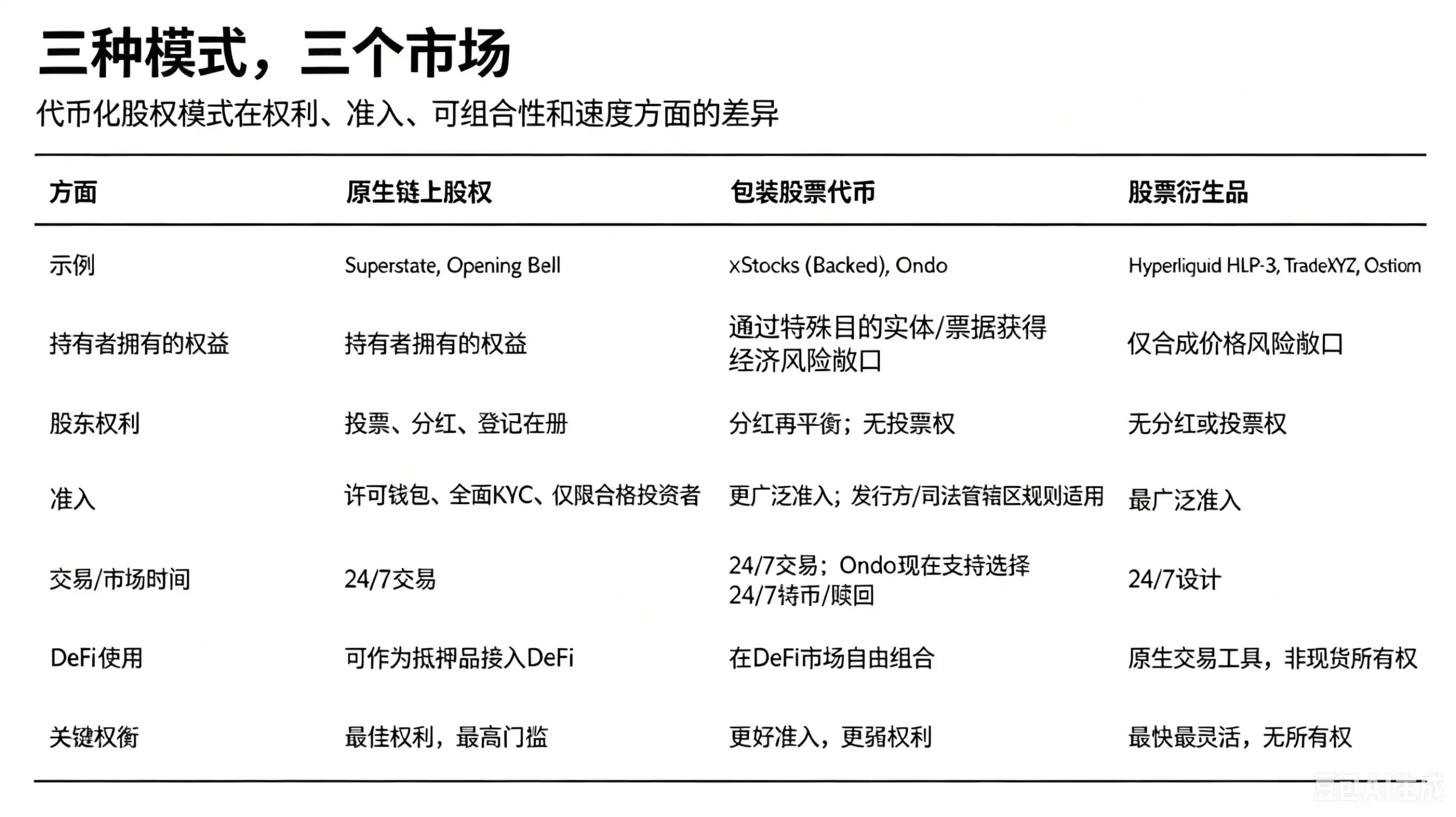
The first is native equity registered on-chain by the stock issuer itself. The second is a backed token representing real shares held 1:1 by an offshore entity. The third is a perpetual futures contract with no underlying stock support whatsoever. The ownership, voting rights, and price appreciation rights enjoyed by holders of these three types of products are vastly different.

Currently, NVIDIA has all three types of token products. The first two types combined have over 650,000 real shares as underlying backing. Yet the trading volume of the perpetual contracts, which are completely unbacked by stock, is 4 to 5 times that of the other two spot token types.

Last week, Vaidik outlined some industry background: since 1973, most stocks (whether tokenized or not) have operated under the same custodial structure. He also explained a core fact—most people who nominally 'hold stocks' do not actually own the corresponding shares. For details, see "Who Really Holds Your US Stocks? 83% of the Market's Stocks Are Nominally Held by This Institution".

In this article, I will deconstruct the ownership structures of different on-chain stock tokens and analyze the underlying logic of why the market is still willing to trade these tokens, even when investors are completely detached from real equity.

What Are Tokenized Stocks

Tokenized stocks are a digital representation of corporate shares on the blockchain. These tokens are programmable, can be freely transferred between wallets, traded 24/7, and integrated into various DeFi protocols. The economic attributes of stocks—such as share price, dividends, and corporate payouts—are embedded within the token's mechanisms.

The market size for tokenized stocks is no longer what it used to be: over the past year, the total market capitalization of the sector has surged nearly fivefold, from $327 million to $1.5 billion.

One of the most noteworthy aspects of this tokenization wave is the participation of traditional giants in experimentation. DTCC, the clearing, settlement, and custodian institution for the vast majority of US and global securities trading, announced last month that it will launch a tokenized securities pilot project in October 2026. The New York Stock Exchange also revealed earlier this year that it is building a 24/7 tokenized stock trading platform. These established institutions, with decades of experience in securities infrastructure, are reevaluating the existing trading system.

Currently, various stock tokenization solutions have emerged. Different on-chain products make trade-offs in terms of ownership, redemption mechanisms, DeFi composability, and price appreciation rights. Let's break them down one by one.

Trade-offs in Rights for Tokenized Products

Model 1: Complete Real Equity, Holders Enjoy Full Ownership

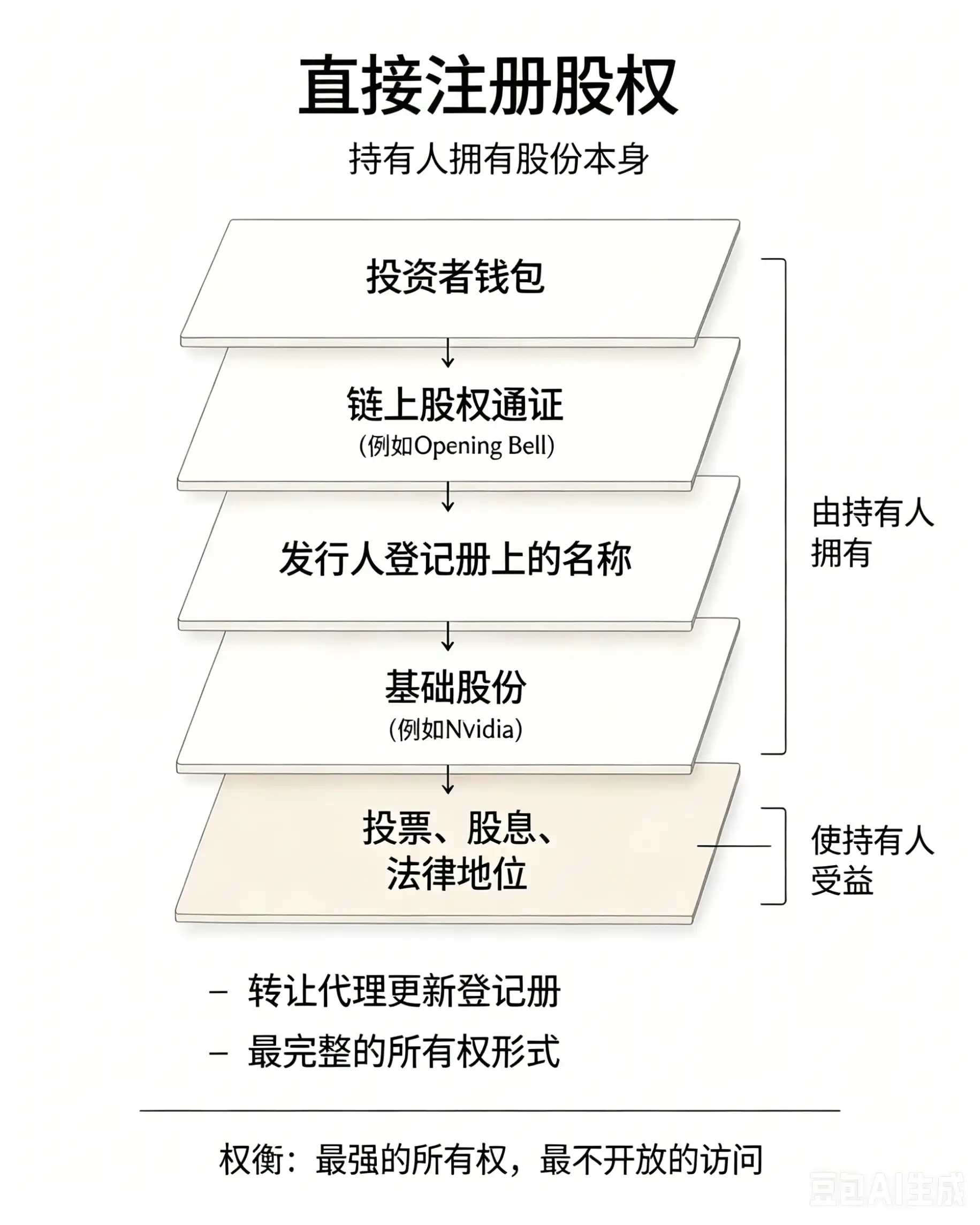
The SEC-registered transfer agent Superstate registers equity directly on the Solana public blockchain. The holder's name is recorded in the company's official shareholder register, granting full voting rights, dividend eligibility, and legal shareholder status.

In May 2026, Galaxy adopted this model to complete equity tokenization and achieved on-chain proxy voting through Broadridge. As early as December 2025, Superstate's compliant equity tokens were listed on Kamino, becoming the first registered equity usable as collateral in DeFi protocols.
Model 2: Surrendering Full Ownership for DeFi Composability

Backed's xStocks issues tracking certificates through a Jersey special purpose vehicle (SPV), covering over 160 stocks, with underlying shares matched 1:1. Ondo issues total return notes through a British Virgin Islands SPV, supporting over 200 types of tokenized stocks, with the total value locked surpassing $1 billion in just 8 months after launch. Both products allow investors to benefit from stock price appreciation and dividends, but dividends are not paid in cash; they are automatically added to your token balance.

The biggest advantage of this model is its high composability: xStocks can be used as collateral for lending on Kamino and Morpho. Less than 24 hours before this article's publication, Ondo opened round-the-clock minting and redemption channels for its mainstream tokenized stocks, enabling a 24/7 primary market.
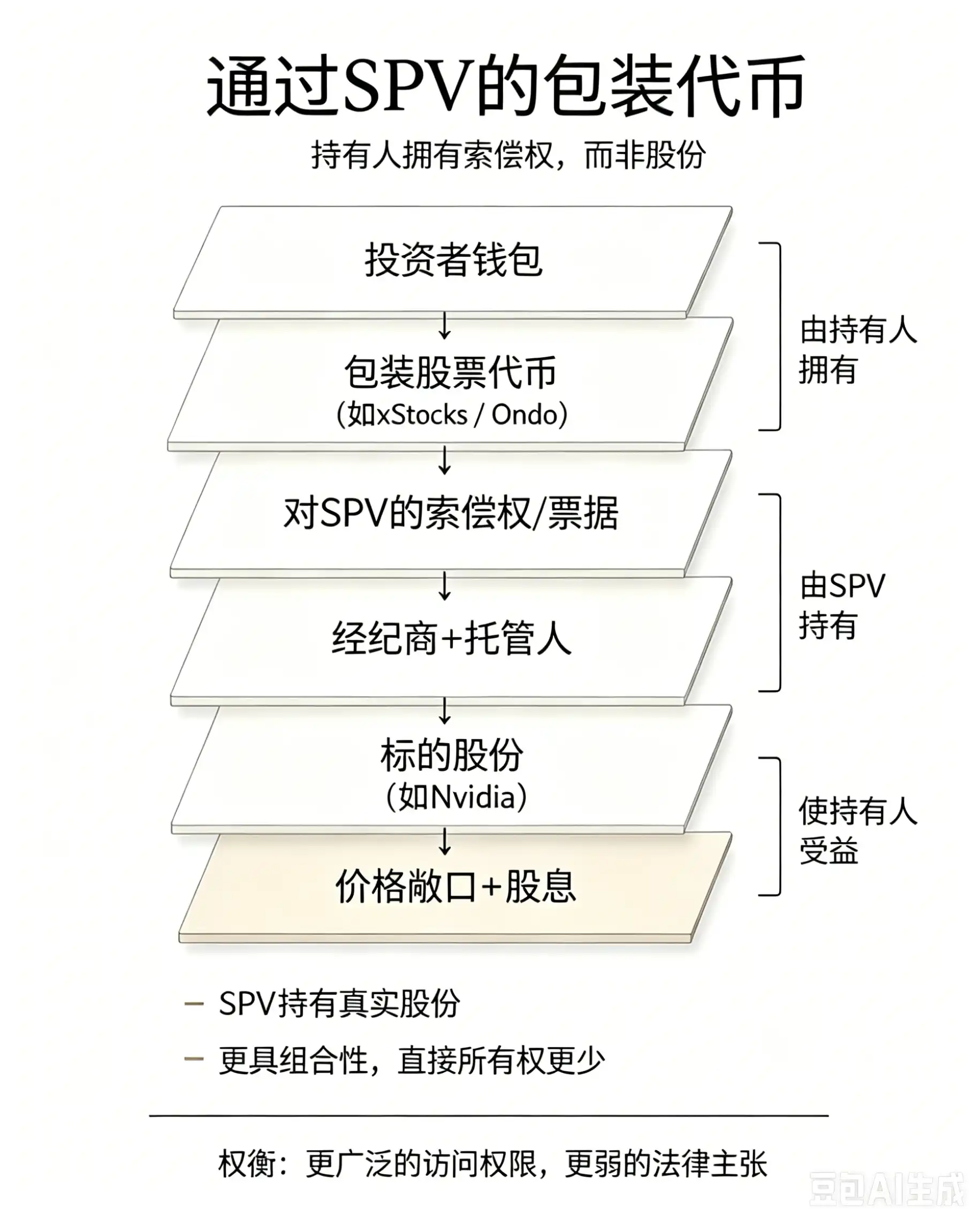
But the risks are equally prominent: you only hold a claim against the SPV, not direct ownership of the underlying shares. The PreStocks crash serves as a cautionary tale: in May 2026, the transfer of its underlying shares was deemed invalid. With only $23 million in real stock backing tokens valued at $1.3 trillion, the product ultimately collapsed. Although Backed and Ondo mitigate risks through segregated custody and proof-of-reserves, the risk is not eliminated; it's merely transferred from the corporate entity to the SPV wrapper layer.

Model 3: Completely Abandoning Equity Ownership, a Pure Price Speculation Tool

Hyperliquid's HIP-3 framework allows anyone to build perpetual contract markets, requiring only a price oracle and a liquidity pool to operate. The leading project, TradeXYZ, accounts for over 90% of the open interest within the HIP-3 framework, offering perpetuals for NVIDIA, Tesla, Google, Amazon, and the Nasdaq 100 index. Ostium, deployed on Arbitrum, has also launched similar products.

The platform charges a funding rate hourly to balance long and short positions, thereby anchoring the perpetual contract price to the stock's spot price.
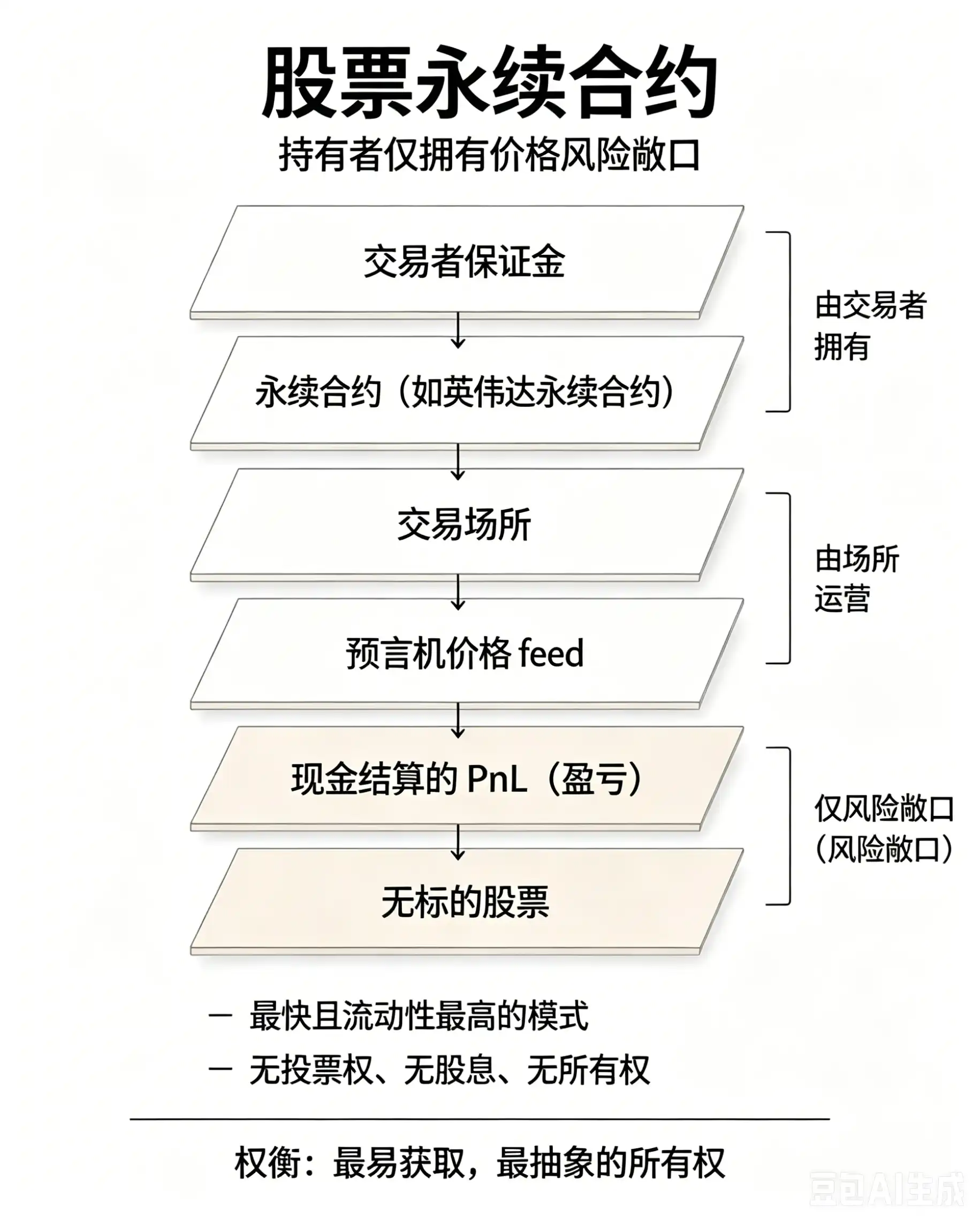
The trading volume of perpetual contracts far exceeds that of spot tokens for a practical reason: building a spot token market requires a complete supporting system including SPVs, brokerages, custodians, and proof-of-reserves. Launching a perpetual contract only requires connecting to a price data source. TradeXYZ even launched a SpaceX perpetual contract *before* the company filed its S-1 IPO prospectus, with open interest directly reaching $50 million. Spot tokens relying on SPVs simply cannot achieve this speed, as physical institutions cannot quickly and sufficiently purchase the corresponding underlying shares.
The Core Value of Tokens: They Don't Need to Be Tied to Real Shares

The vast majority of retail investors never exercise their voting rights. Research data from the Harvard Law School Forum shows that, on average, only about 12% of retail accounts in a company participate in shareholder meeting votes. For global traders looking to gain exposure to blue-chip stocks like NVIDIA, Google, SpaceX, and Tesla, giving up a voting right they will never use is largely inconsequential.

Tokens themselves possess independent asset value; they do not need to be completely equivalent to native shares. The three types of tokenized products cater to three types of investment needs: institutional long-term capital seeking full shareholder rights, on-chain users valuing DeFi collateral and liquidity, and short-term speculators preferring high leverage and round-the-clock trading. Tokenization is not a replacement for traditional stocks; it is a new type of financial instrument that adapts to different needs across various layers.


Трендовые криптовалюты

Связанные с этим вопросы

QWhat are the three main types of tokenized stocks discussed in the article, and what is the key difference between them?

AThe article discusses three types: 1) Native Equity on-chain (full ownership/voting rights), 2) Backed Tokens via SPVs (price exposure & yield, no direct ownership), and 3) Perpetual Futures (no underlying stock, pure price speculation). The key difference lies in the level of ownership, voting rights, and price exposure they provide to the holder.

QAccording to the article, why is the trading volume for perpetual futures contracts for stocks like NVIDIA much higher than for tokenized stock 'spot' tokens?

APerpetual futures have much higher volume because they are easier and faster to launch. They only require a price oracle and liquidity pool, while spot tokens need a full infrastructure of SPVs, brokers, custodians, and proof-of-reserves. Futures can also be launched for companies like SpaceX even before an IPO, which spot tokens cannot.

QWhat is the primary advantage and the associated risk for tokenized stocks using the SPV (Special Purpose Vehicle) model, as exemplified by Backed and Ondo?

AThe primary advantage is high DeFi composability (e.g., using the tokens as collateral in lending protocols). The key risk is that investors do not own the underlying stock; they hold a claim against the SPV. This introduces counterparty and structural risk, as seen in the PreStocks collapse where tokens were massively over-leveraged against the actual stock holdings.

QWhat core argument does the article make about the value of a token, in relation to the traditional concept of stock ownership?

AThe article argues that a token's core value is that it does not need to be fully equivalent to a native stock share. It can function as an independent asset class that serves different investor needs (full ownership, DeFi utility, or pure price speculation), making tokenization a new type of layered financial tool rather than a simple replacement for traditional stocks.

QWhich traditional financial infrastructure giants are mentioned as exploring tokenized securities, and what are their respective initiatives?

ATwo giants are mentioned: The Depository Trust & Clearing Corporation (DTCC) plans to launch a tokenized securities pilot in October 2026. The New York Stock Exchange (NYSE) is building an around-the-clock trading platform for tokenized stocks.

Похожее

Аналитики предсказывают, что XRP и BNB могут достичь капитализации в $100 млрд к концу 2026 года

Аналитики предполагают, что рыночная капитализация XRP и BNB может достичь отметки в 100 миллиардов долларов во второй половине 2026 года. Эта информация, основанная на отчете Finbold от 29 июня 2026 года и данных CoinMarketCap, носит спекулятивный характер и основана на историческом анализе графиков и фундаментальных показателях проектов, а не является гарантированным прогнозом. Для трейдеров данный прогноз важен как индикатор сдвигов в аппетитах к риску и движения ликвидности на рынке криптовалют, который все еще зависит от потоков ETF, решений казначейств и ротации капитала между альткойнами. Обсуждение столь высокой капитализации для XRP и BNB, хотя и выглядит амбициозно, считается достижимым при благоприятных рыночных условиях и наличии специфических катализаторов для каждого актива. Ключевой вывод заключается в том, что подобные сигналы следует воспринимать в более широком контексте. Они влияют на сопутствующие активы и общие рыночные настроения, особенно в периоды низкой ликвидности, когда второстепенные эффекты могут быть значительными. Важно отслеживать, подтвердятся ли эти предположения последующими данными о потоках средств, ончейн-метриках и позиционировании, или же они останутся краткосрочным рыночным шумом.

bitcoinist11 мин. назад

Аналитики предсказывают, что XRP и BNB могут достичь капитализации в $100 млрд к концу 2026 года

bitcoinist11 мин. назад

Капитализация рынка альткойнов вернулась к уровню почти 900-дневной давности, аналитик указывает на ключевую зону поддержки

Аналитик Михаэль ван де Поппе отметил, что общая капитализация рынка альткоинов откатилась к уровням конца 2023 года, потеряв примерно 900 дней роста. Такая динамика объясняет, почему рыночные настроения настолько негативны: широкий класс альткоинов в целом не показывал прогресса почти три года. Ключевой момент сейчас — бывшая зона прорыва, которая теперь стала критической областью поддержки. Если рынок удержит этот уровень, здесь может сформироваться основа для следующего роста и зона накопления. Если же поддержка не сработает, это будет сигналом о провале прошлого бычьего движения. Для формирования устойчивого восстановления необходима не единичная активность, а широкое участие разных секторов: L1-протоколов, DeFi, инфраструктурных и AI-токенов, а также качественных проектов средней капитализации. Текущая ситуация является переломной точкой для всего рынка альткоинов, который должен доказать свою жизнеспособность на этом уровне.

bitcoinist12 мин. назад

Капитализация рынка альткойнов вернулась к уровню почти 900-дневной давности, аналитик указывает на ключевую зону поддержки

bitcoinist12 мин. назад

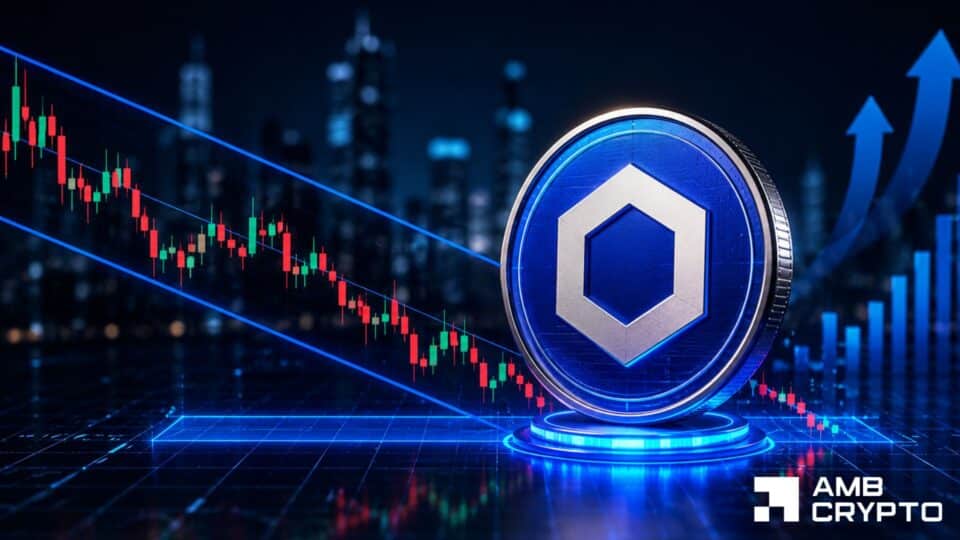
Chainlink увеличил число держателей на 8000 – Сможет ли LINK развернуть нисходящий тренд?

Chainlink (LINK) за последние пять дней привлек более 8000 новых держателей, увеличив общее количество непустых кошельков до 892,8 тыс. Несмотря на сохраняющуюся слабость цены и торговлю в нисходящем канале, это указывает на устойчивое расширение сети. Активность на биржах демонстрирует чистый отток средств (-$479,49 тыс.), что сигнализирует о накоплении токенов в частных кошельках, а не о распродажах. Цене удается удерживать ключевую зону поддержки около $7,00, однако для прорыва выше сопротивления $8,31 не хватает объема покупок. Индикатор RSI (34,6) остается ниже нейтрального уровня, отражая слабую покупательскую активность. При этом позиции на фьючерсном рынке остаются оптимистичными: положительное финансирование (0,0077%) показывает, что трейдеры сохраняют уверенность в будущем росте. В итоге, сочетание растущей базы держателей, оттока с бирж и уверенности на деривативах создает фундамент для возможного разворота нисходящего тренда, если вернется более сильный спрос на спотовом рынке.

ambcrypto15 мин. назад

Chainlink увеличил число держателей на 8000 – Сможет ли LINK развернуть нисходящий тренд?

ambcrypto15 мин. назад

Chainlink добавил 6100 кошельков за два дня в самом сильном всплеске роста за 2026 год

Chainlink продемонстрировал самый значительный всплеск роста числа кошельков в 2026 году, добавив 6100 новых адресов за два дня. Это произошло на фоне сложной рыночной ситуации для альткойнов, включая LINK, и указывает на сохраняющийся интерес пользователей и инвесторов, даже когда динамика цены остается слабой. Рост числа кошельков является важным индикатором реального участия в сети, в отличие от спекулятивных ценовых движений. Для Chainlink, как инфраструктурного проекта в сфере оракулов, данных и реальных активов, это особенно актуально. Однако тип новых адресов (мелкие держатели, новые пользователи, кошельки бирж) неизвестен, поэтому данные следует считать конструктивным, но не окончательным сигналом. В целом, этот всплеск активности показывает, что экосистема Chainlink продолжает привлекать внимание. Для быков это позитивный сигнал об адаптации, но он не гарантирует роста цены токена. Ключевым для LINK будет последующее подтверждение в виде увеличения транзакционной активности, накопления токенов и улучшения ценовой динамики на фоне общего поведения рынка.

bitcoinist57 мин. назад

Chainlink добавил 6100 кошельков за два дня в самом сильном всплеске роста за 2026 год

bitcoinist57 мин. назад

Открытый интерес по Dogecoin колеблется около $959 млн, поскольку трейдеры ждут сигнала к восстановлению

Открытый интерес по деривативам Dogecoin сохраняется на уровне около 959 миллионов долларов, что привлекает внимание трейдеров на фоне спокойных выходных на спотовом рынке. Этот показатель отражает значительный объем активных контрактов, что может усилить волатильность при резком движении цены. Важно отметить, что сам по себе высокий открытый интерес не указывает на направление тренда. Он лишь сигнализирует о наличии существенных позиций. Для понимания контекста необходимо учитывать динамику цены, объемы торгов и уровни ликвидации. Рост цены на фоне увеличения открытого интереса может указывать на приток новых leveraged-позиций, в то время как падение цены при высоком OI может говорить о «застрявших» позициях. Dogecoin остается активом, сильно зависящим от настроений рынка. Текущая ситуация характеризуется вовлеченностью деривативного рынка при отсутствии четкого сигнала к восстановлению. Устойчивый рост DOGE потребует поддержки со стороны реального спроса на спотовом рынке, а не только активности в деривативах. Таким образом, текущие данные служат скорее сигналом для внимательного наблюдения, чем основанием для торгового решения, и требуют подтверждения в виде последующей динамики цены и общего поведения рынка.

bitcoinist1 ч. назад

Открытый интерес по Dogecoin колеблется около $959 млн, поскольку трейдеры ждут сигнала к восстановлению

bitcoinist1 ч. назад

Торговля

Спот

Популярные статьи

Как купить ONE

Добро пожаловать на HTX.com! Мы сделали приобретение Harmony (ONE) простым и удобным. Следуйте нашему пошаговому руководству и отправляйтесь в свое крипто-путешествие.Шаг 1: Создайте аккаунт на HTXИспользуйте свой адрес электронной почты или номер телефона, чтобы зарегистрироваться и бесплатно создать аккаунт на HTX. Пройдите удобную регистрацию и откройте для себя весь функционал.Создать аккаунтШаг 2: Перейдите в Купить криптовалюту и выберите свой способ оплатыКредитная/Дебетовая Карта: Используйте свою карту Visa или Mastercard для мгновенной покупки Harmony (ONE).Баланс: Используйте средства с баланса вашего аккаунта HTX для простой торговли.Третьи Лица: Мы добавили популярные способы оплаты, такие как Google Pay и Apple Pay, для повышения удобства.P2P: Торгуйте напрямую с другими пользователями на HTX.Внебиржевая Торговля (OTC): Мы предлагаем индивидуальные услуги и конкурентоспособные обменные курсы для трейдеров.Шаг 3: Хранение Harmony (ONE)После приобретения вами Harmony (ONE) храните их в своем аккаунте на HTX. В качестве альтернативы вы можете отправить их куда-либо с помощью перевода в блокчейне или использовать для торговли с другими криптовалютами.Шаг 4: Торговля Harmony (ONE)С легкостью торгуйте Harmony (ONE) на спотовом рынке HTX. Просто зайдите в свой аккаунт, выберите торговую пару, совершайте сделки и следите за ними в режиме реального времени. Мы предлагаем удобный интерфейс как для начинающих, так и для опытных трейдеров.

793 просмотров всегоОпубликовано 2024.04.12Обновлено 2026.06.02

Как купить ONE

Обсуждения

Добро пожаловать в Сообщество HTX. Здесь вы сможете быть в курсе последних новостей о развитии платформы и получить доступ к профессиональной аналитической информации о рынке. Мнения пользователей о цене на ONE (ONE) представлены ниже.

活动图片