Deconstructing HyperEVM: Which Applications Can Truly Reap the Core Benefits of Hyperliquid?

Foresight NewsОпубликовано 2026-06-26Обновлено 2026-06-26

Введение

### Summary HyperEVM, positioned as a smart contract layer, enables applications to directly access and utilize HyperCore's trading, collateral, positions, and risk data. Its core value lies in making the exchange programmable, distinguishing it from typical "chain-first" approaches. Valuable HyperEVM-native applications must leverage EVM flexibility, rely on HyperCore's unique state, and enhance Hyperliquid's utility as a financial venue. Applications can be categorized within a 2x2 matrix based on their need for general EVM logic and integration with HyperCore. Key categories include: - **Local EVM Finance:** Portable DeFi primitives (e.g., AMMs, lending markets) that form the essential base layer. - **Core-Native Extensions:** Applications that tokenize or wrap Hyperliquid-native assets to enhance their utility. - **Programmable HyperCore:** The most promising category, where applications deeply integrate EVM logic with HyperCore's state and execution to create novel products. The ultimate vision is a unified financial account where a single user balance can seamlessly power trading, lending, yield generation, hedging, and payments, all built on HyperCore's robust infrastructure and controlled by the user via HyperEVM's open application layer.


Author: ponyo_fp (Four Pillars Research Team)

Compiled by: AididiaoJP, Foresight Newsna


Key Takeaways


HyperEVM should be viewed as a smart contract layer, whose core value lies in enabling applications to directly read and utilize HyperCore's trading, collateral, positions, and risk data.


The simplest way to judge whether a HyperEVM application is valuable is to ask two questions: Why does it need EVM? Why does it need Hyperliquid?


Basic functions like swaps, lending, and asset wrappers are certainly necessary, but what truly creates a competitive edge are products that cannot function properly without HyperCore.


In the long run, the ultimate form is a highly integrated account—users can perform all operations like trading, lending, yield farming, hedging, and payments using just one balance.


Exchange First


Most smart contract platforms follow the 'chain first, then find applications' route: first launch infrastructure, subsidize liquidity, attract developers, and finally hope that applications naturally create financial gravity.


Hyperliquid's path is completely opposite. It builds the exchange first, possessing a native spot and perpetual order book, trader mindshare, a protocol-owned liquidity system, and real trading volume already flowing through HyperCore. This fundamentally changes the positioning of HyperEVM—it is not another place to simply fork DeFi contracts, but rather to make the exchange itself programmable.


This article is not a comprehensive list of all factors that can drive Hyperliquid's growth (HIP 3 markets, builder codes, portfolio margin, native liquidity, Unit assets, fee recycling, etc., are also important). It focuses on just one question: What characteristics should truly worthwhile applications on HyperEVM possess?


A valuable native HyperEVM application needs to satisfy three points simultaneously:


  • Can express general logic not achievable by HyperCore itself (requiring EVM's flexibility);
  • Relies on unique states not available on other chains (HyperCore's composability);
  • Makes Hyperliquid more useful as a financial venue.


HyperCore is the home for trading, collateral, and risk engines. HyperEVM is the place to write application logic. Through precompiles, contracts can directly query HyperCore data such as balances, positions, prices, staking delegation, and vault equity; through CoreWriter, contracts can write operations back to HyperCore.


This design turns the exchange into a native input source for applications. Collateral, execution, settlement, and allocation can be more tightly integrated on the same ledger.
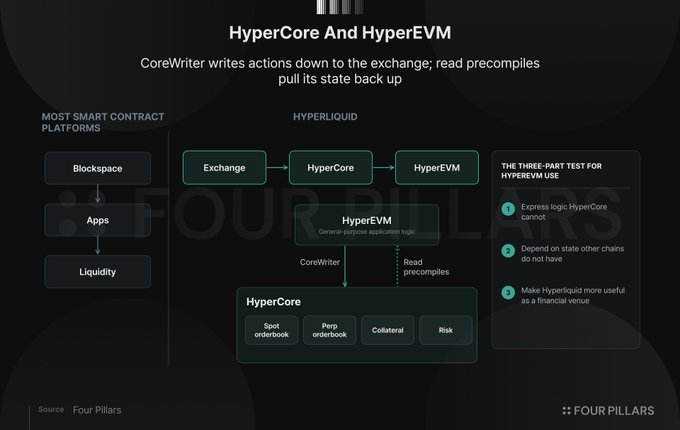


Of course, not all HyperEVM applications need to pursue 'novelty'. The ecosystem first needs familiar primitives for users to naturally perform swaps, lending, leveraging, rebalancing, and exits. A local financial surface can keep capital within the system, making the entire ecosystem truly usable.


But the deeper opportunity is definitely not simply forking existing lending protocols with a new front end. It's building credit, asset management, payments, and structured finance around the exchange ledger—things ordinary EVM chains cannot replicate even by issuing incentives.


CoreWriter will not turn HyperEVM into a synchronous extension of the order book either. Cross-environment operations have ordering constraints, delayed writes, and state coordination issues. Builders must handle failure rollbacks, delayed execution, cross-environment collateral accounting, and risk management. While this narrows some design spaces, it also forms a unique moat.


Understanding the HyperEVM Economy Through a 2×2 Matrix


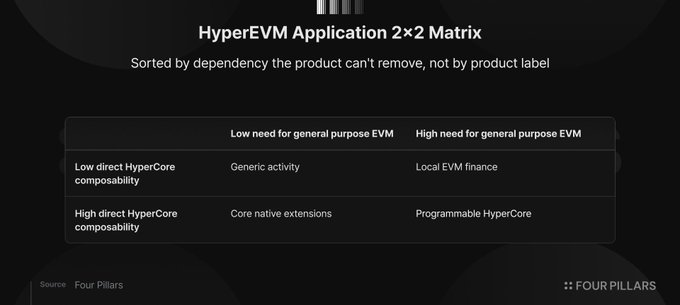
The best framework for evaluating HyperEVM applications is a two-dimensional matrix:


  • Horizontal Axis: Does the application require general EVM logic?
  • Vertical Axis: Does the application directly compose with HyperCore's state or execution?


Category labels are not important; the key is the product's non-removable dependencies.


Local EVM Finance


Applications in this category need smart contracts, but their product models are largely portable. AMMs, money markets, CDPs, routers, option venues, leverage products, and yield markets belong to this quadrant.


Felix is a typical example. HyperLend also started here, as one of the main credit venues on HyperEVM (its roadmap later evolves towards programmable HyperCore).


This quadrant is easily underestimated but is actually very important. Any financial center needs banks, brokers, liquidity venues, and risk transfer markets to support more complex balance sheet products. Portability makes them the foundational layer for user activity.


Core-Native Extensions


Applications in this category are more directly dependent on Hyperliquid, but EVM's role is mainly wrapping, tokenizing, or composing native primitives.


Typical examples include: Kinetiq, StakedHYPE, Kintsu, HLP wrappers, Unit-linked assets, etc. Their core task is to make assets inside Hyperliquid more useful.


This quadrant is crucial—collateral is the raw material for all financial activity. Money markets need assets users are willing to borrow, structured products need assets that can be staked or hedged, and unified accounts require balances that can freely flow between different functions.


Programmable HyperCore


This is the quadrant with the most imagination: applications require both the general logic of EVM and deeply depend on HyperCore's state and execution. Here, exchange activity truly begins to be 'productized'.


  • Rysk: Converts options into volatility income for assets users already own;
  • Liminal: Packages Hyperliquid strategies into tokenized products;
  • Hyperbeat: Delta-neutral strategies combining Core positions with ERC-20 composability.


Derive sits at the edge—it enables HYPE and kHYPE to be used as collateral for options/perpetuals via HyperEVM-vault bridging, but its core trading and settlement logic remains within its own stack. It expands HYPE collateral usage but does not strictly belong to the native programmable HyperCore category.


Currently, projects strictly meeting the 'contract-custodied assets + reading HyperCore state + using CoreWriter for execution' criteria are still early. Valantis Prime is a representative public beta case: it uses HyperEVM smart accounts as a control layer, operates HyperCore via CoreWriter, and sets constraints like permissions, proxies, session keys, and guardians, making the account itself a programmable interface to the exchange.


HyperLend and Rysk also point towards the same frontier from different angles, but ultimately must be measured against the standard of 'whether assets are truly custodied and CoreWriter is deeply integrated.'


The Financial Account is the Ultimate Form


The most valuable HyperEVM application might not look like an 'application' at all, but more like an account.


Today, crypto users still have to switch between multiple interfaces: exchange balances for trading, wallet balances for DeFi, vault shares for yield, borrowing capacity hidden in money markets, hedging requires opening another platform... This fragmentation is not just a user experience issue; it reflects the fact that liquidity, collateral, execution, and risk are scattered across different systems.


HyperEVM has the opportunity to compress these systems into the same account. Users can deposit assets like BTC, ETH, SOL, HYPE just once and start from the same balance: trade on HyperCore, lend on HyperEVM, earn yield through vaults, hedge with perpetuals, and directly spend from the payment account. The product is not a bridge; the product is that balance that can flow across functions.


Centralized exchanges have long understood this—their accounts feel unified because trading, margin, lending, and yield all exist in one controlled environment. But the problem is the closed ledger, opaque risk engines, and the inability for external developers to build freely.


General-purpose public chains are the opposite: users truly control accounts, but the financial stack is highly fragmented.


Hyperliquid sits at the sweet spot: HyperCore provides exchange-level liquidity and risk infrastructure, while HyperEVM provides an open application surface. The end result is a unified financial account completely controlled by the user yet backed by HyperCore as a powerful balance sheet engine—this is the strongest manifestation of the 'all-in-one financial home' vision.


Future evidence will appear at the account level: collateral follows users across trading, lending, saving, hedging, and spending; risk is priced in real-time from HyperCore state; liquidations are executed via HyperCore depth; structured products directly hedge with Core liquidity; ERC-20s represent claims on various financial activities within the system.


The first wave of HyperEVM makes the ecosystem usable; the next wave will make HyperCore truly programmable.


Трендовые криптовалюты

Связанные с этим вопросы

QWhat are the three criteria that a valuable native HyperEVM application must meet according to the article?

AA valuable native HyperEVM application must meet three criteria: 1) It must be able to express general logic that cannot be implemented by HyperCore itself (requiring EVM flexibility); 2) It must depend on unique states that are not available on other chains (HyperCore's composability); 3) It must make Hyperliquid more useful as a financial venue.

QWhat is the core value proposition of HyperEVM as described in the article?

AThe core value proposition of HyperEVM is that it should be seen as a smart contract layer, whose primary value lies in allowing applications to directly read and use HyperCore's trading, collateral, position, and risk data. It enables the programming of the exchange itself.

QAccording to the article's framework, what defines the most valuable and imaginative quadrant for HyperEVM applications?

AAccording to the article's 2x2 matrix framework, the most valuable and imaginative quadrant for HyperEVM applications is 'Programmable HyperCore.' Applications in this quadrant both require the general logic of the EVM and deeply depend on the state and execution of HyperCore, effectively 'productizing' exchange activity.

QWhat is the 'ultimate form' or 'ultimate shape' envisioned for the most valuable HyperEVM applications?

AThe ultimate form envisioned is not a typical 'application,' but rather a highly integrated, unified financial account. With just a single balance, a user can simultaneously perform all operations like trading, borrowing, yield farming, hedging, and payments, with liquidity and risk management seamlessly powered by HyperCore.

QHow is Hyperliquid's development path different from that of most smart contract platforms?

AHyperliquid's path is the opposite of most smart contract platforms. Instead of building the chain first and then looking for applications, Hyperliquid built the exchange first. It possesses a native spot and perpetual order book, trader mindshare, protocol-owned liquidity, and real trading volume already flowing through HyperCore. This fundamentally changes HyperEVM's role—it's not just another place to copy DeFi contracts, but to make the exchange itself programmable.

Похожее

Ripple расширяет глобальное соответствие требованиям перед дебатами по Закону о ясности в США

Краткое содержание: Ripple продолжает глобальную экспансию с акцентом на соответствие нормативным требованиям, получая новые лицензии в Сингапуре и Европе для развития институциональных продуктов с реальной полезностью. Эта стратегия направлена на укрепление позиций компании на регулируемых рынках, особенно для трансграничных платежей, и происходит на фоне дебатов о Законе о ясности криптовалютного регулирования в США. Ключевой момент для трейдеров заключается в том, чтобы рассматривать эти события как историю развития инфраструктуры и полезности, а не просто как очередной повод для спекуляций на цене. Успехи Ripple в области регулирования могут влиять на настроения рынка и перераспределение ликвидности между различными криптоактивами, особенно в условиях, когда рынок остается чувствительным к потокам ETF, макроэкономическим факторам и данным по деривативам. Важно отделять прогресс в получении глобальных лицензий от новостей по судебному иску SEC. Рынки склонны преувеличивать значение отдельных сигналов. Поэтому текущие шаги Ripple следует расценивать именно как сигнал о сдвиге в сторону регулируемой институциональной адаптации, а не как гарантию немедленного ценового движения. Следует наблюдать, подтвердят ли эту тенденцию последующие данные по потокам капитала, ончейн-метрикам и позициям на рынке деривативов.

bitcoinist18 мин. назад

Ripple расширяет глобальное соответствие требованиям перед дебатами по Закону о ясности в США

bitcoinist18 мин. назад

Заявка Goldman Sachs на создание траста XRP показывает, как Уолл-стрит тестирует возможности крипторынка

Американский банк Goldman Sachs раскрыл в документах SEC наличие экпозиции к XRP через регулируемые трастовые продукты, аналогичные инструментам Grayscale. Это не означает прямого владения токенами банком, но демонстрирует, как Уолл-стрит тестирует доступ к альткоинам через знакомые структуры — трасты, фонды и ценные бумаги, связанные с сектором. Такие инструменты позволяют институциональным инвесторам получать ценовое воздействие, соблюдая традиционные правила отчетности и хранения активов. Позиция, отраженная в отчетности Form 13F, является исторической и не сигнализирует о текущих сделках. Однако сам факт появления XRP в подобных filings показывает, что актив остается в поле зрения профессиональных инвестиционных каналов. Сообщается, что Goldman Sachs впоследствии перераспределил капитал из трастов XRP в другие акции, связанные с криптоиндустрией, что отражает зрелый подход: институты управляют экспозицией, ротируя между различными регулируемыми инструментами — прокси-токенами, акциями майнеров, бирж и трастами. Таким образом, ключевое значение имеет не громкий заголовок о покупке XRP, а наличие рабочих, регулируемых путей для институциональной экспозиции к активу, что подтверждается данными SEC.

bitcoinist19 мин. назад

Заявка Goldman Sachs на создание траста XRP показывает, как Уолл-стрит тестирует возможности крипторынка

bitcoinist19 мин. назад

Институциональные инвесторы избавляются от ETH, пока Ethereum падает на 36% с начала года – Давление продаж усиливается

Эфириум (ETH) продолжает торговаться в диапазоне $1,5–1,6 тыс. на фоне общей слабости рынка. Институциональные инвесторы, такие как FG Nexus, фиксируют убытки и выходят из позиций. FG Nexus продал дополнительные 3375 ETH на $5,34 млн, а его общие реализованные потери превысили $86,8 млн. Индекс Coinbase Premium остаётся отрицательным уже 53 дня подряд, что указывает на устойчивое давление продаж со стороны американских институциональных инвесторов. Чистый приток ETH на биржи (Netflow) также положителен два дня подряд, сигнализируя о преобладании продавцов над покупателями. Технический анализ показывает, что дневной индекс относительной силы (RSI) ETH находится на уровне 35, в медвежьей зоне, что говорит о доминировании продавцов. При сохранении текущего настроения существует риск тестирования уровня поддержки в $1,4 тыс. Краткосрочным позитивным сценарием может стать лишь боковое движение в коридоре $1,5–1,7 тыс.

ambcrypto22 мин. назад

Институциональные инвесторы избавляются от ETH, пока Ethereum падает на 36% с начала года – Давление продаж усиливается

ambcrypto22 мин. назад

Что ожидать от цены XRP в июле 2026 года?

Цена XRP 26 июня опустилась до $1,009, приблизившись к психологическому уровню $1 впервые с ноября 2024 года. Несмотря на слабость рынка, приток средств в спотовые ETF XRP оставался положительным, что сокращало доступное предложение, хотя это и не приводило к немедленному росту цены в текущих стрессовых условиях. Более широкий рыночный спрос на XRP оставался низким, а спекулятивный интерес снизился в последние месяцы, что указывает на мрачные перспективы. На дневном графике XRP наблюдается долгосрочный нисходящий тренд, идущий с июля 2025 года. Продажи в конце мая прорвали предыдущий диапазон, и после отскока к $1,3 цена вновь колебалась около локальных минимумов $1,05. Открытый интерес на деривативах стабилизировался вокруг 400 миллионов XRP, а коэффициент оборачиваемости оставался около 0.71, что указывает на спокойствие и отсутствие ажиотажа среди спекулянтов. На 4-часовом графике видно, что недавний отскок был отбит, и цена может продолжить движение к целям нисходящего расширения на уровнях $0,975 и $0,854. Таким образом, в июле 2026 года высока вероятность падения цены XRP ниже уровня $1 с перспективой снижения к отметке $0,85 на фоне сохраняющегося медвежьего тренда и структуры рынка. Трейдерам следует остерегаться возможного роста волатильности при изменении условий.

ambcrypto23 мин. назад

Что ожидать от цены XRP в июле 2026 года?

ambcrypto23 мин. назад

BNB Chain заявляет о лидерстве над Solana по объему торгов токенизированными акциями

BNB Chain сообщает, что объем торгов токенизированными акциями на ее блокчейне достиг $5,2 млрд, что позволило ей опередить Solana в этой конкретной категории торговли реальными активами (RWA). Это достижение укрепляет позиции BNB Chain в конкуренции за оцифровку традиционных финансов. Хотя BNB Chain лидирует по этому показателю, сравнение с Solana не является полным. Solana сохраняет силу в других областях, таких как розничная активность и DeFi. Успех BNB Chain в сегменте RWA, поддерживаемый такими протоколами, как Ondo и xStocks, демонстрирует растущую роль блокчейна не только для спекулятивной торговли, но и как платформы для институциональных финансовых продуктов. Этот рост подчеркивает, что конкуренция между блокчейнами за долю на рынке токенизированных активов перешла из теоретической плоскости в практическую. Ключом к долгосрочному успеху станет способность привлекать и удерживать эмитентов, ликвидность и пользователей.

bitcoinist1 ч. назад

BNB Chain заявляет о лидерстве над Solana по объему торгов токенизированными акциями

bitcoinist1 ч. назад

Торговля

Спот

Популярные статьи

Как купить CORE

Добро пожаловать на HTX.com! Мы сделали приобретение CORE (CORE) простым и удобным. Следуйте нашему пошаговому руководству и отправляйтесь в свое крипто-путешествие.Шаг 1: Создайте аккаунт на HTXИспользуйте свой адрес электронной почты или номер телефона, чтобы зарегистрироваться и бесплатно создать аккаунт на HTX. Пройдите удобную регистрацию и откройте для себя весь функционал.Создать аккаунтШаг 2: Перейдите в Купить криптовалюту и выберите свой способ оплатыКредитная/Дебетовая Карта: Используйте свою карту Visa или Mastercard для мгновенной покупки CORE (CORE).Баланс: Используйте средства с баланса вашего аккаунта HTX для простой торговли.Третьи Лица: Мы добавили популярные способы оплаты, такие как Google Pay и Apple Pay, для повышения удобства.P2P: Торгуйте напрямую с другими пользователями на HTX.Внебиржевая Торговля (OTC): Мы предлагаем индивидуальные услуги и конкурентоспособные обменные курсы для трейдеров.Шаг 3: Хранение CORE (CORE)После приобретения вами CORE (CORE) храните их в своем аккаунте на HTX. В качестве альтернативы вы можете отправить их куда-либо с помощью перевода в блокчейне или использовать для торговли с другими криптовалютами.Шаг 4: Торговля CORE (CORE)С легкостью торгуйте CORE (CORE) на спотовом рынке HTX. Просто зайдите в свой аккаунт, выберите торговую пару, совершайте сделки и следите за ними в режиме реального времени. Мы предлагаем удобный интерфейс как для начинающих, так и для опытных трейдеров.

625 просмотров всегоОпубликовано 2024.03.29Обновлено 2026.06.02

Как купить CORE

Обсуждения

Добро пожаловать в Сообщество HTX. Здесь вы сможете быть в курсе последних новостей о развитии платформы и получить доступ к профессиональной аналитической информации о рынке. Мнения пользователей о цене на CORE (CORE) представлены ниже.

活动图片