Super Spiral Mega-Boom, Micron's Earnings Report Rekindles the Semiconductor Bull Run

Odaily星球日报Опубликовано 2026-06-25Обновлено 2026-06-25

Введение

On June 25, 2026, Micron Technology released its blockbuster Q3 FY2026 results, significantly exceeding market expectations and reigniting confidence in the semiconductor bull market. Revenue soared to $41.456 billion (vs. ~$35.4B expected), up 346% year-over-year, while GAAP net profit surged nearly 15 times to $28.243 billion. Guidance for Q4 was even more striking, with projected revenue of approximately $50 billion, far surpassing prior estimates. The report highlighted that the AI boom is now fueling growth across Micron's entire product stack, not just HBM. Cloud memory, core data center, SSD, mobile, and automotive businesses all saw revenue growth exceeding 250-600%, with margins hovering around 80%. While HBM4 is already in volume shipment and 2026 capacity is sold out, AI-driven demand is also tightening supply for traditional DRAM and NAND, sustaining a strong pricing cycle. A pivotal development is Micron's shift toward a "demand-first" model. The company disclosed 16 long-term strategic customer agreements (SCAs), most spanning 5 years to 2030, covering about 20% of DRAM and one-third of NAND shipments. These are take-or-pay contracts, with 14 agreements already securing roughly $100 billion in guaranteed future revenue and $22 billion in customer performance assurances. To fulfill this locked-in demand, Micron plans substantial capacity expansion, with Q4 capital expenditure projected at ~$10 billion. This investment, backed by concrete long-term orders rathe...

Original | Odaily Planet Daily (@OdailyChina)

Author | Azuma (@azuma_eth)

At midnight Beijing time on June 25th, the highly anticipated Micron Q3 FY2026 earnings report was officially released.

Prior to this quarter's report, Micron found itself in a somewhat awkward position. On one hand, everyone knew it would deliver an outstanding report. On the other hand, everyone also knew that the market had already priced in such "outstanding" performance.

Over the past few weeks, various market participants have been speculating around the same question — for a memory giant already at the heart of the AI wave, just how strong do its results need to be to continue driving its stock price higher and inject further confidence into the already frenzied semiconductor bull market?

The answer is — more exaggerated than anyone expected!

The Market Was Aggressive Enough, But Still Conservative

The Q3 report released this morning shows that Micron's third-quarter revenue reached $41.456 billion (consensus estimates were around $35.4 billion), a staggering year-over-year increase of 346%; GAAP net profit was $28.243 billion, up nearly 15 times year-over-year; adjusted earnings per share were $25.11.
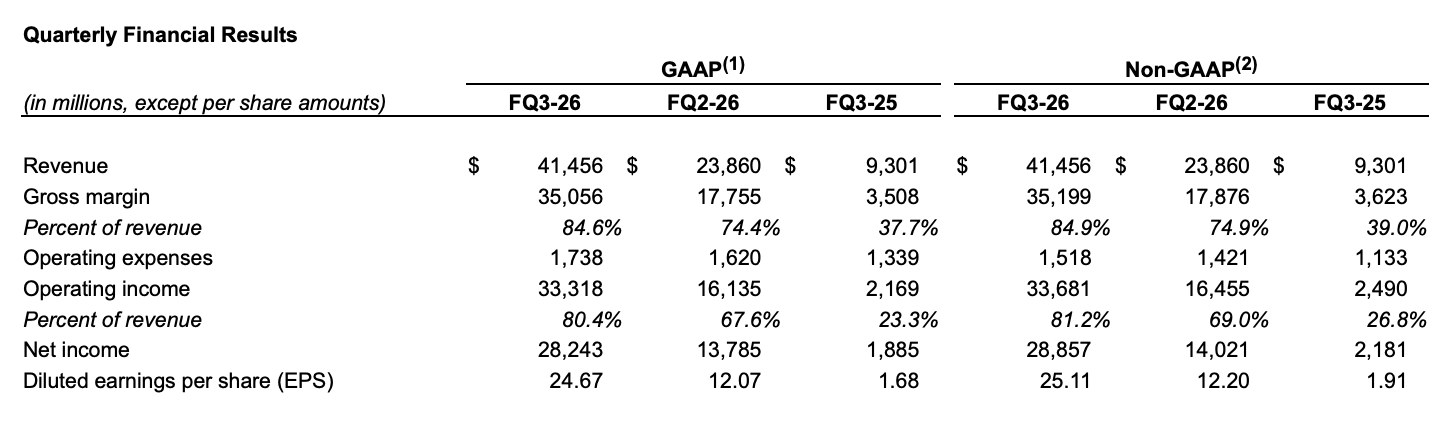
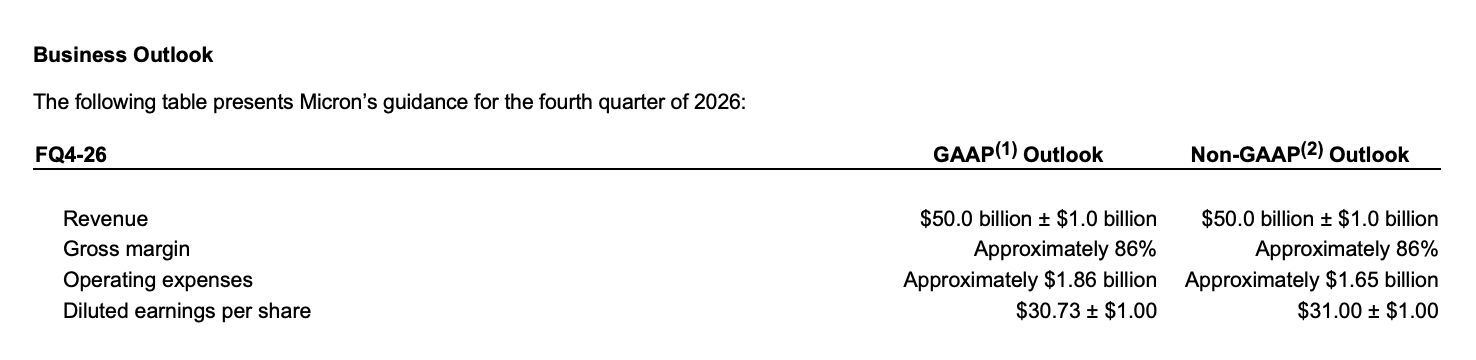
Even more exaggerated is the next quarter's guidance. Micron expects its Q4 revenue to reach $50 billion (plus or minus $1 billion), far exceeding the market's previous expectation of about $42.9 billion and even Goldman Sachs's aggressive forecast of $48.8 billion (widely seen as the most optimistic scenario); Q4 gross margin is expected to be about 86%, with EPS expected to reach around $31.
This is why many investors exclaimed the same sentiment immediately after the report's release: this is what you call a super, invincible, spiral, explosive, sky-rocketing earnings report!

From HBM to SSD, the Entire Memory Stack is Sprinting

If one were to identify a core driver for this round of growth, the answer remains, of course, AI. However, compared to the HBM that the market has repeatedly discussed over the past year, a more noteworthy point in this report is — AI's influence has begun to spread throughout the entire memory supply chain.

From a business structure perspective, almost all of Micron's core businesses are growing simultaneously, including:

  • Cloud memory business revenue reached $13.77 billion, up over 300% year-over-year;
  • Core data center business revenue reached $11.52 billion, up over 600% year-over-year;
  • Data center SSD revenue exceeded $5 billion;
  • Mobile and client business grew over 250% year-over-year;
  • Automotive and embedded business also achieved over 300% growth;
  • Gross margins across business lines generally remained around 80% or higher.

This signifies that the current AI wave is benefiting not just a single product, but the entire memory industry chain comprehensively.

On one hand, HBM remains the most direct beneficiary. Micron stated that HBM4 has begun volume shipments to core customers, with samples already delivered to multiple end customers; HBM4E is progressing as planned and is expected to enter mass production in 2027. Simultaneously, the company reiterated that its 2026 HBM capacity is completely sold out.

On the other hand, the continued expansion of AI training and inference demand is also driving concurrent growth in high-end DRAM, enterprise SSD, and NAND product demand. As more advanced capacity is prioritized for HBM, supply in the traditional DRAM and NAND markets tightens further, propelling the entire memory market into its strongest pricing cycle in recent years.

This is also why Micron remains extremely optimistic about the industry's outlook. Management expects the tight supply-demand situation in the DRAM and NAND markets to persist beyond 2027. In other words, in Micron's view, the industry is not nearing a cycle peak, but rather resembles the early stages of the AI infrastructure construction cycle.

Long-Term Agreements Locked In as Far Out as 2030

If we merely interpret this earnings report as a victory for HBM, we might still be underestimating its true significance. Because compared to the $50 billion revenue guidance, perhaps the most noteworthy numbers in this report are another set — $100 billion.

On the earnings call, Micron disclosed that to date, the company has signed 16 long-term strategic customer agreements (SCAs) covering data center, consumer electronics, and automotive customers. Most of these agreements have terms of up to 5 years, with some automotive client agreements lasting 3 years, extending as far out as the end of 2030.

These agreements already cover approximately 20% of DRAM shipments and about one-third of NAND shipments. As more agreements are finalized, over half of future revenue is expected to fall under the long-term agreement framework.

It is important to emphasize that these agreements are not traditional supply contracts. Management confirmed that the agreements utilize a strongly binding Take-or-Pay model. Even if customers do not fully take delivery in the future, they are still obligated to fulfill the agreed purchase commitments. Some major agreements even incorporate price ceiling and floor mechanisms, with the ceiling anchored to Q2 FY2026 market prices. Even at the agreement's price floor, the corresponding gross margin level remains significantly higher than Micron's historical cycle peaks.

Based on data disclosed by Micron management, 14 of these agreements currently correspond to guaranteed revenue of approximately $100 billion; concurrently, customers will also provide a total of about $22 billion in performance guarantees, with roughly $18 billion in cash form, which can be directly used to support future capacity construction and R&D investment.

For the memory industry, this is almost a historic change. For decades, the industry's operating logic has been "expand capacity first, then wait for demand to catch up"; now, Micron is gradually shifting to another model — lock in orders first, then expand capacity.

This is also what excites the capital market the most. Because it means Micron's current profitability is no longer based solely on expectations for a cyclical upturn, but is underpinned by long-term contracts.

Capacity Expansion, Expansion, and More Expansion, $10 Billion to be Spent in Q4

If long-term agreements answer "where is the demand coming from?", then capital expenditure answers another question — how does Micron plan to meet this demand?

The report shows that Micron expects Q4 capital expenditure to reach approximately $10 billion (higher than Wall Street's previous expectation of about $8.9 billion). Full-year FY2026 capital expenditure is projected to be around $27 billion, and quarterly capital expenditure in FY2027 will be higher than the Q4 FY2026 level. New investments will primarily be used for HBM, advanced DRAM, and advanced packaging capacity construction.

In the past, such capital expenditure figures might have raised market concerns. After all, for the memory industry, "large-scale capacity expansion" is hardly an unfamiliar phrase. Historically, whether it's Samsung, SK Hynix, or Micron itself, companies have ramped up investment at industry peaks, ultimately leading to oversupply, price collapses, and亲手 ending the previous bull market.

But this time, things seem to be changing. The reason is simple — this new capacity is not based on optimistic forecasts of future demand, but on long-term orders already signed.

On one side is $100 billion in guaranteed revenue, $22 billion in performance guarantees, and long-term agreements extending to 2030; on the other side is continuously expanding HBM, advanced DRAM, and advanced packaging capacity. Comparing these data points, the current capacity expansion appears more like executing already locked-in orders, rather than the traditional cycle-betting expansion based on demand forecasts.

Micron's Earnings Report Rekindles the Semiconductor Bull Market

Prior to the release of Micron's quarterly report, market sentiment surrounding the ongoing semiconductor bull run had shown signs of wavering.

Earlier this week, the South Korean semiconductor sector experienced a noticeable pullback, with leading companies like SK Hynix and Samsung Electronics collectively under pressure. Some investors began to worry whether the AI trade had become too crowded after over a year of frenzied gains.

And Micron's answer was quite direct — demand hasn't peaked; the market is still underestimating demand.

From the far-exceeding-expectations Q3 performance and the high $50 billion Q4 revenue guidance; from the sold-out HBM capacity to the long-term strategic agreements extending to 2030 — all convey the same signal: AI infrastructure construction is accelerating, not slowing down.

Following the report's release, Micron's stock surged 16% in after-hours trading, driving collective gains for other U.S. semiconductor companies like Intel, ASML, Marvell, and Qualcomm. Japanese and South Korean markets also opened higher and rose today, with the South Korean market experiencing another trading halt, and Samsung and Hynix both rebounding significantly. After the A-share market opened, the semiconductor industry chain also strengthened, led by memory and advanced packaging sectors.

In a sense, this is no longer just an earnings report belonging to Micron, but another confidence booster for the entire semiconductor industry. Because the market has reconfirmed one thing — the AI story is far from over, and memory is becoming an increasingly important protagonist in this story.

Трендовые криптовалюты

Связанные с этим вопросы

QWhat were the key financial highlights of Micron's Q3 2026 earnings report?

AMicron's Q3 2026 revenue reached $41.456 billion, a 346% year-over-year increase, significantly exceeding the expected ~$35.4 billion. GAAP net profit was $28.243 billion, up nearly 1500% year-over-year. Adjusted earnings per share were $25.11. The company's Q4 guidance forecasts revenue of approximately $50 billion, far surpassing prior market expectations.

QWhat is driving the explosive growth across Micron's business segments, and which product is specifically mentioned as a direct beneficiary?

AThe explosive growth is primarily driven by the AI wave. While the impact has expanded across the entire memory stack, the High Bandwidth Memory (HBM) remains the most direct beneficiary. Micron confirmed that HBM4 is in volume production for core customers, HBM4E is on schedule, and all HBM capacity for 2026 is sold out.

QWhat significant change in business model does Micron's 16 Long-term Strategic Customer Agreements (SCAs) represent for the memory industry?

AThe 16 'take-or-pay' SCAs, some extending to 2030, represent a historic shift. Instead of the traditional industry model of 'expand capacity first, then wait for demand to catch up,' Micron is moving towards a model of 'lock in orders first, then expand capacity.' This provides guaranteed future revenue and reduces cycle volatility.

QHow is Micron's massive capital expenditure plan for Q4 2026, estimated at ~$10 billion, different from historical expansion cycles?

AThis massive capital expenditure is fundamentally different. It is not based on speculative future demand forecasts, but is primarily driven by the need to fulfill the firm, long-term 'take-or-pay' customer agreements already secured. This makes the expansion more akin to executing on locked-in orders rather than a traditional gamble on the cycle.

QHow did Micron's earnings report impact broader market sentiment towards the semiconductor sector?

AMicron's report, with its hugely exceeded expectations and strong long-term visibility, re-ignited confidence in the semiconductor bull market. It countered recent concerns about AI trade saturation by signaling that AI infrastructure build-out is accelerating. This led to a surge in Micron's stock and sparked rallies across U.S., South Korean, and A-share semiconductor stocks.

Похожее

Крупный игрок Сэйлор усиливает распродажу биткоинов: Strategy объявляет об очередной масштабной распродаже BTC!

Крупнейший публичный держатель биткоинов, компания Strategy, продолжает распродажу криптоактивов. Основатель Майкл Сэйлор объявил о продаже 1690 биткоинов (BTC) в период с 3 по 9 августа на сумму примерно $108,6 млн по средней цене $64 262 за монету. Цель продаж — финансирование дивидендов по привилегированным акциям и выкуп акций STRC. В результате этой, уже четвертой недели продаж подряд, общий запас биткоинов Strategy сократился до 840 447 BTC. Компания не покупала BTC около семи недель. Параллельно Strategy привлекла $653,1 млн от продажи акций MSTR, из которых $109 млн были направлены на выкуп STRC. Долларовые резервы компании выросли до примерно $4,65 млрд. По заявлению Strategy, этого достаточно для увеличения срока, в течение которого можно выплачивать дивиденды за счет этих резервов, на 143 дня — до 2,7 лет. Также на 10 базисных пунктов была уменьшена сумма займа в биткоинах для STRC.

cryptonews.ru20 мин. назад

Крупный игрок Сэйлор усиливает распродажу биткоинов: Strategy объявляет об очередной масштабной распродаже BTC!

cryptonews.ru20 мин. назад

Компания MARA Holdings, занимающаяся майнингом биткоинов, продала большое количество биткоинов в первом полугодии! Вот все подробности

Крупнейшая публичная майнинговая компания MARA Holdings, торгующаяся на Nasdaq, в первом полугодии 2026 года продала 23 093 BTC на сумму около $1,6 млрд. После этих масштабных продаж резервы компании сократились, но она по-прежнему владеет 35 577 BTC, оцениваемыми примерно в $2,3 млрд по текущему курсу. Эта активная торговая деятельность демонстрирует стратегию MARA по управлению ликвидностью, при этом биткоин остается значимым долгосрочным активом на её балансе. Решения компании о продаже добытых биткоинов, принимаемые для покрытия операционных расходов и в зависимости от рыночных условий, находятся под пристальным вниманием рынка, так как могут влиять на предложение. Будущая политика компании в отношении своих резервов будет зависеть от динамики цены биткоина, себестоимости майнинга и потребностей в финансировании.

cryptonews.ru1 ч. назад

Компания MARA Holdings, занимающаяся майнингом биткоинов, продала большое количество биткоинов в первом полугодии! Вот все подробности

cryptonews.ru1 ч. назад

Основатель Bitcoin Red Team обращается к китайскому ИИ: 'Это меня просто убивает'

Основатель группы Bitcoin Red Team Роб Гамильтон сообщил, что вынужден вернуться к использованию открытых китайских моделей искусственного интеллекта (ИИ) после того, как OpenAI ограничил ему доступ для анализа кодовых баз. Это произошло вскоре после того, как он начал интегрировать инструменты OpenAI в свою работу по поиску уязвимостей в репозиториях, связанных с Bitcoin. Гамильтон выразил разочарование, отметив, что наиболее мощные инструменты ИИ становятся недоступными для защитников, в то время как злоумышленники не сталкиваются с подобными ограничениями. Его группа добровольцев использует ИИ для сканирования сотен открытых репозиториев Bitcoin на предмет уязвимостей, особенно после взлома аппаратного кошелька Coldcard, в результате которого было украдено более 100 миллионов долларов в биткойнах. По его словам, текущая политика создает ситуацию, когда возможности разведки неограниченны для тех, кто не соблюдает правила, а те, кто занимается снижением рисков, остаются в стороне. Ранее крипто-исполнители также указывали, что лишь немногие компании получили доступ к передовым моделям ИИ для усиления защиты своего кода.

cointelegraph1 ч. назад

Основатель Bitcoin Red Team обращается к китайскому ИИ: 'Это меня просто убивает'

cointelegraph1 ч. назад

Bitdeer увеличил добычу биткоинов почти в пять раз во втором квартале

Bitdeer значительно увеличил добычу биткойнов во втором квартале 2026 года, добыв 2694 BTC, что почти в пять раз больше, чем 565 BTC годом ранее. Однако на балансе компании к концу квартала осталось лишь 150 BTC, что на 90% меньше, чем 1502 BTC годом ранее. В феврале компания продала все 943 BTC из своего казначейства, объяснив это решениями по ликвидности. Bitdeer также активно диверсифицирует деятельность, расширяясь в сферу центров обработки данных для ИИ. В августе компания заключила долгосрочную аренду в Норвегии на сумму $4,7 млрд для мощностей ИИ. Выручка компании во втором квартале составила $228,8 млн, что на 47% больше, чем годом ранее. Основную часть выручки ($168,4 млн) обеспечил собственный майнинг, хешрейт которого вырос на 389%. При этом чистый убыток увеличился до $92,3 млн. Выручка Bitdeer немного превысила ожидания аналитиков Уолл-стрит. Акции компании выросли на 1,5% в ходе премаркета в понедельник.

cointelegraph2 ч. назад

Bitdeer увеличил добычу биткоинов почти в пять раз во втором квартале

cointelegraph2 ч. назад

Сценарий «обратного поглощения чипами» завершился: акции Baolai упали на 20% после возобновления торгов, несмотря на удвоение цены с начала года

10 августа 2026 года акции компании Baolai Medical (300246.SZ), после почти недельной приостановки торгов, упали на 20% (предел падения на Chinext) на новостях о прекращении переговоров по смене контроля над компанией. Это падение завершило резкий рост акций в течение года (до +138%), вызванный слухами о возможном «обратном поглощении» (backdoor listing) со стороны компании Weigu Information, специализирующейся на твердотельных накопителях и чипах. Изначально ожидания возникли в январе 2026 года, когда новый акционер (Quwei Zhihe) с долей 7%, связанный с Weigu Information, вошел в капитал. Однако 7 августа сделка по смене контроля была неожиданно прекращена. За ралли акций последовала жесткая реальность слабых базовых показателей Baolai Medical. Компания, производитель медицинского оборудования, три года подряд несет убытки, начиная с 2023 года, из-за ценового давления госзакупок (tender) в ключевом сегменте диализа и насыщения рынка мониторов пациентов. Кроме того, компания сталкивается с острой проблемой краткосрочной ликвидности: текущие обязательства (8.3 млрд юаней) превышают денежные средства, и в сентябре 2026 года подходит срок погашения конвертируемых облигаций на сумму около 218 млн юаней. В итоге, крах спекулятивных надежд на реструктуризацию обнажил фундаментальные проблемы бизнеса и долговое бремя Baolai Medical.

marsbit2 ч. назад

Сценарий «обратного поглощения чипами» завершился: акции Baolai упали на 20% после возобновления торгов, несмотря на удвоение цены с начала года

marsbit2 ч. назад

Торговля

Спот

Популярные статьи

Как купить MEGA

Добро пожаловать на HTX.com! Мы сделали приобретение MegaETH (MEGA) простым и удобным. Следуйте нашему пошаговому руководству и отправляйтесь в свое крипто-путешествие.Шаг 1: Создайте аккаунт на HTXИспользуйте свой адрес электронной почты или номер телефона, чтобы зарегистрироваться и бесплатно создать аккаунт на HTX. Пройдите удобную регистрацию и откройте для себя весь функционал.Создать аккаунтШаг 2: Перейдите в Купить криптовалюту и выберите свой способ оплатыКредитная/Дебетовая Карта: Используйте свою карту Visa или Mastercard для мгновенной покупки MegaETH (MEGA).Баланс: Используйте средства с баланса вашего аккаунта HTX для простой торговли.Третьи Лица: Мы добавили популярные способы оплаты, такие как Google Pay и Apple Pay, для повышения удобства.P2P: Торгуйте напрямую с другими пользователями на HTX.Внебиржевая Торговля (OTC): Мы предлагаем индивидуальные услуги и конкурентоспособные обменные курсы для трейдеров.Шаг 3: Хранение MegaETH (MEGA)После приобретения вами MegaETH (MEGA) храните их в своем аккаунте на HTX. В качестве альтернативы вы можете отправить их куда-либо с помощью перевода в блокчейне или использовать для торговли с другими криптовалютами.Шаг 4: Торговля MegaETH (MEGA)С легкостью торгуйте MegaETH (MEGA) на спотовом рынке HTX. Просто зайдите в свой аккаунт, выберите торговую пару, совершайте сделки и следите за ними в режиме реального времени. Мы предлагаем удобный интерфейс как для начинающих, так и для опытных трейдеров.

868 просмотров всегоОпубликовано 2026.04.30Обновлено 2026.06.02

Как купить MEGA

Обсуждения

Добро пожаловать в Сообщество HTX. Здесь вы сможете быть в курсе последних новостей о развитии платформы и получить доступ к профессиональной аналитической информации о рынке. Мнения пользователей о цене на MEGA (MEGA) представлены ниже.

活动图片