When 500 Million People Abandon ChatGPT

marsbitОпубликовано 2026-06-22Обновлено 2026-06-22

Введение

ChatGPT's Global AI Assistant Market Share Drops Below 50% Three and a half years after its groundbreaking launch, ChatGPT faces a pivotal moment. While it remains the largest AI assistant globally, its market share has fallen below 50% for the first time, reaching 46.4% as of May, according to Sensor Tower's 2026 AI landscape report. Google's Gemini (27.7%) and Anthropic's Claude (10.3%) are now its main competitors, with Grok, Perplexity, and others also gaining ground. The market has evolved from awe and initial adoption into a phase of product comparison, ecosystem integration, and commercialization. User behavior has matured significantly. Loyalty is low; users readily switch between assistants for specific tasks. Gemini benefits from deep integration within Google's ecosystem (Search, Gmail, Android), while Claude has carved a niche among productivity-focused users with strong retention, nearly matching ChatGPT's. User choice is now influenced by a complex mix of capability, ecosystem, price, use case, and even brand trust. Commercialization is accelerating. AI app downloads continue but growth is slowing, while user spending is rising. Over $4.2 billion was spent in-app during H1 2026. Claude leads in premium subscription conversion rates (13%). OpenAI is expanding its revenue streams, testing ads shown to 17% of ChatGPT users daily by May. This shift highlights the immense financial pressure of model training and inference costs. Despite revenue growth, OpenAI's c...

It has been three and a half years since ChatGPT burst onto the scene.

Back then, many people realized for the first time that a dialog box might become the next-generation internet portal. Today, it has long since become the fastest application in human history to reach 1 billion monthly active users. Yet, at the same time, it has reached a symbolic turning point:

ChatGPT's global market share has dropped below 50% for the first time.
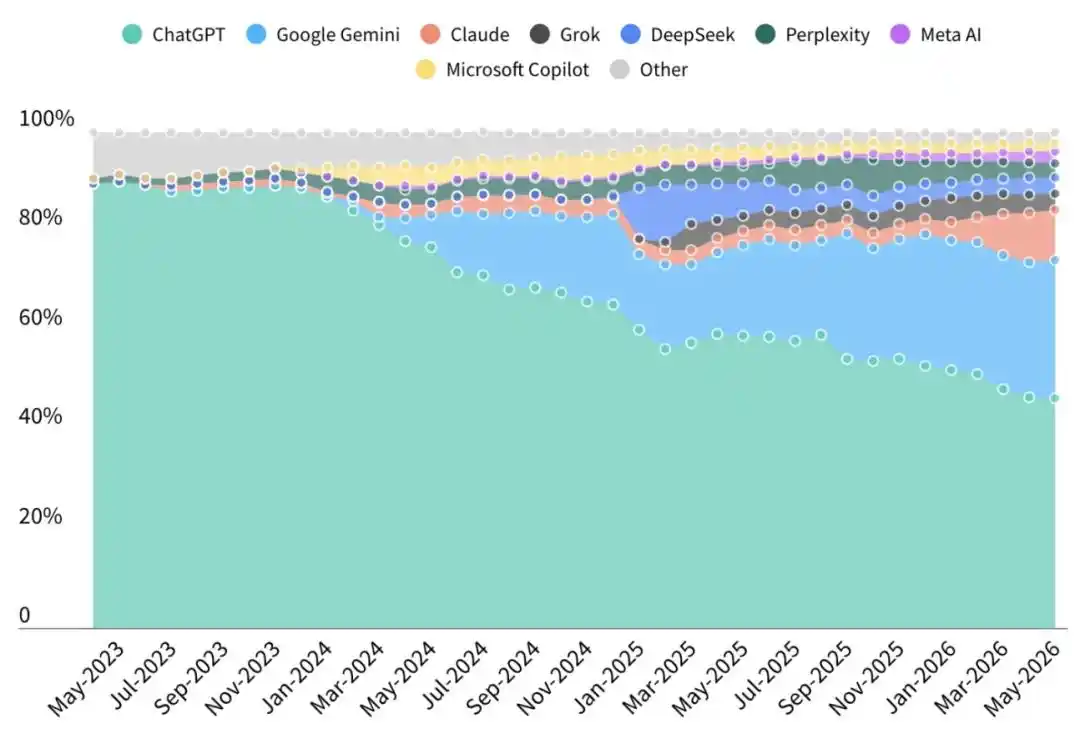
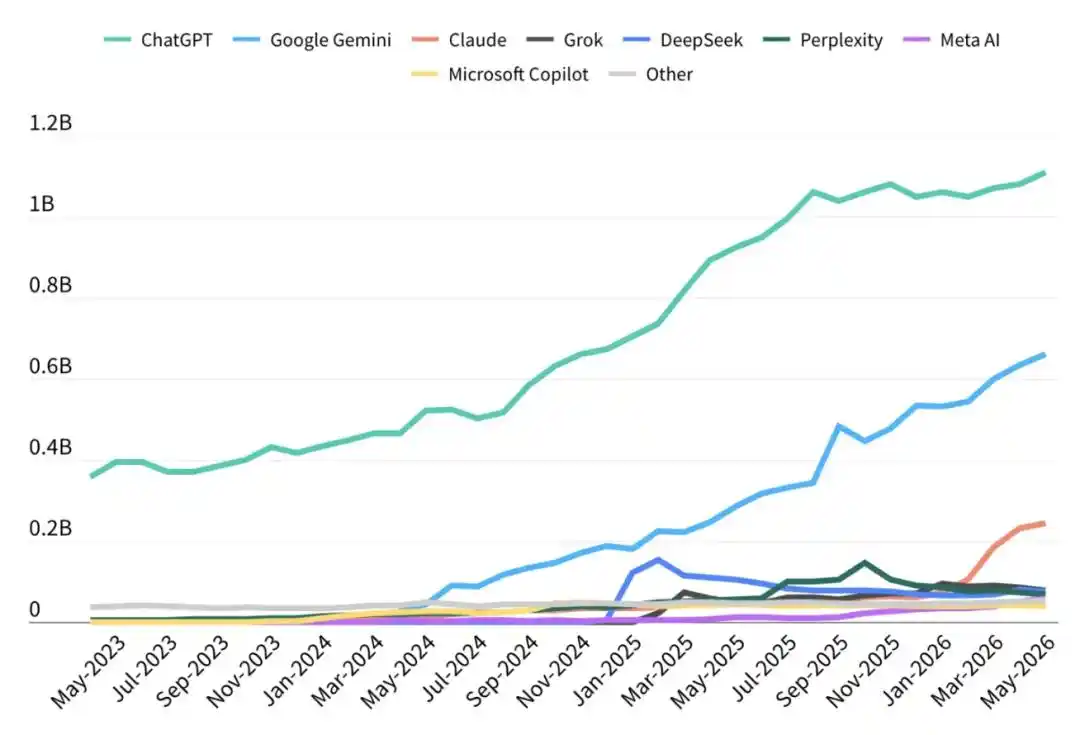
According to the analytics firm Sensor Tower in its "State of AI 2026 Report," as of the end of May this year, ChatGPT's share of the global AI assistant market fell to 46.4%. Prior to January this year, this figure was still above 50%.

ChatGPT remains the world's largest AI assistant. But leading no longer equals monopoly. The AI assistant boom ignited by OpenAI has moved from wonder, trial, and awe into the stage of product comparison, ecosystem lock-in, paid conversion, and commercialization.

Loyalty is a False Promise; Users are 'Players'

In 2023, having a ChatGPT account still carried a certain identity as an AI trendsetter. By 2026, AI assistants are increasingly becoming infrastructure in internet life, much like search, email, and office suites.

The most noteworthy change in Sensor Tower's report is not just that ChatGPT still ranks first. More importantly, users are becoming more willing to migrate. As long as another assistant is more convenient in a specific scenario, users will immediately allocate their time to that other product.

The main rivals pulling ChatGPT's share below 50% are Gemini and Claude.

As of the end of May, Gemini's global share reached 27.7%, and Claude reached 10.3%. Products like Grok, Perplexity, DeepSeek, and Meta AI each remain below 5%, but they are also continuously squeezing the remaining market.
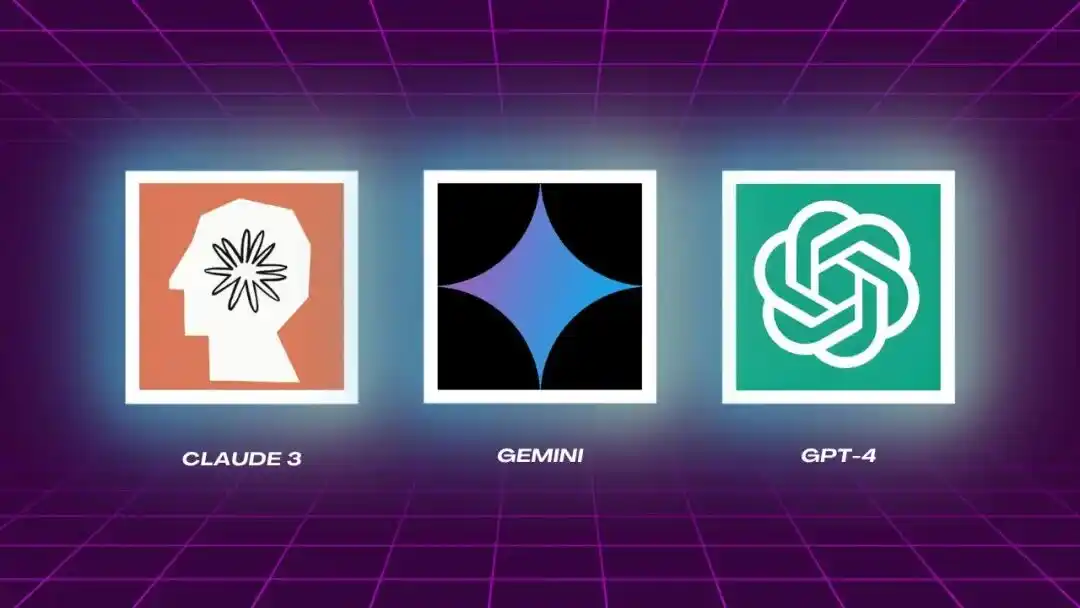
Gemini's growth is not hard to understand.

It stands on the foundation of Google's complete ecosystem. Search, Gmail, Docs, Calendar, and Android are all natural entry points. When AI is embedded into tools users must use daily, many ordinary users don't need to specifically open another webpage to summon ChatGPT.

Especially after the release of Gemini 3.0, Google also achieved its first real major victory, officially joining the AI game table and entering the view of more mainstream users.

Claude's path is more like a victory for productivity tools.

It doesn't have a distribution system like Google's, but it has built a strong reputation in scenarios such as writing, coding, long-text processing, and complex task collaboration. Sensor Tower states that Claude is approaching ChatGPT's user retention levels. For heavy users, AI assistants have shed their toy-like attributes and are starting to genuinely impact work efficiency.
A more subtle change is that users are no longer judging AI products solely based on model capability.

As AI assistants increasingly take on personalized interactive characteristics, users are also beginning to discuss work, emotions, judgments, and decisions with them. Brand trust, value orientation, and institutional relationships may all become part of user choice.

And the slightest bit of negative publicity can trigger a wave of massive uninstalls. This is something OpenAI CEO Sam Altman has likely felt deeply over the past year.

AI companies used to believe that as long as the model was stronger, users would stay. The reality of 2026 is much more complex. Capability, ecosystem, price, scenario, and brand trust are now collectively determining whether an assistant will be used continuously.

The Free Lunch is Over; AI Apps are Starting to Talk Money

Beyond market share, another set of data from Sensor Tower's report better illustrates the stage change in the industry: AI apps are still growing, but the growth logic has changed.

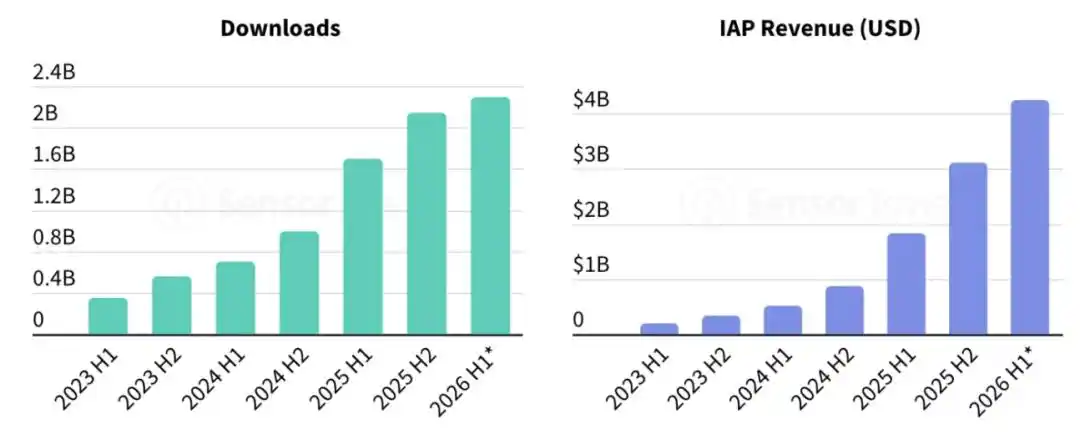
Sensor Tower estimates that in the first half of 2026, global AI app downloads will approach 2.3 billion, and in-app spending will exceed $4.2 billion. In comparison, AI app in-app spending in the first half of 2025 was $1.83 billion.

Users are still downloading AI apps and are willing to pay for AI.

But the growth rates for both downloads and spending have slowed. Meanwhile, the industry has moved from a period of rapid expansion into a more realistic competitive phase. Companies can no longer just talk about user growth; they must also prove they can turn traffic into revenue.

Regional differences are also beginning to show.

Asia remains the highest market for AI app downloads, but in Q1 2026, it saw its first-ever download decline, dropping by 3.3%, mainly influenced by markets like India.
In contrast, North America and Europe are stronger in in-app consumption. For AI companies, what truly determines the business model is often the ability to pay; installation scale can only solve part of the problem.

The trend in the US market is even more pronounced.

Users are increasingly using AI assistants for productivity tasks and are more willing to pay for advanced features. Claude performs well here. Sensor Tower states that Anthropic has 13% of its users subscribing to paid plans, with a conversion rate among the highest in the industry.

A 13% subscription conversion rate explains why Claude can continue to expand its presence amidst the squeeze from giants. As long as AI helps users save time, write code, organize documents, and handle complex tasks, a subscription fee of twenty or even two hundred dollars per month is actually within an acceptable range.

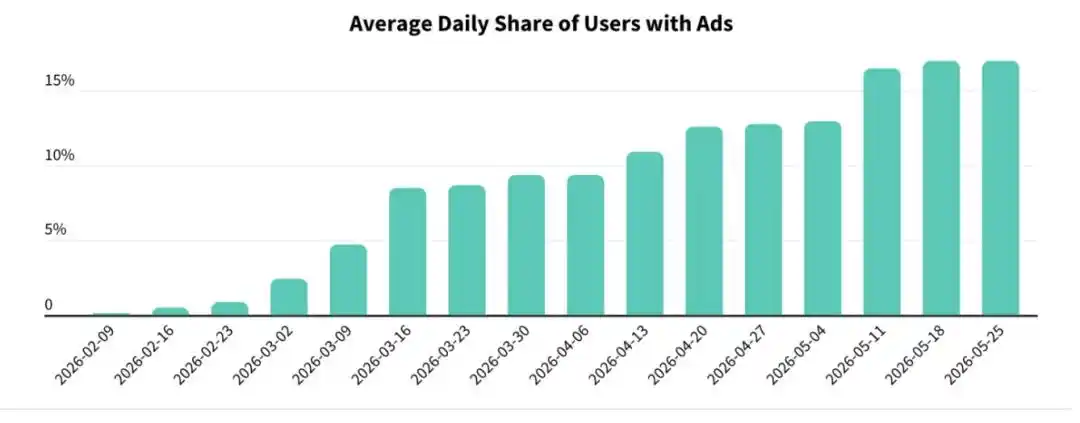
ChatGPT's commercialization path is more diverse and also more controversial. Sensor Tower states that OpenAI began testing ads in ChatGPT starting in February this year, gradually expanding ad display scale and user coverage.

By May, an average of 17% of users saw ads daily. Software and shopping are currently the largest advertiser categories, followed by media & entertainment, and food & beverage.
From subscriptions to ads, ChatGPT is moving towards a more typical internet business model. Early users were familiar with a clean dialog box, a portal imbued with the dream of Artificial General Intelligence (AGI).

Unfortunately, even the smartest AI on the planet ultimately can't escape the fate of becoming a shopping guide. For OpenAI, advertising and shopping have become experiments that must be pursued. Now, this portal is also beginning to carry ads, shopping guides, recommendations, and transaction conversions.

Model inference, training, and compute expenditures are extremely expensive; relying solely on subscription revenue can hardly cover long-term investment. Advertising and shopping are becoming the next pieces of the puzzle for ChatGPT's commercialization.

As AI begins to penetrate core scenarios like shopping, office work, and search, the imagination of AI becoming a unified super portal is also encountering increasingly realistic platform boundaries.

Sensor Tower estimates that in the first half of 2026, global AI app usage time will grow from 17.2 billion hours in the same period last year to approximately 36 billion hours. Among these, the top three AI assistants account for 89% of the total usage time of AI assistant apps.

There is still opportunity for later players, but it exists more in fragmented scenarios, such as AI companions, AI content generation, and vertical industry tools. The main battlefield for general assistants has largely been occupied by ChatGPT, Gemini, and Claude.

Farewell to the Altar; AI Moves Towards the Everyday

The decline in ChatGPT's share occurs at a somewhat paradoxical point in time: OpenAI's revenue is still growing rapidly, its user base is still expanding, and its capital reserves far exceed those of most startups.

According to a report by The Information based on documents disclosed by OpenAI to shareholders, OpenAI's cash consumption reached $3.7 billion in the first quarter, exceeding half of its $5.7 billion revenue. Both cash consumption and revenue roughly tripled year-over-year.

This is also a common challenge facing the current AI industry. Users and revenue continue to grow, yet massive capital investment is required to maintain model training, inference services, and infrastructure construction.
Furthermore, OpenAI expects its cash consumption in 2026 could reach $25 billion, rising further to $57 billion in 2027. Even though OpenAI has secretly submitted IPO filing documents, the listing timing may still be adjusted based on market conditions.

In other words, as one of the world's strongest AI brands, OpenAI still needs to answer a question: when models are getting more expensive, competition is getting fiercer, and users are becoming more willing to migrate, how high a profit margin can ChatGPT's business model ultimately generate.

However, even though ChatGPT's share has fallen below 50%, it remains the world's largest AI assistant and is still the most frequently mentioned name when people talk about AI. But this milestone is symbolic.

The AI assistant market has moved past the era where a single product defined the industry. In the past, ChatGPT was responsible for making the masses believe AI could change the internet. Now, Gemini, Claude, Grok, DeepSeek, and various vertical AI assistants are collectively dividing user time, usage scenarios, and commercial revenue.
User demands are also subtly changing.

By now, you probably are no longer satisfied with just asking AI to write a poem or tell a lame joke. Instead, you're starting to demand it writes code with fewer errors, processes documents more accurately, facilitates office collaboration more conveniently, and offers more reasonable subscription prices.

When a technology no longer elicits repeated amazement but instead begins to be scrutinized, compared, and replaced, it has truly begun to enter mainstream life.

ChatGPT has lost its dominant half of the market, but AI has truly begun to win the world. It's just that in this new world, there are no eternal kings, only us, forever ready to migrate for the sake of a more useful tool.

This article is from the WeChat public account "ifanr," author: ifanr, discovering tomorrow's products.


Трендовые криптовалюты

Связанные с этим вопросы

QAccording to the article, what is the key symbolic change in the global AI assistant market share as of May 2026?

AThe key symbolic change is that ChatGPT's global market share has dropped below 50% for the first time, to 46.4%.

QWhich two main competitors are primarily responsible for reducing ChatGPT's market share below 50%?

AGemini (27.7% share) and Claude (10.3% share) are the two main competitors responsible for this reduction.

QWhat are the two main business model paths highlighted for ChatGPT's monetization beyond subscriptions?

AThe two main paths are integrating advertising and e-commerce/shopping features into the ChatGPT platform.

QWhat does the 13% subscription conversion rate for Claude's users indicate, according to the report?

AIt indicates that users are willing to pay for AI assistants that demonstrably improve productivity, such as by saving time or handling complex tasks, making Claude's premium subscription model successful.

QWhat broader industry shift does the article suggest is represented by ChatGPT's market share decline?

AIt represents a shift from a period of awe and trial with a single dominant product to a mature, competitive phase where user choice is driven by specific features, ecosystem integration, pricing, and trust, integrating AI into everyday life.

Похожее

‘Продажа…’ – Как Grayscale планирует покрыть убыток Strategy в $14 млрд

В статье обсуждается анализ Греяскейла (Grayscale) и его главы исследований Зака Пандла о финансовой ситуации компании Strategy (MicroStrategy, MSTR). Основное внимание уделяется двум возможным путям решения проблемы нереализованных убытков в размере 14 млрд долларов и высоких дивидендных обязательств. Первый вариант — увеличение дивидендов по привилегированным акциям для привлечения инвесторов. Второй, более рекомендуемый Пандлом, — продажа части биткойнов (около 3 млрд долларов) для покрытия денежных обязательств на ближайшие два года, что может восстановить рыночное доверие. Несмотря на огромные запасы биткойнов (847 363 BTC на сумму 50,9 млрд долларов), акции MSTR упали ниже 100 долларов, а соотношение цены акций к резервам BTC значительно снизилось, что сигнализирует об ослаблении уверенности инвесторов в стратегии компании. Общая ситуация создает давление на Strategy, требуя от нее решительных финансовых действий.

ambcrypto15 мин. назад

‘Продажа…’ – Как Grayscale планирует покрыть убыток Strategy в $14 млрд

ambcrypto15 мин. назад

Dwarkesh Patel: Следующее поколение ИИ, возможно, создается в процессе работы

Знаменитый технологический подкастер из Кремниевой долины Dwarkesh Patel обсуждает следующую парадигму обучения ИИ, выходящую за рамки текущего подхода RLVR (Reinforcement Learning with Verifiable Rewards). Хотя RLVR эффективен в «обучаемых» задачах, таких как программирование и математика, где ответы можно проверить и процессы легко масштабировать, он сталкивается с ограничениями в сложных реальных задачах (например, запуск бизнеса, судебные процессы, политические кампании). Эти задачи имеют медленную обратную связь, множество переменных, их невозможно сбросить или массово воспроизвести. Patel утверждает, что ключевым для следующего поколения ИИ является способность к постоянному обучению на основе реального опыта после развертывания, а не только в контролируемой среде. Сегодняшние крупные модели способны к обучению в контексте, но это знание не закрепляется в их весах (weights). Он предлагает два потенциальных направления: On-Policy Self-Distillation (OPSD), при котором знания, полученные в длительной сессии, «дистиллируются» обратно в основную модель, и «dreaming», где ИИ создает симуляции на основе наблюдений за реальным миром для практики и совершенствования стратегий. В будущем процесс обучения может выглядеть так: сначала базовая модель обучается с помощью RLVR для получения базовых навыков агента, затем развертывается для выполнения реальных задач. Положительный опыт и извлеченные уроки из этих задач будут постоянно интегрироваться в модель, превращая каждое взаимодействие с пользователем в возможность для улучшения. Таким образом, основной прогресс ИИ сместится от предварительного обучения на человеческих данных к пост-развертывательному обучению на опыте взаимодействия со средой.

marsbit26 мин. назад

Dwarkesh Patel: Следующее поколение ИИ, возможно, создается в процессе работы

marsbit26 мин. назад

Еженедельные победители и аутсайдеры крипторынка – VELVET, BEAT, WLD, XLM

На этой неделе крипторынок находился под давлением. Bitcoin и Ethereum продолжили слабое выступление, в то время как капитал перетек в ряд низкокапитализированных альткойнов, что привело к значительному росту на отдельных токенах. **Лидеры недели:** * **Velvet [VELVET]:** стал крупнейшим еженедельным победителем с ростом на 235%, приблизившись к своему историческому максимуму. Технический анализ предполагает, что восходящий тренд остается в силе, несмотря на перекупленность. * **DeXe [DEXE]:** вырос на 60%, вернувшись к уровню $22 впервые с 2021 года. Активная покупка на просадках указывает на сохранение контроля быков. * **Audiera [BEAT]:** подорожал на 45%, что стало резким разворотом после падения на 70% неделей ранее, указывая на агрессивное возвращение покупателей. Среди других значимых ростов отмечены Cortex [CX] (+2710%) и Biconomy [BICO] (+246%). **Аутсайдеры недели:** * **MemeCore [M]:** обрушился на 70% после сообщений о манипуляциях инсайдеров. Токен находится в глубоко перепроданной зоне, идут первые попытки стабилизации. * **Worldcoin [WLD]:** упал на 26%, что выглядит как здоровая коррекция после пятинедельного ралли. Ключевой уровень поддержки находится возле $0.40. * **Stellar [XLM]:** потерял 18.5%, продолжив серию падения. Пробитие поддержки $0.25 увеличивает риск более глубокой коррекции. К другим заметным падениям относятся Humanity [H] (-71%) и Biconomy [BICO] (-68.5%). Итог недели: высокая волатильность с резкими взлетами и падениями, характерная для ротации капитала в условиях неопределенности.

ambcrypto2 ч. назад

Еженедельные победители и аутсайдеры крипторынка – VELVET, BEAT, WLD, XLM

ambcrypto2 ч. назад

Sui сотрудничает с Token Terminal для предоставления институциональной аналитики в блокчейне

Sui Network объявила о партнерстве с Token Terminal для интеграции финансовых данных и аналитики блокчейна в рабочие процессы институциональных исследований. Цель интеграции — упростить анализ данных сети Sui для профессиональных пользователей, повысив прозрачность и доступность информации для институциональных инвесторов. Важно отметить, что это партнерство направлено на улучшение исследовательской инфраструктуры и не должно рассматриваться как фактор, непосредственно влияющий на цену токена SUI или немедленный рост общего объема заблокированных средств (TVL). В текущих рыночных условиях, когда ликвидность снижена, а направление Биткойна остается неопределенным, подобные обновления экосистемы предоставляют трейдерам конкретные, проверяемые данные для анализа, в отличие от спекулятивных нарративов. Трейдерам рекомендуется обращаться к официальным материалам Sui Foundation и Token Terminal для проверки информации. Эта интеграция представляет собой шаг в развитии инфраструктуры Sui, а не сигнал к немедленным рыночным действиям.

bitcoinist4 ч. назад

Sui сотрудничает с Token Terminal для предоставления институциональной аналитики в блокчейне

bitcoinist4 ч. назад

SecondFi представляет план восстановления после эксплуатации кошелька Cardano на 2,4 миллиона долларов

**ВторойFi представляет план восстановления после взлома кошелька Cardano на $2,4 млн** После эксплуатации уязвимости на уровне кошелька, в результате которой было изъято около $2,4 млн в ADA, протокол SecondFi провел криминалистический анализ. Согласно официальному отчету, команда сделала снимок балансов пострадавших аккаунтов и представила план возврата средств в течение двух недель. Важно отметить, что инцидент связан с уязвимостью конкретного кошелька, а не с недостатками самого блокчейна Cardano. В связи с этим пользователям рекомендуется не делать поспешных выводов о безопасности протокола Cardano без прямых технических доказательств. Эта ситуация служит напоминанием для рынка о важности проверяемых данных — таких как обновления безопасности и записи в блокчейне — особенно в условиях неопределенности, когда внимание к движению средств и официальным заявлениям повышено. Трейдерам следует сосредоточиться на проверке следующих шагов: официальных обновлений от SecondFi и записей транзакций в сети Cardano.

bitcoinist4 ч. назад

SecondFi представляет план восстановления после эксплуатации кошелька Cardano на 2,4 миллиона долларов

bitcoinist4 ч. назад

Торговля

Спот

Популярные статьи

Как купить PEOPLE

Добро пожаловать на HTX.com! Мы сделали приобретение ConstitutionDAO (PEOPLE) простым и удобным. Следуйте нашему пошаговому руководству и отправляйтесь в свое крипто-путешествие.Шаг 1: Создайте аккаунт на HTXИспользуйте свой адрес электронной почты или номер телефона, чтобы зарегистрироваться и бесплатно создать аккаунт на HTX. Пройдите удобную регистрацию и откройте для себя весь функционал.Создать аккаунтШаг 2: Перейдите в Купить криптовалюту и выберите свой способ оплатыКредитная/Дебетовая Карта: Используйте свою карту Visa или Mastercard для мгновенной покупки ConstitutionDAO (PEOPLE).Баланс: Используйте средства с баланса вашего аккаунта HTX для простой торговли.Третьи Лица: Мы добавили популярные способы оплаты, такие как Google Pay и Apple Pay, для повышения удобства.P2P: Торгуйте напрямую с другими пользователями на HTX.Внебиржевая Торговля (OTC): Мы предлагаем индивидуальные услуги и конкурентоспособные обменные курсы для трейдеров.Шаг 3: Хранение ConstitutionDAO (PEOPLE)После приобретения вами ConstitutionDAO (PEOPLE) храните их в своем аккаунте на HTX. В качестве альтернативы вы можете отправить их куда-либо с помощью перевода в блокчейне или использовать для торговли с другими криптовалютами.Шаг 4: Торговля ConstitutionDAO (PEOPLE)С легкостью торгуйте ConstitutionDAO (PEOPLE) на спотовом рынке HTX. Просто зайдите в свой аккаунт, выберите торговую пару, совершайте сделки и следите за ними в режиме реального времени. Мы предлагаем удобный интерфейс как для начинающих, так и для опытных трейдеров.

801 просмотров всегоОпубликовано 2024.04.12Обновлено 2026.06.02

Как купить PEOPLE

Обсуждения

Добро пожаловать в Сообщество HTX. Здесь вы сможете быть в курсе последних новостей о развитии платформы и получить доступ к профессиональной аналитической информации о рынке. Мнения пользователей о цене на PEOPLE (PEOPLE) представлены ниже.

活动图片