Mining Companies' High-Stakes Bet on AI: Valuations Enter a Phase of Divergence, Uphill Battle Ahead

marsbitОпубликовано 2026-06-20Обновлено 2026-06-20

Введение

Crypto miners are facing increasing pressure amid weak digital asset markets, pushing many to pivot towards AI infrastructure as a new growth avenue. Leveraging existing assets like power resources, land, and cooling systems, miners can convert facilities for AI compute at lower costs. This transition narrative has fueled significant stock rallies, with some miners' shares outperforming Bitcoin year-to-date. Market valuations have diverged, with pioneers like CoreWeave reaching a multi-billion dollar valuation, while others lag. The shift is driven by AI's explosive demand for data centers and compute, with clients willing to pay premiums for power and space. However, the transformation is capital-intensive, requiring massive funding for GPU procurement and facility upgrades, with an estimated short-term funding gap of $50 billion. Miners are raising capital through convertible bonds, Bitcoin sales, and securing long-term AI contracts to finance the build-out. While AI offers greater long-term potential than mining, success hinges on execution, timely project delivery, and securing quality tenants, moving the valuation focus from power capacity to cash flow and return metrics.

Author: Nancy, PANews

As crypto assets continue to experience weakness and decline, crypto mining companies are facing increasingly severe survival pressures. In search of new growth avenues, more and more mining companies are accelerating their shift into the AI arena. This transformation narrative has quickly gained favor in the capital markets, leading to significant stock price increases for many mining firms, with some even reaching new all-time highs.

However, while the AI business injects new growth potential into mining companies, the massive capital expenditures, ongoing funding requirements, and lengthy return cycles behind it are pushing these firms into another battle of capital consumption. At a time when the profitability of mining operations remains under pressure, this high-stakes gamble of transitioning to AI is testing the financial strength and execution capabilities of mining enterprises.

Stock Prices Outperform Bitcoin Significantly, Mining Companies' Valuations Enter a Divergence Phase

Mining companies are transforming into landlords of computing power in the AI era.

With the profit margins for Bitcoin mining continuously narrowing and some mining companies even falling into losses, the AI boom has fueled a sharp surge in global demand for data centers, power resources, and GPU computing power. An increasing number of mining companies are accelerating their pivot towards AI infrastructure, seeking new growth curves.

For mining companies, this transition offers inherent advantages. Over the years, to meet the demands of large-scale mining, they have amassed critical assets such as abundant power resources, land reserves, substation access capabilities, and mature cooling and heat dissipation systems. Compared to data center operators starting from scratch, mining companies only need to upgrade and retrofit their existing facilities to quickly enter the AI infrastructure market, catering to AI computing power demands at a lower cost and with a shorter cycle.

Since last year, the pace of mining companies transitioning to AI has noticeably accelerated. Some miners have decisively scaled back or even exited traditional mining operations, fully shifting to AI computing and data center operations; others have retained part of their mining business but are gradually reallocating resources and capital expenditure focus towards the AI sector. Today, several mining companies have grown into significant players in AI infrastructure construction.
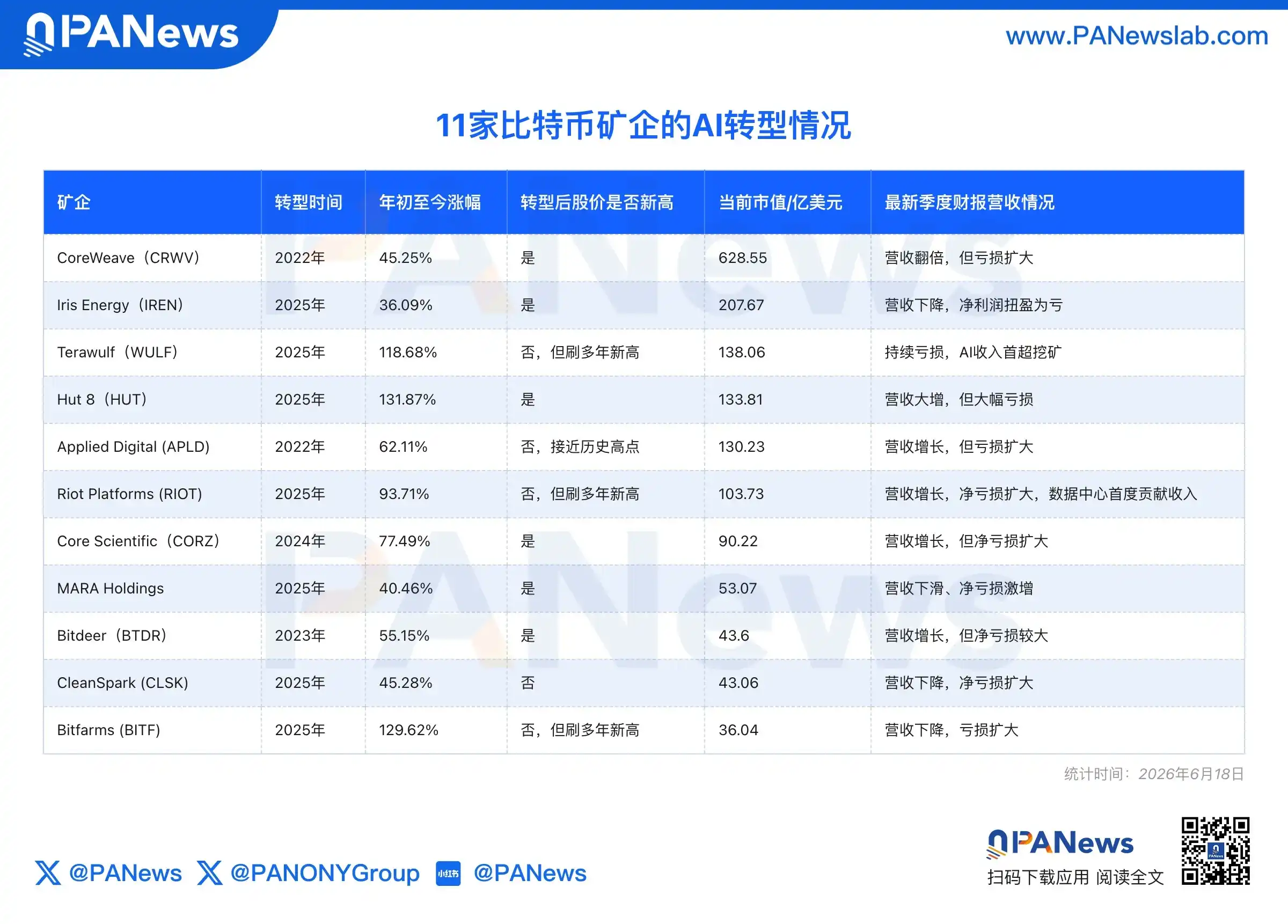
Looking at the timing of transition, CoreWeave, Applied Digital, and Bitdeer began laying out AI computing and data center businesses as early as 2022-2023, among the earlier movers in the industry; while mining firms like Iris Energy, Terawulf, Hut 8, Riot Platforms, and Bitfarms began to fully ramp up AI infrastructure construction in 2025, coinciding with the AI industry's rapid expansion cycle.

In terms of stock performance, the market has shown considerable recognition for the AI transition narrative of mining companies. The 11 mining companies have seen an average year-to-date gain of 75.97%, significantly outperforming Bitcoin over the same period, with most hitting new highs after their transition. Among them, Bitfarms (129.62%), Hut 8 (131.87%), Terawulf (118.68%), and Riot Platforms (93.71%) have been particularly standout performers, benefiting from this wave of AI infrastructure revaluation.

In terms of market capitalization, mining companies have shown clear divergence. As a representative of successful transition, CoreWeave's market cap has reached $62.855 billion, far exceeding other miners and setting a new valuation benchmark for the industry; Iris Energy, Terawulf, Hut 8, Applied Digital, and Riot Platforms form a tier with market caps between $10 billion and $20 billion; companies like MARA Holdings, Core Scientific, Bitdeer, CleanSpark, and Bitfarms remain in the sub-$5 billion range. This divergence stems not only from first-mover advantages but also reflects the market's differentiated pricing based on each mining company's AI strategy execution capabilities, client resources, and data center deployment progress.

However, from a fundamental perspective, most mining companies are still in the heavy investment phase of their AI transition. Although the latest quarterly earnings reports of many miners show revenue growth, overall profitability remains under pressure. On one hand, volatility in the value of crypto asset portfolios weighs on profit performance; on the other hand, the construction of AI data centers requires massive capital expenditures, with costs for power expansion, infrastructure development, and procurement of equipment like GPUs continuously increasing, driving up operating costs and leaving most mining companies yet to escape a loss-making state.

It is noteworthy that despite generally pressured earnings performance, the stock prices of related mining companies have still risen significantly, indicating that the current market focus is not on short-term profitability but rather on the growth potential of mining companies as operators of next-generation computing power infrastructure.

Mining Companies' Survival Battle Escalates, AI Transition Requires Overcoming Multiple Hurdles

The downturn in the Bitcoin market is making the survival environment for mining companies increasingly severe.
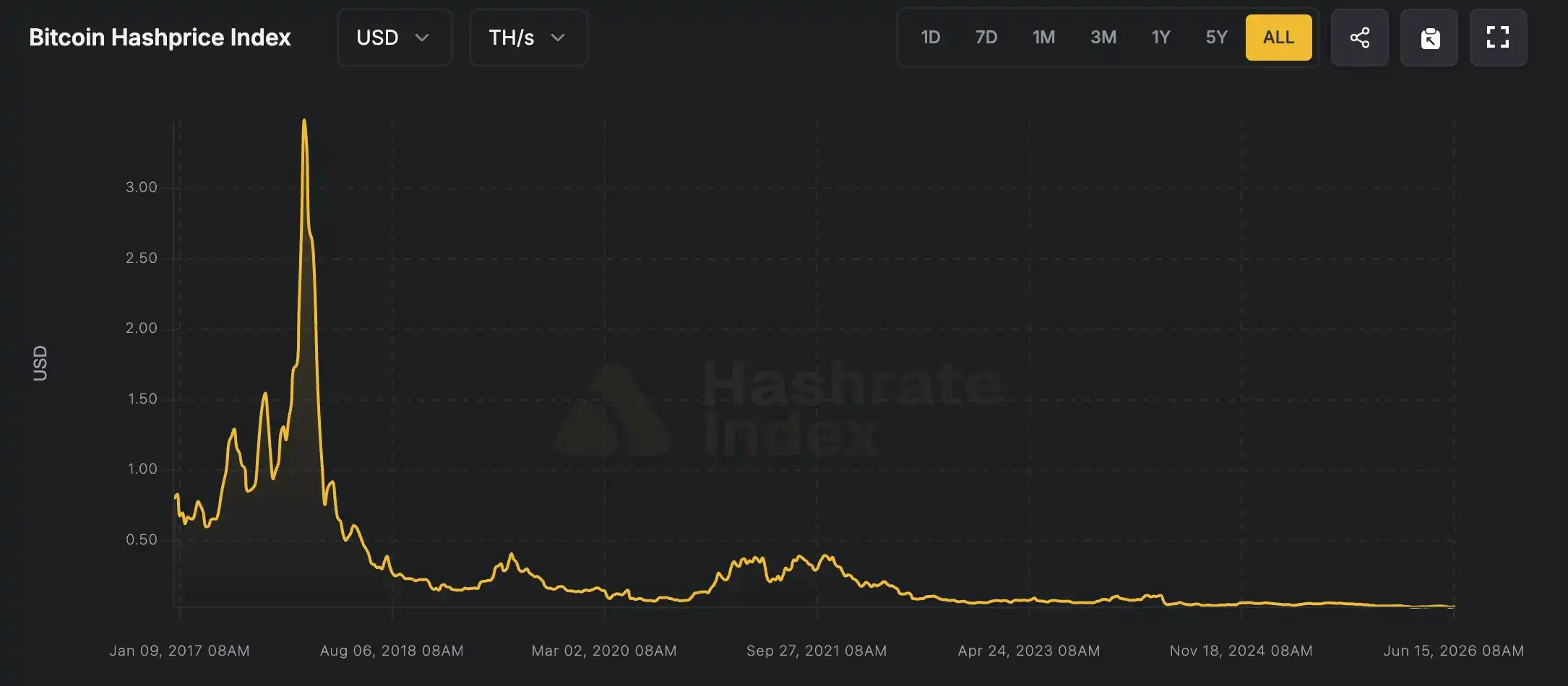
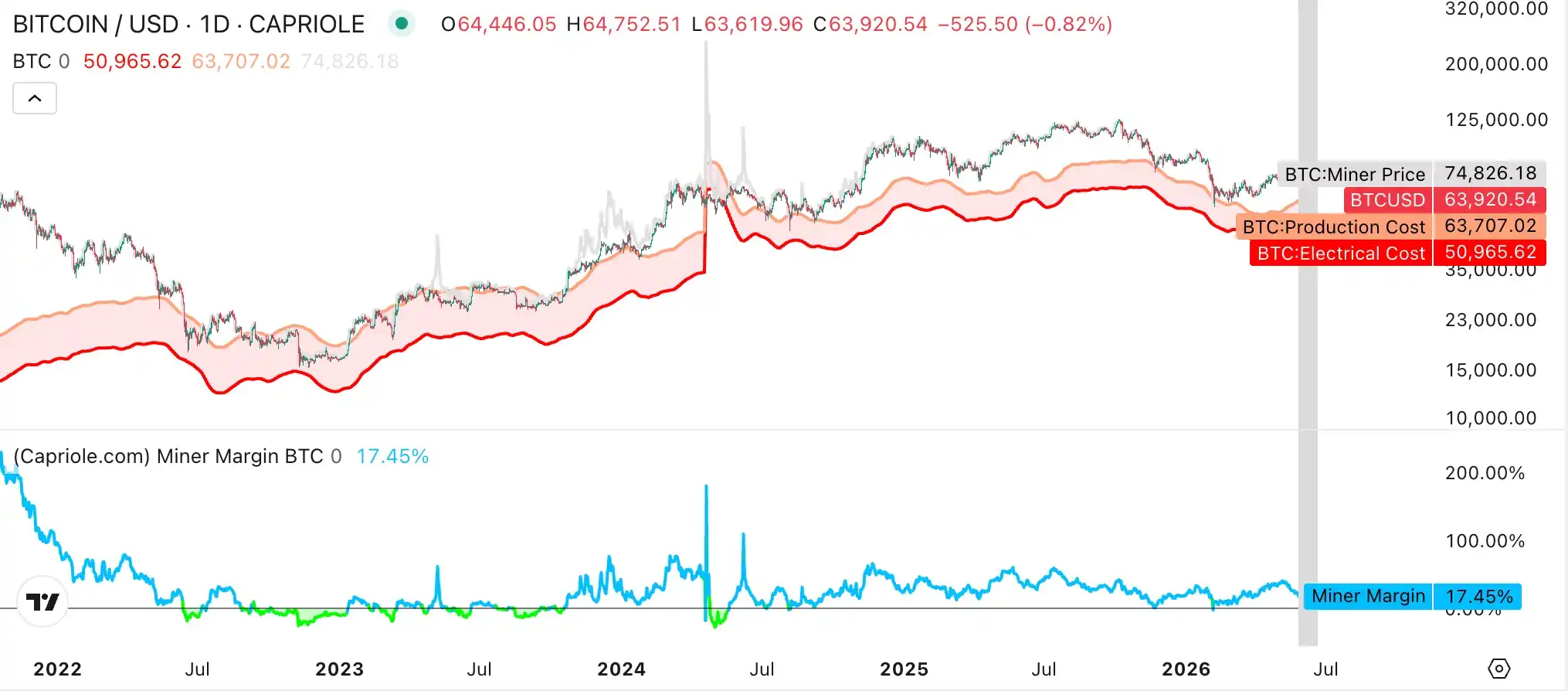
Data from Capriole Investments shows that as of June 18, the average production cost for Bitcoin is approximately $63,707, with power costs around $50,965, resulting in a miner profit margin of only 17.45%. Over the past 30 days, miner profit margins have contracted by 47.8%. Meanwhile, data from the Luxor Hashrate Index also shows that as of June 18, the daily revenue per 1 TH/s of hashrate has dropped to $0.032, a significant decline from $0.053 during the same period last year.
As mining revenues continue to shrink, many mining companies have had to sell Bitcoin to maintain cash flow, further increasing survival pressure on small and medium-sized miners, and mining resources are accelerating their concentration towards top players. Currently, the three major mining pools—Foundry USA, AntPool, and F2Pool—collectively account for 59% of the global network's hashrate share. In comparison, in 2022, the top three Bitcoin mining pools collectively accounted for only 44% of the hashrate share.

Although traditional mining operations are struggling, the explosive growth in demand for AI data centers is also driving a market re-evaluation of mining companies' value. VanEck points out in its latest research report that the most valuable assets of mining companies are not their mining rigs, but rather their power resources, substation access capabilities, land reserves, and data center infrastructure—precisely the scarce core resources most needed by the current AI industry. Because AI clients are willing to pay electricity and rental rates far higher than those of traditional mining operations, AI infrastructure is expected to become the primary growth engine for mining companies over the next decade.

According to a report from research firm Bernstein, hyperscale cloud providers, AI cloud service providers, and chip companies have announced over $90 billion in AI infrastructure partnerships, involving approximately 3.7 GW of power capacity. Currently, the pursuit of power resources has become the core of AI infrastructure competition, with Bitcoin mining companies collectively controlling over 27 GW of planned power capacity. In some parts of the United States, the cycle for securing new 1 GW power connections can be as long as 50 months, making existing mining sites important landing spots for AI data center expansion.

However, the transition to AI is far from an easy path. VanEck states that the market is still in the early stages of the AI transition, with enterprise valuations primarily measured based on Gross Energized Power. Mining companies that have signed AI leases generally receive higher valuation premiums, while projects still in the planning stage struggle to gain market recognition. Future industry valuation logic will gradually shift from "power capacity" to "project delivery capability," eventually returning to core metrics such as cash flow, return on capital, and tenant quality. Currently, the industry has only delivered about 25% of its signed capacity. The ability to complete AI data center construction on time and within budget will become a key factor determining enterprise valuation.

VanEck also emphasizes that AI tenant quality will directly impact the valuation levels of mining companies. Clients like Microsoft, Amazon, and Google—hyperscale cloud providers—can bring more stable cash flows and lower financing costs, while smaller GPU cloud service providers correspond to higher operational risks and capital costs.

Meanwhile, the enormous funding required for the transition is testing the financial strength of mining companies. VanEck estimates that mining companies transitioning to AI infrastructure still face massive capital expenditure needs, with a short-term funding gap of approximately $50 billion and long-term capital requirements potentially reaching $221 billion.

Under immense financial pressure, many mining companies have begun raising funds through various methods. For instance, miners like Iris Energy, TeraWulf, Bitfarms, and CleanSpark have raised capital through issuing convertible bonds, attracting investors with low coupon rates and future conversion potential; while companies like Core Scientific, Terawulf, MARA, Bitdeer, and Riot Platforms have chosen to sell off or even liquidate part of their Bitcoin reserves to continually fuel their AI transitions.

Additionally, many mining companies are beginning to secure future revenue by signing long-term AI or high-performance computing (HPC) contracts, thereby obtaining project financing support and reducing overall operational risks. For example, CoreWeave reached a $6 billion AI cloud services cooperation agreement with Jane Street; IREN secured a $9.7 billion AI cloud computing contract with Microsoft; Hut 8 signed data center leasing agreements totaling $9.8 billion; and Bitdeer is collaborating with Norway's DCI to build the country's largest AI data center project.

For mining companies, AI currently offers a development path with far greater imagination space than traditional mining operations. However, this transition is not a simple switch from mining to selling computing power; it is essentially a long-term competition centered on capital, resources, and execution capabilities.


Трендовые криптовалюты

Связанные с этим вопросы

QWhat are the main challenges cryptocurrency mining companies face when transitioning to the AI infrastructure sector?

AThe main challenges include significant capital expenditures, continuous financial investment, prolonged return periods, intense competition for capital, resources, and execution capabilities, and the need to transition from a valuation based on 'power capacity' to 'project delivery capability' and ultimately to core financial metrics such as cash flow and capital returns.

QWhy are cryptocurrency mining companies considered to have natural advantages in transitioning to AI infrastructure?

AMining companies possess key assets like extensive power resources, land reserves, substation access capabilities, and mature cooling systems built for large-scale mining operations. This allows them to upgrade existing facilities to enter the AI infrastructure market more quickly and at a lower cost compared to starting from scratch.

QHow has the stock market performance of mining companies transitioning to AI compared to Bitcoin's performance?

AThe stock prices of mining companies transitioning to AI have significantly outperformed Bitcoin. The average year-to-date increase for 11 such companies was 75.97%, far exceeding Bitcoin's performance during the same period. Many saw their stock prices reach new highs following their AI transition announcements.

QAccording to the article, what is the new basis for valuing mining companies that are pivoting to AI, and how might this evolve?

ACurrently, valuation is primarily based on 'Gross Energized Power.' However, it is expected to shift towards 'project delivery capability' and eventually return to core financial indicators like cash flow, return on capital, and the quality of AI tenants or clients secured by the company.

QWhat methods are mining companies using to finance their expensive transition into AI infrastructure?

AMining companies are raising funds through various methods, including issuing convertible bonds (e.g., Iris Energy, TeraWulf), selling or liquidating part of their Bitcoin reserves (e.g., Core Scientific, Riot Platforms), and securing large, long-term contracts with AI or HPC clients (e.g., CoreWeave, Hut 8) to lock in future revenue and facilitate project financing.

Похожее

TechFlow Разведслужба: Шансы на IPO Anthropic превышают 80%, Иран вновь перекрывает Ормузский пролив, вызывая волатильность цен на нефть

Технологические новости: ожидается IPO Anthropic в 2026 году, рынок обсуждает сосуществование её заявленной ценности в области безопасности ИИ с потенциальной триллионной оценкой. Набирают популярность виртуальные инфлюенсеры, созданные ИИ. Маск заявляет о необходимости астрономических инвестиций в антиматерию для межзвёздных путешествий. Крипто/Web3: Иран объявил о закрытии Ормузского пролива, вызвав волатильность на нефтяном рынке, однако данные о движении судов показывают неоднозначную картину. Одновременно Иран возобновил погрузку нефти на острове Харг, что может увеличить предложение. На рынке чипов: Goldman Sachs предупреждает о возможном приближении к пределу кредитования масштабных расходов на ИИ-инфраструктуру. Корпоративные новости: Cloudflare представил функцию временных аккаунтов для ИИ-агентов. Google сообщает, что более 50% его трафика теперь использует IPv6. Hyundai Motor Group планирует полный выкуп Boston Dynamics. Рынок акций: частные инвесторы активно вкладываются в акции SpaceX. В Европе зафиксирован первый с 2008 года дефолт по акциям CLO. Макроэкономика: Украина атаковала нефтяные объекты в Крыму и Краснодарском крае. Nomura предупреждает о возможном резком ужесточении политики ФРС. Общая тенденция: глобальная ликвидность сокращается на фоне роста предельных издержек в энергетике, кредитовании и технологиях, в то время как капитал продолжает искать новые масштабные возможности для роста.

marsbit38 мин. назад

TechFlow Разведслужба: Шансы на IPO Anthropic превышают 80%, Иран вновь перекрывает Ормузский пролив, вызывая волатильность цен на нефть

marsbit38 мин. назад

Соотношение ETH/BTC упало до уровней начала 2023 года на фоне дебатов о стоимости Ethereum

Курс ETH/BTC упал до уровня начала 2023 года, достигнув отметки 0.027. По сравнению с пиком 2021 года в 0.088 это означает, что Ethereum сейчас выглядит исторически дешевым по отношению к Bitcoin. Аналитик Woetoe задается вопросом, является ли это возможностью для контрарианских инвестиций или признаком структурного снижения. Одновременно с этим график ETH/USDT указывает на риск коррекции. По данным SwallowAcademy, после агрессивного недельного открытия цена может откатиться, при этом была нарушена структура рынка. План предполагает возможную продажу при повторном тестировании зоны $1723 с целью коррекции до $1660. Таким образом, сложилась противоречивая ситуация: Ethereum кажется недооцененным относительно Bitcoin, но при этом испытывает давление на долларовой паре. Для быков ETH первоочередной задачей является не обсуждение оценки, а восстановление технической силы и возобновление роста относительно BTC.

bitcoinist44 мин. назад

Соотношение ETH/BTC упало до уровней начала 2023 года на фоне дебатов о стоимости Ethereum

bitcoinist44 мин. назад

Охотник сам становится добычей: самый прибыльный MEV-бот был взломан

**Взлом высокодоходного MEV-бота Jaredfromsubway.eth: убыток составил $7.5 млн** Знаменитый и печально известный MEV-бот Jaredfromsubway.eth, один из самых активных и прибыльных на сети Ethereum, стал жертвой сложной цепной атаки, потеряв более 7.5 миллионов долларов. Атака, произошедшая в субботу, не была традиционным фишингом или эксплуатацией уязвимости смарт-контракта. Вместо этого злоумышленники применили целенаправленную «контр-MEV-атаку с помощью ловушки» (counter-MEV honeypot attack). В течение нескольких недель атакующие развернули 66 поддельных контрактов токенов и фальшивых пулов ликвидности, искусно замаскированных под популярные активы, такие как WETH, USDC и USDT. Они создали иллюзию прибыльных арбитражных возможностей. Автоматизированная система бота, обнаружив эти «возможности», выполнила транзакции, в процессе чего предоставила разрешения (approve) контролируемым атакующими вспомогательным контрактам. Не отозвав эти разрешения вовремя, бот оставил свои средства уязвимыми. В итоге атакующие в одной транзакции воспользовались «бэкдором» и вывели ETH, USDC и USDT с адреса бота. Jaredfromsubway.eth был ключевым исполнителем «сэндвич-атак» (Sandwich Attack) в Ethereum, систематически извлекая прибыль из мемпула. По некоторым данным, он был связан с примерно 70% таких атак в сети за последний год и заработал десятки миллионов долларов. Этот инцидент демонстрирует, что даже самые изощренные цепочки атак в криптопространстве теперь сами могут стать мишенью для еще более сложных стратегий. После взлома в X появился фейковый аккаунт, выдав себя за команду бота, что побудило экспертов призвать пользователей к бдительности.

Odaily星球日报2 ч. назад

Охотник сам становится добычей: самый прибыльный MEV-бот был взломан

Odaily星球日报2 ч. назад

Платежная реальность Латинской Америки совсем не такая, как вы думаете

Автор провела почти месяц в Латинской Америке, проведя более 500 часов полевых исследований и пообщавшись с более чем 100 местными пользователями, разработчиками и регуляторами. Ее выводы противоречат распространенным представлениям. 1. Основной объем операций с криптокартами приходится на состоятельных клиентов, которые получают зарплату в долларах или USDT и конвертируют их в местную валюту через Pix, а не на розничные покупки. 2. QR-платежи доминируют в большинстве развивающихся стран (Бразилия, Китай, Индия и др.), тогда как рынки США и Европы все еще ориентированы на карты. Pix в Бразилии обрабатывает больше транзакций, чем кредитные и дебетовые карты вместе взятые. 3. Ключевая нерешенная проблема — отсутствие международной совместимости между системами мгновенных платежей (Pix, UPI, CoDi и др.), что затрудняет платежи иностранцев. 4. Конкуренция смещается от привлечения клиентов к контролю над расчетной инфраструктурой; ведущие компании приобретают банки для ускорения расчетов и снижения затрат. 5. Латиноамериканский рынок крайне неоднороден: Бразилия, Мексика, Аргентина и другие страны имеют разные валютные режимы и модели поведения пользователей. 6. Маржа на конвертацию стабильных монет стремительно сокращается, приближаясь к нулю. Будущие победители создадут ценность поверх дешевых конвертационных услуг. 7. Новые платежные компании должны с самого начала создавать узнаваемый международный бренд и кросс-граничную технологическую платформу. 8. Бразилия и Мексика — перенасыщенные рынки. Перспективными являются менее конкурентные коридоры, такие как "забытая пятерка" стран (Доминикана, Гватемала, Гондурас, Никарагуа, Сальвадор) или маршруты Колумбия-Европа. 9. Маркетинг должен быть точно сегментирован. Например, в Бразилии минимум 5 различных групп пользователей с уникальными денежными потоками и потребностями. 10. Регуляторы Латинской Америки (Бразилия, Мексика, Колумбия) часто опережают США в создании четких рамок для криптовалют и цифровых платежей, стремясь не запрещать, а сделать их безопаснее. Главный вывод: победа в платежной сфере Латинской Америки зависит не от копирования западных моделей, а от понимания локальных реалий, адаптации к доминированию QR-платежей и построения инфраструктуры для международной совместимости.

marsbit2 ч. назад

Платежная реальность Латинской Америки совсем не такая, как вы думаете

marsbit2 ч. назад

Делать музыку в медвежьем рынке: выживающий эксперимент биткоин-группы

В условиях медвежьего рынка криптовалют группа Orange Pill Jam продолжает записывать музыку, сосредоточенную на темах финансового суверенитета, приватности и критики современных систем. Их стиль варьируется от гипси-регги до афро-латинских и хип-хоп ритмов. Несмотря на скромное присутствие на YouTube и Spotify, группа находит отклик в определённых кругах, стремясь создавать музыку, доступную как понимающим, так и не знакомым с биткоином. История началась с импровизированного выступления на конференции Plan B Forum в Лугано в 2022 году. Вокалистка Mermaid, вдохновлённая подкастом Макса Кейзера, написала песню "Dollar Apocalypse". Это событие привело к формированию коллектива с продюсером и мультиинструменталистом Michi, который отвечает за аранжировки и ритм, и менеджером Martino. В песнях, таких как "Cypherpunks' Manifesto" и "Fire of Freedom", группа исследует идеи приватности, опасности "бесплатных" продуктов и личной свободы, находя вдохновение в принятии биткоина Сальвадором. Отношение группы к искусственному интеллекту в музыке философское: они видят в нём инструмент для рутинных задач, но не для подлинного творчества, которое рождается из человеческого намерения и инстинкта. Практические вызовы включают монетизацию по модели copyleft с добровольными взносами в биткоинах, сложности с продвижением в эпоху алгоритмов и поиск подходящих концертных площадок. Их проект представляет собой эксперимент по сохранению человеческого, не поддающегося оптимизации творческого процесса — в медвежьем рынке и эпоху ИИ именно такая аутентичность становится самой ценной валютой.

marsbit2 ч. назад

Делать музыку в медвежьем рынке: выживающий эксперимент биткоин-группы

marsbit2 ч. назад

Торговля

Спот
Фьючерсы

Популярные статьи

Неделя обучения по популярным токенам (2): 2026 может стать годом приложений реального времени, сектор AI продолжает оставаться в тренде

2025 год — год институциональных инвесторов, в будущем он будет доминировать в приложениях реального времени.

1.9k просмотров всегоОпубликовано 2025.12.16Обновлено 2025.12.16

Неделя обучения по популярным токенам (2): 2026 может стать годом приложений реального времени, сектор AI продолжает оставаться в тренде

Обсуждения

Добро пожаловать в Сообщество HTX. Здесь вы сможете быть в курсе последних новостей о развитии платформы и получить доступ к профессиональной аналитической информации о рынке. Мнения пользователей о цене на AI (AI) представлены ниже.

活动图片