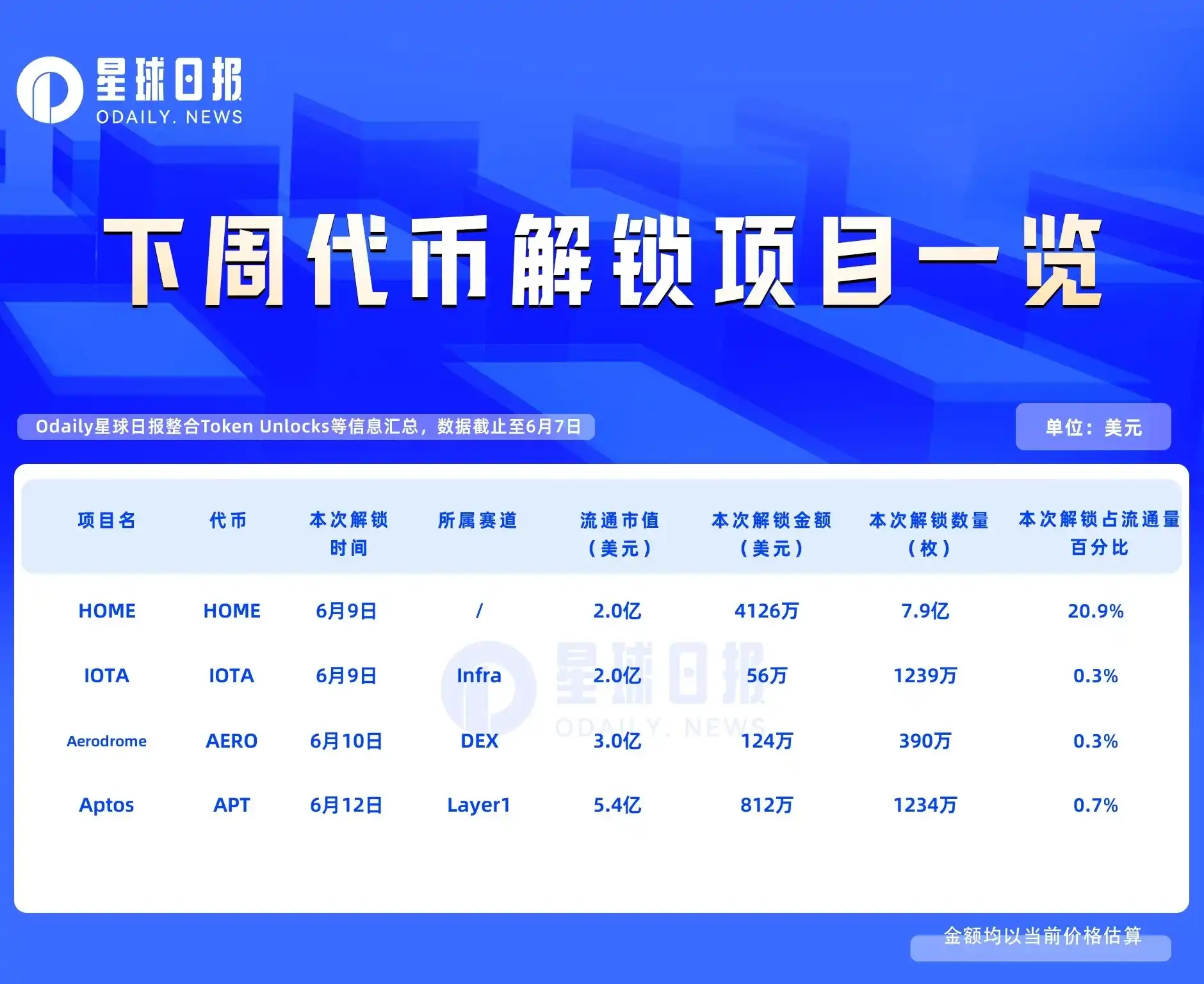
Déblocage de tokens hebdomadaire : HOME débloque des tokens représentant plus de 20% de l'offre en circulation

marsbitОпубликовано 2026-06-07Обновлено 2026-06-07

Введение

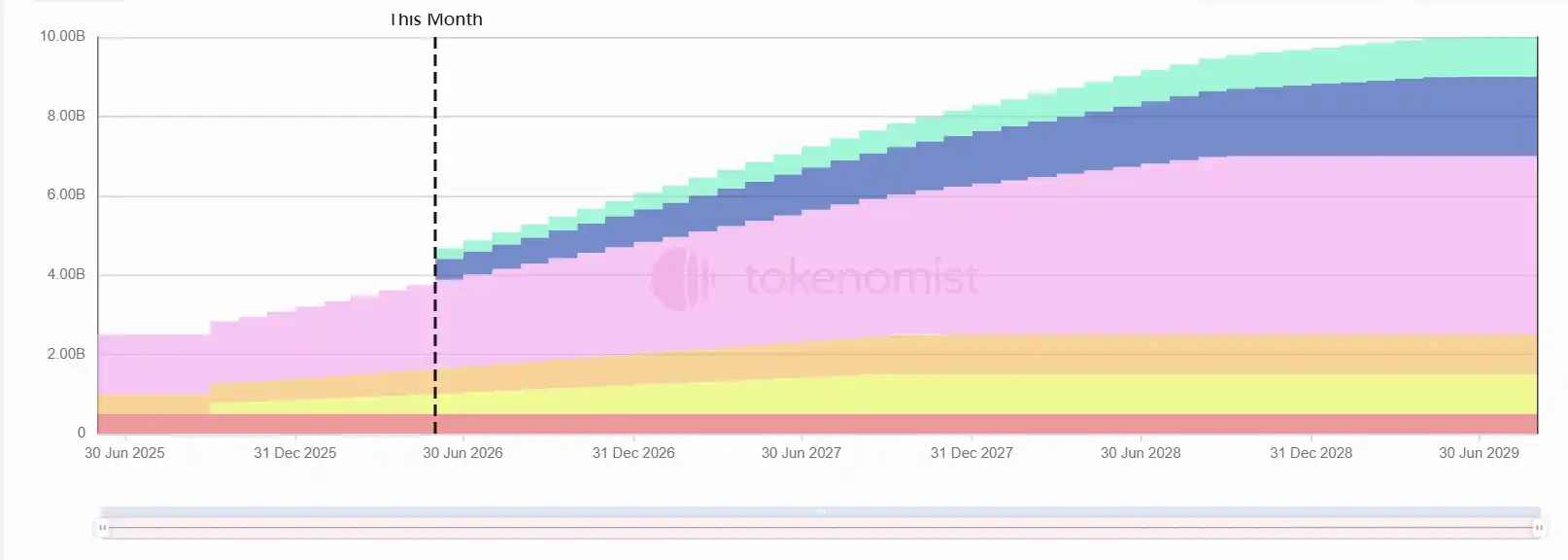
**Defi App : Un déverrouillage majeur de tokens HOME** L'article annonce un important déverrouillage ("unlock") de tokens pour le projet **HOME (DeFi.app)** cette semaine, représentant plus de **20% de l'offre en circulation**. **Détails clés du déverrouillage :** * **Quantité :** 790 millions de tokens. * **Valeur estimée :** Environ 41,26 millions de dollars. **Présentation du projet DeFi.app :** DeFi.app est une plateforme qui vise à simplifier les transactions de finance décentralisée (DeFi) tout en permettant aux utilisateurs de conserver la garde totale de leurs actifs cryptographiques. Elle propose des fonctionnalités telles que l'achat de tokens sur différentes blockchains, des échanges inter-chaînes "instantanés et en un clic", l'accès à des marchés de produits dérivés décentralisés et des opportunités de rendement ("yield") — le tout sans frais de gaz ("gas") ni recours à des ponts ("bridges"). L'article inclut un graphique détaillant la courbe de libération future des tokens (vesting schedule).

Defi App

Compte Twitter du projet :https://x.com/defiapp

Site officiel du projet :https://defi.app/

Quantité débloquée cette fois-ci : 790 millions de tokens

Valeur du déblocage cette fois-ci : environ 41,26 millions de dollars

DeFi.app vise à simplifier les transactions DeFi tout en maintenant la garde complète et autonome des actifs cryptographiques. Via DeFi.app, les utilisateurs peuvent acheter des tokens sur n'importe quelle blockchain, effectuer des transactions inter-chaînes « instantanées, en un clic », accéder aux marchés de produits dérivés décentralisés et obtenir des opportunités de rendement, le tout sans frais de gaz ni nécessité de passer par des ponts.

La courbe de libération spécifique est la suivante :

Связанные с этим вопросы

QQuel est le nom du projet qui va déverrouiller plus de 20% de son offre en circulation ?

AHOME (bien que le nom du projet mentionné plus en détail dans le texte soit DeFi.app, le titre indique HOME pour l'exemple majeur de déverrouillage).

QQuel est l'objectif principal de la plateforme DeFi.app selon l'article ?

ADeFi.app vise à simplifier les transactions DeFi, en permettant aux utilisateurs d'acheter des jetons, d'effectuer des échanges inter-chaînes, d'accéder à des marchés de produits dérivés décentralisés et d'obtenir des opportunités de rendement, le tout sans frais de gaz et sans avoir à utiliser des ponts.

QCombien de jetons HOME vont être déverrouillés au cours de cette période ?

AL'article ne mentionne pas le nombre spécifique pour HOME. Pour le projet détaillé DeFi.app, 790 millions de jetons (7,9 milliards) vont être déverrouillés.

QQuelle est la valeur approximative (en dollars américains) des jetons déverrouillés pour DeFi.app ?

ALa valeur approximative des jetons déverrouillés pour DeFi.app est d'environ 41,26 millions de dollars.

QOù peut-on trouver plus d'informations sur le projet DeFi.app selon l'article ?

AOn peut trouver plus d'informations sur le compte Twitter officiel à l'adresse https://x.com/defiapp et sur le site web officiel du projet à l'adresse https://defi.app/.

Похожее

Has the Cryptocurrency Market Hit Bottom? Here's What Institutions Think

"Has the crypto market bottomed out? Major institutions are divided on the outlook, according to a recent analysis by Matt Hougan, Chief Investment Officer of Bitwise. Three prominent research firms published in-depth reports on the topic with differing conclusions. Galaxy Digital argues Bitcoin has not yet found its bottom, pointing to only 4 out of 13 historical bottoming indicators being met. Their analysis suggests a potential bottom range of $30,000 to $54,000. NYDIG adopts a more cautious stance, noting that while metrics are close to historical bear market lows, a classic panic-selling capitulation event is missing. They acknowledge the possibility of a bottom but consider it unlikely, citing structural changes from institutional adoption. In contrast, Standard Chartered Bank asserts the bottom is already in at around $59,000. Their revised bullish view, predicting a year-end target of $100,000, hinges on anticipated reductions in ETF selling pressure linked to events like a potential SpaceX IPO. Despite the surface-level disagreement on the exact price floor, the reports share significant common ground crucial for long-term investors. All three institutions agree that a market bottom will likely form within the current year, that current prices are closer to the bottom than to previous cycle highs, and that Bitcoin is poised for another major bull cycle in the future. The core takeaway is that while the precise bottom level remains debated, the long-term value proposition for Bitcoin remains strong and may even be strengthening. Key supportive trends include rising global debt, persistent inflation, declining trust in traditional institutions, accelerating digitization, and improving market infrastructure. Therefore, for investors with a long-term horizon, the focus should shift from pinpointing the exact bottom to recognizing that the cycle's peak is likely still ahead, making current levels an attractive entry point for substantial potential upside."

Foresight News9 мин. назад

Has the Cryptocurrency Market Hit Bottom? Here's What Institutions Think

Foresight News9 мин. назад

2029 Finale Prediction: When Cryptocurrency Completely "Vanishes", Who Can Remain in This Financial Upheaval?

By 2029, the crypto industry will have transformed into a largely invisible but foundational layer for traditional finance. This timeline outlines the key shifts from now until then. By mid-2026, the most sought-after assets on-chain will not be traditional tokens, but synthetic perpetual contracts for private, high-growth companies (like SpaceX, OpenAI). These become primary price discovery tools, highlighting the market's craving for real-world asset value. Most altcoins enter a sustained bear market as their fundamental lack of asset-backed value is exposed. In late 2026, the "AI + Crypto" narrative largely fades as AI giants prove they don't need crypto infrastructure, except for prediction markets betting on model performance. Simultaneously, a quiet but significant wave of tokenization for institutional assets (money market funds, private credit) begins. The industry splits into a noisy speculative economy and a silent institutional one. Throughout 2027, major public blockchain foundations pivot decisively to serve institutional clients, building compliance toolkits and sales teams. However, key sectors hit growth ceilings: private perpetual contracts are legally restricted from public promotion, stable币 growth is capped by looming political uncertainty, and tokenization projects remain cautious. In 2028, following a U.S. election assumed to maintain a regulatory (not prohibitive) stance, a pivotal change occurs. After a major liquidation crisis exposes the flaws of synthetic contracts lacking a real-asset anchor, new regulations allow the *public solicitation* of private security sales (secondary market shares) to accredited investors. This creates a legitimate, direct on-ramp for retail capital into previously illiquid private equity. By 2029, the resulting bull market is driven by trading in real, innovative company shares (biotech, robotics, AI labs), not speculative tokens. "Crypto" as a distinct asset class recedes; it becomes the mundane, unseen plumbing for this new global private markets infrastructure. Tokens that survive are those capturing real cash flows from this infrastructure. Speculation persists but is marginalized. The core questions posed at the start are answered: token value is tied to legally enforceable claims on real assets, frontier tech adoption happens via private market channels, and crypto's absorption into traditional finance is marked by its becoming boring and invisible. The key validation for this entire thesis is whether, by late 2028, a legal pathway exists for ordinary accredited investors to access private assets directly.

marsbit52 мин. назад

2029 Finale Prediction: When Cryptocurrency Completely "Vanishes", Who Can Remain in This Financial Upheaval?

marsbit52 мин. назад

After the U.S. Banned Fable 5, Zhipu's Stock Soared 47%

On June 15, Chinese AI company Zhipu's stock surged up to 47.6% in Hong Kong, closing with a 32.82% gain. This sharp rise followed two key industry events. On June 12, Anthropic was compelled by a U.S. government export control order to suspend global access to its latest flagship models, Claude Fable 5 and Claude Mythos 5, impacting developers and businesses reliant on them. The next day, Zhipu announced it was opening access to its new open-source flagship model, GLM-5.2, for all Coding Plan users, with API and model weights (under the MIT license) to follow. The Anthropic incident highlighted a critical shift in the AI industry: beyond raw capability, the stability, continuous accessibility, and control over AI models are becoming equally vital, especially as AI integrates deeper into business workflows. Zhipu's move, emphasizing that "frontier intelligence should not belong to a few nor be subject to arbitrary revocation," positioned its open, accessible model as an alternative. GLM-5.2 focuses on "Long Horizon Tasks" with a 1M context window, aiming for consistency in complex, extended projects. Market analysts suggest this event exposes the risk of dependency on closed-source models subject to single jurisdiction policies, potentially accelerating a shift toward domestic base models and localized deployments. The investment response indicates a new valuation metric is emerging—prioritizing which companies can provide AI capabilities that are not only advanced but also reliably and sustainably accessible.

marsbit53 мин. назад

After the U.S. Banned Fable 5, Zhipu's Stock Soared 47%

marsbit53 мин. назад

Торговля

Спот
Фьючерсы

Популярные статьи

Как купить HOME

Добро пожаловать на HTX.com! Мы сделали приобретение Defi.app (HOME) простым и удобным. Следуйте нашему пошаговому руководству и отправляйтесь в свое крипто-путешествие.Шаг 1: Создайте аккаунт на HTXИспользуйте свой адрес электронной почты или номер телефона, чтобы зарегистрироваться и бесплатно создать аккаунт на HTX. Пройдите удобную регистрацию и откройте для себя весь функционал.Создать аккаунтШаг 2: Перейдите в Купить криптовалюту и выберите свой способ оплатыКредитная/Дебетовая Карта: Используйте свою карту Visa или Mastercard для мгновенной покупки Defi.app (HOME).Баланс: Используйте средства с баланса вашего аккаунта HTX для простой торговли.Третьи Лица: Мы добавили популярные способы оплаты, такие как Google Pay и Apple Pay, для повышения удобства.P2P: Торгуйте напрямую с другими пользователями на HTX.Внебиржевая Торговля (OTC): Мы предлагаем индивидуальные услуги и конкурентоспособные обменные курсы для трейдеров.Шаг 3: Хранение Defi.app (HOME)После приобретения вами Defi.app (HOME) храните их в своем аккаунте на HTX. В качестве альтернативы вы можете отправить их куда-либо с помощью перевода в блокчейне или использовать для торговли с другими криптовалютами.Шаг 4: Торговля Defi.app (HOME)С легкостью торгуйте Defi.app (HOME) на спотовом рынке HTX. Просто зайдите в свой аккаунт, выберите торговую пару, совершайте сделки и следите за ними в режиме реального времени. Мы предлагаем удобный интерфейс как для начинающих, так и для опытных трейдеров.

744 просмотров всегоОпубликовано 2025.06.10Обновлено 2026.06.10

Как купить HOME

Обсуждения

Добро пожаловать в Сообщество HTX. Здесь вы сможете быть в курсе последних новостей о развитии платформы и получить доступ к профессиональной аналитической информации о рынке. Мнения пользователей о цене на HOME (HOME) представлены ниже.

活动图片