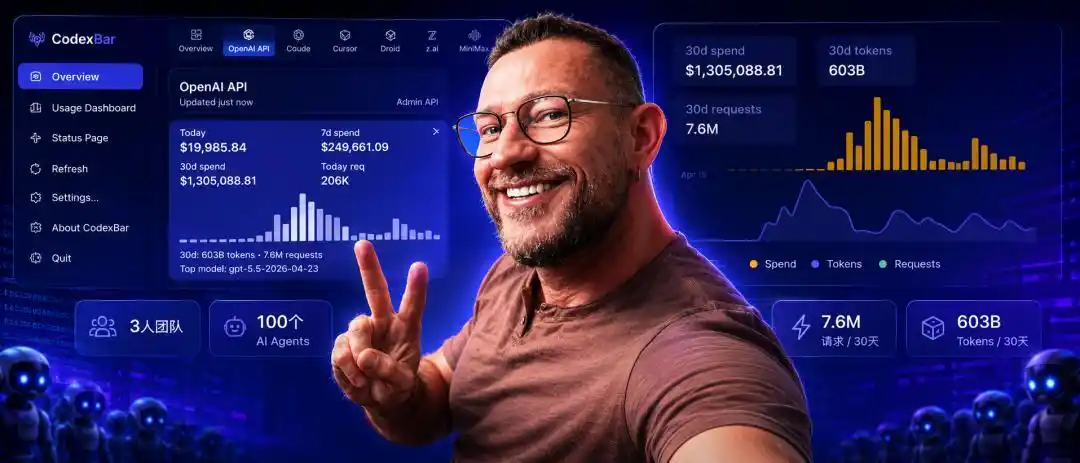
3 Orang dengan 100 Programmer AI, Habiskan $1,3 Juta dalam Sebulan! OpenAI: Saya yang Bayar

marsbitОпубликовано 2026-05-17Обновлено 2026-05-17

Введение

"Peter Steinberger, pencipta OpenClaw, menggegerkan dengan membagikan tagihan AI timnya senilai $1,3 juta hanya dalam 30 hari. Yang mengejutkan, biaya sebesar ini ditanggung oleh OpenAI. Hanya dengan tiga orang di tim, mereka menjalankan sekitar 100 agen AI (instans Codex) yang secara otomatis menangani berbagai tugas pengembangan perangkat lunak yang rumit seperti meninjau permintaan tarik (PR), menemukan bug, memantau benchmark, dan bahkan membuat PR usai rapat. Penggunaan token yang masif—6,03 triliun token dari 7,6 juta permintaan—menunjukkan pergeseran paradigma: token kini menjadi 'bahan produksi' baru. Steinberger melihat ini sebagai eksplorasi tentang bagaimana pengembangan perangkat lunak akan berubah jika biaya token bukan lagi hambatan. Meski biayanya tampak fantastis, ia menyebut dengan menonaktifkan mode cepat, biayanya lebih rendah daripada gaji satu insinyur, namun hasilnya jauh lebih efektif. Fenomena ini memicu diskusi tentang masa depan peran programmer manusia dan potensi revolusi produktivitas ketika tim kecil dapat mengerahkan 'pasukan' agen AI yang tidak pernah tidur."

Peter Steinberger

Editor: Solomon

【Ringkasan Xin Zhi Yuan】3 orang, 100 agen AI, menghabiskan $1,3 juta dalam sebulan—Bapak OpenClaw mengubah pengembangan perangkat lunak menjadi 'jalur produksi AI', dan OpenAI yang membayar tagihannya.

Orang lain memamerkan slip gaji, dia memamerkan tagihan—hampir $1,3 juta per bulan!

Atau setara dengan hampir 9 juta RMB setiap bulannya. Langsung membuat netizen terkejut.

Bapak OpenClaw, Peter Steinberger, dengan santai membagikan tangkapan layar di X.
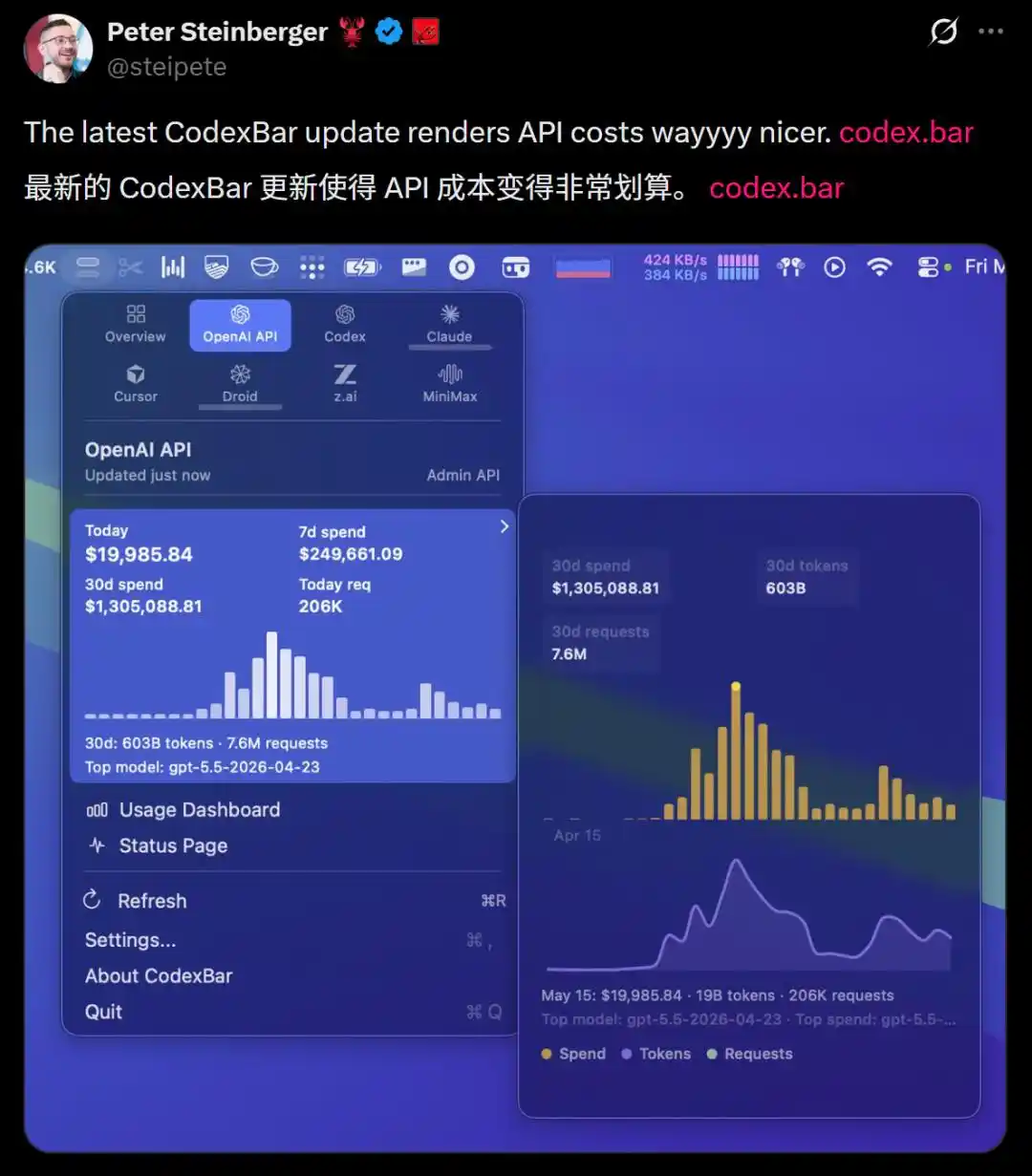
Peter Steinberger

Tapi angka di tangkapan layar itu benar-benar luar biasa:

Pengeluaran 30 hari: $1.305.088,81. Menelan 6,030 miliar token. Mengirimkan 7,6 juta permintaan.

Anda tidak salah baca, ini $1,3 juta dolar AS. Bukan juga anggaran AI triwulanan perusahaan besar mana pun—penggunaan oleh tim 3 orang dalam sebulan.

Yang lebih menggelegar: Uang ini, di-reimburse oleh OpenAI.

Bagian komentar langsung heboh.

Ada yang kagum, ada yang meragukan, ada yang mengeluarkan kalkulator dan mulai menghitung 'ini setara dengan berapa programmer'.

Steinberger sendiri menanggapi dengan tenang: "Setelah mematikan mode cepat, pengeluaran saya lebih rendah dari biaya seorang insinyur, dan ini memang membantu jauh lebih banyak."

Terjemahannya adalah—sangat hemat!

Lebih lagi, netizen terkejut dengan insinyur bergaji $400 ribu per bulan—"Pasar kerja San Francisco terlalu gila."
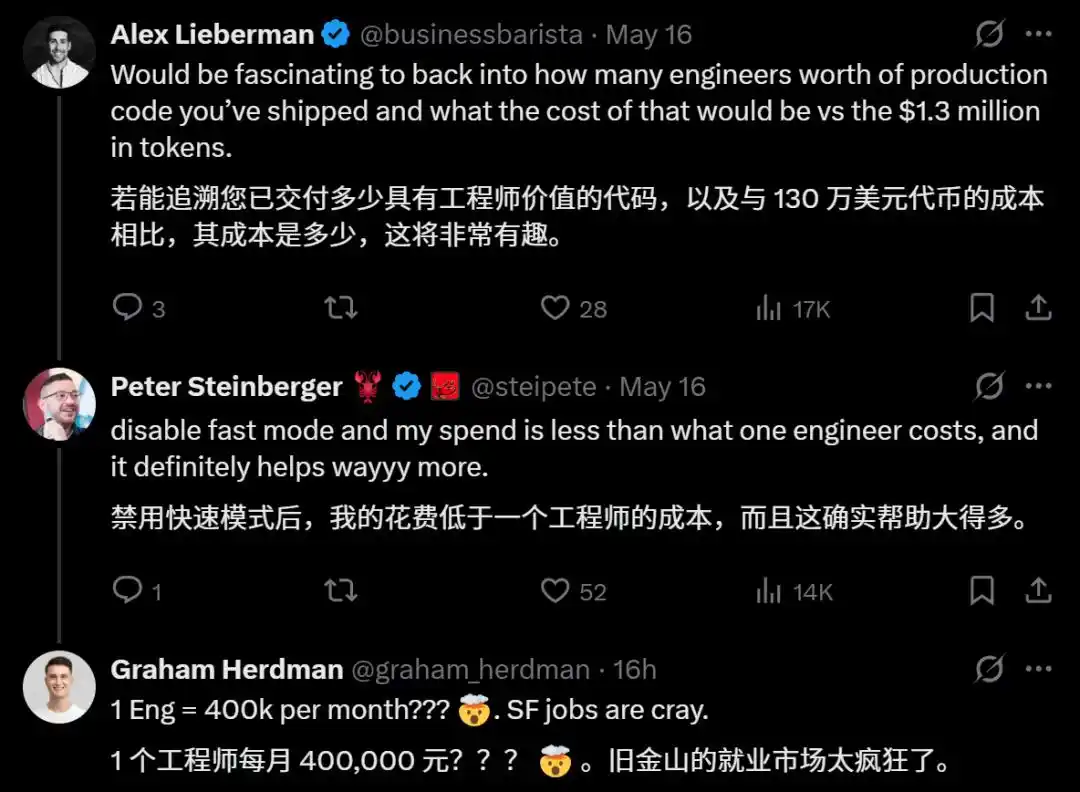
Komentar netizen
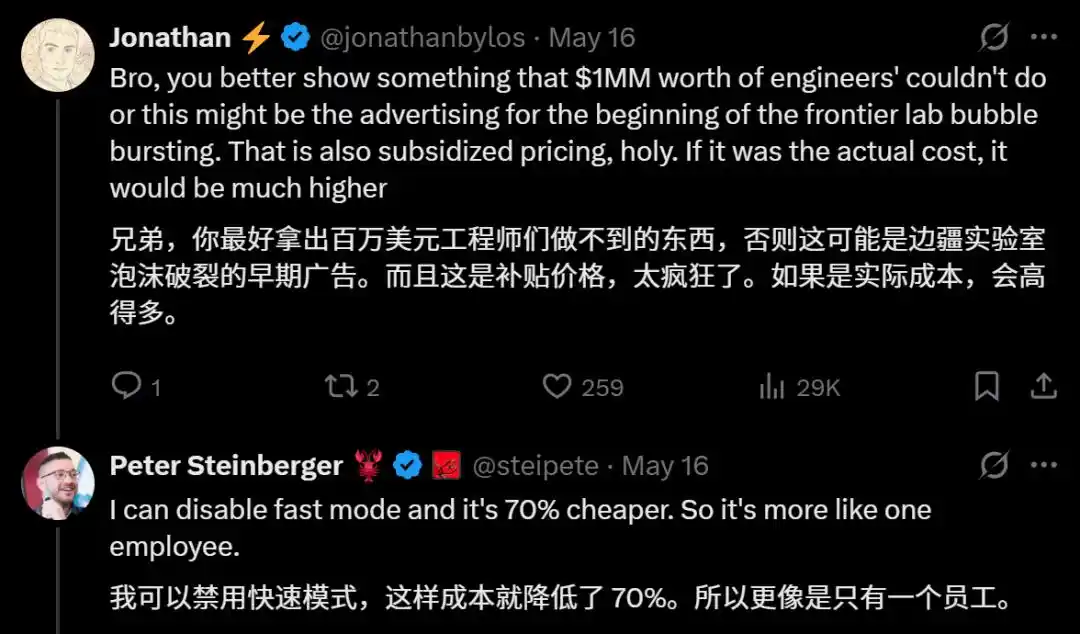
Komentar netizen

Ada juga netizen yang penasaran, untuk apa token dalam jumlah besar ini digunakan.

Peter menjawab sebagian besar digunakan untuk pengembangan OpenClaw.
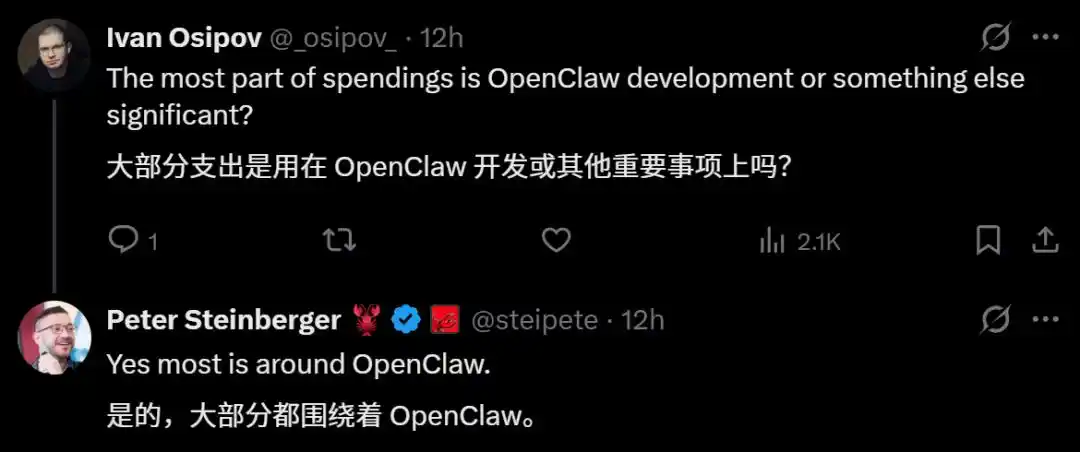
Komentar netizen

Pasukan Programmer di Awan

Yang paling tidak masuk akal dalam hal ini adalah, tim kecil Pete hanya terdiri dari 3 orang.

Mereka terus-menerus menjalankan sekitar 100 instance Codex di cloud, mengerjakan pekerjaan terkotor, paling melelahkan, dan paling menjengkelkan dalam rekayasa perangkat lunak—

Mereview PR, mencari kerentanan keamanan, mende-duplikasi issue, memperbaiki bug, memantau benchmark, mengirim ke Discord setelah menemukan regresi, bahkan langsung membuka PR setelah mendengarkan rapat.

Dengan demikian, AI bukan hanya 'membantu menulis kode', tapi masuk ke setiap celah kolaborasi perangkat lunak.

Ini sangat menakutkan.

Karena yang benar-benar mahal dalam pengembangan perangkat lunak adalah komunikasi, pemahaman, peralihan konteks, peninjauan, regresi, perbaikan, penantian, pekerjaan berulang.

Dulu, banyak waktu tim setiap hari dihabiskan untuk hal-hal yang tampaknya bukan 'kreatif', tapi tanpanya proyek akan berantakan.

Sekarang, Peter melempar semua bagian ini sekaligus ke sekelompok agen AI.

Ini adalah AI yang mulai memelihara sistem saraf suatu organisasi untukmu.

Ilustrasi

Ada satu detail penting dalam tangkapan layar ini: Ini bukan dashboard OpenAI, melainkan CodexBar yang dibuat oleh Peter.

CodexBar adalah alat menu bar macOS untuk melacak jendela penggunaan, kredit, biaya, dan waktu reset berbagai alat pemrograman AI.

CodexBar mendukung banyak layanan seperti Codex, Claude, Cursor, Gemini, Copilot, dll.

Dulu, menu bar programmer berisi apa? CPU, memori, daya baterai, kecepatan internet.

Sekarang ada tambahan satu hal: token. Token sedang berubah menjadi 'alat produksi' baru.
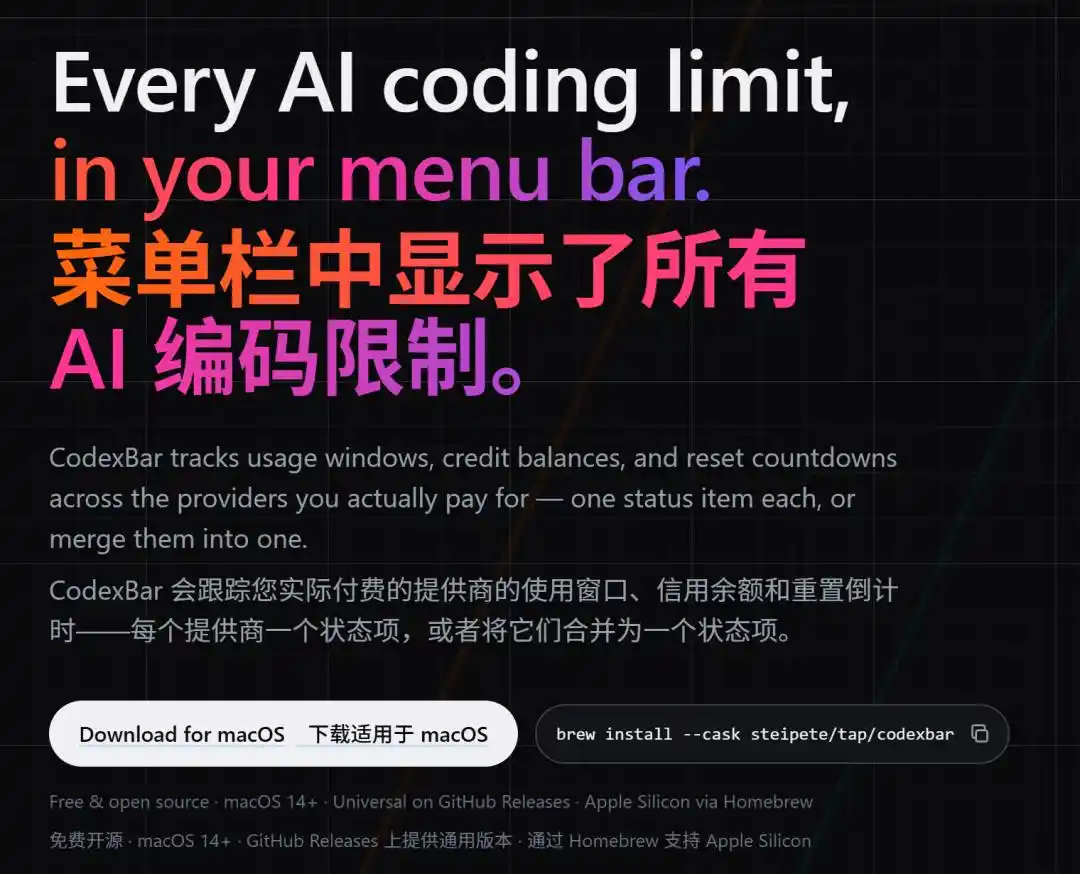
CodexBar

Kata Penutup

$1,3 juta per bulan, 3 orang, 100 agen AI.

Coba renungkan angka-angka ini—tiga manusia, memimpin seratus karyawan digital yang tidak makan, tidak tidur, tidak minta kenaikan gaji, mengerjakan semua pekerjaan satu tim rekayasa.

Ada yang setelah membaca merasa bersemangat: AI akhirnya bukan lagi pajangan yang hanya bisa ngobrol! Ada juga yang setelah membaca merasakan dingin di punggung: Tunggu, kalau begitu kami yang menulis kode ini, nanti ngapain?

Tapi sejujurnya, yang paling membuatku tidak bisa tidur, adalah ucapan Steinberger yang ringan itu: "Saya sedang mengeksplorasi, jika biaya token bukan masalah, pengembangan perangkat lunak akan menjadi seperti apa."
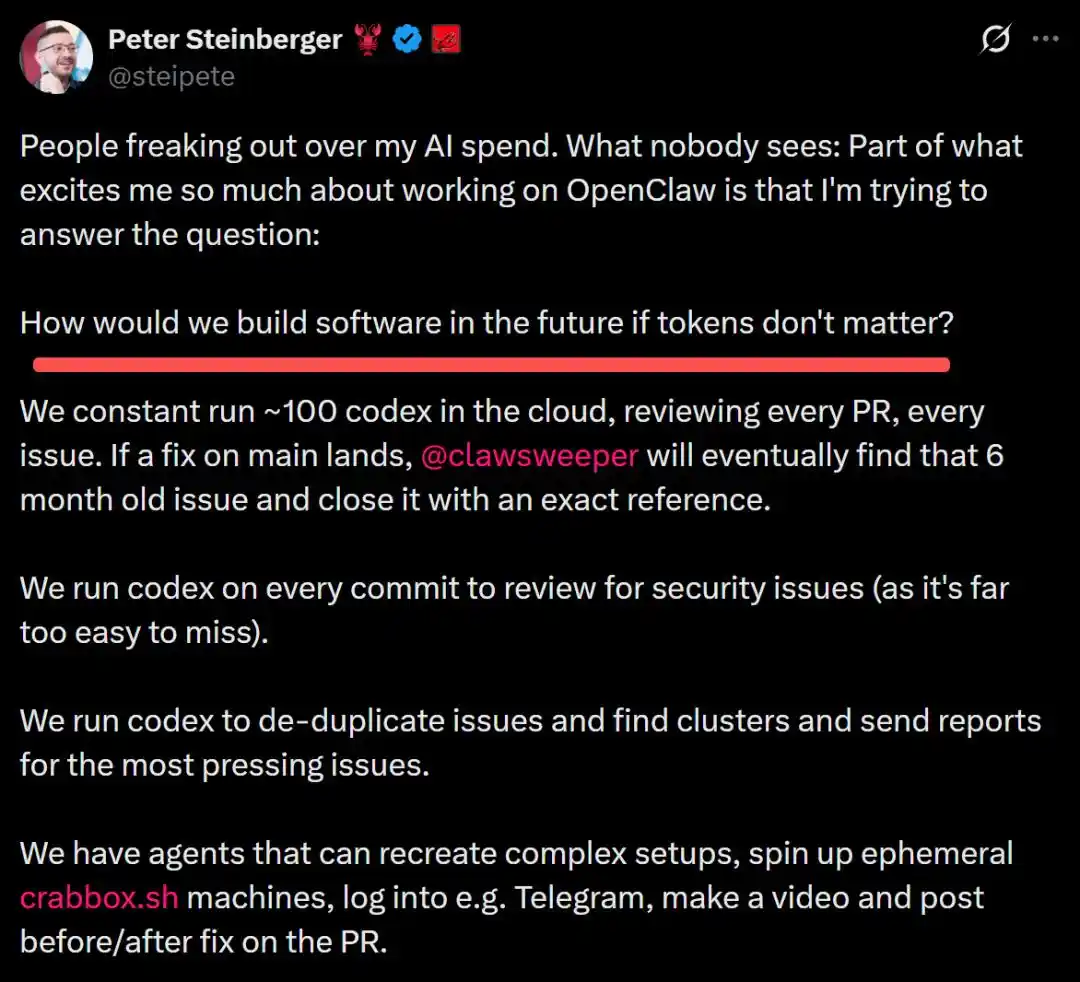
Peter Steinberger

Saudara-saudara, yang dia katakan adalah 'jika'.

Tapi masalahnya, 'jika' ini dengan kecepatan yang terlihat jelas sedang berubah menjadi 'ketika'.

Pekerjaan yang hari ini menghabiskan $1,3 juta, model turun satu putaran harga, $130 ribu. Turun satu putaran lagi, $13 ribu.

Sampai hari itu, 100 agen AI bekerja secara bersamaan, bukan lagi permainan eksklusif para bos Silicon Valley, melainkan operasi dasar tim startup tiga orang mana pun.

Tiga anak muda di garasi, memegang seratus programmer AI yang tidak kenal lelah—gambaran ini, hanya memikirkannya saja sudah tidak masuk akal.

Peter Steinberger membuka kartunya.

Di kartu itu tertulis: Masa depan sudah mengetuk pintu, dan dia tidak berniat menunggu Anda siap.

Referensi:

https://the-decoder.com/for-1-3-million-a-month-openclaw-founder-peter-steinberger-runs-100-ai-agents-that-code-review-prs-and-find-bugs/

https://x.com/steipete/status/2055346265869721905

https://developers.openai.com/codex/speed

Artikel ini berasal dari akun WeChat resmi "Xin Zhi Yuan", penulis: Xin Zhi Yuan

Связанные с этим вопросы

QBerapa jumlah pengeluaran yang dikeluarkan oleh tim Peter Steinberger dalam sebulan untuk menjalankan 100 agen AI?

ATim yang terdiri dari 3 orang ini mengeluarkan biaya sebesar $1.305.088,81 dalam 30 hari untuk menjalankan sekitar 100 agen AI.

QSiapa yang membiayai pengeluaran sebesar 130 juta dollar AS tersebut?

APengeluaran sebesar 130 juta dollar AS tersebut dibayar atau ditanggung oleh OpenAI.

QTugas-tugas apa saja yang dilakukan oleh 100 agen AI dalam pengembangan perangkat lunak ini?

AAgen-agen AI tersebut menangani berbagai tugas pengembangan perangkat lunak seperti meninjau pull request (PR), mencari kerentanan keamanan, menghapus duplikasi issue, memperbaiki bug, memantau benchmark, melaporkan regresi ke Discord, dan bahkan membuat PR langsung setelah rapat.

QApa itu CodexBar dan apa fungsinya?

ACodexBar adalah alat bilah menu macOS yang dibuat oleh Peter Steinberger. Fungsinya adalah untuk melacak penggunaan, kredit, biaya, dan waktu reset dari berbagai alat pemrograman AI seperti Codex, Claude, Cursor, Gemini, dan Copilot.

QApa dampak potensial dari eksperimen ini terhadap masa depan pengembangan perangkat lunak menurut artikel?

AEksperimen ini menunjukkan masa depan di mana, dengan biaya token yang semakin turun, tim kecil dapat menggunakan banyak agen AI untuk mengotomatisasi sebagian besar pekerjaan pengembangan perangkat lunak, mengubah secara radikal cara kerja dan struktur biaya dalam industri ini.

Похожее

When Futu Turns into a Matchmaking Corner: Overseas Identity Becomes the Hard Currency for the Middle Class

When Futu Becomes a Matchmaking Corner: Overseas Status as the New Hard Currency for China's Middle Class Following a severe penalty announcement from Chinese regulators on May 22nd targeting offshore brokerages like Futu, its app community unexpectedly transformed into an impromptu matchmaking platform. Users posted相亲 (matchmaking) requests, explicitly seeking partners with overseas residency or citizenship, revealing a stark new reality: for China's middle class, an overseas identity has become a crucial asset. The regulatory crackdown, which restricts mainland Chinese residents from opening new accounts to buy overseas securities like US stocks, has sharply escalated the value of a foreign passport or permanent residency. This status now acts as a gateway to global asset allocation—including US equities, offshore property, and foreign currency deposits—effectively becoming a new form of "hard currency." Its scarcity, non-transferability (except through marriage, inheritance, etc.), and role as a hedge against domestic uncertainty have driven its premium. The article traces the evolution of how China's middle class views overseas resources: from an investment for opportunity (2000s), to risk diversification (2010s), and now to a mandatory "insurance policy" for financial access. With the regulatory window closing for many, the demand is shifting towards securing such status for the next generation through international education. The surreal scene of high-performing investors posting dating resumes underscores a 2026 where financial talent can be secondary to the right passport.

marsbit29 мин. назад

When Futu Turns into a Matchmaking Corner: Overseas Identity Becomes the Hard Currency for the Middle Class

marsbit29 мин. назад

Understanding Bound in One Article: The "Multi-signature + Timelock" Escape Mechanism and the Off-Chain Matching Black Box

**Title**: Understanding Bound: The Escape Mechanism of "Multi-Sig + Time Lock" and the Off-Chain Matching Black Box **Summary**: Bound Exchange, evolved from the earlier radFi platform, introduces a novel approach to Bitcoin trading by combining self-custody security with exchange-like speed. Its core mechanism relies on a 2-of-2 multi-signature (multi-sig) address for user deposits. One private key is held by the user via a passkey, and the other is held by Bound. This setup requires both keys to sign any transaction, preventing Bound from unilaterally accessing user funds (non-custodial). To address the risk of Bound becoming unavailable, a 3-month timelock is integrated into the Bitcoin script. After this period, users can withdraw their assets with just their single signature, ensuring an escape hatch. For trading, Bound operates a concentrated liquidity AMM. However, as Bitcoin L1 lacks smart contracts, the AMM curve, liquidity management, and trade price calculations occur off-chain in Bound's backend database. On-chain Bitcoin transactions serve only as final settlement receipts for pre-determined amounts. This creates a centralization point: the critical sequence of trade execution—which determines the exact price along the curve for each order—is managed off-chain by Bound in a non-transparent "black box." While the 2-of-2 setup protects user本金 (principal), the pricing and ordering of trades introduce potential operational MEV risks, as the order processing is invisible and unverifiable on-chain. In practice, users can also connect external wallets (like Unisat) for fully self-custodied trading, but this requires manually signing every transaction. The platform currently supports deposits of BTC and Runes only.

marsbit34 мин. назад

Understanding Bound in One Article: The "Multi-signature + Timelock" Escape Mechanism and the Off-Chain Matching Black Box

marsbit34 мин. назад

Amid Internal and External Challenges, Is Ethereum's Neutral Route Still Viable?

"Ethereum is facing a dual crisis of market pressure and internal challenges. Its native token ETH is in a mid-term downtrend, with negative sentiment prevailing, weak price action, and significant outflows from ETFs. The ETH/BTC ratio has hit a ten-month low, and institutional holdings have shrunk. Concurrently, the Ethereum Foundation has seen a major exodus of core personnel following its commitment to a neutral, non-commercial development roadmap focused on censorship resistance, openness, privacy, and security (CROPS). This stance has sparked debate. Critics, including former members, argue that the ecosystem lacks a dedicated, well-funded entity to promote ETH's commercial value and compete with rival chains. Proposals suggest creating a new, independent body to drive adoption and token value, forming a dual-model with the Foundation. While some investors view the personnel changes as normal turnover and remain bullish on Ethereum's long-term fundamentals, the immediate path forward is unclear. Analysts believe Ethereum must execute its technical roadmap (like upcoming upgrades), clarify governance, and focus on high-value sectors like DeFi and tokenization to convert its technological edge into a compelling investment thesis. The current downturn tests whether its decentralized model can adapt to balance core principles with commercial competitiveness."

marsbit40 мин. назад

Amid Internal and External Challenges, Is Ethereum's Neutral Route Still Viable?

marsbit40 мин. назад

Technology Has No Barriers, 24/7 Trading is the Key to Hyperliquid's Success

The article argues that Hyperliquid's competitive edge lies not in technological superiority but in its 24/7 trading model, which fundamentally challenges traditional finance's fixed market hours. Based in Singapore with an 11-person team, Hyperliquid has generated significant revenue and trading volume. Its core advantage is the ability to facilitate trading continuously, including during weekends when major exchanges like the CME are closed. This was demonstrated when Hyperliquid listed a SpaceX pre-IPO perpetual contract on a Sunday, allowing the market to price the company hours before traditional institutions opened. This disruption has drawn regulatory scrutiny from traditional giants like CME and ICE, who cite risks like lack of KYC and market manipulation. However, the article suggests their concern stems from Hyperliquid eroding the "time monopoly" of established markets. The piece contrasts Hyperliquid's synthetic derivatives—pure price-betting contracts with no underlying asset or centralized issuer—with other models like PreStocks (dependent on real股权) and Ondo (licensed but targetable). Hyperliquid's code-based, decentralized structure makes it resilient to takedowns, even if founders face legal action. Ultimately, the author concludes that while it raises legitimate regulatory questions, Hyperliquid's "unforgeable" competitive barrier is the time advantage of non-stop trading, a feature legacy systems cannot replicate.

marsbit40 мин. назад

Technology Has No Barriers, 24/7 Trading is the Key to Hyperliquid's Success

marsbit40 мин. назад

New Information Laundering in Prediction Markets: How Secrets Blend into Investment Signals

"The New Information Laundering in Prediction Markets: How Secrets Infiltrate Investment Signals In late February 2026, nine linked anonymous wallets on Polymarket placed over 80 bets on specific details of a US-Iran war, winning over $2.4 million with a 98% win rate. This exemplifies 'information laundering'—a destructive flaw inherent to prediction markets. These markets function by aggregating trader supply and demand on an order book to set prices, which represent collective probability estimates. This makes them valuable real-time sentiment indicators for institutions. However, the system cannot distinguish between public information and stolen secrets. Confidential information enters one end, and 'clean' market prices—bearing no trace of their illicit origin—emerge from the other. For example, an insider knowing of an imminent strike can buy contracts at low odds, pushing the price up and disguising the secret as a savvy market signal, then profit massively when the event occurs. Analysts can sometimes uncover these schemes due to the blockchain's transparency, as seen with Bubblemaps. Paradoxically, this same transparency can inadvertently broadcast secrets to adversarial observers, providing them with low-cost intelligence. Current laws, like insider trading regulations focused on corporate information, fail to address this issue, especially concerning events like military actions with no 'issuer.' Jurisdictional challenges are amplified as platforms operate offshore, easily bypassing national bans with VPNs. Recent US congressional investigations and proposed bills aim to ban war betting and trading on non-public information by officials. The core issue is that information laundering is not a bug but a feature: a market that perfectly converts knowledge into price will inherently reward those with the best information, including those who obtained it illicitly. As prediction markets grow, potentially reaching hundreds of billions in volume, society must confront whether it can tolerate a machine that profitably transforms its most guarded secrets into public, tradable numbers."

链捕手48 мин. назад

New Information Laundering in Prediction Markets: How Secrets Blend into Investment Signals

链捕手48 мин. назад

Торговля

Спот
Фьючерсы

Популярные статьи

Как купить BILL

Добро пожаловать на HTX.com! Мы сделали приобретение Billions Network (BILL) простым и удобным. Следуйте нашему пошаговому руководству и отправляйтесь в свое крипто-путешествие.Шаг 1: Создайте аккаунт на HTXИспользуйте свой адрес электронной почты или номер телефона, чтобы зарегистрироваться и бесплатно создать аккаунт на HTX. Пройдите удобную регистрацию и откройте для себя весь функционал.Создать аккаунтШаг 2: Перейдите в Купить криптовалюту и выберите свой способ оплатыКредитная/Дебетовая Карта: Используйте свою карту Visa или Mastercard для мгновенной покупки Billions Network (BILL).Баланс: Используйте средства с баланса вашего аккаунта HTX для простой торговли.Третьи Лица: Мы добавили популярные способы оплаты, такие как Google Pay и Apple Pay, для повышения удобства.P2P: Торгуйте напрямую с другими пользователями на HTX.Внебиржевая Торговля (OTC): Мы предлагаем индивидуальные услуги и конкурентоспособные обменные курсы для трейдеров.Шаг 3: Хранение Billions Network (BILL)После приобретения вами Billions Network (BILL) храните их в своем аккаунте на HTX. В качестве альтернативы вы можете отправить их куда-либо с помощью перевода в блокчейне или использовать для торговли с другими криптовалютами.Шаг 4: Торговля Billions Network (BILL)С легкостью торгуйте Billions Network (BILL) на спотовом рынке HTX. Просто зайдите в свой аккаунт, выберите торговую пару, совершайте сделки и следите за ними в режиме реального времени. Мы предлагаем удобный интерфейс как для начинающих, так и для опытных трейдеров.

221 просмотров всегоОпубликовано 2026.05.07Обновлено 2026.05.12

Как купить BILL

Обсуждения

Добро пожаловать в Сообщество HTX. Здесь вы сможете быть в курсе последних новостей о развитии платформы и получить доступ к профессиональной аналитической информации о рынке. Мнения пользователей о цене на BILL (BILL) представлены ниже.

活动图片