After 50x Storage Surge, Justin Sun Always Looks to the Next Decade

marsbitОпубликовано 2026-05-11Обновлено 2026-05-11

Введение

Sun Yuchen, known for his controversial stunts like a $30 million lunch with Warren Buffett (canceled due to a kidney stone) and eating a $6.2 million duct-taped banana, is often overshadowed by a significant fact: his decade-long track record of spotting major investment trends. In 2016, he famously advised young people to invest in Bitcoin, Nvidia, Tesla, and Tencent instead of buying property. A hypothetical $20,000 investment in Nvidia and Tesla from that list would now be worth over 50 million RMB. His latest major call was on November 6, 2025, predicting a "50x storage opportunity" tied to the AI boom, which materialized with Sandisk's stock surging nearly 50-fold by 2026. Looking ahead, Sun now focuses on the next frontier: Physical AI. He identifies four key areas: 1. **Embodied AI/Robotics**: He sees this reaching its "iPhone moment," with companies like UBTech and Galaxy General leading in commercialization. 2. **Drones**: Viewed as the first commercially viable form of Physical AI, revolutionizing sectors from warfare (e.g., AeroVironment's Switchblade) to logistics. 3. **Spatial Computing**: Beyond VR, it's about AI understanding physical space, a foundational technology for robotics and autonomous systems, exemplified by Apple's Vision Pro. 4. **Space Exploration**: After a 2025 suborbital flight with Blue Origin, Sun advocates for space as the ultimate frontier, discussing blockchain's potential role in space asset management and data transactions. His in...

Most people in China know Justin Sun from his bizarre stories.

Spending 30 million to have dinner with Warren Buffett, only to cancel at the last minute due to a kidney stone; buying a duct-taped banana for 6.2 million dollars at an auction and eating it in front of everyone at a press conference; investing 75 million dollars to become the largest backer of the Trump family's crypto project, securing a seat at a White House dinner; and at the age of 35, flying past the Kármán line, declaring himself the youngest Chinese commercial astronaut.

There are also many negatives. In 2023, he was sued by the SEC for market manipulation, with accusations including over 600,000 wash trades to inflate the price of TRX and hiring celebrities for promotion without disclosing payments. Currently, he is in a lawsuit with the Trump family-related project WLFI.

These stories spread so widely that they almost overshadowed a serious matter. This man, over the past decade in the secondary capital markets, has almost never missed betting on any trend.

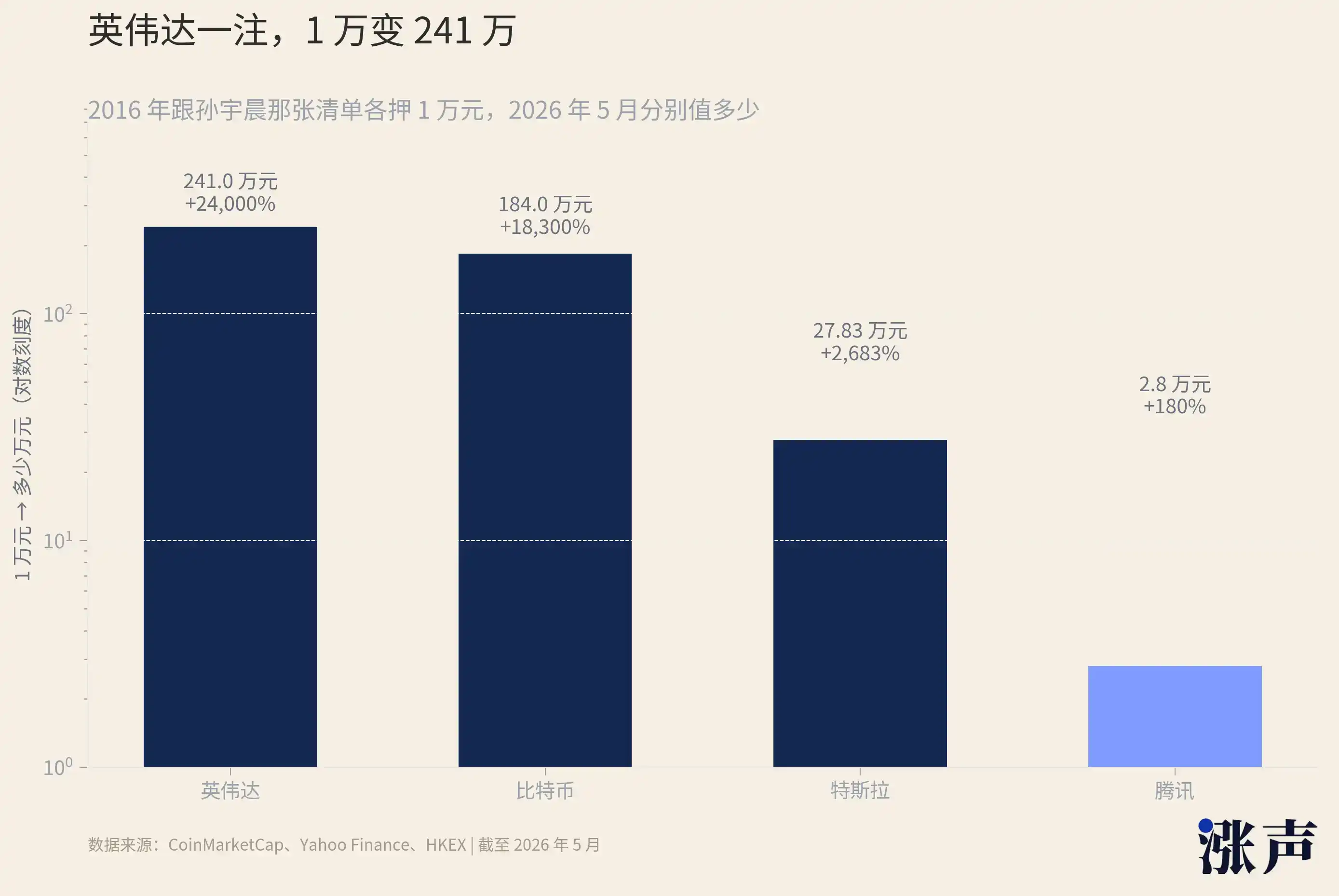
From buying BTC starting in late 2013, to 2016, advising post-90s generations not to buy houses, but to buy:

Bitcoin, NVIDIA, Tesla, Tencent.

Ten years have passed. As of May 2026, Tesla's total return is approximately 2683%, and NVIDIA's total return is nearly 24000%.

If you had listened to Brother Sun back then and invested 10,000 yuan in NVIDIA, it would be 2.4 million today; 10,000 yuan in Tesla would be 278,000 today. A listener who bet 200,000 yuan on each item on that list in 2016 would have seen just the NVIDIA bet turn into approximately 48 million, and the Tesla bet into approximately 5.4 million, totaling over 53 million.
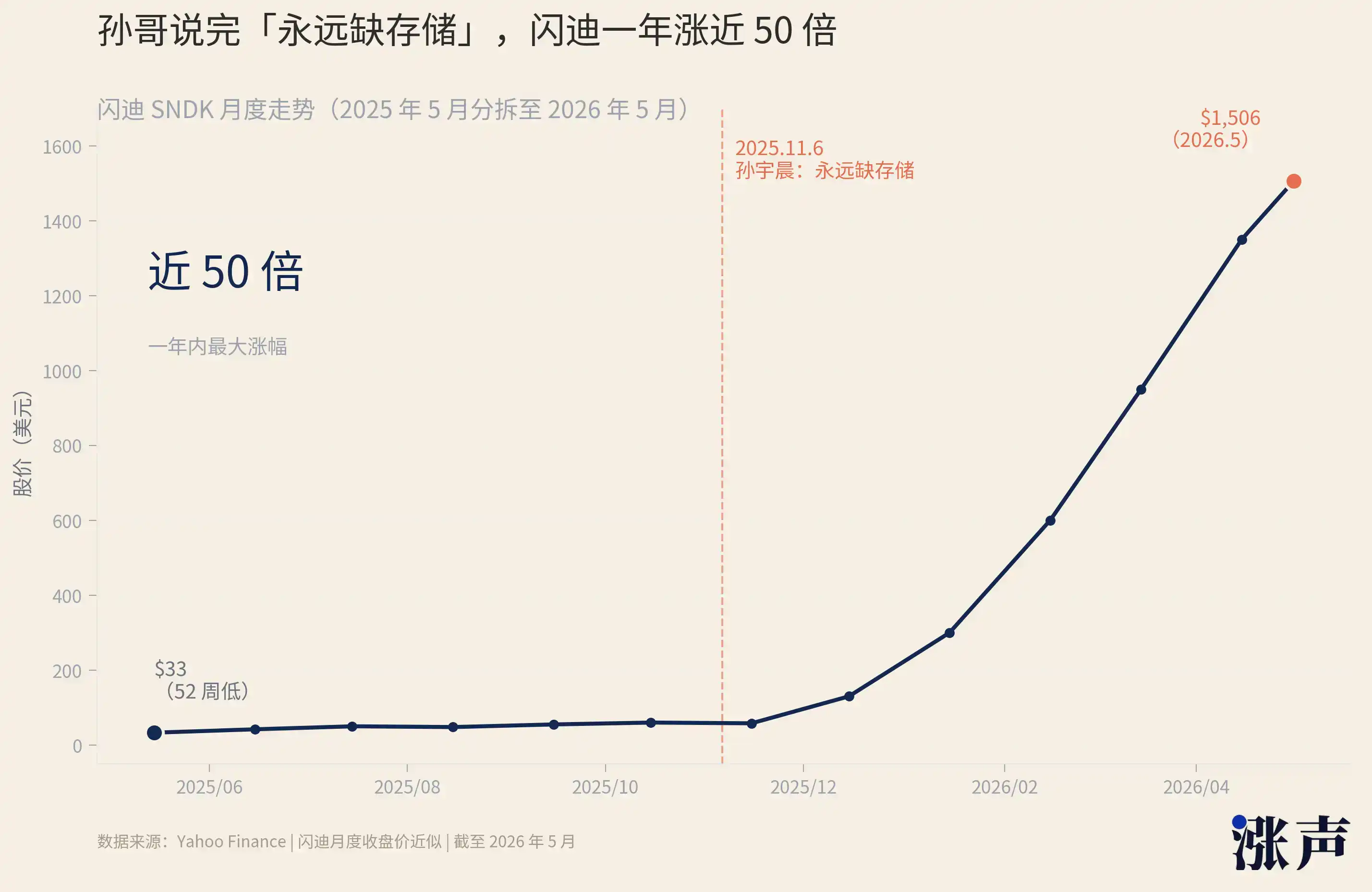
And this man continues to take shots today. On November 6, 2025, Justin Sun dropped a statement:

The capital market's reaction to this statement didn't reach fever pitch until 2026. SanDisk (SNDK), spun off from Western Digital, rose from a low of around $35 to $1,439 in a year, a maximum increase of nearly 50 times.
HBM memory capacity from Samsung, SK Hynix, and Micron was fully booked for 2026, already sold out, with orders scheduled through 2027-2028.

While everyone is still chasing the memory concept frenzy, in early 2026, Justin Sun changed his tune again in a video.

That video was originally about the outlook for 2026. Besides topics leaning towards wellness like putting health on the new year's list, he dedicated a segment to advise young people: embodied AI, drones, spatial computing, space exploration.

The author collected Justin Sun's public statements over the past two years regarding these four directions. Stringing them together, preliminary capital leaders have also emerged on each path.

Who Is the Next Storage Stock?

The first area Justin Sun pointed to was embodied AI.

The concept of robots has been discussed by humans for at least a hundred years. The Czech playwright Čapek coined the word "Robot" in 1920; industrial robotic arms have been used since the 1980s; Honda's ASIMO could climb stairs over twenty years ago. But the real bottleneck has always been the brain.

In the last two years, the entire industry has shifted towards VLA models—Vision-Language-Action. In plain terms, robots used to act based on code; now robots are starting to act based on seeing the world.

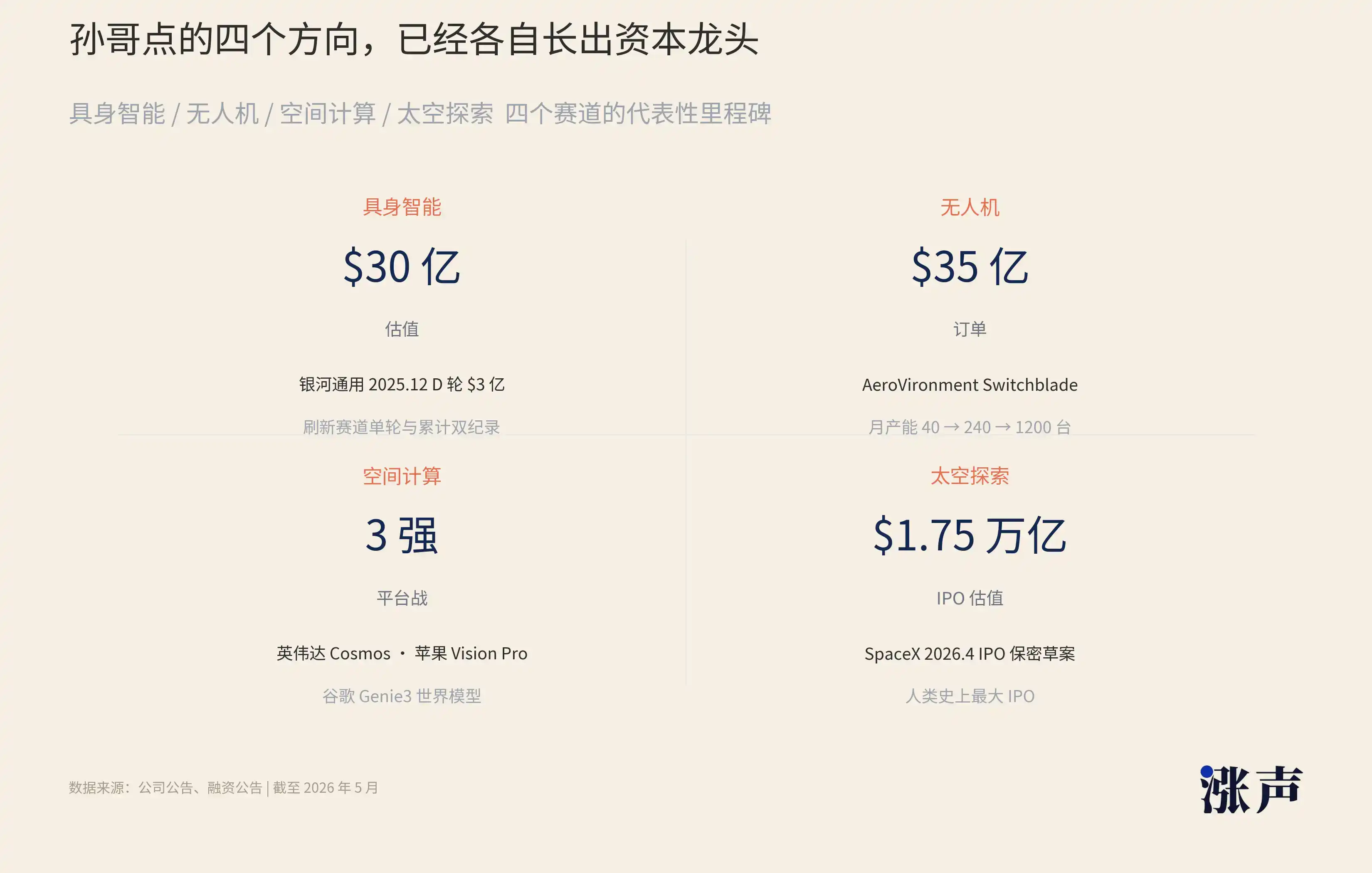
Unitree shipped over 5,500 humanoid robots in 2025, ranking first globally, and applied for a Science and Technology Innovation Board IPO in March 2026. Galaxy General raised a new round of $300 million (approx. 2.1 billion RMB) in December 2025, with cumulative funding of about $800 million and a valuation of $3 billion (approx. 21.1 billion RMB), setting new records for both single-round and total funding in the embodied AI sector.

Justin Sun said he likely won't personally venture into building robots, but he has a nose for narratives and the direction of capital flow. He said in a Bloomberg interview, "In a market where 99% of people don't know what a wallet is, the cost of education must be factored into the business model."

This statement, used to explain stablecoins in 2018, applies equally well in 2026. 99% of Chinese haven't used an embodied AI robot yet, but as long as that robot can cook, move boxes, or care for the elderly, the remaining 1% is the next opportunity.

The second sector he pointed to is drones.

While humanoid robots are still ramping up production, drones have already taken a step ahead into commercial deployment. They are naturally suited for what AI does best, from autonomous navigation to swarm coordination to data collection. They don't need to walk; flying is simpler than bipedal locomotion.

On the Russia-Ukraine battlefield, AI drone swarms have already taken over a large part of the role of tank units; Ukraine's annual drone production target has climbed to several million units. Over rice fields in rural China, DJI's agricultural drones fly, one replacing ten farm workers. In Shenzhen, Meituan has operationalized drone delivery, with order-to-delivery times not exceeding 15 minutes.

Drones are ahead of humanoid robots. They are the first form where AI has achieved a commercial closed-loop in the physical world.

The third area Justin Sun mentioned is spatial computing. This is the least mainstream among the directions he pointed out.

When Apple released the Vision Pro in 2024, most people saw it as a VR headset that cost several times more. This might be a misreading.

The Vision Pro's ambition has little to do with VR. It's Apple's first attempt to make AI understand space—how big your living room is, how far the table is from you, whether the coffee cup is to the left or right of the sofa, if you can reach it when you stretch your hand. This sounds simple but is ten times harder than training ChatGPT. Large language models only need to understand language; spatial computing needs to understand physics.

This is precisely the common prerequisite for robots, drones, and autonomous driving—they all require a form of spatial intelligence. NVIDIA's Cosmos platform, Google's Genie 3 world model, Tesla's FSD, are all doing the same thing: transitioning AI from understanding text to understanding the world.

ChatGPT only needs to understand language, but the next generation of AI needs to understand the world itself.

For the first three sectors, Justin Sun only verbally pointed them out. When it comes to space, he actually went there in person.

On August 3, 2025, he boarded Blue Origin's "New Shepard" NS-34 capsule and flew past the Kármán line.

After returning to Earth, he expressed an ambition: to make his company not just a "cryptocurrency exchange" but a "service provider for space economy infrastructure," using blockchain to solve space asset ownership, satellite data trading, and interplanetary payments. It sounds like science fiction. But look back at how he evangelized USDT ten years ago—people thought that was science fiction too back then.
Back on Earth, his message to young people was more direct: "Space exploration is a common mission for all humanity. I hope this flight inspires more young people to devote themselves to technology and innovation, collectively shaping humanity's interstellar future."

Brother Sun's Investment Logic

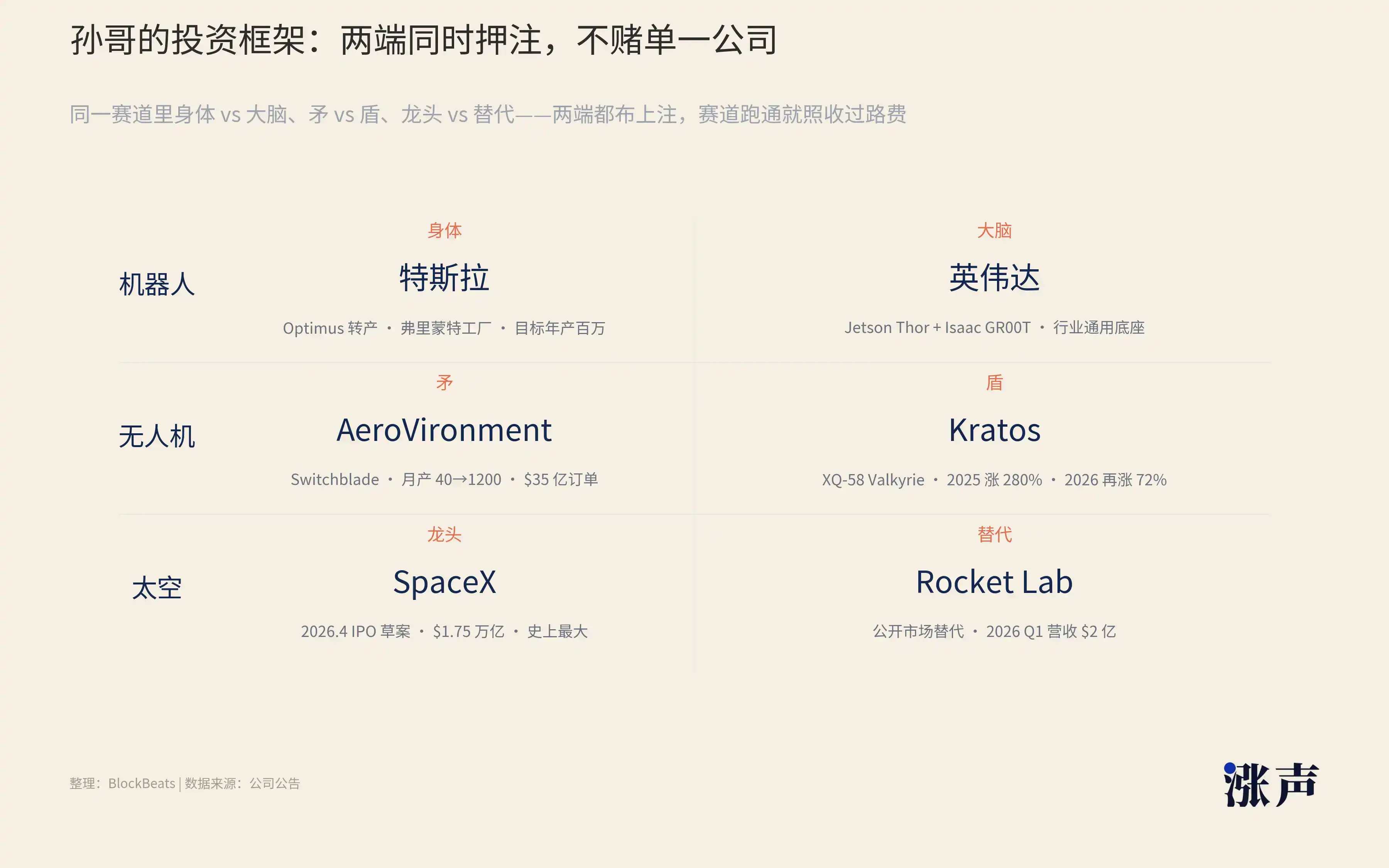
Justin Sun's publicly expressed investment logic is: find sectors with a clear direction, place bets on both ends, and do not gamble on the execution of a single company.

On the robotics line, his framework is to bet separately on the body and the brain.

Bet on Tesla for the body. In early 2026, Tesla announced discontinuing Model S and Model X, converting the Fremont factory into an Optimus production line, targeting an annual output of one million units with a mass-production unit price of about $20,000 to $25,000; current version Optimus robots are already handling parts transport and sorting at Austin and Fremont factories; the Gen 3 production line is scheduled to start in summer 2026.

Bet on NVIDIA for the brain. Jetson Thor puts server-grade AI inference into the robot body, Isaac GR00T has almost become the industry's common base, and Jensen Huang declared at GTC that there will be 1 billion humanoid robots globally by 2035.

Whether Optimus delivers on schedule is Elon Musk's problem, not NVIDIA's. As long as the sector takes off, the toll will be collected.

On the drone line, the core judgment is the irreversibility of Physical AI in military scenarios.

AeroVironment's Switchblade loitering munition became an iconic weapon in Ukraine, with monthly production capacity increased from 40 to 500 units, targeting 1,200 units; a $3.9 billion order locks in revenue for the next three years in advance. Kratos' XQ-58 Valkyrie is the "loyal wingman" to the F-35—manned aircraft on missions, drones on the flanks—with a unit price less than a fraction of a fifth-generation fighter jet, rising 280% in 2025 and another 72% in 2026.

One makes tanks uneconomical, the other makes manned fighter jets redundant—the logic on both ends is complementary.
On the space line, Justin Sun bid $28 million for a Blue Origin flight seat in 2021. This money was donated to the Blue Origin STEM charity fund, distributed among 19 non-profit organizations. On August 3, 2025, he boarded the New Shepard NS-34 mission, completing a suborbital flight.

In public markets, SpaceX filed a confidential IPO draft with the SEC in April 2026, targeting a valuation of $1.75 trillion, poised to become the largest IPO in human history; Rocket Lab's Q1 2026 revenue exceeded $200 million, making it the most direct alternative investment when SpaceX isn't available.

Once SpaceX goes public, the entire space sector's valuation framework will be rewritten.

Listen to Brother Sun

Stringing together Justin Sun's statements over the past two years, "AI, robotics, and blockchain have reached their iPhone moment" is his judgment on embodied AI. "Robot armies, robot police" is his prophecy for autonomous weaponized AI. "The integration of AI, robotics, and spatial computing" is his bet on the next generation of human-machine interfaces. "Earth is too small; it's our home" is his perspective shift after flying past the Kármán line.

These four things pieced together form the complete picture of Physical AI.

Over the past two decades, the internet changed the way information flows. WeChat replaced letters, Taobao replaced markets, Douyin replaced TV.

But the underlying rules of the physical world didn't change. Workers are still workers, factories are still factories.

In the next two decades, AI might change the very way the real world operates. Factories will have tireless humanoid robots, roads will have autonomous vehicle traffic, battlefields will roar with drone swarms, and the first "residents" on the Moon and Mars are likely to be pioneering AI robots.

That young man who in 2016 told everyone not to buy houses has now flown past the Kármán line.

And most of us are probably still waiting for the next Yanjiao.

Трендовые криптовалюты

Связанные с этим вопросы

QWhat is the core of Sun Yuchen's investment philosophy as presented in the article?

ASun Yuchen's core investment philosophy, as presented, is to identify long-term, trend-based themes with high potential for change, and then invest in multiple key players across that entire value chain rather than betting on a single company. His approach focuses on the structural change of an industry.

QWhich sectors or technologies does Sun Yuchen point to as the next big opportunities after the success in the storage sector?

ASun Yuchen points to four key areas as the next big opportunities: Embodied AI/Robotics, AI Drones, Spatial Computing (the AI-powered understanding of physical space), and Space Exploration. He sees these as the frontiers where AI will begin to materially alter the physical world.

QHow does Sun Yuchen's investment strategy in the robotics sector exemplify his broader logic?

AIn the robotics sector, his strategy is to invest in both the 'body' and the 'brain' separately. He cites Tesla (Optimus) as a bet on the physical robot platform (the body) and Nvidia (Jetson Thor, Isaac platform) as a bet on the AI intelligence and operating system (the brain). This way, he benefits from the growth of the overall sector regardless of which specific company executes best.

QAccording to the article, what is the author's perspective on the historical impact of AI and its future potential?

AThe author argues that the internet and AI have so far primarily changed information flow and digital services. The future potential lies in AI fundamentally altering the operation of the physical world itself—through robots in factories, autonomous vehicles, drone swarms, and even AI/robotics pioneers in space—representing a much deeper transformation of reality.

QWhat is the significance of Sun Yuchen's space flight in the context of his overall vision?

AHis space flight on Blue Origin's New Shepard is symbolic of his shift towards a long-term, frontier-oriented vision. It represents his ambition to move beyond cryptocurrency into 'space economy infrastructure' and serves as a personal statement to inspire younger generations to engage with transformative, long-horizon technologies like space exploration.

Похожее

Обзор 8 «кэш-коров» бычьего рынка: крупнейший проект выкупил токенов на $283 млн за год

В условиях продолжающегося криптомедвежьего рынка некоторые проекты демонстрируют устойчивую способность генерировать денежные потоки и активно выкупают свои токены. По данным Tokenomist, с января 2026 года восемь проектов значительно превзошли рост предложения своих токенов объемами выкупа. Лидером стал Hyperliquid (HYPE), выкупивший токены на сумму 2,83 млрд долларов, что составляет 3% от его предложения при одновременном сокращении предложения на 11%. Другие заметные проекты включают Meteora (MET), где выкуп составил 71% от предложения на начало года, Pump.fun, GMX, Lighter, Aave, Rollbit (RLB) и Metaplex (MPLX). Эти проекты, представляющие различные сегменты (Perp DEX, DeFi, Launchpad для мемкоинов), используют выручку от комиссий для обратного выкупа и сжигания токенов, что теоретически увеличивает их дефицит. Однако авторы отмечают, что такая деятельность не гарантирует роста цены, на которую также влияют общая рыночная конъюнктура, новости и развитие продукта. Тем не менее, в текущей рыночной среде эти проекты выделяются как стабильные генераторы денежных потоков.

marsbit22 мин. назад

Обзор 8 «кэш-коров» бычьего рынка: крупнейший проект выкупил токенов на $283 млн за год

marsbit22 мин. назад

Эфириум налегке? Как E-гвардейцы смотрят на обновление Lean Ethereum и перспективы на рынке

Автор: Biteye Эфириум (ETH) демонстрирует рост на фоне ожиданий снижения процентных ставок. В этот момент Виталик Бутерин представил дорожную карту «Lean Ethereum» (Облегченный Эфириум), назвав это третьим крупным обновлением сети. Цель — перепроектировать уровни консенсуса, данных и выполнения, чтобы сделать Ethereum проще, безопаснее (с квантовой устойчивостью), более проверяемым и масштабируемым. Это происходит на фоне реструктуризации: Фонд Эфириума сократил штат на 20%, а новые организации, такие как EthLabs, активизируются. **Оптимисты** видят в этом ключевой сигнал. Они считают, что Lean Ethereum вернет фокус на фундаментальные основы: безопасность, приватность и децентрализацию. Это укрепит долгосрочную ценность Ethereum как «минимального надежного фундамента» для мировой экономики. Обновление может резко снизить требования к узлам, повысив доступность. **Осторожные голоса** согласны с целями, но сомневаются в сроках. Дорожная карта рассчитана на 3-4 года, что в быстро меняющемся рынке кажется медленным. Конкуренты, такие как Tempo и Canton, наступают на пятки в сегментах RWA и институционального внедрения. Критики указывают, что Ethereum необходимо не только планировать, но и быстро выполнять, демонстрируя реальный прогресс. **Итог:** Lean Ethereum — это попытка Ethereum перезагрузить свою базовую повестку дня, сосредоточившись на долгосрочной устойчивости и простоте. Хотя техническое видение сильное, его влияние на цену ETH в краткосрочной перспективе будет зависеть от фактической скорости реализации и способности сети доказывать свою актуальность на фоне растущей конкуренции.

marsbit1 ч. назад

Эфириум налегке? Как E-гвардейцы смотрят на обновление Lean Ethereum и перспективы на рынке

marsbit1 ч. назад

Стресс у майнеров биткоина возвращается к историческим минимумам – Близко ли восстановление BTC?

Напряжение в майнинговом секторе биткойна достигло исторически низких значений, соответствующих сигналам капитуляции, наблюдаемым в прошлых циклах (2015, 2018, 2020, 2022 и 2024 годах). Это подтверждается данными индикатора Miner Cycle Stress Composite и продолжительным давлением на майнеров согласно Hash Ribbons, сохраняющимся после халвинга. Низкая прибыльность вынуждает слабых игроков продавать резервы для покрытия расходов, в то время как сильные участники укрепляют сеть. Настроения инвесторов также достигли крайне пессимистичного уровня, о чём свидетельствует коэффициент Шарпа BTC, опускавшийся до -20, что отражает один из худших периодов с поправкой на риск в текущем цикле. Однако подобные экстремумы в прошлом (в 2015, 2018 и 2022 годах) знаменовали начало фаз накопления, когда давление продавцов иссякало. Таким образом, текущее выравнивание данных о капитуляции майнеров и пессимизме инвесторов создаёт предпосылки для ослабления нисходящего давления. Если волатильность снизится, а долгосрочные держатели продолжат поглощать предложение, это может заложить основу для более масштабного восстановления рынка биткойна.

ambcrypto1 ч. назад

Стресс у майнеров биткоина возвращается к историческим минимумам – Близко ли восстановление BTC?

ambcrypto1 ч. назад

ИИ-складывание, Fable 5 и GPT-5.6 становятся привилегией избранных

Мы живем в мире «искусственного интеллекта для избранных». Пока большинство населения либо вообще не использует ИИ, либо довольствуется бесплатными «игрушками» вроде базового ChatGPT, технологическая элита уже работает с мощнейшими системами, такими как Fable 5 и ожидаемый GPT-5.6. Разрыв в возможностях колоссален: бесплатные модели часто ошибаются даже в медицинских вопросах, в то время как платные инструменты в руках специалистов превращаются в целые рабочие экосистемы, способные за 30 минут выполнять задачи недельной сложности. Эта «складывающаяся» реальность создает новое неравенство: доступ к передовому ИИ, меняющему правила игры, становится привилегией немногих, оставляя основную массу людей за пределами подлинной технологической революции.

marsbit1 ч. назад

ИИ-складывание, Fable 5 и GPT-5.6 становятся привилегией избранных

marsbit1 ч. назад

Кэти Вуд в июне приобрела акции криптокомпаний на 77 миллионов долларов: действительно ли криптоакции — это «альтернатива» биткоину?

Арк инвестиции Кэти Вуд в июне приобрели акции криптокомпаний на 77 миллионов долларов, включая Coinbase, Circle и Bullish. Идея таких инвестиций — получить доступ к крипторынку через регулируемые акции без прямого владения биткоином. Однако анализ показывает, что акции криптокомпаний несут более высокие риски, чем сам биткоин. Волатильность акций девяти криптокомпаний США за 30 дней составляет 68–90%, что почти вдвое выше волатильности биткоина (37,6%). При этом корреляция с биткоином у многих из них низкая (0,55–0,58), а значит, большая часть колебаний их цен обусловлена специфическими бизнес-рисками: финансовыми отчетами, конкуренцией, эмиссией акций и др. Исключением является MicroStrategy (MSTR), чьи акции тесно связаны с биткоином (бета 1,59, корреляция 0,85), работая как инструмент с левериджем. Coinbase также показывает относительно сильную связь с биткоином, но его волатильность все еще высока. Такие компании, как Circle (эмитент стейблкоина USDC), сильно зависят от отраслевой конкуренции, а Robinhood — от общего брокерского бизнеса. Майнинговые компании, такие как Riot и Marathon, в этом году показали рост благодаря контрактам в сфере ИИ, а не движениям цены биткоина. Кейс MicroStrategy демонстрирует дополнительные риски, присущие акциям: необходимость поддержания премии к чистой стоимости активов (mNAV) и возможные продажи биткоинов для покрытия расходов, что нехарактерно для прямых держателей криптовалюты. Таким образом, инвестиции в акции криптокомпаний часто означают не «замену» биткоину с меньшим риском, а либо повышенную волатильность, либо принятие на себя совершенно иных бизнес-рисков, слабо связанных с динамикой крипторынка.

marsbit1 ч. назад

Кэти Вуд в июне приобрела акции криптокомпаний на 77 миллионов долларов: действительно ли криптоакции — это «альтернатива» биткоину?

marsbit1 ч. назад

Торговля

Спот

Популярные статьи

Как купить SUN

Добро пожаловать на HTX.com! Мы сделали приобретение SUN (SUN) простым и удобным. Следуйте нашему пошаговому руководству и отправляйтесь в свое крипто-путешествие.Шаг 1: Создайте аккаунт на HTXИспользуйте свой адрес электронной почты или номер телефона, чтобы зарегистрироваться и бесплатно создать аккаунт на HTX. Пройдите удобную регистрацию и откройте для себя весь функционал.Создать аккаунтШаг 2: Перейдите в Купить криптовалюту и выберите свой способ оплатыКредитная/Дебетовая Карта: Используйте свою карту Visa или Mastercard для мгновенной покупки SUN (SUN).Баланс: Используйте средства с баланса вашего аккаунта HTX для простой торговли.Третьи Лица: Мы добавили популярные способы оплаты, такие как Google Pay и Apple Pay, для повышения удобства.P2P: Торгуйте напрямую с другими пользователями на HTX.Внебиржевая Торговля (OTC): Мы предлагаем индивидуальные услуги и конкурентоспособные обменные курсы для трейдеров.Шаг 3: Хранение SUN (SUN)После приобретения вами SUN (SUN) храните их в своем аккаунте на HTX. В качестве альтернативы вы можете отправить их куда-либо с помощью перевода в блокчейне или использовать для торговли с другими криптовалютами.Шаг 4: Торговля SUN (SUN)С легкостью торгуйте SUN (SUN) на спотовом рынке HTX. Просто зайдите в свой аккаунт, выберите торговую пару, совершайте сделки и следите за ними в режиме реального времени. Мы предлагаем удобный интерфейс как для начинающих, так и для опытных трейдеров.

1.1k просмотров всегоОпубликовано 2024.04.18Обновлено 2026.06.02

Как купить SUN

Обсуждения

Добро пожаловать в Сообщество HTX. Здесь вы сможете быть в курсе последних новостей о развитии платформы и получить доступ к профессиональной аналитической информации о рынке. Мнения пользователей о цене на SUN (SUN) представлены ниже.

活动图片