Aave Is Surrendering the Throne of DeFi Lending Due to Its Own Stupidity

marsbitОпубликовано 2026-04-24Обновлено 2026-04-24

Введение

An article titled "Aave Is Giving Up Its Throne in DeFi Lending Due to Its Own Foolishness" discusses how Aave mishandled a crisis following a $292 million hack of rsETH from Kelp DAO, leading to significant outflows and reputational damage. After the hack, Aave failed to promptly reassure users or commit to covering potential bad debt—estimated between $123.7 million and $230.1 million—despite having sufficient reserves. This hesitation triggered panic, resulting in $17.2 billion in outflows and liquidity crises across multiple pools. The author argues that Aave’s poor crisis management and reluctance to act quickly exacerbated the situation, damaging its reputation as the "safest DeFi" platform. Meanwhile, competitor Spark, a fork of Aave V3, capitalized on the situation by attracting fleeing funds, growing its TVL by nearly $2 billion. Spark had previously delisted rsETH, avoiding any exposure to the hack. Its proactive communication and strategic positioning contrast sharply with Aave’s delayed response. Although Aave’s founder later announced a relief plan (DeFi United) with multiple partners and a personal donation, the damage to user trust and liquidity may be lasting. The article concludes that Aave’s missteps have allowed competitors like Spark, Morpho, and Jupiter Lend to challenge its dominant position in DeFi lending.

Original | Odaily Planet Daily (@OdailyChina)

Author | Azuma (@azuma_eth)

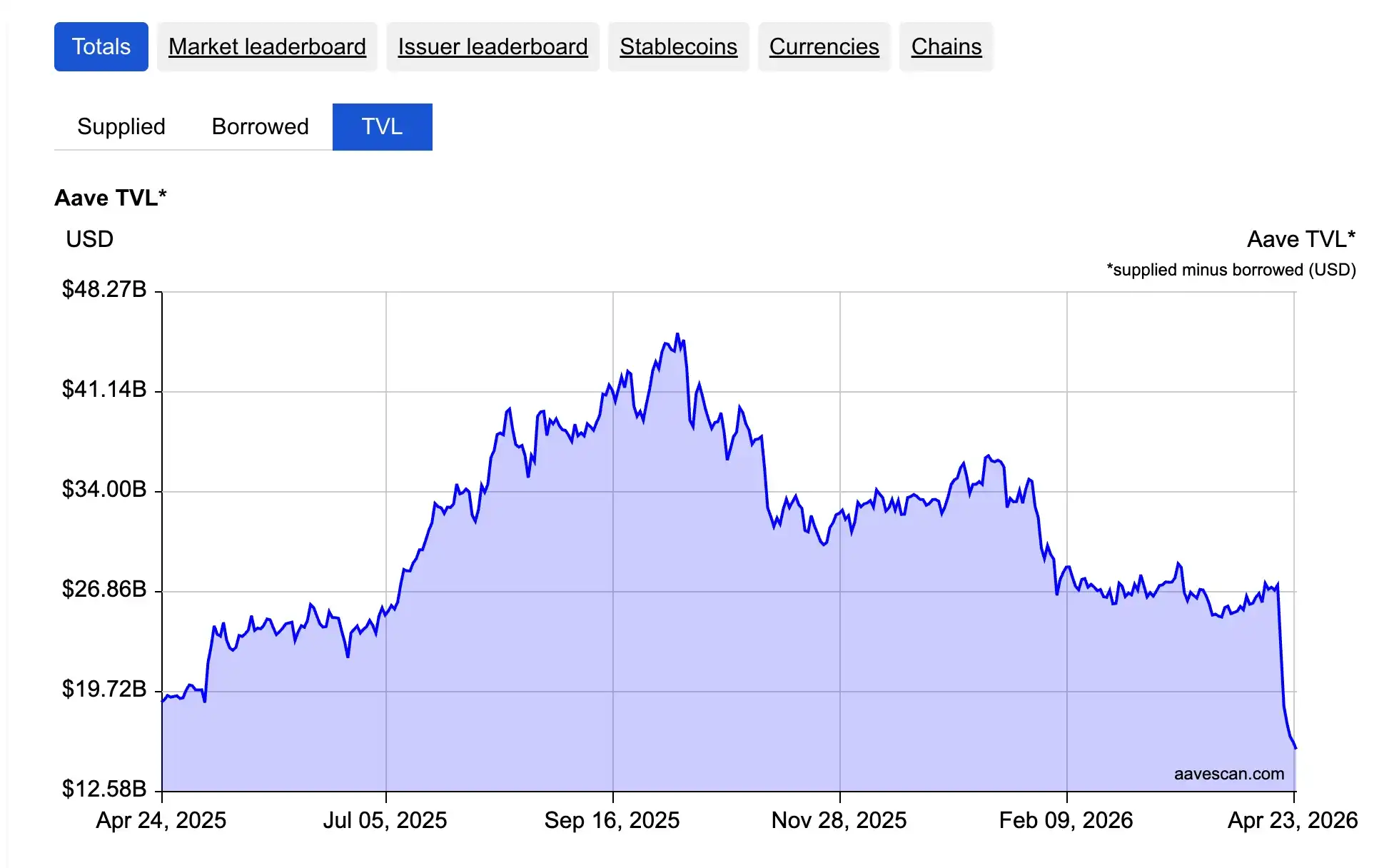
$292 million, this is the total amount of rsETH funds stolen from Kelp DAO; $17.2 billion, this is the scale of funds that have flowed out of Aave since the incident.

Aave is watching the community's panic sentiment ferment for several consecutive days due to its extremely foolish crisis PR strategy, thereby losing its once greatest advantage in the lending track—hundreds of billions of dollars in deposited funds and the user mindset label of "the safest DeFi".
  • Odaily Note: For background, please refer to "DeFi Hacked Again for $292 Million, Is Aave No Longer Safe?" and "The Tripartite Game Under the $290 Million Hole: Who Will Pay the Bill—Aave, L0, or Kelp?".

What Did Aave Do Wrong?

The details of the Kelp DAO hack need not be repeated; blaming Aave for why it granted rsETH such a high LTV is meaningless now. Here, I mainly want to discuss Aave's response strategy after the incident from the perspective of a long-term AAVE user.

First is the bad debt scale issue; Aave itself has done the math. Depending on the different handling of rsETH, there might be two possible bad debt scenarios—if the stolen loss is written off from all rsETH in circulation, it is expected to generate $123.7 million in bad debt; if the value of mainnet rsETH is protected and the loss is fully recorded in the mapped version of rsETH on Layer2, it is expected to generate $230.1 million in bad debt.

In either case, Aave has the capability to cover it with its reserves from Umbrella, the DAO treasury, and the team. I understand that Aave is unwilling to pay this money itself and wants the main responsible party, Kelp DAO, and the secondary responsible party, LayerZero, to contribute as much as possible. But the problem is that the other parties will think the same way—"Aave is so rich, the situation is so awkward, it should bear more." Therefore, in the short term, it is difficult for these three parties to reach a consensus, which implies that a solution that satisfies everyone is temporarily impossible.

But users cannot wait that long—Aave's yield levels have never been very competitive in the industry. Users who choose to deposit with Aave are all attracted by its reputation, security, and liquidity. However, the situation now is that in the most critical days after the incident, Aave consistently failed to give users some kind of bottom-line guarantee promise, but instead kept emphasizing "our code has no problems" and "how rsETH is accounted for is beyond Aave's control" to shift blame.

This is why panic sentiment kept fermenting within the community. Users tried every means to escape and avoid risk: those who could withdraw directly did so, and those who couldn't went to borrow from other pools first, causing the impact to gradually expand. So Aave's current situation is: on one hand, it faces continuous fund outflows; on the other hand, multiple pools are experiencing liquidity drying up due to utilization rates being maxed out.

This awkward situation could have been avoided (or at least not been this bad)... Since Aave can afford the money, why didn't it inject a dose of reassurance into the community from the beginning to prevent a bank run? At most, it's $230 million in bad debt (possibly less), and this money wouldn't necessarily be paid by Aave alone;后续 could continue to dispute with LayerZero and Kelp DAO.

Now, it's done. For the sake of a promised relief of at most $230 million, Aave watched $17.2 billion in deposited funds flow out (the number may continue to grow), and this doesn't even include the decline in AAVE's price these days... No matter how you calculate it, it's a huge loss.

What makes Aave even more uncomfortable is that the worse its situation becomes, the more relaxed opponents like LayerZero and Kelp DAO will be, because they will judge that Aave will be more motivated to solve the problem as soon as possible, which only puts Aave at a disadvantage in the game.

Having reached this point, Aave has brought this upon itself.

Behind Aave, Spark Is Watching Covetously

While Aave is suffering from headaches, the situation of its competitor Spark is booming and extremely positive. What is even more lamentable is that Spark is actually a competitor "personally incubated" by Aave.

Spark was originally a lending protocol forked and developed by Sky (formerly MakerDAO) based on the open-source code of Aave V3; both sides actually use the same underlying code logic. In return, there was once a profit-sharing agreement between Spark and Aave, but later Aave accused Spark of涉嫌 breaching the contract, and coupled with route differences, the two are now purely competitive.

Three months before the Kelp DAO theft, Spark had just removed support for rsETH (for details, please refer to "Same Day, Different Fate: Aave Embraces rsETH and Loses Nearly $200 Million, Spark Exits Unscathed"). You call it strategic conservatism or rigorous risk control, or even attribute it entirely to luck, but the result is that Spark was not affected at all in this incident—on this point alone, Spark can wantonly attack Aave's former "safest DeFi" label.

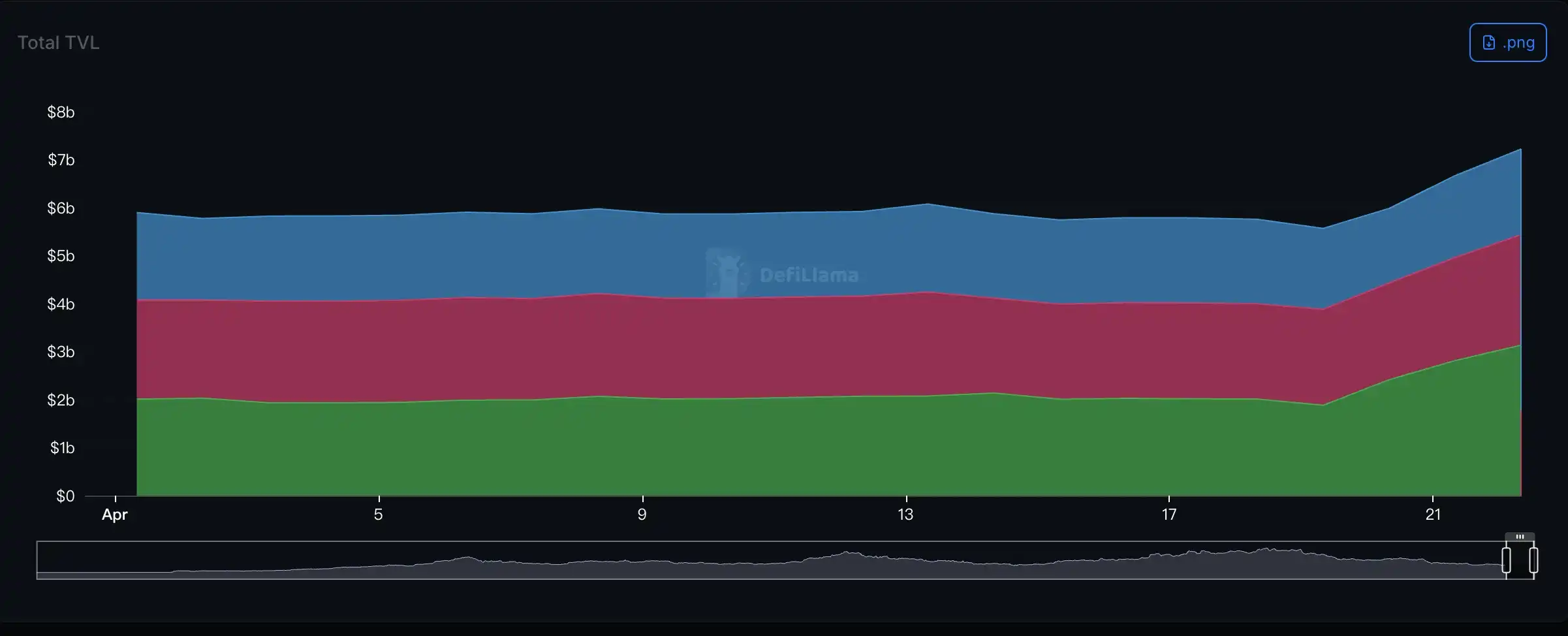
Thus, Spark became one of the safe havens for funds fleeing Aave. Since the incident, Spark's TVL has grown by nearly $2 billion (green part in the chart below). On the day of the incident, Justin Sun withdrew 53,665 ETH (worth $124 million) from Aave and subsequently deposited it into Spark. After continued accumulation in recent days, the total deposit has reached $1.3 billion—in the DeFi world, Brother Sun's operations are really something to learn.
On April 23, Upbit officially announced the launch of the Spark (SPK) Korean Won trading market. SPK, stimulated by this positive news, rose over 80% in a single day, significantly narrowing the market value gap between itself and AAVE.

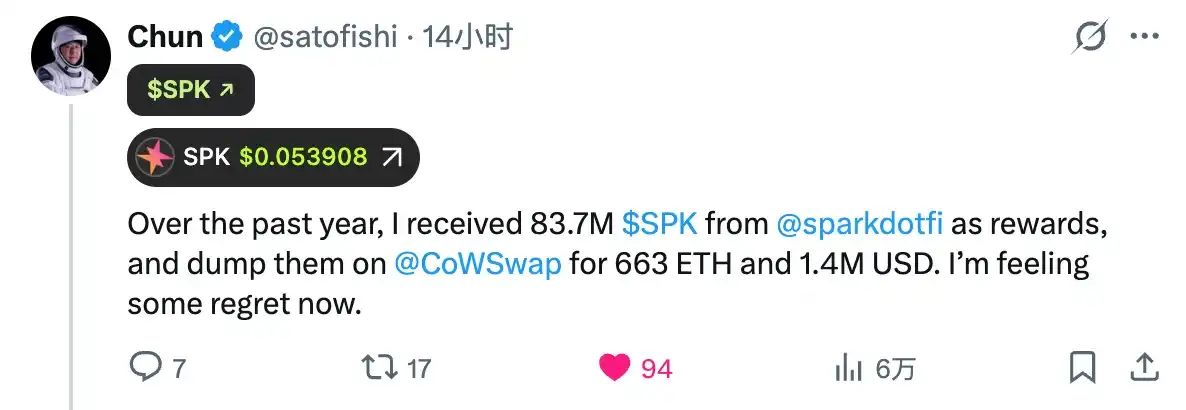
Even Wang Chun, founder of F2Pool, lamented on X: "In the past year, I received 83.7 million SPK rewards from Spark and sold them on CoWSwap for 663 ETH and $1.4 million. Now I kind of regret it."
Spark clearly realizes that this is a perfect opportunity to seize market share from Aave's mouth. Since the incident, Spark's Strategy Lead, MonetSupply, has almost become the most frequent KOL speaking out on this matter, posting dozens of times a day. Although his发言 can indeed help the public understand what happened, it objectively also加剧 the panic sentiment surrounding Aave.

But this is the purest商业 competition; MonetSupply just made the most correct choice.

Aave Is Losing the Throne of DeFi Lending

In the early morning of April 24, perhaps realizing the严峻 situation, Aave founder Stani announced on X the launch of a relief plan called DeFi United. Cooperative participants include LayerZero, Ethena, ether.fi, Ink Foundation, Golem Foundation, Trydo, etc. Stani personally will also donate 5,000 ETH to solve the current problem.

But the funds have already flowed out, and user trust has been severely damaged. Relying solely on this belated statement, Aave will find it difficult to regain deposited funds and user trust in the short term.

The DeFi lending track has long presented a pattern of "one superpower, multiple great powers," with Aave一直以来 having seemingly extremely solid leading advantages. But now, Aave is拱手 surrendering the throne. Behind it, challengers are coming aggressively; besides the booming Spark, other opponents like Morpho and Jupiter Lend also hope to take a bite out of Aave's share.

Last year, Stani bought a five-story luxury house in London for approximately $30 million, one of the most expensive transactions in the UK's sluggish luxury real estate market in the past year. I don't know if there is something like a "jinx," but with precedents like Su Zhu and others, it seems that big shots who consume conspicuously within the circle always run into some倒霉事.

I can't guess what Stani is thinking right now in his five-story luxury house.

Связанные с этим вопросы

QWhat was the main reason for the massive outflow of funds from Aave following the Kelp DAO hack?

AAave's extremely poor crisis management strategy, which failed to provide a timely and reassuring commitment to cover the potential bad debt, led to widespread community panic and a user rush to withdraw funds.

QWhat are the two potential bad debt scenarios calculated by Aave after the rsETH exploit?

AIf the stolen loss is written off from all rsETH in circulation, it would result in approximately $123.7 million in bad debt. If the value of mainnet rsETH is protected and the loss is fully attributed to the mapped version of rsETH on Layer 2, it would result in approximately $230.1 million in bad debt.

QWhich competitor protocol directly benefited from the funds flowing out of Aave, and what was a significant factor in its immunity to the hack?

ASpark Protocol directly benefited, with its TVL growing by nearly $2 billion. A significant factor was that Spark had removed support for rsETH three months prior to the hack, avoiding any exposure to the incident.

QWhat was the name of the key initiative announced by Aave founder Stani Kulechov in a belated attempt to address the crisis?

AStani Kulechov announced an initiative called 'DeFi United,' a relief plan involving partners like LayerZero and Ethena, to which he also personally pledged a donation of 5,000 ETH.

QAccording to the author, what is the fundamental reason users traditionally deposited funds into Aave, given its uncompetitive yield rates?

AUsers traditionally deposited into Aave due to its reputation for safety, security, and deep liquidity, not for competitive yield rates.

Похожее

Fed's Internal Doves Flock to Hawkish Stance, Warsh's Debut "Between a Rock and a Hard Place"

U.S. Federal Reserve officials who previously advocated for rate cuts, including Governor Christopher Waller, have recently shifted their stance, with many now not ruling out the possibility of future rate hikes. This sets a challenging stage for new Fed Chair Kevin Warsh's first policy meeting. Appointed by President Trump based on his dovish views, Warsh now faces a committee where the debate has pivoted from "when to cut" to "whether to hike," driven by persistent inflation above 3%, a strong labor market, and supply-side pressures from AI infrastructure demands and geopolitical tensions. Key figures illustrate the shift. Governor Waller, once concerned about employment, now says data has pushed him toward considering rate increases. Even moderate voices like Governor Lisa Cook, while expecting inflation to ease, have indicated readiness to hike if it fails to do so. Long-time hawks such as regional Fed presidents Beth Hammack, Lorie Logan, and Neel Kashkari have grown more vocal, arguing that the real policy rate is effectively falling and that action may soon be needed. The upcoming Fed meeting is expected to keep rates steady but will likely remove the "easing bias" from its statement, signaling a neutral stance between cuts and hikes. The quarterly "dot plot" is anticipated to show most officials projecting no cuts this year, with some potentially indicating hikes. Chair Warsh, a critic of the Fed's reliance on forward guidance like the dot plot, must navigate communicating this pivot using tools he has questioned, all while steering policy in a direction counter to the preferences of the president who appointed him. The consensus suggests the Fed's next move could well be a rate increase.

marsbit59 мин. назад

Fed's Internal Doves Flock to Hawkish Stance, Warsh's Debut "Between a Rock and a Hard Place"

marsbit59 мин. назад

The Trillion-Yuan Market Cap 'Yi Zhong Tian': Who is the True Value King?

The article analyzes the three leading Chinese optical module companies, collectively nicknamed "Yi Zhong Tian": Xinyisheng, Zhongji Innolight, and TFC Optical Communication. It evaluates their "cost-performance" not by current stock price, but through three lenses: PEG ratio (growth vs. valuation), earnings quality, and premium/discount for certainty. Xinyisheng shows the most attractive PEG ratio and high profitability, but its valuation reflects discounts for risks like high customer concentration and reliance on overseas markets. Zhongji Innolight, the most expensive, commands a premium for its market leadership, dominant share in key products like 800G/1.6T modules, and higher earnings certainty, though it faces geopolitical risks. TFC Optical, as an upstream component supplier ("water seller"), has the highest gross margin and bets on the long-term CPO/NPO architecture trend, but trades at a high valuation with more stable, less explosive growth. The core argument is that while these companies dominate module assembly, the true profit pool and technological moat lie upstream in laser and switch chips, currently controlled by U.S. firms like Lumentum and Coherent. The long-term "cost-performance" for these Chinese leaders hinges on whether the domestic industry, exemplified by companies like Yuanjie Technology, can successfully move up the value chain into high-power laser chips. Otherwise, their high growth may remain confined to the lower-margin assembly segment.

marsbit1 ч. назад

The Trillion-Yuan Market Cap 'Yi Zhong Tian': Who is the True Value King?

marsbit1 ч. назад

Has the Crypto Market Bottomed? Here's What Institutions Think

The crypto market is in a period of significant debate, with leading institutions offering differing views on whether a bottom has been reached. Three prominent firms have published detailed analyses: * **Galaxy Digital** argues Bitcoin has **not yet bottomed**. Their analysis of 13 historical indicators across six dimensions (valuation, profit-taking, miner pressure, etc.) shows only four are fully met. They project a potential bottom range between $30k and $54k. * **NYDIG** states a bottom is **possible but not likely**. While metrics are close to historic bear market extremes, they note the absence of a classic panic-selling event. They also suggest increased institutional adoption may have structurally altered the market cycle, potentially leading to a shallower downturn. * **Standard Chartered Bank** asserts the **bottom has already occurred** at around $59k. They cite two key factors: potential US-Iran diplomatic progress and the anticipated SpaceX IPO, which they believe absorbed capital and caused ETF selling pressure that is now subsiding. They forecast a year-end price target of $100k. Despite the surface-level disagreement, the reports share critical common ground more valuable for long-term investors: 1. All three believe the market bottom will form **within this year**. 2. All agree the current price is **closer to the bottom than to previous highs**. 3. All maintain a **bullish long-term outlook** for Bitcoin and a new cycle. The core takeaway is that while the exact bottom price ($40k, $50k, or $60k) is debated, the consensus is that a bottom is imminent. For long-term holders, the primary focus should not be pinpointing the absolute low, but on the future potential for prices to reach $100k, $200k, or higher. The fundamental thesis for Bitcoin—sovereign debt accumulation, inflation, declining trust in centralized institutions, global digitization, and improved accessibility—remains intact and is arguably strengthening. The overall landscape is viewed as more favorable than in previous crypto winters.

marsbit1 ч. назад

Has the Crypto Market Bottomed? Here's What Institutions Think

marsbit1 ч. назад

The 'Chip' Challenge and Breakthroughs in China's Optical Industry Chain

China's Photonics Industry: Bottlenecks and Breakthroughs In the global AI race, computing chips dominate the narrative, but the underlying bottleneck increasingly defining the scale of AI clusters is light—or more specifically, optical connectivity. Optical modules, which translate electrical signals to light and vice versa, are crucial for connecting thousands of GPUs in AI data centers, preventing data congestion and ensuring efficient model training. High-speed modules (800G, 1.6T) are now standard, with performance hinging on advanced DSP (Digital Signal Processor) chips. This is where a critical dependency lies. Two US giants—Marvell and Broadcom—collectively dominate over 90% of the high-end DSP chip market. Chinese optical module leaders like Zhongji Innolight and Eoptolink rely on these chips to manufacture modules for overseas AI customers, primarily in North America. While this creates a supply chain vulnerability, complete decoupling is difficult. Marvell derives over half its revenue from Greater China, and the US firms depend on Chinese partners for chip packaging and optical components. The risk from laser chips (e.g., from Lumentum), another key component, is considered more manageable due to multiple global suppliers and faster progress in domestic alternatives from companies like YOFC and Accelink. To mitigate risks, China's industry is pursuing a multi-pronged strategy: diversifying supply chains and locking in long-term orders; fostering a domestic market ecosystem to adopt homegrown DSPs from firms like Huawei HiSilicon and CETC; accelerating R&D in high-speed DSPs and advanced packaging; and investing in next-gen technologies like silicon photonics and Co-Packaged Optics (CPO) to reduce reliance on discrete DSPs. The ultimate solution lies not in short-term博弈 but in persistent advancement of domestic high-end chip R&D and manufacturing. While challenges remain in performance, certification, and ecosystem building, China's vast domestic market and manufacturing base provide a crucial buffer, buying time for the industry to achieve greater technological independence.

marsbit1 ч. назад

The 'Chip' Challenge and Breakthroughs in China's Optical Industry Chain

marsbit1 ч. назад

Торговля

Спот
Фьючерсы

Популярные статьи

Как купить AAVE

Добро пожаловать на HTX.com! Мы сделали приобретение Aave Protocol (AAVE) простым и удобным. Следуйте нашему пошаговому руководству и отправляйтесь в свое крипто-путешествие.Шаг 1: Создайте аккаунт на HTXИспользуйте свой адрес электронной почты или номер телефона, чтобы зарегистрироваться и бесплатно создать аккаунт на HTX. Пройдите удобную регистрацию и откройте для себя весь функционал.Создать аккаунтШаг 2: Перейдите в Купить криптовалюту и выберите свой способ оплатыКредитная/Дебетовая Карта: Используйте свою карту Visa или Mastercard для мгновенной покупки Aave Protocol (AAVE).Баланс: Используйте средства с баланса вашего аккаунта HTX для простой торговли.Третьи Лица: Мы добавили популярные способы оплаты, такие как Google Pay и Apple Pay, для повышения удобства.P2P: Торгуйте напрямую с другими пользователями на HTX.Внебиржевая Торговля (OTC): Мы предлагаем индивидуальные услуги и конкурентоспособные обменные курсы для трейдеров.Шаг 3: Хранение Aave Protocol (AAVE)После приобретения вами Aave Protocol (AAVE) храните их в своем аккаунте на HTX. В качестве альтернативы вы можете отправить их куда-либо с помощью перевода в блокчейне или использовать для торговли с другими криптовалютами.Шаг 4: Торговля Aave Protocol (AAVE)С легкостью торгуйте Aave Protocol (AAVE) на спотовом рынке HTX. Просто зайдите в свой аккаунт, выберите торговую пару, совершайте сделки и следите за ними в режиме реального времени. Мы предлагаем удобный интерфейс как для начинающих, так и для опытных трейдеров.

964 просмотров всегоОпубликовано 2024.04.12Обновлено 2026.06.02

Как купить AAVE

Обсуждения

Добро пожаловать в Сообщество HTX. Здесь вы сможете быть в курсе последних новостей о развитии платформы и получить доступ к профессиональной аналитической информации о рынке. Мнения пользователей о цене на AAVE (AAVE) представлены ниже.

活动图片