Aave正因自己的愚蠢,拱手让出DeFi借贷的王座

Odaily星球日报Опубликовано 2026-04-24Обновлено 2026-04-24

Введение

Aave因Kelp DAO被盗事件陷入严重危机,因处理不当导致资金大规模流出和信任崩塌。事件起因是Kelp DAO的rsETH被盗2.92亿美元,Aave作为借贷平台面临最高2.3亿美元坏账风险。尽管Aave有资金覆盖损失,但其危机公关策略失误——未及时承诺托底,反而推卸责任,引发用户恐慌和挤兑,导致172亿美元资金流出和多个资金池枯竭。 与此同时,竞争对手Spark(原基于Aave分叉)因提前移除rsETH支持而未受影响,并趁机吸纳从Aave流出的资金,TVL增长20亿美元。Spark借机强化市场攻势,加剧了Aave的困境。尽管Aave创始人Stani最终宣布启动救济计划并个人捐赠5000 ETH,但用户信任和资金规模已严重受损。 Aave在DeFi借贷领域的领先地位正被Spark、Morpho等对手挑战,此次事件可能使其丧失“最安全DeFi”标签和王座地位。

原创 | Odaily 星球日报(@OdailyChina)

作者|Azuma(@azuma_eth)

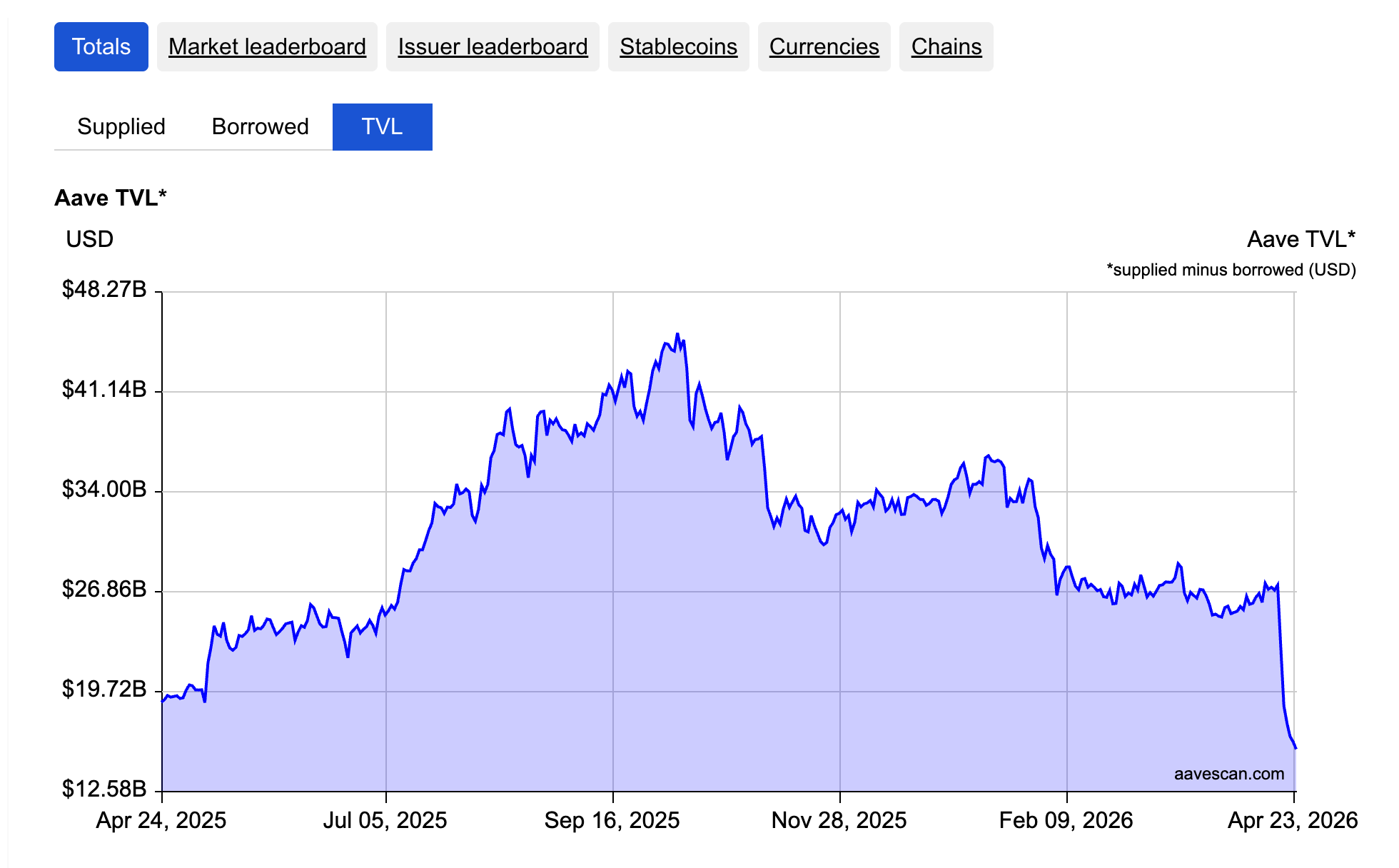
2.92 亿美元,这是 Kelp DAO 被盗的 rsETH 资金总额;172 亿美元,这是自事发日起从 Aave 流出的资金规模。

Aave 正在因自己极度愚蠢的危机公关策略,坐视社区恐慌情绪接连发酵数日,继而丢失掉自己曾经在借贷赛道最大的优势 —— 数百亿美元级别的沉淀资金规模以及“最安全 DeFi”的用户心智标签。
  • Odaily注:前情提要可参阅《DeFi再次被盗2.92亿美元,这下连Aave都不安全了?》;《2.9亿窟窿下的三方博弈:Aave、L0、Kelp谁能买单?》。

Aave 犯了什么错?

关于 Kelp DAO 黑客事件的细节已不用多说,再去指责 Aave 为何给予 rsETH 如此高的 LTV 已无意义,这里主要是想从一个 AAVE 长期用户的角度,来聊一聊事发之后 Aave 的应对策略。

首先是坏账规模问题,Aave 自己曾算过账。基于 rsETH 的不同处置情况,可能会有两种坏账可能 —— 若从所有 rsETH 流通中减计被盗损失,预计会产生 1.237 亿美元的坏账;若保障主网 rsETH 的价值,将损失全部计入 Layer2 中的映射版 rsETH,预计将产生 2.301 亿美元的坏账。

无论是哪种情况,凭借着 Umbrella、DAO 财库、团队的资金储备,Aave 都是有实力覆盖的。我理解 Aave 不愿意自己出这笔钱,想要让事故的主责方 Kelp DAO 以及次责方 LayerZero 尽量也多爆些金币,但问题在于对方也会这么想 —— “你 Aave 这么有钱,局面这么尴尬,怎么也得多担些吧”。所以,短期来看这三方的掰扯很难达成一个共识,这就意味着暂时不可能出现一个皆大欢喜的解决方案。

可用户是不可能等这么久的 —— Aave 的收益率水平在业界向来没什么竞争力,选择向 Aave 存款的用户都是冲着信誉、安全、流动性去的,但现在情况却是,Aave 在事发后最紧张的那几天,始终未向用户给出某种类似于托底的承诺,而是在一味强调“自身代码没问题”、“rsETH 如何记账 Aave 无法控制”来甩锅。

所以恐慌情绪才会一直在社区内发酵,用户会想尽办法出逃避险,能取钱的就直接取,取不出来的就先去其他池子借,导致影响逐步扩大。所以现在 Aave 的状况就是,一边面临着持续不断的资金流出,一边又是多个池子因利用率被拉满而出现流动性枯竭。

这一尴尬局面本是可以避免的(至少不会这么糟糕)......既然 Aave 掏得起钱,为什么不一开始就给社区注入一针定心剂来防止挤兑?最多 2.3 亿的坏账(可能更少)而已,这钱也不可能只由 Aave 一家掏,后续再和 LayerZero、Kelp DAO 扯皮即可。

现在好了,为了最多 2.3 亿美元的承诺救济,Aave 眼睁睁看着 172 亿美元的沉淀资金流失(数字可能继续增长),这还没计入 AAVE 币价这些天的跌幅......怎么算都是一笔亏麻的账。

更让 Aave 难受的是,其处境越糟糕,LayerZero、Kelp DAO 等对手方就会越从容,因为他们会判断 Aave 将更有动力去尽早解决问题,这只会导致 Aave 在博弈上处于劣势。

走到这一步,Aave 真是自作自受。

Aave 的身后,Spark 正虎视眈眈

在 Aave 头疼不已的同时,竞争对手 Spark 的现状却是锣鼓喧天,一片大好。更令人唏嘘的是,Spark 正是 Aave “亲手孵化”出来的竞争对手。

Spark 本是 Sky(原 MakerDAO)基于 Aave V3 的开源代码分叉开发的借贷协议,双方其实用的是同一套底层代码逻辑。作为回报,Spark 与 Aave 之间曾有过利润分享协议,但后来 Aave 方面曾指责 Spark 涉嫌毁约,再加之路线分歧,双方目前已是纯粹的竞争关系。

在 Kelp DAO 被盗之前的三个月,Spark 刚刚移除了对 rsETH 的支持(详情可参阅《同日不同命:Aave拥抱rsETH损失近2亿,Spark退出毫发无损》),你说这是战略保守也好,风控严谨也罢,甚至还可以完全归因于运气,但结果就是 Spark 在本次事件中为受任何波及 —— 仅在这一点上,Spark 便可肆无忌惮地攻击 Aave 曾经的“最安全 DeFi”标签。

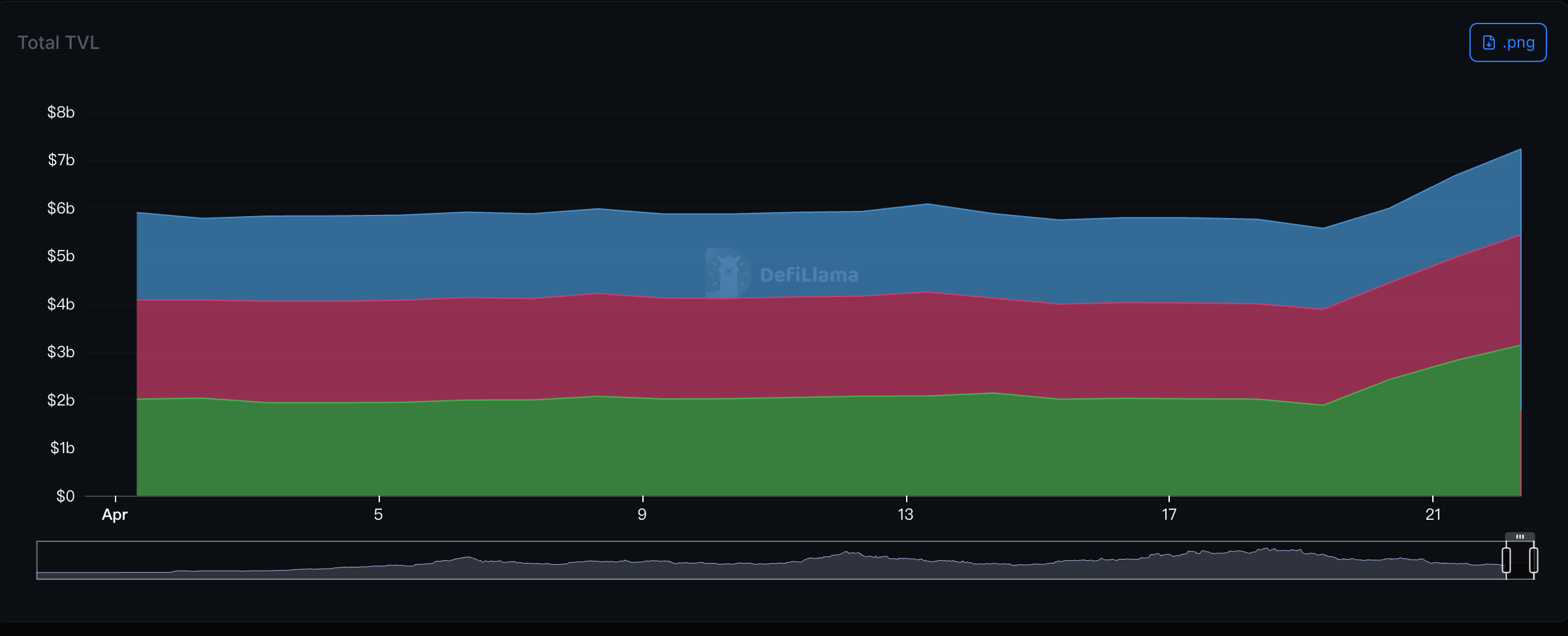
于是,Spark 便成了 Aave 资金出逃的避险地之一。自事发日起,Spark TVL 已增长了近 20 亿美元(下图绿色部分),孙宇晨在事发当日从 Aave 提出 53665 枚 ETH(价值 1.24 亿美元)随后存入 Spark,近些日继续累积后存款总额已达 13 亿美元 —— DeFi 世界中,孙哥的操作真的要学。
4 月 23 日,Upbit 正式宣布上线 Spark(SPK)韩元交易市场,SPK 受此利好刺激单日一度上涨超 80%,大幅缩小了自身与 AAVE 之间的市值差距。

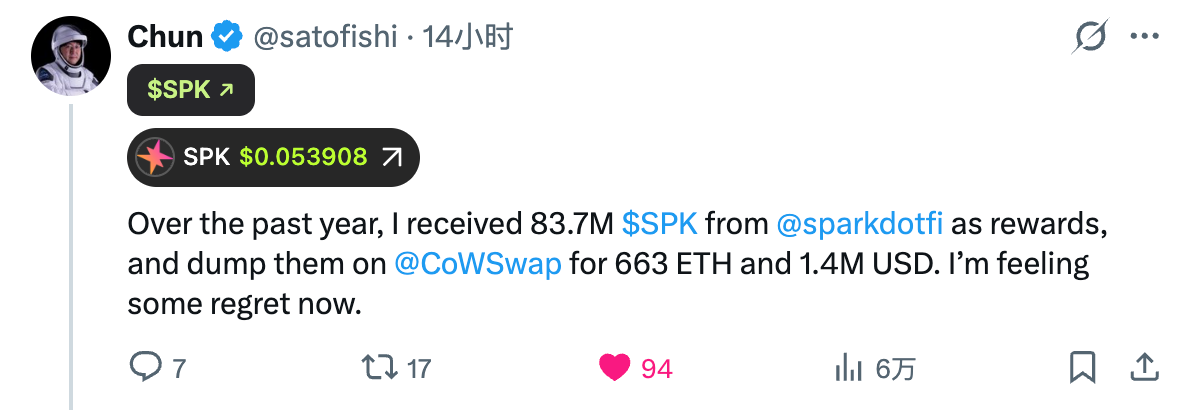
就连鱼池创始人王纯都在 X 感慨:“在过去一年里,我从 Spark 收到了 8370 万枚 SPK 奖励,并在 CoWSwap 上将其卖出,换得了 663 枚 ETH 和 140 万美元。现在有点后悔了。

Spark 显然意识到了这是从 Aave 口中夺取市场份额的绝佳良机。自事发以来,Spark 策略主管 MonetSupply 几乎成为了就此事发声最高频的 KOL,一天能发几十条帖子。虽然其发言在一定程度上确实能帮助公众理解发生了什么,但客观上也加剧了围绕 Aave 的恐慌情绪。

但这就是最纯粹的商业竞争,MonetSupply 只是做了最正确的选择。

Aave 正在丢失 DeFi 借贷的王座

4 月 24 日凌晨,或是意识到了当下的严峻状况,Aave 创始人 Stani 于 X 宣布将启动一项名为 DeFi United 的救济计划,合作参与方包括 LayerZero、Ethena、ether.fi、Ink 基金会、Golem 基金会、Trydo 等等,Stani 个人还将捐赠 5000 ETH 用于解决当下问题。

可资金已然流失,用户信任已遭重创。仅靠这份姗姗来迟的表态,Aave 短时间内也很难再挽回沉淀资金和用户信任。

DeFi 借贷赛道长期呈现着“一超多强”的格局,Aave 一直以来都有着看似极稳固的领跑优势。可如今,Aave 却拱手让出了王座。在其身后,挑战者们来势汹汹,除去势头正盛的 Spark 外,Morpho、Jupiter Lend 等其他对手也希望从 Aave 口中夺食。

去年,Stani 曾以约 3000 万美元在伦敦购买了一栋五层豪宅,这是过去一年中英国低迷的奢侈房产市场中最昂贵的交易之一。我不知道是不是存在什么类似“毒奶”的东西,但前有 Su Zhu 等人为例,好像在圈内高调消费的大佬们总是会撞到些倒霉事。

我是猜不到,Stani 如今在他的五层豪宅中正想些什么。

Связанные с этим вопросы

QAave 在 Kelp DAO 黑客事件后犯了什么主要错误?

AAave 在事件发生后没有及时向用户提供托底承诺,而是强调自身代码无问题并试图推卸责任,导致社区恐慌情绪发酵,引发大规模资金流出和流动性枯竭。

QKelp DAO 黑客事件可能给 Aave 造成多大的坏账规模?

A根据 Aave 的计算,若从所有 rsETH 流通中减计被盗损失,预计会产生 1.237 亿美元的坏账;若将损失全部计入 Layer2 中的映射版 rsETH,预计将产生 2.301 亿美元的坏账。

Q为什么 Spark 是 Aave 的竞争对手,并且在此次事件中受益?

ASpark 是基于 Aave V3 代码分叉开发的借贷协议,但双方因利润分享协议和路线分歧已成为竞争关系。Spark 在事件前移除了对 rsETH 的支持,未受波及,并趁机吸收了大量从 Aave 流出的资金,TVL 增长了近 20 亿美元。

QAave 创始人 Stani 在事件后期采取了什么补救措施?

AStani 宣布启动名为 DeFi United 的救济计划,合作方包括 LayerZero、Ethena 等,他个人还将捐赠 5000 ETH 用于解决问题,但此举被视为姗姗来迟,难以快速挽回资金和信任流失。

Q此次事件对 Aave 在 DeFi 借贷市场的地位产生了什么影响?

AAave 因处理不当导致大量资金流失和用户信任受损,拱手让出借贷市场的王座,竞争对手如 Spark、Morpho、Jupiter Lend 等正趁机争夺市场份额。

Похожее

Dalio's Latest Warning: Don't Get Carried Away by AI, Real Returns on US Stocks in the Next 5-10 Years Could Be -5% to -10%

Ray Dalio, founder of Bridgewater Associates, warns investors against excessive concentration in AI stocks. He argues the current market, dominated by a few AI giants, mirrors historical patterns where revolutionary new technologies lead to high risk, volatility, and uncertainty. While acknowledging AI's transformative potential, Dalio emphasizes that most investors fail at this stage of the cycle by over-concentrating in a handful of leading companies. He cites inherent risks: companies cannot accurately forecast investment needs or external shocks (e.g., monetary policy, geopolitics, taxes), face potential disruption from future technologies and international competition (notably from China), and experience significant price swings. Dalio's core advice is diversification, calling it his "Holy Grail of Investing." He presents a mathematical case that a well-diversified portfolio of 15-20 uncorrelated, good bets offers a superior risk-adjusted return compared to a concentrated position. Dalio also offers a cautious outlook, suggesting U.S. stocks may deliver real returns of -5% to -10% over the next 5-10 years based on valuation and bubble indicators. He concludes that in the face of high uncertainty, the prudent strategy is not to avoid betting entirely, but to avoid large, concentrated bets where one lacks sufficient informational edge. Instead, investors should build a strategically balanced, diversified portfolio.

marsbit31 мин. назад

Dalio's Latest Warning: Don't Get Carried Away by AI, Real Returns on US Stocks in the Next 5-10 Years Could Be -5% to -10%

marsbit31 мин. назад

Rain Valuation Approaches $20 Billion: The Battle for U-Cards Extends to Rewards Systems

Rain, a stablecoin payments infrastructure company, is shifting the competitive focus for U Cards from simple issuance to user retention and repeated usage. On June 15, Rain launched "Rain Rewards," an embedded loyalty program capability within its card-issuing infrastructure. This allows partner businesses—like fintech platforms and neobanks—to configure branded loyalty points, earning rules, redemptions, and merchant promotions directly within their card products. The system, built from the 2025 acquisition of Uptop, ensures points are only issued upon final transaction settlement, preventing liabilities from refunds. Trials, such as with Avalanche Card, reportedly boosted spending by 25% among enrolled users. Founded by Farooq Malik and Charles Yoo-Naut, Rain evolved from a tool for managing Web3 company expenses into a full-stack enterprise platform. It is a Principal Member of Visa and Mastercard, enabling partners to issue stablecoin-backed cards and wallets while leveraging traditional payment networks. Notably, the popular U Card Plasma One is issued by Rain under Visa's authority. Rain also integrates with Visa's stablecoin settlement pilot, using USDC for network settlement. Rain's rapid funding reflects growing institutional interest in stablecoin payment infrastructure. It raised a $245 million Series A in March 2025, a $58 million Series B in August 2025, and a $250 million Series C in January of this year, reaching a $19.5 billion valuation. Annualized transaction volume exceeds $3 billion, serving over 200 partners including Western Union and Nuvei. Beyond cards, Rain is expanding into programmable payments. Its June 2026 "Agent Control Layer" allows businesses to set spending rules—like merchant categories, amounts, and frequency—for AI agents before transactions occur. This positions Rain not as a single product but as an operating system for stablecoin payments, handling everything from card issuance and wallet management to rewards, on/off-ramps, and automated compliance. The goal is to enable seamless, often invisible, real-world spending of on-chain assets.

Foresight News34 мин. назад

Rain Valuation Approaches $20 Billion: The Battle for U-Cards Extends to Rewards Systems

Foresight News34 мин. назад

Google TPU Shipments Revised Up by 50%

Recent industry research indicates a significant upward revision in the shipments of Google's TPU (Tensor Processing Unit) chips. Previous expectations for 2027 were set at around 10 million units, but new estimates now point to 15 million units, a 50% increase. This substantial boost directly translates to higher demand across the entire supporting supply chain. Google's TPU clusters utilize a standardized all-optical interconnect architecture. Consequently, key hardware components are deeply integrated and scaled in fixed ratios with the chips. The 15 million TPU target will drive corresponding demand increases for NPO optical engines (roughly a 1:1 match), 1.6T optical modules, OCS optical switches, high-end server power supplies, fiber optics & MPO connectors, and liquid cooling solutions. Among these, liquid cooling is highlighted as the sector experiencing the most significant transformation and offering the most stable potential for excess returns. As next-generation TPU chips reach power levels where traditional air cooling is insufficient, liquid cooling becomes essential. 2026 is forecasted as the first year of substantial adoption for Google's liquid cooling solutions. This shift, coupled with delivery and capacity bottlenecks faced by incumbent overseas manufacturers, is creating a prime window for domestic Chinese suppliers to enter and secure Google's core supply chain. The market size for Google-specific liquid cooling is projected to potentially triple from a baseline of hundreds of billions to around 300 billion units by 2028. The logic for the fiber optic sector is also being rewritten. Once considered a cyclical commodity tied to telecom operator procurement, fiber is now a strategic and scarce resource for AI Data Centers (AIDC). A severe supply-demand imbalance, driven by the long lead time for preform production (18-24 months) and surging demand from cloud giants, is supporting strong performance. Chinese fiber manufacturers are well-positioned to capture a significant share of global AIDC demand, with exports potentially reaching 200-300 million core kilometers in 2026. Overall, the investment focus within the AI computing industry is shifting from pure "chip performance speculation" towards the more certain incremental growth in computing infrastructure and its supporting ecosystem. The upward revision in Google TPU shipments, along with the potential for further doubling by 2028, is seen as solidifying performance visibility for the entire supporting supply chain over the next two years.

marsbit2 ч. назад

Google TPU Shipments Revised Up by 50%

marsbit2 ч. назад

What Wall Street Really Wants After the Crypto Story Recedes

The tide of speculative crypto narratives has receded, revealing Wall Street's true objective: building a controlled, yield-generating, and compliant financial pipeline on distributed ledgers. They are migrating core functions onto blockchains, not for decentralization, but for efficiency and new revenue streams. Key developments include BlackRock's BUIDL fund, a tokenized treasury fund acting as a foundational reserve asset, and the rise of Securitize, which is going public and partnering with the NYSE to build a 24/7 digital securities trading and settlement system. This signals a major shift of securities clearing to blockchain technology. To make volatile assets like Bitcoin palatable for institutional investors, firms like BlackRock and Goldman Sachs are creating "covered call" ETFs (e.g., BITA). These products systematically sell options on Bitcoin holdings, transforming price volatility into stable monthly income, effectively repackaging crypto as a yield-bearing asset. Stablecoins are being positioned not as speculative tools but as efficient payment rails. Companies like Stripe and Mastercard are integrating them for instant, low-cost merchant settlements and cross-border card payments, respectively. Critically, new legislation like the GENIUS Act shapes them as non-interest-bearing, heavily regulated extensions of the US dollar system. In summary, Wall Street is quietly constructing a parallel, blockchain-based financial infrastructure featuring tokenized traditional assets, structured crypto yields, and programmable dollar pipelines—all under its control and fully integrated with existing regulatory and credit frameworks.

marsbit2 ч. назад

What Wall Street Really Wants After the Crypto Story Recedes

marsbit2 ч. назад

Торговля

Спот
Фьючерсы

Популярные статьи

Как купить AAVE

Добро пожаловать на HTX.com! Мы сделали приобретение Aave Protocol (AAVE) простым и удобным. Следуйте нашему пошаговому руководству и отправляйтесь в свое крипто-путешествие.Шаг 1: Создайте аккаунт на HTXИспользуйте свой адрес электронной почты или номер телефона, чтобы зарегистрироваться и бесплатно создать аккаунт на HTX. Пройдите удобную регистрацию и откройте для себя весь функционал.Создать аккаунтШаг 2: Перейдите в Купить криптовалюту и выберите свой способ оплатыКредитная/Дебетовая Карта: Используйте свою карту Visa или Mastercard для мгновенной покупки Aave Protocol (AAVE).Баланс: Используйте средства с баланса вашего аккаунта HTX для простой торговли.Третьи Лица: Мы добавили популярные способы оплаты, такие как Google Pay и Apple Pay, для повышения удобства.P2P: Торгуйте напрямую с другими пользователями на HTX.Внебиржевая Торговля (OTC): Мы предлагаем индивидуальные услуги и конкурентоспособные обменные курсы для трейдеров.Шаг 3: Хранение Aave Protocol (AAVE)После приобретения вами Aave Protocol (AAVE) храните их в своем аккаунте на HTX. В качестве альтернативы вы можете отправить их куда-либо с помощью перевода в блокчейне или использовать для торговли с другими криптовалютами.Шаг 4: Торговля Aave Protocol (AAVE)С легкостью торгуйте Aave Protocol (AAVE) на спотовом рынке HTX. Просто зайдите в свой аккаунт, выберите торговую пару, совершайте сделки и следите за ними в режиме реального времени. Мы предлагаем удобный интерфейс как для начинающих, так и для опытных трейдеров.

964 просмотров всегоОпубликовано 2024.04.12Обновлено 2026.06.02

Как купить AAVE

Обсуждения

Добро пожаловать в Сообщество HTX. Здесь вы сможете быть в курсе последних новостей о развитии платформы и получить доступ к профессиональной аналитической информации о рынке. Мнения пользователей о цене на AAVE (AAVE) представлены ниже.

活动图片