1 Billion DOT Minted Out of Thin Air, Yet Hacker Only Made $230,000

marsbitОпубликовано 2026-04-13Обновлено 2026-04-13

Введение

On April 13, a security breach occurred involving the Polkadot bridge on the Ethereum network, where an attacker exploited a replay vulnerability in the MMR proof mechanism of Hyperbridge’s ISMP protocol. By reusing a historically valid proof and pairing it with a malicious request, the attacker bypassed verification and gained admin and minting rights over the wrapped DOT contract on Ethereum. They then minted 1 billion wrapped DOT tokens—2,805 times the existing supply—and attempted to liquidate them. However, due to extremely low liquidity in the wrapped DOT market, the massive sell-off crashed the token’s price by 99.98%, from $1.22 to approximately $0.000128. The attacker ultimately exchanged the tokens for only about 108.2 ETH (worth roughly $237,000), with gas costs as low as $0.74. The same exploit had been used previously in attacks on MANTA and CERE tokens, resulting in a total loss of around $242,000. Polkadot confirmed that the incident only affected DOT bridged via Hyperbridge to Ethereum and did not impact the native Polkadot network or DOT on other bridges. Exchanges including Upbit and Bithumb temporarily suspended DOT deposits and withdrawals as a precaution. The event highlights ongoing vulnerabilities in cross-chain infrastructure and the critical role of liquidity in limiting actual damages during large-scale exploits. It also reflects a broader trend of increasing DeFi security incidents in early 2026.

Author: Zhou, ChainCatcher


On the morning of April 13th Beijing time, on-chain monitoring platforms issued alerts one after another: abnormal issuance of Polkadot bridged assets was detected on the Ethereum network.

According to CertiK's analysis, the attacker submitted a carefully crafted cross-chain request to the HandlerV1 contract on the Ethereum side via Hyperbridge's ISMP protocol, and paired it with a real MMR proof that had been historically accepted by the system, successfully bypassing the verification mechanism.
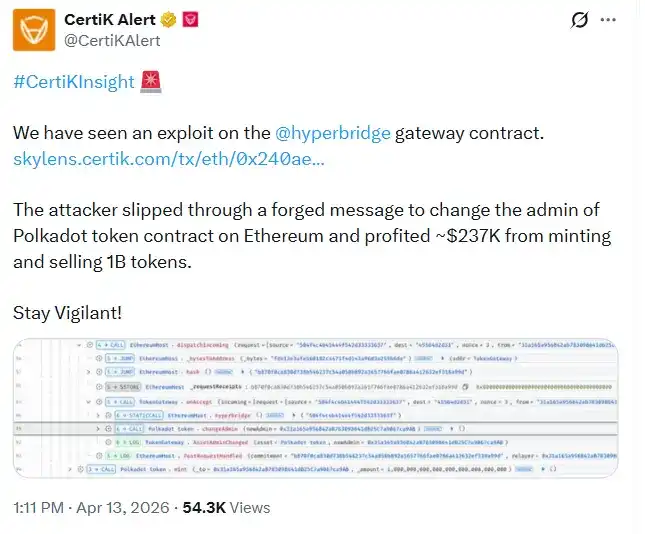
BlockSec Phalcon subsequently issued a technical alert, characterizing this vulnerability as an MMR proof replay vulnerability. According to their analysis, the root cause of the vulnerability lies in the fact that the replay protection of the HandlerV1 contract only verifies whether the hash of a request has been used before, but the proof verification process did not bind the submitted request payload to the proof being verified.

This logical flaw allowed the attacker to replay a historically valid proof and pair it with a newly constructed malicious request, thereby executing the ChangeAssetAdmin operation via the TokenGateway.onAccept() path, transferring the admin and minting permissions of the wrapped DOT contract on Ethereum (address: 0x8d...8F90b8) to an address controlled by the attacker.

On-chain data shows that after obtaining minting permissions, the attacker minted 1 billion wrapped DOT tokens, a quantity approximately 2805 times the reported circulating supply of about 356,000 tokens on Ethereum at the time.

Subsequently, the attacker exchanged the entire amount for approximately 108.2 ETH via Odos Router and Uniswap V4 liquidity pools, and transferred it to the attacker's external account, profiting about $237,000 at the time, with the gas cost for the entire attack being only about $0.74.

BlockSec Phalcon also mentioned that a previous attack using the same method had occurred, targeting MANTA and CERE tokens, resulting in a loss of about $12,000. The total combined loss from both attacks is approximately $242,000.

Following the incident, major South Korean exchanges Upbit and Bithumb announced the suspension of deposit and withdrawal services for DOT and the AssetHub Polkadot network to prevent potential fake deposit risks.

Polkadot officials stated that this vulnerability only affects DOT bridged to Ethereum via Hyperbridge, and does not affect DOT assets within the Polkadot ecosystem, nor DOT transferred via other bridges. Polkadot and its parachains, as well as native DOT, remain secure and unaffected. Hyperbridge has currently been suspended to investigate the issue.

It is worth mentioning that despite the minting scale reaching 1 billion tokens, the actual loss is far lower than the theoretical figure.Due to the extremely limited on-chain liquidity of wrapped DOT on Ethereum, the concentrated sell-off of 1 billion tokens instantly crashed the price of wrapped DOT from $1.22 to $0.00012831, a drop of 99.98%, rendering the vast majority of tokens unable to be effectively liquidated.

According to CoinMarketCap data, the price of native DOT tokens was also briefly dragged down by market sentiment, falling nearly 5%.

Users on X bluntly stated, who would have thought that DOT, once a cross-chain myth alongside Ethereum, would引爆 social media in this way. Cross-chain bridges have once again become the "Achilles' heel" of the crypto world. The once-deserted quiet has now turned into a scene of devastation and sighing. When 1 billion DOT appeared out of thin air, all technical indicators became worthless.

Other users jokingly remarked that low liquidity "saved Polkadot" in this incident by意外, limiting the actual loss to about $237,000.

However, while the low liquidity of bridged assets limited the hacker's profit, it exposed the potential fragility of the cross-chain interoperability layer.

It is reported that Hyperbridge, developed by Polytope Labs, is a cross-chain interoperability project within the Polkadot ecosystem, long positioning itself as trust-minimized cross-chain infrastructure with its core security mechanism relying on cryptographic proofs instead of multi-signature committees. The project had previously emphasized its resistance to common bridge attacks.
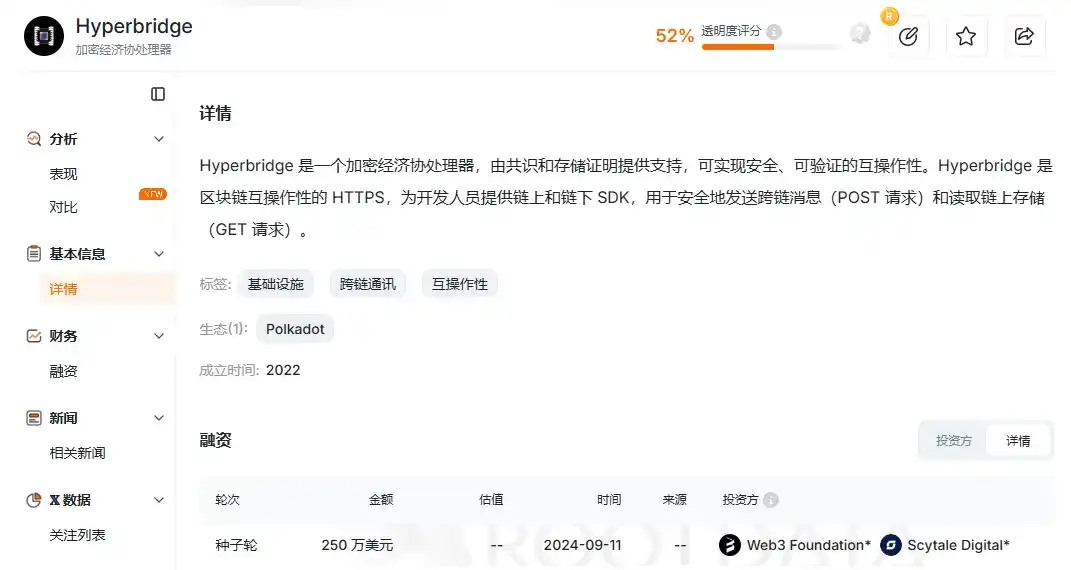
But this incident perhaps indicates that the integrity of the cryptographic proof mechanism itself is not sufficient to guarantee security; the specific implementation logic of the Gateway contract on the Ethereum side also constitutes an attack surface.

From a more macro perspective, this incident is a microcosm of the持续严峻 DeFi security landscape in 2026. Since the beginning of the year, several major attacks have occurred, including Venus generating $2.15 million in bad debt due to price manipulation, Resolve over-minting 80 million USR, and Drift losing over $285 million in assets. The attack methods varied and involved diverse areas.

Taking over minting rights for无限增发 is not a new attack模式. However, Hyperbridge's损失 was意外压低 due to its extremely shallow liquidity.

According to CertiK data, March alone recorded 46 security incidents, with total losses of approximately $39.8 million, the highest monthly record since November 2024. CertiK also pointed out that the increased frequency of code vulnerability exploits may be related to the rise of AI-assisted vulnerability mining tools.

The rise in attack frequency is also pushing the industry to重新审视 the boundaries of security and regulation. Circle's Chief Strategy Officer Dante Disparte previously, in response to the Drift Protocol theft, called for protocols, wallets, exchanges, and stablecoin issuers to treat security and accountability as a shared obligation. He suggested that DeFi protocols could develop on-chain technical protection measures参考 traditional market circuit breakers, and promote relevant legislation to enshrine property rights and financial privacy protection standards into law before the next major incident occurs.


Трендовые криптовалюты

Связанные с этим вопросы

QWhat was the core vulnerability exploited in the Hyperbridge attack on April 13th?

AThe attack exploited an MMR proof replay vulnerability. The flaw was in the HandlerV1 contract, where the replay protection only checked if a request's hash had been used before, but the proof verification process did not bind the submitted request payload to the proof being validated. This allowed the attacker to replay a historically valid proof with a new, forged request.

QHow much wrapped DOT did the attacker mint, and why was the actual financial gain so low compared to the amount minted?

AThe attacker minted 1 billion wrapped DOT tokens. However, the actual financial gain was only about $237,000 because the on-chain liquidity for wrapped DOT on Ethereum was extremely limited. The massive sell-off crashed the token's price by 99.98%, from $1.22 to approximately $0.00012831, making it impossible to liquidate the vast majority of the tokens.

QWhich other tokens were previously targeted using the same attack method mentioned in the article?

AAccording to the article, the same attack method was previously used against MANTA and CERE tokens, resulting in losses of approximately $12,000.

QWhat was the official response from Polkadot regarding the scope and impact of this incident?

APolkadot official stated that the vulnerability only affected DOT that was bridged to Ethereum via Hyperbridge. It did not affect DOT within the Polkadot ecosystem, DOT bridged through other bridges, or native DOT. They confirmed that Polkadot, its parachains, and native DOT remained secure and unaffected. Hyperbridge was paused for investigation.

QWhat broader trend in DeFi security does this event represent, according to the article?

AThe article states this event is a reflection of the increasingly severe DeFi security landscape in 2026. It cites other major incidents like the Venus protocol ($2.15M in bad debt), Resolve (80M USR over-minted), and the Drift Protocol hack (over $285M). It also notes a rise in code vulnerability exploits, potentially linked to the emergence of AI-assisted bug-finding tools, with March alone seeing 46 security incidents totaling ~$39.8M in losses.

Похожее

Фидделити в отчете за 3-й квартал: BTC, ETH и SOL продолжают формировать дно. Как долго еще продлится текущий крипто-медвежий рынок?

Отчёт Fidelity за 3-й квартал 2026 года анализирует состояние рынка криптоактивов, отмечая, что BTC, ETH и SOL продолжают формировать дно. **Ключевые выводы:** * **Общий рыночный настрой:** Взвешенный показатель NUPL (чистая нереализованная прибыль/убыток) упал до -0.01, что указывает на то, что рынок в целом находится на грани безубыточности. Только BTC сохраняет нереализованную прибыль, выступая стабилизатором, в то время как ETH и SOL находятся в зоне убытков. * **Доминирование Bitcoin:** Доля BTC в общей капитализации рынка выросла до 68%, что говорит о консервативных настроениях инвесторов и отсутствии ротации капитала в альткойны. * **Падение цен:** За год BTC упал на ~45%, ETH на 37%, SOL на 53%. Рынок демонстрирует признаки капитуляции, включая рекордный отток средств из спотовых ETP. * **Прогноз по дну:** Ссылаясь на исторические циклы (около 300 дней в 2018 и 2022 гг.), в отчёте предполагается, что текущий медвежий период, длящийся уже около 203 дней, может пройти около двух третей своего пути. Октябрь 2026 года упоминается как потенциальный временной ориентир для наблюдения, но не как точный прогноз. **Оценка по активам:** * **Bitcoin:** NUPL (0.09) и Yardstick (показатель «стоимость/хэшрейт») оцениваются позитивно, что может указывать на привлекательную оценку. Однако импульс и динамика относительно золота остаются негативными. Хэшрейт снижается из-за давления на майнеров и конкуренции с AI-сектором. * **Ethereum:** NUPL (-0.43) глубоко в зоне капитуляции, что исторически связано с высокими последующими доходами. Импульс негативный. Объём переводов стейблкоинов (позитивно) остаётся высоким, но комиссии сети и активность базового слоя снижаются (нейтрально/негативно). * **Solana:** NUPL (-0.72) также в зоне капитуляции с высокой исторической волатильностью. Импульс негативный. При этом фундаментальные показатели использования и объёмы стейблкоинов остаются устойчивыми (позитивно), а сетевые комиссии, возможно, приближаются к дну (нейтрально). Отчёт подчёркивает, что рынок находится в фазе консолидации и поиска дна, где BTC демонстрирует относительную силу, в то время как настроения в целом остаются подавленными. Долгосрочным инвесторам текущие уровни могут предоставить привлекательные возможности, если тенденция внедрения базовых сетей сохранится.

marsbit4 мин. назад

Фидделити в отчете за 3-й квартал: BTC, ETH и SOL продолжают формировать дно. Как долго еще продлится текущий крипто-медвежий рынок?

marsbit4 мин. назад

Как показали себя Bitcoin и Ethereum в августе? Вот основные факты, которые вам необходимо знать

Биткоин и Эфириум, завершившие июль ростом (18,5% и 7% соответственно), вступили в август с исторически слабыми сезонными показателями. Анализ динамики Ethereum за август с 2016 года показывает неоднозначную картину: из 10 периодов рост был лишь в 4 случаях. Средняя доходность месяца составляет 6,74%, но медианная отрицательна (-1,74%), что указывает на влияние единичных сильных ралли, подобных скачку на 92,86% в 2017 году. Исторические данные по Биткоину за август также не дают четкого бычьего сигнала: средняя доходность — 1,06%, а медианная — отрицательные -6,99%. Это означает, что убыточные закрытия в этом месяце случаются чаще. Таким образом, несмотря на положительные средние значения у обеих криптовалют, отрицательная медианная доходность свидетельствует о повышенной вероятности негативного завершения августа.

cryptonews.ru19 мин. назад

Как показали себя Bitcoin и Ethereum в августе? Вот основные факты, которые вам необходимо знать

cryptonews.ru19 мин. назад

Сенатор предложил создать бюро борьбы с криптовалютным бизнесом Трампа

Сенатор Чак Шумер предложил создать независимое федеральное бюро для расследования коррупции, связанной с криптовалютным бизнесом, и возврата незаконно полученных средств. Инициатива направлена на борьбу со злоупотреблениями госслужащих. Шумер также предлагает разрешить частным лицам и прокурорам штатов подавать иски против чиновников и компаний. В качестве примера он привёл доходы Дональда Трампа и его семьи, превышающие $5,4 млрд с 2025 года от таких проектов, как World Liberty Financial и мемкоины TRUMP и MELANIA. Белый дом отвергает наличие конфликта интересов. Споры вокруг криптобизнеса Трампа заблокировали законопроект CLARITY: демократы настаивают на включении в него запрета на получение прибыли от криптовалют для высших должностных лиц и их семей. Ранее Шумер с коллегами безуспешно пытался внести аналогичные поправки в закон о стейблкоинах GENIUS.

cryptonews.ru2 ч. назад

Сенатор предложил создать бюро борьбы с криптовалютным бизнесом Трампа

cryptonews.ru2 ч. назад

Руководитель HIVE: Графические процессоры для ИИ приносят в 10 раз больше дохода в час, чем майнинговые фермы

Руководитель HIVE заявил, что использование графических процессоров для вычислений в сфере искусственного интеллекта приносит в 10 раз больше дохода в час, чем майнинг биткоина. Конкретный кластер из 504 GPU Nvidia B200 приносит около $2,90 за GPU-час, в то время как майнинговые установки компании генерируют примерно $0,12 в час. Эта разница лежит в основе стратегии компании: инвестиции направляются в высокодоходный ИИ-бизнес при продолжении майнинговой деятельности. В 2026 финансовом году выручка HIVE выросла на 158% до $297,8 млн, а доход от нового подразделения ИИ и высокопроизводительных вычислений (HPC) составил $19,5 млн. Компания ранее сделала крупную ставку на чипы Nvidia, что дало ей преимущество с началом бума ИИ. HIVE строит в Торонто центр обработки данных для ИИ мощностью 320 МВт, который после запуска в 2027 году сможет приносить около $360 млн годовой выручки. Компания ставит цель увеличить доход от ИИ/HPC в десять раз к концу финансового года. Аналогичный тренд наблюдается и у других майнинговых компаний, таких как MARA, Hut 8 и Terawulf, которые также переориентируют мощности на более доходные контракты в сфере ИИ и HPC на фоне снижения маржинальности майнинга биткоина.

cryptonews.ru2 ч. назад

Руководитель HIVE: Графические процессоры для ИИ приносят в 10 раз больше дохода в час, чем майнинговые фермы

cryptonews.ru2 ч. назад

«Каждый день без правил — это потеря капитала»: Grayscale обратилась к Сенату из-за CLARITY Act

Компания Grayscale Investments обратилась к лидерам Сената США с призывом провести голосование по законопроекту CLARITY Act до августовского перерыва Конгресса. В открытом письме компания подчеркивает, что американская криптоиндустрия годами работает без четкой законодательной базы, вынужденно адаптируясь к «регулированию через принудительное правоприменение», что создает неопределенность для бизнеса и инвесторов. Принятие CLARITY Act, по мнению Grayscale, установит ясные правила, распределит полномочия между CFTC и SEC и повысит конкурентоспособность США, остановив отток капитала и инноваций в юрисдикции с более понятным регулированием, такие как Сингапур или Абу-Даби. Закон также будет способствовать развитию рынка крипто-ETF и других регулируемых инвестиционных инструментов. Законопроект, являющийся результатом двухпартийной работы, уже прошел комитетские стадии. Однако его рассмотрение в Сенате откладывается из-за перегруженного законодательного календаря и приоритета других вопросов. Несмотря на достигнутый прогресс, в том числе по блоку этических поправок, документ продолжает сталкиваться с критикой. Генеральный прокурор Нью-Йорка опасается ослабления борьбы с мошенничеством на уровне штатов, а крупные банки призывают ужесточить регулирование стейблкоинов, чтобы предотвратить отток депозитов.

cryptonews.ru2 ч. назад

«Каждый день без правил — это потеря капитала»: Grayscale обратилась к Сенату из-за CLARITY Act

cryptonews.ru2 ч. назад

Торговля

Спот

Популярные статьи

Как купить DOT

Добро пожаловать на HTX.com! Мы сделали приобретение Polkadot (DOT) простым и удобным. Следуйте нашему пошаговому руководству и отправляйтесь в свое крипто-путешествие.Шаг 1: Создайте аккаунт на HTXИспользуйте свой адрес электронной почты или номер телефона, чтобы зарегистрироваться и бесплатно создать аккаунт на HTX. Пройдите удобную регистрацию и откройте для себя весь функционал.Создать аккаунтШаг 2: Перейдите в Купить криптовалюту и выберите свой способ оплатыКредитная/Дебетовая Карта: Используйте свою карту Visa или Mastercard для мгновенной покупки Polkadot (DOT).Баланс: Используйте средства с баланса вашего аккаунта HTX для простой торговли.Третьи Лица: Мы добавили популярные способы оплаты, такие как Google Pay и Apple Pay, для повышения удобства.P2P: Торгуйте напрямую с другими пользователями на HTX.Внебиржевая Торговля (OTC): Мы предлагаем индивидуальные услуги и конкурентоспособные обменные курсы для трейдеров.Шаг 3: Хранение Polkadot (DOT)После приобретения вами Polkadot (DOT) храните их в своем аккаунте на HTX. В качестве альтернативы вы можете отправить их куда-либо с помощью перевода в блокчейне или использовать для торговли с другими криптовалютами.Шаг 4: Торговля Polkadot (DOT)С легкостью торгуйте Polkadot (DOT) на спотовом рынке HTX. Просто зайдите в свой аккаунт, выберите торговую пару, совершайте сделки и следите за ними в режиме реального времени. Мы предлагаем удобный интерфейс как для начинающих, так и для опытных трейдеров.

1.0k просмотров всегоОпубликовано 2024.03.29Обновлено 2026.06.02

Как купить DOT

Обсуждения

Добро пожаловать в Сообщество HTX. Здесь вы сможете быть в курсе последних новостей о развитии платформы и получить доступ к профессиональной аналитической информации о рынке. Мнения пользователей о цене на DOT (DOT) представлены ниже.

活动图片