Worldcoin alcanza un mínimo de 6 meses: ¿Serán $0.20 el próximo nivel de soporte de WLD?

ambcryptoОпубликовано 2026-03-28Обновлено 2026-03-28

Введение

Worldcoin (WLD) ha caído a un mínimo de 6 meses, situándose en $0.282, con una pérdida diaria del 9.03%. El equipo de Worldcoin transfirió 89.65 millones de tokens, valorados en $26.17 millones, a varios exchanges, lo que podría indicar una preparación para la venta y ejercer presión bajista adicional. La capitalización de mercado se redujo a $876 millones, reflejando importantes salidas de capital. En Binance, el volumen de ventas superó al de compras, y los mercados de futuros mostraron una salida neta agresiva de fondos. El RSI sugiere dominio de los vendedores, y se prevé que el soporte de $0.20 podría ser probado próximamente. Para una recuperación, WLD necesitaría recuperar la resistencia de $0.30.

Worldcoin [WLD] ha operado dentro de una fuerte tendencia bajista desde que cayó por debajo de $1. De hecho, el altcoin ha cerrado en mínimos más bajos desde enero, lo que refleja una fuerte presión bajista.

Worldcoin extendió su racha bajista, rompiendo el soporte de $0.3 y cayendo a un mínimo de 6 meses de $0.2701. Al momento de escribir, WLD cotizaba a $0.282, una caída del 9.03% en los gráficos diarios.

En el mismo período, la capitalización de mercado del altcoin cayó de $1 mil millones a $876 millones, lo que indica salidas masivas de capital. Tras este deslizamiento del mercado, los niveles de liquidación se dispararon con más de $4.26 millones en posiciones largas liquidadas, extendiendo aún más la tendencia bajista.

En medio de esta debilidad del mercado, el equipo de Worldcoin ha movido fondos significativos a exchanges.

El equipo de WLD mueve 89.65 millones de tokens

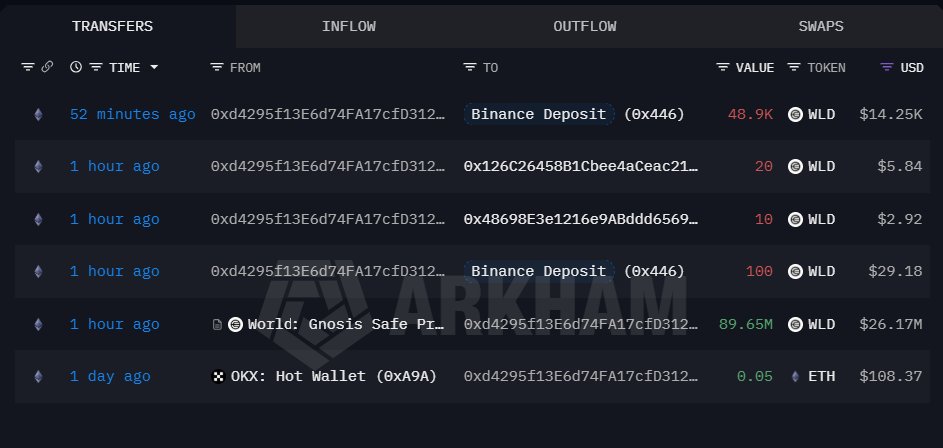
Onchain Lens informó que el equipo de WorldCoin envió 89.65 millones de WLD, con un valor de $26.17 millones, a una nueva billetera. Después de la transferencia, el equipo luego comenzó a enviar fondos a múltiples exchanges centralizados (CEX).
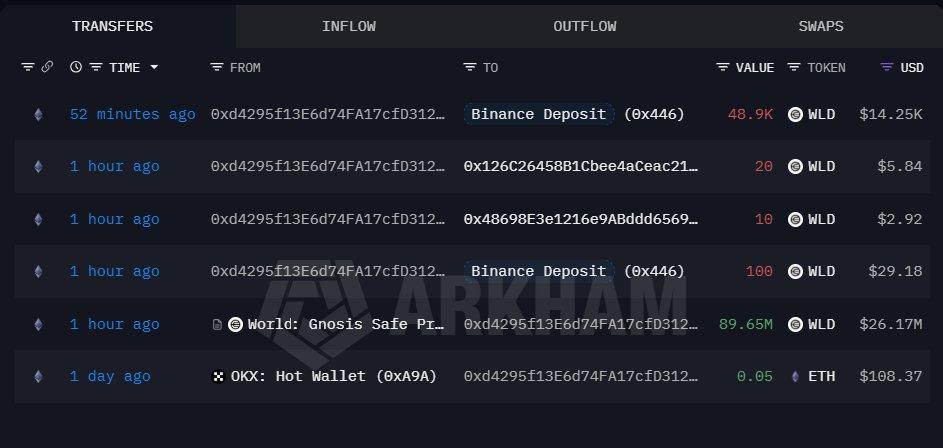
Fuente: Onchain Lens

Cuando una billetera de un equipo realiza tales transferencias, podría significar dos cosas importantes. En primer lugar, mover fondos a exchanges podría significar que los tokens se están preparando para la venta.

Por lo general, este movimiento es inflacionario, causando presión bajista a corto plazo y conduciendo a una caída de precios. Sin embargo, a veces los equipos mueven fondos a exchanges para proporcionar liquidez, apoyando la estabilidad del mercado al evitar un deslizamiento mayor.

Aunque menos bajista, también podría crear presión a la baja si la demanda es débil. En conjunto, cualquier movimiento podría resultar en presión bajista, conduciendo a precios más bajos.

WLD enfrenta una fuerte presión bajista

Además de las transferencias de tokens del equipo, Worldcoin ha enfrentado una presión significativa de otros participantes del mercado.

En el lado spot, los vendedores han dominado en gran medida el mercado, como lo evidencia el Volumen de Compra Venta en Binance. Al momento de escribir, el Volumen de Venta subió a 94 millones, mientras que el Volumen de Compra cayó a 76 millones, con el delta neto del mercado manteniéndose en -152 millones.
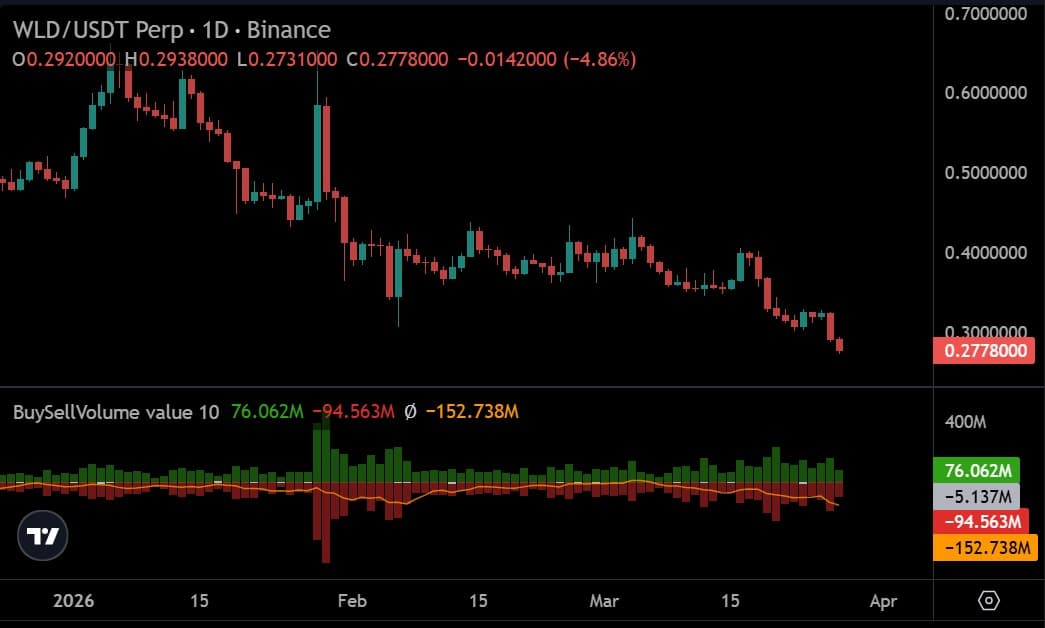
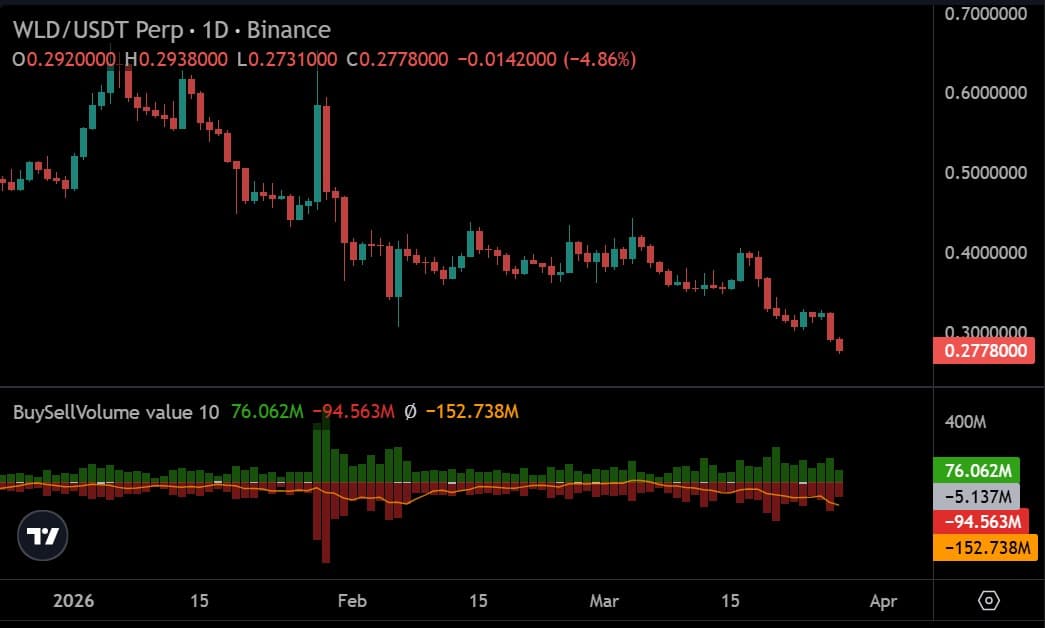
Fuente: Coinalyze

El mismo comportamiento del mercado se observó en el lado de Futuros. Según datos de CoinGlass, el Flujo de Entrada de Futuros cayó a $101 millones mientras que las salidas saltaron a $120.3 millones.

Como resultado, el Flujo Neto de Futuros cayó un 277% a -$18.98 millones, una clara señal de salidas agresivas en el mercado de futuros. Tales condiciones del mercado sugieren un aumento del sentimiento de aversión al riesgo, con traders reduciendo su exposición.
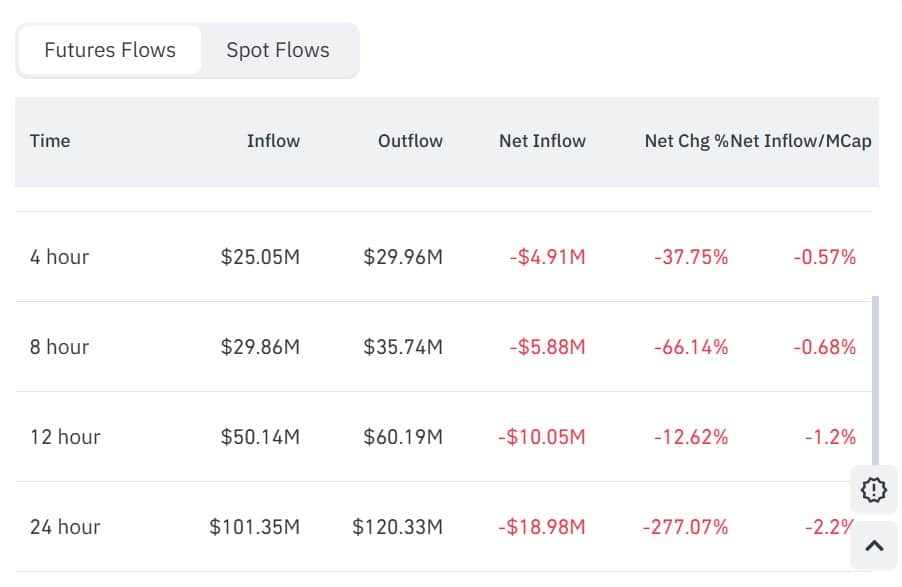
Fuente: CoinGlass

¿Más pérdidas por delante para WLD?

Worldcoin ha enfrentado una presión significativa a la baja, y la última transferencia de tokens del equipo exacerbó la tendencia bajista.

Al momento de escribir, el Índice de Fuerza Relativa (RSI) del altcoin cayó más profundamente en la zona bajista y se acercaba a un cruce bajista. A menudo, cuando este indicador de momentum cae a tales niveles, sugiere que los vendedores han superado a los compradores.
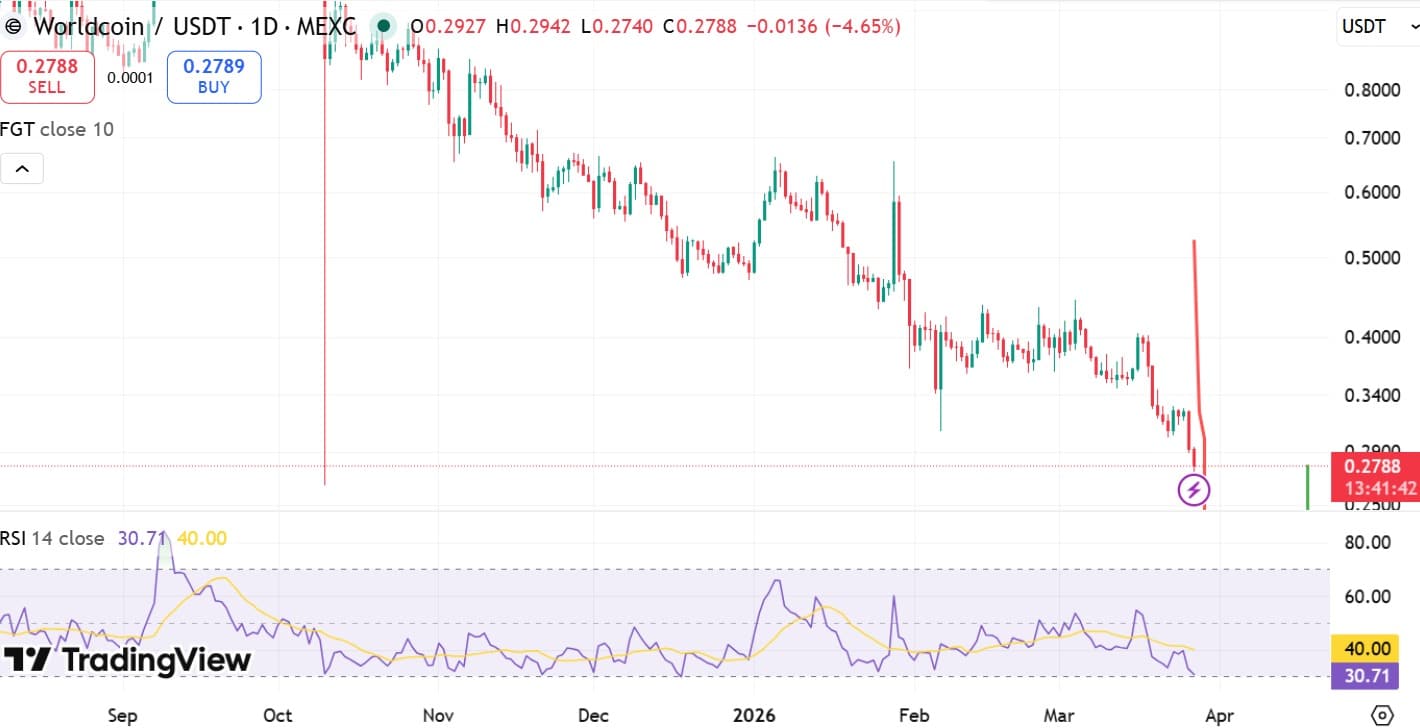
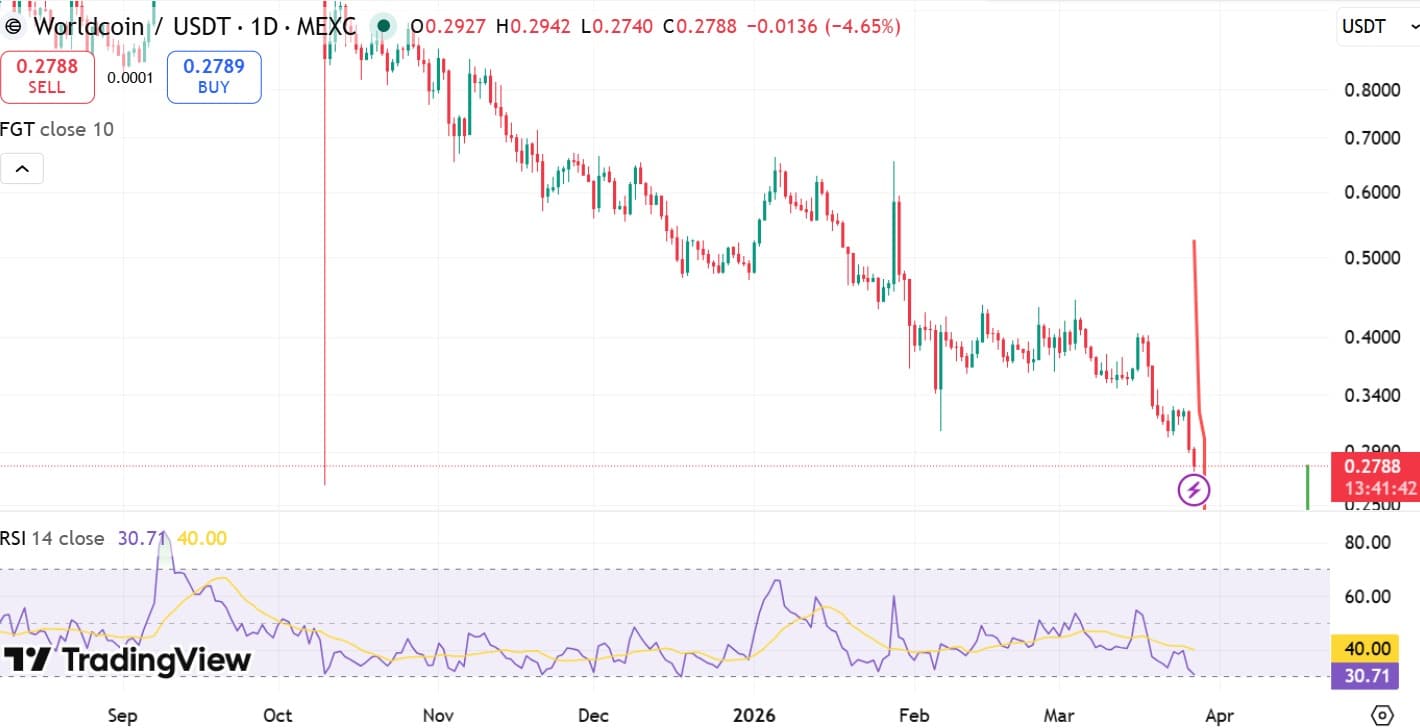
Fuente: TradingView

Tradicionalmente, una caída en territorio de sobreventa ha precedido a precios más bajos. De hecho, el indicador Future Grand Trend indicó una continua caída del mercado, con una probabilidad de caer por debajo del soporte de $0.2.

Para una potencial reversión de tendencia, WLD necesita recuperar la resistencia de $0.3 y convertirla en soporte.


Resumen Final

  • El equipo de Worldcoin mueve 89.65 millones de WLD, con un valor de $26.17 millones, a múltiples exchanges.
  • WLD declinó un 9.03%, rompiendo el soporte de $0.3 para alcanzar un mínimo de 6 meses de $0.27.

Связанные с этим вопросы

Q¿A cuánto cayó el precio de Worldcoin (WLD), marcando un mínimo de 6 meses?

AEl precio de Worldcoin (WLD) cayó a un mínimo de 6 meses de $0.2701.

Q¿Cuántos tokens WLD transfirió el equipo de Worldcoin a exchanges y cuál era su valor?

AEl equipo de Worldcoin transfirió 89.65 millones de tokens WLD, con un valor de $26.17 millones, a varios exchanges centralizados (CEXs).

QSegún el indicador RSI, ¿qué sugiere sobre la presión compradora y vendedora para WLD?

AEl Relative Strength Index (RSI) de WLD cayó profundamente en la zona bajista, lo que sugiere que los vendedores han superado a los compradores.

Q¿Cuál fue el impacto en el mercado de futuros, específicamente en el 'Netflow'?

AEl Netflow de futuros cayó un 277% hasta -$18.98 millones, lo que es una clara señal de salidas agresivas en el mercado de futuros.

Q¿Qué nivel de precio necesita recuperar WLD para una posible reversión de la tendencia bajista?

APara una posible reversión de la tendencia bajista, WLD necesita recuperar la resistencia de $0.3 y convertirla en soporte.

Похожее

The Gold Buy-on-the-Dip Guide: Watch Interest Rates, Not Just War

"Gold Buying Guide: Focus on Interest Rates, Not Just War" Four months ago, gold buyers likely didn't anticipate buying at a peak that even a war couldn't sustain. After hitting a record high of $5,596 on January 29, gold entered a bear market just 91 days later, its fastest decline since 2008. A key trigger was the Fed's hawkish shift, highlighting that monetary policy, not geopolitics, is the primary driver. The article argues that the traditional "buy gold in turmoil" script has changed. While the US-Iran conflict initially boosted prices, the sustained rally in oil prices heightened inflation fears, forcing central banks to maintain or consider tighter policy. Since gold yields no interest, higher rates increase its opportunity cost, eroding its appeal. This dynamic was evident when gold fell sharply on May 18 despite positive peace talks, as lower oil prices eased inflation and thus rate hike pressures. The recent sell-off is also part of a broader market deleveraging. Correlations between gold, Nasdaq, and Bitcoin spiked as leveraged investors sold liquid assets to cover losses, creating a synchronized downturn. Historically, gold bottoms align with policy shifts, not conflict resolutions. The 2008 and 2022 bear markets ended with shifts to extreme easing and peak inflation expectations, respectively. For potential buyers, the author suggests monitoring three signals: 1) Peak interest rate hike expectations, 2) Reopening of the Strait of Hormuz (to ease oil/inflation pressure), and 3) A return to net inflows for Gold ETFs, indicating the end of forced selling. While predicting the exact bottom is impossible, the author's personal strategy involves scaling into a position across price levels like $4000, $3700, and $3500, committing no more than 30% of the intended total allocation initially, and adding the remainder only if key signals emerge. The core conclusion: In turbulent times, watching interest rates is more crucial than watching wars.

marsbit3 мин. назад

The Gold Buy-on-the-Dip Guide: Watch Interest Rates, Not Just War

marsbit3 мин. назад

Recent On-Chain Review: No Clear Narrative Under U.S. Stock Market Pressure, Just Hype

This article analyzes the current state of the Solana meme coin and community token ecosystem, highlighting a market caught between two dominant forces: attention-based PvP and a gradual return to community-centric projects. The first part explores the "Attention PvP" dynamic, where success is driven by celebrity endorsements, viral events, and speed. Examples include $JOTCHUA, which surged after its meme creator's social media activity, and $WORLDCUP, which outperformed a similar Base chain project ($PITCH) largely due to influencer support. The recent "pump.fun GO" feature, allowing bounty tasks for token promotion, is critiqued for fostering sensationalist and often negative stunts—like people getting token tickers tattooed on their bodies for rewards—reminiscent of old internet shock content. In contrast, the article points to a resurgence of organic, community-driven tokens that survive market volatility through strong holder bases and shared ideology, not just hype. Influencer Ansem is cited, arguing that durable meme coins rely on communities willing to endure losses and promote their core message daily. Examples given are older tokens like $neet (anti-work ethos), $troll, $buttcoin, and $triplet, which have maintained relative price stability. A prime example of this community-build model is the new project $KINS, the token for the browser-based MMORPG Kintara. Its success stems not from advanced graphics but from consistently delivering updates, fostering player trust, and creating genuine engagement (e.g., in-game economies, events, property auctions). It has attracted a growing player base and even notable KOLs as participants, demonstrating that sustainable growth can come from building trust rather than orchestrating pumps. The article concludes by questioning whether the market is ultimately a game of mutual trust or mutual deception, expressing hope that such reflection might lead to a healthier ecosystem.

marsbit3 мин. назад

Recent On-Chain Review: No Clear Narrative Under U.S. Stock Market Pressure, Just Hype

marsbit3 мин. назад

On-Chain Scene on Opening Day: $20 Billion Already Staked, How Do On-Chain Contracts Know Who Wins?

On the opening day of the 2026 World Cup, over $2 billion had already been wagered on just the "tournament winner" contracts on platforms like Polymarket and Kalshi. This article explores how these blockchain-based prediction markets actually function once the games begin. It breaks down the massive volume and explains how single-game and tournament-long contracts are priced, with values moving between 1-99 cents to reflect implied probabilities. A key mechanism highlighted is "elimination zeroing," where a team's "champion yes" contract immediately settles to zero once they are mathematically eliminated. The core technical question answered is: how does a smart contract "know" who won a real-world match? The answer lies in oracles. The article details two primary paradigms: UMA's "optimistic oracle" (used by most of Polymarket), which allows a challenge period after a proposed result, and Chainlink's multi-source data aggregation (used by FIFA partners like ADI Predictstreet), which automates settlement with minimal dispute windows. Finally, the article injects a note of caution, citing research estimating that a significant portion of historical trading volume on these platforms might be "wash trading" to inflate numbers. It concludes by contrasting the legal status of these "event contracts" under CFTC rules in the U.S. versus traditional, state-regulated sports betting. As the tournament progresses, the real-time operation of this multi-billion dollar machine—its settlements, eliminations, and underlying mechanisms—becomes a story as compelling as the football itself.

marsbit19 мин. назад

On-Chain Scene on Opening Day: $20 Billion Already Staked, How Do On-Chain Contracts Know Who Wins?

marsbit19 мин. назад

Sequoia Dialogue with Jensen Huang: Computing Model Undergoes a 60-Year Transformation; You Won't Be Replaced by AI, But You Will Be Dimensionality-Reduced by 'Those Who Master AI'

NVIDIA founder and CEO Jensen Huang, in a conversation with Sequoia Capital's Konstantine Buhler, argues that we are witnessing the most significant computing shift in 60 years—from retrieval-based to generative computing. Instead of just storing and retrieving data, future systems will generate highly personalized content (text, images, video) on demand, powered by massive "AI factories." Huang envisions a global "intelligence network" that will envelop the planet, following the historical patterns of energy and communication grids. He outlines a five-layer investment framework: 1) Energy, 2) Chips/Computers, 3) Infrastructure (data centers), 4) AI Models, and 5) Applications. He predicts this ecosystem will reach a scale of $20 trillion annually. Crucially, Huang pushes back against fears of AI-driven job loss. He distinguishes between specific "tasks" (e.g., typing, analyzing images) and overall "jobs" (e.g., CEO, radiologist). While AI automates tasks, it increases efficiency and demand for the higher-value problem-solving aspects of professions, thus creating more jobs and "up-leveling" careers. The real risk, he asserts, is not being replaced by AI, but being outperformed by someone who effectively leverages it. He urges everyone to embrace AI as a tool for augmented capability and innovation.

marsbit1 ч. назад

Sequoia Dialogue with Jensen Huang: Computing Model Undergoes a 60-Year Transformation; You Won't Be Replaced by AI, But You Will Be Dimensionality-Reduced by 'Those Who Master AI'

marsbit1 ч. назад

Торговля

Спот
Фьючерсы

Популярные статьи

Как купить WLD

Добро пожаловать на HTX.com! Мы сделали приобретение Worldcoin (WLD) простым и удобным. Следуйте нашему пошаговому руководству и отправляйтесь в свое крипто-путешествие.Шаг 1: Создайте аккаунт на HTXИспользуйте свой адрес электронной почты или номер телефона, чтобы зарегистрироваться и бесплатно создать аккаунт на HTX. Пройдите удобную регистрацию и откройте для себя весь функционал.Создать аккаунтШаг 2: Перейдите в Купить криптовалюту и выберите свой способ оплатыКредитная/Дебетовая Карта: Используйте свою карту Visa или Mastercard для мгновенной покупки Worldcoin (WLD).Баланс: Используйте средства с баланса вашего аккаунта HTX для простой торговли.Третьи Лица: Мы добавили популярные способы оплаты, такие как Google Pay и Apple Pay, для повышения удобства.P2P: Торгуйте напрямую с другими пользователями на HTX.Внебиржевая Торговля (OTC): Мы предлагаем индивидуальные услуги и конкурентоспособные обменные курсы для трейдеров.Шаг 3: Хранение Worldcoin (WLD)После приобретения вами Worldcoin (WLD) храните их в своем аккаунте на HTX. В качестве альтернативы вы можете отправить их куда-либо с помощью перевода в блокчейне или использовать для торговли с другими криптовалютами.Шаг 4: Торговля Worldcoin (WLD)С легкостью торгуйте Worldcoin (WLD) на спотовом рынке HTX. Просто зайдите в свой аккаунт, выберите торговую пару, совершайте сделки и следите за ними в режиме реального времени. Мы предлагаем удобный интерфейс как для начинающих, так и для опытных трейдеров.

622 просмотров всегоОпубликовано 2024.03.29Обновлено 2026.06.02

Как купить WLD

Обсуждения

Добро пожаловать в Сообщество HTX. Здесь вы сможете быть в курсе последних новостей о развитии платформы и получить доступ к профессиональной аналитической информации о рынке. Мнения пользователей о цене на WLD (WLD) представлены ниже.

活动图片