"No hay acuerdos especiales": CEO de LayerZero niega vínculos con ballena que posee el 2.6% de ZRO

ambcryptoОпубликовано 2026-03-19Обновлено 2026-03-19

Введение

Un gran inversor anónimo ha acumulado 2.6% del suministro circulante de ZRO, el token de LayerZero, comprando aproximadamente 24.5 millones de tokens (valorados en $47.5 millones) a través de 9 carteras financiadas desde Coinbase Prime. La acumulación comenzó en marzo, tres semanas después del anuncio de la cadena Zero, lo que generó especulaciones sobre un posible vínculo interno. Sin embargo, el CEO de LayerZero, Bryan Pellegrino, negó conocer al inversor y enfatizó que no se ofrecen acuerdos especiales o descuentos. Mientras tanto, ZRO enfrenta una resistencia clave en $2.5, nivel que ha obstaculizado su avance desde 2025. Aunque los holders continúan acumulando, la venta de tokens comprados en esa zona podría reforzar esta barrera. La cadena Zero se lanzará en otoño de 2026.

Una entidad o individuo desconocido ha estado acumulando en secreto el token ZRO de LayerZero. Al momento de escribir, dicha ballena ha adquirido 47.5 millones de dólares en ZRO, aproximadamente 24.5 millones de tokens, un abrumador 2.6% de la oferta circulante.

Según la plataforma de análisis cripto Nansen, la frenética acumulación ha ocurrido en 9 billeteras, financiadas por una única fuente: Coinbase Prime. La firma destacó además.

A principios de marzo, la acumulación comienza en silencio en Coinbase. La acumulación comenzó exactamente 3 semanas después del anuncio de la cadena Zero.

Dada la coincidencia del anuncio de la cadena y la inversión a nivel de ballena, algunos observadores del mercado especularon que el inversor podría ser parte del círculo interno de LayerZero.

LayerZero niega conocer al comprador misterioso

Sin embargo, el CEO de LayerZero, Bryan Pellegrino, aclaró que no conocía al inversor.

Le hemos dicho a todos los fondos e instituciones con los que hemos hablado que nuestra preferencia es que simplemente compren ZRO directamente en el mercado abierto, en lugar de comprar a los laboratorios o a la fundación. No hay acuerdos especiales, ni descuentos.

La cadena Zero está programada para lanzarse en el otoño de 2026, y el proyecto atrajo a importantes patrocinadores financieros, incluyendo Citadel Securities, Tether, Ark Invest y Google. Para algunos, esto podría ser un posicionamiento para el trading institucional de mercados tokenizados.

Pero aún no está claro si el misterioso comprador ballena planeaba vender los tokens cuando la cadena se lance.

ZRO golpea un muro de venta

Dicho esto, ZRO subió un 60% desde el mínimo del rango de $1.49 y había llegado a $2.5, una zona de resistencia clave desde la segunda mitad de 2025. Los recientes intentos de recuperación en enero y febrero fueron rechazados en este obstáculo (rojo).
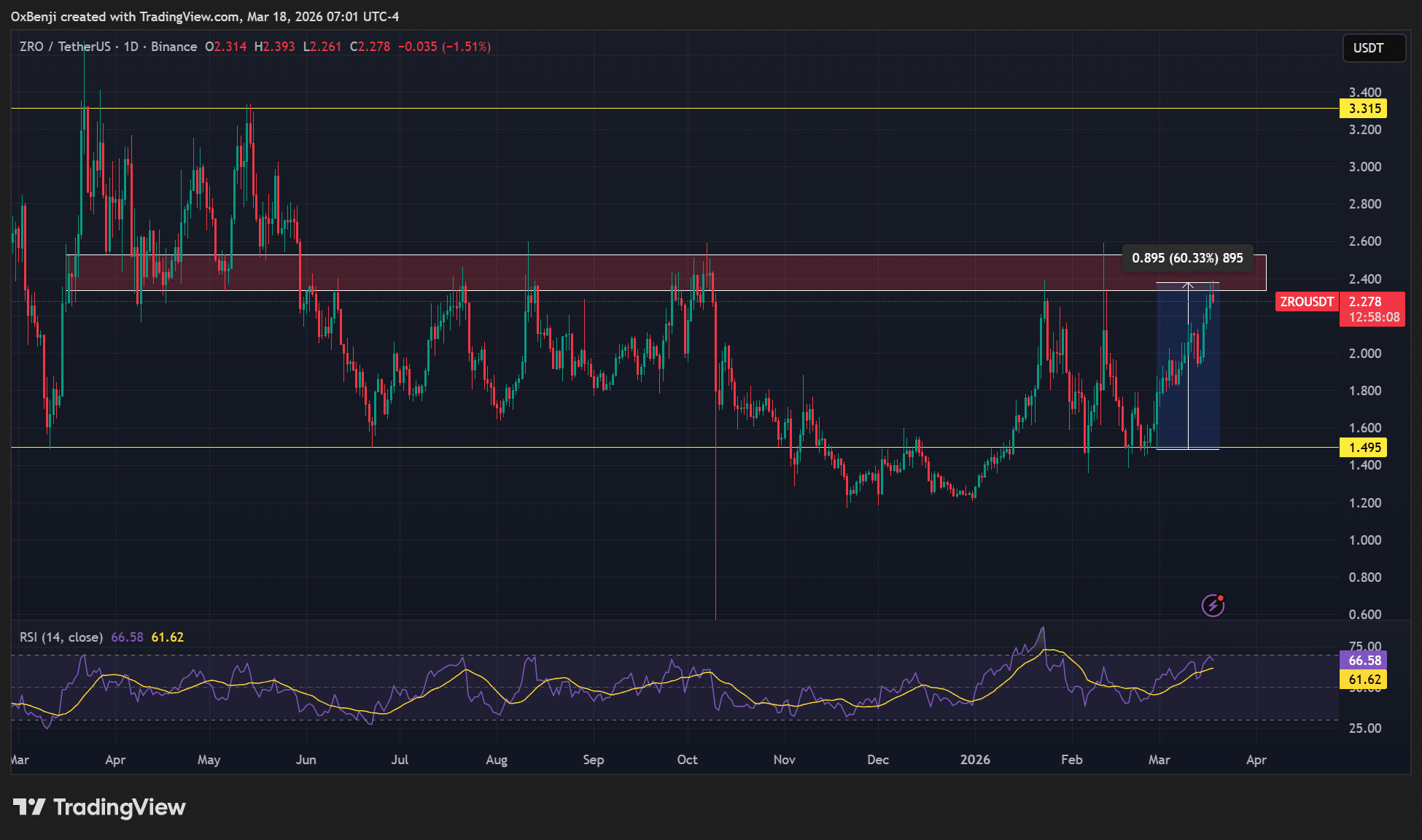
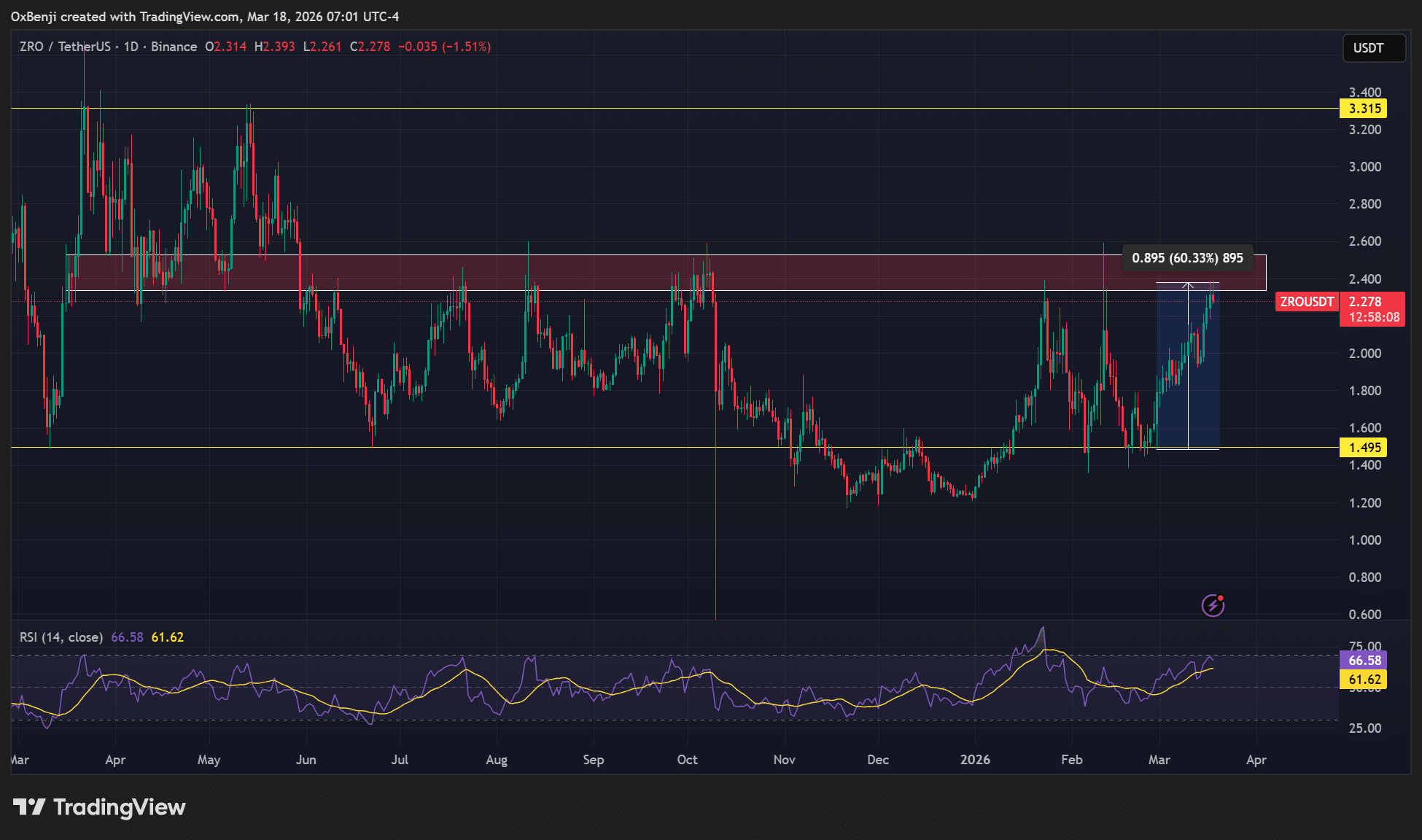
Fuente: ZRO/USDT, TradingView

Si la tendencia se repite, los compradores tardíos podrían esperar otra oportunidad de compra en $1.5. Sin embargo, convertir $2.5 en soporte podría impulsar el rally a $3.3.

No obstante, se adquirieron más de 34 millones de ZRO en la zona de resistencia, lo que podría inclinar a algunos inversores que han alcanzado el punto de equilibrio a cerrar sus posiciones. De ser así, esto podría añadir presión y reforzar el área como un obstáculo clave.
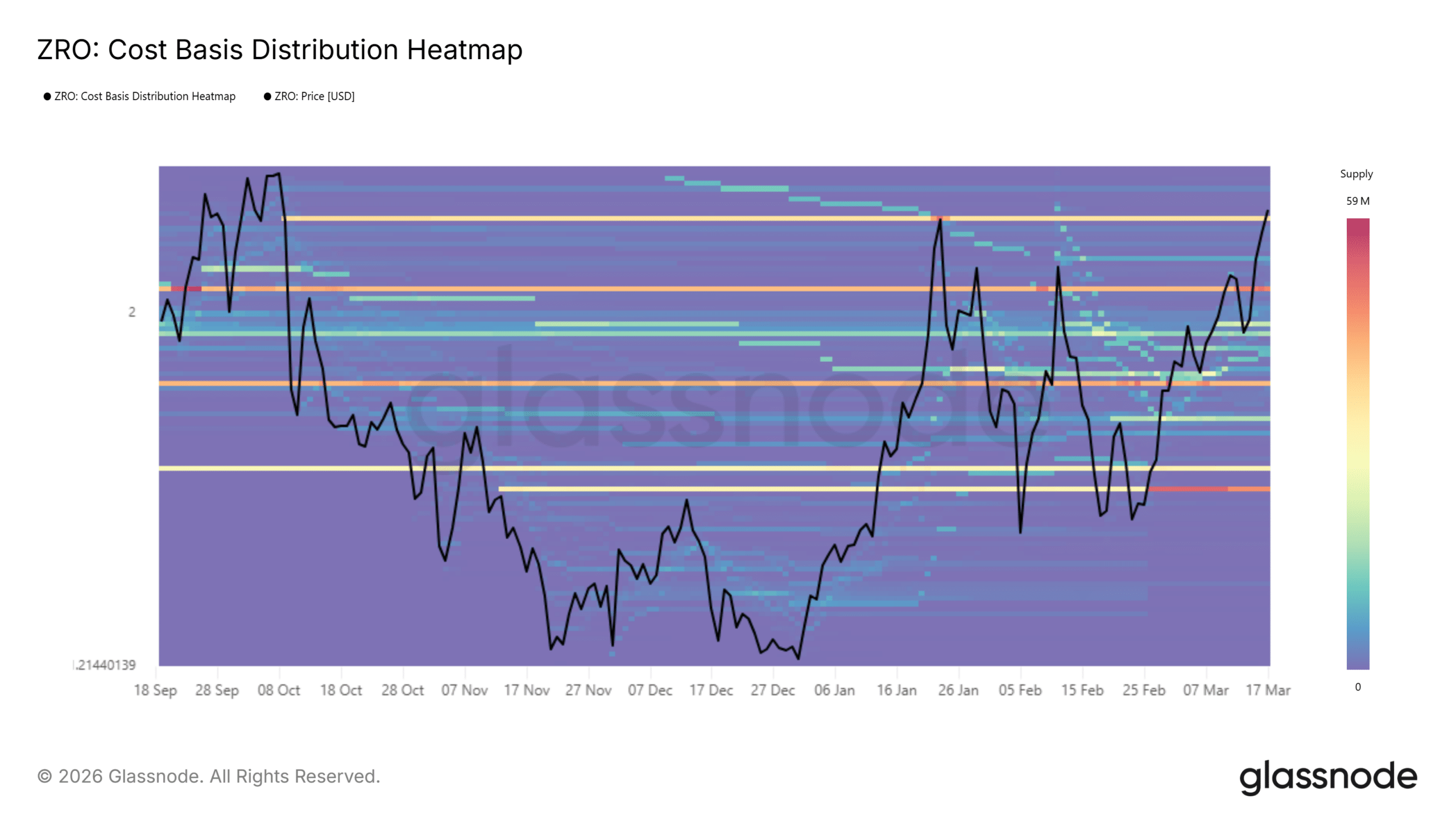
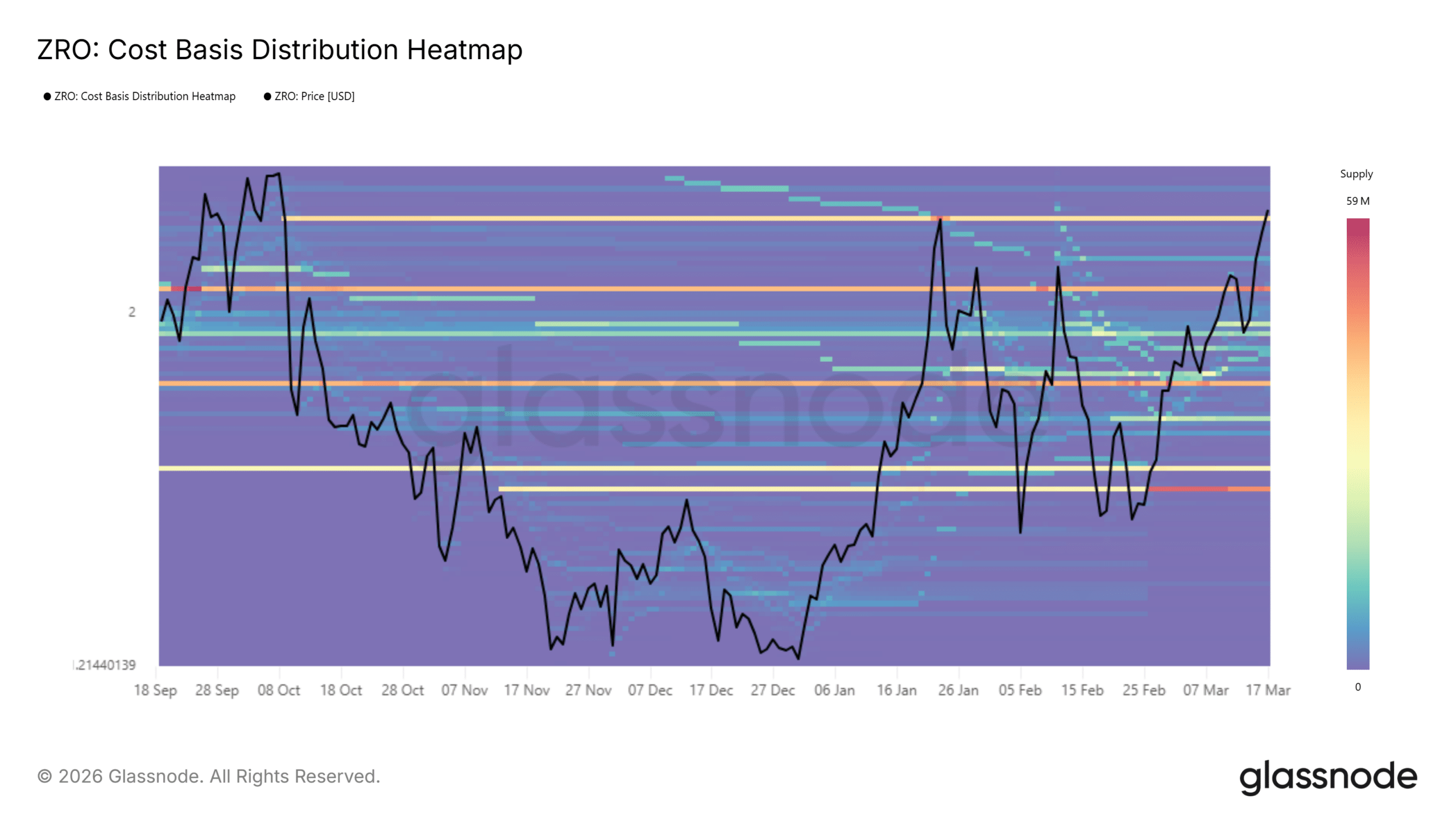
Fuente: Glassnode

Aun así, al momento de escribir, la presión de venta de los tenedores aún no era evidente.

Según el Cambio Neto de Posición de Tenedores promedio de 14 días, los inversores aún estaban manteniendo y añadiendo a sus reservas, como lo muestran las barras verdes.
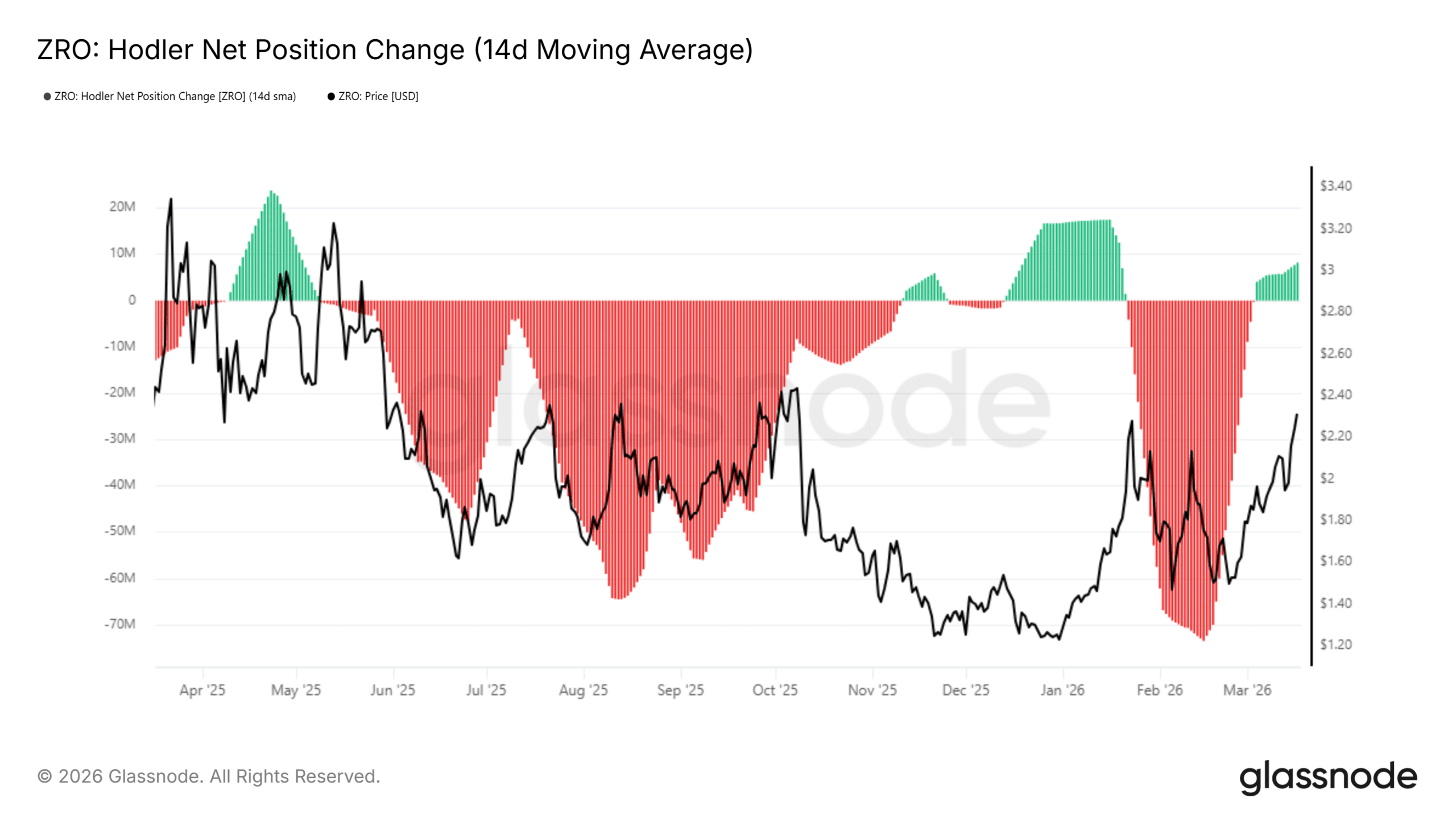
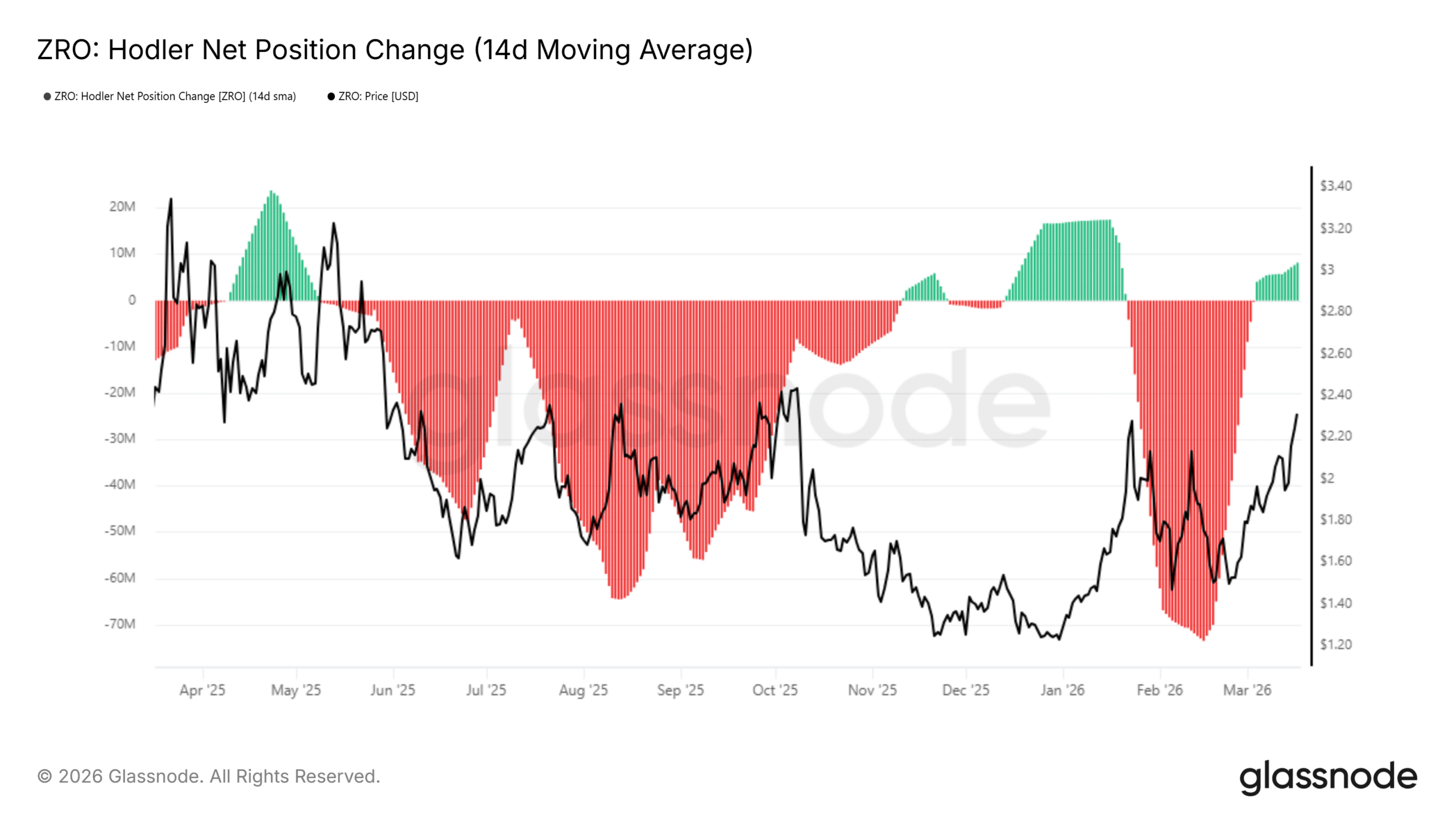
Fuente: Glassnode

Sin embargo, si el indicador se volviera rojo, sugeriría que los tenedores han comenzado a descargar. Tal movimiento podría reforzar aún más los $2.5 como un obstáculo clave que los toros deben superar para extender el rally.


Resumen Final

  • Una ballena misteriosa ha adquirido el 2.6% de la oferta circulante total de ZRO, pero LayerZero negó cualquier afiliación con el inversor.
  • El nivel de $2.5 ha sido un obstáculo desde 2025 y podría descarrilar la recuperación de ZRO si no hay un catalizador a corto plazo.


Связанные с этим вопросы

Q¿Qué porcentaje de la oferta circulante de ZRO ha adquirido la ballena misteriosa?

ALa ballena misteriosa ha adquirido un 2,6% de la oferta circulante de ZRO, lo que equivale a aproximadamente 24,5 millones de tokens.

Q¿Cómo ha negado LayerZero su relación con este gran inversor?

AEl CEO de LayerZero, Bryan Pellegrino, aclaró que no conoce al inversor y afirmó que no ofrecen 'acuerdos especiales ni descuentos', prefiriendo que los fondos e instituciones compren ZRO directamente en el mercado abierto.

Q¿A través de qué plataforma se financiaron las carteras utilizadas para la acumulación de ZRO?

ASegún la plataforma de análisis Nansen, la acumulación se realizó a través de 9 carteras, todas financiadas por una única fuente: Coinbase Prime.

Q¿Cuál es un nivel de resistencia clave para el precio de ZRO según el artículo?

AEl nivel de $2,5 ha sido una zona de resistencia clave desde la segunda mitad de 2025, y superarlo podría impulsar el precio hasta $3,3.

Q¿Qué indicador sugiere que los tenedores actuales no están vendiendo sus ZRO aún?

AEl indicador 'Holder Net Position Change' de 14 días muestra barras verdes, lo que indica que los inversores aún están manteniendo e incluso aumentando sus tenencias de ZRO.

Похожее

With Daily Active Users Reaching 3-4 Times That of the Industry's Second Place, Which Crack in the Office Agent Market Has Tencent's WorkBuddy Torn Open?

Tencent's AI office assistant, WorkBuddy, has achieved daily active users (DAU) 3-4 times that of the industry's second-place product, primarily driven by non-technical users like HR, operations, and administrative staff. Its rapid growth, starting with a public beta in March 2026, highlights a key strategic divergence from competitors like OpenAI's Codex and Anthropic's Claude Code. Unlike those tools, which originated as developer-focused assistants (in command lines or IDEs) and are now expanding towards office scenarios, WorkBuddy was built from the ground up for non-technical office workers. Its development was user-driven, initiated after腾讯云's team observed non-technical employees using their CodeBuddy coding tool for general tasks. WorkBuddy's design is defined by three core decisions aimed at lowering barriers: 1) Using natural language instead of technical concepts, so users describe their goal without needing to understand prompts or agents. 2) Providing pre-packaged "Skill" templates for common office tasks like data processing, content creation, and research. 3) Natively integrating into existing腾讯 ecosystems like腾讯 Docs and WeChat, making the agent a seamless part of the user's workflow rather than a separate tool. This "scenario encapsulation" approach, prioritizing the shortest path for users to get work done, contrasts with the "underlying capability" focus of Codex and Claude, which offer more flexibility but require more technical setup. Analysts confirm WorkBuddy's leading market position in China by mid-2026, with massive user and request growth following its launch. Recognizing the same trend of surging non-technical adoption, OpenAI and Anthropic are now pivoting their products with features like role-based plugins (Codex) and a simplified desktop interface (Claude Cowork). However, adapting tools built for developers requires significant changes to interaction models and integrations. WorkBuddy currently holds an estimated six-month lead in delivering a complete solution for non-technical office users. Its recently launched enterprise version aims to solidify this advantage. The competition underscores two valid paths: embedding agent capabilities directly into familiar work environments versus building powerful, general-purpose agents that users must learn to access. WorkBuddy's early success demonstrates the effectiveness of the former strategy for mainstream office adoption.

marsbit8 мин. назад

With Daily Active Users Reaching 3-4 Times That of the Industry's Second Place, Which Crack in the Office Agent Market Has Tencent's WorkBuddy Torn Open?

marsbit8 мин. назад

Dalio's Latest Warning: Don't Get Carried Away by AI, Real Returns on US Stocks in the Next 5-10 Years Could Be -5% to -10%

Ray Dalio, founder of Bridgewater Associates, warns investors against excessive concentration in AI stocks. He argues the current market, dominated by a few AI giants, mirrors historical patterns where revolutionary new technologies lead to high risk, volatility, and uncertainty. While acknowledging AI's transformative potential, Dalio emphasizes that most investors fail at this stage of the cycle by over-concentrating in a handful of leading companies. He cites inherent risks: companies cannot accurately forecast investment needs or external shocks (e.g., monetary policy, geopolitics, taxes), face potential disruption from future technologies and international competition (notably from China), and experience significant price swings. Dalio's core advice is diversification, calling it his "Holy Grail of Investing." He presents a mathematical case that a well-diversified portfolio of 15-20 uncorrelated, good bets offers a superior risk-adjusted return compared to a concentrated position. Dalio also offers a cautious outlook, suggesting U.S. stocks may deliver real returns of -5% to -10% over the next 5-10 years based on valuation and bubble indicators. He concludes that in the face of high uncertainty, the prudent strategy is not to avoid betting entirely, but to avoid large, concentrated bets where one lacks sufficient informational edge. Instead, investors should build a strategically balanced, diversified portfolio.

marsbit1 ч. назад

Dalio's Latest Warning: Don't Get Carried Away by AI, Real Returns on US Stocks in the Next 5-10 Years Could Be -5% to -10%

marsbit1 ч. назад

Rain Valuation Approaches $20 Billion: The Battle for U-Cards Extends to Rewards Systems

Rain, a stablecoin payments infrastructure company, is shifting the competitive focus for U Cards from simple issuance to user retention and repeated usage. On June 15, Rain launched "Rain Rewards," an embedded loyalty program capability within its card-issuing infrastructure. This allows partner businesses—like fintech platforms and neobanks—to configure branded loyalty points, earning rules, redemptions, and merchant promotions directly within their card products. The system, built from the 2025 acquisition of Uptop, ensures points are only issued upon final transaction settlement, preventing liabilities from refunds. Trials, such as with Avalanche Card, reportedly boosted spending by 25% among enrolled users. Founded by Farooq Malik and Charles Yoo-Naut, Rain evolved from a tool for managing Web3 company expenses into a full-stack enterprise platform. It is a Principal Member of Visa and Mastercard, enabling partners to issue stablecoin-backed cards and wallets while leveraging traditional payment networks. Notably, the popular U Card Plasma One is issued by Rain under Visa's authority. Rain also integrates with Visa's stablecoin settlement pilot, using USDC for network settlement. Rain's rapid funding reflects growing institutional interest in stablecoin payment infrastructure. It raised a $245 million Series A in March 2025, a $58 million Series B in August 2025, and a $250 million Series C in January of this year, reaching a $19.5 billion valuation. Annualized transaction volume exceeds $3 billion, serving over 200 partners including Western Union and Nuvei. Beyond cards, Rain is expanding into programmable payments. Its June 2026 "Agent Control Layer" allows businesses to set spending rules—like merchant categories, amounts, and frequency—for AI agents before transactions occur. This positions Rain not as a single product but as an operating system for stablecoin payments, handling everything from card issuance and wallet management to rewards, on/off-ramps, and automated compliance. The goal is to enable seamless, often invisible, real-world spending of on-chain assets.

Foresight News1 ч. назад

Rain Valuation Approaches $20 Billion: The Battle for U-Cards Extends to Rewards Systems

Foresight News1 ч. назад

Торговля

Спот
Фьючерсы

Популярные статьи

Как купить ZRO

Добро пожаловать на HTX.com! Мы сделали приобретение LayerZero (ZRO) простым и удобным. Следуйте нашему пошаговому руководству и отправляйтесь в свое крипто-путешествие.Шаг 1: Создайте аккаунт на HTXИспользуйте свой адрес электронной почты или номер телефона, чтобы зарегистрироваться и бесплатно создать аккаунт на HTX. Пройдите удобную регистрацию и откройте для себя весь функционал.Создать аккаунтШаг 2: Перейдите в Купить криптовалюту и выберите свой способ оплатыКредитная/Дебетовая Карта: Используйте свою карту Visa или Mastercard для мгновенной покупки LayerZero (ZRO).Баланс: Используйте средства с баланса вашего аккаунта HTX для простой торговли.Третьи Лица: Мы добавили популярные способы оплаты, такие как Google Pay и Apple Pay, для повышения удобства.P2P: Торгуйте напрямую с другими пользователями на HTX.Внебиржевая Торговля (OTC): Мы предлагаем индивидуальные услуги и конкурентоспособные обменные курсы для трейдеров.Шаг 3: Хранение LayerZero (ZRO)После приобретения вами LayerZero (ZRO) храните их в своем аккаунте на HTX. В качестве альтернативы вы можете отправить их куда-либо с помощью перевода в блокчейне или использовать для торговли с другими криптовалютами.Шаг 4: Торговля LayerZero (ZRO)С легкостью торгуйте LayerZero (ZRO) на спотовом рынке HTX. Просто зайдите в свой аккаунт, выберите торговую пару, совершайте сделки и следите за ними в режиме реального времени. Мы предлагаем удобный интерфейс как для начинающих, так и для опытных трейдеров.

457 просмотров всегоОпубликовано 2024.06.19Обновлено 2026.06.02

Как купить ZRO

Обсуждения

Добро пожаловать в Сообщество HTX. Здесь вы сможете быть в курсе последних новостей о развитии платформы и получить доступ к профессиональной аналитической информации о рынке. Мнения пользователей о цене на ZRO (ZRO) представлены ниже.

活动图片