Ending 'Subsidized Growth': The Logic of Ultimate Capital Efficiency Behind Berachain's 'Fiscal' Reform

marsbitОпубликовано 2026-03-10Обновлено 2026-03-10

Введение

Berachain has implemented a major reform of its Proof-of-Liquidity (PoL) mechanism, reducing the annual inflation rate of its non-transferable governance token $BGT from 8% to 5%—a 46% cut in emissions. This move, described as a "fiscal reform," signals the end of the initial subsidy-driven growth phase and a shift toward a more capital-efficient economic model. The update also involves removing around 200 underperforming reward vaults and introducing stricter, performance-based criteria for vault eligibility. Key tokens in the PoL system include $BERA (gas token), $HONEY (native stablecoin), and $BGT (governance token). The reforms aim to enhance the value and utility of $BGT by directing incentives toward protocols that demonstrate real user activity, sustainable demand, and measurable contributions to the ecosystem—such as boosting transaction volume or deepening liquidity. This restructuring is designed to prioritize quality over quantity, encouraging projects with stronger product-market fit and business models. By making $BGT emissions more scarce and targeted, Berachain aims to build a self-sustaining economy where incentives function as productive capital rather than subsidies, ultimately supporting long-term growth and value creation for token holders.

Author: Black Mario

Recently, Berachain's PoL mechanism underwent a reform, reducing the annual inflation rate of $BGT from 8% to 5% (an active cut of approximately 46% in emissions), while clearing a series of "ghost vaults" and updating the vault access standards. This move has been hailed by the community as a sovereign fiscal reform.

This seems to signal that Berachain is officially ending the subsidy era of its cold start, and through ultimate "capital efficiency" and a "business closed-loop," it is beginning to build a mature economic system with higher ROI certainty.

The Logical Evolution from Cold Start Strategy to Sovereign Value Return

In traditional PoS systems, security is directly tied to the scale of staking, and "staking coins equals participation in governance" is the core logic. Focusing on the PoL (Proof-of-Liquidity) mechanism itself, it is a highly complex financial engineering design that binds network security, governance power, and ecological liquidity together with liquidity as the core element, attempting to redefine the internal power distribution and incentive flow within a public chain.

The operation of the PoL system relies on three types of tokens with clear functions and mutual checks and balances.

  • $BERA (Fuel Base): The operating fuel of the system, carrying basic security functions, is the asset foundation of the entire Berachain.
  • $HONEY (Value Scale): An over-collateralized native stablecoin, serving as the financial settlement medium within the ecosystem, ensuring the stability of on-chain economic activities.
  • $BGT (Governance Hub): As a non-transferable soul-bound token, $BGT is the soul of the PoL system. It deeply binds governance rights with "real ecological contributions." Holding and delegating $BGT means mastering the distribution rights of network incentive routing.

Validators, by receiving delegated $BGT, can dynamically influence which Reward Vaults the incentives flow to. This is not only a symbol of power but also the most critical value lever in Berachain's sovereign economic system.

In the early stages of the mainnet launch, Berachain adopted a high inflation model of approximately 8%–10%. As a typical cold start strategy, it successfully achieved primitive accumulation of liquidity in the short term and verified the实战 resilience of the PoL mechanism.

However, as the ecosystem matures, some potential issues have emerged:

  • The high-yield environment in the early stage attracted a large amount of highly sensitive capital. While this capital completed the task of attracting funds during the cold start phase, its contribution to long-term retention and commercial co-building still has room for optimization.
  • Some vaults in the ecosystem are operating inefficiently, and there are even some self-circulating distribution paths. This, to some extent, disperses the precious $BGT budget and fails to fully transform into long-term stickiness of the ecosystem.
  • Sustained high emission rates have somewhat affected the marginal value of $BGT as a sovereign asset. For long-term builders, optimizing the inflation structure is an inevitable choice to protect their long-term rights and enhance the network's risk resistance.

If the PoL incentive mechanism eventually evolves into a pure operating cost, no matter how good the short-term data looks, the long-term value of the entire ecosystem will face limitations. Incentives should not be just subsidies, nor should they be indiscriminate airdrops. Instead, they should be regarded as productive capital capable of generating ROI. Every unit of $BGT emission should be exchanged for sustainable transactions, user retention, and real cash flow potential. This is perhaps the true meaning behind the slogan "Bera Builds Businesses."

Under this consensus, this reform aimed at "eliminating the false and retaining the true" and重构 sovereign fiscal efficiency officially kicked off at the beginning of the new year 2026.

Berachain's "Fiscal" Reform

$BGT Emission Optimization: Anchoring the Long-Term Value Coordinates of the Ecosystem

In fact, in any mature economy, adjustments in monetary policy often signal a qualitative change in the growth logic. Berachain's reduction of the annual $BGT inflation rate from about 8% to 5% is essentially a key step towards "value sovereignty."
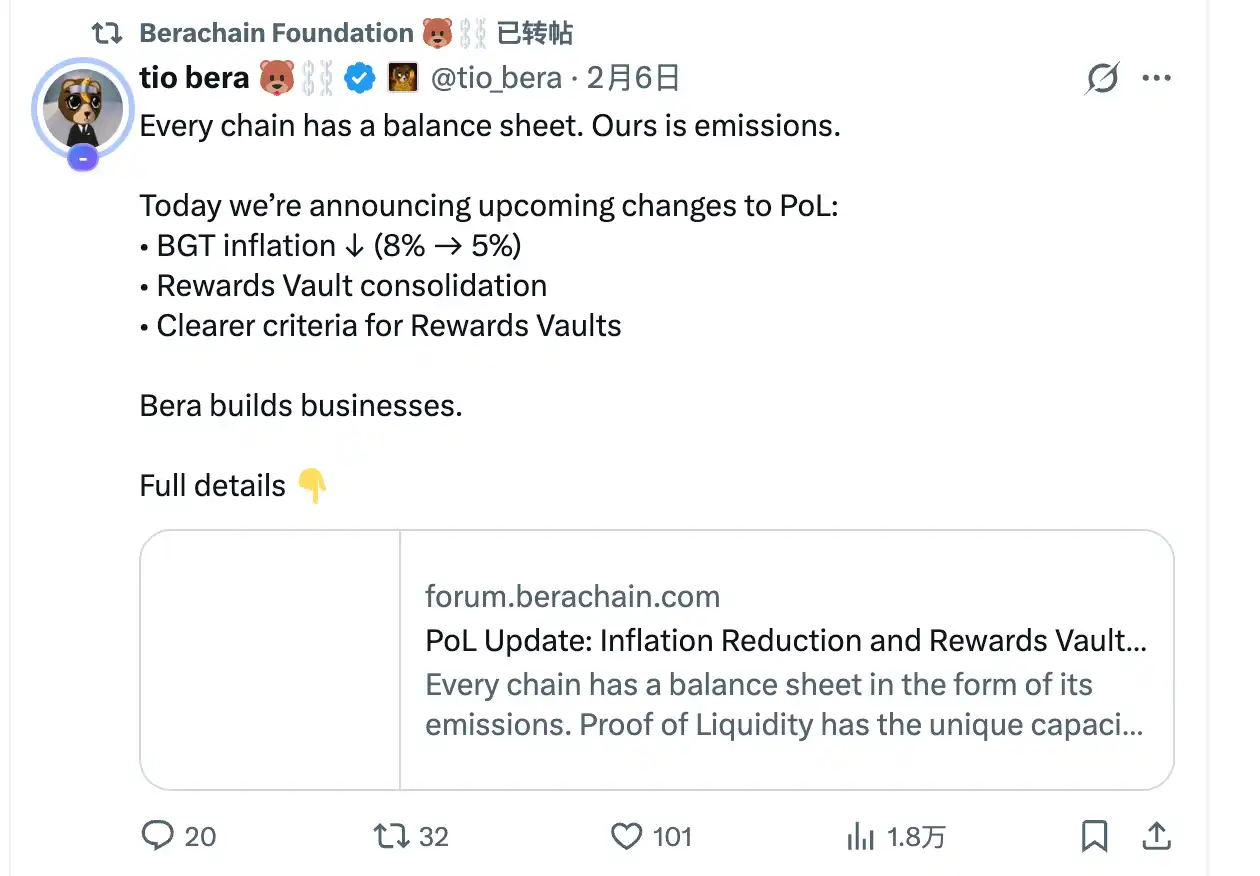
We see that the earlier 8% inflation rate was more like an "expansionary credit" for the ecosystem's startup phase, successfully completing the primitive accumulation of liquidity in the short term. Now, reducing PoL-related emissions by approximately 46% (reward rate reduced from 1.2 to 0.65) not only reflects its precise control over the current ecosystem's carrying capacity and incentive efficiency but also embodies a refinement of liquidity management:

That is, while maintaining the stability of the network security base rate, by moderately tightening new emissions, ensuring that every $BGT injected into the ecosystem gains a higher value anchor.

For $BGT, a governance asset with the attributes of a soul-bound token, scarcity is the core pillar for exercising its引流 power. As the emission rate slows, the marginal dilution pressure faced by holders and delegators is significantly reduced. This "active balance sheet reduction" directly strengthens the hard currency属性 of $BGT as a core governance asset, further promoting the rebalancing of value capture:

Of course, if we observe the development paths of Ethereum or various top L1s, a steady decline in the inflation rate is often the entry ticket to the "golden maturity period." Berachain's turn at this moment actually sends a clear signal that the ecosystem has already achieved stability driven by "endogenous growth" and no longer relies solely on scale expansion.

Then, as the total incentive becomes more precious, protocols within the ecosystem will spontaneously initiate an efficiency competition.

This "tight" incentive budget is actually creating higher溢价 space for high-quality protocols. Under the new economic model, $BGT emission rights will flow more to those "high-productivity protocols" that can generate real interactions and have a deep user base.

Reward Vault Integration—Ecological Value Sedimentation from "Scale Expansion" to "Quality and Depth"

If inflation reduction is a "balance sheet reduction" at the macro level, then the further integration of reward vaults is a precise drip irrigation targeting micro-efficiency within the ecosystem.

The Berachain Foundation stated in its latest tweet that the ecosystem plans to remove about 200 reward vaults with low operational efficiency. Of course, the plan itself is not simply a negation of early projects but more of a resource rebalancing expected after the Berachain ecosystem enters a specific stage.

In fact, during the cold start phase, a wide distribution of vaults helps探测 different market demands. When the ecosystem enters maturity, withdrawing incentive resources from长期闲置 or functionally overlapping pools and re-injecting them into core protocols with real trading activity is an inevitable choice to enhance the network's overall competitiveness.

Similarly, with the integration, Berachain immediately enacted more rigorous and dynamic vault access standards. This means that future incentive distribution will no longer be based on the first-come-first-served inertia of the early days but will更多的是 based on a multi-dimensional KPI evaluation system. Some potential standards may include:

  • Sustained Demand: Examining whether the protocol has generated real transaction volume and user interaction, not just static沉淀 of funds.
  • External Incentive Coordination: Encouraging protocol parties to use their own resources and external financing to form a synergy with $BGT emissions, jointly energizing the ecosystem.
  • Verifiable Contribution: Every unit of incentive emission must be transformed into an observable network effect, such as the depth of $HONEY liquidity or the value回流 of transaction fees.

By clearing some self-circulating or inefficient incentive paths, Berachain is actually making room for growth for teams with real product strength. This process of "discarding the dross and selecting the essential" aims to end models that rely solely on system subsidies for survival,转而扶持 business entities with independent profitability capabilities.

This is also perhaps the embodiment of the "Bera Builds Businesses" vision: the incentive mechanism is no longer an indiscriminate温床 but a precise capital accelerator. Projects筛选ed through this mechanism will have stronger risk resistance and commercial value, thereby providing $BGT holders with more确定性 value support in the fierce L1 competition.

Evolution is the Only Way Out

This major reform of Berachain's PoL marks the ecosystem's official paradigm shift towards a "mature L1 with real output." By optimizing emission efficiency, the ecosystem is彻底重构 $BGT emissions into productive capital with ROI certainty. While pushing the network towards the ultimate capital efficiency interval, it is also anchoring a more solid value signal for $BGT and $BERA holders.

Under the new pilot mechanism, incentives are endowed with precise引流 properties: every unit of injected liquidity will激发超额 real transaction fees, interest income, or ecological溢价 at the protocol layer, thereby constructing a positive value closed-loop of "incentive cost < protocol收益".

This "1 > 1 capital alchemy" is a public chain-level active asset management system,正在 transforming every bit of inflation into KPIs that drive commercial prosperity, fundamentally locking in the return of Berachain's long-term sovereign value, and establishing a leading position towards real economic growth and business闭环 in the highly homogeneous L1 track.

Thus, "Bera Builds Businesses" is also transforming from a grand narrative into a precise financial engine.


Трендовые криптовалюты

Связанные с этим вопросы

QWhat is the core change in Berachain's PoL mechanism as described in the article?

AThe core change is a reduction in the annual inflation rate of $BGT from 8% to 5%, which is an active cut of approximately 46% in emissions.

QWhat are the three tokens in the PoL system and their primary functions?

AThe three tokens are: $BERA (the gas token and base for security), $HONEY (an over-collateralized native stablecoin for financial settlement), and $BGT (a non-transferable soulbound token that serves as the governance hub, binding governance power to 'real contributions' to the ecosystem).

QWhat was the main purpose of the high inflation model (8-10%) used by Berachain at its mainnet launch?

AIt was a cold-start strategy designed to achieve the primitive accumulation of liquidity in the short term and validate the practical resilience of the PoL mechanism.

QWhat are some of the new potential criteria for a vault to gain access to incentives after the reform?

APotential criteria include: Sustainable Demand (real transaction volume and user interaction), Coordination with External Incentives (using the protocol's own resources and external financing alongside $BGT emissions), and Verifiable Contribution (converting each unit of incentive into observable network effects like $HONEY liquidity depth or fee value回流).

QHow does the article characterize the ultimate goal of Berachain's incentive mechanism after this reform?

AThe goal is to transform the incentive mechanism from a blanket subsidy into a precise capital accelerator, ensuring every unit of $BGT emission is productive capital with a high certainty of ROI, ultimately building a positive value closed-loop where 'incentive cost

Похожее

UNI вырос вдвое за два месяца на фоне общего спада: пятилетняя задержка в восстановлении стоимости

В июне-июле 2025 года, на фоне общей волатильности крипторынка, токен UNI децентрализованной биржи Uniswap показал исключительный рост, почти удвоившись в цене с $2,3 до $4,6. Основная причина — реализация механизма сбора доли комиссий протокола (т.н. «переключатель комиссий») и их направления на выкуп и сжигание UNI, что изменило его статус с чисто управленческого токена на актив с реальным денежным потоком. Несмотря на то, что предложение было принято еще в декабре 2024 года, значимый эффект проявился только в июле 2025 года после запуска Robinhood Chain, ориентированной на токенизированные акции. Развернутые на ней пулы Uniswap резко увеличили объемы торгов и комиссий протокола. Ежедневные средства, направляемые на сжигание UNI, выросли примерно с $114 тысяч до $325 тысяч, причем более половины суммы генерировала Robinhood Chain. Ключевым фактором успеха механизма выкупа и сжигания для UNI стала зрелая и распределенная структура предложения токена, выпущенного еще в 2020 году, без крупных предстоящих разблокировок. Это отличает его от многих новых проектов, где эмиссия часто превышает объемы выкупа. Главный вопрос на будущее — сможет ли Uniswap сохранить высокие объемы торгов на Robinhood Chain после окончания 90-дневного периода субсидирования комиссий сети, или текущий рост окажется временным эффектом.

marsbit14 мин. назад

UNI вырос вдвое за два месяца на фоне общего спада: пятилетняя задержка в восстановлении стоимости

marsbit14 мин. назад

Экстренный отзыв функции генерации изображений Nano Banana 2 в Google Earth!

В Google Earth экстренно отозвали функцию генерации изображений Nano Banana 2 после того, как пользователи менее чем за день "сломали" её, создавая неподобающий или абсурдный контент (например, исторические памятники в постапокалиптическом стиле). Функция, позволявшая накладывать сгенерированные ИИ изображения на реальные спутниковые снимки и 3D-ландшафты в Google Earth, была временно отключена для усиления защитных мер. Эта технология, названная "геопространственным закреплением" (Geospatial Grounding), использует текущий спутниковый вид, данные рельефа и камеры для создания изображений, которые реалистично вписываются в реальную географию. Она открывала новые возможности: визуализацию исторических мест, создание информационных графиков и предварительный просмотр архитектурных проектов в их реальном окружении. Однако недостатки, такие как отсутствие поддержки режима Street View и неточности в генерируемой информации, а также возможность злоупотреблений, вынудили Google отозвать функцию. Этот шаг подчеркивает стратегию Google по использованию своего уникального массива географических данных для создания нового типа "правдоподобной" AI-визуализации, в отличие от конкурентов, сосредоточенных только на эстетике изображений.

marsbit1 ч. назад

Экстренный отзыв функции генерации изображений Nano Banana 2 в Google Earth!

marsbit1 ч. назад

Алтман признаёт: переоценил способность ИИ отнимать работу! Хуан Жэньсюнь: разговоры о безработице абсолютно ошибочны

Открытие OpenAI - не первая крупная компания под управлением ИИ, но Сэм Олтман изменил свою позицию. В подкасте «Invest Like the Best» он заявил, что люди «не хотят ИИ-гендиректора», поскольку им важно знать, кто принимает решения и несет ответственность. Он также признал, что переоценил скорость, с которой ИИ заменит младшие офисные должности. Дженсен Хуанг, глава NVIDIA, в свою очередь, заявил на YC Startup School, что нарратив об «ИИ, уничтожающем рабочие места», ошибочен. Он разграничил понятия «задача» и «работа»: ИИ берет на себя некоторые задачи, но не устраняет всю должность. Например, спрос на радиологов и разработчиков ПО растет, поскольку ИИ помогает быстрее обрабатывать накопленные объемы работы, позволяя расширять деятельность. Исследование Университета Мэриленда и LinkUp, охватившее 155 млн вакансий в США с 2018 года, не выявило общего снижения спроса на работу из-за ИИ. Доля вакансий для выпускников даже выросла. Молодые специалисты могут получить преимущество, используя ИИ для компенсации недостатка опыта. Однако стандартные вводные задачи (обработка данных, написание базового кода), которые раньше служили стартовой ступенькой для карьеры, теперь автоматизируются. Это сужает точку входа на рынок труда для новичков. Ключевой вывод: по мере автоматизации задач ценность человеческой работы смещается в сторону ответственности, построения доверия, принятия окончательных решений и личного взаимодействия. Эти элементы, которые ИИ не может заменить, становятся настоящим профессиональным преимуществом.

marsbit1 ч. назад

Алтман признаёт: переоценил способность ИИ отнимать работу! Хуан Жэньсюнь: разговоры о безработице абсолютно ошибочны

marsbit1 ч. назад

Крупные изменения в ФРС? Сообщается, что Ваш рассматривает возможность сокращения частоты заседаний по ставкам, нарушая 40-летнюю традицию

Председатель ФРС Уолш рассматривает возможность сокращения количества регулярных заседаний по установлению процентных ставок, проводимых Федеральным комитетом по открытым рынкам (FOMC) каждый год. Это изменение, если оно будет реализовано, станет одним из самых значительных преобразований в работе ФРС за последние десятилетия и打破ет практику, действующую с 1981 года, когда заседания проводятся восемь раз в год (примерно каждые шесть недель). Согласно информации The New York Times, Уолш вынес этот вопрос на обсуждение на заседании ФРС на этой неделе. Новый график может быть определен до следующего заседания в середине сентября, хотя конкретные изменения вступят в силу позже. Закон о банках 1935 года требует, чтобы FOMC проводил «не менее четырех заседаний в год». Сокращение количества заседаний уменьшит возможности для голосования по процентным ставкам и может ослабить способность ФРС оперативно реагировать на изменения в инфляции и на рынке труда. Это также сократит каналы получения рынком сигналов о денежно-кредитной политике и снизит прозрачность, что противоречит многолетнему тренду на ее усиление. Данный шаг соответствует общему стилю руководства Уолша, который уже сократил объем публичных заявлений и рассматривает возможность уменьшения количества пресс-конференций после заседаний. Это предложение является частью более широкой повестки Уолша по «институциональной реформе» ФРС. В истории ФРС частота заседаний менялась: до 1981 года они могли проводиться до 19 раз в год, как это было в 1956 году. Внутренняя памятная записка ФРС 1988 года признавала преимущества более частых заседаний для оперативного рассмотрения новой информации, но сочла существующий график из восьми заседаний подходящим. Реформа Уолша идет в противоположном направлении, и ее потенциальное влияние на гибкость политики и коммуникацию с рынком будет тщательно отслеживаться.

marsbit2 ч. назад

Крупные изменения в ФРС? Сообщается, что Ваш рассматривает возможность сокращения частоты заседаний по ставкам, нарушая 40-летнюю традицию

marsbit2 ч. назад

Еженедельная подборка редакции Weekly Editor's Picks (25-31 июля)

Еженедельные выборы редактора (25-31 июля). В мире финансов и криптовалют продолжают доминировать темы макроэкономической неопределенности и технологических сдвигов. На фоне одного из самых неопределенных заседаний ФРС, где сохраняется риск повышения ставок, эксперты обсуждают долгосрочную ценность криптовалют. Акцент делается на стратегическом инвестировании в биткоин как «цифровое золото» и базовые смарт-контрактные платформы, а не на краткосрочных спекуляциях. На рынке акций наблюдается тенденция к «криптовализации»: нарративы и рычаги усиливают волатильность. При этом успешные платформы, такие как Hyperliquid и Polymarket, сталкиваются с трудностями при расширении за пределы своей основной специализации. В секторе AI и чипов сохраняется напряженность. Рост стоимости кредитных дефолтных свопов (CDS) Nvidia отражает опасения по поводу рисков финансирования инфраструктуры AI. Корейский гигант SK Hynix, несмотря на рекордную прибыль, не оправдал завышенных рыночных ожиданий, что подчеркивает споры между быками и медведями о будущем росте. Законодательная судьба американского билля Clarity Act остается под вопросом из-за политических разногласий, хотя рынок, вероятно, уже учел эту неопределенность. В экосистеме Ethereum начался масштабный переход стейкинга в сторону более эффективной архитектуры валидаторов после обновления Pectra. Также среди ключевых событий недели: выход на рынок акций Changxin Tech, мнения Сэма Олтмана и Тома Ли о будущем OpenAI и Ethereum, а также данные о крупных сделках южнокорейских производителей чипов с американскими технологическими гигантами.

marsbit2 ч. назад

Еженедельная подборка редакции Weekly Editor's Picks (25-31 июля)

marsbit2 ч. назад

Торговля

Спот

Популярные статьи

Как купить POL

Добро пожаловать на HTX.com! Мы сделали приобретение Polygon Ecosystem Token (POL) простым и удобным. Следуйте нашему пошаговому руководству и отправляйтесь в свое крипто-путешествие.Шаг 1: Создайте аккаунт на HTXИспользуйте свой адрес электронной почты или номер телефона, чтобы зарегистрироваться и бесплатно создать аккаунт на HTX. Пройдите удобную регистрацию и откройте для себя весь функционал.Создать аккаунтШаг 2: Перейдите в Купить криптовалюту и выберите свой способ оплатыКредитная/Дебетовая Карта: Используйте свою карту Visa или Mastercard для мгновенной покупки Polygon Ecosystem Token (POL).Баланс: Используйте средства с баланса вашего аккаунта HTX для простой торговли.Третьи Лица: Мы добавили популярные способы оплаты, такие как Google Pay и Apple Pay, для повышения удобства.P2P: Торгуйте напрямую с другими пользователями на HTX.Внебиржевая Торговля (OTC): Мы предлагаем индивидуальные услуги и конкурентоспособные обменные курсы для трейдеров.Шаг 3: Хранение Polygon Ecosystem Token (POL)После приобретения вами Polygon Ecosystem Token (POL) храните их в своем аккаунте на HTX. В качестве альтернативы вы можете отправить их куда-либо с помощью перевода в блокчейне или использовать для торговли с другими криптовалютами.Шаг 4: Торговля Polygon Ecosystem Token (POL)С легкостью торгуйте Polygon Ecosystem Token (POL) на спотовом рынке HTX. Просто зайдите в свой аккаунт, выберите торговую пару, совершайте сделки и следите за ними в режиме реального времени. Мы предлагаем удобный интерфейс как для начинающих, так и для опытных трейдеров.

524 просмотров всегоОпубликовано 2024.12.11Обновлено 2026.06.02

Как купить POL

Обсуждения

Добро пожаловать в Сообщество HTX. Здесь вы сможете быть в курсе последних новостей о развитии платформы и получить доступ к профессиональной аналитической информации о рынке. Мнения пользователей о цене на POL (POL) представлены ниже.

活动图片