$357 Billion Evaporated! Microsoft Plummets: Is the Death Knell for the AI Bubble Officially Sounding?

比推Опубликовано 2026-01-30Обновлено 2026-01-30

Введение

Microsoft's stock plummeted 7% in a single day, erasing $357 billion in market value, despite reporting strong quarterly results with a 23% profit increase and record revenue of $81.3 billion. The decline was driven by concerns over slowing Azure growth (38% vs. previous 39%) and rising capital expenditures. High hardware prices, especially for HBM memory, squeezed cloud margins, dropping profitability to around 67%. Heavy reliance on OpenAI—45% of future cloud contracts—and competition from low-cost open-source AI alternatives added to investor anxiety. While Microsoft benefits from paper gains on its OpenAI stake, markets are questioning the sustainability of its capital-intensive AI model and its ability to monetize next-gen services like Copilot effectively.

After releasing an earnings report that exceeded market expectations, Microsoft(Microsoft) encountered its most severe market sell-off of the year.

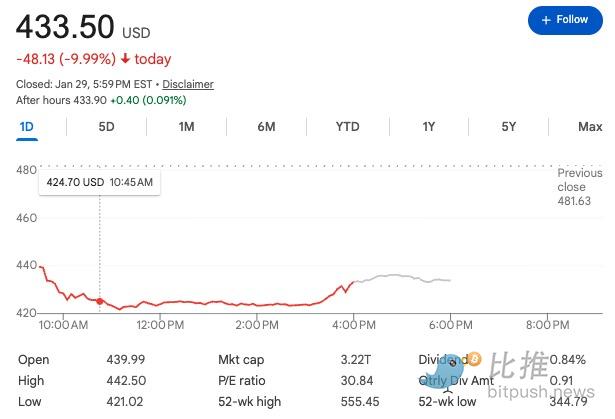
On Thursday, the software giant Microsoft plunged 7% in pre-market trading, losing $357 billion in market value in a single day—a figure equivalent to an entire Coca-Cola company vanishing from the Earth. And just on the same day, Microsoft had delivered a near-perfect report card: profits surged by nearly a quarter, and revenue hit a record high.

Profits were rising, but the stock price crashed. Behind Wall Street's vote with its feet lies an unspoken fear: the more the AI account is calculated, the more alarming it becomes. Has the growth story reached its end? When all the giants are crowding onto the same track, who can truly make money?

A Beautiful "Facade" and a Cracked "Foundation"

From the top line of the financial statements, Microsoft's performance was robust:

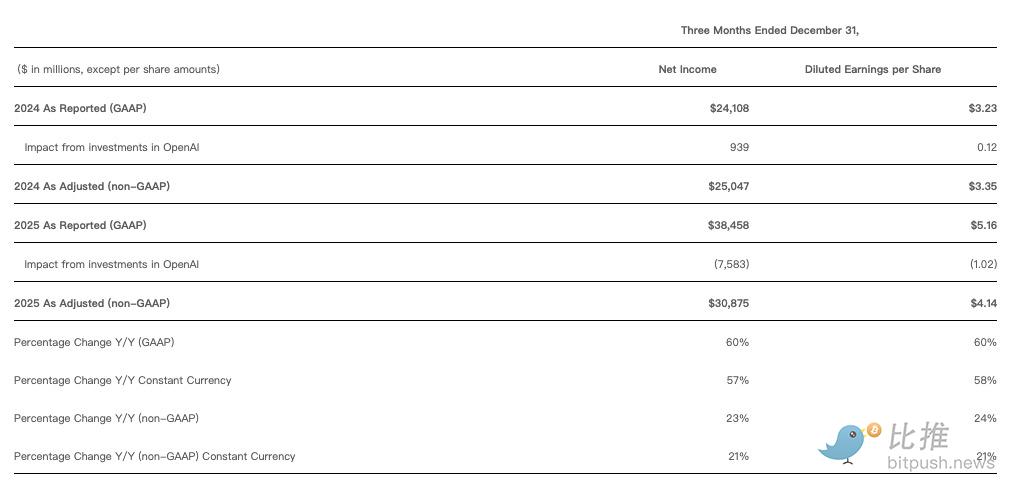
  • Net Profit: Adjusted net profit grew 23% to $30.9 billion, higher than the analyst expectation of $28.9 billion.

  • Revenue: Increased 17% to $81.3 billion, also exceeding the expected $80.3 billion.

  • Cloud Business: Quarterly revenue surpassed $50 billion for the first time.

However, the market's attention quickly focused on two details: the growth pace of Azure and the expansion rate of capital expenditures.

The earnings report showed that Azure's year-over-year growth rate was 38%, still strong but down one percentage point from the previous quarter's 39%.

Against the backdrop of historically high valuations, this 1% deceleration was seen as a signal of "peak growth." Barclays analysts bluntly stated: "Even though the numbers are healthy overall, buy-side investors clearly wanted to see more."

Microsoft as a "Hardware Laborer"?

In this AI gold rush, although Microsoft is a frontrunner, it resembles more of a "high-end OEM."

Behind the astronomical investments lies extremely brutal hardware premium pressure. According to the latest industry report from TrendForce as of January 2026, HBM (High Bandwidth Memory), the core配套 for NVIDIA's B200 series, is experiencing an unprecedented "capacity hijacking."

Data monitoring shows that as Micron and SK Hynix's HBM orders are generally booked until early 2027, the average selling price of HBM chips has risen against the trend by about 30% over the past two quarters. For Microsoft, this is tantamount to "structural extortion." To ensure Azure AI's computing power doesn't fall behind, Microsoft must accept a premium of thousands of dollars per chip.


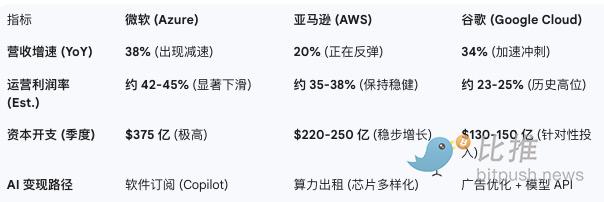
Horizontal Comparison of Cloud Giants' Core Data (2025 Q4 – 2026 Q1)

What does this mean?

The hundreds of billions of dollars Microsoft invests each quarter mostly flow to upstream hardware suppliers. This means the money Microsoft earns hasn't even warmed up on the books before being handed over to NVIDIA for GPUs and to Micron for memory. Although Microsoft is also developing its own Maia chips, it remains highly dependent on external procurement. The result is brutal: the gross margin of Microsoft's cloud business has slipped from above 70% to around 67%.

In contrast, Amazon AWS, with its early布局 of self-developed chips (Trainium series), has reduced its reliance on expensive hardware, and its operating margin remains solid at 38%. And while Meta is also investing heavily, its stock price反而 surged 10% because AI directly improved ad conversion rates, showing "receipts." Comparatively, Microsoft seems more like it's "working for hardware manufacturers."

This "bleeding" investment not only failed to satisfy the market's appetite but also triggered a unique computing power "internal consumption" for Microsoft. Due to supply constraints, Microsoft faces a brutal balance: should it lease the top-tier computing power to external cloud customers for immediate profit, or reserve it for its own Copilot to bet on the ecosystem's future? Microsoft chose the latter. This strategy of "sacrificing external for internal" stabilized the user experience but severely diluted Azure's profitability as a pure cloud platform in the short term.

Concentration Anxiety: The "Single-Point Dependency" Crisis with OpenAI

In this earnings report, Microsoft disclosed a startling figure for the first time: about 45% of its $625 billion future cloud contract book value comes from OpenAI.

This means Microsoft's cloud growth is highly tied to a single startup. Although CFO Amy Hood emphasized that another $350 billion comes from other industry customers, investors still worry: if OpenAI falters in competition or shifts to its own hardware in the future, Microsoft's massive, costly system will face serious "idle risk."

The Erosion of the Moat: Open Source and Low-Cost Disruption

Furthermore, the strong tie with OpenAI is facing a "cost-effectiveness revolution" disrupting from a lower dimension.

With the rise of low-cost or open-source models like China's DeepSeek, the "price war" in the AI market has already begun. When enterprise clients find that open-source models costing a few cents can solve 90% of their problems, Microsoft's high-premium Copilot subscription fee model is facing challenges.

This business model uncertainty makes Microsoft's high P/E ratio seem precarious. If Microsoft cannot prove that its high computing costs can translate into equally high premium revenue, the moat it built might be quietly leveled by the open-source wave.

Facing the stock decline, Nadella remains resolute. He极力推销 his "full-stack AI" vision on the analyst call: "When you think about our capital expenditure, don't just think about Azure, think about Copilot. We don't want to maximize just one business; we want to allocate capacity to build the best portfolio."

Conclusion

Despite the panic selling, the giant is stabilizing its position through a series of complex capital maneuvers.

Microsoft disclosed an $7.6 billion accounting gain this quarter, entirely thanks to its early investment in OpenAI. As OpenAI reorganized from a non-profit to a traditional for-profit entity in October, its balance sheet膨胀ed dramatically with multiple rounds of huge financing. Currently, Microsoft holds a 27% stake in this AI leader. With OpenAI seeking a new round of financing at a valuation exceeding $750 billion, Microsoft's initial investment of $14 billion has yielded惊人的 paper returns.

This左脚踩右脚的 "ecosystem flywheel" is becoming increasingly complex: competitor Anthropic just committed to buying $30 billion worth of Azure computing power in the future, and Microsoft随即 plans to inject $5 billion into it. In this potential deal, the startup's valuation has been pushed to $350 billion.

In summary, the $357 billion evaporated market value is a market correction of Microsoft's "heavy capital, slow monetization" model. Although the paper investment gains are极其丰厚, what Wall Street truly cares about is not how much valuation premium Microsoft earns as a "VC firm," but whether its core cloud business can truly recoup real money from global enterprises under the erosion of hardware costs.

The AI industry at this moment is like a high-speed train: once the infrastructure is laid, it's hard to stop. Whether it can maintain speed while gradually achieving commercial闭环 willdetermine the market pricing logic for the next phase.

Author: Bootly


Twitter:https://twitter.com/BitpushNewsCN

Bitpush TG Discussion Group:https://t.me/BitPushCommunity

Bitpush TG Subscription: https://t.me/bitpush

Original link:https://www.bitpush.news/articles/7607125

Связанные с этим вопросы

QWhy did Microsoft's stock price drop significantly despite reporting strong quarterly earnings?

AMicrosoft's stock plummeted due to concerns over slowing Azure growth (down 1% from the previous quarter) and fears that the massive capital expenditures on AI infrastructure are not translating into proportional profitability, raising doubts about the sustainability of its AI-driven growth narrative.

QWhat is the main reason behind the decline in Microsoft's cloud business毛利率 (gross margin)?

AMicrosoft's cloud gross margin has declined from over 70% to around 67% primarily because of its heavy reliance on expensive external hardware procurement, such as NVIDIA's GPUs and HBM memory from Micron and SK Hynix, which are facing significant price premiums and supply constraints.

QHow is Microsoft's growth strategy creating a 'single-point dependency' risk according to the article?

AMicrosoft's growth is highly dependent on OpenAI, as 45% of its $625 billion future cloud contract value is tied to this single startup. This creates a risk of underutilization and financial exposure if OpenAI's competitive position weakens or if it shifts toward self-reliant hardware infrastructure.

QWhat competitive threat does the rise of open-source AI models pose to Microsoft's business model?

AThe emergence of low-cost or open-source AI models, like those from China's DeepSeek, threatens Microsoft's high-margin Copilot subscription model by offering cheaper alternatives for enterprise customers, potentially eroding the premium pricing power of Microsoft's AI services.

QHow is Microsoft offsetting its operational costs with financial gains from its investments?

AMicrosoft reported a $7.6 billion accounting gain from its early investment in OpenAI, which holds a 27% stake. As OpenAI's valuation soars toward $750 billion, these paper gains provide financial cushioning, though investors remain focused on core cloud profitability rather than investment returns.

Похожее

Near Returns to the AI Stage: Transformation into a Public Chain Due to 'Payroll Difficulties,' Agent and Privacy Emerge as New Growth Narratives

NEAR Returns to AI Origins: From Payroll Struggles to Blockchain, Now Focusing on AI Agents and Privacy NEAR Protocol's journey began not with grand blockchain ambitions, but from a practical hurdle: its AI startup founders, including Transformer paper co-author Illia Polosukhin, couldn't efficiently pay international developers in 2017. This led them to pivot and build a high-performance, scalable blockchain. After years navigating various crypto narratives like sharding and cross-chain interoperability, NEAR is now leveraging its AI roots to re-enter the AI arena. A key driver is its "NEAR Intents" layer, which abstracts complex cross-chain transactions. Users simply state their goal (e.g., swap BTC for ETH), and a solver network finds the optimal route. This system has processed over $20B in cross-chain volume, generating significant fee revenue. A major growth area is private transactions via "Confidential Intents/Swaps," which hide trade details until settlement to protect against MEV and front-running. Remarkably, private swaps recently accounted for over 40% of NEAR's transaction volume, highlighting strong demand but also potential regulatory scrutiny. With its AI-founder pedigree, NEAR is positioning itself at the intersection of blockchain, AI agents, and privacy, aiming to become infrastructure for the emerging agent economy while navigating the challenges of its rapid adoption.

marsbit1 ч. назад

Near Returns to the AI Stage: Transformation into a Public Chain Due to 'Payroll Difficulties,' Agent and Privacy Emerge as New Growth Narratives

marsbit1 ч. назад

From Ethereum to AI's 'CROPS': What Exactly is This Set of 'Slow Variables' That Vitalik Repeatedly Emphasizes?

In recent discussions, Vitalik Buterin has frequently emphasized the concept of "CROPS," a framework defining core values for Ethereum's development. CROPS stands for Censorship Resistance, Capture Resistance, Open Source, Privacy, and Security. Initially outlined in the Ethereum Foundation's "EF Mandate," it represents a commitment to user sovereignty, ensuring that the network resists external control, remains open, protects privacy, and prioritizes security. The relevance of CROPS extends beyond Ethereum's foundational principles, becoming crucial in the context of AI integration. As AI agents begin handling wallet operations and automated transactions, the risk increases that users may cede control over their digital assets, privacy, and intentions to centralized AI service providers. A "CROPS AI" would therefore emphasize local execution where possible, privacy-preserving remote model calls (e.g., using zero-knowledge proofs), and transparent, verifiable processes to maintain user agency. Vitalik highlights a significant convergence between "CROPS Ethereum access layer" and "CROPS AI." Both address the same fundamental challenge: how users can access powerful services—be it blockchain data via RPCs or AI models—without exposing sensitive information or relinquishing ultimate control. This intersection points toward a future digital entry point that is more private, secure, and user-controlled. Ultimately, CROPS is not merely an abstract ideal but a practical guidepost. It steers development—from protocol resilience and wallet design to AI agent safety—towards a future where users retain self-sovereignty even as digital systems grow more complex and powerful. In an era of accelerating AI adoption, these "slow variables" of censorship resistance, openness, privacy, and security may define Ethereum's enduring value.

marsbit1 ч. назад

From Ethereum to AI's 'CROPS': What Exactly is This Set of 'Slow Variables' That Vitalik Repeatedly Emphasizes?

marsbit1 ч. назад

Silicon Valley 'Startup Guru' Steve Hoffman: Web3 + AI Could Be a Trap

Silicon Valley investor and "Godfather of Startups" Steve Hoffman warns that combining Web3 with AI is likely a trap, not a promising venture. In an interview, Hoffman argues that while AI is a foundational technology touching all industries, Web3 adds complexity, friction, and regulatory risk without solving mainstream consumer or business needs. He advises founders to focus on deep, specialized applications where startups can out-iterate giants, rather than on generic features easily replicated by large tech companies. Hoffman observes that Silicon Valley will lead foundational AI research, while China excels at rapid, large-scale application and commercialization, particularly in robotics. He stresses that AI-driven autonomous agents capable of collaborative, multi-step tasks are 2-4 years away, which will cause significant job displacement. The solution is not to slow AI but to redesign business models around human-AI collaboration and reform social systems like education and retraining. For startups, Hoffman recommends focusing on vertical, expertise-heavy domains to build defensibility. He sees major opportunities in AI fraud detection and cybersecurity. Key founder mindsets include systemic thinking over feature-focus, relentless customer centricity, building adaptive teams, and deeply understanding AI's capabilities and limits. Hoffman is also leading a non-profit initiative to establish university centers aimed at training future leaders in responsible, human-value-aligned AI innovation.

marsbit2 ч. назад

Silicon Valley 'Startup Guru' Steve Hoffman: Web3 + AI Could Be a Trap

marsbit2 ч. назад

Token Inefficient, Economy Tokenless

The article "Tokens Aren't Economical, Economics Aren't Tokenized" analyzes a pivotal shift in the AI industry from a technology-driven narrative to one dominated by capital efficiency. It highlights two concurrent trends: a severe capital shortage due to the exorbitant and recurring costs of compute (e.g., OpenAI's high burn rate) and a wave of corporate spin-offs where major tech companies are separating their AI units (like Kuaishou's Kling and Baidu's Kunlunxin). The core argument is that AI's "anti-internet" business model, where user growth increases costs rather than profits, has created a disconnect between high valuations and actual cash flow. Spin-offs address this by allowing AI assets to be valued independently. Within a parent company, they are seen as cost centers, but as standalone entities, they are priced based on their growth potential and scarcity in the primary market, leading to massive valuation premiums (e.g., Kling's estimated value tripling post-spin-off). The industry is at an inflection point, moving from "model worship" to "value realization." The competition is evolving from a pure compute (GPU) race to a broader focus on systemic efficiency and full-stack engineering (involving CPUs and orchestration) to achieve viable commercialization. The year 2026 is framed as a critical moment where the industry must definitively answer how to economically translate AI capability into tangible business value, reshaping the sector's future power structure.

marsbit2 ч. назад

Token Inefficient, Economy Tokenless

marsbit2 ч. назад

Торговля

Спот
Фьючерсы

Популярные статьи

Неделя обучения по популярным токенам (2): 2026 может стать годом приложений реального времени, сектор AI продолжает оставаться в тренде

2025 год — год институциональных инвесторов, в будущем он будет доминировать в приложениях реального времени.

1.8k просмотров всегоОпубликовано 2025.12.16Обновлено 2025.12.16

Неделя обучения по популярным токенам (2): 2026 может стать годом приложений реального времени, сектор AI продолжает оставаться в тренде

Обсуждения

Добро пожаловать в Сообщество HTX. Здесь вы сможете быть в курсе последних новостей о развитии платформы и получить доступ к профессиональной аналитической информации о рынке. Мнения пользователей о цене на AI (AI) представлены ниже.

活动图片