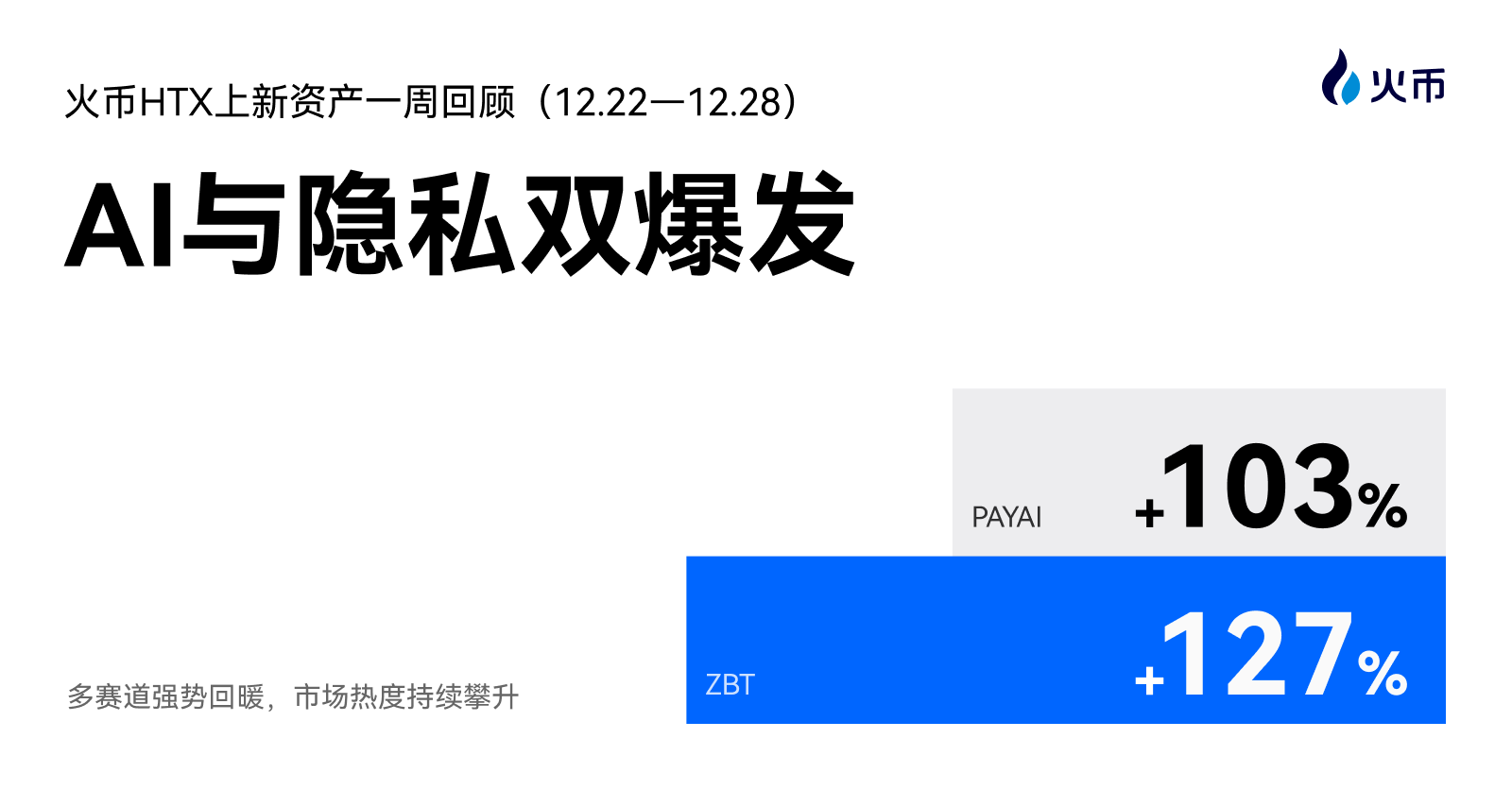
AI and Privacy Double Breakout! Huobi HTX New Assets Weekly Review (12.22—12.28): ZBT +127%, PAYAI +103%, Multiple Sectors Show Strong Rebound

marsbitОпубликовано 2025-12-31Обновлено 2025-12-31

Введение

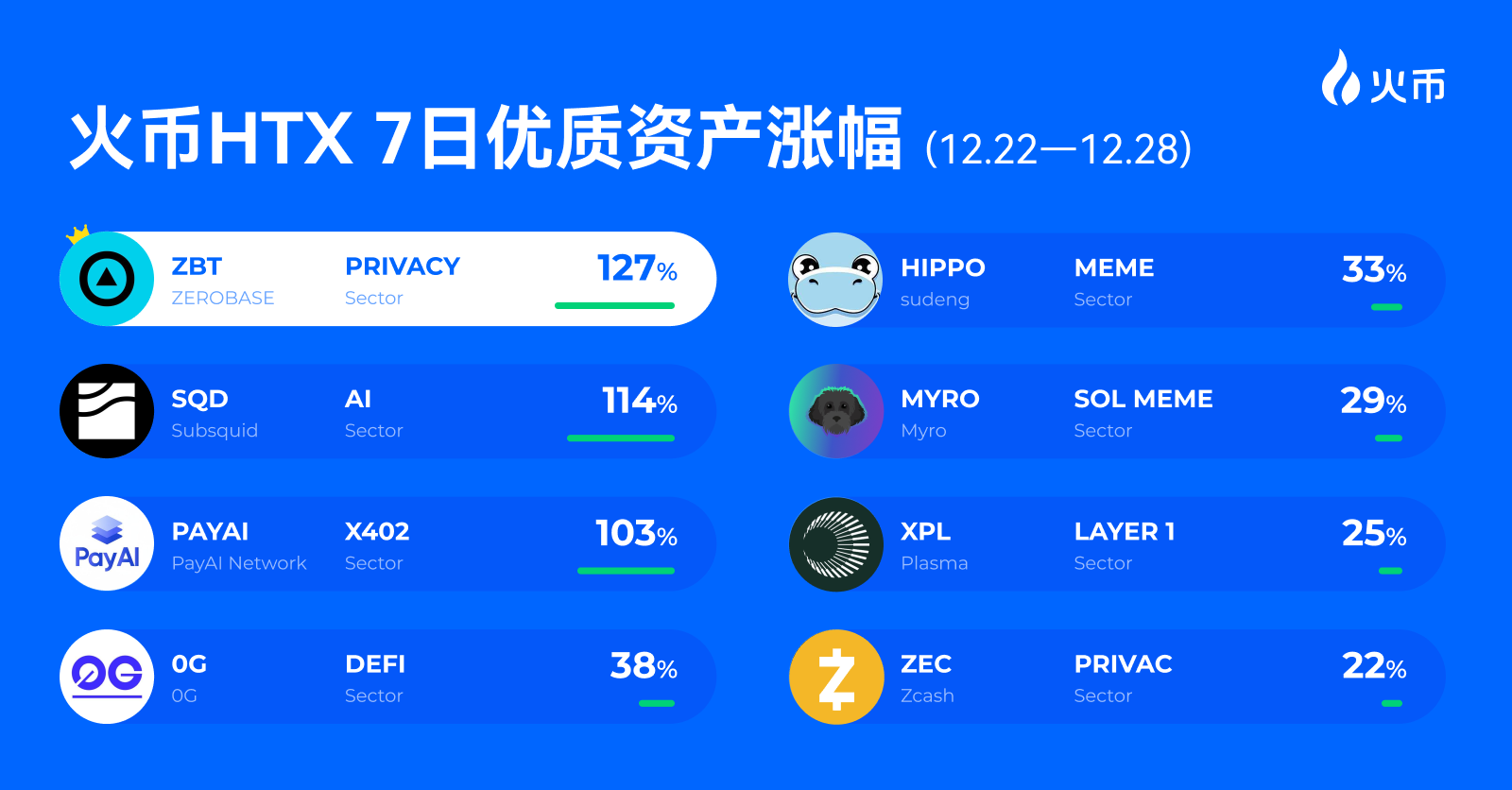
In the final week of 2025, the cryptocurrency market saw a broad recovery across multiple sectors, including AI, privacy, and meme tokens, driven by positive macro sentiment and holiday trading activity. On Huobi HTX, several assets recorded significant gains from December 22 to 28. ZBT (Zerobase), a privacy-focused infrastructure project, led with a 127% increase. The AI narrative regained momentum with PAYAI (PayAI Network) rising 103% and SQD (Subsquid) up 114%, partly due to the launch of Coinbase’s x402 V2 payment protocol supporting multi-chain transactions. ZEC (Zcash), a established privacy coin, also climbed 22%. Meme tokens showed seasonal strength, with DONKEY (BSC-based, +21%), MYRO (Solana-based, +29%), and HIPPO (Sui-based, +33%) all posting gains. Other notable performers included DeFi and L1 assets: 0G (Zero Gravity, +38%), SPK (Spark, +17%), and XPL (Plasma, +25%). Huobi HTX highlighted its early support for these trending assets, enabling users to capture opportunities as the crypto market continues its structured recovery.

As we approach the end of 2025, the sentiment in the crypto market continues to recover, with trading activity heating up again alongside the festive season行情. Macro tailwinds and hot narratives are driving sector strength, with multiple sectors like AI, Privacy, and Meme showing a comprehensive rebound. Capital flows are clearly directed towards high-growth narratives and value targets in细分 themes. Several popular assets on Huobi HTX saw outstanding gains over the past week (December 22nd - December 28th), with ZBT leading the pack with a 127% increase, as market sentiment continues to聚集 around leading sectors.

AI Narrative Returns to the Mainstream: PAYAI, SQD Lead the Charge

The AI narrative remains the absolute main theme of 2025, with accelerating technological adoption driving a revaluation of application-layer assets. A key driver behind this week's strong rebound in the AI sector was the official launch of the V2 version of the x402 protocol by the Coinbase developer team. x402 is an open-source payment protocol built specifically for AI agents. The new version offers default multi-chain support, covering native token payments on ecosystems like Base and Solana, and is directly compatible with traditional channels like ACH and bank card networks, providing greater scalability for the commercialization of AI services.

Driven by this positive development, assets within the x402 ecosystem saw significant strength. This performance further validates the mid-2025 sector trend judgment—AI business models are moving from concept to a scalable stage. Huobi HTX's early布局 of related core assets provides users with ample opportunity to capture the行情.

  • PAYAI (PayAI Network): Rose 103% this week, belongs to the AI sector within the x402 ecosystem. PayAI is an open-source, decentralized AI agent marketplace built on ElizaOS, libp2p, IPFS, and Solana. Market focus is on model capability upgrades and ecosystem expansion plans, making it a key tool for capital seeking exposure to the AI sector.

  • SQD (Subsquid): Rose 114%, AI computing power infrastructure. SQD Network is a decentralized data lake and query engine designed to provide developers with high-performance, permissionless data access. Rising expectations for computing power demand are driving valuation repairs, with trading volume significantly increasing, creating resonance between narrative and capital.

Privacy Protocols Regain Favor: ZBT, ZEC Both Rise

On-chain privacy capabilities are seen as a fundamental infrastructure proposition for the next cycle. The privacy sector continues to heat up, driven by policy trends and industry structural adjustments, showing a "resonance between old and new" structural行情. Huobi HTX's rich asset coverage provides users with multi-dimensional布局 options.

  • ZBT (Zerobase): Topped the list this week with a 127% gain, a breakout project in the privacy narrative. Zerobase is a decentralized cryptographic infrastructure network supporting products like zkStaking, zkLogin, and ProofYield, connecting institutional DeFi, user privacy protection, and real-world asset (RWA) strategies, ensuring system verifiability and trustworthiness while safeguarding private data security.
  • ZEC (Zcash): Rose 22%, a classic privacy asset representative. Zcash is a decentralized, open-source crypto internet currency, developed based on the Zerocash Protocol paper presented at the 2014 IEEE conference, utilizing zero-knowledge proofs and multiple account mechanisms to ensure transaction anonymity.
Seasonal Meme行情 Emerges: DONKEY, MYRO, HIPPO Rotate and Strengthen

Approaching the year-end, Meme sentiment is warming up. Light narratives and strong liquidity remain the advantageous characteristics of Meme-type assets. Several Meme assets on Huobi HTX achieved good gains. Their volatility advantage is matched with higher trading efficiency on the Huobi HTX platform, helping users flexibly grasp structural行情.

  • DONKEY: Rose 21% this week, a BSC ecosystem Meme with some community heat. Its origin is a post by Binance founder CZ saying "I am a donkey." The donkey is seen as a symbol of hard work in Chinese culture, representing those who work diligently.
  • MYRO (Myro): Rose 29%, a SOL ecosystem Meme. Myro is named after Solana founder Raj Gokal's beloved dog, Myro. This project pays homage to him and his dog and responds to the crypto space's普遍 demand for dog-themed narratives.
  • HIPPO (sudeng): Rose 33%, a SUI ecosystem Meme. $HIPPO is a meme coin created by fans on SUI to celebrate the world's cutest hippo, Sudeng. Under new community-driven management, the project donates part of its profits to global wildlife causes.

Multiple Sectors Resonate Upward: DeFi, L1 Ecosystems Synchronously Recover

Beyond the hot narrative areas, multi-sector asset轮动上涨 indicates stronger signs of incremental capital回流, suggesting the year-end structural行情 may continue.

  • 0G (Zero Gravity): Rose 38%, belongs to the DeFi+AI sector. Zero Gravity is a decentralized AI operating system, serving as the foundational layer for decentralized AI applications and blockchains. It efficiently coordinates the utilization of hardware resources like storage and computing, as well as software assets like data and models, to handle the scale and complexity of AI workloads.
  • SPK (Spark): Rose 17%, benefiting from capital回流 and improved protocol expectations. Spark is an on-chain capital allocator, currently deploying $3.86 billion in capital across DeFi, CeFi, and RWA fields. It dynamically adjusts asset allocation based on market conditions automatically, significantly improving capital efficiency while maintaining a prudent risk appetite.
  • XPL (Plasma): Rose 25%, belongs to the L1 ecosystem. Plasma is an EVM-compatible Layer 1 blockchain specifically built for high-capacity, low-cost global stablecoin payments. Prices continue to fluctuate upwards with expectations of traffic growth from underlying network ecosystem expansion.

Wealth Effect Highlights: Hot Assets Available on Huobi HTX

As the 2025行情 gradually recovers, sector differentiation remains significant. Choosing the right trading venue and a platform with forward-looking asset reserves will be key for users to gain an advantage in the new cycle. For most projects on this week's gainers list, Huobi HTX had already enabled trading support during their early布局 stages, allowing users more participation opportunities at the起点 of the行情.

Leveraging its敏锐 asset listing strategy and trading ecosystem advantages, Huobi HTX helps users achieve more efficient opportunity capture in complex market conditions. In the future, Huobi HTX will continue to iterate its platform strategies around market trends, user needs, and行情 cycle changes, expanding high-quality assets and trading depth to create a higher-certainty wealth appreciation path for users. More行情 and asset opportunities are available on Huobi HTX.

About Huobi HTX

Huobi HTX was founded in 2013. After 12 years of development, it has evolved from a cryptocurrency exchange into a comprehensive blockchain business ecosystem encompassing digital asset trading, financial derivatives, research, investment, incubation, and other businesses.

As a leading global Web3 portal, Huobi HTX adheres to a development strategy focused on global expansion, ecological prosperity, wealth effect, and security & compliance, providing comprehensive, secure, and reliable value and services to virtual currency enthusiasts worldwide.

To learn more about Huobi HTX, please visithttps://www.htx.com/ or HTX Square, and follow us on X, Telegram, and Discord. For further inquiries, please contact [email protected].


Связанные с этим вопросы

QWhich asset had the highest percentage gain on Huobi HTX from December 22 to December 28, 2025, and what was its percentage increase?

AZBT (Zerobase) had the highest percentage gain, increasing by 127%.

QWhat was the main driver behind the strong rebound of the AI sector mentioned in the article?

AThe main driver was the launch of the V2 version of the open-source payment protocol x402 by the Coinbase developer team, which supports multi-chain and traditional payment channels for AI services.

QName two assets from the privacy protocol sector that performed well and their respective gains.

AZBT (Zerobase) gained 127% and ZEC (Zcash) gained 22%.

QWhich meme asset on the Solana ecosystem saw a 29% increase, and what is its namesake?

AMYRO (Myro) saw a 29% increase, and it is named after Solana co-founder Raj Gokal's dog, Myro.

QWhat is the primary function of the SQD Network as described in the article?

ASQD Network is a decentralized data lake and query engine designed to provide developers with high-performance, permissionless data access.

Похожее

PANews Column Registration and Article Submission Guide

"PANews Column Registration and Submission Guide" provides instructions for users to register as columnists and publish articles on the PANews platform. Key application requirements are emphasized: content should focus on in-depth analysis within Crypto, Web3, blockchain, data, and viewpoints. Content primarily for brand/product introductions will not be approved, and heavily AI-generated content will be rejected. Promotional (PR/soft) content is directed to the business channel. **Registration Process:** * **Web:** Go to the official website footer, click "Apply for Column," and register with a phone number or email (login via verification code, no password). Fill in the column name, description, upload an avatar, and submit links to previously published work. * **Mobile:** Navigate to "My" -> "Contribute & Create" and complete the form. **Article Submission Tutorial:** 1. Log in to the PANews website. 2. Access the "Creator Center" from your personal homepage. 3. Use the editor to create and publish articles. **Video Upload:** The platform supports embedding videos from third-party sites (e.g., Bilibili). Copy the embed code from the source video, use the editor's "Insert/Edit media" button, paste the code under the "Embed" tab, and adjust the display size (recommended: width 100%, height 560px). **PANews Skills (AI Agent Tool):** PANews offers an official AI Agent skill set called PANews Skills, enabling AI tools to query platform content, track trends, and publish column articles directly. It includes three main skills: 1. `panews`: For tracking daily must-read lists, popular articles, and funding news. 2. `panews-creator`: For managing columns, publishing articles, and uploading images. 3. `panews-web-viewer`: For parsing PANews webpages into Markdown. These skills are compatible with various AI Agent tools (OpenClaw, Cursor, Claude Code, ChatGPT, Gemini, etc.). To use the `panews-creator` skill, users must obtain a specific authentication value from the PANews website after logging into their columnist account.

marsbit6 мин. назад

PANews Column Registration and Article Submission Guide

marsbit6 мин. назад

I Built Myself an Investment Workbench Using AI

For the past two weeks, I've been immersed in Vibe Coding—using AI to write code from natural language descriptions. This process has enabled me to quickly build functional tools that address long-standing personal ideas. Previously, I had many concepts but found execution too cumbersome. Key ideas included a unified dashboard for assets across US stocks, Crypto, HK stocks, and A-shares; a real-time alert system for price movements; an investment map visualizing sector relationships; and a tool to correlate prediction market bets with news and market data. Traditional development hurdles meant these often remained unrealized. Using AI (Codex, Claude Code, and DeepSeek API), I built four initial tools: 1. A **Cross-Market Asset Dashboard** showing total assets, daily P&L, and holdings by market, with added features for alerts and sector mapping. It's deployed locally for privacy. 2. A **Prediction Market (PM) Monitor** tracking bets on events (e.g., company valuations) and correlating probability shifts with news and market movements. I categorize bets by conviction to filter noise. 3. A **Simple Operations Backend** for managing my writing workflow (topics, progress, publishing). It's cloud-deployed for mobile access. 4. A **One-Click Formatting Tool** that automates converting drafts into various platform-specific formats, saving manual effort. While these tools are basic, they represent a significant shift: AI lowers the barrier to creating personalized systems. I believe individual investors can now feasibly build core systems for: * **Asset Observation** (tracking holdings and changes) * **Signal Monitoring** (watching for key market shifts) * **Sector Mapping** (understanding network relationships within a sector) * **Performance Review** (documenting rationale and outcomes) The power of Vibe Coding is its fast feedback loop. Ideas can be implemented, tested, and iterated on rapidly, turning "want-to-do" into "done." This marks the start of my new phase, where I'll share investment thoughts, tool tests, on-chain operations, and educational Web3 content.

marsbit22 мин. назад

I Built Myself an Investment Workbench Using AI

marsbit22 мин. назад

After Tokenization of Assets, How to Exit?

Title: How to Exit After Asset Tokenization? Author: Symbiotic Compiled by: Hu Tao, ChainCatcher Summary: Tokenization addresses how assets go on-chain but largely leaves the redemption question unresolved. While tokenized assets can settle instantly, the underlying redemption for assets like treasuries, private credit, or real estate can take from T+1 to 180 days. This gap hinders DeFi adoption of Real World Assets (RWAs). Three emerging models aim to provide instant exit liquidity, differing primarily in their capital structure and efficiency: 1. **Balance Sheet Model (e.g., Grove Basin):** A single entity (like Sky) provides immediate liquidity from its balance sheet, acting as a bridge during the settlement period. It offers simplicity and deep initial liquidity but is constrained by a single entity's capacity and risk appetite. 2. **Asset-Specific Vault Model (e.g., Upshift Clear):** Independent liquidity providers fund dedicated vaults for each supported asset, earning fees. It decentralizes capital sources but isolates liquidity and capital per asset, leading to potential fragmentation. 3. **Shared Liquidity Layer Model (e.g., Symbiotic Liquid Lane):** A shared capital pool supports multiple RWA types simultaneously. Funds remain productive between redemptions (e.g., earning yield in lending markets). Exits are settled via a competitive RFQ market. This model aims for higher capital efficiency, scalability across assets, and serves longer-duration assets like private credit. Key differentiators are: 1) Source of capital and risk bearer, 2) Redemption pricing mechanism, 3) Capital efficiency, 4) Scalability to new asset types, and 5) Composability. The shared liquidity layer model represents a move from piecemeal solutions toward scalable infrastructure, enabling T+0 exits by pooling capital, maintaining yield, and using competitive pricing, thus enhancing RWA utility in DeFi.

marsbit35 мин. назад

After Tokenization of Assets, How to Exit?

marsbit35 мин. назад

After Tokenizing Assets, How to Exit?

After tokenization, a key unresolved issue is providing holders with a reliable exit mechanism, as underlying asset settlement (taking days to months) lags far behind on-chain token settlement. Three primary models for instant liquidity have emerged, differing in their capital structure and efficiency: 1. **Balance Sheet Model (e.g., Grove Basin):** A single, well-capitalized entity (like Sky) provides immediate liquidity from its own reserves. This offers simplicity and deep initial liquidity but is constrained by that single balance sheet's capacity and risk appetite, limiting scalability. 2. **Dedicated Vault Model (e.g., Upshift Clear):** Independent liquidity providers (LPs) fund separate vaults for each supported asset. This decentralizes capital sources but isolates liquidity and capital, which becomes inefficient as the number of tokenized assets grows. 3. **Shared Liquidity Layer Model (Symbiotic Liquid Lane):** Independent capital providers fund shared vaults that can support multiple tokenized assets simultaneously. Capital remains productive between redemptions (e.g., earning yield in DeFi markets). Exits are settled via a competitive RFQ market where market makers bid. The article argues that the shared layer model offers superior capital efficiency and scalability. It transforms exit liquidity from an asset-specific patch into shared market infrastructure, allowing liquidity capacity to grow with overall market participation rather than being fragmented per asset. This is particularly valuable for longer-duration assets like private credit, where reliable T+0 exits can significantly enhance their utility in DeFi.

链捕手49 мин. назад

After Tokenizing Assets, How to Exit?

链捕手49 мин. назад

Торговля

Спот
Фьючерсы

Популярные статьи

Как купить ZBT

Добро пожаловать на HTX.com! Мы сделали приобретение Zerobase (ZBT) простым и удобным. Следуйте нашему пошаговому руководству и отправляйтесь в свое крипто-путешествие.Шаг 1: Создайте аккаунт на HTXИспользуйте свой адрес электронной почты или номер телефона, чтобы зарегистрироваться и бесплатно создать аккаунт на HTX. Пройдите удобную регистрацию и откройте для себя весь функционал.Создать аккаунтШаг 2: Перейдите в Купить криптовалюту и выберите свой способ оплатыКредитная/Дебетовая Карта: Используйте свою карту Visa или Mastercard для мгновенной покупки Zerobase (ZBT).Баланс: Используйте средства с баланса вашего аккаунта HTX для простой торговли.Третьи Лица: Мы добавили популярные способы оплаты, такие как Google Pay и Apple Pay, для повышения удобства.P2P: Торгуйте напрямую с другими пользователями на HTX.Внебиржевая Торговля (OTC): Мы предлагаем индивидуальные услуги и конкурентоспособные обменные курсы для трейдеров.Шаг 3: Хранение Zerobase (ZBT)После приобретения вами Zerobase (ZBT) храните их в своем аккаунте на HTX. В качестве альтернативы вы можете отправить их куда-либо с помощью перевода в блокчейне или использовать для торговли с другими криптовалютами.Шаг 4: Торговля Zerobase (ZBT)С легкостью торгуйте Zerobase (ZBT) на спотовом рынке HTX. Просто зайдите в свой аккаунт, выберите торговую пару, совершайте сделки и следите за ними в режиме реального времени. Мы предлагаем удобный интерфейс как для начинающих, так и для опытных трейдеров.

367 просмотров всегоОпубликовано 2025.10.16Обновлено 2026.06.02

Как купить ZBT

Обсуждения

Добро пожаловать в Сообщество HTX. Здесь вы сможете быть в курсе последних новостей о развитии платформы и получить доступ к профессиональной аналитической информации о рынке. Мнения пользователей о цене на ZBT (ZBT) представлены ниже.

活动图片