Crypto Morning Brief: Flow Protocol Hacked, Major Unlocks for HYPE, SUI, EIGEN Tokens This Week

深潮Опубликовано 2025-12-29Обновлено 2025-12-29

Введение

Crypto Morning Brief: Flow Protocol was hacked, with approximately $3.9 million exploited due to an execution layer flaw, though user deposits remain secure. The network is temporarily halted, with a target restart in 4-6 hours. Meanwhile, several tokens, including HYPE, SUI, and EIGEN, are set for significant unlocks this week, totaling hundreds of millions of dollars. In other news, Uniswap’s treasury burned 100 million UNI tokens ($596 million) following a passed proposal. Michael Saylor hinted at potential Bitcoin accumulation by MicroStrategy, while former Alameda CEO Caroline Ellison is scheduled for early release in January. Japan’s central bank emphasized the need for steady interest rate hikes in the coming months. Additionally, the SEC is shifting from enforcement to a "compliance" model starting in 2026.

Author: Deep Tide TechFlow

Yesterday's Market Dynamics

Bank of Japan Meeting Opinion: Need to Maintain a Steady Pace of Interest Rate Hikes in the Coming Months

Bank of Japan meeting opinion summary: One member stated that the Bank of Japan must raise interest rates at a pace of about once every few months for some time. Even if the policy rate is raised to 0.75%, Japan's real interest rates will still be in deeply negative territory.

Lighter AMA: 50% of Total Token Supply to be Allocated to Community, Token Buyback Mechanism Planned

Lighter team's Head of Marketing @Pilla_eth shared some TGE details in an AMA themed "Lighter TGE" today,主要包括:

1. TGE and airdrop will take place in 2025, with the airdrop amount being 25% of the total supply, with no lock-up restrictions. The airdrop does not require claiming and will be directly deposited into the Lightner wallets of points holders.

2. 50% of the token supply will be provided to the community. More tokenomics details will be gradually released. There will be token buybacks, but the specific amount is undecided. "Therefore, value will flow to the token."

3. LIT tokens will initially only be tradable on the Lighter platform. Coinbase and Bybit have added LIT to their roadmaps. They will not pay for exchange listings.

4. There will be no official Lighter NFT, but some community NFTs, like Fuego, are acknowledged. Meme coin airdrops are just rumors.

Additionally, @Pilla_eth revealed that Lighter is developing "a mobile app that can rival CEX apps."

Trust Wallet: Over 2,630 Claim Tickets Received, Amounts Ranging from $1.05M to $3.5M

Trust Wallet CEO Eowync.eth issued a security incident update. Trust Wallet has received over 2,630 claim tickets, with claim amounts ranging from $1.05 million to $3.5 million. The customer support team is doing its best to process claims as quickly as possible.

Flow: User Existing Balances Not Accessed in This Hack, All User Deposits Safe

Flow official posted on X platform stating that on December 27, 2025, attackers exploited a vulnerability in the Flow execution layer to transfer approximately $3.9 million in assets before the network went down. This attack did not access users' existing balances; all user deposits are safe.

Currently, approximately $3.9 million in funds have been primarily bridged out via bridges like Celer, Debridge, Relay, Stargate, etc. The attacker's wallet has been identified and flagged, and their money laundering activities through Thorchain and Chainflip are being tracked in real-time.

The Flow Foundation has submitted freeze requests to Circle, Tether, and major exchanges. The network is currently stopped to cut off all exit paths. A fix is undergoing final validation. The confirmed amount of funds outflow is manageable and does not threaten the network's solvency or user fund safety.

The target restart time is within 4 to 6 hours, depending on testnet validation results. FindLabs is releasing forensic data including transaction hashes and the attacker's Ethereum wallet address.

Uniswap Treasury Has Burned 100 Million UNI Worth $596 Million

According to on-chain analyst Yu Jian monitoring, following the passage of the Uniswap fee burn proposal the day before yesterday, 100 million $UNI ($596 million) was burned from the Uniswap treasury at 4:30 AM today.

According to the proposal, subsequent fees collected by Uniswap will also be used for UNI burns.

Huma Responds to Some Users' Vanguard Badges Being Revoked: Plans to Extend Staking Requirement Grace Period to January 5th

PayFi protocol Huma Finance posted on X platform stating that some users reported their Vanguard badges were revoked after the Season 2 airdrop event went live. In reality, holders need to continuously meet the relevant staking requirements to retain their badges, including holding 10,000 HUMA tokens or staking 100% of the airdropped tokens received. However, some users did not fully understand this ongoing requirement. Huma Finance has temporarily restored Vanguard badges and set a grace period until January 5, 2026, 00:00 (UTC).

Bit.com Announces Orderly Wind-Down of Existing Business, Launches "User Asset Migration Plan"

According to an official announcement, due to business adjustments, crypto exchange Bit.com will conduct an orderly wind-down of its existing business and simultaneously launch a "User Asset Migration Plan".

Bit.com承诺将在明确的时间窗口内,完成所有透明、可追溯的用户资产迁移工作。(Bit.com commits to completing all transparent and traceable user asset migration work within a clear timeframe.)

Effective immediately, Bit.com will suspend new user registration. Existing users can log in normally, view assets, and participate in the migration process.

All spot assets will remain queryable. Spot trading functionality will cease on January 31, 2026.

All users holding contract account balances, positions, or unsettled P&L on Bit.com, effective immediately, are prohibited from opening new contract positions, only closing is allowed.

Former Alameda CEO Caroline Ellison to Be Released Next Month, About 10 Months Early

According to Theblock, U.S. Federal Bureau of Prisons records show that former Alameda Research co-CEO Caroline Ellison will be released from federal supervision on January 21, 2026.

The 31-year-old Ellison has been transferred from a federal prison in Connecticut to a community confinement facility since October 2025. She pleaded guilty in December 2022 to fraud and conspiracy charges related to the collapse of the cryptocurrency exchange FTX, which caused customers to lose billions of dollars.

Ellison was sentenced to two years in prison and ordered to forfeit $11 billion in September 2024, but due to good behavior and cooperation in the FTX investigation, she will be released about 10 months earlier than her original sentence. Earlier this month, she also agreed to a 10-year ban from serving as an executive at public companies or cryptocurrency exchanges.

Meanwhile, FTX founder Sam Bankman-Fried is currently actively seeking a pardon from the U.S. President and is expected to be released in September 2044.

Supreme Court's Academic Journal Publishes Article: Commercial Law Reform for Digital Transactions, Electronic Money, and Virtual Property

The Supreme People's Court's official account published an article from its affiliated academic journal "Digital Rule of Law" titled "Commercial Law Reform for Digital Transactions, Electronic Money, and Virtual Property". It pointed out: The revised Uniform Commercial Code by the U.S. Uniform Law Commission and the American Law Institute was formally passed in 2022 and subsequently widely adopted by state legislatures in the U.S. It incorporates diverse transaction methods including electronic forms, clarifies the relationship between physical currency, central bank digital currency, and other virtual currencies, creates a new property type called "controllable electronic records," and defines the rules for controlling and transferring such property.

China's civil and commercial norms should also be practice-oriented and improved in response to the development of digital transactions, electronic money, and virtual property, thereby incentivizing economic and technological development and gaining an advantage in international institutional competition.

Michael Saylor Again Posts Bitcoin Tracker Information, May Increase Bitcoin Holdings Next Week

Michael Saylor posted Bitcoin Tracker information on the X platform again and said, "Back to Orange".

Based on previous patterns, MicroStrategy (note: Saylor's company) always discloses Bitcoin acquisition information the day after related messages are posted.

Major Unlocks for HYPE, SUI, EIGEN and Other Tokens This Week

According to Token Unlocks data, major unlocks for HYPE, SUI, EIGEN and other tokens are scheduled for this week;

HYPE will unlock 9.92 million tokens on December 29th at 3:30 PM, worth approximately $251 million, accounting for 2.87% of circulating supply;

SUI will unlock 43.69 million tokens on January 1st at 8:00 AM, worth approximately $63.36 million, accounting for 1.17% of circulating supply;

EIGEN will unlock 36.82 million tokens on January 1st at 12:00 PM, worth approximately $14.44 million, accounting for 9.74% of circulating supply;

KMNO will unlock 229 million tokens on December 30th at 8:00 PM, worth approximately $11.71 million, accounting for 5.35% of circulating supply;

OP will unlock 31.34 million tokens on December 31st at 8:00 AM, worth approximately $8.60 million, accounting for 1.65% of circulating supply;

ENA will unlock 40.63 million tokens on January 2nd at 3:00 PM, worth approximately $8.60 million, accounting for 0.56% of circulating supply;

SVL will unlock 234 million tokens on December 30th at 8:00 AM, worth approximately $6.80 million, accounting for 2.96% of circulating supply;

ZORA will unlock 166 million tokens on December 30th at 8:00 AM, worth approximately $6.70 million, accounting for 4.17% of circulating supply.

Market Trends
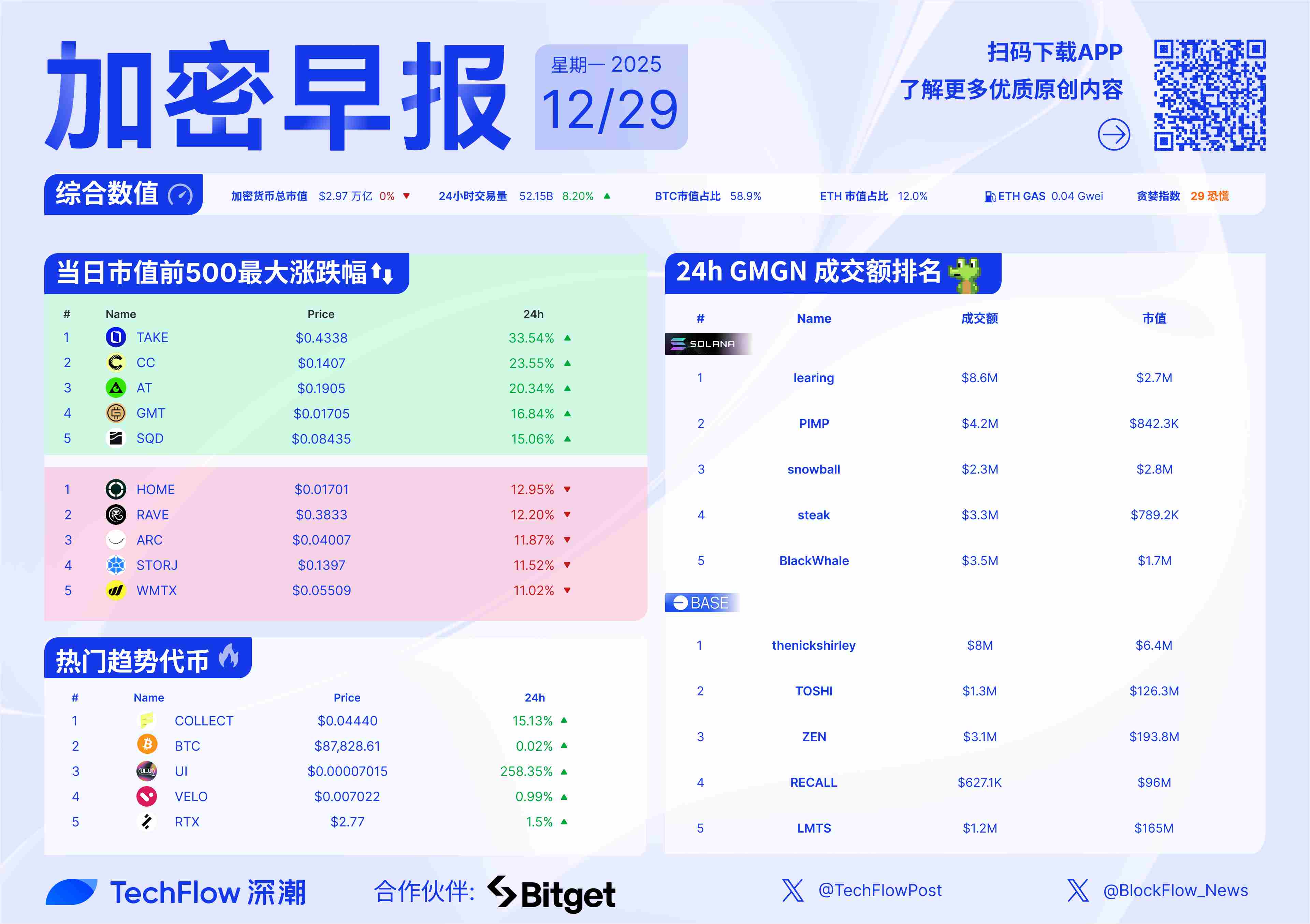
Recommended Reading

Conversation with Xie Jiayin: I Have Ambition, Bitget Also Has Ambition

This article, through an interview with Bitget exchange's Chinese language负责人 (responsible person) Xie Jiayin, explores in detail his career experience in the cryptocurrency industry, leadership philosophy, Bitget's development history, and future strategic planning. The article also covers the current state and future trends of the crypto market.

Web3 Recruitment & Job Hunting 2025 Year-End Review: Who's Making Money, Who's Paying to Work?

This article provides a comprehensive review and analysis of the Web3 industry's recruitment and job market in 2025, revealing the industry's current state, hiring trends, salary distribution, and the real experiences of practitioners. It delves into the opportunities and challenges of the Web3 industry while uncovering the difficulties and hopes faced by practitioners.

2025 Crypto Industry Workplace Survey: 70% Earn Less Than $4K Monthly, N+1 Severance a Luxury

This article, through a questionnaire survey in the crypto industry workplace, reveals the real situation of Web3 practitioners regarding income, work environment, career choices, etc., analyzes the current state of the industry and future development trends, lists popular and unpopular crypto companies, and explores hot careers in the crypto industry.

IOSG Founder: 2025 Was a Dark Year for the Crypto Market, So What About 2026?

This article discusses how 2025 was called a "dark year" for the crypto market, but it was actually a transition period from retail-driven to institution-driven dominance. Although crypto asset prices performed poorly, institutional investor participation increased significantly, and the market structure underwent fundamental changes. Meanwhile, policy environment support for the crypto market is also strengthening, laying the foundation for future growth.

SEC 2026 New Rules Detailed: Farewell to "Regulation by Enforcement", New Compliance Paradigm for Stablecoin Payments

This article analyzes the U.S. Securities and Exchange Commission (SEC)'s announcement to end the "regulation by enforcement" era for the crypto industry starting January 2026 and shift to a "compliance sandbox" model. The SEC introduced an "innovation exemption" policy, providing a 12 to 24-month compliance buffer period for eligible entities and simplifying information submission processes. The SEC's new rules mark the crypto industry's entry into an "embedded compliance" phase, where the integration of technology and compliance will be key to future survival.


Связанные с этим вопросы

QWhat was the amount of assets stolen in the Flow protocol attack and how did the attacker move the funds?

AApproximately $3.9 million in assets were stolen. The attacker moved the funds primarily through cross-chain bridges like Celer, Debridge, Relay, and Stargate. Their wallet has been identified and marked, and their money laundering activities through Thorchain and Chainflip are being tracked in real-time.

QWhich tokens are scheduled for significant unlocks this week according to the article?

AThe tokens scheduled for significant unlocks this week are HYPE, SUI, EIGEN, KMNO, OP, ENA, SVL, and ZORA.

QWhat major action did Uniswap take regarding its treasury and UNI tokens?

AUniswap burned 100 million UNI tokens, worth $596 million, from its treasury. This action was taken after a fee burn proposal was passed, and future fees collected by Uniswap will also be used to burn UNI.

QWhat is the new regulatory approach the SEC is adopting for the crypto industry starting in 2026?

AThe SEC is ending the 'regulation by enforcement' era and moving to a 'compliance sandbox' model. It is introducing an 'Innovation Exemption' policy that offers a 12 to 24-month compliance buffer for qualified entities and simplifies the information submission process, marking an entry into an 'embedded compliance' phase.

QWhen is the former Alameda CEO Caroline Ellison scheduled to be released and why is it earlier than her original sentence?

ACaroline Ellison is scheduled to be released from federal supervision on January 21, 2026. She is being released approximately 10 months early due to good behavior and her cooperation in the investigation into the collapse of FTX.

Похожее

Google TPU Shipments Revised Up by 50%

Recent industry research indicates a significant upward revision in the shipments of Google's TPU (Tensor Processing Unit) chips. Previous expectations for 2027 were set at around 10 million units, but new estimates now point to 15 million units, a 50% increase. This substantial boost directly translates to higher demand across the entire supporting supply chain. Google's TPU clusters utilize a standardized all-optical interconnect architecture. Consequently, key hardware components are deeply integrated and scaled in fixed ratios with the chips. The 15 million TPU target will drive corresponding demand increases for NPO optical engines (roughly a 1:1 match), 1.6T optical modules, OCS optical switches, high-end server power supplies, fiber optics & MPO connectors, and liquid cooling solutions. Among these, liquid cooling is highlighted as the sector experiencing the most significant transformation and offering the most stable potential for excess returns. As next-generation TPU chips reach power levels where traditional air cooling is insufficient, liquid cooling becomes essential. 2026 is forecasted as the first year of substantial adoption for Google's liquid cooling solutions. This shift, coupled with delivery and capacity bottlenecks faced by incumbent overseas manufacturers, is creating a prime window for domestic Chinese suppliers to enter and secure Google's core supply chain. The market size for Google-specific liquid cooling is projected to potentially triple from a baseline of hundreds of billions to around 300 billion units by 2028. The logic for the fiber optic sector is also being rewritten. Once considered a cyclical commodity tied to telecom operator procurement, fiber is now a strategic and scarce resource for AI Data Centers (AIDC). A severe supply-demand imbalance, driven by the long lead time for preform production (18-24 months) and surging demand from cloud giants, is supporting strong performance. Chinese fiber manufacturers are well-positioned to capture a significant share of global AIDC demand, with exports potentially reaching 200-300 million core kilometers in 2026. Overall, the investment focus within the AI computing industry is shifting from pure "chip performance speculation" towards the more certain incremental growth in computing infrastructure and its supporting ecosystem. The upward revision in Google TPU shipments, along with the potential for further doubling by 2028, is seen as solidifying performance visibility for the entire supporting supply chain over the next two years.

marsbit40 мин. назад

Google TPU Shipments Revised Up by 50%

marsbit40 мин. назад

What Wall Street Really Wants After the Crypto Story Recedes

The tide of speculative crypto narratives has receded, revealing Wall Street's true objective: building a controlled, yield-generating, and compliant financial pipeline on distributed ledgers. They are migrating core functions onto blockchains, not for decentralization, but for efficiency and new revenue streams. Key developments include BlackRock's BUIDL fund, a tokenized treasury fund acting as a foundational reserve asset, and the rise of Securitize, which is going public and partnering with the NYSE to build a 24/7 digital securities trading and settlement system. This signals a major shift of securities clearing to blockchain technology. To make volatile assets like Bitcoin palatable for institutional investors, firms like BlackRock and Goldman Sachs are creating "covered call" ETFs (e.g., BITA). These products systematically sell options on Bitcoin holdings, transforming price volatility into stable monthly income, effectively repackaging crypto as a yield-bearing asset. Stablecoins are being positioned not as speculative tools but as efficient payment rails. Companies like Stripe and Mastercard are integrating them for instant, low-cost merchant settlements and cross-border card payments, respectively. Critically, new legislation like the GENIUS Act shapes them as non-interest-bearing, heavily regulated extensions of the US dollar system. In summary, Wall Street is quietly constructing a parallel, blockchain-based financial infrastructure featuring tokenized traditional assets, structured crypto yields, and programmable dollar pipelines—all under its control and fully integrated with existing regulatory and credit frameworks.

marsbit57 мин. назад

What Wall Street Really Wants After the Crypto Story Recedes

marsbit57 мин. назад

Tying Itself to SpaceX: Cursor's $60 Billion Rise

This article recounts the rapid rise of AI-powered coding startup Cursor and its 25-year-old MIT graduate CEO, Michael Truell. Launched in 2023, Cursor achieved explosive growth, reaching over 10 billion USD in revenue by late 2025. However, its journey highlights a central dilemma for AI application companies: dependence on foundational model providers. Cursor initially relied heavily on Anthropic's models but faced an existential threat when Anthropic launched its own competing coding tool, Claude Code. In response, Cursor declared an internal emergency in early 2026 and accelerated development of its own model, Composer. To secure the immense computing power needed, Truell struck a pivotal deal with Elon Musk's SpaceX in April 2026. The collaboration grants Cursor access to SpaceX's supercomputing resources for Composer, while SpaceX's Grok model benefits from Cursor's programming data. The agreement includes a potential 600 billion USD acquisition of Cursor by SpaceX later in the year, though a substantial termination fee is in place if the deal falls through. The story explores Cursor's intense, sometimes controversial hiring practices involving lengthy unpaid "work trials," its complex partnership-turned-rivalry with Anthropic, and its high-stakes gamble to ensure independence through the SpaceX alliance. The core question remains: will Cursor evolve into a defining, independent "generational" software company, or become a key piece in a tech giant's AI arsenal?

marsbit1 ч. назад

Tying Itself to SpaceX: Cursor's $60 Billion Rise

marsbit1 ч. назад

Warsh's Debut: Will the FED Chair Who Knows Crypto Best Bring Surprises or Shocks to the Market?

Kevin Warsh, the new Federal Reserve Chairman, prepares for his inaugural press conference amidst a challenging macroeconomic landscape: resurgent inflation, a bond market sell-off, and political pressure from President Trump for rate cuts. Uniquely, Warsh holds indirect investments in over 20 crypto and Web3 entities (e.g., Solana, dYdX), making him the first Fed Chair with disclosed crypto exposure. His stance may combine a hawkish, inflation-focused monetary policy with a crypto-friendly regulatory philosophy that shifts from Powell’s “same risk, same rule” approach toward a framework acknowledging blockchain’s productivity value. Warsh’s leadership could impact crypto markets across three dimensions: a paradigm shift in regulation (potentially accelerating pro-innovation legislation and stable币 rules), a re-pricing of risk premiums based on clearer communication and his view of AI as a structural disinflationary force, and a long-term reallocation of global institutional capital driven by increased legitimacy. Two potential scenarios for the press conference are outlined. A “positive surprise” would involve a dovish-leaning tone on rates coupled with signals of regulatory openness, potentially boosting crypto asset valuations. Conversely, a “negative shock” would see a more hawkish-than-expected stance on inflation and rates, triggering a broad risk-asset selloff that crypto markets would not escape. While ethics rules required Warsh to divest his crypto holdings upon confirmation, his deep understanding of the technology may fundamentally lower policy uncertainty and build a more receptive long-term foundation for digital assets’ integration into the mainstream financial system.

marsbit11 ч. назад

Warsh's Debut: Will the FED Chair Who Knows Crypto Best Bring Surprises or Shocks to the Market?

marsbit11 ч. назад

Торговля

Спот
Фьючерсы

Популярные статьи

Как купить FLOW

Добро пожаловать на HTX.com! Мы сделали приобретение Flow (FLOW) простым и удобным. Следуйте нашему пошаговому руководству и отправляйтесь в свое крипто-путешествие.Шаг 1: Создайте аккаунт на HTXИспользуйте свой адрес электронной почты или номер телефона, чтобы зарегистрироваться и бесплатно создать аккаунт на HTX. Пройдите удобную регистрацию и откройте для себя весь функционал.Создать аккаунтШаг 2: Перейдите в Купить криптовалюту и выберите свой способ оплатыКредитная/Дебетовая Карта: Используйте свою карту Visa или Mastercard для мгновенной покупки Flow (FLOW).Баланс: Используйте средства с баланса вашего аккаунта HTX для простой торговли.Третьи Лица: Мы добавили популярные способы оплаты, такие как Google Pay и Apple Pay, для повышения удобства.P2P: Торгуйте напрямую с другими пользователями на HTX.Внебиржевая Торговля (OTC): Мы предлагаем индивидуальные услуги и конкурентоспособные обменные курсы для трейдеров.Шаг 3: Хранение Flow (FLOW)После приобретения вами Flow (FLOW) храните их в своем аккаунте на HTX. В качестве альтернативы вы можете отправить их куда-либо с помощью перевода в блокчейне или использовать для торговли с другими криптовалютами.Шаг 4: Торговля Flow (FLOW)С легкостью торгуйте Flow (FLOW) на спотовом рынке HTX. Просто зайдите в свой аккаунт, выберите торговую пару, совершайте сделки и следите за ними в режиме реального времени. Мы предлагаем удобный интерфейс как для начинающих, так и для опытных трейдеров.

532 просмотров всегоОпубликовано 2024.03.29Обновлено 2026.06.02

Как купить FLOW

Обсуждения

Добро пожаловать в Сообщество HTX. Здесь вы сможете быть в курсе последних новостей о развитии платформы и получить доступ к профессиональной аналитической информации о рынке. Мнения пользователей о цене на FLOW (FLOW) представлены ниже.

活动图片












