Where Did the $362 Million Go? Hyperliquid Counters FUD, A Decentralization Route Debate Behind the Reconciliation

marsbitОпубликовано 2025-12-24Обновлено 2025-12-24

Введение

A technical report published on December 20, 2025, accused Hyperliquid, a decentralized exchange, of multiple severe issues—including insolvency and a "God mode backdoor"—claiming it was a centralized platform disguised as a blockchain. Hyperliquid issued a detailed response refuting the claims. The most serious allegation—a $362M shortfall in user funds—was debunked. The discrepancy arose because the accuser overlooked native USDC on HyperEVM during Hyperliquid’s transition from an L2 to an independent L1. Total reserves across Arbitrum and HyperEVM matched user balances. Other accusations were partially addressed: some code was testnet-related, limited broadcast nodes were an anti-MEV measure, and chain freezes were part of upgrade procedures. However, Hyperliquid did not fully respond to claims about unqueryable governance proposals and a lack of a cross-chain "escape hatch" for withdrawals. The exchange also compared itself to competitors like Lighter and Aster, criticizing their reliance on centralized sequencers and lack of transparency, while highlighting its own fully on-chain state verification. Additionally, Hyperliquid addressed community concerns about insider trading, attributing significant short selling to a former employee. The incident underscores broader challenges in DeFi transparency as protocols grow more complex, emphasizing the crypto mantra: "Don’t trust, verify."

On December 20, 2025, a technical article titled "Reverse Engineering Hyperliquid," published on blog.can.ac, directly deconstructed Hyperliquid's binary files through reverse engineering, accusing it of nine serious issues ranging from "insolvency" to a "God Mode backdoor." The article bluntly stated:

"Hyperliquid is a centralized trading platform disguised as a blockchain."

In response to the FUD, the official Hyperliquid team issued a lengthy reply. Perhaps this was not merely a simple refutation of rumors but also a declaration of war regarding "who truly possesses decentralized trading infrastructure." While the official response successfully clarified the fund security issues, it left intriguing "gaps" in some sensitive areas of decentralization.

Where Did the $362 Million Go? The Audit Blind Spot Under the "Dual Ledger" System

The most damaging accusation was that user assets within the Hyperliquid system were $362 million short compared to the on-chain reserves. If true, this would mean it was a "chain-based FTX" operating on fractional reserves.

However, upon verification, this was a misinterpretation due to information asymmetry caused by an "architecture upgrade." The auditor's logic was: Hyperliquid reserves = USDC balance on the Arbitrum cross-chain bridge. Based on this logic, they checked the cross-chain bridge address and found the balance was indeed less than the total user deposits.

Hyperliquid responded that it is undergoing a complete evolution from an "L2 AppChain" to an "independent L1." During this process, asset reserves have become a two-track system:

The accuser completely ignored the native USDC on HyperEVM. According to on-chain data (as of the time of writing):

· Arbitrum cross-chain balance: 3.989 billion USDC (verifiable on Arbiscan)

· HyperEVM native balance: 362 million USDC (verifiable on Hyperevmscan)

· HyperEVM contract balance: 59 million USDC

Total solvency = 3.989B + 0.362B + 0.059B ≈ 4.351B USDC

This figure completely matches the Total User Balances on HyperCore. The alleged "$362 million gap" is precisely the native assets that have already migrated to HyperEVM. This is not a disappearance of funds but a transfer of funds between different ledgers.

Checklist of 9 Accusations: What Was Clarified? What Was Avoided?
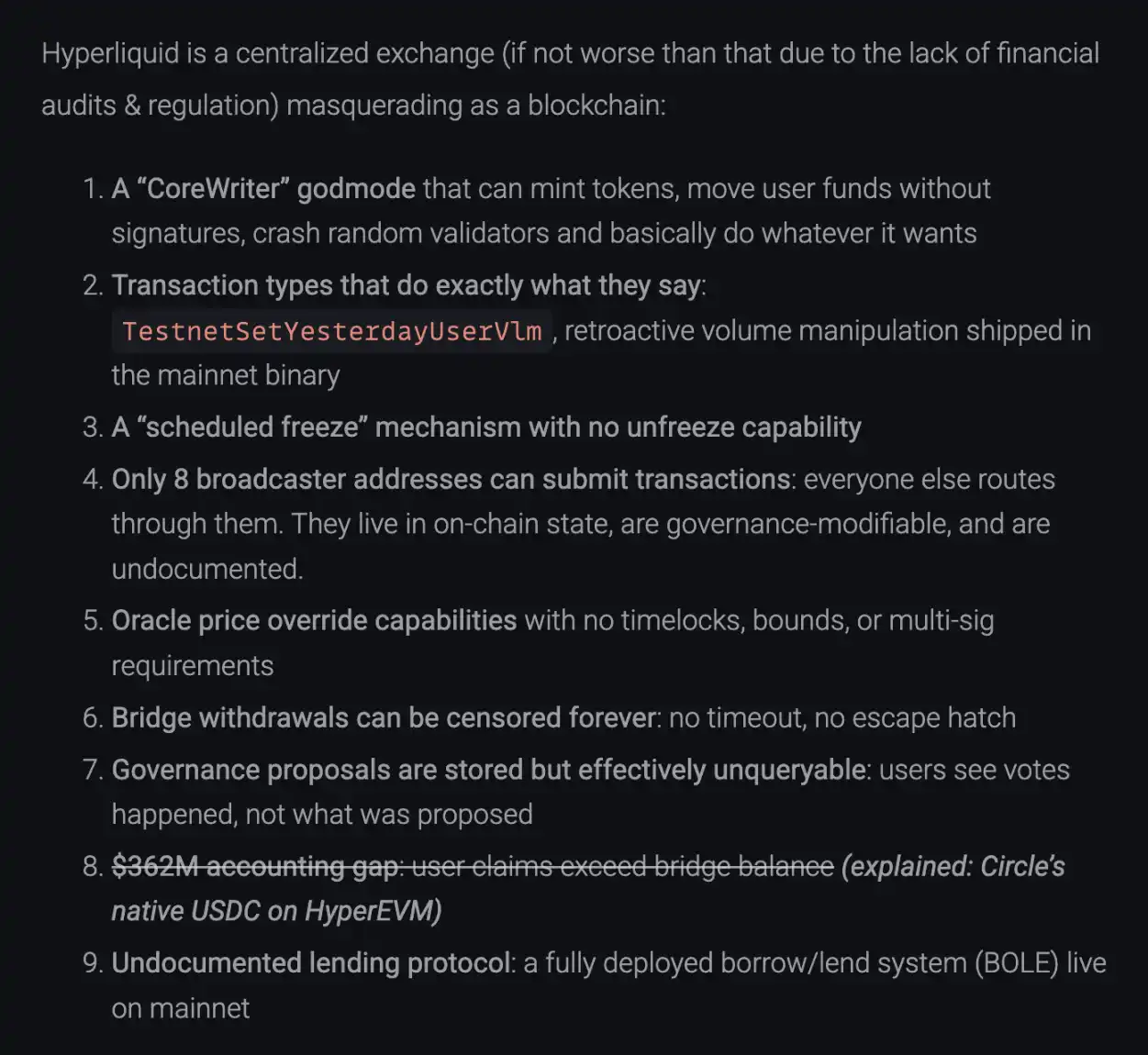
Clarified Accusations

Accusation: "CoreWriter" God Mode: Accused of being able to print money out of thin air and misappropriate funds.

Response: Officially explained that this is an interface for L1 to interact with HyperEVM (e.g., staking), with restricted permissions and no ability to misappropriate funds.

Accusation: $362 million funding gap.

Response: As described above, it was due to not accounting for Native USDC.

Accusation: Undisclosed lending protocol.

Response: Official pointed out that the spot/lending function (HIP-1) documentation is publicly available and in a pre-release stage, not secretly operating.

Acknowledged Accusations with Reasonable Explanations

Accusation: Binary file contains code to "modify trading volume" (TestnetSetYesterdayUserVlm).

Response: Acknowledged existence. Explained as testnet (Testnet) residual code used to simulate fee logic; the mainnet nodes have physically isolated this path, making execution impossible.

Accusation: Only 8 broadcast addresses can submit transactions.

Response: Acknowledged. Explained as an anti-MEV (Maximal Extractable Value) measure to prevent user transactions from being front-run. Committed to implementing a "multi-proposer" mechanism in the future.

Accusation: The chain can be "plannedly frozen" with no revocation function.

Response: Acknowledged. Explained as a standard process for network upgrades (Upgrade), requiring a full network pause to switch versions.

Accusation: Oracle price can be instantly overwritten.

Response: Explained as a system security design. To liquidate bad debt promptly during extreme volatility (like 10x), the validator oracle indeed does not have a time lock.

Missing / Vague Responses

In our review, two accusations were not directly addressed or fully resolved in the official response:

Accusation: Governance proposals are unqueryable. Users can only see that voting occurred, but the on-chain data does not contain the specific text content of the proposals.

Response: The official did not address this point in the long post. This means Hyperliquid's governance remains a "black box" for ordinary users—you can only see the results, not the process.

Accusation: Cross-chain bridge has no "escape hatch." Withdrawals could be censored indefinitely, and users cannot force withdrawals back to L1.

Response: Although the official explained that locking the bridge during the POPCAT incident was for safety, it did not refute the architectural fact of "no escape hatch." This indicates that at the current stage, the inflow and outflow of user assets highly depend on the permission of the validator set, lacking the anti-censorship forced withdrawal capability of L2 Rollups.

"Throwing Shade" at Competitors

The most interesting aspect of this incident is that it forced Hyperliquid to show its cards, giving us an opportunity to re-examine the landscape of the Perp (Perpetuals)赛道. The official response unusually "threw shade" at competitors, targeting Lighter, Aster, and even industry giant Binance.

It stated, "Lighter uses a single centralized sequencer, and its execution logic and zero-knowledge (ZK) circuits are not public. Aster uses centralized matching and even offers dark pool trading, which can only be achieved with a single centralized sequencer and an unverifiable execution process. Other protocols that include open-source contracts lack a verifiable sequencer."

Hyperliquid unabashedly categorized these competitors as relying on a "Centralized Sequencer." The official emphasized: on these platforms, no one except the sequencer operator can see the complete state snapshot (including order book history, position details). In contrast, Hyperliquid attempts to eliminate this "privilege" by having all validators execute the same state machine.

This wave of "throwing shade" might also stem from Hyperliquid's concerns about its current market share. According to DefiLlama's trading volume data for the past 30 days, the market has shown a tripartite balance of power:
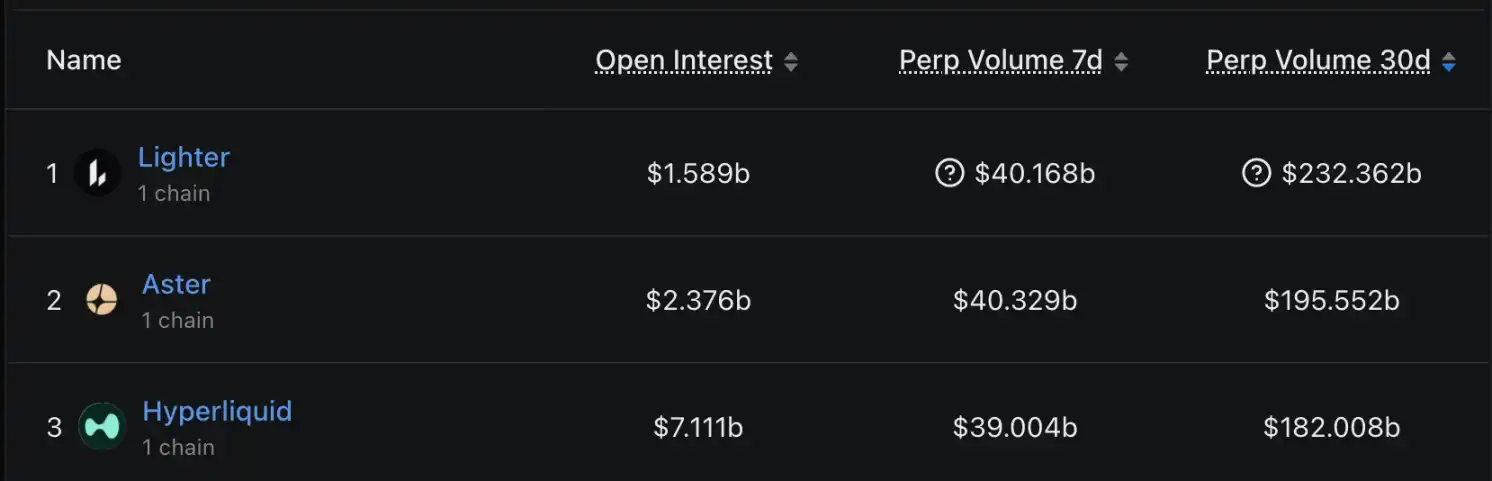
· Lighter: Trading volume $232.3 billion, temporarily leading,约占 26.6%.

· Aster: Trading volume $195.5 billion,位居第二,约占 22.3%.

· Hyperliquid: Trading volume $182.0 billion,位居第三,约占 20.8%.

Facing the trading volume of latercomers Lighter and Aster surpassing its own, Hyperliquid attempts to play the "transparency" card—meaning "although I have 8 centralized broadcast addresses, my entire state is on-chain and verifiable; while you can't even check yours." However, it is worth noting that although Hyperliquid's trading volume is slightly lower than the top two, it呈现碾压态势 in terms of Open Interest (OI).

Public Sentiment Response: Who is Shorting HYPE?

Beyond technical and fund issues, the community is also highly concerned about recent rumors that HYPE tokens were allegedly shorted and dumped by "insiders." In response, a Hyperliquid team member gave a定性回应 on Discord for the first time: "The shorting address starting with 0x7ae4 belongs to a former employee." This individual was once a team member but was fired in early 2024. The personal trading behavior of this former employee is unrelated to the current Hyperliquid team. The platform emphasized that it currently implements extremely strict HYPE trading restrictions and compliance reviews for all在职 employees and contractors, strictly prohibiting insider trading using their positions.

This response attempts to downgrade the accusation of "team misconduct" to "personal behavior of a former employee." However, regarding the transparency of token distribution and unlocking mechanisms, the community might still expect more detailed disclosure.

Don't Trust, Verify

Hyperliquid's clarification tweet can be considered a textbook example of crisis PR—relying not on emotional output but on data, code links, and architectural logic. It did not stop at proving its innocence but instead went on the offensive, strengthening its brand and advantage of "full state on-chain" by comparing competitor architectures.

Although the FUD was disproven, the profound thought left for the industry by this incident is far-reaching. As DeFi protocols evolve towards independent application chains (AppChain), architectures become increasingly complex, and asset distribution becomes more fragmented (Bridge + Native). The traditional method of checking balances by "looking at the contract balance" has become ineffective.

For Hyperliquid, proving "the money is there" is only the first step. How to gradually transfer the permissions of those 8 submission addresses while maintaining the advantages of high performance and anti-MEV, truly achieving the transition from "transparent centralization" to "transparent decentralization," is the necessary path to becoming the "ultimate DEX."

For users, this incident once again confirms the iron law of the crypto world: don't trust any narrative, verify every byte.

Связанные с этим вопросы

QWhat was the core accusation made in the 'Reverse Engineering Hyperliquid' blog post regarding user funds?

AThe blog post accused Hyperliquid of having a 362 million USDC shortfall, suggesting it was operating as a fractional-reserve exchange with user assets not fully backed by on-chain reserves.

QHow did Hyperliquid explain the alleged 362 million USDC discrepancy in its reserves?

AHyperliquid clarified that the 'missing' 362 million USDC was not a shortfall but was part of the native USDC balance on its new HyperEVM chain, which the accuser had failed to account for in their audit. The total reserves across Arbitrum and HyperEVM matched user balances.

QWhich two specific accusations did the article note were not fully addressed or resolved in Hyperliquid's official response?

AThe two accusations were: 1) Governance proposals are unqueryable (users cannot see the proposal text, only the voting result), and 2) The cross-chain bridge has no 'escape hatch' (users cannot force a withdrawal to L1, making withdrawals reliant on validator approval).

QWhat key competitive advantage did Hyperliquid claim over its rivals Lighter and Aster in its response?

AHyperliquid claimed its key advantage is transparency through 'full state on-chain,' arguing that while it uses 8 broadcast addresses, its entire state (like order book history) is publicly verifiable, unlike competitors it accused of relying on opaque, centralized sequencers.

QAccording to the article, what was Hyperliquid's explanation for the address that was shorting its HYPE token?

AHyperliquid stated that the address shorting HYPE belonged to a former employee who had been fired in early 2024 and that this was a personal trading action unrelated to the current team, which operates under strict trading restrictions.

Похожее

Google TPU Shipments Revised Up by 50%

Recent industry research indicates a significant upward revision in the shipments of Google's TPU (Tensor Processing Unit) chips. Previous expectations for 2027 were set at around 10 million units, but new estimates now point to 15 million units, a 50% increase. This substantial boost directly translates to higher demand across the entire supporting supply chain. Google's TPU clusters utilize a standardized all-optical interconnect architecture. Consequently, key hardware components are deeply integrated and scaled in fixed ratios with the chips. The 15 million TPU target will drive corresponding demand increases for NPO optical engines (roughly a 1:1 match), 1.6T optical modules, OCS optical switches, high-end server power supplies, fiber optics & MPO connectors, and liquid cooling solutions. Among these, liquid cooling is highlighted as the sector experiencing the most significant transformation and offering the most stable potential for excess returns. As next-generation TPU chips reach power levels where traditional air cooling is insufficient, liquid cooling becomes essential. 2026 is forecasted as the first year of substantial adoption for Google's liquid cooling solutions. This shift, coupled with delivery and capacity bottlenecks faced by incumbent overseas manufacturers, is creating a prime window for domestic Chinese suppliers to enter and secure Google's core supply chain. The market size for Google-specific liquid cooling is projected to potentially triple from a baseline of hundreds of billions to around 300 billion units by 2028. The logic for the fiber optic sector is also being rewritten. Once considered a cyclical commodity tied to telecom operator procurement, fiber is now a strategic and scarce resource for AI Data Centers (AIDC). A severe supply-demand imbalance, driven by the long lead time for preform production (18-24 months) and surging demand from cloud giants, is supporting strong performance. Chinese fiber manufacturers are well-positioned to capture a significant share of global AIDC demand, with exports potentially reaching 200-300 million core kilometers in 2026. Overall, the investment focus within the AI computing industry is shifting from pure "chip performance speculation" towards the more certain incremental growth in computing infrastructure and its supporting ecosystem. The upward revision in Google TPU shipments, along with the potential for further doubling by 2028, is seen as solidifying performance visibility for the entire supporting supply chain over the next two years.

marsbit19 мин. назад

Google TPU Shipments Revised Up by 50%

marsbit19 мин. назад

What Wall Street Really Wants After the Crypto Story Recedes

The tide of speculative crypto narratives has receded, revealing Wall Street's true objective: building a controlled, yield-generating, and compliant financial pipeline on distributed ledgers. They are migrating core functions onto blockchains, not for decentralization, but for efficiency and new revenue streams. Key developments include BlackRock's BUIDL fund, a tokenized treasury fund acting as a foundational reserve asset, and the rise of Securitize, which is going public and partnering with the NYSE to build a 24/7 digital securities trading and settlement system. This signals a major shift of securities clearing to blockchain technology. To make volatile assets like Bitcoin palatable for institutional investors, firms like BlackRock and Goldman Sachs are creating "covered call" ETFs (e.g., BITA). These products systematically sell options on Bitcoin holdings, transforming price volatility into stable monthly income, effectively repackaging crypto as a yield-bearing asset. Stablecoins are being positioned not as speculative tools but as efficient payment rails. Companies like Stripe and Mastercard are integrating them for instant, low-cost merchant settlements and cross-border card payments, respectively. Critically, new legislation like the GENIUS Act shapes them as non-interest-bearing, heavily regulated extensions of the US dollar system. In summary, Wall Street is quietly constructing a parallel, blockchain-based financial infrastructure featuring tokenized traditional assets, structured crypto yields, and programmable dollar pipelines—all under its control and fully integrated with existing regulatory and credit frameworks.

marsbit35 мин. назад

What Wall Street Really Wants After the Crypto Story Recedes

marsbit35 мин. назад

Tying Itself to SpaceX: Cursor's $60 Billion Rise

This article recounts the rapid rise of AI-powered coding startup Cursor and its 25-year-old MIT graduate CEO, Michael Truell. Launched in 2023, Cursor achieved explosive growth, reaching over 10 billion USD in revenue by late 2025. However, its journey highlights a central dilemma for AI application companies: dependence on foundational model providers. Cursor initially relied heavily on Anthropic's models but faced an existential threat when Anthropic launched its own competing coding tool, Claude Code. In response, Cursor declared an internal emergency in early 2026 and accelerated development of its own model, Composer. To secure the immense computing power needed, Truell struck a pivotal deal with Elon Musk's SpaceX in April 2026. The collaboration grants Cursor access to SpaceX's supercomputing resources for Composer, while SpaceX's Grok model benefits from Cursor's programming data. The agreement includes a potential 600 billion USD acquisition of Cursor by SpaceX later in the year, though a substantial termination fee is in place if the deal falls through. The story explores Cursor's intense, sometimes controversial hiring practices involving lengthy unpaid "work trials," its complex partnership-turned-rivalry with Anthropic, and its high-stakes gamble to ensure independence through the SpaceX alliance. The core question remains: will Cursor evolve into a defining, independent "generational" software company, or become a key piece in a tech giant's AI arsenal?

marsbit40 мин. назад

Tying Itself to SpaceX: Cursor's $60 Billion Rise

marsbit40 мин. назад

Warsh's Debut: Will the FED Chair Who Knows Crypto Best Bring Surprises or Shocks to the Market?

Kevin Warsh, the new Federal Reserve Chairman, prepares for his inaugural press conference amidst a challenging macroeconomic landscape: resurgent inflation, a bond market sell-off, and political pressure from President Trump for rate cuts. Uniquely, Warsh holds indirect investments in over 20 crypto and Web3 entities (e.g., Solana, dYdX), making him the first Fed Chair with disclosed crypto exposure. His stance may combine a hawkish, inflation-focused monetary policy with a crypto-friendly regulatory philosophy that shifts from Powell’s “same risk, same rule” approach toward a framework acknowledging blockchain’s productivity value. Warsh’s leadership could impact crypto markets across three dimensions: a paradigm shift in regulation (potentially accelerating pro-innovation legislation and stable币 rules), a re-pricing of risk premiums based on clearer communication and his view of AI as a structural disinflationary force, and a long-term reallocation of global institutional capital driven by increased legitimacy. Two potential scenarios for the press conference are outlined. A “positive surprise” would involve a dovish-leaning tone on rates coupled with signals of regulatory openness, potentially boosting crypto asset valuations. Conversely, a “negative shock” would see a more hawkish-than-expected stance on inflation and rates, triggering a broad risk-asset selloff that crypto markets would not escape. While ethics rules required Warsh to divest his crypto holdings upon confirmation, his deep understanding of the technology may fundamentally lower policy uncertainty and build a more receptive long-term foundation for digital assets’ integration into the mainstream financial system.

marsbit11 ч. назад

Warsh's Debut: Will the FED Chair Who Knows Crypto Best Bring Surprises or Shocks to the Market?

marsbit11 ч. назад

Торговля

Спот
Фьючерсы

Популярные статьи

Как купить SFP

Добро пожаловать на HTX.com! Мы сделали приобретение SafePal (SFP) простым и удобным. Следуйте нашему пошаговому руководству и отправляйтесь в свое крипто-путешествие.Шаг 1: Создайте аккаунт на HTXИспользуйте свой адрес электронной почты или номер телефона, чтобы зарегистрироваться и бесплатно создать аккаунт на HTX. Пройдите удобную регистрацию и откройте для себя весь функционал.Создать аккаунтШаг 2: Перейдите в Купить криптовалюту и выберите свой способ оплатыКредитная/Дебетовая Карта: Используйте свою карту Visa или Mastercard для мгновенной покупки SafePal (SFP).Баланс: Используйте средства с баланса вашего аккаунта HTX для простой торговли.Третьи Лица: Мы добавили популярные способы оплаты, такие как Google Pay и Apple Pay, для повышения удобства.P2P: Торгуйте напрямую с другими пользователями на HTX.Внебиржевая Торговля (OTC): Мы предлагаем индивидуальные услуги и конкурентоспособные обменные курсы для трейдеров.Шаг 3: Хранение SafePal (SFP)После приобретения вами SafePal (SFP) храните их в своем аккаунте на HTX. В качестве альтернативы вы можете отправить их куда-либо с помощью перевода в блокчейне или использовать для торговли с другими криптовалютами.Шаг 4: Торговля SafePal (SFP)С легкостью торгуйте SafePal (SFP) на спотовом рынке HTX. Просто зайдите в свой аккаунт, выберите торговую пару, совершайте сделки и следите за ними в режиме реального времени. Мы предлагаем удобный интерфейс как для начинающих, так и для опытных трейдеров.

275 просмотров всегоОпубликовано 2026.05.22Обновлено 2026.06.02

Как купить SFP

Как купить CTR

Добро пожаловать на HTX.com! Мы сделали приобретение Citrea (CTR) простым и удобным. Следуйте нашему пошаговому руководству и отправляйтесь в свое крипто-путешествие.Шаг 1: Создайте аккаунт на HTXИспользуйте свой адрес электронной почты или номер телефона, чтобы зарегистрироваться и бесплатно создать аккаунт на HTX. Пройдите удобную регистрацию и откройте для себя весь функционал.Создать аккаунтШаг 2: Перейдите в Купить криптовалюту и выберите свой способ оплатыКредитная/Дебетовая Карта: Используйте свою карту Visa или Mastercard для мгновенной покупки Citrea (CTR).Баланс: Используйте средства с баланса вашего аккаунта HTX для простой торговли.Третьи Лица: Мы добавили популярные способы оплаты, такие как Google Pay и Apple Pay, для повышения удобства.P2P: Торгуйте напрямую с другими пользователями на HTX.Внебиржевая Торговля (OTC): Мы предлагаем индивидуальные услуги и конкурентоспособные обменные курсы для трейдеров.Шаг 3: Хранение Citrea (CTR)После приобретения вами Citrea (CTR) храните их в своем аккаунте на HTX. В качестве альтернативы вы можете отправить их куда-либо с помощью перевода в блокчейне или использовать для торговли с другими криптовалютами.Шаг 4: Торговля Citrea (CTR)С легкостью торгуйте Citrea (CTR) на спотовом рынке HTX. Просто зайдите в свой аккаунт, выберите торговую пару, совершайте сделки и следите за ними в режиме реального времени. Мы предлагаем удобный интерфейс как для начинающих, так и для опытных трейдеров.

271 просмотров всегоОпубликовано 2026.05.25Обновлено 2026.06.02

Как купить CTR

Что такое USOIL

USOILUSDT Перпетуальный контракт — это торговый символ для нефти сорта Западный Техас (WTI), цена которой указана в долларах США, представляющий 1 баррель сырой нефти.

143 просмотров всегоОпубликовано 2026.05.25Обновлено 2026.05.25

Что такое USOIL

Обсуждения

Добро пожаловать в Сообщество HTX. Здесь вы сможете быть в курсе последних новостей о развитии платформы и получить доступ к профессиональной аналитической информации о рынке. Мнения пользователей о цене на A (A) представлены ниже.

活动图片