Over 80% of New Tokens Peak at TGE: The Root Cause and Cure for Web3's False Prosperity

marsbitОпубликовано 2025-12-23Обновлено 2025-12-23

Введение

Nearly 85% of tokens launched in 2025 have seen their fully diluted valuation (FDV) fall below their initial TGE valuation, with a median decline of 71%. Only 15% of new tokens outperformed their TGE price. This trend reveals systemic issues in the Web3 space, where high fundraising, large communities, and major exchange listings—often considered markers of quality—show no statistical correlation with token performance. Key findings include: - Projects raising $1 million performed similarly to those raising $10 million. Excessive funding often leads to faster token failure due to investor unlocks and market pressure. - Community size (e.g., 50k vs. 500k followers) has no predictive value for token success. Most "communities" are speculative and disappear when prices drop. - Token pricing is critical: tokens priced between $0.01–$0.05 at launch showed the best survival rates, while those outside this range often failed. - AI tokens outperformed others in both peak and sustainability, while Gaming and DeFi sectors struggled severely. - IDO/IEO platforms provided no reliable protection; most launches resulted in significant losses. The root causes include flawed tokenomics, over-reliance on speculative metrics, poor timing, and a market that prioritizes narrative over substance. The article urges builders in 2026 to focus on sustainable fundraising, realistic token pricing, product-market fit, and genuine metrics like user retention and revenue—rather than vanity indicators. T...

Original Author:Solus Group, Crypto Researcher

Compiled by: CryptoLeo(@LeoAndCrypto)

Editor's Note: Recently, analyst Ash stated in a popular post that among over 100 new tokens TGE'd in 2025, 84.7% had an FDV lower than at TGE. The median FDV of these tokens fell by 71% (median market cap fell by 67%) from issuance. Only 15% of tokens saw an increase in FDV compared to TGE. Overall, for new tokens issued in 2025, most tokens fall into the category of "peaking at TGE price".

Following these data points, I found a more interesting article (from Solus Group), which also starts from the project token TGE, analyzing the correlation between the post-TGE performance of 113 tokens in 2025 and their funding situation, community activity, and exchange listings. The research found that high funding, active communities, and exchange listings—common screening criteria for project quality—have little impact on token performance. We often used to combine these conditions to filter good projects, but in 2025, this project evaluation model has "failed". One set of data is particularly thought-provoking:

- Projects trading below their IDO price had an average revenue of $1.36 million.

- Projects trading above their IDO issuance price had an average revenue of $790,000.

But these projects all received venture capital support, indicating to some extent that the market values hype over actual performance, stories over data, and promises over the product itself. Web3 can no longer pretend "everything is fine," nor call bot traffic "growth." Of course, this article only draws some statistical conclusions and is not a standard suitable for all projects. Good projects and large funding rounds still represent the direction of the crypto industry's development. Odaily Planet Daily compiles it as follows:

$2 million in funding, top-tier VC participation, 500,000 community followers, listed on a major exchange, a spectacular first day, jubilation on Discord, and celebratory atmosphere all over social media.

In a previous article, we revealed the reality of the 0.96x ROI: By 2025, the average token effectively died on day one, we proved the system is broken. Now, we analyzed 113 token issuance cases since 2025, proving this with hard data—data most founders dare not face.

The findings are shocking: large funding doesn't help, massive communities are irrelevant, every variable you optimize is statistically insignificant.

But something more twisted lies beneath the surface, still haunting many founders:

Currently, a project's revenue status is a bearish signal; tokens of profitable projects trade lower than those of non-profitable ones. This dynamic is a matter of life and death. If we continue to punish the profitable and reward the hype-driven, the entire industry cannot survive.

Odaily Planet Daily Note: Solus Group previously disclosed relevant data, showing the average ROI for new project tokens TGE'd in 2025 calculated from the day after issuance was 0.96, meaning their product launch was losing money from day one.

Founder Data Trap: The Funding Paradox, High Funding ≠ Token Advantage
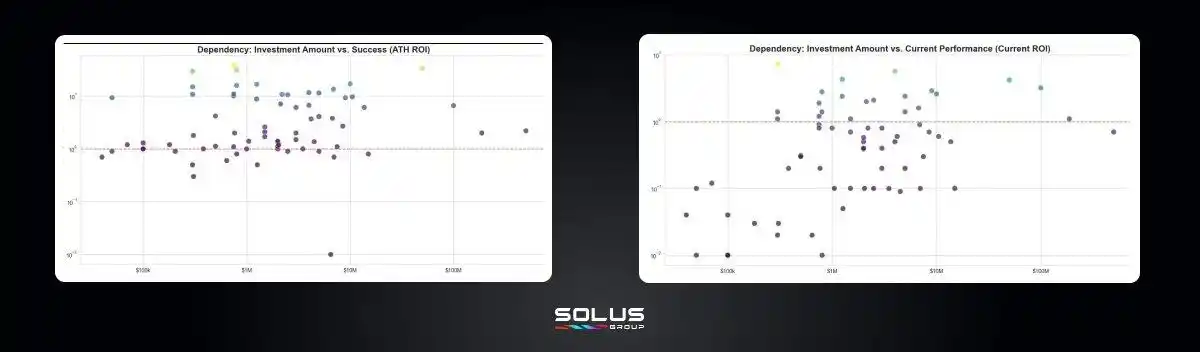
Correlation between funding and token performance: 0.04, statistically considered zero.

Tokens from projects that raised $10 million performed identically to those that raised $1 million. The chart above proves this—the distribution of token ROI is random regardless of funding amount. The best performers: Myshell, B2 Network, Bubblemaps, Mind Network, Particle Network, Creator.Bid (10x to 30x valuation at ATH) raised $300k to $3 million. Meanwhile, projects like Boundless and Analog that raised over $10 million only saw valuation multiples of around 1x.

Current token performance is even worse; most tokens have an ROI below 1x, regardless of funding size. For example, tokens with $5M to $100M funding have ROIs of 0.1x to 0.7x (e.g., Fleek, Pipe Network, Sahara AI), the same as tokens with little funding.

The truth is: Large funding accelerates token death.

Projects with the least funding ($300k to $5M) have a higher ROI per dollar raised. They execute faster, pivot cheaper, and aren't drowned in quarterly VC token unlock schedules, where massive unlocks destroy project gains.

If you chase $10 million for "competitiveness," you are preparing for failure.

The Myth of Followers: Massive Project Communities Are Also "Paper Tigers"

500,000 social media followers vs. 50,000 followers, the statistical result is exactly the same.
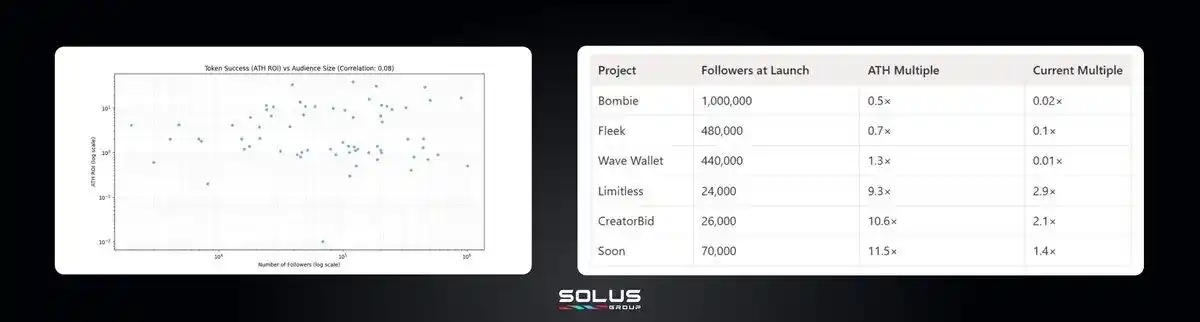
Correlation coefficient: 0.08 (Token ATH) and -0.06 (Token status quo)

The data shows audience size has no predictive value for token performance. Projects with huge follower bases had mixed performances—some soared, some crashed, just like projects with small audiences. No trend, no pattern, no correlation.

Your Discord group is not a community; it's a speculative audience waiting to leave.
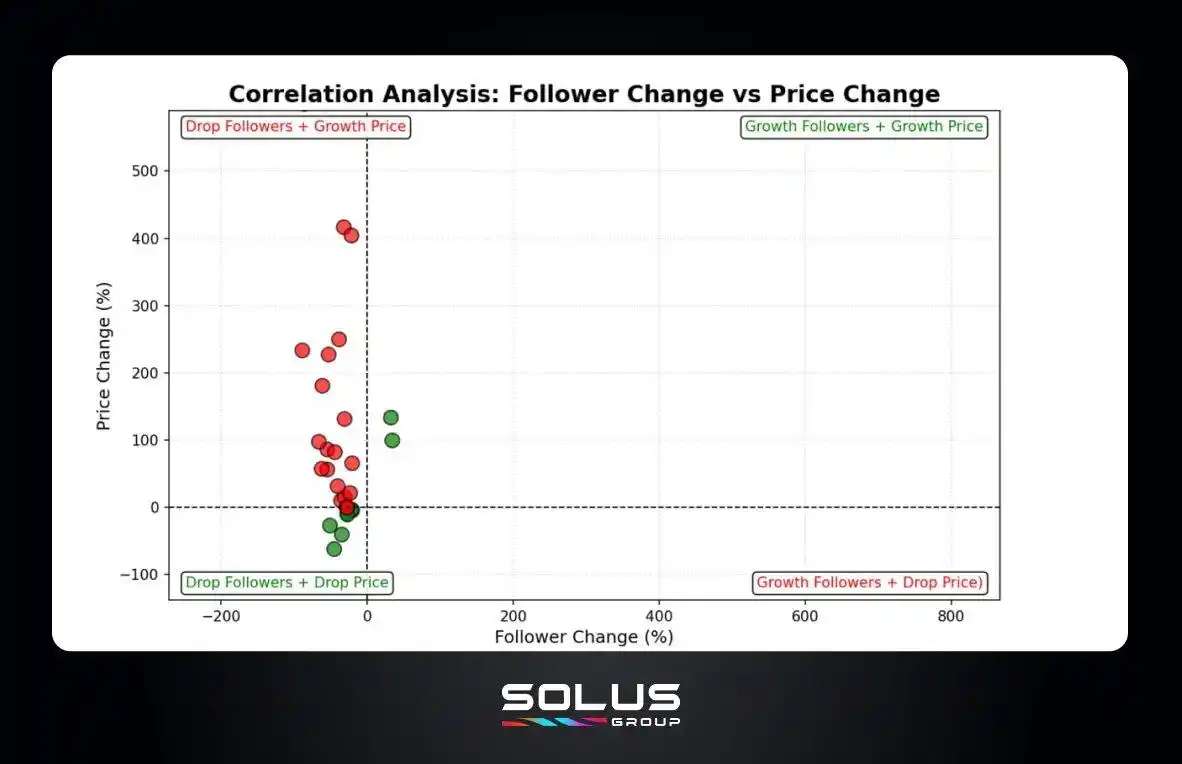
Reality: Price determines community growth, not the other way around.

When the price crashes, followers disappear. The chart proves this—the bottom-left quadrant (decreasing followers + falling price) is very dense. When the price soars, followers sometimes grow, but it's unstable.

This means:

Your "active community" never really cared about the product—they cared about the token price action. Once the token underperforms, they vanish. Community growth is a lagging indicator, not a leading one.

This isn't just theory; it's the openly stated view of @belizardd (Researcher & Trader/KOL):

Most people are here purely for speculation, not the product itself. We see very few protocols performing well post-TGE, mainly those with low initial token FDV, not high fundraising, and generous airdrops. Honestly, I won't blindly ape into anything right now. The risk/reward isn't worth it; I'm just waiting for the market to improve.

Speculators know the game is broken. They are waiting on the sidelines. Meanwhile, founders keep burning 60% of their budgets on Discord bots, Twitter giveaways, and KOL promotions—burning money on statistically irrelevant metrics.

The real question is: "If the token dropped 50% tomorrow, how many would stay?"

The answer: Almost none.

Token Price Trap: Beware of Overpricing/Underpricing
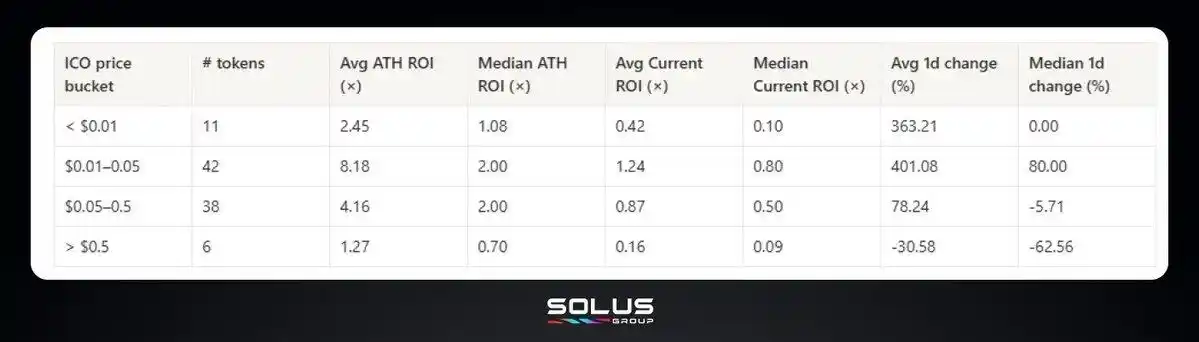
Median ROI by token listing price:

Below $0.01: 0.1x (90% loss)

$0.01 to $0.05: 0.8x (Survivable zone)

$0.05 to $0.50: 0.5x (50% loss)

Above $0.50: 0.09x (91% loss)

Let me repeat:

A listing price below $0.01 doesn't make your token "more accessible"; it makes you a low-priced coin attracting mercenary capital that pumps fast and dumps faster.

Pricing above $0.50 doesn't make your token a "premium token"; it just signals overvaluation. Excessively high token prices kill retail markets, and whales won't bite either.

The $0.01 to $0.05 token price range is the only viable pricing zone. This price is high enough to signal legitimacy and low enough to leave room for upside. Within this range, only 42 out of 97 tokens had a median positive performance.

If your tokenomics place your valuation at $0.003 or $1.20, stop rebuilding the model; the data suggests the project has already failed.

Industry Status Quo: Stop Building Like It's 2021
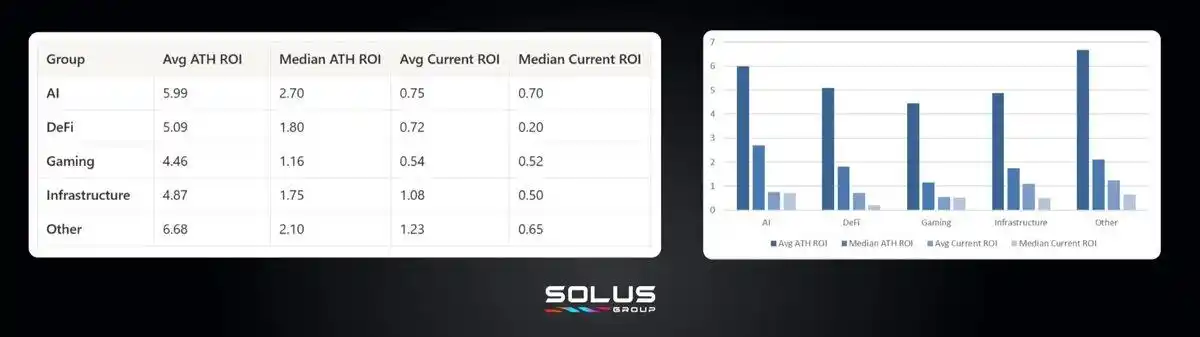
Loser: Gaming

Average ATH ROI: 4.46x (Lowest)

Median Current ROI: 0.52x

GameFi tokens are like lottery tickets; play once, forgotten forever.

Trap: DeFi

Average ATH ROI: 5.09x (Looks good)

Median Current ROI: 0.2x (Disastrous)

DeFi sees early price spikes followed by crashes sharper than any other sector. The gap between hype and reality is brutally stark.

Winner: AI

Average ATH ROI: 5.99x (Highest peak)

Median Current ROI: 0.70x (Best retention)

AI tokens spike and hold their ground. This trend has staying power, and capital follows.

If you're building GameFi, your execution needs to be 10x better than average to achieve average results. If you're in DeFi, prepare for rapid rises and sharp falls. If you're in AI, the market gives you a chance, but only if you deliver. Infrastructure is even tougher: you burn more time and resources compared to standard dApps (like AI agents), yet your median current ROI is slightly lower than the universally frowned-upon GameFi sector.

Data doesn't care which project interests you.

IDO/IEO Data Overview: Good Platforms Can't Save Projects
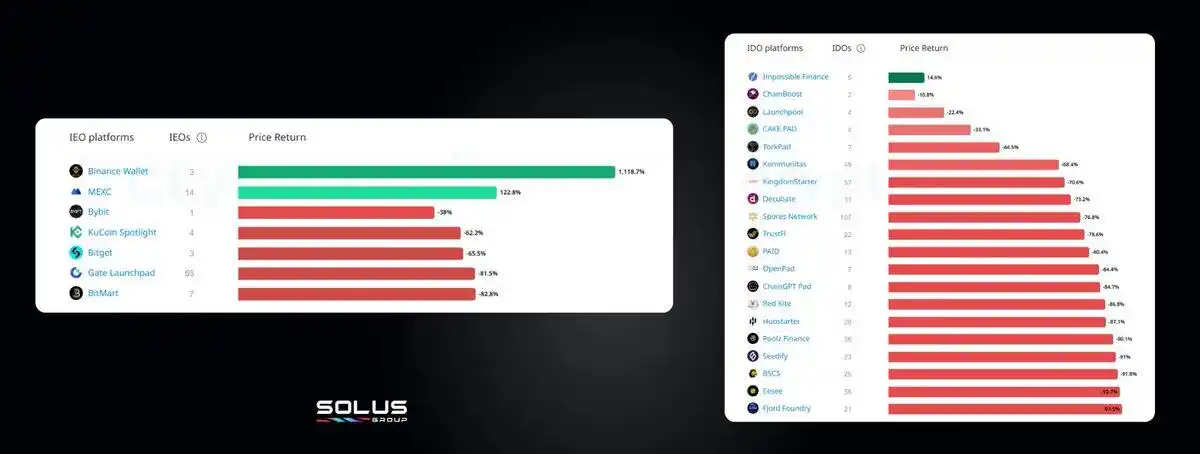
You spend months networking just to get a spot on Binance Launchpad or an allocation from a tier-1 IDO, thinking platform screening means protection. The data shows otherwise.

IDO Platforms: Almost all projects are in the red

Only one project across 5 IDO platforms had a return of +14.6%, that's it. All others ranged from -70% to -93%.

So-called "premium Launchpads" don't protect buyers; they just offer a way to lose money.

IEO Platforms: The epitome of survivorship bias

Binance Wallet shows an 11x return. Looks amazing, but it's only 3 launches, a tiny sample. MEXC shows +122.8% across 14 launches—a larger sample, but still an outlier. Everyone else? Underperformance. Bybit IEO tokens lost 38%, others lost even more.

This proves:

Platform choice is a lottery with better branding. A few outlier wins skew the average, while the vast majority of launches trend downward. The "curation service" you pay for—whether through connections, listing fees, or token allocations—does not reliably protect token ROI.

Platforms can't save garbage tokens, nor can they help good ones.

Reflecting on 2025, Looking Ahead to 2026

Project development in 2025 failed at every level.

Layer Zero: Foundation

Problem: "Speculation-based tokenomics." Indiscriminate token dumping into illiquid markets without organic revenue models to absorb the shock.

Layer One: Funding

Problem: "Fake it in the PDF, fix it later."

Layer Two: Marketing

Problem: The KOL model, paid shills, rented users who vanish the moment payments stop.

Layer Three: Liquidity

Problem: Assuming liquidity follows hype; it doesn't. Institutional investors wait for proof.

Layer Four: User Retention

Problem: Zero-retention infrastructure. The "project community" is 10,000 Telegram users who will abandon you within 90 days.

2026 shouldn't be about playing the old game. There's a deeper issue behind all this: infrastructure matters, but timing dictates everything, even with perfect infrastructure. As Ivan Paskar (Growth Lead at Altius Labs) said:

Tokens don't fix broken things—they amplify reality. Right timing = amplified momentum. Wrong timing = years of effort vaporized instantly. Most teams don't fail on token design; they fail by misjudging their stage and the macro environment. Timing isn't a detail; it's everything.

What Should Projects Do in 2026

Survival isn't about following the old playbook; it's about building a new one.

1. Raise Wisely

Target $300k to $5 million. The highest ROI per dollar is here. More money = more problems.

2. Price for Survival

List between $0.01 and $0.05. Other prices struggle to survive. If your tokenomics don't fit this range, they are broken.

3. Product First, Token Second

If you can't explain in one sentence why your token exists, it doesn't. Revenue must precede speculation.

4. Ignore Vanity Metrics

Follower count is a distraction. Wallet activity, retention rate, and revenue per user are key metrics.

5. Industry Realism

Understand your sector's failure rate before writing code. GameFi needs 2x the execution just to break even. AI has tailwinds—if you can deliver.

6. Integrate or Die

The era of M&A is coming. If you can't scale alone, find an acquirer. Acquisition isn't failure; it's wisdom.

These six principles matter. But the truth is: the standard playbook is obsolete. There is no longer a one-size-fits-all model.


Трендовые криптовалюты

Связанные с этим вопросы

QAccording to the article, what percentage of new tokens launched in 2025 have an FDV lower than their TGE FDV?

A84.7% of new tokens launched in 2025 have an FDV lower than their TGE FDV.

QWhat does the data reveal about the correlation between high fundraising amounts and token performance?

AThe data shows a correlation coefficient of 0.04 between fundraising amount and token performance, which is statistically zero. This means high fundraising amounts do not lead to better token performance.

QWhat is the only viable token price range for survival at TGE, as identified in the research?

AThe only viable token price range for survival at TGE is between $0.01 and $0.05.

QWhich sector's tokens had the highest median ROI at All-Time High (ATH) according to the analysis?

AAI sector tokens had the highest median ROI at All-Time High (ATH), with a multiple of 5.99x.

QWhat is one of the key recommendations for projects in 2026 regarding their community metrics?

AOne key recommendation is to ignore vanity metrics like follower count and instead focus on key metrics such as wallet activity, user retention, and revenue per user.

Похожее

После трёх кварталов падения: получится ли у крипторынка стабилизироваться в третьем квартале?

Криптовалютный рынок пережил худший квартал с 2022 года, общая капитализация упала на 12,6% до $2,1 трлн, а дневные объемы торгов снизились на 20,9%. Впервые за три года сократилась и капитализация стейблкоинов. Основные факторы спада — отток средств из биткоин-ETF, распродажа биткоинов корпоративным казначейством Strategy и ужесточение монетарной политики ФРС. Второй квартал завершился чистым оттоком $46,7 млрд из ETF, при этом в июне отток достиг рекордных $45 млрд. Ключевым событием третьего квартала станет заседание ФРС 28–29 июля. Мягкий сигнал может поддержать биткоин в диапазоне $68 000–84 000 и вернуть приток в ETF, тогда как жесткая риторика способна сместить торговый диапазон к $50 000–56 000. Законодательная неопределенность также давит на рынок: прогресс по закону CLARITY Act, определяющему регуляторные границы, замедлился, и вероятность его принятия в 2026 году упала до 40–45%. Несмотря на общий спад, два сегмента показали рост: объемы на рынках предсказаний выросли на 48,7%, а торговля токенизированными коллекционными предметами увеличилась на 143%. Сектор RWA продолжает стабильно развиваться, достигнув $28,1 млрд. Рынок, вероятно, миновал фазу острой распродажи, но для устойчивого восстановления необходимы ясность от ФРС и регуляторный прогресс.

marsbit14 ч. назад

После трёх кварталов падения: получится ли у крипторынка стабилизироваться в третьем квартале?

marsbit14 ч. назад

BIT Торговые часы: BTC по-прежнему под давлением 200 EMA на недельном графике, после отскока возможен перезапуск нисходящего движения; секторы хранения данных и полупроводников, выросшие ночью, начали падение в вечерней сессии

**Краткий обзор рынка: BTC под давлением, коррекция на рынке акций, внимание к данным и событиям** Рынок криптовалют демонстрирует осторожное восстановление. Bitcoin торгуется около $66 000, сталкиваясь со значительным сопротивлением в районе $68 000, где сосредоточены объемные "застрявшие" позиции. Ключевые технические уровни — 200-недельная скользящая средняя (~$63 333) и 200-недельная EMA (~$68 328). Аналитики отмечают низкую ликвидность, характерную для летнего периода. На фондовом рынке после сильного роста во вторник наблюдается коррекция. Фьючерсы на основные индексы США снижаются. Акции полупроводниковой и памяти, которые резко выросли накануне, падают в ночных торгах. Исключением стал SMCI, который вырос более чем на 15% после оптимистичного прогноза. На общий настрой негативно влияют рост цен на нефть (более $91 за баррель Brent) и доходности государственных облигаций США (10-летние — около 4,64%), что возрождает инфляционные опасения. Азиатские рынки показали нестабильную динамику. Индекс KOSPI в Корее вырос на 0,74%, а японский Nikkei 225 снизился на 0,18%. Основной риск для региона — ослабление японской иены до минимумов с 1986 года, что повышает вероятность вмешательства властей. **Ключевые события для наблюдения:** * **24 июля:** Финансовые отчеты Alphabet (Google), Tesla, IBM. Событие AMD, посвященное ИИ. * **25 июля:** Решение по процентной ставке ЕЦБ и пресс-конференция Кристин Лагард. Финансовые отчеты Intel, American Airlines, Honeywell и других. Данные по числу первичных заявок на пособие по безработице в США.

marsbit14 ч. назад

BIT Торговые часы: BTC по-прежнему под давлением 200 EMA на недельном графике, после отскока возможен перезапуск нисходящего движения; секторы хранения данных и полупроводников, выросшие ночью, начали падение в вечерней сессии

marsbit14 ч. назад

Бывший глава CFTC и президент Circle Тарберт: призывает к долгосрочной стратегии, но сам выводит $30 млн

Бывший председатель CFTC и президент Circle Хит Тарберт, публично пропагандируя долгосрочное видение компании для инвесторов на фоне падения акций на 70% с пиковых значений, сам активно распродавал свои акции CRCL. С момента IPO Circle он по плану 10b5-1 продал более 360 тысяч акций, выручив около 30 миллионов долларов, и при этом ни разу не докупал акции на открытом рынке. Эта разница между его публичными заявлениями и личными действиями вызвала критику. Карьера Тарберта демонстрирует классическое использование «вращающейся двери» между регулирующими органами и частным сектором. Уйдя с поста председателя CFTC в 2021 году, через 27 дней он занял должность главного юрисконсульта в маркет-мейкере Citadel Securities, который в тот момент находился под пристальным вниманием из-за скандала с акциями GameStop. Позже, уже работая в Citadel, Тарберт выступал за расширение полномочий CFTC на крипторынок, в то время как его работодатель планировал выход на этот рынок. В 2023 году Тарберт присоединился к Circle, где его опыт и связи сыграли ключевую роль в успешном проведении IPO компании в 2025 году. Однако его последующие массовые продажи акций, совпавшие с падением котировок и его же призывами к долгосрочным инвестициям, ставят под сомнение искренность его уверенности в будущем компании. Критики видят в его карьере образец превращения регуляторного опыта и политических связей в личную выгоду, в то время как риски несут обычные инвесторы, верящие его нарративам.

marsbit14 ч. назад

Бывший глава CFTC и президент Circle Тарберт: призывает к долгосрочной стратегии, но сам выводит $30 млн

marsbit14 ч. назад

Gate Research: Взлет «уолл-стритизации» криптофинансовых продуктов — это конкуренция или интеграция?

**Аналитический обзор Gate Research Institute: Волна "уолл-стритизации" криптофинансовых продуктов — конкуренция или интеграция?** Создание биткоина в 2009 году было ответом на финансовый кризис и стремлением построить децентрализованную систему без доверенных посредников. Однако к 2026 году значительная часть биткоинов (около 7,14%) хранится через ETF таких гигантов, как BlackRock. Это символизирует глубокую интеграцию традиционных финансов (TradFi) и крипторынка. С появлением биткоин-ETF, фьючерсов, RWA (токенизированных реальных активов) и государственных облигаций на блокчейне, традиционные институты получают всё больше влияния на выпуск, ценообразование, кастодию и дистрибуцию криптоактивов. Однако это не одностороннее поглощение, а взаимодополняющая конвергенция. Криптосфера приносит TradFi глобальную 24/7 ликвидность и программируемость, а TradFi предоставляет криптосфере регулируемые каналы, институциональное доверие и массовый доступ. Яркий пример — две противоположные, но ведущие к одной цели траектории: * **Путь А:** Криптобиржи, такие как Gate, начинают с токенизированных акций и CFD, а затем напрямую подключаются к инфраструктуре традиционных брокеров, предлагая реальную торговлю акциями США, Гонконга и Кореи за стейблкоины. * **Путь Б:** Традиционные брокеры, такие как Robinhood, интегрируют криптоактивы, а затем создают собственные Layer 2 для токенизации своих акций, стремясь к круглосуточной торговле. Обе стратегии нацелены на создание **универсального финансового аккаунта будущего** — единой точки доступа к акциям, криптовалютам, ETF, токенизированным облигациям и другим активам. Ключевой конкурентной борьбой становится не между CEX и брокерами, а между этими "супераккаунтами". Параллельно, слой RWA и токенизированных гособлигаций растёт даже на медвежьем рынке, становясь "прослойкой" для объединения капиталов. Хотя этот рынок (около $150 млрд токенизированных казначейских облигаций) ещё мал по сравнению с традиционным ($30 трлн), он демонстрирует устойчивый структурный тренд, привлекающий крупнейшие финансовые институты (JPMorgan, DTCC и др.). **Вывод:** "Уолл-стритизация" — это не поражение идеалов децентрализации, а формирование новой гибридной модели. Децентрализованные протоколы продолжают работать на базовом уровне, в то время как на уровне приложений и пользовательского опыта формируется более эффективный, глобальный и свободный объединённый рынок капитала, где активы TradFi и DeFi торгуются бок о бок в одном интерфейсе. Уолл-стрит не завоевала криптосферу, а криптосфера не обошла Уолл-стрит — они совместно строят новые финансовые рельсы.

marsbit14 ч. назад

Gate Research: Взлет «уолл-стритизации» криптофинансовых продуктов — это конкуренция или интеграция?

marsbit14 ч. назад

S&P Dow Jones и Pantera выпускают криптоиндекс, биткоин оставлен за бортом из-за «отсутствия прибыли»

Стандард энд Пурс (S&P Dow Jones Indices) совместно с Pantera Capital запускает индекс S&P Pantera Digital Asset Index. Новый индекс включает 18 токенов, но исключает биткоин, XRP и мем-токены. Критерием отбора послужила «финансовая жизнеспособность», по аналогии с S&P 500: протокол должен демонстрировать положительный доход в течение нескольких кварталов и распределять стоимость среди держателей токенов. Это первое применение фундаментального подхода к оценке криптоактивов со стороны крупнейшего в мире провайдера индексов. В первую пятерку активов вошли Ethereum (ETH), BNB, Solana (SOL), TRON (TRX) и Hyperliquid (HYPE). Pantera отмечает, что совокупный годовой доход всех протоколов индекса превышает $30 млрд. Биткоин был исключен по трем причинам: он рассматривается как монетарный актив, доступный через отдельные ETF; он не генерирует доход протокола; а смешивание его в индексе с доходными активами затрудняет фундаментальный анализ для институциональных инвесторов. Пока индекс является эталонным, но Pantera ведет переговоры о создании на его основе ETF и других инвестиционных продуктов. Компания также отмечает значительный разрыв на рынке: многие институциональные инвесторы готовы к аллокации в криптоактивы, но им не хватает структурированных продуктов, фокусирующихся на активах с реальной экономической деятельностью.

marsbit14 ч. назад

S&P Dow Jones и Pantera выпускают криптоиндекс, биткоин оставлен за бортом из-за «отсутствия прибыли»

marsbit14 ч. назад

Торговля

Спот

Популярные статьи

Как купить S

Добро пожаловать на HTX.com! Мы сделали приобретение Sonic (S) простым и удобным. Следуйте нашему пошаговому руководству и отправляйтесь в свое крипто-путешествие.Шаг 1: Создайте аккаунт на HTXИспользуйте свой адрес электронной почты или номер телефона, чтобы зарегистрироваться и бесплатно создать аккаунт на HTX. Пройдите удобную регистрацию и откройте для себя весь функционал.Создать аккаунтШаг 2: Перейдите в Купить криптовалюту и выберите свой способ оплатыКредитная/Дебетовая Карта: Используйте свою карту Visa или Mastercard для мгновенной покупки Sonic (S).Баланс: Используйте средства с баланса вашего аккаунта HTX для простой торговли.Третьи Лица: Мы добавили популярные способы оплаты, такие как Google Pay и Apple Pay, для повышения удобства.P2P: Торгуйте напрямую с другими пользователями на HTX.Внебиржевая Торговля (OTC): Мы предлагаем индивидуальные услуги и конкурентоспособные обменные курсы для трейдеров.Шаг 3: Хранение Sonic (S)После приобретения вами Sonic (S) храните их в своем аккаунте на HTX. В качестве альтернативы вы можете отправить их куда-либо с помощью перевода в блокчейне или использовать для торговли с другими криптовалютами.Шаг 4: Торговля Sonic (S)С легкостью торгуйте Sonic (S) на спотовом рынке HTX. Просто зайдите в свой аккаунт, выберите торговую пару, совершайте сделки и следите за ними в режиме реального времени. Мы предлагаем удобный интерфейс как для начинающих, так и для опытных трейдеров.

1.7k просмотров всегоОпубликовано 2025.01.15Обновлено 2026.06.02

Как купить S

Sonic: Обновления под руководством Андре Кронье – новая звезда Layer-1 на фоне спада рынка

Он решает проблемы масштабируемости, совместимости между блокчейнами и стимулов для разработчиков с помощью технологических инноваций.

2.4k просмотров всегоОпубликовано 2025.04.09Обновлено 2025.04.09

Sonic: Обновления под руководством Андре Кронье – новая звезда Layer-1 на фоне спада рынка

HTX Learn: Пройдите обучение по "Sonic" и разделите 1000 USDT

HTX Learn — ваш проводник в мир перспективных проектов, и мы запускаем специальное мероприятие "Учитесь и Зарабатывайте", посвящённое этим проектам. Наше новое направление .

1.9k просмотров всегоОпубликовано 2025.04.10Обновлено 2025.04.10

HTX Learn: Пройдите обучение по "Sonic" и разделите 1000 USDT

Обсуждения

Добро пожаловать в Сообщество HTX. Здесь вы сможете быть в курсе последних новостей о развитии платформы и получить доступ к профессиональной аналитической информации о рынке. Мнения пользователей о цене на S (S) представлены ниже.

活动图片














