USD Coin (USDC) Stablecoin Challenges Tether (USDT) Supremacy: Comprehensive Guide

u.todayОпубликовано 2022-07-07Обновлено 2022-07-07

Введение

Amid the carnage on the cryptocurrency markets, more and more investors are increasing the share of stablecoins in their portfolios.

Contents

Amid the carnage on the cryptocurrency markets, more and more investors are increasing the share of stablecoins in their portfolios. As such, the right moment has come to study the features of USD Coin, the second largest stablecoin and one of the most promising assets of the segment.
USD Coin (USDC) inches closer to historic "flippening": Details
USD Coin (USDC) is a U.S. Dollar-pegged stablecoin issued by Circle Inc. payments provider. While it has the second largest market capitalization as of June 2022, it has all the chances to become the leader of the segment:

  • USDC is the fastest-growing stablecoin by market cap: its net capitalization rallied 52x in the last 23 months;
  • USDC surpassed USDT as Ethereum’s largest stablecoin in February 2022;
  • USDC eclipsed USDT in daily transactions on the Ethereum count;
  • Accounts with over $1 million in equivalent prefer USDC over USDT;
  • USDC managed to keep it pegged to the fiat U.S. Dollar amid the May-June 2022 volatility spikes, while other top-tier stablecoins failed to do so.

In this guide, we will cover the latest developments of USD Coin (USDC), review its core features and observe its prospects for the coming months.
What is a stablecoin?
A stablecoin is a digital asset (blockchain-based asset, cryptocurrency) that has its price pegged to this or that real-world (fiat) currency, precious metal or index. Largely, stablecoins are pegged to the U.S. Dollar (USD) and Euro (EUR). Also, there are stablecoins pegged to the Chinese Yuan (CNY), Mexican Peso (MXN), Gold (XAU) and Silver (XAG).
First-ever stablecoins BitUSD and NuBits were created in 2014. Stablecoins gained popularity as they are useful as a blockchain-based fiat equivalent necessary for both traders and holders. It is much easier to exchange Bitcoin (BTC) or Ethereum (ETH) to a stablecoin than to fiat currency.
There are centralized and decentralized (algorithmically backed) stablecoins. Centralized stablecoins (USDT, USDC, BUSD, GUSD, TUSD) are backed by cash and commercial papers stored by the issuers of stablecoins. Auditors periodically check whether these "baskets" are healthy. Decentralized stablecoins (DAI, FEI, FRAX, MIM, USDD) have their pegs guaranteed by a sophisticated architecture of smart contracts.
What is USDT?
Launched in late 2014, the United States Dollar Tether (USDT or Tether) is the most popular stablecoin and the ongoing leader of this segment by market capitalization. As of June 2022, its market cap exceeds $67 billion in equivalent while, at its peak, it was over $82 billion.
USDT is issued by Tether Limited; CTO of Tether and Bitfinex Paolo Ardoino is its key figurehead. Tether (USDT) is backed by a balanced basket of U.S. Treasuries, commercial papers (short-term loans to U.S. companies) and by a small number of non-U.S. bonds.
Introducing USD Coin (USDC), fastest-growing stablecoin in Web3
Since its launch in 2014, U.S. Dollar Tether (USDT) has retained its leadership in the stablecoin segment. However, in 2022, USD Coin (USDC) is closer to a historic "flippening" than ever before.
What is USDC?
USDC, or USD Coin, is a Dollar-pegged stablecoin launched in 2018 by Circle Inc. Since its first releases, USDC has been maintained by Centre, a large fintech consortium that includes professionals from different spheres. In turn, Circle is helmed by veteran entrepreneur Jeremy Allaire.
Various platforms, various use cases
Like other stablecoin majors, USD Coin (USDC) is minted on various blockchains. As of Q2, 2022, USDC is issued on Ethereum (ETH), Algorand (ALGO), Solana (SOL), Stellar (XLM), Tron (TRX), Hedera (HBAR), Avalanche (AVAX), Flow (FLOW) and Polygon (MATIC). 
Also, Circle Inc. offers instruments designed to move USDC through cards, ACH and wire transfers. Also, USDC multi-chain swap instruments allow users to move USDC between various blockchains in a seamless manner.
Largely, USDC is used by retail investors for trading and investing in crypto. However, its technical toolkit makes it attractive for institutions as well. Per Circle, USDC is used by traditional and crypto-native businesses (e.g., for blockchain games and NFT marketplaces). USDC is integrated into cross-border remittance mechanisms as its transfers are almost fee-less.
USDC is 100% backed by the U.S. Dollar; out of its $55.2 billion in reserves, $14 billion are in cash while $41.2 billion are in short-duration U.S. Treasuries.
The most "stable" stablecoin
USD Coin was in the spotlight amid the market collapse of May-June 2022. Due to the exit of liquidity from Anchor Protocol (ANC), the Terra (LUNA) asset and TerraUSD (UST) stablecoin plunged to almost zero values.
As such, the selling pressure resulted in spiked interest in stablecoins. Due to this imbalance, almost all major stablecoins have de-pegged. For instance, USDT "dipped" below $0.9 in pairs with fiat USD; decentralized stablecoins demonstrated even scarier dropdowns.
Amid this carnage, USDC's 1:1 peg was almost unaffected. Its price even spiked to $1.02; many investors chose it as an alternative to USDT and DAI.
Circle Yield, Accounts, Payouts: Circle for businesses
To leverage the full stack of opportunities unlocked by USD Coin (USDC), Circle introduced a number of products for the B2B and B2C audience. For instance, Circle Yield solution allows users to generate 1% on every deposit in 1-12 month programs.
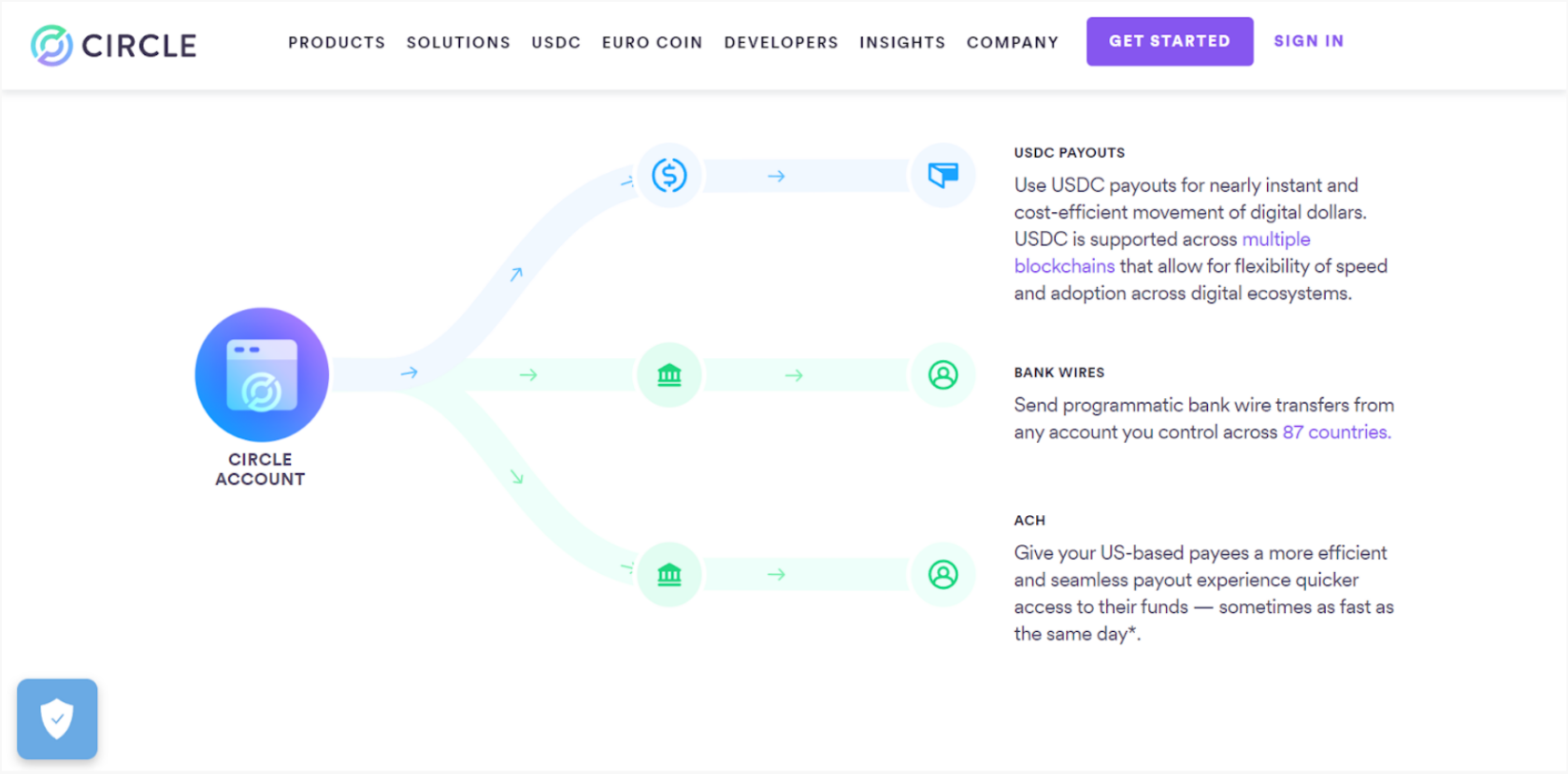
Circle Account is designed to let crypto holders use USDC as an autonomous digital banking instrument. With Circle Accounts, users can buy USDC straight from the issuer and leverage the coins in various lending/borrowing designs. Also, Circle Account removes the need for additional centralized services in cross-border remittances and business transfers.
circle

Image by Circle Last but not least, the Circle Payouts mechanism is designed to streamline the process of crypto usage in retail: entrepreneurs can have their money transfers automated. Circle Payouts instrument can be treated as a bridge between the Web2 and Web3 worlds; it makes digital payments accessible in 85+ countries worldwide.
USDT
USDC
Launched
Q4, 2014
Q4, 2018
Blockchains
Ethereum, Tron, Solana, Omni, Avalanche, Algorand, EOS, Liquid, SLP
Ethereum, Algorand, Solana, Stellar, Tron, Hedera, Avalanche, Flow, Polygon
Market capitalization (June, 2022)
$67 bln
$55,2 bln
Backed by
85,64% cash, cash equivalents and other short-term deposits, commercial paper
4,52% corporate bonds, funds and precious metals
3,82% secured loans
6,02% other (including digital tokens)
74,6% short-duration U.S. Treasuries
25,6% cash
Operator
Tether Operations Limited
Circle Incorporated
Reviewed
Moore Cayman (audits)
Grant Thornton (attestation reports)
Bottom line
USD Coin (USDC) by Circle is a reliable centralized stablecoin and promising alternative to U.S. Dollar Tether (USDT). Its adoption gained traction in 2021-2022; it has already surpassed USDT by a couple of metrics.
USDC is issued on virtually all mainstream programmatic blockchains; it is also integrated into the feature-rich payments infrastructure of Circle Inc. As such, USDC is suitable for many retail and entrepreneurial uses.


Похожее

$26 Billion: An 'All-Chinese Team' Backs the World's Highest-Valued AI Programming Company

Cognition AI, the company behind the AI programmer "Devin," has raised over $1 billion in new funding at a valuation of $26 billion, just eight months after reaching a $10.2 billion valuation. The round was led by Lux Capital, General Catalyst, and 8VC. Founded by three young Chinese entrepreneurs with strong competitive programming backgrounds, Cognition initially gained fame with Devin, marketed as the world's first AI software engineer capable of handling tasks from start to finish. While its early demos were impressive, real-world usage revealed reliability and cost-effectiveness issues, leading to a significant price cut for Devin in 2025. A pivotal moment came when Cognition acquired the assets of AI IDE company Windsurf after a failed acquisition by OpenAI. This move gave Cognition a crucial developer-facing tool, allowing it to pursue a two-pronged strategy: Devin for autonomous task execution and Windsurf for integrated, collaborative coding within an IDE. This shift helped the company move away from the controversial "AI replacement" narrative towards a model of augmenting human engineers, particularly for repetitive or maintenance tasks. This strategic pivot is backed by strong commercial metrics. The company reports a 10x increase in enterprise usage this year, with an annual revenue run-rate of $492 million and a 50% month-over-month growth in enterprise Devin usage over the past six months. Its client list now includes major corporations like Goldman Sachs and Mercedes-Benz, as well as government agencies like NASA and the U.S. Army. Investors are betting on Cognition becoming a foundational piece of next-generation software engineering infrastructure, positioning it at the center of a hybrid future where AI agents and human developers work in tandem.

marsbit14 мин. назад

$26 Billion: An 'All-Chinese Team' Backs the World's Highest-Valued AI Programming Company

marsbit14 мин. назад

The Hottest 00s Generation on Wall Street

"Wall Street's Hottest '00s Phenom: The 25-Year-Old Fund Manager Who Bet on AI's 'Boring' Backbone" At just 25, Leopold Aschenbrenner, once fired by OpenAI, now runs a hedge fund worth $13.7 billion. His strategy? Betting against the consensus. While others chased AI chips, he invested early in the physical infrastructure powering the AI boom: electricity, data centers, and energy. Expelled from OpenAI's safety team in 2024, Aschenbrenner foresaw the coming bottleneck. He argued that AI progress would be limited not by algorithms, but by power, chip capacity, and space. Acting on this, he founded Situational Awareness LP to go long on these "old economy" assets. His bets have paid off spectacularly. His fund's assets soared from $255 million in late 2024 to $13.7 billion by Q1 2026. His portfolio is a direct reflection of his thesis: major long positions in fuel cell company Bloom Energy and data center/bitcoin mining firms like CleanSpark and Riot Platforms, which control critical land and power resources. Conversely, he holds massive put options against overheated semiconductor giants like NVIDIA and AMD. A notable exception was his bullish bet on storage company SanDisk, which surged ~160% in Q2. Aschenbrenner's vision is materializing. Tech giants like Amazon, Alphabet, and Meta are ramping up colossal capital expenditure on data centers. Global data center power consumption is projected to skyrocket, with AI accounting for over half by 2030. The demand for enabling technologies like optical fiber and modules is also exploding. His story underscores a fundamental truth of the AI era: the ethereal intelligence of algorithms rests on a very physical, heavy, and power-hungry foundation. The future is being built not just in code, but in concrete, copper, and kilowatts.

marsbit2 ч. назад

The Hottest 00s Generation on Wall Street

marsbit2 ч. назад

Review of Cathie Wood's Masterstroke Operation on Circle

A Recap of Cathie Wood's Masterful Trading in Circle's IPO This article analyzes the strategic moves made by ARK Invest's Cathie Wood around the IPO of Circle (CRCL). Despite her typical long-term, narrative-driven investment style, Wood executed a textbook "buy low, sell high" trade. Wood secured a core position of approximately 4.49 million shares at the $31 IPO price. The stock debuted at $69, surged to a high of $299 in June 2025 fueled by stablecoin regulatory news (the GENIUS Act), and then entered a prolonged decline. During this rally, ARK systematically sold around 1.7 million shares at an average price near $210, driven partly by internal fund rebalancing rules triggered by the stock's soaring weight. This move locked in substantial profits. As the stock later fell due to lockup expirations, new share issuance, and interest rate concerns—even dipping below $50—Wood began repurchasing shares. Starting in November 2025 around $86, she continued buying on the way down, eventually rebuilding her position to roughly the original size by Q1 2026. Key takeaways include: 1) Having a strong, independent long-term thesis (viewing Circle as critical digital dollar infrastructure). 2) Trading in tranches instead of trying to time exact tops or bottoms. 3) Maintaining strict position-sizing discipline, using rules to force profit-taking and preserve buying power. For most retail investors, chasing the dramatic "pop" at open is dangerous, as the subsequent 83% drawdown showed. Wood's success hinged on pre-IPO access, a clear investment thesis, and disciplined execution.

marsbit4 ч. назад

Review of Cathie Wood's Masterstroke Operation on Circle

marsbit4 ч. назад

Sharplink CEO: Ethereum's Future is Unfolding Now

In an article titled "Sharplink CEO: Ethereum's Future is Unfolding," Joseph Chalom, a former BlackRock executive and current Sharplink CEO, argues that the current debates surrounding the Ethereum Foundation (EF) and ETH price miss the bigger picture. He asserts that Ethereum's long-term institutional adoption is secured by its foundational strengths: trust, security, and liquidity. Chalom highlights Ethereum's dominance in settling stablecoin value, tokenizing real-world assets (RWA), and facilitating high-value DeFi transactions as evidence of its winning position. He defends the Ethereum Foundation's focus on rigorous protocol development and a decade-long track record of major upgrades (The Merge, EIP-1559, Dencun, etc.), viewing its upcoming technical roadmap as the most ambitious in the industry. Contrary to critics, Chalom posits that Ethereum's decentralization and reliable neutrality are core strengths for institutional adoption, not weaknesses, as they prevent control by any single entity. Drawing a parallel to Amazon's early days, he suggests that ETH's intrinsic value is tied to the expansion of its network, which is poised for a step-change in transaction volume across stablecoins, RWAs, DeFi, and agentic finance. Chalom advocates for a "be greedy when others are fearful" approach, citing historical examples from Warren Buffett and his own experience at BlackRock during the crypto winter. He concludes that while the EF should remain focused on core protocol attributes (CROPS: Censorship Resistance, Capture Resistance, Open Source, Privacy, Security), there is a leadership gap in market outreach. Chalom calls for ecosystem participants, including Sharplink and other key players, to become more vocal advocates to support the coming institutional adoption supercycle, asserting that "Ethereum's future is unfolding now."

marsbit4 ч. назад

Sharplink CEO: Ethereum's Future is Unfolding Now

marsbit4 ч. назад

6 Questions to Understand the Business Trends of AI

The AI industry has entered its "summer" phase, according to a six-dimensional scoring framework assessing its development cycle. Each dimension—narrative vs. delivery, system connectivity, delivery capability, ROI rationalization, common industry trends, and capital environment—scores 1 point, totaling 6 points. This places the industry firmly in summer (5-7 points), characterized by a coexistence of grand promises and tangible deliverables, with increasing pressure to demonstrate value and profitability. Key signals mark this shift. ByteDance's Doubao launched paid subscriptions, while OpenAI introduced an advertising platform. These moves are driven by dual forces: immense cost pressures from scaling user bases and massive compute requirements, and the maturation of commercial opportunities. Major players like Anthropic report explosive growth, highlighting AI's transition into core productivity infrastructure. For businesses, the path forward involves three strategic steps. First, identify a small, high-impact use case to quickly demonstrate a closed-loop value proposition, such as automating customer service or content generation. Second, systematically replicate successful pilots across the organization by standardizing processes, building shared AI capabilities, and aligning talent, incentives, and leadership. Finally, move beyond simply adding AI to existing workflows and undertake systemic reconstruction—redesigning processes for parallel AI-human collaboration, implementing real-time dashboards, and establishing automated trigger chains. The era where storytelling alone secured funding is over. The focus has shifted to delivering measurable efficiency gains, cost savings, and new revenue streams, as evidenced by real-world implementations in companies like Semir, Anta, and Midea. Success now depends on starting with a focused proof point, scaling it organization-wide, and ultimately allowing AI to redefine operational paradigms.

marsbit10 ч. назад

6 Questions to Understand the Business Trends of AI

marsbit10 ч. назад

Торговля

Спот
Фьючерсы

Популярные статьи

Как купить USDC

Добро пожаловать на HTX.com! Мы сделали приобретение USD Coin (USDC) простым и удобным. Следуйте нашему пошаговому руководству и отправляйтесь в свое крипто-путешествие.Шаг 1: Создайте аккаунт на HTXИспользуйте свой адрес электронной почты или номер телефона, чтобы зарегистрироваться и бесплатно создать аккаунт на HTX. Пройдите удобную регистрацию и откройте для себя весь функционал.Создать аккаунтШаг 2: Перейдите в Купить криптовалюту и выберите свой способ оплатыКредитная/Дебетовая Карта: Используйте свою карту Visa или Mastercard для мгновенной покупки USD Coin (USDC).Баланс: Используйте средства с баланса вашего аккаунта HTX для простой торговли.Третьи Лица: Мы добавили популярные способы оплаты, такие как Google Pay и Apple Pay, для повышения удобства.P2P: Торгуйте напрямую с другими пользователями на HTX.Внебиржевая Торговля (OTC): Мы предлагаем индивидуальные услуги и конкурентоспособные обменные курсы для трейдеров.Шаг 3: Хранение USD Coin (USDC)После приобретения вами USD Coin (USDC) храните их в своем аккаунте на HTX. В качестве альтернативы вы можете отправить их куда-либо с помощью перевода в блокчейне или использовать для торговли с другими криптовалютами.Шаг 4: Торговля USD Coin (USDC)С легкостью торгуйте USD Coin (USDC) на спотовом рынке HTX. Просто зайдите в свой аккаунт, выберите торговую пару, совершайте сделки и следите за ними в режиме реального времени. Мы предлагаем удобный интерфейс как для начинающих, так и для опытных трейдеров.

943 просмотров всегоОпубликовано 2024.04.18Обновлено 2025.06.06

Как купить USDC

Что такое $USDC

Классический USDC: Полный обзор Введение в Классический USDC В быстро развивающемся мире рынка криптовалют стейблкоины стали важной частью, особенно в обеспечении стабильности на фоне волатильности, которая характеризует цифровые активы. Один из таких проектов - Классический USDC, инициатива цифровой валюты, которая нацелена на предоставление стабильного и надежного средства обмена. Поддерживая привязку 1:1 к доллару США, Классический USDC стремится предложить пользователям надежный цифровой актив, пригодный для различных применений в экосистемах web3 и криптовалют. Что такое Классический USDC? Классический USDC по своей сути является стейблкоином, который представляет собой тип криптовалюты, предназначенной для минимизации ценовой волатильности, обычно наблюдаемой на рынке цифровых активов. В частности, Классический USDC стремится близко отражать стоимость доллара США, обеспечивая пользователям возможность использовать эту цифровую валюту для транзакций, сбережений и других финансовых операций без страха перед внезапными колебаниями цен, которые могут беспокоить многие криптовалюты. Основная цель Классического USDC - предоставить надежный и доверенный цифровой аналог доллара США, разработанный для бесшовной интеграции в широкий спектр приложений web3, платформ децентрализованных финансов (DeFi) и других финансовых систем, связанных с криптовалютой. Создавая стабильную цифровую валюту, Классический USDC стремится облегчить повседневную торговлю, сделать технологии блокчейна более удобными для пользователей и способствовать принятию криптовалют для массового использования. Создатель Классического USDC Личность создателя или команды разработчиков Классического USDC остается в значительной степени неизвестной, и отсутствие прозрачности создало определенную степень неопределенности относительно происхождения проекта. В то время как многие криптовалютные инициативы открыто представляют своих основателей и команды разработчиков, Классический USDC не предоставляет четкой информации о своих создателях, что ставит под угрозу доверие потенциальных пользователей или инвесторов, оценивающих надежность и состоятельность проекта. Инвесторы Классического USDC Помимо неопределенности относительно его создателей, Классический USDC также не имеет конкретной информации о своих инвесторах. Финансовая поддержка проекта может часто придавать ему авторитет и стабилизировать его операционную деятельность; однако отсутствие задокументированных инвестиционных фондов или организаций, поддерживающих Классический USDC, вызывает вопросы о его структуре финансирования. Эта неопределенность может потенциально подорвать доверие заинтересованных сторон к проекту. Как работает Классический USDC? Операционные механизмы Классического USDC во многом зависят от его резервной системы, которая является основополагающей для любого стейблкоина. Классический USDC обязуется поддерживать резерв активов, который напрямую соответствует стоимости цифровой валюты в обращении. В частности, за каждые выпущенные токены Классического USDC сохраняется эквивалентная сумма резервных активов, будь то наличные или эквиваленты близкие к наличным. Эта стратегия нацелена на поддержание стоимости Классического USDC, предлагая пользователям уверенность в том, что они могут в любой момент обменять свои токены на доллары США. Эта резервная структура направлена на повышение стабильности и надежности Классического USDC, позиционируя его как безопасную альтернативу на рынке криптовалют. Обеспечивая постоянную корреляцию стоимости Классического USDC с долларом США, проект стремится вызывать доверие среди пользователей, которые могут быть насторожены по поводу более широких рыночных динамик. Хронология Классического USDC История Классического USDC отмечена несколькими ключевыми вехами, отражающими его путешествие и эволюцию в экосистеме криптовалют: 2021: Отмечено начало Классического USDC, введение нового варианта цифровой валюты, разработанного для стабильности. В этом году появились первые записи о деятельности токена, и были установлены его первоначальные уровни цен. 2024: Классический USDC начинает испытывать значительные колебания цен, поскольку крипторынок в целом сталкивается с различными тенденциями и настроениями пользователей. Появляются прогнозы относительно его будущего потенциала, указывающие на сильный интерес со стороны наблюдателей и аналитиков рынка, которые предвидят возможности для роста. Будущие прогнозы Эксперты предполагают, что Классический USDC может достичь более высоких уровней принятия и стабильности в ближайшие годы, с потенциальными дальнейшими разработками, ожидаемыми около 2025 и 2026 года. Однако к этим прогнозам следует подходить с осторожным оптимизмом, поскольку рынок криптовалют по своей природе непредсказуем, и различные внешние факторы могут повлиять на траекторию Классического USDC. Ключевые моменты о Классическом USDC Стабильность: Основное предложение Классического USDC заключается в предоставлении цифровой валюты, параллельной стоимости доллара США, тем самым обеспечивая стабильность на часто волатильном рынке. Резервная система: Обязательство проекта поддерживать резерв активов для обеспечения своей стоимости подчеркивает его надежность и операционную устойчивость. Интеграция в Web3 и крипто: Классический USDC разработан для облегчения интеграции в различные приложения, стремясь улучшить пользовательский опыт и расширить принятие криптовалюты в повседневных транзакциях. Потенциал будущего роста: Несмотря на то что он еще только начинает, Классический USDC имеет перспективные направления для роста по мере увеличения осведомленности и использования стейблкоинов в контексте web3 и криптовалют. Заключение Классический USDC представляет собой заметную инициативу стейблкоина в сфере криптовалют, стремясь предоставить пользователям надежную цифровую валюту, которая воплощает стабильность доллара США. Несмотря на неопределенности относительно его создателей и финансовой поддержки, основополагающие принципы Классического USDC - сосредотачивающиеся на обеспеченных резервами гарантиях - стремятся позиционировать его как надежный вариант для индивидуумов и бизнеса, ориентированных на цифровую экономику. С учетом будущего, аналитики рынка с нетерпением ожидают, как Классический USDC будет эволюционировать в ответ на изменяющуюся динамику рынка криптовалют, потенциально устанавливая себя в качестве значительного игрока в области стейблкоинов.

57 просмотров всегоОпубликовано 2024.05.01Обновлено 2024.12.03

Что такое $USDC

HTX Learn: Изучите "Layer3" и Разделите 6000 USDC

Участники, которые изучат обучающий курс и пройдут тест, получат шанс выиграть потрясающие призы.

3.2k просмотров всегоОпубликовано 2024.12.11Обновлено 2024.12.12

HTX Learn: Изучите "Layer3" и Разделите 6000 USDC

Обсуждения

Добро пожаловать в Сообщество HTX. Здесь вы сможете быть в курсе последних новостей о развитии платформы и получить доступ к профессиональной аналитической информации о рынке. Мнения пользователей о цене на USDC (USDC) представлены ниже.

活动图片