Participating in Dual Governance: A Guide for stETH Holders

项目方LDO(Lido)Опубликовано 2025-10-02Обновлено 2025-11-10

Dual Governance empowers stETH and wstETH holders to safeguard their assets in the event of contentious or harmful governance decisions within the Lido protocol. If necessary, it enables holders to delay or block proposed changes until they have safely exited the protocol.

This guide outlines how Dual Governance works, possible scenarios where it may be activated, and step-by-step instructions for stETH holders.


What is Dual Governance?

Dual Governance introduces a mechanism that gives stakers a direct role in protocol governance through the dynamic timelock system. This mechanism ensures that holders can exit the protocol before potentially harmful proposals are enacted.

The mechanism relies on an immutable escrow contract, which accepts stETH, wstETH, and unstETH withdrawal NFTs. Two thresholds apply to the escrow:

  • 1% threshold: Once 1% of the total stETH supply is deposited, Veto Signalling is triggered. This delays governance proposals for 5 to 45 days, depending on the level of opposition.
  • 10% threshold: Once 10% of the total stETH supply is deposited, Rage Quit is triggered. This blocks all governance motions until all escrowed stETH, wstETH, and unstETH tokens are fully withdrawn.

While LDO holders maintain voting power, Dual Governance ensures stETH holders can signal opposition, delay execution, and exit the protocol before changes impact their assets.

For more details on the underlying design, see:


Withdrawals and Their Role in Dual Governance

Although the withdrawal process itself has not changed, it is central to Dual Governance:

  1. Request withdrawal: Lock your stETH/wstETH at stake.lido.fi/withdrawals/request. Each withdrawal request mints a unique NFT (unstETH). Your stETH is burned, and ETH is sourced to fulfill the request.
  2. Claim: Once the withdrawal is finalized, the unstETH NFT updates to “finalized,” allowing you to claim ETH.

Why it matters: Withdrawal NFTs can be deposited into the Veto Signalling escrow alongside stETH/wstETH. This lets you signal opposition while keeping your place in the withdrawal queue—a key option in both moderate and severe threat scenarios.

For a walkthrough, see:


Two Categories of Scenarios

Dual Governance responses fall into two broad categories:

  1. Moderately bad proposals: Well-intentioned but flawed proposals, mistakes, or governance gaps.
  2. Severe threats: Deliberate attempts to exploit governance or impose hostile protocol changes.

Each scenario has specific strategies available to stETH holders.


Scenario 1: Moderately Bad Proposals

These are usually unintended mistakes, compromises, or unclear proposals. While problematic, they do not represent immediate existential threats.

Examples include:

  • Security oversights or misaligned parameters.
  • Governance decisions that unintentionally harm stETH holders.
  • Technical changes that reduce validator decentralization.
  • Honest errors in fees or reward mechanics.
  • Poor communication of proposal rationale or impact.


Step by Step Response

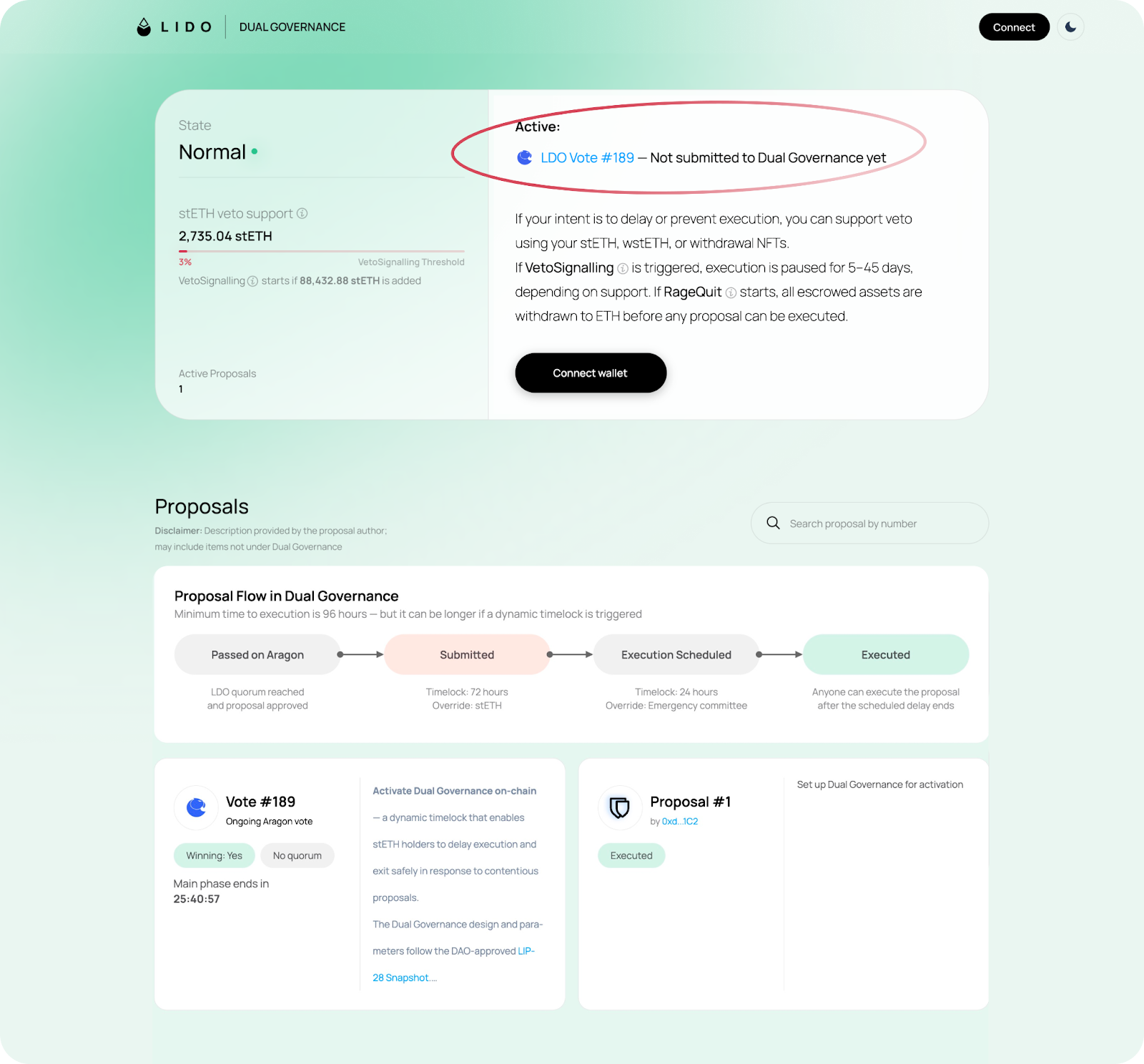
After LDO holders approve a proposal, it enters the Dual Governance review process. You can find all active proposals at dg.lido.fi. Click each proposal to review details and verify the items under consideration.
1. Place tokens in the Veto Signalling Escrow

Veto Signalling does not fully block execution, but it activates a dynamic timelock: the more exit signals from stETH holders, the longer governance motions are delayed.

If you believe a submitted or active proposal is problematic:

  • Connect your wallet.
  • Click the Support Veto button.
  • Select the token type (stETH, wstETH, or unstETH) and the amount to deposit into the Veto Signalling contract.

For detailed instructions, see the Dual Governance UI guide.
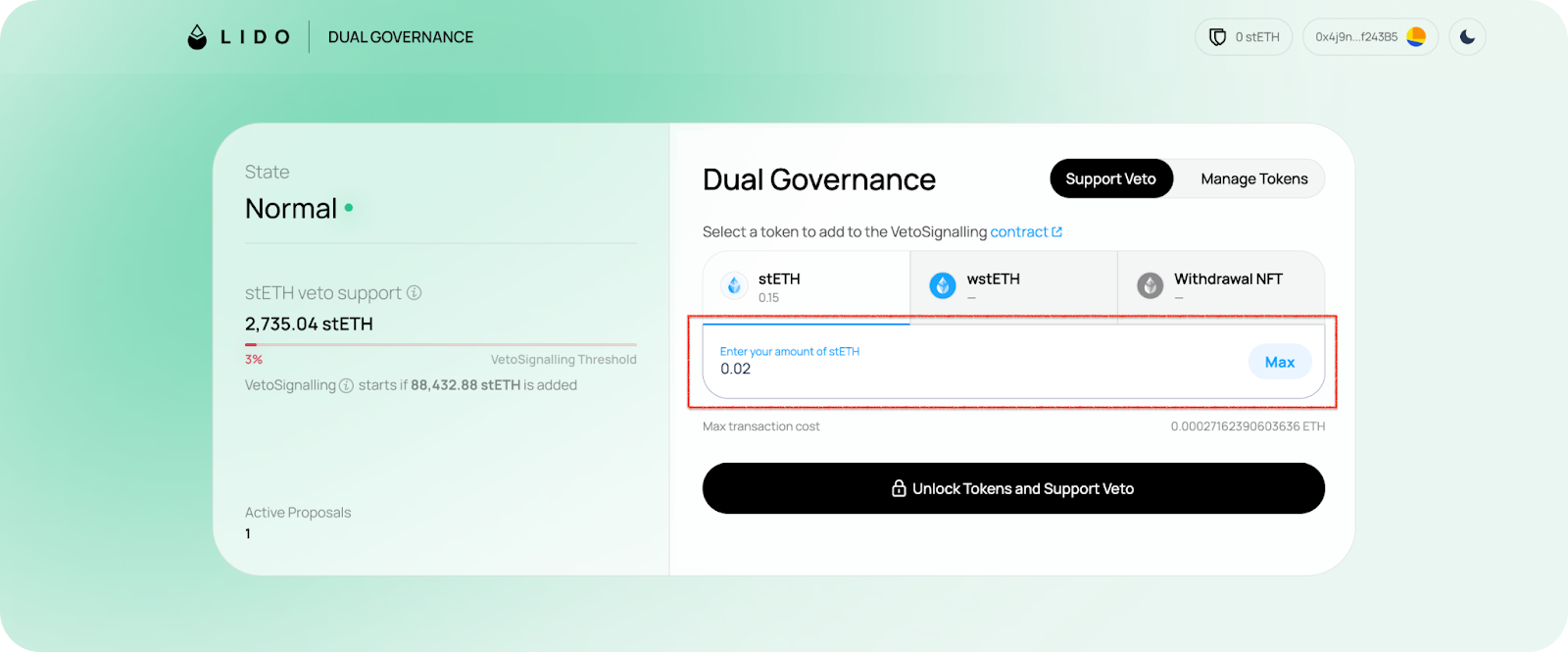
Note: stETH/wstETH deposited in escrow remains staked. You can choose any amount to support Veto Signalling.

If the 1% threshold is NOT reached

The Veto is not supported by enough stETH holders (<1% of total supply). In this case, the governance process is unaffected, and the proposal will be enacted once the pending time ends (3 days + 1 day technical buffer).

During and after this time, stETH holders may either exit the protocol via the withdrawal queue or revoke tokens from the Veto Signalling escrow. Proposals can still be executed even while opponents are in the process of exiting.

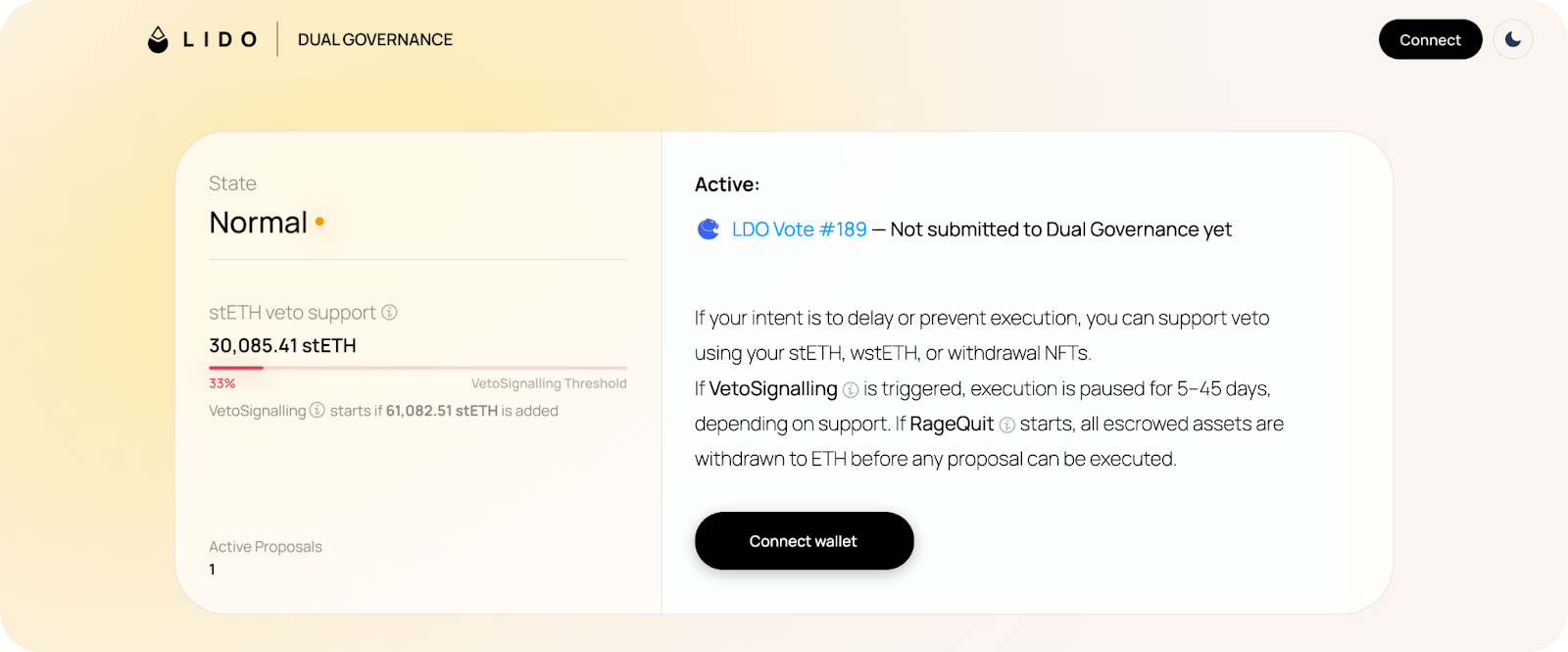
Indicator: A yellow “Normal” state background means 30% of the amount required for the next threshold has been gathered (a sign of significant opposition).
If the 1% threshold IS reached

More than 1% of stETH is deposited, triggering Veto Signalling. Execution is paused, giving stakers and LDO holders time to coordinate.

From here, two outcomes are possible:

  • DAO cancels or revises the proposal
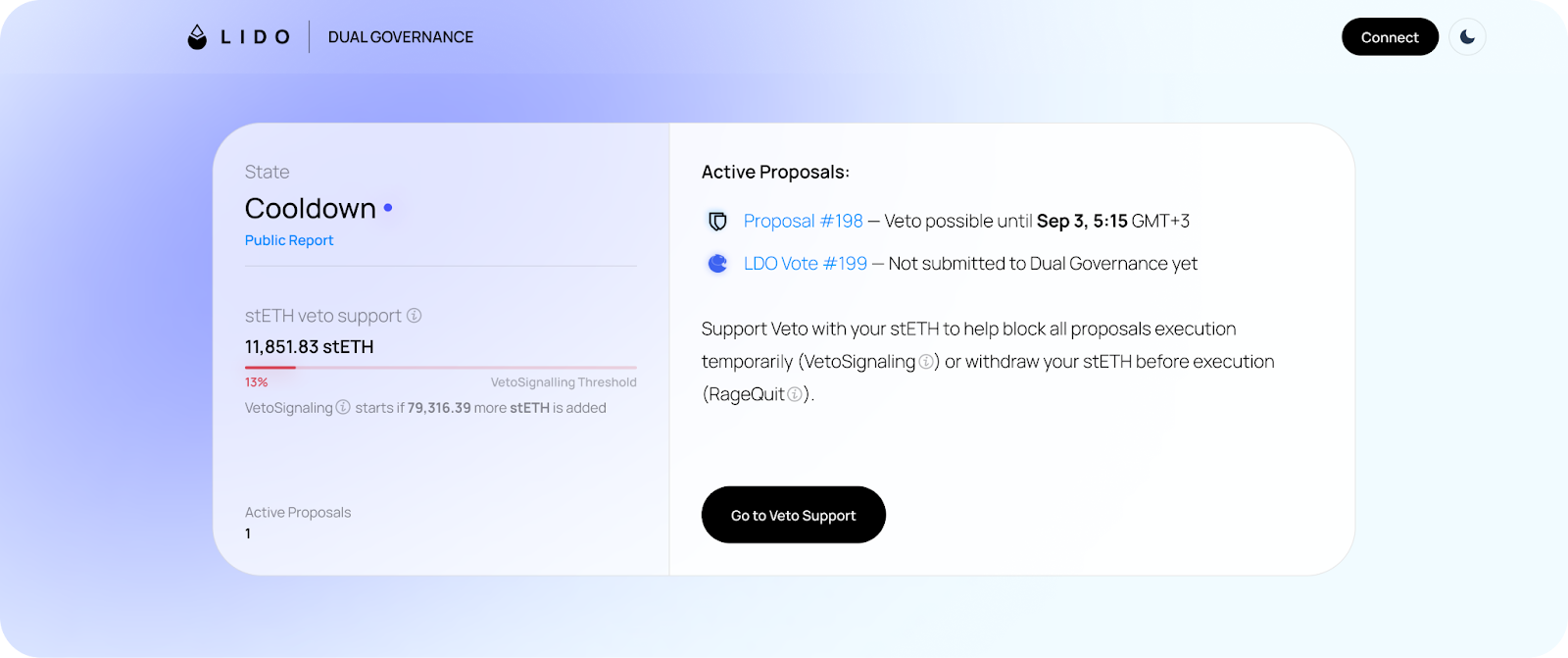
    The DAO may cancel the proposal, gather feedback, and revise it. stETH holders can then revoke their tokens. After the dynamic timelock expires, the system enters a Deactivation sub-state, followed by the Veto Cooldown state:
    • Transitional phase (5 hours) where uncancelled proposals may still be executed.
    • After cooldown, the system returns to Normal.
  • DAO proceeds with the proposal
    Once the Veto Signalling dynamic timelock has elapsed, if the DAO continues despite opposition, the system enters the Deactivation sub-state (up to 3 days).
    • This informs stakers that Veto Signalling is about to end, giving them time to either stay or exit.
    • stETH holders who remain should revoke their tokens from escrow.
    • Those exiting should revoke from escrow, then request withdrawals at stake.lido.fi/withdrawals/request.
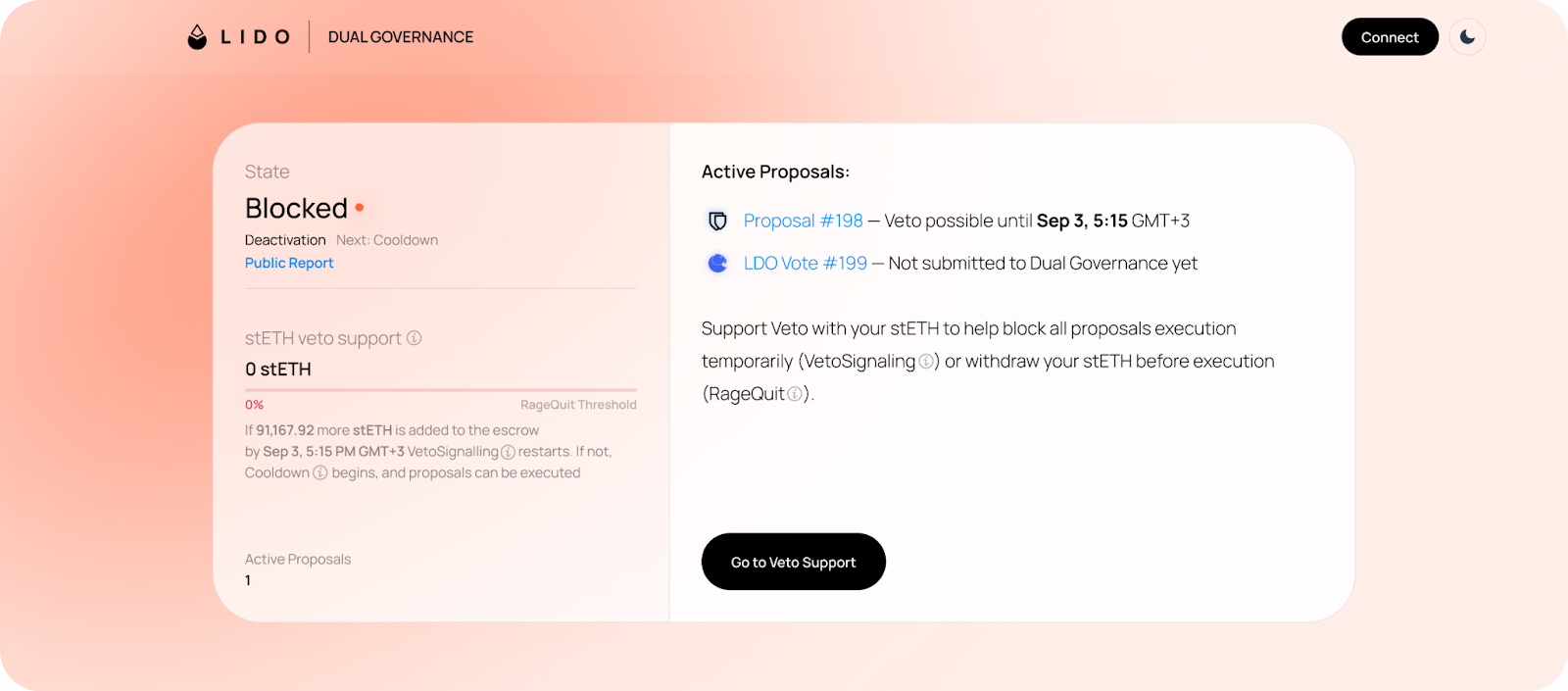
 

⚠️ Escalation risk: If more stETH holders join Veto Signalling during Deactivation, it can escalate into Rage Quit.


Scenario 2: Severe Protocol Threats

These are deliberate and hostile attempts to exploit governance or undermine the protocol.

Examples include:

  • Malicious governance attacks by concentrated LDO holders.
  • Hostile changes to withdrawal contracts, fees, or security parameters.

Step by Step Response

1. Withdraw tokens

In case of a governance attack or hostile proposal, the safest action is to exit as soon as possible.

  • Tokens in the Veto Signalling escrow will automatically exit if Rage Quit is triggered, but this may take time depending on Ethereum validator exit capacity.
  • To secure an earlier position, request withdrawals directly at stake.lido.fi/withdrawals/request. This ensures your exit is processed before the Rage Quit batch.
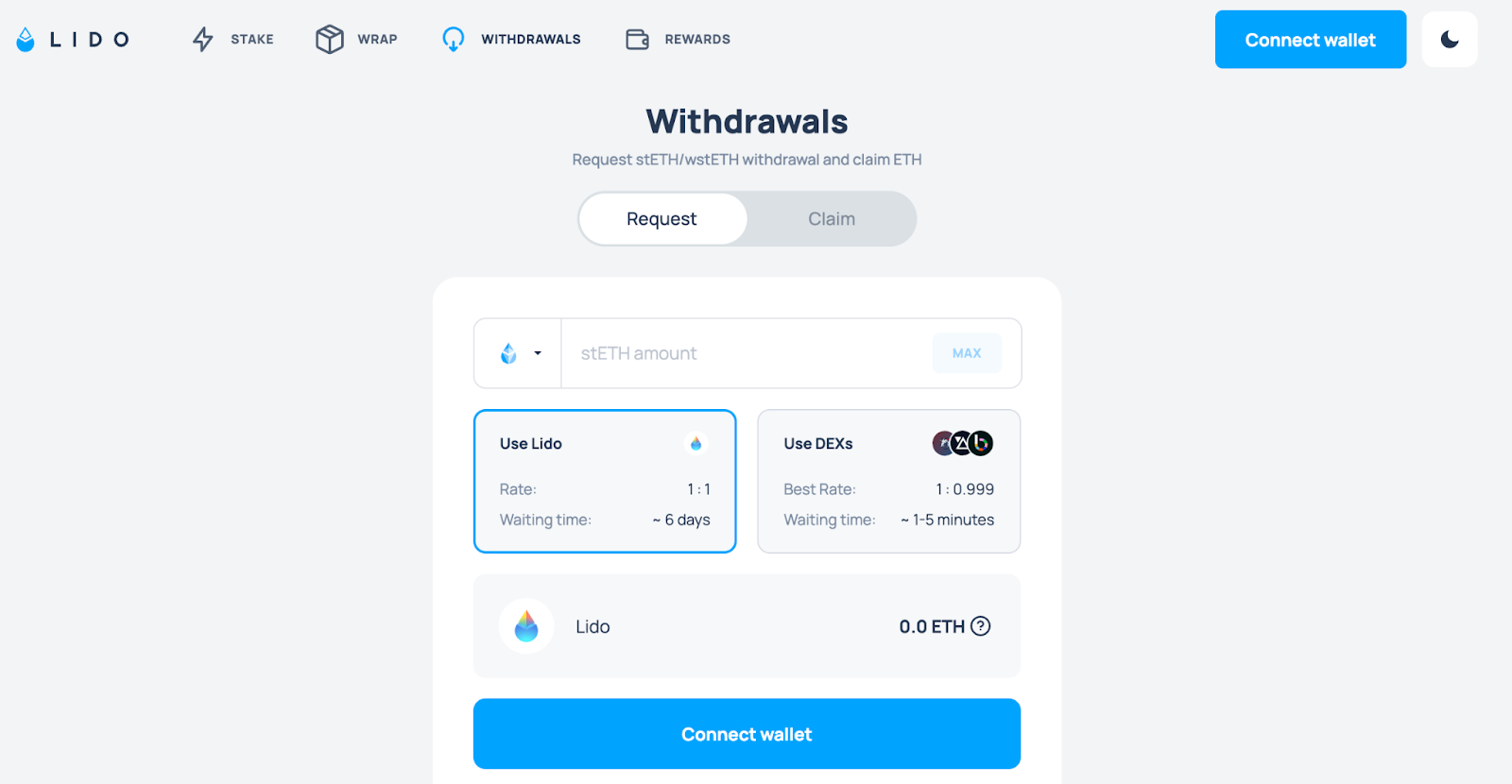
2. Place withdrawal NFTs into the Veto Signalling escrow

After initiating a withdrawal, you can still support a governance freeze by depositing your unstETH NFT into the Veto Signalling escrow.

  • These NFTs count toward thresholds and extend the dynamic timelock.
  • This gives stETH holders more time to exit while proposals remain blocked.

Note: If Rage Quit is triggered, withdrawal NFTs placed in escrow become subject to a 60–180 day timelock.

To support Veto while your withdrawal request is processing, return to the Dual Governance website, click the "Support Veto" button and place your withdrawal NFT there →
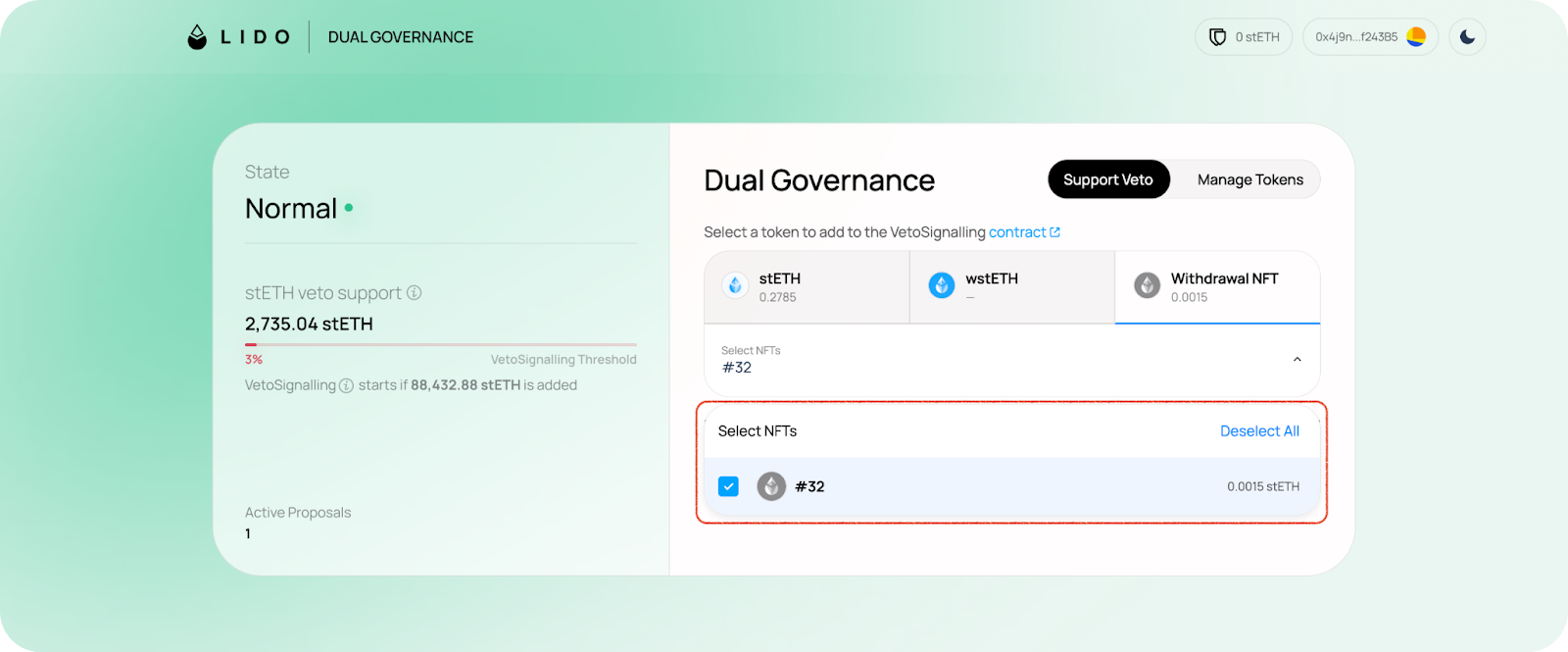
If Rage Quit is not triggered

  • Your tokens will finalize via the normal withdrawal queue.
  • To claim, first remove NFTs from the Veto Signalling escrow (5-hour minimum timelock applies).
  • Then use the Lido staking widget to claim ETH to your wallet.

You may revoke tokens or NFTs from the Veto Signalling escrow at any time before Rage Quit is triggered.

If the 10% threshold is reached

  • Rage Quit activates at the end of the Veto Signalling period (maximum 45 days).
  • All escrowed tokens are forced into exit.
  • Tokens cannot be revoked, restaked, or prevented from leaving.
  • A withdrawal timelock of 60–180 days applies, depending on escalation.
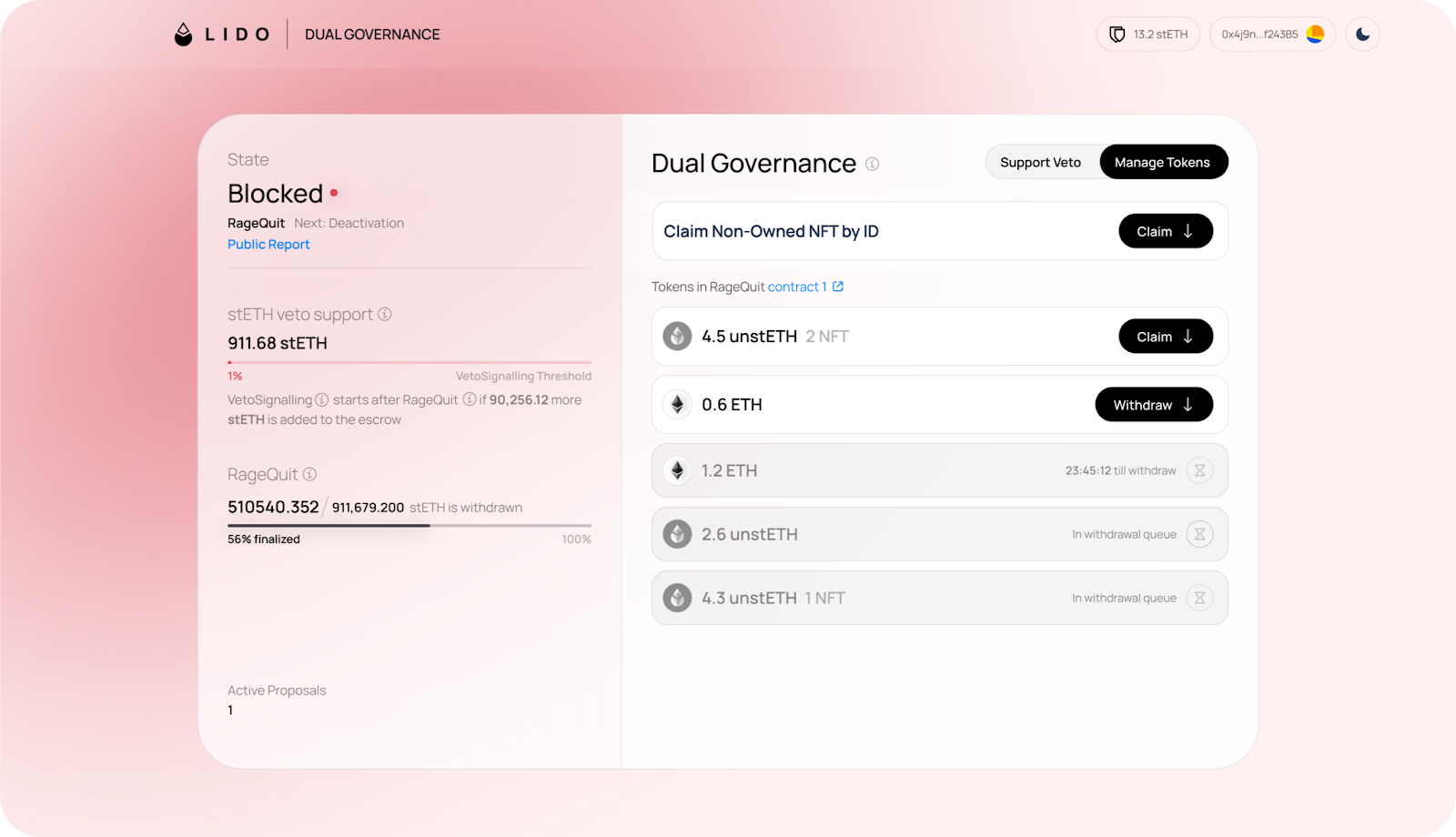
During Rage Quit:

  • stETH/wstETH is automatically exited and claimed.
  • Withdrawal NFTs must be claimed manually.
  • A new Veto Signalling escrow is deployed to allow continued opposition.

If successive escrows also reach 10%, additional Rage Quits occur, extending timelocks by 15 days each time (capped at 180 days). This prevents abuse of Rage Quit as a governance attack vector.

After all Rage Quit exits complete and the 7-day extension ends, the system transitions to Veto Cooldown, then back to Normal, unless ≥1% of stETH remains in the active escrow, in which case a new cycle begins.


Dual Governance - Frequently Asked Questions

What if the 1% threshold isn’t reached?

You can still exit normally. However, proposals will be enacted after the default timelock.

Can I revoke tokens after Rage Quit is triggered?

No. Once Rage Quit begins, all escrowed tokens are irreversibly queued for withdrawal.

Do standard withdrawals face the 60-180 day lock?

No. The timelock applies only to tokens in the Rage Quit escrow. Standard withdrawals can be claimed immediately once finalized.

What if I withdraw during Rage Quit but never joined vetoing?

Your withdrawal follows the normal process, unaffected by Rage Quit timelocks. Important to note however that the withdrawal order will be placed after the batch withdrawal NFTs of the Rage Quit, and processing time could therefore be longer than usual.

What if withdrawals are paused (GateSeal/Reseal)?

All exits, including Rage Quit and standard, are temporarily suspended until the DAO resolves the issue. More information on this here.

What if my stETH is on a centralized exchange?

You cannot participate in Dual Governance from a CEX. To take part:

  1. Transfer stETH to a self-custody wallet.
  2. Connect to dg.lido.fi.
  3. Deposit tokens into the Veto Signalling escrow.


Final Notes

Dual Governance adds an essential layer of protection for stETH holders, giving them time and tools to respond to contentious governance outcomes. Whether dealing with minor missteps or major protocol threats, stETH holders have clear, enforceable options to safeguard their assets.


Похожее

Has the 'Digital Gold' Narrative for BTC Failed?

**Title: Has the "Digital Gold" Narrative for Bitcoin Failed?** The article argues that Bitcoin's "digital gold" narrative remains valid despite a recent sharp price decline (from a peak near $126k in Oct 2025 to briefly under $61k in Feb 2026). It presents a long-term investment framework based on three core points: **1. Viewing Bitcoin as an Asset:** Bitcoin is presented as a superior potential store of value compared to gold. Key arguments are its absolute scarcity (21 million cap), superior portability, and transparent auditability via its public ledger. While acknowledging its current use in early, volatile stages (~3-4% global adoption), the author draws parallels to the early, disruptive phases of the internet and e-commerce. **2. Understanding the Recent Downturn:** The current ~50% correction is framed as a predictable, consensus-driven cycle following its post-halving peak (the 2024 halving preceded the Oct 2025 high). A crucial factor is a historic "changing of hands": the influx of new institutional buyers via ETFs allowed early, low-cost holders (miners, OG believers) to take profits. The author notes that while severe, Bitcoin's historical drawdowns (e.g., 93% in 2011, 77% in 2021-22) have been progressively smaller, suggesting maturing holder structure and decreasing volatility over time. **3. The Long-Term Perspective:** The long-term thesis hinges on Bitcoin capturing a portion of gold's market value. With Bitcoin's market cap at ~$1.4 trillion (at $70k) versus gold's ~$20 trillion, significant upside potential exists if the "digital gold" narrative is partially realized. However, the author strongly cautions that short-term risks remain, the bottom is unpredictable, and high volatility is inherent. The real risk is not Bitcoin failing but poor personal position management (over-leverage, wrong capital) and a lack of deep understanding, which can force investors out during severe downturns. The conclusion uses Amazon's 95% crash post-2000 dot-com bubble and subsequent 42x recovery as an analogy. The ultimate question is not if Bitcoin's price will rise, but if an investor's strategy and conviction can withstand the volatility to see the long-term play out. The recent divergence (gold up, Bitcoin down) is posed not as a narrative failure, but as potential evidence of this ongoing, painful transition from a speculative asset to a mainstream allocation.

marsbit1 ч. назад

Has the 'Digital Gold' Narrative for BTC Failed?

marsbit1 ч. назад

Has BTC's 'Digital Gold' Narrative Failed?

The article discusses Bitcoin's "digital gold" narrative, its recent price drop, and long-term outlook through the perspective of "Jason". It argues the narrative is not a failure but that Bitcoin represents a superior, new asset class due to its fixed supply (21 million), portability, and auditability. The piece compares its current ~3-4% global adoption rate to early internet/e-commerce, suggesting significant growth potential. Regarding the 2025-2026 price decline (from ~$126k to briefly under $61k), the author views it as a predictable, consensus-driven sell-off within Bitcoin's ~4-year cycle post-halving, exacerbated by a major "handover" from early, low-cost holders to new institutional buyers via ETFs. A key observation is that historical peak-to-trough drawdowns have lessened over time (e.g., 93% in 2011 to ~50% in 2026), indicating maturing volatility as holder structure changes. For the long term, the author uses a simple framework: Bitcoin's total market cap (~$1.4T at $70k) is only about 7% of gold's (~$20T). Even capturing 30-50% of gold's value would imply substantial upside. However, the article strongly cautions against viewing this as investment advice, emphasizing extreme volatility and the critical importance of risk management, position sizing, and deep fundamental understanding to survive severe drawdowns. It concludes by drawing a parallel to Amazon's 95% crash in 2000 and subsequent 42x recovery, stressing that the key is surviving market cycles to realize long-term potential.

链捕手1 ч. назад

Has BTC's 'Digital Gold' Narrative Failed?

链捕手1 ч. назад

From Code to Cognition: A Ten-Thousand-Word Guide to the Evolution of the Robot Brain

"From Code to Cognition: The Evolution of Robot Brains" The journey of robotic intelligence has shifted dramatically from manually coded systems to AI-driven brains. For decades, robots relied on layered software stacks—perception, state estimation, planning, control—each handcrafted. While predictable, they lacked adaptability. The 2010s saw deep learning revolutionize perception (e.g., object detection) and control (via reinforcement learning), but learned skills remained narrow. The arrival of Large Language Models (LLMs) marked a turning point. LLMs acted as high-level planners, interpreting natural language instructions and generating sequences of actions for traditional robotic systems to execute. However, true integration came with Visual-Language-Action (VLA) models, which fused vision, language, and motion prediction into a single network. Pioneered by models like RT-2 and open-source projects like OpenVLA, VLAs enable robots to reason and act directly from visual input and commands. The most advanced humanoid robots now employ a "dual-brain" architecture: a slow-thinking, large VLA (System 2) for reasoning and planning, and a fast-reacting, small network (System 1) for high-frequency motion control, sometimes with an even lower-level System 0 for balance. This split balances cognition with the physics of real-time movement. Computation is split between onboard hardware (e.g., NVIDIA Jetson) for safety-critical control loops and cloud/edge servers for non-critical tasks like learning and interfaces. A crucial driver is the open-source ecosystem—models like GR00T and OpenVLA allow startups to build upon pre-trained brains and fine-tune them with their own data, accelerating development. Despite progress, current systems struggle with recovery from errors, sample inefficiency, and long-horizon tasks. This has spurred the rise of **World Models**—neural networks that predict the consequences of actions. By simulating possible futures before acting (like NVIDIA Cosmos or Meta V-JEPA), robots can plan, recover, and generalize better. This represents the next frontier: shifting intelligence from learned reactions to an internal model of physics and cause-and-effect. The field is rapidly evolving. While not yet at its "ChatGPT moment," the convergence of cheaper hardware, scalable simulation, and world models points toward robots that are increasingly capable, adaptive, and useful. The question is shifting from "what can robots do?" to "what *should* they do?"

marsbit1 ч. назад

From Code to Cognition: A Ten-Thousand-Word Guide to the Evolution of the Robot Brain

marsbit1 ч. назад

AI Bubble Is Bursting

The AI Bubble is Bursting: A Necessary Purge on the Path to Ubiquitous Intelligence Market volatility has reignited debates about an AI bubble, with figures like Ray Dalio pointing to high valuations. However, this parallels the dot-com bubble, which, despite its crash, laid the physical infrastructure for today's internet era. The current AI investment frenzy, with tech giants planning trillions in infrastructure spending far outstripping current AI application revenues, appears similarly imbalanced. This 'bubble' is seen as an inevitable phase for a disruptive technology, paying the "innovation tax." Critically, AI inference costs have plummeted over 99.7% since 2023, making intelligence nearly free at the margin. This hasn't reduced spending but has instead unlocked massive new demand, as seen in enterprise AI cloud expenditure tripling. This follows the Jevons Paradox: efficiency gains lead to greater total consumption. The market is now entering a cleansing phase, weeding out speculative ventures lacking real moats. The deeper shift is a move from capital expenditure (CapEx) on hardware to value creation in operational expenditure (OpEx) through AI applications that solve real industry problems. While infrastructure valuations are high, rapid earnings growth from widespread AI adoption across sectors—from manufacturing and finance to law and healthcare—may digest these valuations over time. Ultimately, this creative destruction will leave behind robust infrastructure and optimized models, cheaply powering an AI-augmented future for all industries, much as the internet became indispensable after its own bubble burst. The core productive potential remains undiminished.

链捕手1 ч. назад

AI Bubble Is Bursting

链捕手1 ч. назад

Торговля

Спот
Фьючерсы

Популярные статьи

Как купить STETH

Добро пожаловать на HTX.com! Мы сделали приобретение Lido Staked ETH (STETH) простым и удобным. Следуйте нашему пошаговому руководству и отправляйтесь в свое крипто-путешествие.Шаг 1: Создайте аккаунт на HTXИспользуйте свой адрес электронной почты или номер телефона, чтобы зарегистрироваться и бесплатно создать аккаунт на HTX. Пройдите удобную регистрацию и откройте для себя весь функционал.Создать аккаунтШаг 2: Перейдите в Купить криптовалюту и выберите свой способ оплатыКредитная/Дебетовая Карта: Используйте свою карту Visa или Mastercard для мгновенной покупки Lido Staked ETH (STETH).Баланс: Используйте средства с баланса вашего аккаунта HTX для простой торговли.Третьи Лица: Мы добавили популярные способы оплаты, такие как Google Pay и Apple Pay, для повышения удобства.P2P: Торгуйте напрямую с другими пользователями на HTX.Внебиржевая Торговля (OTC): Мы предлагаем индивидуальные услуги и конкурентоспособные обменные курсы для трейдеров.Шаг 3: Хранение Lido Staked ETH (STETH)После приобретения вами Lido Staked ETH (STETH) храните их в своем аккаунте на HTX. В качестве альтернативы вы можете отправить их куда-либо с помощью перевода в блокчейне или использовать для торговли с другими криптовалютами.Шаг 4: Торговля Lido Staked ETH (STETH)С легкостью торгуйте Lido Staked ETH (STETH) на спотовом рынке HTX. Просто зайдите в свой аккаунт, выберите торговую пару, совершайте сделки и следите за ними в режиме реального времени. Мы предлагаем удобный интерфейс как для начинающих, так и для опытных трейдеров.

107 просмотров всегоОпубликовано 2024.04.12Обновлено 2026.06.02

Как купить STETH

Обсуждения

Добро пожаловать в Сообщество HTX. Здесь вы сможете быть в курсе последних новостей о развитии платформы и получить доступ к профессиональной аналитической информации о рынке. Мнения пользователей о цене на STETH (STETH) представлены ниже.

活动图片












