Nasdaq CEO Shows 3 Ways Blockchain Could Change Finance Forever: Best Wallet Token Amps Up

bitcoinistОпубликовано 2025-11-05Обновлено 2025-11-05

Введение

Quick Facts: ➡️ Nasdaq’s CEO says blockchain can fix settlement and market plumbing. Wallets become the access layer for that...

Trusted Editorial content, reviewed by leading industry experts and seasoned editors. Ad Disclosure

Quick Facts:

  • ➡️ Nasdaq’s CEO says blockchain can fix settlement and market plumbing. Wallets become the access layer for that shift and need strong security and UX.
  • ➡️ Best Wallet uses Fireblocks MPC-CMP, supports multiple chains, and bundles a DEX aggregator, staking, and presale access to turn a wallet into a full crypto hub.
  • ➡️ $BEST presale shows momentum with a live price of $0.025895 and more than $16.8M raised. Tokens are payable via crypto or card with token claims post presale.
  • ➡️ Staking runs during the presale with dynamic rewards from an 8% pool, aiming to reward longer-term holders rather than short-term speculation.

Nasdaq chief Adena Friedman recently outlined three ways blockchain could upgrade global finance. Her message focused on how distributed ledgers can improve post-trade settlement, support tokenized assets, and streamline market infrastructure.

During her conversation with Ripple’s Monica Long, Friedman’s takeaway was simple. Capital markets are moving toward on-chain rails that need secure user access and intuitive wallets to reach scale.

Mobile crypto wallets sit at the top of that stack. They are the gateway to tokenized securities, DeFi liquidity, and on-chain payments. If exchanges and brokers bring issuance and settlement on chain, consumers will need mobile wallets that are both secure and easy to use.

That is why wallet UX and security architecture are fast becoming competitive moats.

Best Wallet Token ($BEST) is positioned for this shift with a mobile-first, non-custodial wallet that integrates Fireblocks MPC-CMP security, a decentralized exchange (DEX) aggregator, and a presale portal for trusted launches. The native $BEST token underpins reduced fees, staking, and governance.

As regulated markets lean into tokenization, the best crypto wallets will be those that combine enterprise-grade security with simple cross-chain action.

And Best Wallet is designed to capture the growing market with tangible holder perks, live staking during presale, and a product roadmap that expands utility beyond storage into swaps, cards, and curated presale access.

Best Wallet Token ($BEST) — Mobile First MPC Wallet With Perks

Best Wallet is a non-custodial, multi-chain wallet built around Fireblocks MPC-CMP technology. MPC removes single points of failure by splitting keys across secure computation, while the app layers biometric login and a mobile-native UX.

The wallet supports cross-chain swaps through an integrated DEX aggregator, which provides access to all major blockchains. Read our Best Wallet review for more on this game-changing crypto app.
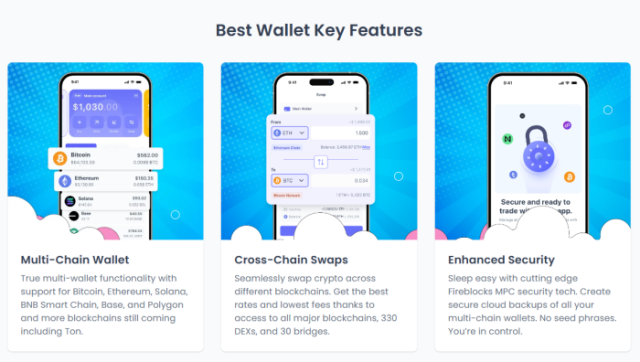
Best Wallet’s key features.

The wallet’s native token, $BEST, is now on presale with a visible raise and price tracker. At the current stage shown on the sale page, $BEST is priced at $0.025895 with more than $16.8M collected. Buyers can use $ETH, $BNB, $USDT, $USDC, or a card, and claiming will be available at the end of the presale window.

🛒 Learn how to buy $BEST here.

Utility is the core pitch rather than hype. Holding $BEST reduces fees inside the Best Wallet ecosystem, grants early access to curated presales via the ‘Upcoming Tokens’ portal, and provides governance decision rights, including what new chains and features to add to the ecosystem.

A staking pool is already available during the sale. Rewards are dynamic and funded from an 8% allocation of the total supply, which aligns incentives with long-term usage rather than short airdrops.

Token design details are straightforward. The total supply is 10B $BEST and the whitepaper outlines allocations for development, marketing, airdrops, staking rewards, exchange liquidity, community rewards, and treasury.

The contract is an ERC-20 on Ethereum and has been audited by Coinsult.

The product suite goes beyond a wallet. Over 330 DEXs and 30 bridges are embedded for same-chain and cross-chain swaps. A Best Card is also in development to enable spending $BTC, $ETH, and other major cryptos, with cashback for $BEST token holders.

The roadmap also includes a browser extension, portfolio tools, an NFT gallery, market analytics, and trading features like limit orders and DCA. The approach is to turn the wallet into a daily driver while keeping custody with the user.

For presale participants, two factors stand out. First is the ‘earn while you wait’ design. That’s because staking during presale lets early users compound exposure rather than sitting idle.

Second is the demand signal. Our $BEST price prediction suggests that the token could reach $0.62 by 2026, marking a 2,290% gain, if demand for secure wallets keeps pace with crypto adoption rates.

A multi-million-dollar raise at this early stage demonstrates traction for a wallet narrative that benefits from traditional finance’s shift toward crypto. That is the same structural change Nasdaq’s leadership is signaling.

Secure $BEST now. The presale ends November 28.

This is informational content only, not financial advice. Do your own research and consider risks. Crypto assets can lose value quickly.

Authored by Bogdan Patru, Bitcoinist: https://bitcoinist.com/best-wallet-token-presale-mpc-security-staking-benefits-best

Editorial Process for bitcoinist is centered on delivering thoroughly researched, accurate, and unbiased content. We uphold strict sourcing standards, and each page undergoes diligent review by our team of top technology experts and seasoned editors. This process ensures the integrity, relevance, and value of our content for our readers.

As a crypto writer, Bogdan’s responsibilities are split between researching and writing articles and entertaining the team with his humor bordering on the politically incorrect, an aspiring Bill Burr, if you will. Thanks to his 12+ years of writing experience in just as many fields, including tech, cybersecurity, modelling, fitness, crypto, and other topics-that-shall-not-be-named, he's become a genuine asset to the team. While his position as a senior writer at PrivacyAffairs thought him valuable lessons about the power of self-management, his entire writing career was and is an exercise in self-improvement. Now, he's ready to sink his teeth into crypto and teach people how to take control of their own money on the blockchain. With fiat as an eternally devaluing currency, Bitcoin and altcoins seem like the best-fitting alternative for Bogdan. Bogdan’s biggest professional accomplishment, aside from securing a position as a main writer for Bitcoinist, was his 5-year run as a writing manager at Blackwood Productions, where he coordinated a team of four writers. During that time, he learned the value of teamwork and that of creating a working environment that breeds efficiency, positivity, and friendship.

Похожее

The Paradox of Automation: The Stronger the AI, the Busier Humans Become

The Paradox of Automation: The more powerful AI becomes, the more work humans have to do. This article, based on observations from AI-heavy company Every, argues that while AI agents automate tasks like coding, writing, and customer service, they don't eliminate human jobs. Instead, they transform work and create *more* demand for human expertise. AI commoditizes "yesterday's human capabilities" by cheaply generating code, text, and images from past data. This leads to an abundance of similar, generic outputs. Consequently, what becomes scarce and valuable is human judgment in the present moment: knowing *what* is worth doing, *why*, and *how* to do it well. The article identifies two collaboration models: "Agent employees" for delegated tasks and "human-AI collaboration" within tools like Claude Code for complex work. In both cases, humans are essential to set direction, judge quality, and maintain systems. As AI makes execution cheap, human roles shift from executors to designers, reviewers, and meaning-makers. The author addresses "benchmark anxiety" by explaining that AI excels within specific, human-defined problem "frames." As AI masters one frame (e.g., code rewriting), new, more complex frames emerge (e.g., deciding *when* to rewrite). This creates an ongoing cycle where AI chases the frames, but humans remain the "framers." Even with advanced AGI, this dynamic may persist as long as AI lacks true human-like agency and self-directed purpose. The core paradox holds: automation amplifies the need for the very human judgment it seems to replace.

marsbit17 мин. назад

The Paradox of Automation: The Stronger the AI, the Busier Humans Become

marsbit17 мин. назад

a16z: 7 Charts to Understand How Tokenization is Changing the Nature of Assets

"a16z: 7 Charts on How Tokenization is Changing the Nature of Assets" Tokenized Assets (or Real-World Assets - RWA) are transforming asset forms, liquidity, and financial system construction. The market recently surpassed $30 billion, stabilizing around $34 billion (excluding stablecoins), representing a tenfold increase in less than two years, driven by clearer regulations, mature institutional infrastructure, and increased financial institution adoption. The primary driver of recent growth is tokenized U.S. Treasury bonds. These offer investors efficient, flexible digital access to yield-bearing assets and improve institutional operations like settlement and collateral management. Other asset classes show varied growth: asset-backed credit leads, followed by niche financial assets (e.g., reinsurance, mining notes), while venture capital took longer to scale. Market segmentation shows high concentration. In commodities, tokenized gold dominates (~$5 billion), as its standardized, storable nature fits tokenization well. Bonds are the largest category ($15.2B), but only ~5% are used in DeFi protocols. Conversely, smaller niches like reinsurance tokens see high (~84%) on-chain utilization, highlighting a core industry divide: most current tokenized assets are merely digitized records for easier holding/transfer, lacking the "composability" (free combination/interaction) that is key to blockchain-native finance. The ecosystem is distributed across multiple blockchains, with Ethereum hosting over half the value ($15.7B), followed by BNB Chain, Solana, and others. Future market size predictions vary widely (e.g., $2-$30 trillion by 2030+), but all indicate massive potential from the current small base. Tokenized assets currently represent minuscule fractions of their global counterparts (e.g., 0.01% of global bonds). The current phase focuses on digitizing straightforward assets. The next challenge is to bring more complex financial components on-chain and deeply integrate tokenized assets into composable, internet-native financial infrastructure.

链捕手58 мин. назад

a16z: 7 Charts to Understand How Tokenization is Changing the Nature of Assets

链捕手58 мин. назад

a16z: How Tokenization is Transforming the Nature of Assets in 7 Charts

"Tokenized Assets: How Tokenization Changes the Nature of Assets" by a16z Crypto The market for tokenized assets, excluding stablecoins, has grown from under $3 billion two years ago to over $340 billion today. US Treasury bonds are the primary growth driver, allowing investors to hold yield-bearing assets digitally and enabling more efficient settlement. Other key sectors include private credit (growing fastest), commodities (dominated by gold), and niche financial assets. However, the market remains concentrated in tokenized US Treasuries and gold. A critical insight is that most tokenized assets currently lack "composability." While the total market is large, only a small fraction is actively used within DeFi protocols. For instance, only about 5% of tokenized bonds and a low percentage of tokenized gold are utilized on-chain. In contrast, assets like reinsurance and private credit tokens show much higher on-chain usage rates (84% and 33%, respectively). This highlights a divide: many tokenized assets are merely digital records on a blockchain without enabling new, programmable financial applications. The Pantera Capital Token Native Index indicates over 70% of tokenized assets have minimal on-chain native functionality. Ethereum remains the dominant blockchain for tokenized assets (over $150B), but the ecosystem is diversifying across chains like BNB Chain, Solana, and Stellar, based on factors like cost and compliance. Major institutions forecast massive future growth, with predictions for the tokenized asset market ranging from $2 trillion to over $30 trillion by the early 2030s. However, compared to the global financial system (e.g., ~$140T bonds, multi-trillion dollar gold market), tokenized assets currently represent a tiny fraction (0.01% or less). The conclusion is that while tokenization has begun by digitizing and streamlining settlement for simpler assets, the next phase involves bringing more complex financial instruments on-chain and deeply integrating them into composable, internet-native financial infrastructure.

Odaily星球日报1 ч. назад

a16z: How Tokenization is Transforming the Nature of Assets in 7 Charts

Odaily星球日报1 ч. назад

The Revived Codex, Carrying OpenAI's Hopes for IPO

This article analyzes the intense recent development of OpenAI's Codex, positioning it as a crucial component for OpenAI's impending IPO. Over the past two months, Codex has seen a rapid series of major updates focused on integrating into real enterprise workflows. Key new features include enhanced context capture (Appshots, file previews, built-in browser), long-running task execution ("Goal Mode"), remote operation (phone control, lock-screen access), and enterprise management tools (plugin sharing, access tokens, automated risk review). These updates aim to make Codex a comprehensive AI workbench that can "see the scene, push tasks, and manage risks." The author argues that while ChatGPT proves OpenAI's massive user base and API provides foundational revenue, Codex represents OpenAI's clearest path to demonstrating tangible, high-value commercial viability. It targets developers and engineering teams—a segment already accustomed to paying for efficiency gains in costly software development cycles. This is critical because, despite higher overall revenue, OpenAI's adjusted operating margins remain deeply negative, highlighting the challenge of outrunning immense compute costs. The pressure is amplified by competitor Anthropic's success with Claude Code, which has shown that a focused approach on high-value enterprise and developer workflows can lead to a path toward profitability. Codex's aggressive evolution is thus seen as OpenAI's strategic move to capture a similar enterprise-ready, revenue-generating narrative essential for its market debut. In essence, "ChatGPT proved OpenAI has users. Codex needs to prove OpenAI is a business that can make money."

marsbit2 ч. назад

The Revived Codex, Carrying OpenAI's Hopes for IPO

marsbit2 ч. назад

a16z: 7 Charts to Understand How Tokenization Is Changing the Nature of Assets

a16z: 7 Charts on How Tokenization is Transforming the Nature of Assets Tokenized Assets, often referred to as "real-world assets" (RWA), are altering the form, flow, and structure of the financial system. The market recently surpassed $30 billion (excluding stablecoins), driven largely by tokenized U.S. Treasuries. These offer investors digital, yield-bearing assets with efficient settlement. Growth varies significantly by asset class. Asset-backed credit leads in speed, followed by niche financial assets, while venture capital and active strategies took longer to scale. U.S. Treasuries and commodities dominate, holding about two-thirds of the current market share. Within commodities, gold tokenization dominates entirely due to its standardization and historical appeal in crypto. The ecosystem is spread across multiple blockchains. Ethereum holds over half the market, with others like BNB Chain, Solana, and Stellar holding significant shares. However, a key insight is that most tokenized assets currently lack "composability." While the total market is large, only a small fraction (e.g., 5% of tokenized bonds) is used within DeFi protocols. Many tokens are simply digital records of off-chain assets, not natively programmable financial building blocks. In contrast, smaller categories like reinsurance tokens see very high on-chain usage. Looking ahead, forecasts for the tokenized asset market by 2030 range from $2 trillion to over $30 trillion, representing immense potential growth from today's ~$340 billion base. Yet, relative to global markets (e.g., $140T+ in bonds), tokenization's penetration remains minuscule (<0.02%). The current phase focuses on digitizing straightforward assets for efficiency. The next major challenge is bringing more complex financial instruments on-chain and integrating tokenized assets into truly composable, internet-native financial infrastructure.

marsbit2 ч. назад

a16z: 7 Charts to Understand How Tokenization Is Changing the Nature of Assets

marsbit2 ч. назад

Торговля

Спот
Фьючерсы
活动图片