Something ‘Very Big’ Is Coming To Cardano, Says Charles Hoskinson

bitcoinistОпубликовано 2025-10-28Обновлено 2025-10-28

Введение

Cardano founder Charles Hoskinson says the network is on the cusp of a significant shift, reacting to news that an...

Trusted Editorial content, reviewed by leading industry experts and seasoned editors. Ad Disclosure

Cardano founder Charles Hoskinson says the network is on the cusp of a significant shift, reacting to news that an HTTP-402–based payments standard—known as “x402”—is being brought to Cardano and integrated with Masumi, an agent-to-agent protocol built atop the chain. “This is very big for Cardano,” Hoskinson wrote on X on October 27, in response to the demo announcement.

The catalyst is a proof-of-concept published by Masumi cofounder Patrick Tobler showing a live x402 “pay-to-access” flow that ends in an on-chain action: a memecoin mint on Cardano. Tobler framed it as a milestone en route to standardizing how autonomous agents and web services exchange value via APIs without log-ins or OAuth.

“x402 is coming to Cardano (and Masumi)! … The first x402 Proof-Of-Concept Memecoin Mint,” he posted, adding that users can try the demo with 2 USDM for payment and a small amount of ADA for fees—and stressing that the token itself is strictly a technical showcase with “0 future plans.”

What This Means For Cardano

In a series of follow-ups, Tobler described x402 as a revival of the web’s long-dormant HTTP 402 “Payment Required” status code, generalized for modern machine-to-machine commerce. “Built around the HTTP 402 status code, x402 enables users to pay for resources via API without registration, emails, OAuth, or complex signatures,” he wrote, noting that Coinbase developed the protocol and that it is integrated into Google’s Agent Payments Protocol (AP2).

The Masumi implementation pairs that transport-level payment primitive with smart-contract guarantees for identity, refunds, and decision logging—“turning Cardano into the financial backbone of the agent economy,” as he put it.

The demo itself makes the flow concrete. When a user hits the endpoint, the server responds with “402: Payment Required.” The front end prompts a connected Cardano wallet to construct the payment. The payment proof is then transmitted in the 402 header; the server relays it on-chain, waits for finality, and only then returns the protected resource—in this case, minting the demo memecoins. “Please note: This is NOT a real memecoin. It is ONLY a proof-of-concept intended to showcase the technology!” Tobler emphasized.

Context matters for why Hoskinson’s enthusiasm resonated. x402 has been positioned by Coinbase as an “internet-native payment protocol” for AI agents and APIs, with instant, stablecoin-settled micropayments and merchant tooling. Separately, Google introduced AP2 as an open agent-payments layer designed to support multiple rails—including stablecoins—and to standardize authorization and auditability for agentic commerce. An x402 integration at the chain and smart-contract level gives Cardano a clear line into that emerging stack.

The choice of USDM for the demo highlights another Cardano-specific ingredient: a fiat-backed USD stablecoin native to the network, launched by Moneta (formerly Mehen). USDM’s role in the x402 flow is straightforward—precise, low-friction settlement per request—while ADA remains necessary for network fees. For agent-to-agent use cases, the combination is pragmatic: deterministic fees plus dollar-denominated pricing.

Tobler said the team is now drafting the x402 standard for both Cardano and Masumi, and explicitly not limiting the spec to simple address-to-address transfers. “By not only doing Address-To-Address like most other blockchains do but actually writing the standard to work with the Masumi Smart Contract, we’re making our x402 implementation the most powerful one out there,” he wrote.

At press time, ADA traded at $0.6659.
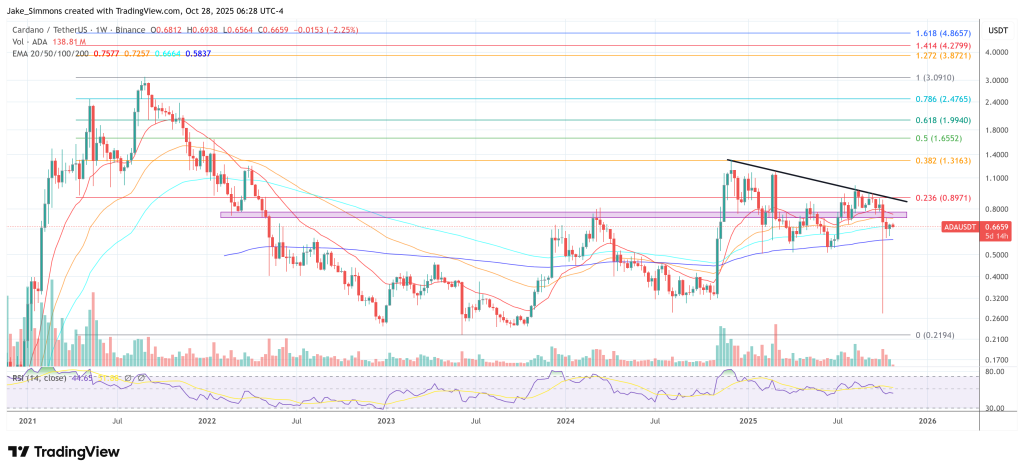
Cardano price
ADA remains below key resistance, 1-week chart | Source: ADAUSDT on TradingView.com
Featured image created with DALL.E, chart from TradingView.com
Editorial Process for bitcoinist is centered on delivering thoroughly researched, accurate, and unbiased content. We uphold strict sourcing standards, and each page undergoes diligent review by our team of top technology experts and seasoned editors. This process ensures the integrity, relevance, and value of our content for our readers.

Jake Simmons has been a Bitcoin enthusiast since 2016. Ever since he heard about Bitcoin, he has been studying the topic every day and trying to share his knowledge with others. His goal is to contribute to Bitcoin's financial revolution, which will replace the fiat money system. Besides BTC and crypto, Jake studied Business Informatics at a university. After graduation in 2017, he has been working in the blockchain and crypto sector. You can follow Jake on Twitter at @realJakeSimmons.

Похожее

Who Will Take the Flag? How Ethereum Will Navigate the Post-Foundation Era After Losing Its 'Big Brother'

**Summary:** Ethereum Foundation (EF) is transitioning to a less central role, prompting debates about its future influence and Ethereum's path forward. Vitalik Buterin has clarified that EF, holding only 0.16% of ETH supply, will focus on core protocol research and public goods, not on supporting ETH's price. He outlined a strategy of organizational streamlining and emphasized technology development around the "CROPS" principles (Censorship-Resistance, Robustness, Openness, Privacy, Security), rather than engaging in direct performance wars with chains like Solana. The article contrasts EF's "long-termist," non-profit model with the more aggressive, fund-driven approaches of newer foundations (e.g., Solana, Aptos) or corporate-backed models like Coinbase's Base. It notes challenges for Ethereum, including talent drain to better-funded competitors and community frustration over ETH's market performance. Despite EF stepping back, Ethereum's mainstream adoption is advancing, highlighted by the potential inclusion of Ethereum DAT companies in major Russell indexes. The piece suggests Ethereum's next phase will rely more on ecosystem self-drive and large external stakeholders (like BitMine, a major ETH holder) for growth, moving into a "post-foundation era." Ultimately, the core question remains how Ethereum can reignite positive momentum through its unique value proposition while navigating this new, less centrally guided landscape.

marsbit14 мин. назад

Who Will Take the Flag? How Ethereum Will Navigate the Post-Foundation Era After Losing Its 'Big Brother'

marsbit14 мин. назад

Research on Commercialization Infrastructure for Crypto Agents: In-depth Analysis of Stablecoin as the Core "Native Currency Layer" and Settlement Network

This article explores the commercialization of AI Agents and the critical "payment gap" they face within traditional financial systems. It argues that stablecoins (like USDC, USDT) provide a superior, native "monetary layer" for AI, enabling programmable, permissionless, 24/7, and transparent value transfer essential for autonomous agents. The piece details infrastructure initiatives from key players: Coinbase's AgentKit and Agentic Wallets for on-chain payments; Circle's CCTP for cross-chain USDC transfers and AgentStack for micro-payments; and Stripe's stablecoin APIs bridging traditional commerce. Collaborations like AWS-Stripe-Coinbase and Google-Coinbase are also highlighted. Key application scenarios are analyzed: 1) DeFi yield optimization, where agents autonomously manage capital across protocols; 2) Ultra-micro-payments (e.g., per API call) enabled by low-fee stablecoin protocols like x402 and Gateway; 3) Automated yield generation through yield-bearing stablecoins, transforming agents into self-sustaining economic units. Major challenges to scaling are identified: private key security and risks like prompt injection; regulatory grey areas regarding agent identity (KYA) and liability; and technical risks including smart contract vulnerabilities and ensuring AI intent alignment during financial operations. In conclusion, the fusion of AI Agents and stablecoins is fundamentally reshaping digital commerce settlement. While security and regulation are immediate hurdles, the infrastructure being built paves the way for a self-operating, agent-driven on-chain economy, shifting humans from transaction approvers to system designers.

marsbit34 мин. назад

Research on Commercialization Infrastructure for Crypto Agents: In-depth Analysis of Stablecoin as the Core "Native Currency Layer" and Settlement Network

marsbit34 мин. назад

Season One of The Beacon Chain Game Goes Live, A Comprehensive Guide to the 7.7 Million BCN Prize Pool and Chest Mechanics

"The Beacon" Season 1 is now live with a 7.7 million BCN prize pool. This guide provides a tutorial and gameplay strategies. To start, players must sign in via a Web3 wallet at the official app, download the game via the Epic Store for optimal experience, and control their character using WASD keys. An optional $19.99 "Starter Pack" provides 2000 Glint and premium chests. Gameplay currently offers two main paths. First, the "Dungeon" (up from spawn) costs 20 Stamina per run to earn Shadow Shards, which exchange for Umbra Chests. Second, "Kraken Klash" (right from spawn) is a betting mini-game using Goblin Tokens to guess correct tiles for rewards. Rewards consist of Cosmetics and BCN tokens. Free players receive account-bound cosmetics, while Starter Pack purchasers ("Premium" players) receive tradable NFT cosmetics. The season features three chest types: 1. **Umbra Chests** (from Shadow Shards): Contain cosmetics and small BCN amounts (Premium only). 2. **Kraken Chests** (from Goblin Tokens): Contain exclusive cosmetics and larger BCN amounts (Premium only). 3. **Glint Chests** (from Glint, premium currency): Contain exclusive cosmetics and the largest BCN amounts (Premium only). Each chest type (Umbra, Kraken, Glint) has detailed rarity probabilities (Common, Rare, Epic, Legendary) and BCN reward distributions listed for free and premium versions. The four in-game currencies are: Shadow Shards, Goblin Tokens, Glint, and BCN. A stable earning method is farming dungeons for Shadow Shards to exchange for Umbra Chests. Kraken Klash is a higher-risk, higher-reward option using Goblin Tokens.

Odaily星球日报35 мин. назад

Season One of The Beacon Chain Game Goes Live, A Comprehensive Guide to the 7.7 Million BCN Prize Pool and Chest Mechanics

Odaily星球日报35 мин. назад

Торговля

Спот
Фьючерсы

Популярные статьи

Как купить ADA

Добро пожаловать на HTX.com! Мы сделали приобретение Cardano (ADA) простым и удобным. Следуйте нашему пошаговому руководству и отправляйтесь в свое крипто-путешествие.Шаг 1: Создайте аккаунт на HTXИспользуйте свой адрес электронной почты или номер телефона, чтобы зарегистрироваться и бесплатно создать аккаунт на HTX. Пройдите удобную регистрацию и откройте для себя весь функционал.Создать аккаунтШаг 2: Перейдите в Купить криптовалюту и выберите свой способ оплатыКредитная/Дебетовая Карта: Используйте свою карту Visa или Mastercard для мгновенной покупки Cardano (ADA).Баланс: Используйте средства с баланса вашего аккаунта HTX для простой торговли.Третьи Лица: Мы добавили популярные способы оплаты, такие как Google Pay и Apple Pay, для повышения удобства.P2P: Торгуйте напрямую с другими пользователями на HTX.Внебиржевая Торговля (OTC): Мы предлагаем индивидуальные услуги и конкурентоспособные обменные курсы для трейдеров.Шаг 3: Хранение Cardano (ADA)После приобретения вами Cardano (ADA) храните их в своем аккаунте на HTX. В качестве альтернативы вы можете отправить их куда-либо с помощью перевода в блокчейне или использовать для торговли с другими криптовалютами.Шаг 4: Торговля Cardano (ADA)С легкостью торгуйте Cardano (ADA) на спотовом рынке HTX. Просто зайдите в свой аккаунт, выберите торговую пару, совершайте сделки и следите за ними в режиме реального времени. Мы предлагаем удобный интерфейс как для начинающих, так и для опытных трейдеров.

2.2k просмотров всегоОпубликовано 2024.03.29Обновлено 2025.07.02

Как купить ADA

SNEK: ведущий мемкоин на блокчейне Cardano, открывающий новую эпоху для экосистемы Cardano

SNEK - это дефляционный мемкоин, выпущенный на блокчейне Cardano. Он создаёт децентрализованную культурную и развлекательную ценность за счёт участия глобального сообщества.

2.1k просмотров всегоОпубликовано 2025.10.15Обновлено 2025.10.15

SNEK: ведущий мемкоин на блокчейне Cardano, открывающий новую эпоху для экосистемы Cardano

Неделя обучения по популярным токенам 8: запуск основной сети Ouroboros Leios для ADA ожидается в 2026 году

Основная сеть Ouroboros Leios для ADA, как ожидается, будет запущена в 2026 году, а хардфорк до версии протокола 11 запланирован на I квартал 2026 года.

2.0k просмотров всегоОпубликовано 2026.02.10Обновлено 2026.02.12

Неделя обучения по популярным токенам 8: запуск основной сети Ouroboros Leios для ADA ожидается в 2026 году

Обсуждения

Добро пожаловать в Сообщество HTX. Здесь вы сможете быть в курсе последних новостей о развитии платформы и получить доступ к профессиональной аналитической информации о рынке. Мнения пользователей о цене на ADA (ADA) представлены ниже.

活动图片