Bitmine Adds 63,539 Ethereum Worth $251.6M – Now Controls 2.73% of Supply

bitcoinistОпубликовано 2025-10-22Обновлено 2025-10-22

Введение

Ethereum is under selling pressure once again, testing a critical support level as the broader crypto market continues to struggle...

Trusted Editorial content, reviewed by leading industry experts and seasoned editors. Ad Disclosure

Ethereum is under selling pressure once again, testing a critical support level as the broader crypto market continues to struggle for bullish momentum. Altcoins are losing strength across the board, and growing concern among traders has fueled renewed talk of a potential bear market. The recent downturn has pushed Ethereum closer to its key technical levels, with investors closely watching whether it can maintain support or if another leg down is imminent.

However, not everyone is bearish. On-chain data from Lookonchain reveals that Bitmine, one of the largest Ethereum holders, just made a massive purchase — acquiring 63,539 ETH worth approximately $251.6 million. Large, timely purchases during drawdowns don’t guarantee a reversal, but they often reveal where deep-pocketed participants think value sits. At a minimum, it injects fresh demand at a moment when sentiment is fragile and reactive.

From here, the tape matters. If ETH can hold this support and compress into a higher low, the market may start to treat the recent selloff as a shakeout rather than a regime shift. Lose it decisively and the “bear market” calls will likely get louder. For now, Ethereum sits at a crossroads—pressure building, skepticism rising, and one sizable buy hinting that the story isn’t finished yet.

Bitmine Adds Ethereum Amid Market Weakness

According to Lookonchain, Ethereum whale Bitmine made a major move just eight hours ago — three newly created wallets received a total of 63,539 ETH, worth approximately $251.6 million, from Kraken and BitGo. The on-chain activity sparked renewed discussion among analysts, as such large-scale transfers during a period of selling pressure often reflect institutional accumulation rather than routine repositioning.

Bitmine on-chain transactions | Source: Lookonchain

This addition pushes Bitmine’s holdings to 3,299,553 ETH, valued at around $13.07 billion, representing roughly 2.73% of Ethereum’s total circulating supply. The sheer scale of this position places Bitmine among the most influential holders of ETH, capable of impacting both sentiment and liquidity across the network. Analysts often interpret these types of movements as confidence signals, particularly when they occur in periods of heightened volatility.

At a time when Ethereum is struggling to maintain key support levels and broader market confidence is fragile, such accumulation could serve as a stabilizing force — or at least a psychological one. Historically, similar whale activity has preceded local price recoveries as supply tightens and market participants reassess short-term bearish bias.

Still, the broader context cannot be ignored. Ethereum remains vulnerable to macro headwinds, and on-chain flows alone may not offset systemic selling. What’s clear, however, is that Bitmine’s latest accumulation stands out as a show of conviction — an assertive move that suggests some large holders still view current price levels as a long-term opportunity rather than a signal of deeper decline.

Testing A Pivotal Price Level

On the 3-day chart, Ethereum (ETH) is attempting to stabilize after a period of sharp selling pressure, currently trading around $3,871. The broader structure still shows an uptrend, but recent candles reveal a clear slowdown in bullish momentum. After peaking near $4,800, ETH entered a correction that brought price back toward the 50-period moving average (blue line), which now serves as a key short-term support level.
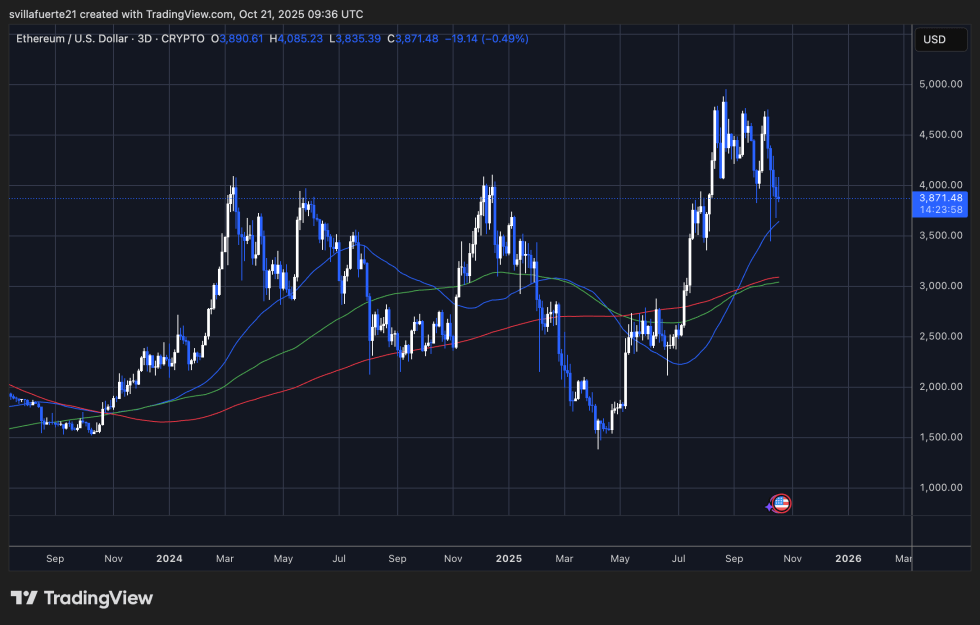
Ethereum consolidates around key level | Source: ETHUSDT chart on TradingView
Ethereum consolidates around a key level | Source: ETHUSDT chart on TradingView

This zone has historically acted as a pivot during mid-cycle consolidations, and holding above it would keep Ethereum within a healthy market structure. However, if ETH loses this level, the next significant support lies between $3,400 and $3,500, where the 100-period (green) and 200-period (red) moving averages converge — an area that often attracts long-term buyers.

To the upside, ETH needs a decisive close above $4,000–$4,200 to regain momentum and potentially retest the $4,500 resistance, which has been a strong rejection level since late September.

Overall, the 3D chart paints a picture of short-term weakness within a broader bullish framework. Ethereum’s ability to defend its mid-range support will determine whether this correction evolves into accumulation or signals the start of a deeper market retrace.

Featured image from ChatGPT, chart from TradingView.com

Editorial Process for bitcoinist is centered on delivering thoroughly researched, accurate, and unbiased content. We uphold strict sourcing standards, and each page undergoes diligent review by our team of top technology experts and seasoned editors. This process ensures the integrity, relevance, and value of our content for our readers.

Sebastian's journey into the world of crypto began four years ago, driven by a fascination with the potential of blockchain technology to revolutionize financial systems. His initial exploration focused on understanding the intricacies of various crypto projects, particularly those focused on building innovative financial solutions. Through countless hours of research and learning, Sebastian developed a deep understanding of the underlying technologies, market dynamics, and potential applications of cryptocurrencies. As his knowledge grew, Sebastian felt compelled to share his insights with others. He began actively contributing to online discussions on platforms like X and LinkedIn, focusing on fintech and crypto-related content. His goal was to expose valuable trends and insights to a wider audience, fostering a deeper understanding of the rapidly evolving crypto landscape. Sebastian's contributions quickly gained recognition, and he became a trusted voice in the online crypto community. To further enhance his expertise, Sebastian pursued a UC Berkeley Fintech: Frameworks, Applications, and Strategies certification. This rigorous program equipped him with valuable skills and knowledge regarding Financial Technology, bridging the gap between traditional finance (TradFi) and decentralized finance (DeFi). The certification deepened his understanding of the broader financial landscape and its intersection with blockchain technology. Sebastian's passion for finance and writing is evident in his work. He enjoys delving into financial research, analyzing market trends, and exploring the latest developments in the crypto space. In his spare time, Sebastian can often be found immersed in charts, studying 10-K forms, or engaging in thought-provoking discussions about the future of finance. Sebastian's journey as a crypto analyst and investor has been marked by a relentless pursuit of knowledge and a dedication to sharing his insights. His ability to navigate the complex world of crypto, combined with his passion for financial research and communication, makes him a valuable asset to the industry. As the crypto landscape continues to evolve, Sebastian remains at the forefront, providing valuable insights and contributing to the growth of this revolutionary technology.

Похожее

Agentized OS: It's Not About AI, It's About the Foundation

The Agentic OS: Beyond AI, It's About the Foundational Stack In 2026, major operating systems like Android, iOS, HarmonyOS, and Windows are entering the "Agentic" era, integrating proactive AI assistants deeply into the system layer. However, the real competition lies not in the flashy AI features showcased at events, but in the three-layer foundational stack that enables them: the system-level AI Runtime, proprietary/controllable chips, and the on-device/cloud model matrix. The AI Runtime acts as the central scheduler, managing model inference, resource allocation, and exposing capabilities to apps. Controllable chips (e.g., Apple Silicon, Google Tensor, Huawei Kirin) are crucial for deep hardware-software co-optimization, determining the efficiency and experience limits of on-device Agents. The on-device/cloud model matrix provides the "intelligence," with proprietary, chip-optimized small models (like Gemini Nano, Apple's ~3B model) handling daily tasks locally for low latency, privacy, and reliability, while cloud models tackle complex requests. Deep synergy between these three layers enables key Agent differentiators: ultra-low latency and power efficiency, genuine "on-device first" privacy, access to system-level personal context across apps, and reliable performance as a system service even offline. OS vendors with strong integration across this stack (like Apple, Google, and Huawei) build a deeper moat. Beyond this core stack, long-term competitiveness depends on variables like structured App integration (e.g., App Intents/AppFunctions) for reliable multi-step workflows, and robust privacy frameworks that build user trust. This shift towards Agentic OS extends beyond phones and PCs to IoT, cars, and XR glasses via existing multi-device ecosystems. The race is won not in a keynote, but through generations of meticulously co-developed chips, models, and system software.

marsbit1 ч. назад

Agentized OS: It's Not About AI, It's About the Foundation

marsbit1 ч. назад

Why Sam Altman's 'Water and Electricity Theory' Sparks Copyright Controversy

OpenAI CEO Sam Altman's recent statement that "intelligence will become a utility like electricity or water" has sparked significant controversy, primarily around copyright issues and the nature of AI development. While positioning AI as a utility serves as a compelling narrative for infrastructure investors, critics argue the analogy is flawed in three key areas. First, there's a fundamental "property gap." Traditional utilities like water and power create new, physical infrastructure from scratch. In contrast, major AI models are trained by reorganizing vast amounts of existing human-created content—books, articles, code, etc.—often scraped from the web without explicit permission or compensation to creators. This "free acquisition, paid resale" model is seen by many as ethically problematic. Second, there's a "pricing gap." True public utilities are typically regulated to ensure universal service with non-discriminatory, cost-plus pricing. AI's token-based pricing, however, involves significant price discrimination (e.g., output tokens costing much more than input tokens) and is designed for revenue maximization, not equitable access. Third, a "governance gap" exists. Utilities operate under public oversight, while AI pricing and development are currently controlled by a few private companies. Furthermore, the industry's own shift toward buying licensed training data (e.g., deals with Reddit or news publishers) undermines its previous legal reliance on "fair use" for freely scraped data. In conclusion, while AI is indeed becoming a foundational technology, calling it a public utility remains contentious. The title requires not just scale and a pay-per-use model, but also credible solutions for data provenance, equitable pricing, and public governance.

marsbit1 ч. назад

Why Sam Altman's 'Water and Electricity Theory' Sparks Copyright Controversy

marsbit1 ч. назад

Торговля

Спот
Фьючерсы

Популярные статьи

Manyu: восходящая мем-звезда на Ethereum, готовая открыть новую эру культуры Shiba

Manyu - это мемтокен на Ethereum, который приносит децентрализованную культурную и развлекательную ценность через вирусное влияние в соцсетях и вовлечённость сообщества.

1.9k просмотров всегоОпубликовано 2025.11.27Обновлено 2025.11.27

Manyu: восходящая мем-звезда на Ethereum, готовая открыть новую эру культуры Shiba

Неделя обучения по популярным токенам 14: Glamsterdam — самое ожидаемое обновление Ethereum в 2026 году

Ordinals/Runes по-прежнему стимулируют доходы от комиссий за блоки и активность разработчиков, рассматриваются как отправная точка «нативной эмиссии активов» в сети.

1.4k просмотров всегоОпубликовано 2026.04.29Обновлено 2026.04.29

Неделя обучения по популярным токенам 14: Glamsterdam — самое ожидаемое обновление Ethereum в 2026 году

Обсуждения

Добро пожаловать в Сообщество HTX. Здесь вы сможете быть в курсе последних новостей о развитии платформы и получить доступ к профессиональной аналитической информации о рынке. Мнения пользователей о цене на ETH (ETH) представлены ниже.

活动图片