Why The Shiba Inu Consolidation Could End Rapidly With An Explosive Price Rally

bitcoinistОпубликовано 2025-10-11Обновлено 2025-10-11

Введение

Shiba Inu has maintained steady momentum in recent days, trading at approximately $0.00001197 after bouncing from its weekly lows near...

Trusted Editorial content, reviewed by leading industry experts and seasoned editors. Ad Disclosure

Shiba Inu has maintained steady momentum in recent days, trading at approximately $0.00001197 after bouncing from its weekly lows near $0.00001180. Shiba Inu’s recent bounce follows a period of increased activity that saw Bitcoin reach new all-time highs this week. 

Although SHIB’s price action is relatively quiet compared to other cryptocurrencies, it is forming a structure on the daily candlestick timeframe chart that could soon lead to an explosive rally. Technical analysis of Shiba Inu on the TradingView platform shows that the meme coin is about to go on an explosive price action.

Testing The Boundaries Of A Long-Term Structure

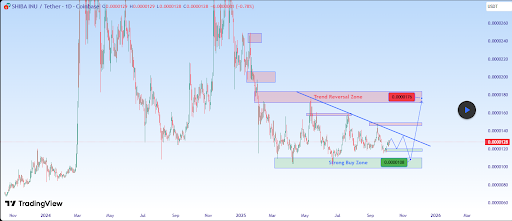
Technical analysis of Shiba Inu’s recent price movement on the daily candlestick chart reveals that the token is currently retesting a major strong buy zone within a broad descending structure that has shaped its trend since May 2025. 

Shiba Inu has been locked in a tight consolidation range over the past several months, defined by a horizontal support region at the bottom and a slanting resistance trendline connecting a sequence of lower highs. The upper resistance is now situated between $0.0000135 and $0.000014.

However, as it stands, Shiba Inu may still solidify its strong buy zone between $0.0000108 and $0.0000120 in order to collect liquidity that’s needed for a breakout momentum. Each test of this area since May has led to some sort of buying pressure that has prevented further declines.

If SHIB can maintain stability within this accumulation zone and begin to push higher, the next important step would be a clean breakout above its descending resistance line. It would need to close decisively above $0.0000150 on the daily chart to confirm the strength of this move. That kind of breakout would mark a clear shift in structure and open up an explosive move to $0.000017.

However, the area around $0.0000176 to $0.0000190 also coincides with a broader trend reversal zone, where Shiba Inu might experience selling pressure from previous order blocks. A rejection here could cause another pullback that will keep the meme coin within its long-term consolidation. 
Shiba Inu
Source: Chart from Tradingview

On the other hand, if the price manages to pierce through $0.0000190 and establish support above it, the SHIB could finally escape the confines of its descending structure and set the stage for a sustained bullish move above $0.00002 again.

Current Shiba Inu Price Action

At the time of writing, Shiba Inu is trading at $0.000012 after a mild pullback from $0.00013 earlier in the week. Whether this breakout materializes will depend heavily on the broader crypto market. Bitcoin’s continued dominance and momentum are dictating the sentiment across altcoins. Therefore, an extended uptrend from Bitcoin’s current consolidation after its most recent all-time high could also contribute to Shiba Inu bouncing off its strong buy zone.

Meanwhile, a popular Shiba Inu community member account on X recently warned the SHIB Army to be careful of a growing phishing scam.

Shiba Inu
SHIB trading at $0.000011 on the 1D chart | Source: SHIBUSDT on Tradingview.com
Featured image from Getty Images, chart from Tradingview.com
Editorial Process for bitcoinist is centered on delivering thoroughly researched, accurate, and unbiased content. We uphold strict sourcing standards, and each page undergoes diligent review by our team of top technology experts and seasoned editors. This process ensures the integrity, relevance, and value of our content for our readers.

Scott Matherson is a leading crypto writer at Bitcoinist, who possesses a sharp analytical mind and a deep understanding of the digital currency landscape. Scott has earned a reputation for delivering thought-provoking and well-researched articles that resonate with both newcomers and seasoned crypto enthusiasts. Outside of his writing, Scott is passionate about promoting crypto literacy and often works to educate the public on the potential of blockchain.

Похожее

How the CLARITY Act Reshapes the Stablecoin Yield Economy

The CLARITY Act, recently advanced by the U.S. Senate Banking Committee, fundamentally reshapes the stablecoin yield economy by closing loopholes left by the earlier GENIUS Act. Its Section 404 expands the ban on "hold-to-earn" rewards to all Digital Asset Service Providers (DASPs) and their affiliates, prohibiting any passive, interest-like yield. Crucially, it introduces a legal distinction, permitting "use-to-earn" rewards based on actual activities like spending, trading, or staking. In anticipation of this regulatory shift, major Wall Street asset managers—Morgan Stanley, BlackRock, and JPMorgan—have launched a series of tokenized money market funds (e.g., BlackRock's BRSRV, JPMorgan's JLTXX) designed explicitly for stablecoin reserve assets. These products represent a new, compliant yield layer: the stablecoin issuer earns interest from the underlying tokenized fund, which can then be passed to users through redesigned activity-based rewards. This marks a paradigm shift from a "hold-to-earn" to a "use-to-earn" market. While pathways remain for exchanges to redesign rewards (Path A) and for DeFi protocols to offer yield (Path B), the tokenized reserve asset layer (Path C) emerges as the most robust and strategically positioned infrastructure. However, this concentration—exemplified by BlackRock's BUIDL fund backing over 90% of USDtb's reserves—introduces new systemic risks. The final outcome hinges on regulatory decisions, particularly the OCC's proposed 20% cap on tokenized assets in reserves, which will determine the scalability of this new financial infrastructure layer.

marsbit8 мин. назад

How the CLARITY Act Reshapes the Stablecoin Yield Economy

marsbit8 мин. назад

Kalshi and Coinbase Receive CFTC Approval, Ushering in the Most Regulation-Friendly Era for the Crypto Industry?

The U.S. Commodity Futures Trading Commission (CFTC) took two landmark actions on May 29. It approved Kalshi's application to list a Bitcoin perpetual futures contract and issued a no-action letter to Coinbase Financial Markets. This allows Coinbase to offer certain perpetual futures products to U.S. customers through a subsidiary, with digital assets permitted as collateral. These moves, coupled with a new CFTC policy statement, provide a clearer regulatory pathway for perpetual contracts in the U.S., moving them from a regulatory gray area. CFTC Chair Mike Selig stated this is a key step for U.S. crypto leadership but noted the policy is not yet permanent. The article explains that CFTC's previous reluctance stemmed from legal ambiguities, as perpetual contracts lack an expiration date. However, such contracts dominate global crypto derivatives, accounting for ~78% of centralized exchange volume in 2025, forcing U.S. regulators to adapt to competition from offshore platforms like Hyperliquid. The approvals offer two compliance paths: Kalshi's direct listing and Coinbase's model using foreign futures. This is expected to attract institutional capital back to regulated U.S. venues, stimulate the launch of more products like ETH perpetuals, and enhance U.S. competitiveness in the global crypto derivatives market. The author suggests this may signal a "regulatorily friendly" era for crypto.

marsbit3 ч. назад

Kalshi and Coinbase Receive CFTC Approval, Ushering in the Most Regulation-Friendly Era for the Crypto Industry?

marsbit3 ч. назад

Sharplink CEO: Ethereum's Future Is Playing Out Now

This article presents a perspective from Joseph Chalom, CEO of Sharplink and a former BlackRock executive. He argues that current controversies surrounding the Ethereum Foundation (EF) and ETH's price miss the bigger picture for institutional adoption. Chalom asserts that Ethereum is decisively winning in the three key attributes institutions value most: trust, security, and liquidity. He cites its dominance in stablecoin settlement, tokenized real-world assets (RWA), and high-value DeFi as evidence. This success is attributed to the EF's consistent, long-term protocol development over a decade, including major upgrades like The Merge and a robust future roadmap. He defends Ethereum's decentralization as a core strength, not a weakness, stating institutions require a neutral infrastructure not controlled by any single entity. Comparing ETH to Amazon, Chalom suggests critics focusing on short-term price are missing its potential to become the foundational settlement layer for the entire global financial system. The article encourages a contrarian "be greedy when others are fearful" investment approach, drawing parallels to Warren Buffett's strategy and BlackRock's continued investment during crypto winters. Chalom concludes that while the EF correctly focuses on core protocol attributes (CROPS: Censorship Resistance, Capture Resistance, Open Source, Privacy, Security), a leadership gap exists in market-facing narrative and institutional adoption. He calls for ecosystem participants, including his own firm Sharplink, to become more vocal advocates to support Ethereum's impending "supercycle" of institutional adoption.

链捕手4 ч. назад

Sharplink CEO: Ethereum's Future Is Playing Out Now

链捕手4 ч. назад

Deconstructing the Investment Methodology of the 'Stock God Serenity' in One Article

"Serenity's Bottleneck Investment Methodology: A Deep Dive" This article dissects the "bottleneck point investment" strategy of the pseudonymous investor Serenity, known for exceptional returns (YTD 4502.45%). The core methodology involves identifying a major technological trend (e.g., AI compute expansion), mapping its supply chain, and investing early in the most irreplaceable, supply-constrained upstream component before the market fully values it. The framework is broken down into a five-factor model: 1. **Deterministic Demand**: Anchored in a large, validated trend. 2. **Constrained Supply**: The component must be difficult to replicate or scale quickly. 3. **Low Market Attention**: Opportunities exist where coverage is sparse. 4. **Value Capture**: The company must have pricing power, high margins, and customer lock-in. 5. **Catalyst**: A near-term event to trigger price discovery (earnings, customer ramp, etc.). The article provides illustrative examples like $AXTI (InP substrates for photonics), $RPI (edge hardware for AI agents), and $AAOI/$LITE (components for cloud ASICs). To apply this method, a six-step process is outlined: identify the macro trend, map the supply chain, pinpoint the true bottleneck, gather evidence (client wins, certifications), assess risks ("anti-thesis table"), and size the position according to research depth. Crucially, the article notes significant limitations: risk of overfitting inferences from sparse data, valuation challenges for pre-revenue companies, liquidity/reflexivity risks due to Serenity's own market influence, and survivor bias amplified by a strong AI bull market. The key takeaway is to emulate the rigorous research process—finding the trend, the bottleneck, the evidence—rather than blindly copying specific stock picks, emphasizing the discipline of "walking through the narrow gate."

marsbit4 ч. назад

Deconstructing the Investment Methodology of the 'Stock God Serenity' in One Article

marsbit4 ч. назад

Торговля

Спот
Фьючерсы
活动图片