White House Pulls Pro-Crypto Quintenz’s Nomination To Lead CFTC Following Major Opposition – Report

bitcoinistОпубликовано 2025-10-02Обновлено 2025-10-02

Введение

Recent reports revealed that the White House has withdrawn Brian Quintenz’s nomination to lead the Commodity Futures Trading Commission (CFTC)...

Trusted Editorial content, reviewed by leading industry experts and seasoned editors. Ad Disclosure

Recent reports revealed that the White House has withdrawn Brian Quintenz’s nomination to lead the Commodity Futures Trading Commission (CFTC) after the pro-crypto candidate’s confirmation process was stalled in July.

Quintenz’s CFTC Chair Nomination Withdrawn

On Tuesday, Politico reported that the White House had pulled Brian Quintez’s nomination for CFTC chairman following opposition from major crypto industry players, according to two anonymous sources who spoke with the news media outlet.

According to the report, a White House official confirmed that Quintenz’s nomination was withdrawn, affirming that “Brian Quintenz remains a trusted ally and the Trump administration looks forward to working with him in other capacities.”

“President Trump has made it a priority to make America the crypto capital of the world, and in doing so has called for the revitalization of the Commodity Futures Trading Commission to play a larger role in securing this promise,” the official added.

Notably, President Trump’s CFTC chair pick had been in confirmation limbo since July, after the US Senate Agriculture Committee delayed a crucial vote to advance the process days before the August recess. At the time, reports claimed that the committee stalled Quintenz’s confirmation process following a request from the White House.

The delay reportedly followed opposition from Tyler and Cameron Winklevoss, Gemini co-founders, who allegedly pressed President Trump to reconsider his CFTC chair pick, arguing that he wouldn’t “shake up” the Commission enough and was not aligned with Trump’s crypto agenda.

Last month, Quintenz seemingly confirmed the reports, suggesting that the Winklevoss twins might have “misled” the US President after a text exchange between the three. As reported by Bitcoinist, the crypto exchange founders inquired about the then-CFTC nominee’s opinion on a complaint letter, but were ultimately disappointed and surprised by his response.

In a message to Politico, Quintenz stated, “Being nominated to chair the CFTC and going through the confirmation process was the honor of my life.” “I am grateful to the President for that opportunity and to the Senate Agriculture Committee for its consideration,” he affirmed, adding that he looks forward to returning to the private sector.

CFTC’s Pro-Crypto Leadership To Be Determined

Despite Quintenz’s widespread support from both the crypto and traditional financial industries, his nomination was not only opposed by the Winklevoss twins. The traditional gaming industry has also opposed the former CFTC chair candidate due to his ties to the up-and-coming prediction market firm Kalshi, the report noted.

Additionally, Democratic House of Representatives member Dina Titus reacted to the news on X, writing, “Good. The CFTC deserves strong, independent leadership that will follow and enforce agency regulations.”

The White House official said a new candidate would be announced “in the near future.” Two weeks ago, Bloomberg reported that the Trump administration was weighing additional nominees to chair the CFTC amid the delay in Quintenz’s confirmation process.

Among the contenders, the White House was reportedly considering Michael Selig, chief counsel to the Securities and Exchange Commission’s (SEC) Crypto Task Force, and Tyler Williams, counselor to Treasury Secretary Scott Bessent on digital asset policy.

Politico sources claimed that Josh Sterling, a former CFTC official who is now a partner at Milbank, and former CFTC Commissioner Jill Sommers, are also being considered to lead the regulatory agency.

It’s worth noting that the highly anticipated market structure is expected to shift most of the crypto market supervision to the CFTC, exponentially increasing the regulator’s responsibilities.

Currently, the agency, which is intended to be a five-person, bipartisan commission, is down to only acting Chairwoman Caroline Pham, who is expected to depart from the agency once a permanent leader is selected.

Multiple industry players have emphasized that installing a permanent Chairman is “absolutely critical” to realizing the Commission’s goals and to ensure a “golden age of crypto innovation.”
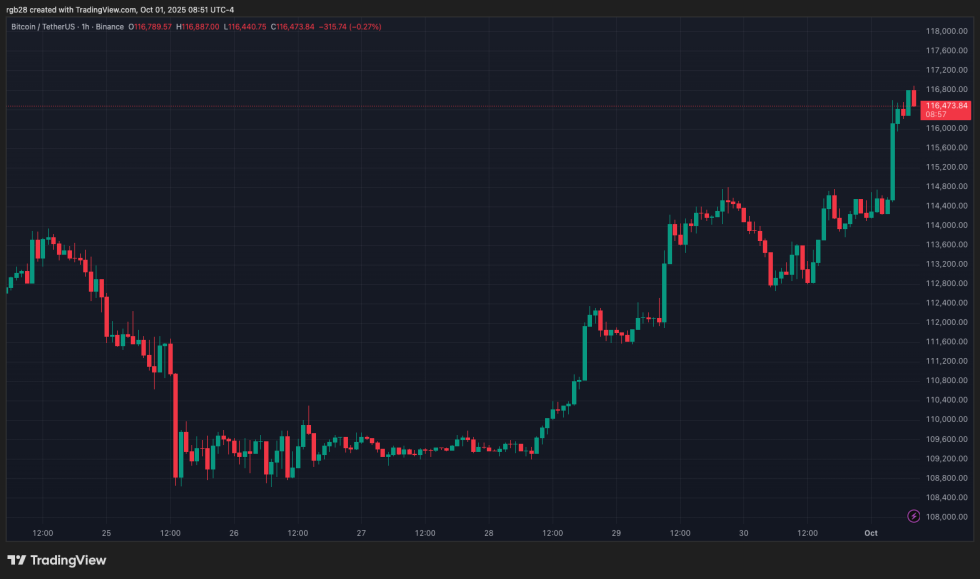
crypto, btc, btcusdt, bitcoin

Bitcoin (BTC) trades at $116,473 in the one-week chart. Source: BTCUSDT on TradingView
Featured Image from Unsplash.com, Chart from TradingView.com
Editorial Process for bitcoinist is centered on delivering thoroughly researched, accurate, and unbiased content. We uphold strict sourcing standards, and each page undergoes diligent review by our team of top technology experts and seasoned editors. This process ensures the integrity, relevance, and value of our content for our readers.

Rubmar is a crypto enthusiast who likes learning and improving constantly. She enjoys reporting on the latest news and developments in the crypto industry. Rubmar also enjoys scrapbooking, crafting, simulation games, and watching football.

Похожее

From Ethereum to AI's 'CROPS': What Exactly is This Set of 'Slow Variables' That Vitalik Repeatedly Emphasizes?

In recent discussions, Vitalik Buterin has frequently emphasized the concept of "CROPS," a framework defining core values for Ethereum's development. CROPS stands for Censorship Resistance, Capture Resistance, Open Source, Privacy, and Security. Initially outlined in the Ethereum Foundation's "EF Mandate," it represents a commitment to user sovereignty, ensuring that the network resists external control, remains open, protects privacy, and prioritizes security. The relevance of CROPS extends beyond Ethereum's foundational principles, becoming crucial in the context of AI integration. As AI agents begin handling wallet operations and automated transactions, the risk increases that users may cede control over their digital assets, privacy, and intentions to centralized AI service providers. A "CROPS AI" would therefore emphasize local execution where possible, privacy-preserving remote model calls (e.g., using zero-knowledge proofs), and transparent, verifiable processes to maintain user agency. Vitalik highlights a significant convergence between "CROPS Ethereum access layer" and "CROPS AI." Both address the same fundamental challenge: how users can access powerful services—be it blockchain data via RPCs or AI models—without exposing sensitive information or relinquishing ultimate control. This intersection points toward a future digital entry point that is more private, secure, and user-controlled. Ultimately, CROPS is not merely an abstract ideal but a practical guidepost. It steers development—from protocol resilience and wallet design to AI agent safety—towards a future where users retain self-sovereignty even as digital systems grow more complex and powerful. In an era of accelerating AI adoption, these "slow variables" of censorship resistance, openness, privacy, and security may define Ethereum's enduring value.

marsbit3 мин. назад

From Ethereum to AI's 'CROPS': What Exactly is This Set of 'Slow Variables' That Vitalik Repeatedly Emphasizes?

marsbit3 мин. назад

Silicon Valley 'Startup Guru' Steve Hoffman: Web3 + AI Could Be a Trap

Silicon Valley investor and "Godfather of Startups" Steve Hoffman warns that combining Web3 with AI is likely a trap, not a promising venture. In an interview, Hoffman argues that while AI is a foundational technology touching all industries, Web3 adds complexity, friction, and regulatory risk without solving mainstream consumer or business needs. He advises founders to focus on deep, specialized applications where startups can out-iterate giants, rather than on generic features easily replicated by large tech companies. Hoffman observes that Silicon Valley will lead foundational AI research, while China excels at rapid, large-scale application and commercialization, particularly in robotics. He stresses that AI-driven autonomous agents capable of collaborative, multi-step tasks are 2-4 years away, which will cause significant job displacement. The solution is not to slow AI but to redesign business models around human-AI collaboration and reform social systems like education and retraining. For startups, Hoffman recommends focusing on vertical, expertise-heavy domains to build defensibility. He sees major opportunities in AI fraud detection and cybersecurity. Key founder mindsets include systemic thinking over feature-focus, relentless customer centricity, building adaptive teams, and deeply understanding AI's capabilities and limits. Hoffman is also leading a non-profit initiative to establish university centers aimed at training future leaders in responsible, human-value-aligned AI innovation.

marsbit1 ч. назад

Silicon Valley 'Startup Guru' Steve Hoffman: Web3 + AI Could Be a Trap

marsbit1 ч. назад

Token Inefficient, Economy Tokenless

The article "Tokens Aren't Economical, Economics Aren't Tokenized" analyzes a pivotal shift in the AI industry from a technology-driven narrative to one dominated by capital efficiency. It highlights two concurrent trends: a severe capital shortage due to the exorbitant and recurring costs of compute (e.g., OpenAI's high burn rate) and a wave of corporate spin-offs where major tech companies are separating their AI units (like Kuaishou's Kling and Baidu's Kunlunxin). The core argument is that AI's "anti-internet" business model, where user growth increases costs rather than profits, has created a disconnect between high valuations and actual cash flow. Spin-offs address this by allowing AI assets to be valued independently. Within a parent company, they are seen as cost centers, but as standalone entities, they are priced based on their growth potential and scarcity in the primary market, leading to massive valuation premiums (e.g., Kling's estimated value tripling post-spin-off). The industry is at an inflection point, moving from "model worship" to "value realization." The competition is evolving from a pure compute (GPU) race to a broader focus on systemic efficiency and full-stack engineering (involving CPUs and orchestration) to achieve viable commercialization. The year 2026 is framed as a critical moment where the industry must definitively answer how to economically translate AI capability into tangible business value, reshaping the sector's future power structure.

marsbit1 ч. назад

Token Inefficient, Economy Tokenless

marsbit1 ч. назад

Crossing the 'Memory Wall': The Wafer-Level Revolution and Computing Power Routes in the AI Inference Era

In 2026, a historic shift occurred in AI as major cloud providers' inference spending surpassed training spending for the first time, signaling a move from "building large models" to "using large models." This shifts the core challenge from computing power to the "memory wall"—the bottleneck of data movement (model weights, activations, KV Cache) between external DRAM and processors, where energy and latency from data transfer far exceed computation itself. Companies like Nvidia face GPU idle time due to bandwidth limits. In contrast, Cerebras Systems adopts a radical "wafer-scale" approach with its Wafer-Scale Engine (WSE). Instead of cutting a silicon wafer into many chips, Cerebras uses almost the entire wafer as one massive chip (WSE-3). This design provides 44GB of on-chip SRAM, delivering memory bandwidth thousands of times higher than traditional HBM (e.g., 21 PB/s vs. Nvidia B200). For LLM inference, weights are streamed layer-by-layer from external MemoryX storage to the chip, avoiding HBM bottlenecks. This results in token generation speeds 1.5–5 times faster than Nvidia's B200 in some models and significant advantages in first-token latency and long-context tasks. Additionally, Cerebras's architecture offers much lower interconnect power consumption (0.15 pJ/bit vs. GPU's ~10 pJ/bit). However, Cerebras faces challenges: SRAM scaling has slowed with advanced nodes, limiting future capacity gains; the chip requires specialized liquid cooling and custom software stacks; and its external I/O bandwidth (150 GB/s) is low compared to NVLink, hindering multi-system scaling for very large models. Competition is intensifying. Major players are pursuing three paths: 1) Developing proprietary inference ASICs (e.g., Google TPU, Microsoft Maia), 2) Leveraging advanced packaging (e.g., TSMC's SoW) to democratize wafer-scale-like integration, potentially eroding Cerebras's process advantage within a few years, and 3) Exploring optical interconnects for ultimate bandwidth. Commercially, Cerebras is transitioning from a hardware vendor to a service provider, facing the immense challenge of building high-power, specialized data centers to meet large contracts (e.g., 250MW/year from 2026–2028). In conclusion, the AI inference era presents a fundamental architectural trade-off. Cerebras opts for extreme physical optimization for low-latency, single-task performance, while Nvidia prioritizes versatility and massive cluster throughput. The path forward remains uncertain, with technology and business models still evolving in the race toward advanced AI.

marsbit1 ч. назад

Crossing the 'Memory Wall': The Wafer-Level Revolution and Computing Power Routes in the AI Inference Era

marsbit1 ч. назад

Торговля

Спот
Фьючерсы

Популярные статьи

Как купить HOUSE

Добро пожаловать на HTX.com! Мы сделали приобретение Housecoin (HOUSE) простым и удобным. Следуйте нашему пошаговому руководству и отправляйтесь в свое крипто-путешествие.Шаг 1: Создайте аккаунт на HTXИспользуйте свой адрес электронной почты или номер телефона, чтобы зарегистрироваться и бесплатно создать аккаунт на HTX. Пройдите удобную регистрацию и откройте для себя весь функционал.Создать аккаунтШаг 2: Перейдите в Купить криптовалюту и выберите свой способ оплатыКредитная/Дебетовая Карта: Используйте свою карту Visa или Mastercard для мгновенной покупки Housecoin (HOUSE).Баланс: Используйте средства с баланса вашего аккаунта HTX для простой торговли.Третьи Лица: Мы добавили популярные способы оплаты, такие как Google Pay и Apple Pay, для повышения удобства.P2P: Торгуйте напрямую с другими пользователями на HTX.Внебиржевая Торговля (OTC): Мы предлагаем индивидуальные услуги и конкурентоспособные обменные курсы для трейдеров.Шаг 3: Хранение Housecoin (HOUSE)После приобретения вами Housecoin (HOUSE) храните их в своем аккаунте на HTX. В качестве альтернативы вы можете отправить их куда-либо с помощью перевода в блокчейне или использовать для торговли с другими криптовалютами.Шаг 4: Торговля Housecoin (HOUSE)С легкостью торгуйте Housecoin (HOUSE) на спотовом рынке HTX. Просто зайдите в свой аккаунт, выберите торговую пару, совершайте сделки и следите за ними в режиме реального времени. Мы предлагаем удобный интерфейс как для начинающих, так и для опытных трейдеров.

579 просмотров всегоОпубликовано 2025.04.27Обновлено 2026.06.02

Как купить HOUSE

Обсуждения

Добро пожаловать в Сообщество HTX. Здесь вы сможете быть в курсе последних новостей о развитии платформы и получить доступ к профессиональной аналитической информации о рынке. Мнения пользователей о цене на HOUSE (HOUSE) представлены ниже.

活动图片