Ethereum Price Risks Closing Below 3M Bollinger Bands, Expert Says Think Longer Term

bitcoinistОпубликовано 2025-03-26Обновлено 2025-03-27

Введение

Ethereum has been weighed down by persistent downward momentum, and even a near-term rally may not be enough to shift...

Trusted Editorial content, reviewed by leading industry experts and seasoned editors. Ad Disclosure

Ethereum has been weighed down by persistent downward momentum, and even a near-term rally may not be enough to shift the broader trend immediately. As it stands, the ETH price is now at an important technical moment, with crypto analyst Tony “The Bull” Severino warning of a possible close below a significant long-term indicator. 

With just days remaining in the first quarter of 2025, Severino took to the social media platform X to highlight the implications of Ethereum’s position relative to its 3-month Bollinger Band basis, which could spell trouble.

Ethereum Faces A Technical Threat On The Quarterly Timeframe Chart

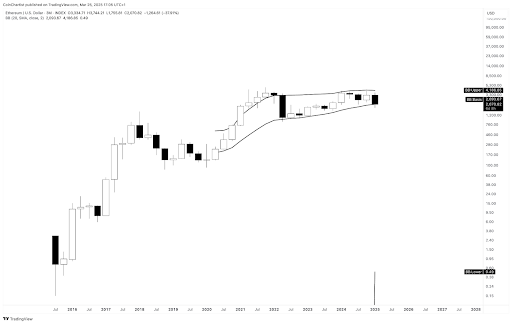
Crypto analyst Tony “The Bull” Severino has sounded the alarm on Ethereum’s quarterly chart. In a recent post on social media platform X, Severino pointed to the 3-month Bollinger Band basis, saying Ethereum’s price is in danger of closing below it. There’s now less than a week remaining in Q1, and the analyst warned, “There are seven days left to save Ethereum from closing below the 3M Bollinger Band basis. If it loses it, look out below.”

The 3M Bollinger Band is a version of the standard Bollinger Bands indicator applied to a 3-month (quarterly) chart. In this case, each candlestick on the chart represents three months of price action, so it covers ETH’s price behavior from a long-term perspective. Speaking of long-term price action, the Ethereum / U.S. Dollar 3-month index shared by Severino shows that the altcoin has been trading within these Bollinger bands since July 2022.
Ethereum
Source: Tony Severino on X

As shown in the price chart below, Ethereum is currently trading close to the lower Bollinger band, which is just around the $2,000 price level. Interestingly, the current candlestick, which only has a few days to close, is highlighted by a lower wick protruding below the lower band. This means the Ethereum price has already broken below the Bollinger Band for a brief period this quarter, but only a close below could quickly seal the deal.

What A Breakdown Below The Band Could Mean For ETH’s Price

If Ethereum does close below the Bollinger Band, it will undoubtedly signal an incoming wave of bearish momentum that might outshine its current lackluster price action. The cryptocurrency might lose the $2,000 psychological price threshold completely and lose many support levels up until $1,500 before any strong rebound. Tony Severino noted that there are only seven days left to save Ethereum from closing below the 3M Bollinger Band and avoid a bearish potential.

In another post on X, the analyst expanded on the implications of ETH’s current structure. Many investors are hoping for a swift rebound and a return to all-time highs, but he cautioned that such an optimistic run might take a long time to manifest.

Any bullish trend in the short term might not be enough to reverse the larger downward trend that has been developing for the past 12 months. A meaningful structural change will require sustained bullish pressure over multiple quarters, not just a short-term bounce.  “Think in terms of quarters, not months, weeks, or days,” he said.

At the time of writing, Ethereum is trading at $2,052.

Ethereum
ETH trading at $2,065 on the 1D chart | Source: ETHUSDT on Tradingview.com
Featured image from iStock, chart from Tradingview.com
Editorial Process for bitcoinist is centered on delivering thoroughly researched, accurate, and unbiased content. We uphold strict sourcing standards, and each page undergoes diligent review by our team of top technology experts and seasoned editors. This process ensures the integrity, relevance, and value of our content for our readers.

Scott Matherson is a leading crypto writer at Bitcoinist, who possesses a sharp analytical mind and a deep understanding of the digital currency landscape. Scott has earned a reputation for delivering thought-provoking and well-researched articles that resonate with both newcomers and seasoned crypto enthusiasts. Outside of his writing, Scott is passionate about promoting crypto literacy and often works to educate the public on the potential of blockchain.

Похожее

Trump, the "Stock Market Manipulator" in U.S. Stocks, Lifts Up the Entire Quantum Computing Sector

"Trump, the 'U.S. Stock Market Mastermind,' Boosts the Entire Quantum Computing Sector" This article details how former U.S. President Donald Trump's policies and public statements have significantly influenced the stock market, particularly in the quantum computing sector. A key example is the U.S. government's direct investment in Intel stock in August 2025, which yielded over $45 billion in gains within seven months. Trump publicly credited himself for this profit. Recently, the Trump administration announced a new $2 billion initiative. Through the Department of Commerce, funding from the CHIPS and Science Act will be provided to nine quantum computing companies in exchange for minority, non-controlling equity stakes. The recipients include IBM ($1B for its subsidiary Anderon), GlobalFoundries ($375M), and listed companies like D-Wave, Infleqtion, and Rigetti ($100M each). Private firms such as Atom Computing and PsiQuantum also received $100M. This "investment-for-equity" strategy marks a shift from pure subsidies to an "active investor" model under the CHIPS Act. The announcement immediately boosted quantum computing stocks. The article frames this as part of Trump's "America First" industrial policy, aimed at securing U.S. technological leadership, similar to past investments in semiconductors, rare earths, and lithium. The author suggests this pattern of government-backed market intervention, alongside Trump's personal stock endorsements, is a hallmark of his approach to driving market gains and may continue in sectors like defense and advanced energy.

marsbit13 мин. назад

Trump, the "Stock Market Manipulator" in U.S. Stocks, Lifts Up the Entire Quantum Computing Sector

marsbit13 мин. назад

2-Year Return of 225x? Uncovering Mysterious Researcher Serenity's AI 'Choke Point' Investment Strategy

"2 Years, 225x Returns? Decoding Serenity's AI 'Chokepoint' Investment Strategy" This article profiles Serenity (formerly AleaBito on Reddit's WallStreetBets), a pseudonymous researcher known for exceptional returns by applying a "Chokepoint Theory" to AI investments. His methodology involves a bottom-up, reverse-engineering approach of the AI hardware supply chain. He identifies critical, irreplaceable physical bottlenecks (chokepoints) that could cripple entire AI systems if disrupted, bypassing Wall Street's top-down focus on major tech firms. Key examples include pinpointing essential suppliers in the emerging Silicon Photonics and Co-Packaged Optics (CPO) sector—components vital for next-generation AI data center interconnects—such as niche companies providing external laser sources, molecular beam epitaxy equipment, or ultra-pure raw materials. Similarly, he highlights geopolitical "chokepoints" in the humanoid robotics supply chain, where key hardware components and rare earth elements are concentrated in Asia. Serenity validates his investment theses through rigorous adversarial AI debates before publication. He leverages institutional blind spots, directing a sophisticated network of retail followers toward undervalued, under-covered micro-cap stocks across global exchanges, driving significant price movements in names like Sivers ($SIVE), Soitec, and Raspberry Pi ($RPI). While presenting a powerful framework for finding critical system dependencies, the strategy carries inherent risks: extreme concentration on specific technological paths, liquidity issues in small-cap stocks, and accusations of market manipulation. Ultimately, the core takeaway is not to copy his trades, but to adopt his analytical lens: to ask which silent, physical switches hold irreplaceable power within a complex system and invest ahead of the market's recognition of their value.

链捕手15 мин. назад

2-Year Return of 225x? Uncovering Mysterious Researcher Serenity's AI 'Choke Point' Investment Strategy

链捕手15 мин. назад

Bitroot Public Chain Invited to Attend Tencent Cloud Singapore AI Conference, Discussing the Future Alongside Solana

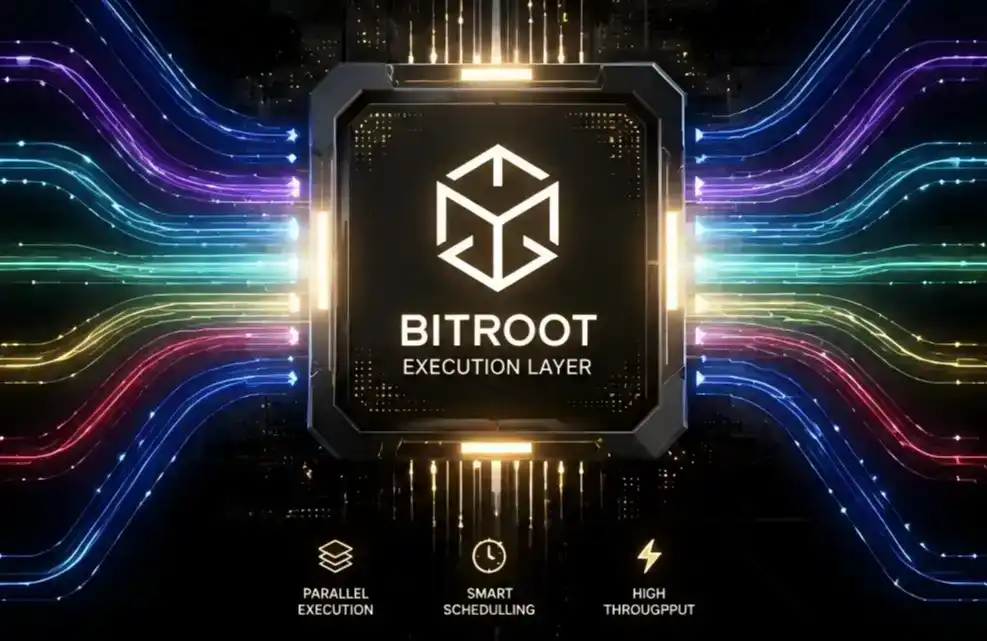
On May 19, Bitroot, an emerging Layer 1 blockchain, participated in the Tencent Cloud AI Summit in Singapore alongside key industry players like Solana Foundation. The event explored the intersection of AI infrastructure, enterprise applications, AI Agents, and Web3. Bitroot's invitation, despite being pre-mainnet, highlights industry interest in its focus on high-performance, AI-native architecture tailored for future AI Agent execution and verifiable on-chain automation. Bitroot CEO Juan Jose emphasized that AI competition is shifting from model performance to data, real-world application scenarios, and trust infrastructure. He argued that for AI Agents to evolve from assistants to autonomous executors managing transactions and assets, they require low-latency, low-cost, and high-throughput blockchain environments. Bitroot aims to address this through its EVM-compatible design, optimistic parallel execution, and a consensus mechanism targeting high scalability. Currently in its Testnet 5.0 phase, Bitroot reports metrics like over 50,000 peak TPS and sub-0.3 second average block time. Its narrative positions it within a growing landscape where next-generation Layer 1s like Monad and Aptos also compete on performance, while Bitroot differentiates by integrating AI computational capabilities natively across its stack. The summit underscored that the fusion of AI and Web3 is moving from concept to infrastructure competition, where networks balancing performance, security, and verifiability will be crucial for enabling scalable AI-driven applications.

marsbit1 ч. назад

Bitroot Public Chain Invited to Attend Tencent Cloud Singapore AI Conference, Discussing the Future Alongside Solana

marsbit1 ч. назад

Hedge Fund Q1 Interpretation: Everyone Is Selling Software, Buying Chips

Hedge Funds and Mutual Funds Aligned in Q1: Dumping Software, Buying Chips A clear consensus emerged among major U.S. hedge funds and mutual funds in Q1: they were simultaneously selling software stocks and pouring capital into the semiconductor sector. This aggressive rotation pushed semiconductor exposure in hedge fund long portfolios to a record high. Hedge funds delivered a 7% return year-to-date, while only 30% of large-cap active mutual funds outperformed their benchmarks. The average short interest for S&P 500 constituents rose to 3% of market cap, the highest since 2011. Within technology, the structural shift was stark. Hedge funds' semiconductor weighting hit an all-time high, while software fell to its lowest since 2019. Excluding Microsoft, mutual funds' relative overexposure to semis vs. software was the largest since 2012. Microsoft was among the most net-sold stocks by both groups. Hedge funds net purchased semiconductor names like LRCX and AMAT. Strategies diverged on leverage and cash. Hedge funds increased their net exposure to near a one-year high after an initial cut. Mutual funds raised their cash allocation, though it remains historically low at 1.4%. Sector alignment was high in Industrials (both overweight) but divergent in Tech: hedge funds increased their Tech net tilt by a record 853 basis points, while mutual funds reduced theirs. Clear splits also appeared in Financials and Consumer Discretionary. Four stocks appeared on both Goldman's hedge fund VIP and mutual fund overweight lists: BA, MA, MRVL, and V. This "shared favorites" basket has returned 10% YTD, outperforming the equal-weight S&P 500. Notably, all "Magnificent Seven" stocks are on the hedge fund VIP list but are uniformly underweighted by mutual funds.

marsbit1 ч. назад

Hedge Fund Q1 Interpretation: Everyone Is Selling Software, Buying Chips

marsbit1 ч. назад

Торговля

Спот
Фьючерсы

Популярные статьи

Manyu: восходящая мем-звезда на Ethereum, готовая открыть новую эру культуры Shiba

Manyu - это мемтокен на Ethereum, который приносит децентрализованную культурную и развлекательную ценность через вирусное влияние в соцсетях и вовлечённость сообщества.

1.9k просмотров всегоОпубликовано 2025.11.27Обновлено 2025.11.27

Manyu: восходящая мем-звезда на Ethereum, готовая открыть новую эру культуры Shiba

Неделя обучения по популярным токенам 14: Glamsterdam — самое ожидаемое обновление Ethereum в 2026 году

Ordinals/Runes по-прежнему стимулируют доходы от комиссий за блоки и активность разработчиков, рассматриваются как отправная точка «нативной эмиссии активов» в сети.

1.4k просмотров всегоОпубликовано 2026.04.29Обновлено 2026.04.29

Неделя обучения по популярным токенам 14: Glamsterdam — самое ожидаемое обновление Ethereum в 2026 году

Обсуждения

Добро пожаловать в Сообщество HTX. Здесь вы сможете быть в курсе последних новостей о развитии платформы и получить доступ к профессиональной аналитической информации о рынке. Мнения пользователей о цене на ETH (ETH) представлены ниже.

活动图片