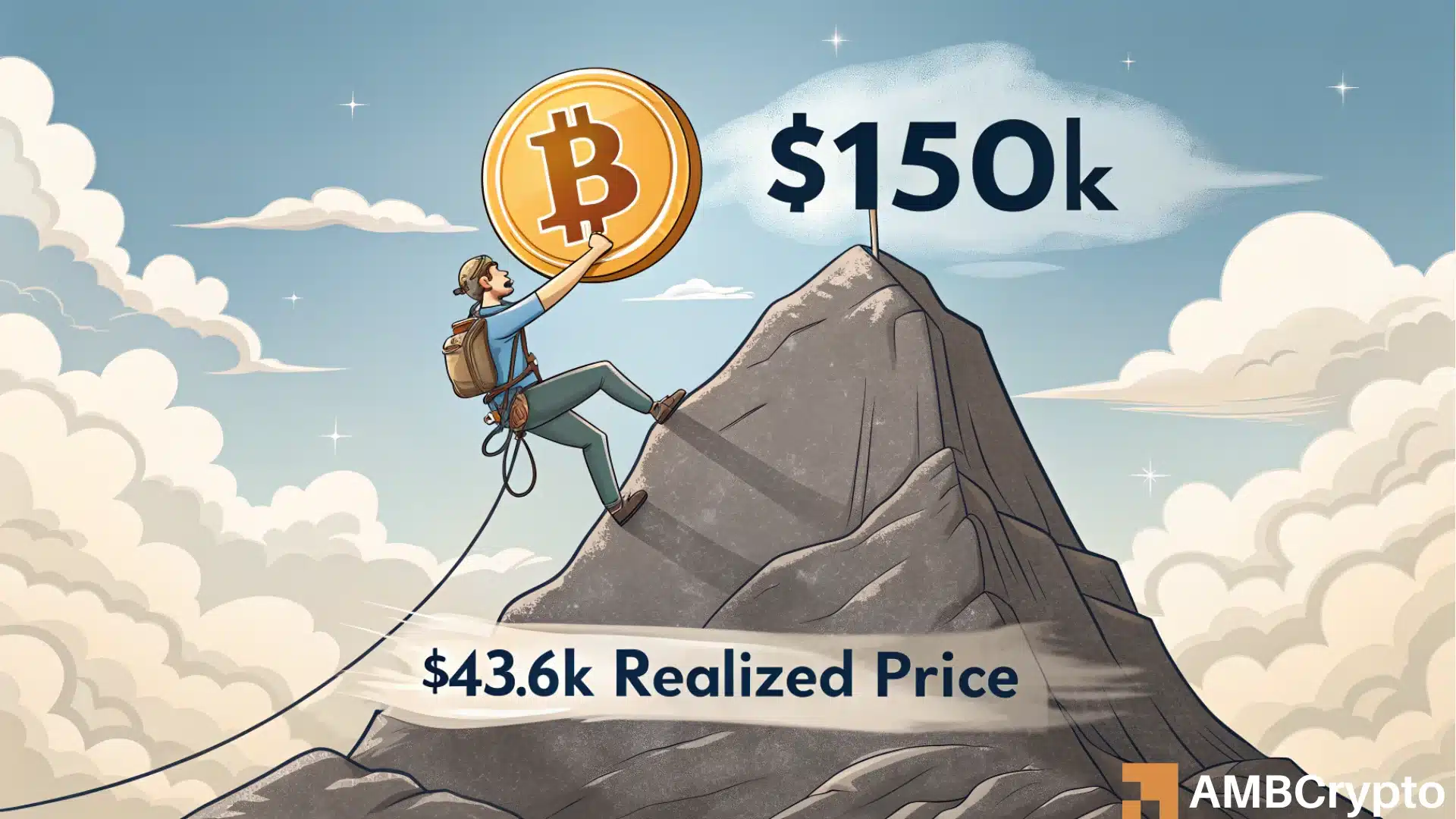
Bitcoin realized price hits $43.6K: Will $150K be BTC’s next milestone?

AmbcryptoОпубликовано 2025-03-25Обновлено 2025-03-25

Введение

There’s more to this than what meets the eye.

Bitcoin [BTC] continues to hover near the $84,000 mark, maintaining its dominance in a market that is both energetic and cautiously observant.
As traders eye new all-time highs, on-chain metrics provide deeper insights into market sentiment and structural strength — none more telling than the concept of realized price.

Realized price, which reflects the average acquisition cost of Bitcoin across all holders or specific user groups, has become a powerful tool for assessing profitability and potential inflection points.

Among the most notable data points: Binance users currently sit on realized price levels near $56,000, suggesting a large majority remain in profit.

Meanwhile, Bitcoin’s overall realized price has climbed to $43.6K, prompting speculation of a possible run toward $150,000…should historical patterns hold.

Will the trend continue, or are we approaching a saturation point?

Binance user deposit address realized price

Binance’s user deposit address realized price reflects the average cost basis of BTC deposited into the exchange — currently around $56,000.

With Bitcoin trading around $84k, most Binance users remain in profit, signaling strong market resilience.

This metric is key for gauging investor sentiment. When it nears or exceeds market price, it can indicate stress or capitulation. Right now, it suggests confidence and continued accumulation.
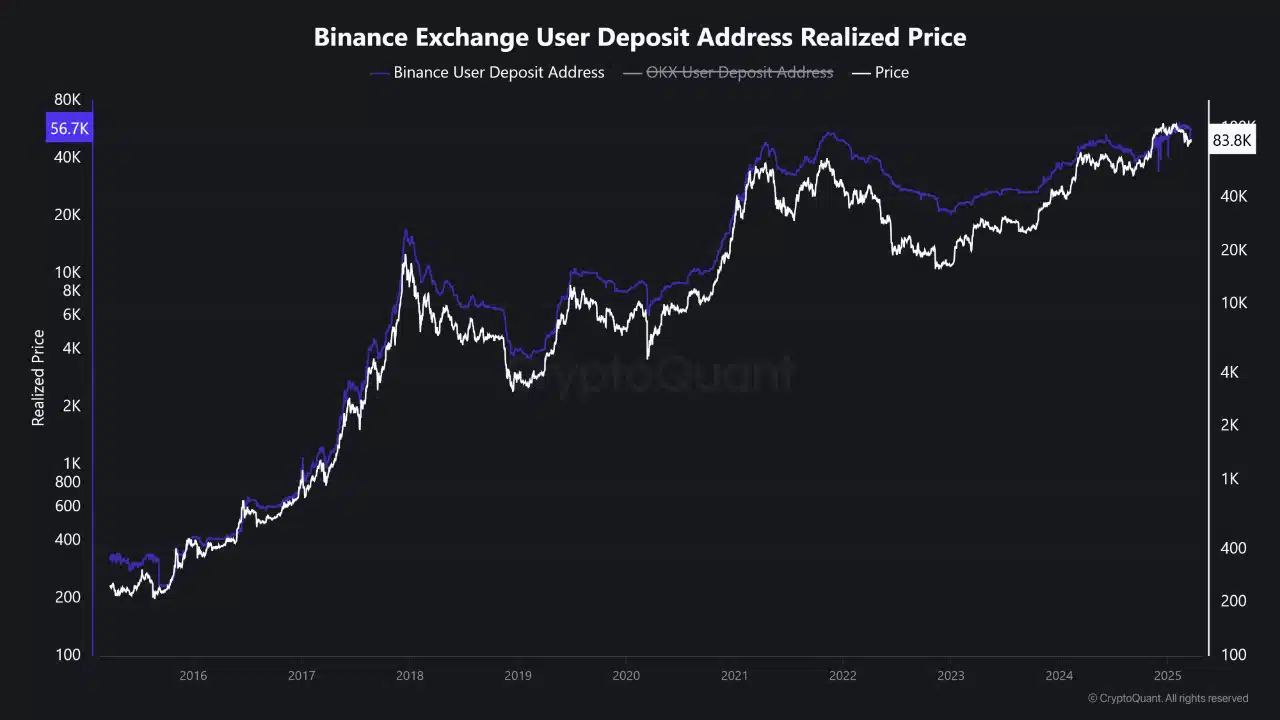
There’s a steady rise in realized price with minor pullbacks that align with Bitcoin’s corrections. Crucially, the realized price hasn’t fallen below market levels, reinforcing that large-scale distribution hasn’t begun.

Binance’s central role in liquidity and user activity adds weight to this trend, pointing to a healthy market cycle still in motion.

Bitcoin realized price: Climbing to new heights

Bitcoin’s realized price — now at $43.6K — represents the average price at which all coins last moved on-chain. It offers a network-wide view of holder cost basis and market sentiment.

With BTC trading at $84K, the average investor holds an unrealized gain of 92%, highlighting broad profitability.
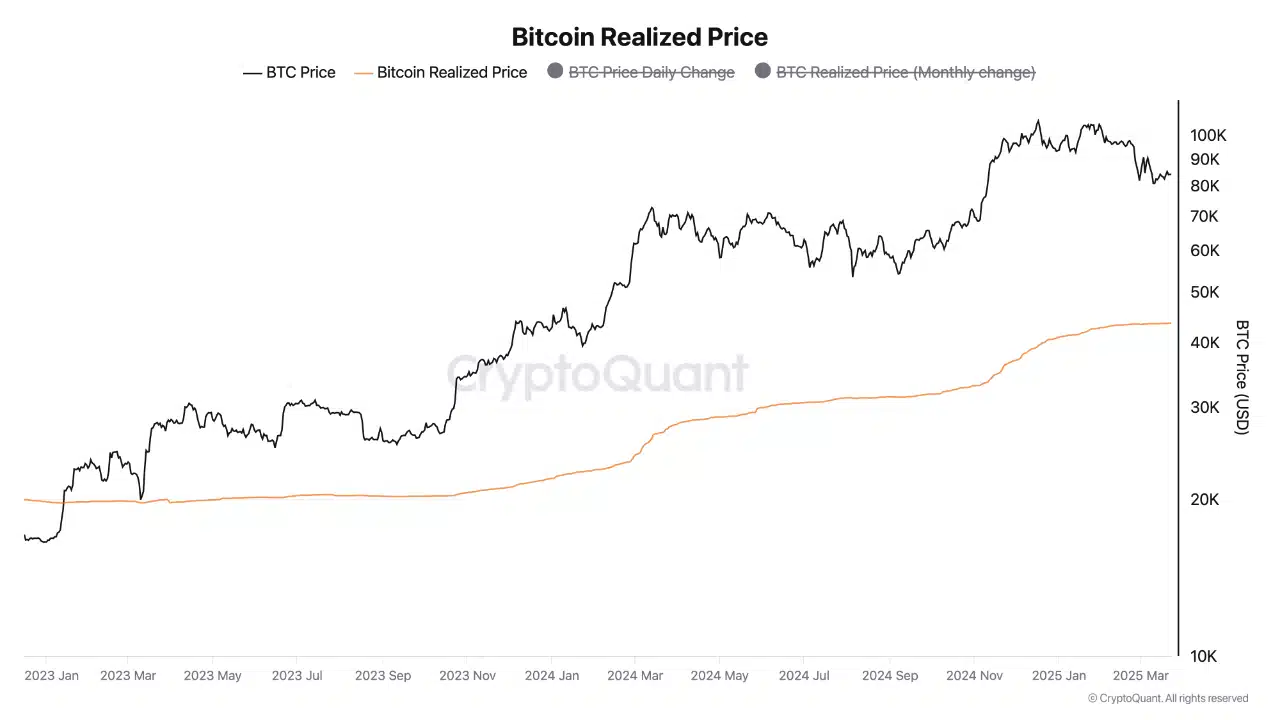
The data shows a steady rise, typical of bull cycles, as coins shift hands at higher prices. This trend often precedes major market tops, reflecting growing capital inflows.

For realized price to hit $70K, a significant volume of transactions would need to occur above current levels.

Experts believe this could push Bitcoin toward the $150K-$180K range, marking a new era where previous all-time highs become support rather than resistance.

Signal of strength or setup for correction?

The divergence between Bitcoin’s realized price and market price serves as a vital sentiment gauge.

As long as the realized price trends higher while staying below the market price, it signals strong conviction and steady capital inflows.

Currently, Binance users’ realized price sits near $56,000 and Bitcoin’s network-wide realized price stands at $43.6K — both well below the current $84,000 market price. This setup points to confidence and continued accumulation.

However, risks remain. A sharp price correction that drags BTC below the Binance user realized price could trigger a psychological shift.

Profit margins would shrink, possibly igniting panic selling and the early stages of a distribution phase.

Still, the long-term outlook holds promise. Historically, Bitcoin peaks at 3-4x its realized price. With realized price at $43.6K, a cycle top between $130K and $180K is plausible.

For realized price to reach $70K or more, we’d need continued inflows, institutional support, and strategic selling. If that unfolds, $150K+ could mark the start of a new price era!

Похожее

The Evolution Path of Physical Bitcoin

The Evolution of Physical Bitcoin Bitcoin's digital nature is its core strength, enabling self-custody and rapid global transfers. However, its intangibility also hinders mainstream adoption. For over a decade, creators have attempted to materialize Bitcoin while preserving its cash-like properties, yielding notable results. Casascius Coins, launched in 2011, were the first and most iconic physical Bitcoin. Creator Mike Caldwell generated private keys offline, printed them on coins, and sealed them with tamper-evident holograms. This model relied on user trust in the centralized issuer. Production ceased in 2013 due to regulatory pressure from FinCEN. RavenBit Coins emerged in 2014 aiming to decentralize minting by letting users generate and apply their own keys. However, this led to trust issues with numerous untrusted minters and insecure key generation methods. In 2016, Coinkite introduced Opendimes—a breakthrough in bearer asset technology. These USB-shaped devices generate and store keys internally. Funds can be received by checking the public key, but spending requires physically breaking the device to extract the private key. While innovative and open-source, its cost (~$20) and form factor limit its use for small, everyday transactions. Satochip's Satodime, a card-shaped device using similar secure chip technology, followed. It supports NFC interaction and comes in various forms. While potentially cheaper in bulk (~13€), it remains a high-security hardware wallet, not a low-cost cash substitute. A fundamental cost barrier exists. For physical Bitcoin to achieve widespread commercial use, hardware costs must drop below $1 to match the production cost of fiat banknotes. Current secure chips capable of running Bitcoin's cryptographic algorithms (like secp256k1) are too expensive. Chips like NXP's NTAG X DNA (~$3) show cost-reduction potential but lack native Bitcoin curve support. Projects like OfflineCash embed chips in banknote-like paper, but face challenges with durability, the need for custom Bitcoin-enabled chips, and the inherent requirement for users to verify balances online—which conflicts with Bitcoin's trustless ideal. Coinkite's Tapsigner, a ~$20 card with a proprietary Bitcoin NFC chip, is seen as a more practical step forward. It functions as a reloadable hardware wallet for contactless payments, solving the "change" problem and focusing on real-world retail integration, a direction also pursued by companies like Cash App and Square. In summary, the journey to physical Bitcoin has progressed from trusted centralized mints (Casascius) to user-generated keys (RavenBit) and finally to self-contained secure hardware (Opendimes, Satodime, Tapsigner). The core challenge remains developing a sufficiently low-cost, durable, and truly trustless physical bearer asset that can function like cash in daily transactions. Current solutions are either too expensive or introduce new trust assumptions, keeping the ideal of ubiquitous physical Bitcoin just out of reach for now.

marsbit9 мин. назад

The Evolution Path of Physical Bitcoin

marsbit9 мин. назад

Samsung Relies on Technology Cycles, SK Hynix on HBM, How Did Micron Win a Trillion-Dollar Market Cap?

Micron Technology, the third-largest memory chip maker alongside Samsung and SK Hynix, recently saw its market cap surpass $1 trillion. Founded in 1978 in Boise, Idaho, Micron survived brutal industry cycles while American peers and Japan's memory sector faltered. Its survival is attributed to a dual strategy: leveraging political and legal avenues for critical breathing room, coupled with relentless manufacturing cost control. Historically, Micron sought U.S. government intervention three times. In 1985, it filed an anti-dumping complaint against Japanese firms, leading to the U.S.-Japan Semiconductor Agreement. Ironically, this created an opening for Samsung, which later became its toughest competitor. In 2002, Micron turned "whistleblower" in a DRAM price-fixing investigation, escaping penalties while rivals were fined. In 2017, it sued China's Fujian Jinhua, contributing to its placement on a U.S. entity list, stifling a nascent competitor. However, a major strategic misstep occurred in 2013 with the acquisition of bankrupt Japanese firm Elpida. Integrating Elpida's mobile-DRAM-focused technology diverted resources, causing Micron to miss the critical early decade of development for High Bandwidth Memory (HBM)—the high-performance memory essential for AI chips like NVIDIA GPUs. By the time AI demand exploded in 2022, SK Hynix, which launched the first HBM in 2013, held about 85% of the HBM3 market, leaving Micron with roughly 3%. Micron now faces a triple squeeze. In the high-end HBM market, it lags significantly behind SK Hynix and Samsung. In the mid-to-low end DRAM market, it faces aggressive price competition from China's CXMT. Furthermore, a 2023 Chinese cybersecurity ban on its products slashed its revenue from China, a once-core market, from over 10% to just 7.1% by FY2025, causing it to exit China's data center server business. Beneath its political maneuvering lies Micron's core strength: exceptional manufacturing efficiency and cost control. Decades of engineering have yielded DRAM chips with a smaller cell area than rivals, meaning more chips per wafer and lower unit costs. This efficiency, not subsidies, has allowed it to withstand price wars. While political leverage bought time, Micron is now paying a "time debt" in the HBM race. It is racing to ramp up HBM3E production and develop HBM4, but catching up to competitors who started a decade earlier is a monumental challenge. Its future hinges on whether its expertise in cost control and political strategy can compensate for the lost time in a technology race where early-mover advantage is decisive.

链捕手42 мин. назад

Samsung Relies on Technology Cycles, SK Hynix on HBM, How Did Micron Win a Trillion-Dollar Market Cap?

链捕手42 мин. назад

New AMD Paper Overturns Conventional Wisdom: FP4 Training Instability's Cause Is Not Insufficient Randomness

AMD's new research challenges the conventional understanding of FP4 training instability. While reducing precision from FP8 to FP4 promises doubled computational throughput and is supported by new hardware like NVIDIA Blackwell and AMD MI350 series, training large language models natively with FP4 has been notoriously unstable, often attributed to insufficient stochasticity. The paper "Pretraining large language models with MXFP4 on Native FP4 Hardware" demonstrates successful end-to-end FP4 pre-training of Llama 3.1-8B on AMD MI355X GPUs using the MXFP4 format, achieving a 9-10% overall speedup over FP8. Crucially, it identifies the root cause of instability: not randomness, but the accumulation of *structural micro-scaling errors* along the sensitive weight gradient (Wgrad) path. Through controlled experiments, researchers found that quantizing the Wgrad operation to FP4 caused significant convergence degradation. Counterintuitively, common stochasticity-based mitigation techniques like stochastic rounding and randomized Hadamard transforms worsened performance. In contrast, applying a *deterministic* Hadamard transform successfully stabilized training by ensuring consistent error patterns, reducing the extra token cost from 26-27% to just 8-9%. This work has significant implications: 1) It provides a clear diagnostic for low-precision training instability, steering focus towards structural errors. 2) It pushes FP4 from a primarily inference-focused format into the realm of viable training. 3) It leverages the open OCP Microscaling (MX) standard, promoting cross-vendor compatibility. The research marks a critical step towards more economical large model training by further pushing the boundaries of low-precision computation.

marsbit1 ч. назад

New AMD Paper Overturns Conventional Wisdom: FP4 Training Instability's Cause Is Not Insufficient Randomness

marsbit1 ч. назад

Торговля

Спот
Фьючерсы

Популярные статьи

Тест по Bitcoin Биткоина

HTX Learn: Изучите Bitcoin halving и Заработаете Токены USDT

3.0k просмотров всегоОпубликовано 2024.04.16Обновлено 2024.04.16

Тест по Bitcoin  Биткоина

Что такое $BITCOIN

ЦИФРОВОЕ ЗОЛОТО ($BITCOIN): Комплексный анализ Введение в ЦИФРОВОЕ ЗОЛОТО ($BITCOIN) ЦИФРОВОЕ ЗОЛОТО ($BITCOIN) — это проект на основе блокчейна, работающий в сети Solana, который стремится объединить характеристики традиционных драгоценных металлов с инновациями децентрализованных технологий. Хотя он носит имя Биткойн, часто называемого “цифровым золотом” из-за его восприятия как средства хранения ценности, ЦИФРОВОЕ ЗОЛОТО является отдельным токеном, предназначенным для создания уникальной экосистемы в ландшафте Web3. Его цель — позиционировать себя как жизнеспособный альтернативный цифровой актив, хотя детали его применения и функциональности все еще развиваются. Что такое ЦИФРОВОЕ ЗОЛОТО ($BITCOIN)? ЦИФРОВОЕ ЗОЛОТО ($BITCOIN) — это токен криптовалюты, специально разработанный для использования в блокчейне Solana. В отличие от Биткойна, который выполняет широко признанную роль хранения ценности, этот токен, похоже, сосредоточен на более широких приложениях и характеристиках. Примечательные аспекты включают: Инфраструктура блокчейна: Токен построен на блокчейне Solana, известном своей способностью обрабатывать высокоскоростные и недорогие транзакции. Динамика предложения: ЦИФРОВОЕ ЗОЛОТО имеет максимальное предложение, ограниченное 100 квадриллионами токенов (100P $BITCOIN), хотя детали о его обращающемся предложении в настоящее время не раскрыты. Утилита: Хотя точные функциональные возможности не описаны, есть указания на то, что токен может быть использован для различных приложений, потенциально связанных с децентрализованными приложениями (dApps) или стратегиями токенизации активов. Кто создатель ЦИФРОВОГО ЗОЛОТА ($BITCOIN)? На данный момент личность создателей и команды разработчиков, стоящих за ЦИФРОВЫМ ЗОЛОТОМ ($BITCOIN), остается неизвестной. Эта ситуация типична для многих инновационных проектов в области блокчейна, особенно тех, которые связаны с децентрализованными финансами и феноменом мем-криптовалют. Хотя такая анонимность может способствовать культуре, ориентированной на сообщество, она усиливает опасения по поводу управления и ответственности. Кто инвесторы ЦИФРОВОГО ЗОЛОТА ($BITCOIN)? Доступная информация указывает на то, что у ЦИФРОВОГО ЗОЛОТА ($BITCOIN) нет известных институциональных спонсоров или значительных венчурных капиталовложений. Проект, похоже, функционирует по модели пирингового взаимодействия, сосредоточенной на поддержке и принятии сообществом, а не на традиционных путях финансирования. Его активность и ликвидность в основном сосредоточены на децентрализованных биржах (DEX), таких как PumpSwap, а не на устоявшихся централизованных торговых платформах, что еще больше подчеркивает его подход, ориентированный на grassroots. Как работает ЦИФРОВОЕ ЗОЛОТО ($BITCOIN) Операционные механизмы ЦИФРОВОГО ЗОЛОТА ($BITCOIN) можно подробно описать на основе его дизайна блокчейна и характеристик сети: Механизм консенсуса: Используя уникальный механизм доказательства истории (PoH) Solana в сочетании с моделью доказательства доли (PoS), проект обеспечивает эффективную валидацию транзакций, что способствует высокой производительности сети. Токеномика: Хотя конкретные дефляционные механизмы не были подробно описаны, большое максимальное предложение токенов подразумевает, что оно может быть предназначено для микротранзакций или нишевых случаев использования, которые еще предстоит определить. Интероперабельность: Существует потенциал для интеграции с более широкой экосистемой Solana, включая различные платформы децентрализованных финансов (DeFi). Однако детали относительно конкретных интеграций остаются неуточненными. Хронология ключевых событий Вот хронология, которая подчеркивает значимые вехи, касающиеся ЦИФРОВОГО ЗОЛОТА ($BITCOIN): 2023: Первоначальное развертывание токена происходит в блокчейне Solana, отмеченное его адресом контракта. 2024: ЦИФРОВОЕ ЗОЛОТО приобретает видимость, когда оно становится доступным для торговли на децентрализованных биржах, таких как PumpSwap, позволяя пользователям обменивать его на SOL. 2025: Проект наблюдает спорадическую торговую активность и потенциальный интерес к инициативам, возглавляемым сообществом, хотя на данный момент не зафиксировано никаких значительных партнерств или технических достижений. Критический анализ Сильные стороны Масштабируемость: Основная инфраструктура Solana поддерживает высокие объемы транзакций, что может повысить полезность $BITCOIN в различных сценариях транзакций. Доступность: Потенциально низкая цена торговли за токен может привлечь розничных инвесторов, способствуя более широкому участию благодаря возможностям дробного владения. Риски Отсутствие прозрачности: Отсутствие публично известных спонсоров, разработчиков или процесса аудита может вызвать скептицизм относительно устойчивости и надежности проекта. Волатильность рынка: Торговая активность сильно зависит от спекулятивного поведения, что может привести к значительной волатильности цен и неопределенности для инвесторов. Заключение ЦИФРОВОЕ ЗОЛОТО ($BITCOIN) является интригующим, но неоднозначным проектом в быстро развивающейся экосистеме Solana. Хотя он пытается использовать нарратив “цифрового золота”, его отход от установленной роли Биткойна как средства хранения ценности подчеркивает необходимость более четкого различения его предполагаемой утилиты и структуры управления. Будущее принятие и усвоение, вероятно, будут зависеть от решения текущей непрозрачности и более четкого определения его операционных и экономических стратегий. Примечание: Этот отчет охватывает синтезированную информацию, доступную на октябрь 2023 года, и с тех пор могут произойти события.

99 просмотров всегоОпубликовано 2025.05.13Обновлено 2025.05.13

Что такое $BITCOIN

Fractal Bitcoin: масштабирование Биткоина с помощью рекурсивной системы

Fractal Bitcoin — масштабное Layer-1-решнение, созданное на базе кода Биткоина, позволяющего достигать бесконечного масштабирования с помощью рекурсивного подхода.

2.3k просмотров всегоОпубликовано 2025.06.30Обновлено 2025.06.30

Fractal Bitcoin: масштабирование Биткоина с помощью рекурсивной системы

Обсуждения

Добро пожаловать в Сообщество HTX. Здесь вы сможете быть в курсе последних новостей о развитии платформы и получить доступ к профессиональной аналитической информации о рынке. Мнения пользователей о цене на BTC (BTC) представлены ниже.

活动图片