From PEPU Gains to WEPE: Whale Puts $200K into Presale After Huge $360K Flip

bitcoinistОпубликовано 2024-12-17Обновлено 2024-12-17

Введение

If you ever needed an example of the potential huge gains to be made on a currently bullish crypto market,...

If you ever needed an example of the potential huge gains to be made on a currently bullish crypto market, look no further than this investor who took a big chance – and it paid off big.

A whale investor placed a not-inconsiderable $160,000 into $PEPU and quickly made $200,000 profit on it. Rather than leave it in there and potentially make more money on $PEPU, he took the $200,000 profit out and put it all on Wall Street Pepe ($WEPE) – with the other $160,000 still sitting on $PEPU and gaining more there.

Is $WEPE Following in $PEPU’s Footsteps?

With a current $WEPE token price of $0.002588 and a staking APY currently sitting at 46%, that $200,000 has a high chance of turning into a huge stack of cash. That’s not guaranteed obviously, but the prospects are looking rather good.

It seems the investor also has a fondness for Pepe the Frog. $PEPU and $WEPE are both based on Pepe, and this fondness is currently translating into a huge financial windfall. $WEPE was designed to exploit the popularity of $PEPU and so far, it seems to be working.

Buying Into $PEPU and $WEPE? Knowing When To Exit is Key

If you want to try your luck at making some money with Pepe, you can go to both $WEPE and $PEPU and buy some tokens. $PEPU is currently valued at $0.015293 and $WEPE at $0.002588. But it’s 10 only hours till the next $WEPE price increase, so you need to hurry before the current price disappears.
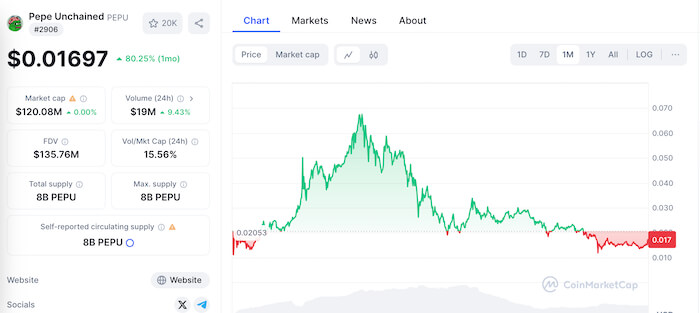
chart showing $PEPU gains and losses

This is a good illustration of why it can be a huge benefit to getting into crypto coins early. PEPU’s value started off low at $0.008 in the initial stage of the presale, then steadily climbed to a high of $0.06585. Then it began a gradual decline down to its current price of $0.017, which is still a significant gain for early buyers.

$PEPE is still trading strongly, and the price may possibly bounce back up. But for anyone looking to make a quick gain, this shows that it can be done if you get in at the right time, and know when to exit.

Investing is always a form of gambling at a certain level, hoping your numbers come up. But success stories like this show the amazing luck that some people can have, if they have the funds and are willing to hold their nerve.

Whales Buying Into WEPE Is a Good Sign – But Still Be Cautious

But as we always like to emphasize, predictions are not guarantees. This is not financial or investment advice. Always do your own independent research and come to your own conclusions before committing any money to crypto markets. Don’t ever invest anything that you can’t afford to potentially lose.

Keep your wits about you and don’t get swept up by hysteria and the lure of even bigger profits. Some people have different benchmarks for knowing when to quit. Some are happy with doubling their money, but it’s perfectly fine to wait for 4x or even 5x. But always know when to call it a day. A little profit is better than a huge loss.

Mark O'Neill

Mark O'Neill

Mark has been writing about tech and online subjects since 2004. He has been managing editor to 5 tech websites, the biggest being MakeUseOf.com which he helped grow from 9,000 monthly visitors to over 500,000 by the end of his 6-year tenure. As well as MakeUseOf, he has branched out into other sites and subject expertise such as cybersecurity, online privacy, online marketing, and online business. His writing credits include Lifehacker, NowSourcing, GroovyPost, Small Business Trends, PC World, Online Tech Tips, Help Desk Geek, Switching to Mac, XDA, Android Authority, Matter Alpha, and Moonlock. He is now branching into cryptocurrencies, with his interest mainly in Ethereum and new meme coins. Being a newcomer to the topic, he wants to educate others as he learns himself.

Похожее

Fantasy's Closing Notes: After Two and a Half Years of Trial and Error in SocialFi, What Have We Learned?

"Fantasy Shutdown Notes: Two and a Half Years of SocialFi Trial, What Have We Learned?" Fantasy, a SocialFi/crypto card game, is shutting down. The team is refunding 100% of investments to angel/seed round backers, as operational costs were fully covered by revenue. Over 2.5 years, the project returned approximately $20M to its community. The core reason for failure was building crypto economics on a foundation not designed for it. Traditional card games (Magic, Pokémon) succeed by prioritizing gameplay; financial value is a secondary outcome. Crypto card games invert this, attracting speculators first, not genuine players. This financialization trapped the team into managing a financial instrument instead of developing a game. This is a sector-wide issue. Embedding tokenomics into social products or creator-fan relationships often attracts short-term traders over genuine users, undermining the core value. The article also critiques premature token launches. Most tokens fail because they're issued before product-market fit is proven, diverting team and community focus to price speculation instead of building. Successful examples like Hyperliquid or Jupiter built sustainable businesses first. Fantasy's journey highlights key crypto pitfalls: the distorting effect of upfront financialization in gaming/social apps, and the dangers of launching tokens too early. The team hopes sharing these lessons helps future builders avoid the same traps.

marsbit28 мин. назад

Fantasy's Closing Notes: After Two and a Half Years of Trial and Error in SocialFi, What Have We Learned?

marsbit28 мин. назад

Two Companies Capture 90% of AI Startup's $80 Billion ARR

The AI startup landscape is highly concentrated, with OpenAI and Anthropic capturing 89% of an estimated $80 billion in annualized revenue among 34 leading companies. OpenAI, with $24-25B in revenue, primarily drives growth through ChatGPT's consumer subscriptions, while Anthropic, exceeding $30B, focuses on enterprise API integration and has rapidly grown its U.S. enterprise market share from under 1% to 34.4% in under two years. The remaining 32 companies share just 11% of the revenue, facing intense pressure as resources, talent, and market attention consolidate around the two giants. This creates a self-reinforcing cycle where higher revenue fuels greater compute investment and model improvement. Despite their dominance, both leaders face challenges. OpenAI is navigating significant legal disputes and partnership tensions, while Anthropic operates under the high expectations of its massive backers like Amazon. Historical parallels in tech infrastructure (e.g., search engines, mobile OS) suggest such oligopolistic tendencies are common due to scale, network effects, and high switching costs, indicating the market could become even more concentrated. However, the rapid pace of AI innovation leaves room for disruption. For other players, the strategic path forward is not direct competition with the giants but specialization in vertical domains where general-purpose models fall short—such as legal, medical, or industrial applications—building indispensable, niche solutions.

marsbit37 мин. назад

Two Companies Capture 90% of AI Startup's $80 Billion ARR

marsbit37 мин. назад

Торговля

Спот
Фьючерсы
活动图片





