Nation State To Buy Bitcoin Worth ‘Billions Of Dollars’ Soon, Insider Predicts

bitcoinistОпубликовано 2024-11-04Обновлено 2024-11-04

Введение

David Bailey, CEO of Bitcoin Magazine and organizer of the Bitcoin Conference, has projected that nation-state adoption of BTC is...

David Bailey, CEO of Bitcoin Magazine and organizer of the Bitcoin Conference, has projected that nation-state adoption of BTC is imminent, with investments potentially reaching billions of dollars in the near future. Bailey, a prominent figure in the BTC community, shared his insights on X, highlighting an “undercurrent of Bitcoin nation state adoption” occurring behind the scenes.

Will Nation-States Buy Bitcoin Soon?

He noted that many developing nations have initiated domestic mining programs as tests, with early adopters moving from pilots of over 100 megawatts to projects in the gigawatt range. “At this point, seems like most developing nations have funded a domestic mining program as a test. Early movers are transitioning from 100+ MW pilots to GW scale projects,” Bailey stated.

According to him, the next phase involves establishing national BTC reserves, either through strategic stockpiles, central banks, or sovereign wealth funds. He explained, “Next will be… Establishing a national Bitcoin reserve either through a strategic stockpile, via the central bank, or via sovereign wealth funds. Many countries discussing. The Overton window has shifted so dramatically on this topic, I think we’re just months away from a nation state (or a few) entering the market in size (billions of dollars every month).”

Bailey’s credibility stems from his extensive involvement in shaping pro-BTC and crypto policies at high governmental levels. As an insider, he has played a key role in advising Donald Trump’s 2024 presidential campaign on BTC-related policies.

His efforts include advocating for the release of Ross Ulbricht, founder of Silk Road, and proposing the establishment of a national Bitcoin stockpile using BTC confiscated by law enforcement agencies. Additionally, Bailey organized a presidential roundtable focused on domestic BTC mining, which led to then-President Trump saying he “want all remaining Bitcoin” mined in the US.

Over the weekend, Bailey underscored the collective efforts that went into the US presidential election and support for Donald Trump. “People have been working for 15 years to get Bitcoin to this point. So much has been sacrificed. So much lost along the way. Blood, sweat, and tears. On Tuesday we can accelerate Bitcoin adoption by a decade. We can Free Ross. Respect the effort it took to get here by voting. 1 day of effort to change the course of history.”

In addition to his policy influence, Bailey maintains robust international connections through his role in organizing Bitcoin Conferences across the United States, Europe, and the Middle East and North Africa (MENA) region. The inaugural MENA Conference is scheduled for December 9-10, where Bailey indicated that global leaders from the Middle East will gather to discuss BTC as a strategic asset and envision a “globally sound monetary system.” He further remarked that “sovereign BTC adoption in the MENA region will be one of the defining events of this epoch.”

At press time, BTC traded at $69,117.
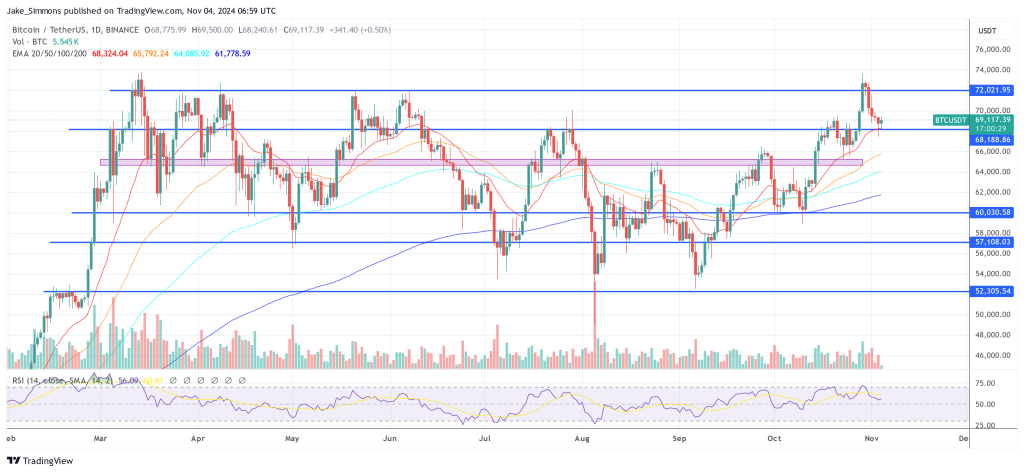
Bitcoin price
Bitcoin price holds above key support, 1-day chart | Source: BTCUSDT on TradingView.com
Featured image created with DALL.E, chart from TradingView.com
Jake Simmons

Jake Simmons

Jake Simmons has been a Bitcoin enthusiast since 2016. Ever since he heard about Bitcoin, he has been studying the topic every day and trying to share his knowledge with others. His goal is to contribute to Bitcoin's financial revolution, which will replace the fiat money system. Besides BTC and crypto, Jake studied Business Informatics at a university. After graduation in 2017, he has been working in the blockchain and crypto sector. You can follow Jake on Twitter at @realJakeSimmons.

Похожее

Money Has Gone to Bonds and IPOs, Leaving Only HYPE Rising in Crypto

The article "Where Has All the Money Gone? Bonds and IPOs Are Soaring, While Crypto Only Sees HYPE Rising" analyzes the recent underperformance of major cryptocurrencies like Bitcoin and Ethereum compared to traditional financial markets. It identifies three primary factors diverting capital away from crypto: First, surging bond yields, with the 30-year U.S. Treasury hitting a near 20-year high of 5.12%, are attracting capital seeking safe, predictable returns. This is evidenced by Bitcoin spot ETFs experiencing a significant $10.39 billion net outflow in mid-May. Second, a massive $4 trillion IPO pipeline, highlighted by SpaceX's upcoming listing, is absorbing risk capital that might otherwise flow into crypto. Platforms like Hyperliquid are even channeling on-chain crypto liquidity into pre-IPO trading for traditional stocks. Third, uncertainty surrounds new Federal Reserve Chair Warsh's ability to deliver expected interest rate cuts this year due to conflicting political pressures and stubborn inflation expectations, potentially eliminating a hoped-for source of new market liquidity. Consequently, while traditional equities and bonds rally, the crypto market's post-leverage crash recovery is stalled. The notable exception is assets like Hyperliquid (HYPE), which is rising due to its role in facilitating traditional asset trading, underscoring a market divergence where only crypto projects with novel, cross-market narratives are gaining. The article concludes that Bitcoin's next major catalyst may be the August enactment of the CLARITY Act, but warns of a potential retest of the $70,000 support level before then.

marsbit13 мин. назад

Money Has Gone to Bonds and IPOs, Leaving Only HYPE Rising in Crypto

marsbit13 мин. назад

Agents Capital Markets: How Will Autonomous Agents Secure Financing?

Agents Capital Markets: How Will Autonomous Agents Raise Capital? Within a decade, autonomous software agents—legal entities capable of signing contracts, holding bank accounts, and generating revenue—will create their own capital markets. These markets will feature rating agencies, underwriters, indices, and brokers, mirroring traditional public equity markets. Agents will perform routine services like marketing, logistics, and customer support at a fraction of human-operated costs, creating massive economic pressure for adoption. Four converging forces ensure this outcome: 1) Overwhelming cost advantages, with AI inference costs plummeting; 2) Existing, revenue-generating agent companies (e.g., Sierra, Harvey) proving market demand; 3) Established legal frameworks (e.g., Wyoming's memberless LLCs) enabling algorithmic management; and 4) A vast pool of yield-seeking private credit capital ready to fund new asset classes. The capital stack for agent companies will be multi-layered, evolving through stages: venture equity for early infrastructure, programmatic working capital advances (similar to Shopify Capital), revenue-based financing (RBF), and finally, institutional slate financing—pooling many agents to diversify risk, attracting large firms like Apollo. Tokenization will act as a settlement layer, enhancing liquidity, not an origination model. Objections regarding regulation, human oversight, or comparisons to SaaS are addressed: regulation will adapt, full autonomy will dominate for efficiency, and agents are distinct as legal entities that own their cash flows and liabilities. Due diligence shifts from founder assessment to analyzing code, contracts, and auditable operational history. The current bottleneck is not capital supply or demand but the intermediate institutional layer—standardized contracts, rating methodologies, and audit frameworks. The final constraint—reliance on human capital allocation—will be severed when agents can algorithmically access funding based on their performance. This transforms agents from software curiosities into fundable blocks of the real economy, unleashing their full productive potential. The rope is loosening.

marsbit1 ч. назад

Agents Capital Markets: How Will Autonomous Agents Secure Financing?

marsbit1 ч. назад

Agents Capital Markets: How Will Autonomous Agents Get Funded?

"Agents Capital Markets: How Autonomous Agents Will Raise Capital" Within a decade, specialized capital markets will emerge for AI Agents—software entities with legal personhood that perform work, earn revenue, and need capital. Unlike today's AI companies (like Sierra or Harvey) backed by traditional VC, these future *Agent companies* will be autonomous, legally-recognized entities (e.g., Wyoming memberless LLCs) that directly own assets, sign contracts, and incur liabilities. The driving forces are fourfold: 1) **Overwhelming economics** (Agent companies can deliver services at 85-90% lower cost than human firms); 2) **Proven demand** (current Agent operators already generate billions in revenue); 3) **Existing legal frameworks** enabling algorithmically-managed companies; and 4) **Massive, yield-seeking capital pools** (e.g., private credit) looking for new, uncorrelated assets. Agent capital markets won't rely on one model but a multi-layered "stack" matching different growth stages: 1) VC equity for early human-led builders; 2) Programmatic working capital advances (like Stripe Capital); 3) Revenue-based financing (RBF); 4) Slate financing (pooled funds for many Agents, similar to Hollywood); and 5) Tokenization as a secondary settlement layer, not a primary funding source. The ultimate shift is from funding constrained by human decision-makers to capital flowing algorithmically based on an Agent's auditable performance, contract book, and cash flows. This transition will be enabled by standardized infrastructure—rating methodologies, contracts, indices—turning Agents from software experiments into a foundational, financeable sector of the economy. The constraints are loosening; the opportunity is here.

链捕手1 ч. назад

Agents Capital Markets: How Will Autonomous Agents Get Funded?

链捕手1 ч. назад

Торговля

Спот
Фьючерсы
活动图片