21Shares Report: HYPE's P/S Ratio Only Half That of CME, Bull Market Target Price $70

marsbitОпубликовано 2026-05-22Обновлено 2026-05-22

Введение

21Shares Research Report: HYPE's P/S Ratio Half of CME's, Bullish Target $70 A recent report from 21Shares highlights Hyperliquid's evolution from a crypto derivatives DEX into a 24/7 "everything exchange" for perpetual contracts across various asset classes. The platform gained prominence during a February geopolitical incident when it provided real-time price discovery for WTI crude oil while traditional markets like CME were closed. Non-digital assets now account for approximately 35% of its volume, with traditional commodities and indices featuring among its top-traded assets. Hyperliquid's business model is rapidly diversifying, significantly reducing its dependence on crypto market cycles. Its cumulative trading volume and revenue are approaching levels comparable to CME Group's crypto derivatives segment. A key feature is its Assistance Fund, which directs 97%-99% of protocol fees to automated HYPE token buybacks, creating a deflationary mechanism with an implied buyback yield significantly higher than CME's traditional share repurchase program. Despite strong fundamentals, HYPE currently trades at a Price-to-Revenue (P/R) ratio of ~10x, roughly half of CME's ~17x. The report outlines valuation scenarios: a bullish case targets $62-$70 based on annualized revenue reaching $12-$15B and applying CME's P/R multiple. A bear case considers $15-$19 if growth slows. Key risks include platform centralization during crises, regulatory uncertainty for on-chain commodities, de...

Author: 21Shares Research Team

Translation: TechFlow News

TechFlow Insights: The 21Shares research team has released an in-depth report on Hyperliquid, with the core argument being: Hyperliquid has evolved from a crypto derivatives DEX into a 7×24 operational exchange for all types of assets. During the February Iran airstrike, when CME was closed, Hyperliquid's WTI crude oil contract completed price discovery nearly 48 hours early. Traditional assets now account for 35% of trading volume, with revenue approaching CME's, yet its valuation multiple is only half. The report provides bull and bear scenario valuations, worth a serious read.

On February 28th, US-Israeli coalition airstrikes on Iran plunged traditional markets into darkness. The Chicago Mercantile Exchange (CME) was closed, its infrastructure unable to react. Hyperliquid didn't stop. This blockchain-based derivatives exchange operates 7×24, with its WTI crude oil perpetual contract pricing in real-time, surging to $111.53, while traditional market traders could only watch.

This event highlighted Hyperliquid's role as a crucial trading venue and price index during intensified geopolitical conflicts—it provided real-time price discovery during the weekend gap. By March 2nd, when traditional markets reopened, WTI had pushed above $110, and the spread between Hyperliquid and CME had closed. Hyperliquid wasn't just faster; it essentially priced in the shock nearly 48 hours ahead of the traditional system.

That narrative alone is compelling. But what turned it into an investment story is what happened next. Fast-forward two months, 24-hour trading volume for crude oil on Hyperliquid remains around $5 billion, with crude oil contracts still among the platform's top five traded assets.

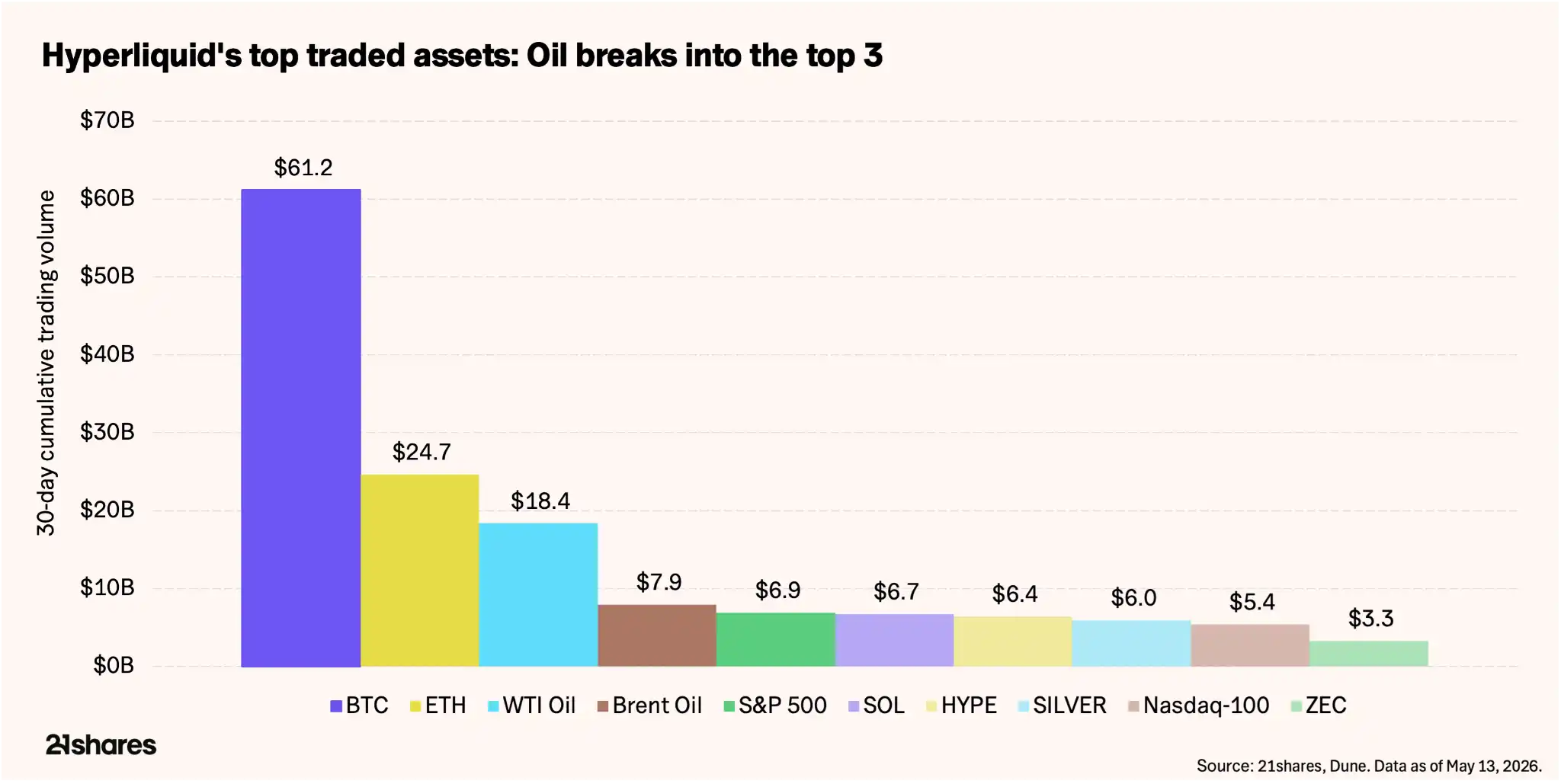
Bitcoin remains the largest traded asset on Hyperliquid, but traditional assets—S&P 500, Silver, Nasdaq 100, WTI, and Brent Crude—now occupy half of the top ten spots. Individual stocks like Micron Technology (MU) even crack the top ten on certain days. We believe this demonstrates Hyperliquid's ultimate trajectory. Hyperliquid is not just an exchange for trading crypto perpetuals; it has fully evolved into an "exchange for everything," where users can trade perpetual contracts on almost any type of asset.

Caption: Distribution of Top Ten Traded Assets on Hyperliquid Platform

Hyperliquid's Business Model is Evolving

This report will help you understand how to reasonably value Hyperliquid and which key metrics and risks investors should monitor.

In the past, most of Hyperliquid's revenue came from digital asset trading, its business model highly correlated with overall crypto market trends. But the growth in non-digital asset trading volume fundamentally broadens the platform's core business model.

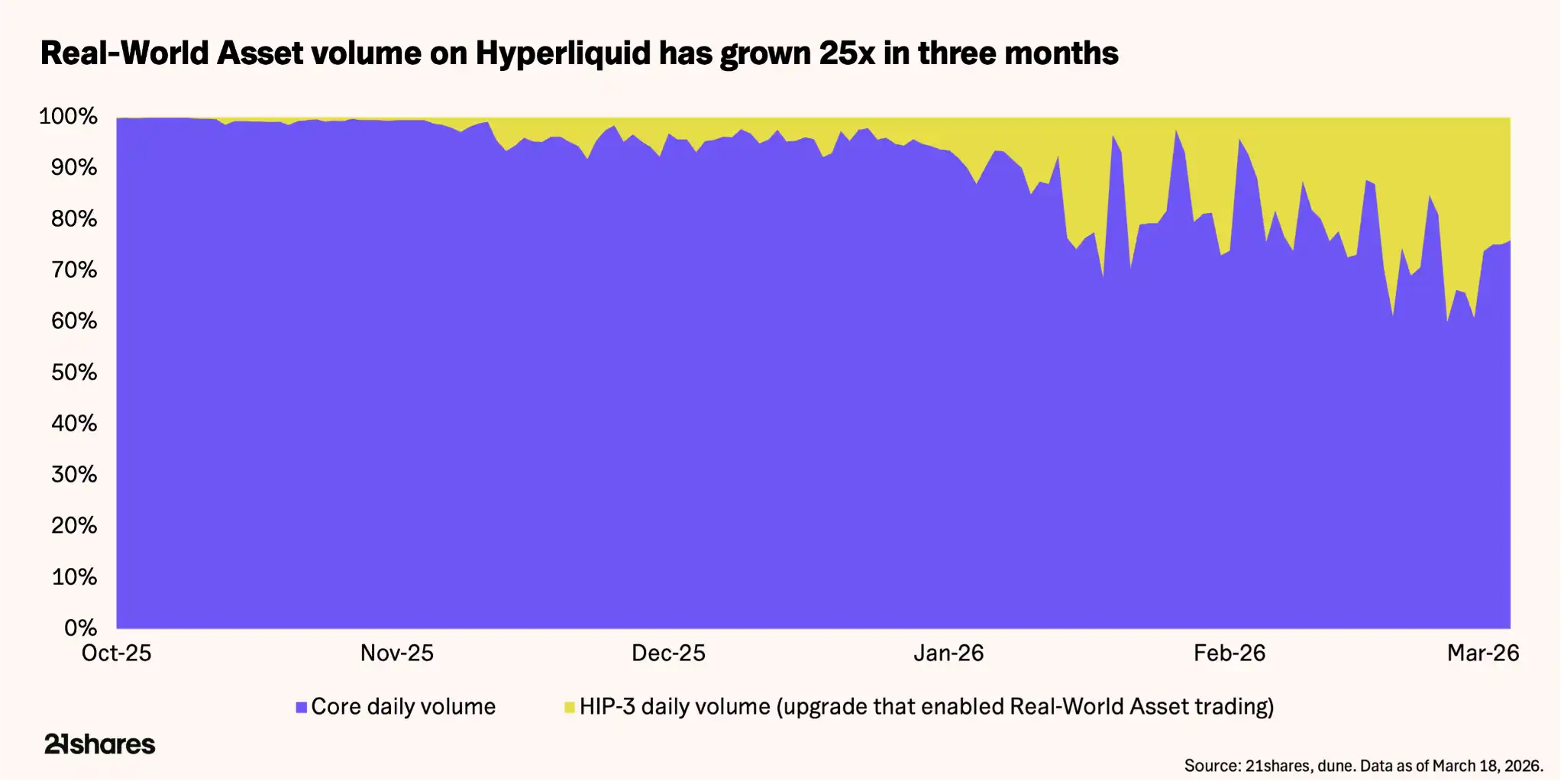
HIP-3 is the protocol's permissionless framework allowing anyone to list new perpetual futures markets. Currently, HIP-3 accounts for about 35%-37% of total trading volume, up 600%-800% from the end of 2025. Open Interest (OI) for these markets reached $1.7 billion in mid-May, growing over 150% since February. Commodities account for about $730 million of that, with crude oil alone making up roughly 20%.

The pace of change is rapid. Crypto trading pairs—the platform's original business—have seen their share drop from around 90% to about 65%. Five of the current top ten traded assets by volume are traditional market instruments, like commodities. A platform that once only offered crypto derivatives is increasingly resembling a macro exchange.

Hyperliquid's bull case is built on this asset class diversification. With the launch of HIP-4 in early May, focusing on prediction markets and options, Hyperliquid is accelerating its journey to becoming an "exchange for everything."

Follow the Money

Hyperliquid's metrics place it among the most profitable protocols in the digital asset space, even allowing comparison with leading traditional derivatives exchanges:

  • Cumulative Historical Total Trading Volume: $4.22 trillion. Of this, $2.9 trillion occurred in 2025, comparable to CME Group's $3 trillion in crypto derivatives contract volume.
  • Cumulative Protocol Total Revenue: $1.15 billion. Single-year revenue in 2025 was $873 million, compared to CME Group's $6.5 billion for the same period.

Furthermore, the HYPE token benefits from a consistent buy-side force and value return mechanism—the Assistance Fund. This fund channels 97%-99% of the platform's generated fees into automated token buybacks, having repurchased over $1.5 billion worth of HYPE to date. This "share buyback program" scales linearly with trading volume, requires no board approval, and directly impacts the token's supply dynamics with every trade.

At current operational pace, the implied buyback yield is approximately 13% of the circulating market cap. For comparison: CME Group approved a $3 billion stock buyback plan at the end of 2024 but only utilized $532 million. Annualizing this gives about $1.06 billion against a market cap of ~$105 billion, a yield of about 1%. Hyperliquid's capital return rate is roughly 13 times that of CME's, albeit with higher risk.

HYPE serves as both the medium for paying trading fees and the required collateral for deploying new HIP-3 markets. Currently, listing a new perpetual contract market requires locking 500,000 HYPE, valued at approximately $19.5 million. As the platform expands to more asset classes, HYPE is simultaneously drawn from circulation in multiple ways. At current trading volumes, the protocol is in a state of net deflation: monthly buybacks of approximately 1.95 million HYPE exceed unlocks and staking releases of about 1.75 million.

Doing the Math

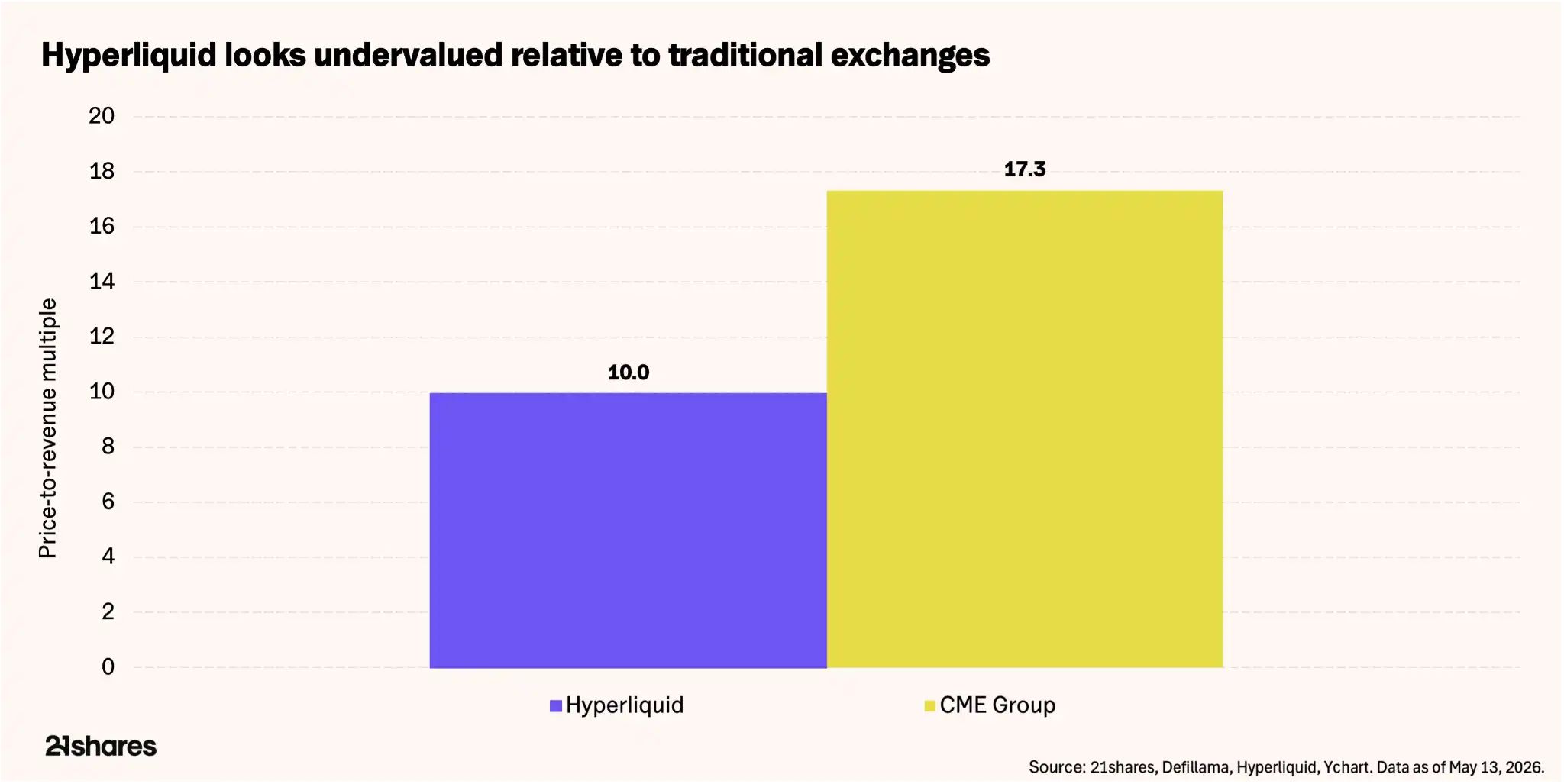
HYPE's current circulating market cap is approximately $9.4 billion. Measured against the past 12 months' revenue of $944 million, Hyperliquid's Price-to-Revenue (P/R) ratio is about 10x—in contrast, the world's largest derivatives exchange, CME Group, trades at a P/R of 17.32x, with a market cap of ~$110 billion and 2025 revenue of $6.5 billion.

Caption: HYPE vs. CME P/R Ratio and Revenue per Employee Comparison

The market is already valuing HYPE using traditional exchange valuation frameworks. The real question is whether Hyperliquid's revenue quality justifies the comparison. To illustrate the efficiency advantage of blockchain infrastructure versus traditional systems: Hyperliquid's 2025 revenue of $873 million was generated by a team of just 11 people—$79.36 million per employee. CME Group's $6.5 billion revenue was supported by 3,875 employees, averaging $1.7 million per person. The difference is stark.

On a fully diluted basis—accounting for the full 1 billion HYPE token supply, most of which is not yet unlocked—the valuation stretches to approximately $37 billion, implying a 38-39x revenue multiple. This figure would only be justified if revenue grows significantly before all tokens enter circulation. But given Hyperliquid's annualized user growth exceeding 100%, coupled with expansion into new asset classes like commodities and prediction markets, this growth premium may be reasonable.

Rather than assigning a specific target price, consider the following scenarios:

Bull Scenario: If geopolitical tensions persist, commodity trading remains elevated, traditional asset traders continue to flock to Hyperliquid post-close, and HIP-3 Open Interest grows to $3-5 billion, annualized revenue could reach the $1.2-$1.5 billion range. Applying CME's 16-17x P/R multiple implies a market cap of $15-$17 billion, corresponding to a HYPE price of ~$62-$70. If options and prediction markets gain traction in the coming months, revenue acceleration could be even stronger.

Base Scenario: Under similar assumptions, with HIP-3 OI growing to $3.2-$5.3 billion, annualized revenue enters the $1.0-$1.1 billion range. At a 17x multiple, the implied market cap is ~$17-$18 billion, corresponding to a HYPE price of ~$75.

Caption: Three Valuation Scenarios Compared (Bull/Base/Bear)

Bear Scenario: If non-digital asset trading cools, buybacks may fail to offset token unlocks, and annualized revenue slides toward the $350-$450 million range. Applying a more conservative 10x multiple—reflecting slower growth and higher dilution—points to a market cap of ~$3.5-$4.5 billion, corresponding to a HYPE price of ~$15-$19, representing a 51%-62% drawdown from current levels. This still does not account for the revenue diversification from the upcoming launch of prediction markets and options trading.

The market is validating our bullish thesis: Bitcoin is down 9% year-to-date, while HYPE is up over 50%. This decoupling stems from HYPE's ongoing transition to diversified revenue streams. HYPE is not risk-free; it simply exchanges crypto beta risk for geopolitical volatility risk. Whether this trend can persist depends on the geopolitical landscape and team execution.

Risks That Must Be Acknowledged

HYPE carries several core risks that investors need to weigh against the protocol's growth:

Centralization & Attack Vectors: The 2025 JELLYJELLY and POPCAT token attack incidents nearly drained the $230 million liquidity vault, forcing validators to manually intervene and delist the assets. While effective, this exposed that the platform can act in a centralized manner when funds are threatened.

Regulation: Hyperliquid still geo-blocks US users, and on-chain commodities operate in a regulatory gray area. To resolve this, HYPE may need to acquire licenses, similar to how Polymarket acquired a CFTC-regulated entity to legally operate in the US market.

Geopolitical Shift: HIP-3 revenue benefits from global tensions. A cooling of macro volatility could quickly erode the "Geopolitical VIX" premium currently driving platform usage, impacting token value.

Issuance vs. Buybacks: Although the protocol is currently in net deflation, its ability to absorb ongoing token unlocks is entirely dependent on trading volumes remaining high.

Conclusion

The crude oil market trades on a blockchain not because of decentralization ideals, but because every other market was closed. This distinction—utility over ideology—is the core difference between Hyperliquid's current moment and previous DeFi narratives.

Valued at 13-15x annualized revenue, the market is pricing HYPE as a legitimate exchange business, not a speculative altcoin. The margin of safety depends on whether non-crypto trading volume is sustainable, whether buybacks continue to outpace dilution, and the execution of new features.

The data itself, at the very least, warrants a serious look at HYPE. As for whether it deserves a place in your portfolio, that depends on your judgment of the world beyond the charts.

Связанные с этим вопросы

QAccording to the report, what key event demonstrated Hyperliquid's role as a critical pricing venue during market closures?

AThe report highlights that during the US-Israel coalition airstrike on Iran on February 28th, when the CME was closed, Hyperliquid remained operational. Its WTI crude oil perpetual contract provided real-time price discovery, with its price spiking to $111.53, effectively pricing in the shock nearly 48 hours before traditional markets reopened.

QWhat is the core argument of 21Shares regarding Hyperliquid's evolution and business model?

A21Shares' core argument is that Hyperliquid has evolved from a crypto derivatives DEX into a 7x24 'exchange for everything'. Its business model is diversifying beyond digital assets, with traditional assets (like commodities and indices) now accounting for ~35% of volume through its permissionless HIP-3 framework, fundamentally broadening its revenue base.

QHow does the valuation of HYPE (using P/R ratio) compare to CME Group, and what is the implied price target in the bull case scenario?

AHYPE's Price-to-Revenue (P/R) ratio is approximately 10x, which is about half of CME Group's 17.32x. In the bull case scenario, with annualized revenue reaching $12-15 billion and applying CME's 16-17x P/R multiple, the implied market cap is $150-170 billion, corresponding to a HYPE price target of $62-70.

QWhat is the function of the HYPE token's 'Assistance Fund', and how does its implied buyback yield compare to CME's stock repurchase?

AThe Assistance Fund channels 97%-99% of platform fees into automated token buybacks, acting as a continuous 'share repurchase program'. Its implied buyback yield is approximately 13% of the circulating market cap. In contrast, CME Group's approved stock repurchase plan translates to a yield of only about 1% of its market cap.

QWhat are two major risks identified for HYPE and the Hyperliquid protocol in the report?

ATwo major risks identified are: 1) Centralization and attack vectors, as evidenced by the JELLYJELLY/POPCAT token attacks which forced validators to intervene centrally, revealing potential centralization in crisis. 2) Regulatory uncertainty, as Hyperliquid geo-blocks US users and its on-chain commodity trading exists in a regulatory gray area, potentially requiring licenses for broader legality.

Похожее

Fei-Fei Li's Team Clarifies the Concept of 'World Models', Sora Merely a Renderer

"World Models" has become a widely used yet confusing term in AI. To address this, a team led by Fei-Fei Li and World Labs proposed a functional taxonomy based on the Partially Observable Markov Decision Process framework. This taxonomy categorizes systems called "world models" into three distinct projections: Renderers, Simulators, and Planners. Renderers, like OpenAI's Sora and other video generation models, focus on producing photorealistic visual outputs for human perception. They prioritize visual fidelity over physical accuracy. Simulators, such as NVIDIA Omniverse, aim to compute precise future environmental states for computational tasks like engineering analysis or digital twins. Planners, like Vision-Language-Action models, take in observations and goals to output executable actions for robots or agents. The article clarifies that most current "world models," including Sora, are primarily Renderers. They generate convincing visuals but lack the core ability to simulate state transitions based on actions, a key requirement for a true world model in classic reinforcement learning definitions. This conceptual confusion has practical implications, leading to potential misalignment in technology selection, investment, and public understanding of AI capabilities. Clear categorization is crucial. It helps enterprises avoid costly mistakes (e.g., using a renderer for robot training), allows investors to accurately assess markets, and enables researchers to build comparable benchmarks. While future systems may integrate these functions, recognizing current boundaries is essential for honest assessment and progress.

marsbit6 мин. назад

Fei-Fei Li's Team Clarifies the Concept of 'World Models', Sora Merely a Renderer

marsbit6 мин. назад

Bloomberg Uncovered: How Do China's Wealthy Circumvent the Annual $50,000 Limit to Transfer Assets?

**Summary: How Wealthy Chinese Circumvent $50,000 Annual Foreign Exchange Limits** Despite China's strict capital controls, including an annual $50,000 per person foreign exchange quota, an estimated $150 billion in funds still leaves the country annually via various gray and underground channels. This report outlines the evolution of China's "capital wall" and the methods used to bypass it. **The Evolving Capital Controls:** * **Foundation (1994):** The system of "current account convertibility with strict capital account controls" was established. * **Quota Set (2007):** The $50,000 individual annual forex purchase limit was formalized. * **Crackdown Begins (2015-2017):** Following market volatility, enforcement tightened. Banks were required to scrutinize transactions, and channels like using UnionPay cards for Hong Kong insurance premiums or buying overseas property were blocked. * **Digital & Legal Upgrades (2024-2026):** Enhanced algorithms now flag suspicious patterns (e.g., "smurfing"). The Common Reporting Standard (CRS) provides Chinese tax authorities with data on citizens' offshore accounts. Unlicensed cross-border brokers have been targeted. **Five Primary Methods for Moving Capital:** 1. **Underground Banking / "Hawala" (Duiqiao):** The largest-scale method. No money crosses borders. Clients pay RMB to a domestic account; an overseas associate deposits equivalent foreign currency into the client's offshore account. Risks include high fees, account freezes, and legal penalties. 2. **"Smurfing" or "Ant Moving":** Using multiple individuals' $50,000 quotas to pool funds for one offshore recipient. Increasingly detected by anti-money laundering algorithms. 3. **Trade Invoice Manipulation:** Businesses over-invoice imports or under-invoice exports via offshore shell companies, creating a pretext to transfer excess funds abroad under the guise of trade. 4. **Channel Migration:** After a crackdown on internet brokers, funds flow toward more compliant but costly channels like major banks' cross-border wealth management services or Qualified Domestic Institutional Investor (QDII) quotas. 5. **Structural Arrangements:** High-net-worth individuals use complex, high-cost legal structures involving offshore trusts, insurance, and investment migration programs to transfer asset ownership. **Regulatory Response: Focusing on People, Not Just Money** The current strategy extends oversight from enterprises to **individual residents**. Tools like CRS allow retroactive visibility into offshore assets. Cryptocurrencies, once seen as a potential loophole, are now actively monitored and prosecuted as an illegal channel. The underlying driver remains: with significant wealth concentrated among millions of affluent households seeking diversification amid domestic economic shifts, the incentive to move assets offshore persists despite regulatory barriers.

marsbit26 мин. назад

Bloomberg Uncovered: How Do China's Wealthy Circumvent the Annual $50,000 Limit to Transfer Assets?

marsbit26 мин. назад

Ethereum's Ballmer Moment: As Everyone Is Bearish, the Circulating Supply Is Disappearing

"Ethereum's Ballmer Moment: Circulation Shrinks Amid Bearish Sentiment" Amid widespread bearish sentiment, with prominent figures like Bankless founder David Hoffman selling ETH and young developers flocking to Solana, some argue Ethereum is entering its "Ballmer era"—akin to Microsoft's perceived stagnation under Steve Ballmer. While surface-level criticisms about slow protocol development, cautious leadership, and competitive pressure are valid, underlying fundamentals tell a different story. Approximately 30% of ETH is staked, major holders like BitMine are accumulating, and spot ETFs continue to absorb supply. Regulatory clarity, including the SEC/CFTC's March ruling on staking rewards and the potential passage of the CLARITY Act, is transforming crypto from a regulatory threat into a legitimized framework. This institutionalization, alongside a shrinking circulating supply (with net issuance around 0.23% annually), creates significant buy-side pressure independent of fee-based value capture. The broader crypto total addressable market is expanding through regulated stablecoins, tokenized assets, and institutional adoption. While public chains face competition from permissioned alternatives, the winning model appears to be permissioned assets settling on public chains like Ethereum and Solana. The author advocates a non-maximalist, barbell strategy: holding ETH for its institutional role and supply squeeze, SOL for consumer/throughput trends, BTC as a macro hedge, and a basket of next-gen L1s. Key bullish drivers for ETH include rapid circulation shrinkage, potential Q2 staked ETF approvals, regulatory tailwinds solidifying its role as a default settlement layer, and the optionality of an eventual "Satya moment" leadership shift. Despite bearish consensus, the current setup—where crypto is "not hot" and regulatory groundwork is being laid—presents a compelling investment opportunity. The crypto cycle's focus may have shifted to AI, but blockchain infrastructure is gaining a legal and institutional foothold precisely while attention is elsewhere.

marsbit26 мин. назад

Ethereum's Ballmer Moment: As Everyone Is Bearish, the Circulating Supply Is Disappearing

marsbit26 мин. назад

Торговля

Спот
Фьючерсы

Популярные статьи

Как купить S

Добро пожаловать на HTX.com! Мы сделали приобретение Sonic (S) простым и удобным. Следуйте нашему пошаговому руководству и отправляйтесь в свое крипто-путешествие.Шаг 1: Создайте аккаунт на HTXИспользуйте свой адрес электронной почты или номер телефона, чтобы зарегистрироваться и бесплатно создать аккаунт на HTX. Пройдите удобную регистрацию и откройте для себя весь функционал.Создать аккаунтШаг 2: Перейдите в Купить криптовалюту и выберите свой способ оплатыКредитная/Дебетовая Карта: Используйте свою карту Visa или Mastercard для мгновенной покупки Sonic (S).Баланс: Используйте средства с баланса вашего аккаунта HTX для простой торговли.Третьи Лица: Мы добавили популярные способы оплаты, такие как Google Pay и Apple Pay, для повышения удобства.P2P: Торгуйте напрямую с другими пользователями на HTX.Внебиржевая Торговля (OTC): Мы предлагаем индивидуальные услуги и конкурентоспособные обменные курсы для трейдеров.Шаг 3: Хранение Sonic (S)После приобретения вами Sonic (S) храните их в своем аккаунте на HTX. В качестве альтернативы вы можете отправить их куда-либо с помощью перевода в блокчейне или использовать для торговли с другими криптовалютами.Шаг 4: Торговля Sonic (S)С легкостью торгуйте Sonic (S) на спотовом рынке HTX. Просто зайдите в свой аккаунт, выберите торговую пару, совершайте сделки и следите за ними в режиме реального времени. Мы предлагаем удобный интерфейс как для начинающих, так и для опытных трейдеров.

1.4k просмотров всегоОпубликовано 2025.01.15Обновлено 2026.06.02

Как купить S

Sonic: Обновления под руководством Андре Кронье – новая звезда Layer-1 на фоне спада рынка

Он решает проблемы масштабируемости, совместимости между блокчейнами и стимулов для разработчиков с помощью технологических инноваций.

2.3k просмотров всегоОпубликовано 2025.04.09Обновлено 2025.04.09

Sonic: Обновления под руководством Андре Кронье – новая звезда Layer-1 на фоне спада рынка

HTX Learn: Пройдите обучение по "Sonic" и разделите 1000 USDT

HTX Learn — ваш проводник в мир перспективных проектов, и мы запускаем специальное мероприятие "Учитесь и Зарабатывайте", посвящённое этим проектам. Наше новое направление .

1.8k просмотров всегоОпубликовано 2025.04.10Обновлено 2025.04.10

HTX Learn: Пройдите обучение по "Sonic" и разделите 1000 USDT

Обсуждения

Добро пожаловать в Сообщество HTX. Здесь вы сможете быть в курсе последних новостей о развитии платформы и получить доступ к профессиональной аналитической информации о рынке. Мнения пользователей о цене на S (S) представлены ниже.

活动图片