When Futu Turns into a Matchmaking Corner: Overseas Identity Becomes the Hard Currency for the Middle Class

marsbitPublished on 2026-05-25Last updated on 2026-05-25

Abstract

When Futu Becomes a Matchmaking Corner: Overseas Status as the New Hard Currency for China's Middle Class Following a severe penalty announcement from Chinese regulators on May 22nd targeting offshore brokerages like Futu, its app community unexpectedly transformed into an impromptu matchmaking platform. Users posted相亲 (matchmaking) requests, explicitly seeking partners with overseas residency or citizenship, revealing a stark new reality: for China's middle class, an overseas identity has become a crucial asset. The regulatory crackdown, which restricts mainland Chinese residents from opening new accounts to buy overseas securities like US stocks, has sharply escalated the value of a foreign passport or permanent residency. This status now acts as a gateway to global asset allocation—including US equities, offshore property, and foreign currency deposits—effectively becoming a new form of "hard currency." Its scarcity, non-transferability (except through marriage, inheritance, etc.), and role as a hedge against domestic uncertainty have driven its premium. The article traces the evolution of how China's middle class views overseas resources: from an investment for opportunity (2000s), to risk diversification (2010s), and now to a mandatory "insurance policy" for financial access. With the regulatory window closing for many, the demand is shifting towards securing such status for the next generation through international education. The surreal scene of high-performing inve...

Author: Xiao Bing, Deep Tide TechFlow

On May 22nd, after China Securities Regulatory Commission (CSRC) announced plans to impose severe penalties on three overseas brokerages—Futu, Tiger Brokers, and Longbridge—their stock prices plummeted sharply.

However, in the community of Futu's own app, the tone took a sudden turn. Beyond discussing stocks, it became a matchmaking platform for investors overnight.
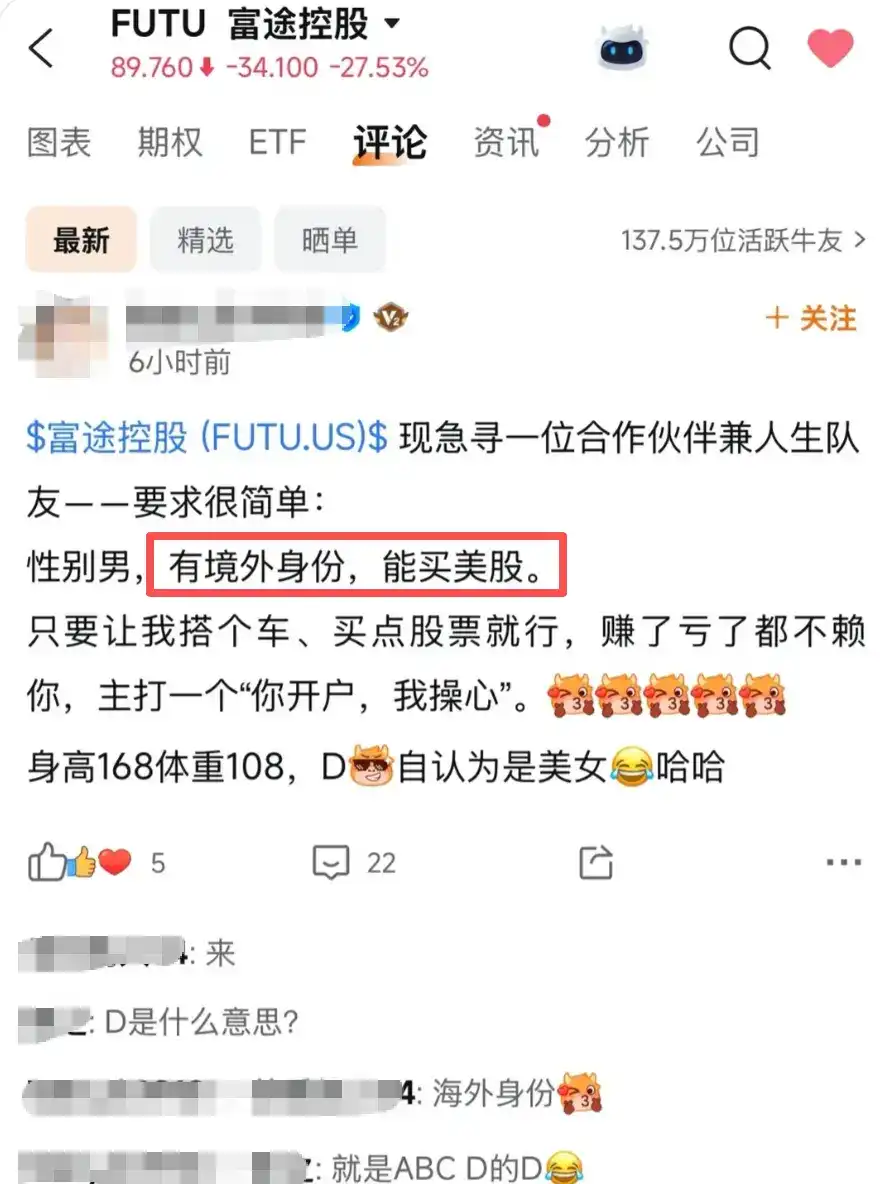
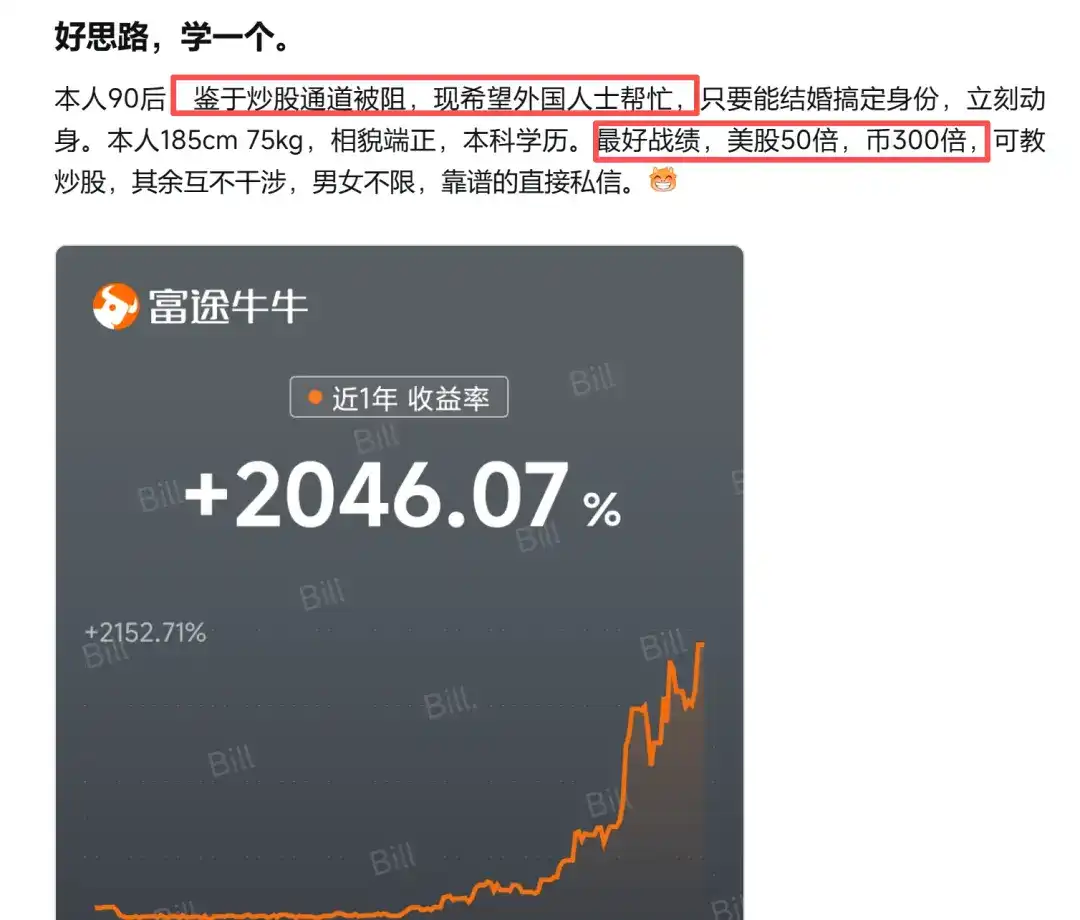
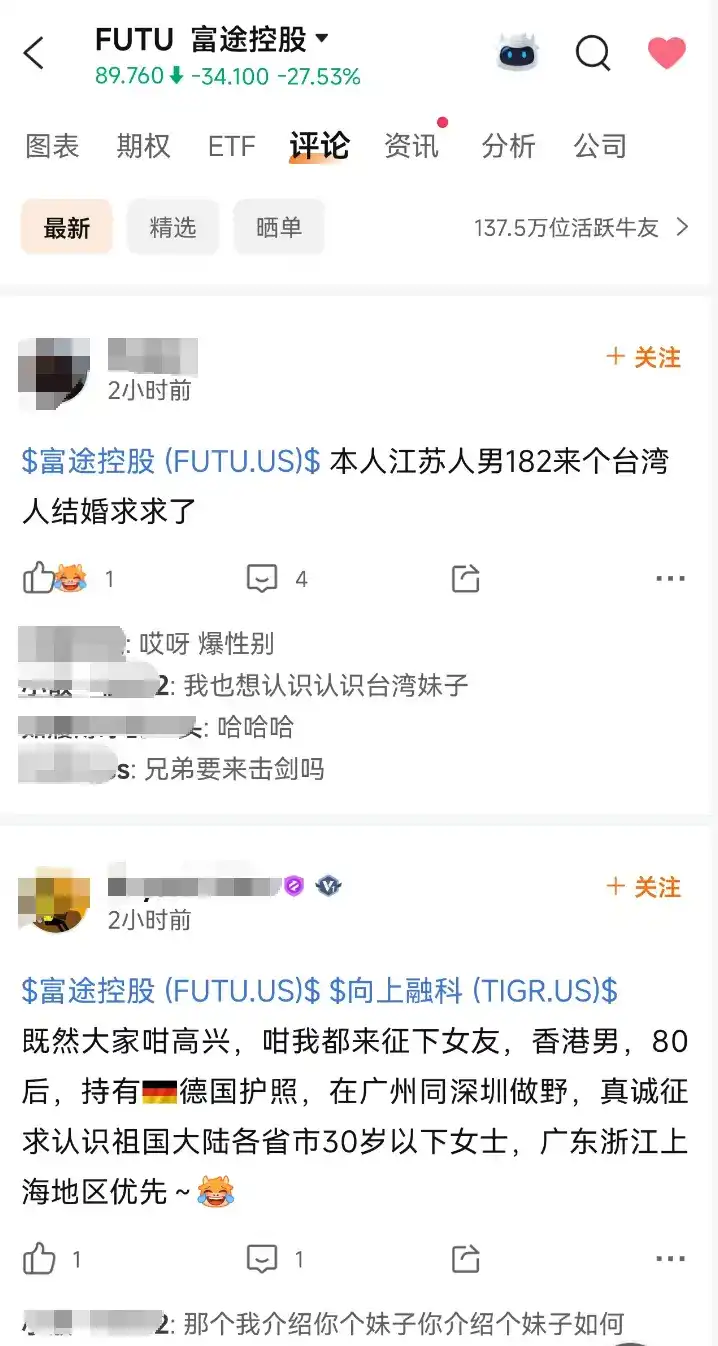
A self-proclaimed D-cup beauty from mainland China is seeking an overseas man; a mainland-born '90s generation individual with a 2046% return is willing to consider "any gender" for an identity swap; a Hong Kong man holding a German passport is inverting the selection criteria, preferring "Guangdong, Zhejiang, or Shanghai natives"......

This isn't just anecdotal. You're witnessing a latent, securitized marriage market taking shape in real time within the Futu community. Demand side, supply side, price preferences, geographical screening conditions... all spontaneously forming. This is the most honest natural language leak of the mindset among China's middle-class investor group in 2026.

The Regulatory Hammer Falls

On May 22nd, China's Securities Regulatory Commission, along with seven other departments, jointly issued the "Implementation Plan for Comprehensive Rectification of Illegal Cross-border Securities, Futures, and Fund Business Activities." On the same day, they announced plans to impose severe penalties on three overseas brokerages: Futu Holdings is slated to be fined approximately 1.85 billion RMB; Tiger Brokers faces a fine of 411.2 million RMB; Longbridge is also on the list. Both Futu and Tiger's US-listed shares plunged over 30% in pre-market trading.

The brokerages' responses were measured in their wording. Futu stated that as of the end of Q1 2026, funded accounts from mainland China accounted for about 13% of the company's total funded accounts; Tiger Brokers said client assets from mainland China constituted roughly 10% of the group's global total assets. Both emphasized that "business operations in all regions outside mainland China remain normal."

But for mainland users who already hold US stocks in their Futu or Tiger accounts, the truly stinging piece of information boils down to one phrase:

Sell only, no buying.

This means that for the foreseeable future, if you want to open a new US stock account to buy NVIDIA, Tesla, or an S&P 500 ETF, you must first possess identification proving you are a non-mainland Chinese resident.

Looking back over the past three years, the account opening threshold for mainland users by overseas brokerages has been raised step by step:

  • Late 2022, the CSRC named them for the first time;
  • May 2023, their apps were removed from mainland app stores;
  • Starting 2024, only mainland residents who "actually work or live overseas" were accepted, requiring proof like overseas utility bills, credit card statements, tax documents;
  • September 2025, the threshold was raised to requiring "proof of overseas permanent residence";
  • Late 2025, only "non-mainland Chinese ID documents" were accepted;
  • May 2026, fines were directly imposed on the brokerage entities.

The threshold for opening an account escalated from a utility bill all the way to an overseas passport or permanent residence card. The other side of this curve is precisely the process by which identity is being repeatedly repriced in the investment market.

Overseas Identity, the New Hard Currency for the Middle Class

For China's domestic middle class in 2026, overseas identity has become a latent asset class. It cannot be bought and sold like real estate, nor does it have a public quote like stocks, yet it possesses all the basic attributes of "hard currency."

First is scarcity. Hong Kong's various talent admission schemes approved around 140,000 applicants in 2024, with the vast majority coming from the mainland. It sounds like a lot, but against a population base of 1.4 billion, the penetration rate is less than one in ten thousand.

Unlike real estate, overseas identity doesn't depreciate due to population outflows, policy adjustments, or rising interest rates. At any given point in time, it corresponds to the same set of clear-cut rights and offers an extremely high rate of return. What it unlocks isn't just a single stock, but an entire dimension of asset allocation: US stocks, overseas real estate, offshore insurance, foreign currency deposits, compliant channels for crypto assets.

Most tempting is its non-transferability. Identity as an asset cannot be arbitraged in a secondary market like stocks. It can only be held by the individual, or transferred through three ancient methods: marriage, childbirth, and inheritance.

School district housing once spawned a complete gray industry chain: agents, transfer companies, fake household registrations, sham marriages, sham divorces. The overseas identity industry chain is now replicating all this: Hong Kong Quality Migrant Admission Scheme agencies, Portugal's Golden Visa, Singapore's Employment Pass, Malta citizenship, rapid Caribbean citizenship programs. Each product comes with a clear price list and processing timeline.

The form of the asset has shifted from a "property deed" to a "residence card," from a "school place" to an "account opening qualification."

The past two decades saw the middle class using school district housing to lock in social status; the next decade will see them using overseas identity to lock in assets.

Is Studying Abroad Equivalent to Buying Insurance?

Stepping back for a broader view, the logic behind the Chinese middle class purchasing overseas resources has been redefined three times over the past twenty years.

2000 to 2010 was about betting on overseas development potential. Sending children abroad for studies or families moving overseas was underpinned by an offensive judgment: opportunities were greater abroad. This was an investment, with the goal of returns.

2010 to 2020 was about diversification. After rapid domestic wealth accumulation, overseas real estate, insurance, and education were incorporated into the family asset framework for geographical dispersion. This was a defensive move, aiming for risk control.

2020 to the present is about "buying insurance." An overseas identity is no longer just part of the portfolio; it has become the entry ticket itself. Even if it generates no returns, without it, you lack the qualification to even enter certain investment markets. It is a premium paid to hedge against uncertainty, its price rising as uncertainty increases.

The regulatory hammer on May 22nd is yet another jump point on this "insurance price curve."

When a generation realizes they have missed the window to obtain an overseas identity themselves, they will transfer their hopes to the next generation. What will truly see price increases next might not be talent scheme agents, but rather spots in international schools, overseas university preparatory courses, and services for accompanying young children studying abroad. This "identity insurance" will be passed down through family generations.

I don't know which path that '90s individual with the 2046% return ultimately chose.

The evidence left behind after a year spent proving they are among the top 1% of the top 1% in the US stock and crypto markets should have been a highlight on a resume.

But after May 22nd, it became an attachment to a matchmaking profile.

A curve that could make a fund manager's eyes turn red is finally being used this way.

This is 2026.

Related Questions

QAccording to the article, what unexpected phenomenon occurred in the Futu community following the regulatory crackdown?

AFollowing the regulatory crackdown, the Futu community unexpectedly transformed into an informal matchmaking platform, where users started posting personal ads seeking relationships, often with a focus on connecting with individuals possessing overseas residency or citizenship.

QWhat key restriction did the 2026 Chinese regulatory action impose on mainland users of overseas brokerages like Futu and Tiger?

AThe key restriction imposed was that mainland Chinese users could only sell, not buy, securities. To open new accounts for buying assets like U.S. stocks, users were required to provide proof of non-mainland Chinese residency.

QHow does the article describe the evolution of the value of an overseas identity for the Chinese middle class over time?

AThe article describes it as evolving from an investment for greater opportunities (2000-2010), to a tool for risk diversification (2010-2020), and finally to a mandatory 'insurance policy' or 'admission ticket' (2020 onwards) that is essential for accessing certain investment markets, thus becoming a hard currency for the middle class.

QWhat does the article suggest might be the next area to see price increases as a consequence of the growing demand for 'identity insurance'?

AThe article suggests that the next areas to see price increases are international school placements, overseas university preparatory courses, and services for accompanying young children studying abroad, as families shift their focus to securing overseas identity opportunities for the next generation.

QWhat ironic contrast does the article highlight using the example of the 90s investor with a 2046% return?

AThe article highlights the ironic contrast between an extraordinary investment track record (a 2046% return) that would typically be a career highlight for a financial professional, and its new, diminished utility as merely an 'attachment' to a personal相亲简历(resume) in the quest for a partner with overseas status.

Related Reads

AI Trading Cools, South Korean Stocks Plunge 1.8%, Spot Gold Rises 1%, Bitcoin Dives

A sell-off in AI-related stocks, triggered by Broadcom's disappointing earnings forecast, sent shockwaves through global markets. South Korea's KOSPI led Asia's decline, plunging 1.8% as the risks from concentrated chip stock gains and surging leveraged investments came to the fore. The tech-heavy Nasdaq 100 futures fell 0.5% following Broadcom's 14% after-hours plunge, which signaled a slower-than-expected transition to AI clients. This pullback extended Wall Street's weakness, halting the S&P 500's nine-day rally amid hawkish Fed signals and renewed Middle East tensions. South Korean authorities convened an emergency meeting, pledging "immediate measures" against market volatility and warning of record-high stock margin debt. The adjustment rippled across assets: Bitcoin fell to around $64,000, its lowest since February, while safe-haven gold rose 1% on bargain hunting. Oil prices dipped on Middle East ceasefire news. Market analysts noted the sell-off was driven by profit-taking after massive gains, particularly in chip stocks like Samsung and SK Hynix, which now dominate the KOSPI. Wall Street banks are divided on Korea's outlook, with Goldman Sachs raising its target while Citigroup and others warn of overvaluation and a potential bubble. Bridgewater's Ray Dalio noted that great technological shifts often create bubbles. Meanwhile, Fed officials' hints at potential future rate hikes added to the cautious mood ahead of key U.S. jobs data.

华尔街日报3m ago

AI Trading Cools, South Korean Stocks Plunge 1.8%, Spot Gold Rises 1%, Bitcoin Dives

华尔街日报3m ago

Seeking Alpha's Hot Article: Why Might the U.S. Stock Market Crash in June?

In a recent Seeking Alpha article, financial professor and analyst Damir Tokic argues that the US stock market may be poised for a significant crash in June 2026. The core thesis centers on a "mega-bubble" in equities, particularly within the technology sector, which has driven the S&P 500 to near-record valuations, with a Shiller P/E ratio exceeding 40—a level comparable to the 2000 dot-com bubble. Tokic identifies two primary catalysts for a potential collapse. First, he points to unsustainable market exuberance fueled by what he terms the "Trump Stimulus"—massive AI capital expenditure by tech giants, which he believes is politically driven and cannot last. Second, and more urgently, he highlights the escalating Iran war as a critical threat. The ongoing closure of the Strait of Hormuz has created a severe global energy supply crunch. Strategic petroleum reserves are projected to hit critically low operational levels by June, potentially causing oil prices to spike above $200 per barrel and triggering a severe, supply-driven inflationary shock. This scenario, Tokic warns, would force the Federal Reserve's hand. Despite currently maintaining a dovish bias, the Fed would likely be compelled to officially pivot to a hawkish stance at its June FOMC meeting to combat soaring inflation and bond yields. He contends that such a shift—or even a failure to act, which would destroy Fed credibility—could be the trigger that punctures the market bubble. The resulting downturn, he concludes, could rival the bear markets of 2000 and 2008, advising investors to prepare for a major correction.

marsbit26m ago

Seeking Alpha's Hot Article: Why Might the U.S. Stock Market Crash in June?

marsbit26m ago

AI PC Battle: Bet on the Toll Booth, Not the Camp

**Title:** The AI PC Battle: Don't Bet on Sides, Bet on the Tollbooth **Summary:** The AI PC competition is moving beyond simple "x86 vs. Arm" narratives. The core investment thesis should focus on identifying which players can sustain margins, cash flow, and pricing power throughout the upgrade cycle, rather than backing a particular architecture. The opportunity is analyzed in three layers: 1. **The Advanced Foundry Tollbooth:** TSMC is positioned to collect "tolls" regardless of which chip designer wins, due to its dominant ~70% share in advanced semiconductor manufacturing, which is essential for high-end AI PC chips. 2. **Compute & Platform Spillover:** AMD represents an offensive in the x86 CPU+GPU space, while NVIDIA leverages its GPU and CUDA software stack dominance. Both benefit from the demand for increased local AI compute. 3. **Architecture Diffusion & Turnaround Plays:** ARM and Intel offer potential for significant upside (elasticity), but investments here require stricter discipline due to higher execution risks and competitive challenges. The industry is transitioning from concept to shipment validation. While short-term forecasts for AI PC adoption have been revised down slightly due to tariffs and procurement delays, the long-term trend towards AI becoming a standard PC feature remains intact. The key driver for upgrade cycles will be whether compelling enterprise applications (e.g., privacy-sensitive computing, low-latency inference) emerge beyond consumer-focused features like meeting summarization. Investment strategy should prioritize companies with platform-level advantages and recurring revenue streams. TSMC offers high certainty as the foundational tollbooth. AMD presents a strong offensive play within the established ecosystem. ARM and Intel are higher-risk, higher-potential-reward turnaround bets. The report cautions against chasing short-term hype and emphasizes a disciplined, long-term approach focused on buying ecosystem strength and cash-flow certainty after market enthusiasm subsides. **Key Risks:** Underwhelming AI PC applications slowing upgrade cycles; slow improvement in Windows on Arm compatibility; macro/tariff impacts on PC demand; potential advanced node supply-demand mismatches affecting TSMC; high overall AI sector valuations making stocks vulnerable to a risk-off shift in markets.

marsbit40m ago

AI PC Battle: Bet on the Toll Booth, Not the Camp

marsbit40m ago

Ten-Thousand-Word Analysis: From $10 to $290, MRVL Wins the Entire AI Era by 'Not Making GPUs'

Marvell Technology's stock price surged from under $10 in 2016 to a record $290 in June 2026, fueled not by making GPUs, but by dominating AI infrastructure connectivity. This analysis argues the market misvalues MRVL as merely a smaller Broadcom in custom AI chips, overlooking its true, unique position. Marvell's core strength lies in enabling high-speed data flow for AI clusters through three interconnected businesses. First, it holds a commanding ~70% market share in high-speed optical DSPs (essential for data center light modules), a deep-moat business with accelerating growth. Second, its custom AI chip design business serves hyperscalers like AWS, Microsoft, and Google, with a significant revenue pipeline despite lower margins. Third, stable cash flows come from Ethernet switch chips and enterprise storage controllers. Together, they form a full-stack "AI data movement" platform. CEO Matt Murphy's transformative leadership since 2016, involving strategic divestments, key acquisitions (like Inphi for optical DSPs), and securing long-term agreements with major cloud providers, repositioned the company. A pivotal $2 billion strategic investment from NVIDIA in 2026 underscored Marvell's critical role in the AI ecosystem, particularly through collaborations like NVLink Fusion. While Marvell faces risks—including client concentration (losing the Amazon Trainium3 design), lower-margin business mix, competitive threats, insider selling, and complex supply chains—its fundamentals remain strong. The optical interconnect moat is widening with the acquisition of Celestial AI (photonics fabric), and financial metrics show accelerating revenue growth and operating leverage. With a PEG ratio suggesting undervaluation relative to its growth, the thesis is that the market undervalues Marvell's monopolistic position in AI "plumbing" while overemphasizing its competitive custom chip segment. The story transcends investing, symbolizing how in any complex system—from the internet to AI—the value of "connection" ultimately surpasses that of individual "nodes."

marsbit1h ago

Ten-Thousand-Word Analysis: From $10 to $290, MRVL Wins the Entire AI Era by 'Not Making GPUs'

marsbit1h ago

Trading

Spot
Futures
活动图片