New Wall Street Play: Yen Shorts Still Adding, But Japan Stocks Don't Rely on Carry Trade Unwinding

marsbitPublished on 2026-06-04Last updated on 2026-06-04

Abstract

On June 3rd, USD/JPY hit 160.44, its highest level since July 2024, while the Nikkei 225 surged past 68,000 points. Contrary to popular narratives of an imminent "carry trade unwind" akin to August 2024, data reveals a more complex picture. Speculative net short positions in yen futures have actually increased, reaching -114,667 contracts by late May, suggesting traders are doubling down rather than retreating. Meanwhile, Japan's Finance Ministry conducted its largest-ever single-round FX intervention (11.73 trillion yen) in April-May but failed to hold the 160 yen line. The Nikkei's rally is not driven by carry trade dynamics. Foreign investors are aggressively buying Japanese stocks, with net purchases in 2026 running nearly 16 times higher than 2025 levels. This inflow is concentrated in AI and semiconductor-related stocks like SoftBank and Socionext, fueled by positive sector outlooks, rather than being a flight from unwinding yen shorts. Furthermore, the Nikkei has continued climbing despite the Bank of Japan's (BOJ) rate hikes to 0.75%. This disconnect exists because the current equity boom is fueled by AI-driven foreign investment, not reliant on cheap yen funding. However, this relationship remains fragile. Should the BOJ hike rates further (e.g., to 1.0%) while dollar weakness increases carry trade costs, the trajectories of the yen and Japanese stocks could reconverge, potentially triggering volatility.

On June 3, USD/JPY touched 160.44 intraday, a new high since July 2024. On the same day, the Nikkei 225 index broke through 68,000 points for the first time, reaching a high of 68,634.74 points. These two figures together immediately triggered a familiar market narrative: 'The carry trade is about to collapse, August 2024 will repeat.'

This narrative is half right. The other half tells a completely opposite story according to the data.

Shorts Not Retreating, But Adding Instead

The most direct measure of the crowdedness of yen carry trades is the weekly Commitments of Traders (COT) report published by the US Commodity Futures Trading Commission (CFTC). It records the net long or net short positions of speculative traders in the yen futures market.

According to the CFTC report for the week ending May 26, the net short yen futures positions held by non-commercial accounts reached 114,667 contracts—112,993 long positions versus 227,660 short positions. This represented a further increase of 27,152 contracts in net short positions compared to the previous week.
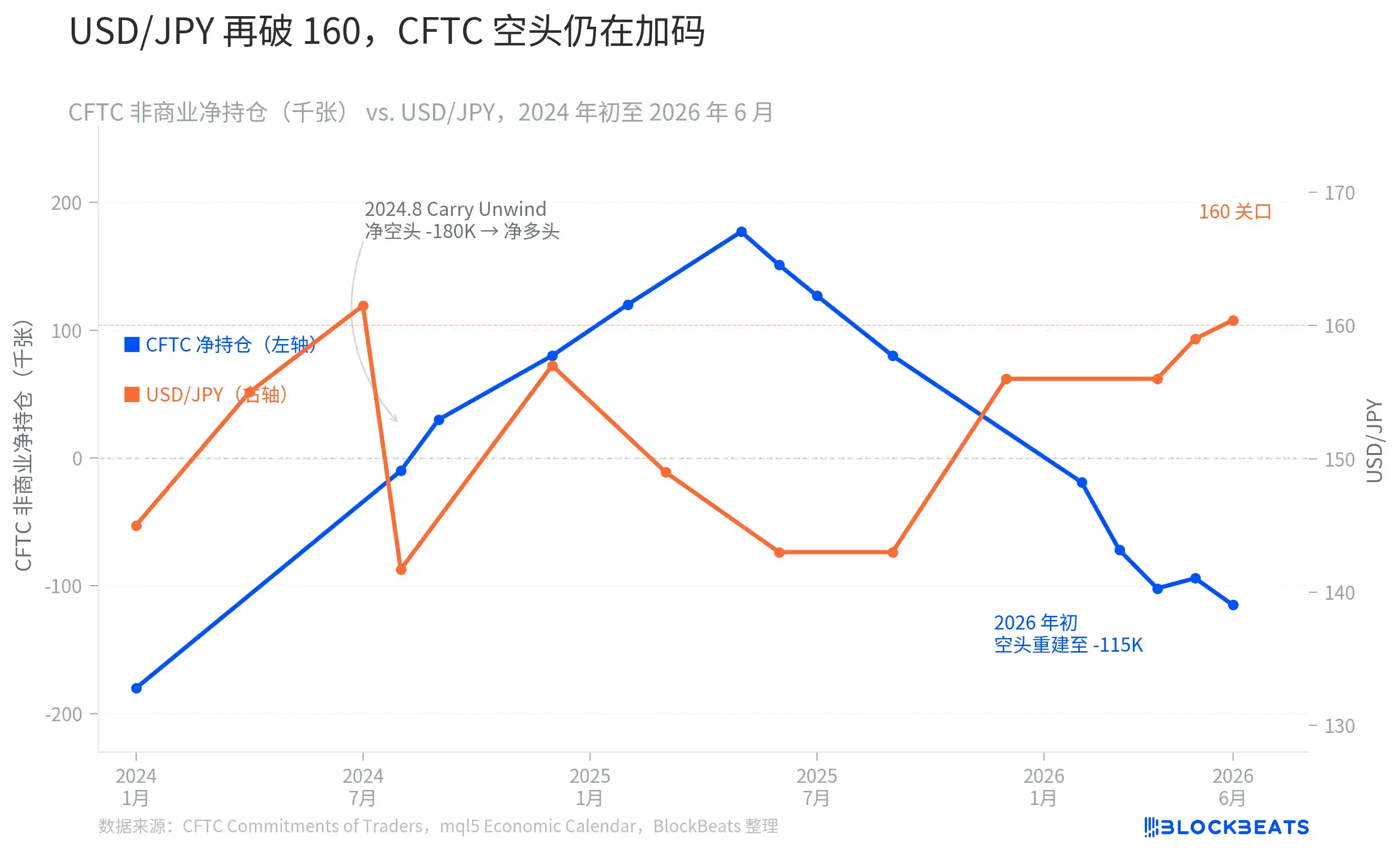
The chart reveals a somewhat counterintuitive trend. In July 2024, when USD/JPY approached highs around 161, the CFTC net short was near the historical extreme zone of about -180,000 contracts. Subsequently, in early August, a surprise rate hike by the Bank of Japan (BOJ) combined with a much-weaker-than-expected US non-farm payrolls report forced a massive unwinding of yen shorts within weeks. The net short position shrank sharply from about -180,000 contracts, even reversing to a net long position exceeding +177,000 contracts by Q2 2025—a systemic carry trade squeeze indeed occurred during that period.

But the subsequent trajectory went completely against the 'squeeze narrative.' Starting from late 2025, yen net short positions began accumulating again, turning negative in February 2026 and expanding rapidly to -102,000 contracts by April. As of May 26, the net short position had reached -114,667 contracts. When USD/JPY returned to around 160, global speculative capital wasn't fleeing, but rather continuing to add to their positions.

This means that if the BOJ sends a more hawkish signal at its July meeting, or if US economic data unexpectedly weakens again, this batch of -114,667 net short positions will face passive unwinding pressure highly similar to that of August 2024. Japan's Ministry of Finance is also aware of this—from April 28 to May 27, the MOF used a record 11.7349 trillion yen to buy yen and sell foreign currency, attempting to suppress the shorts.

Largest Single-Round Intervention Fails to Hold 160

Japan's Ministry of Finance has a history of foreign exchange intervention dating back to 1998. In the autumn of 2022, when the yen fell near 152, the MOF conducted its first 'yen-buying' operation since 1998: spending 2.84 trillion yen in September and adding another 6.34 trillion yen in October, totaling about 9.18 trillion yen. That round briefly pushed USD/JPY down from 152 to around 127, but the effect lasted only a few months.

In the spring of 2024, as USD/JPY again approached and briefly broke through 160, the MOF intervened with about 9.80 trillion yen, which was the largest single-round operation since 2022 at that time, and also 'the first confirmed buying intervention since 2022.'
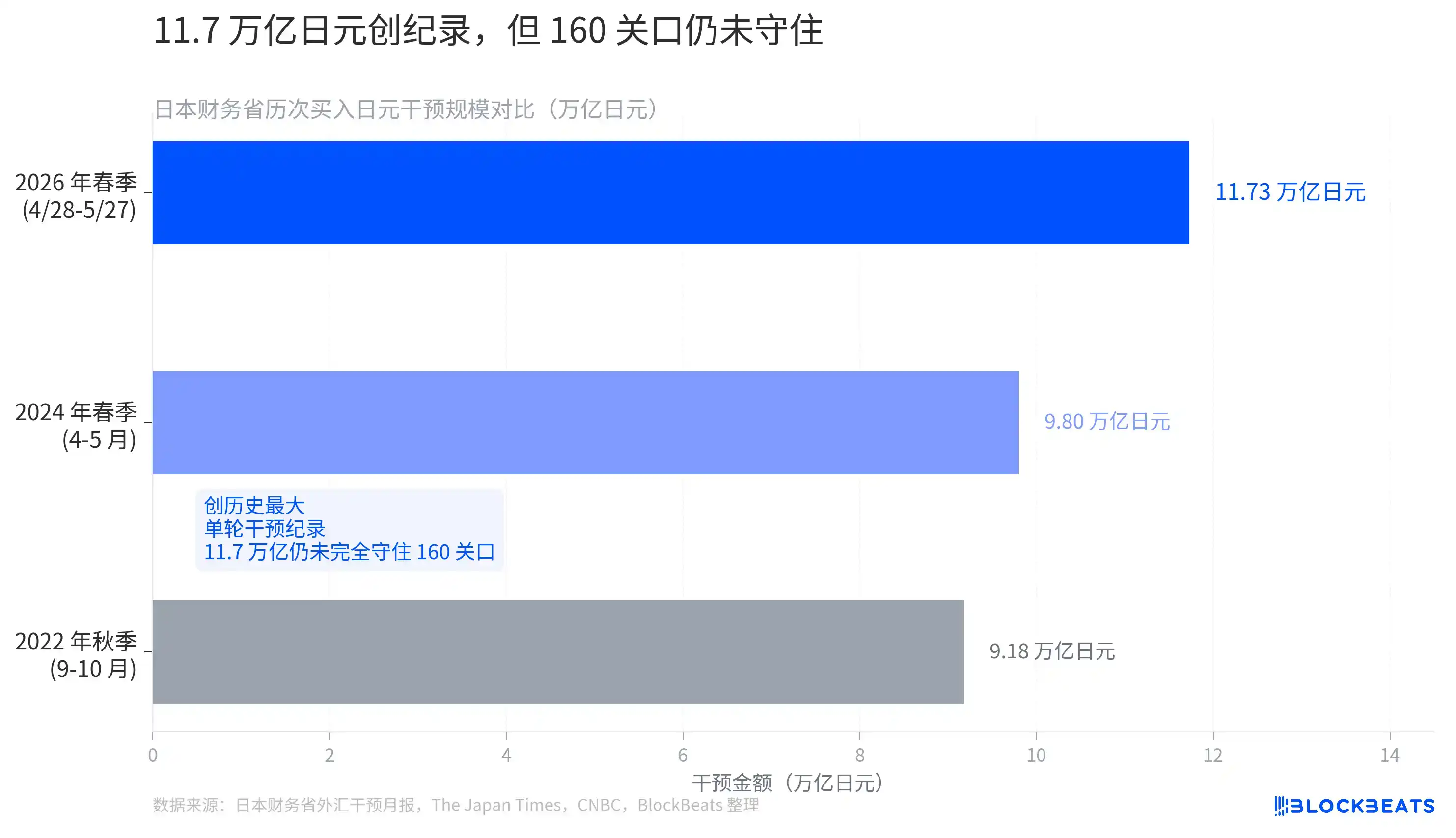
According to monthly intervention data released by Japan's Ministry of Finance on May 29, 2026, the operation scale from April 28 to May 27 was 11.7349 trillion yen (approximately 73.6 billion USD), making it the largest single-round intervention on record. It exceeded the total intervention amount for the entire year of 2022 and was nearly 2 trillion yen more than the spring 2024 intervention.

However, less than a week after the MOF disclosed these figures, USD/JPY still climbed back above the 160 level. The largest-ever intervention failed to completely hold this psychological barrier.

Foreign Funds Buying Japan Stocks Chase AI, Not Safe-Haven Flows from Carry Unwinding

If carry trades remain crowded, why is the Nikkei 225 still hitting new highs?

According to Reuters citing data from Japan Exchange Group (JPX), overseas investors had been net buyers of Japanese stocks for the 8th consecutive week as of the week ending May 23, with a weekly net purchase of 1.08 trillion yen. The cumulative net purchase amount for the year to date is close to 11.7 trillion yen.

During the same period in 2025, foreign investors' cumulative net purchase was only 742.1 billion yen. The 2026 figure is 15.8 times that amount.
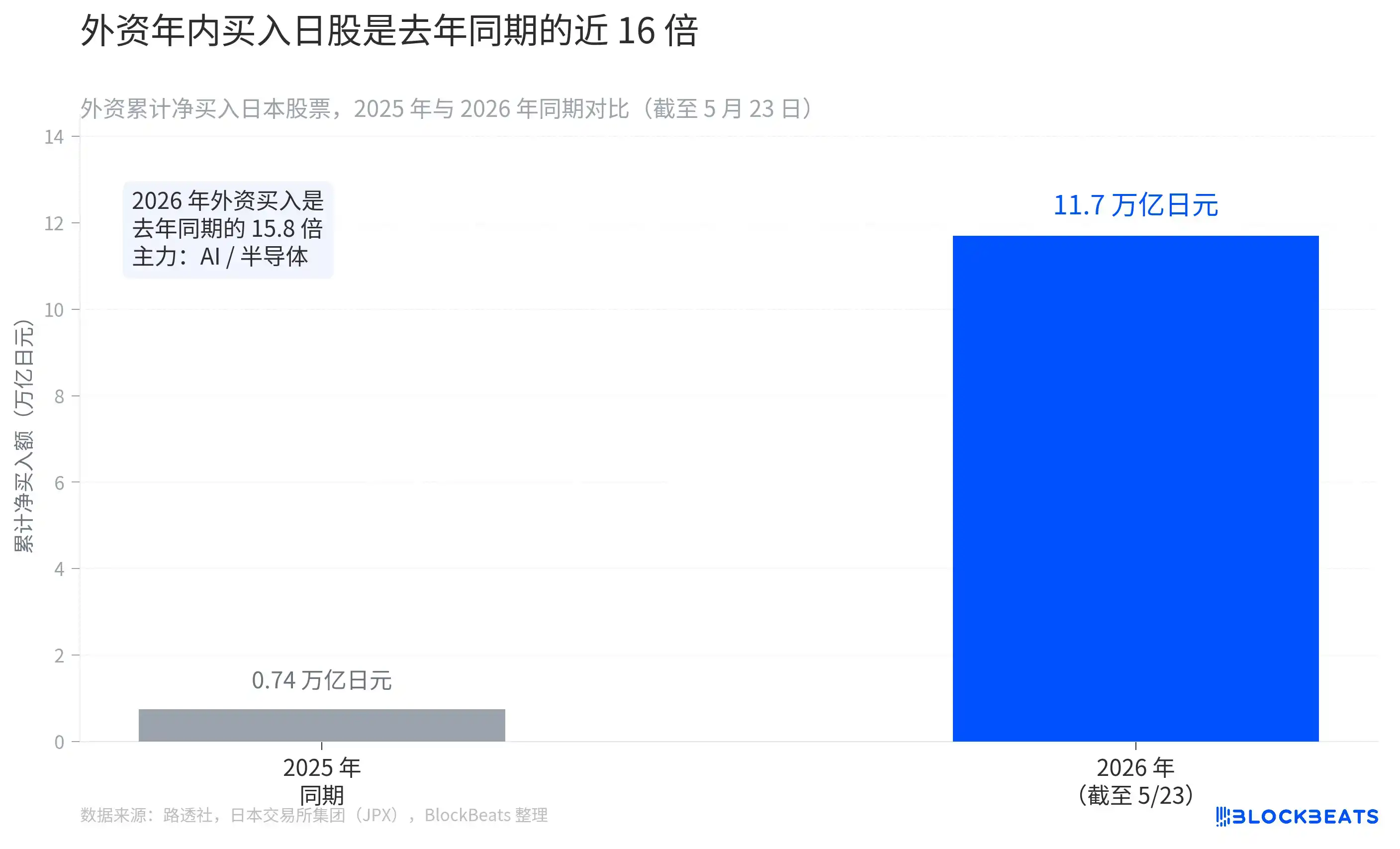
The destination of these funds is highly concentrated. Among the top-performing individual stocks during the same period, AI investment platform SoftBank Group rose 17.62% for the week, while chip designer Socionext gained 12.26%. The Reuters report directly explained the buying impetus: Nvidia's earnings outlook boosted prospects for AI and semiconductor demand, with foreign capital chasing this theme via the Japanese market.

This logic is completely different from the 'carry unwind triggers selling' logic of August 2024. Back then, it was forced de-risking and indiscriminate selling, with capital exiting the Japanese market. The foreign net buying in 2026 is an active choice to enter the Japanese market to pursue the AI reflation trade. Their driving mechanisms differ, and their implications for the Nikkei index are also different.

Rate Hikes Not Suppressing Stocks, But This Relationship Is Becoming More Fragile

Another counterintuitive aspect of the Nikkei 225 is its continued rise against the backdrop of consecutive BOJ rate hikes.

According to the Bank of Japan's policy decision announcements over the past two years, the rate hike path is as follows: March 2024 - ended negative interest rate policy, raising the policy rate from -0.1% to 0.1%; July 2024 - hiked again to 0.25%; January 2025 - hiked to 0.5%; December 2025 - hiked to 0.75%, the highest level since 1995. The April 2026 meeting maintained the rate at 0.75%, but passed by a 6-3 vote—three board members (Hajime Takata, Naoki Tamura, Junko Nakagawa) explicitly advocated for a hike to 1.0%.
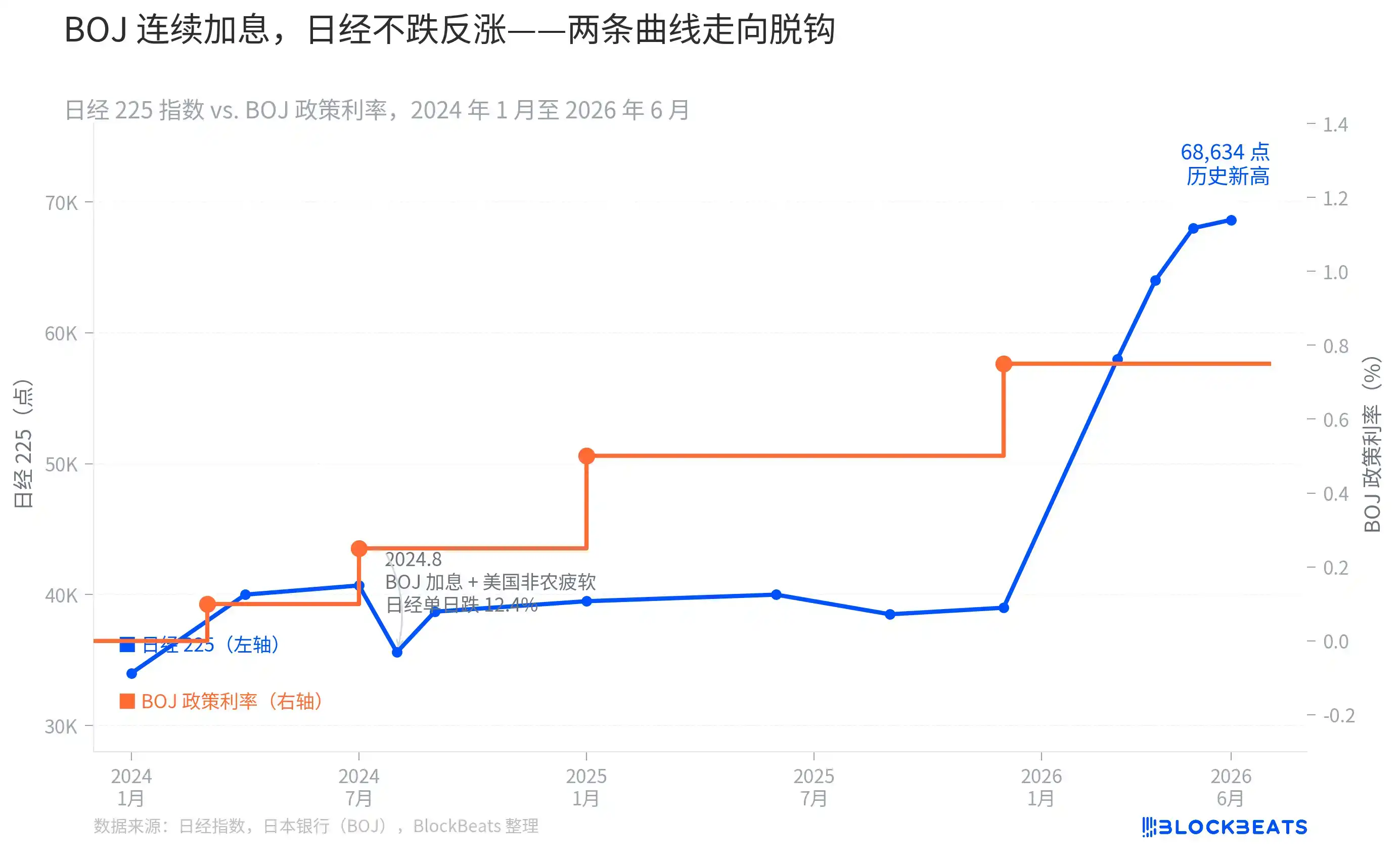
The chart clearly shows that the correlation between rate hike events and Japanese stock movements has been completely different across stages. The July 2024 rate hike triggered a historic crash in the Nikkei 225, with a single-day drop of 12.4%—that was because the BOJ hike and weak US jobs data coincided, directly igniting the carry unwind. However, the two rate hikes in January and December 2025 were accompanied by the Nikkei 225 climbing from around 40,000 points all the way to the current new high of 68,634 points.

The reason behind this is not complicated: when the logic driving foreign buying is chasing the AI reflation trade, rather than relying on low yen interest rate funding costs, the BOJ's modest rate hikes have a quite limited impact on this portion of capital. Of course, this relationship is not immutable—if the BOJ indeed pushes the rate to 1.0% at its July meeting, while the US dollar weakens due to other factors, sharply increasing the funding cost for carry trades, the trajectories of these two curves may recouple at that point.

Putting the three charts together provides a relatively complete cognitive framework: yen short positions remain crowded, the MOF's historically largest intervention failed to hold 160, but the driver of the Japanese stock market's new highs is the AI-driven foreign capital inflow—all three statements can be true simultaneously, they are not mutually contradictory, and none alone can predict what happens next.


Related Questions

QWhat is the current status of yen carry trade positions according to CFTC data, and how does it compare to the situation before the 2024 August squeeze?

AAccording to the CFTC data as of May 26, speculative accounts hold a net short position of 114,667 contracts in yen futures. This indicates that carry trade positions are still crowded and have been increasing recently. This contrasts with the situation before the August 2024 squeeze, where the net short position was near -180,000 contracts, a historical extreme. While current levels are significant, they have not yet reached the peak seen before the 2024 unwind event.

QDespite Japan's largest-ever single round of FX intervention, why did the USD/JPY rate still break above 160?

AThe USD/JPY rate broke above 160 again shortly after Japan's Ministry of Finance disclosed its record 11.7349 trillion yen intervention conducted from April 28 to May 27. This suggests the intervention, while massive, was ultimately insufficient to completely defend the key 160 psychological level against the prevailing market forces driving yen weakness and dollar strength.

QWhat is the primary driver behind foreign investors' significant net buying of Japanese stocks in 2026, according to the article?

AThe primary driver is the pursuit of AI and semiconductor-related investment opportunities, fueled by a positive outlook for AI demand, as highlighted by companies like Nvidia. This is an active, thematic investment flow targeting specific sectors like AI platforms and chip designers, rather than a passive or避险 (risk-averse) flow related to the unwinding of yen carry trades.

QHow has the relationship between Bank of Japan (BOJ) interest rate hikes and the Nikkei 225 index performance changed over time?

AThe relationship has varied. The July 2024 rate hike, coinciding with weak US non-farm payroll data, triggered a massive 12.4% single-day Nikkei plunge due to a forced unwinding of carry trades. However, subsequent hikes in January and December 2025 occurred alongside a sustained rally in the Nikkei from around 40,000 to new highs above 68,000 points. This shift is attributed to the changing driver of equity inflows—from carry-trade dynamics to AI-focused investments—which are less sensitive to modest BOJ rate increases.

QWhat are the three key, seemingly contradictory facts presented in the article that form a complete picture of the current Japanese market?

AThe three key simultaneous facts are: 1) Yen short positions (carry trades) remain crowded and are still being added to. 2) Japan's historically largest foreign exchange intervention failed to decisively hold the USD/JPY rate below 160. 3) The Nikkei 225 is reaching new record highs, driven primarily by foreign capital chasing AI and reflation themes, not by避险 flows from carry trade unwinding.

Related Reads

GitHub, Transfixed by AI

On the night of February 9th, GitHub suffered a major outage caused by a simple configuration change—reducing a cache refresh interval from 12 to 2 hours—that triggered a cascade of failures. This was not an isolated event, but part of a broader pattern. In early 2026, GitHub experienced at least 8 major incidents, failing to meet its promised 99.9% availability. These outages stemmed from structural issues: explosive growth in load, tight service coupling, and insufficient protection against abnormal traffic. This unprecedented load is driven by AI Agents. In 2025, GitHub handled ~1 billion commits. By 2026, weekly commits reached 275 million, projecting to ~14 billion for the year—a 14x increase. AI tools like Claude Code now contribute 4.5% of all public repository commits, with weekly submissions surging 25x in just three months. AI-generated pull requests jumped from 4 million to 17 million per month in half a year. Unlike human developers, AI Agents work continuously, generating commits at a scale that overwhelms infrastructure designed for human rhythms. The surge also shattered GitHub's business model. Copilot's flat-rate pricing, based on assisting human developers, became unsustainable as Agentic AI sessions consumed resources worth hundreds of dollars for a few dollars in fees. In response, GitHub imposed usage limits and, by June 1st, shifted to a pay-per-use "AI Credits" system. Facing this new reality, GitHub realized a 10x scaling plan was insufficient. It announced a need to *redesign* its architecture for 30x current scale—decoupling services, adding fault isolation, and improving change management to prevent cascading failures. Other platforms like Stripe and AWS are facing similar challenges with AI Agents. Fundamentally, GitHub is transitioning from a human collaboration platform to an "exhaust pipe" for automated AI workflows. Its detailed post-mortem reports aim to maintain trust during this turbulent rebuild. The February outage was not just a technical glitch, but a signal of the software industry's entry into a new, AI-driven era.

marsbit5m ago

GitHub, Transfixed by AI

marsbit5m ago

Both Suffer Massive Losses Exceeding $90 Billion, Which Is in Greater Peril: Strategy or Bitmine?

Facing massive paper losses exceeding $90 billion each amidst a sharp market downturn, "Digital Asset Treasury" (DAT) giants Strategy and Bitmine find themselves in a precarious position, but with different underlying risks. Strategy, heavily invested in Bitcoin (BTC), faces significant financial strain. Its strategy relies heavily on debt, including convertible notes and preferred stock (STRC) requiring substantial dividend payments. With its cash reserves dwindling and BTC offering no staking yield for cash flow, Strategy's high leverage makes it vulnerable. A continued price decline could force asset sales to meet obligations, potentially creating a negative feedback loop. Its market value has already fallen sharply. In contrast, Bitmine, an Ethereum (ETH) holder, appears on firmer financial ground. It primarily funds its purchases through equity offerings (like ATM programs), avoiding debt pressure. It also generates income by staking a large portion of its ETH holdings. While not immune to market drops and shareholder dilution concerns, Bitmine maintains more flexibility, recently announcing a new preferred share offering to raise further capital. The core divergence lies in their financing: Bitmine uses equity (investor money), while Strategy uses debt (borrowed money). Consequently, Bitmine currently faces less immediate liquidity pressure than Strategy, which must navigate the dual challenge of servicing debt/dividends and a declining core asset (BTC) price.

marsbit12m ago

Both Suffer Massive Losses Exceeding $90 Billion, Which Is in Greater Peril: Strategy or Bitmine?

marsbit12m ago

Where the AI Bubble Really Is: Which Layer of Players Are Naked

AI Bubble: Where It Really Is and Who's Swimming Naked This analysis dissects the AI industry not as a single entity but as a five-layer pyramid, arguing that bubbles are concentrated in specific tiers, not uniformly distributed. **Key Distinction from the 2000 Dot-com Bubble:** Unlike 2000, where companies had stock prices before revenue, today's leading AI players have massive, contract-backed revenue driving their valuations. Core infrastructure demand is real, with every GPU running at full capacity for paying customers. **The Five-Layer Pyramid & Bubble Assessment:** * **L0 (Fab/Manufacturing) & Top L4 (Leading AI Apps): NO BUBBLE.** Companies like TSMC, NVIDIA, major cloud providers (Microsoft, Google, Meta, Amazon), and top AI labs have real revenues and orders. Supply is tightly constrained by TSMC's disciplined capacity control and physical limits like power/land for data centers, preventing a supply glut. * **L1 (Memory): BATTLEGROUND.** Sky-high HBM margins could signal a new structural cycle or a classic "boom before bust." The oligopoly of three major players may enforce supply discipline, making this a high-stakes bet. * **L2 (Interconnect/Optical Modules): BUBBLE TERRITORY.** Companies like Lumentum and AAOI have seen stock surges (4-10x) far outpacing revenue growth. This hardware segment has lower physical barriers to expansion than fabs, allowing speculation. It mirrors the 2000 bubble's epicenter—optics. * **L3 (Infrastructure/"GPU Landlords"): VULNERABLE.** GPU leasing companies profit from the current compute shortage but own no long-term moat. Their business model relies on a temporary bottleneck that will ease as big tech expands and new tech (e.g., potential space-based data centers) emerges. * **L4 Long Tail (VC-backed Startups): STRONG BUBBLE SIGNALS.** VC funding concentration in AI is twice that of the 1999 peak. Many startups with little revenue use the valuation logic of successful giants to justify their own, creating high risk of a "valuation crunch" when funding dries up. **Critical Risks to Monitor:** 1. **GPU Depreciation & Accounting:** Companies extending the assumed useful life of GPUs artificially boost profits. The true economic life depends on future generational leaps from NVIDIA. 2. **"GPU Credit" & Off-Balance-Sheet Leverage:** Emerging structures where shell companies borrow to buy GPUs and lease them out (with chipmakers sometimes investing) move debt off major balance sheets. This echoes the "vendor financing" of 2000 and the securitization risks of 2008, though currently small-scale. 3. **TSMC Abandoning Caution:** If the primary supply bottleneck (TSMC's conservative capacity planning) breaks, runaway supply could trigger a bust. 4. **Algorithmic Efficiency Breakthrough:** A major leap in software efficiency could drastically reduce the need for raw compute hardware, undermining the investment thesis. **Conclusion:** The AI boom is expensive and has frothy areas, but its core is underpinned by real demand and physical supply constraints. The bubble risk is layered: most present in optical components, GPU leasing, and the long-tail startup ecosystem, while the foundational chip manufacturing and leading application layers remain relatively solid—for now.

marsbit24m ago

Where the AI Bubble Really Is: Which Layer of Players Are Naked

marsbit24m ago

Trading

Spot
Futures

Hot Articles

Discussions

Welcome to the HTX Community. Here, you can stay informed about the latest platform developments and gain access to professional market insights. Users' opinions on the price of S (S) are presented below.

活动图片