Global SaaS Crisis, AaaS Becomes Mainstream, Claude is Undermining SME Software

marsbitPublished on 2026-05-15Last updated on 2026-05-15

Abstract

Claude's new "Claude for Small Business" product integrates directly with tools like QuickBooks, PayPal, and Google Workspace to automate core business workflows. Aimed at small businesses, it handles tasks such as payroll, month-end closing, invoicing, and marketing campaigns through simple conversational commands. The service, included with a Claude subscription, offers pre-built automations for 15 high-frequency scenarios and operates with user-approval steps for security. This move represents a shift from traditional SaaS toward AI Agent-as-a-Service (AaaS), targeting the underserved small business market with a low-cost, intuitive alternative to complex, multi-software stacks. The release follows Anthropic's strategy of industry-specific AI integration, signaling potential disruption for single-function SaaS companies as AI becomes the primary operational interface.

Following the release of 11 plugins by Claude in early January, which triggered the "SaaSpocalypse," Claude has now introduced actual workflows with the new release of Claude for Small Business.

The interface of this new product reads: "Out of the weeds, into the work." Roughly translated to Chinese, it means: Stop getting bogged down in trivial matters and get back to the real work.
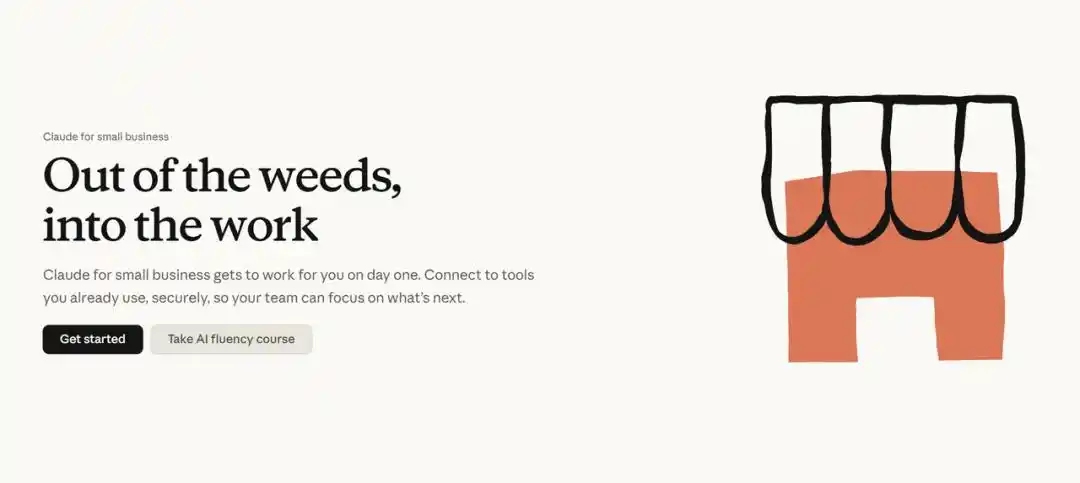
This time, Claude isn't just playing with concepts. It can directly integrate with tools businesses use daily, including QuickBooks, PayPal, HubSpot, Canva, DocuSign, Google Workspace, and Microsoft 365, among others.

Once connected, Claude can automatically handle routine business tasks such as payroll calculation and distribution, month-end financial closing, sales and marketing execution, and invoice follow-ups—without switching software or manual reconciliation.

Scrolling down on the official website, it directly showcases several dialogue examples.

how to do payroll, how to run month-end close, how to automatically generate Monday briefings.

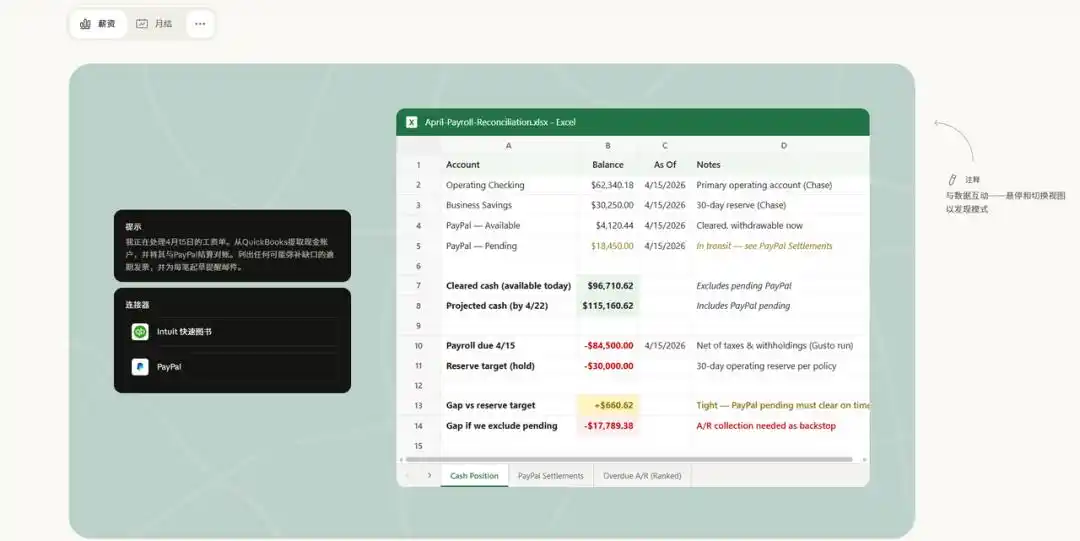
You input a command like: "Close out March for me. Reconcile my QuickBooks transactions against PayPal settlements, flag anything that doesn't match, and write the P&L narrative"

It will reconcile 147 transactions, flag 5 exceptions one by one, and write the profit and loss narrative, ready to be forwarded directly to the accountant.
Product Details Worth Highlighting

The most crucial point is that processing 147 transactions with a single command is remarkably smooth.

You simply need to switch to the Cowork tab in the Claude desktop app, turn on the Claude for Small Business plugin, and it's ready to use—no extra fees, just a Claude subscription.

Regarding security, Claude adheres to the permissions you set in each tool. What an employee cannot see in Gmail, they also cannot see through Claude.

Operationally, there's no need to worry about Claude making random operations that ultimately reduce efficiency. You can see which tool Claude is about to access before execution, and each step requires approval by default.

In terms of feature selection, this is a bundled package combining Cowork + 11 plugins + small business pre-built workflows + deep integration with business software. Claude has curated 15 workflows: Payroll, Invoice Follow-up, Month-end Close, Marketing, Contracts, Onboarding, etc., all high-frequency, practical scenarios that genuinely meet business needs.
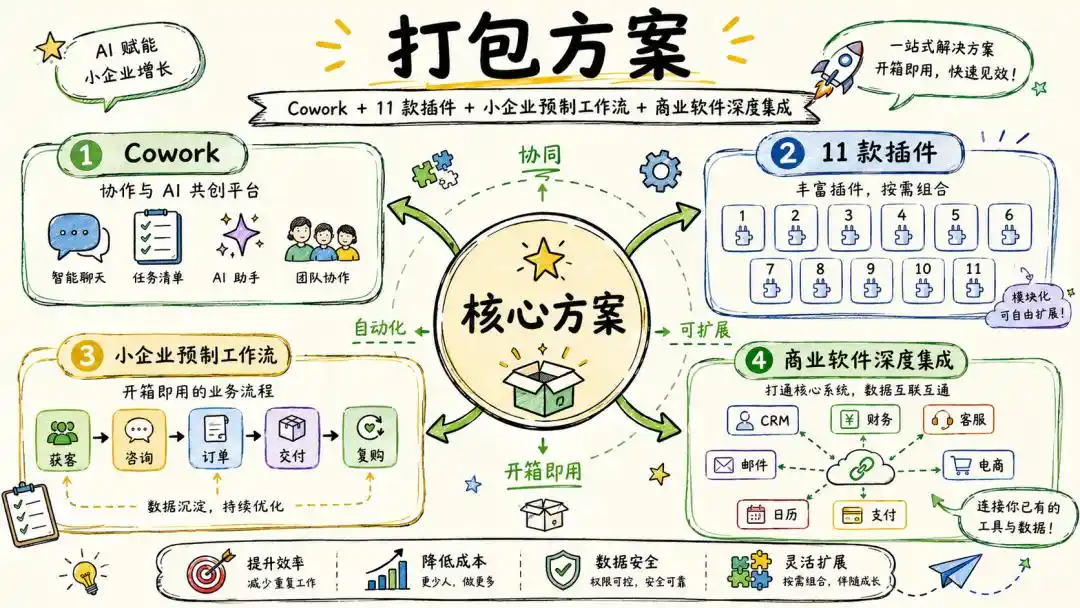
Specific Functions and Scenarios

Seven functions, covering basically all the daily software usage scenarios for a small business owner.

QuickBooks Financial Core: Payroll planning, month-end closing, cash flow analysis, account reconciliation, generating profit & loss statements and cash flow statements, preparing materials for tax season.

PayPal: Settlement, invoicing, refunds, payment follow-up. Works with QuickBooks for cash reconciliation and fund forecasting.

HubSpot Sales and Marketing: Lead triage, customer dynamic analysis, marketing campaign attribution, sales trend analysis.

Canva: Posters, social media graphics, copy with supporting visual content, supports team collaboration, editing, and publishing.

DocuSign: Send contracts, track signing status, automatically archive signed documents.

Google Workspace and Microsoft 365 Office Collaboration: File storage, email processing, scheduling, document generation. Export reports, prepare document packages, team collaboration.

Common Commands

After enabling the Small Business plugin in Claude Cowork, you can use the following common commands to run automated workflows directly in tools like QuickBooks, HubSpot, PayPal, Canva, DocuSign, Stripe, etc.:

/plan-payroll Forecast cash flow + chase overdue invoices

/close-month Reconcile accounts + write P&L narrative

/run-campaign Build Canva assets + prepare HubSpot send

/monday-brief: Cash, pipeline, top three todos displayed on one screen

/chase-invoices: Batch invoice follow-up and chasing

/cash-flow-forecast: Cash flow forecasting and analysis

/business-pulse: Overall business health overview

/contract-review: Contract review and suggestions

/lead-triage: Lead classification and prioritization

/employee-onboarding: New employee onboarding process

Why Has This Market Been Untouched?

The needs of small businesses are completely different from those of large companies. Large companies are willing to pay hundreds of thousands annually for a software feature, with dedicated personnel to study how to use, deploy, and train on it.

A small business owner often combines the roles of finance, HR, and operations. The annual software budget might only be a few thousand dollars. With the same R&D investment, selling to one large client versus a hundred small ones yields similar revenue but much higher service costs. This led SaaS companies in the past to prefer large clients and avoid small businesses.

Thus, even though US small businesses contribute 44% of GDP and employ nearly half of the private workforce—a massive volume—they still haven't been seriously targeted by AI companies.

Claude's design logic aims to solve this problem—you don't need to learn AI, just tell it what to do. It shifts from users adapting to tools, to tools adapting to users' ways of working.

This addresses non-standard scenarios that were difficult for past SaaS to handle. Claude for Small Business, leveraging AI combined with traditional software, effortlessly solves complex business problems.

Moreover, it's priced at a monthly fee of $20–200 (including Claude membership), far below traditional SaaS per-user subscription fees.

Viewing the Product Within Anthropic's Strategy

In the enterprise market, Anthropic is emerging like a beast, increasingly close to disrupting the SaaS market.

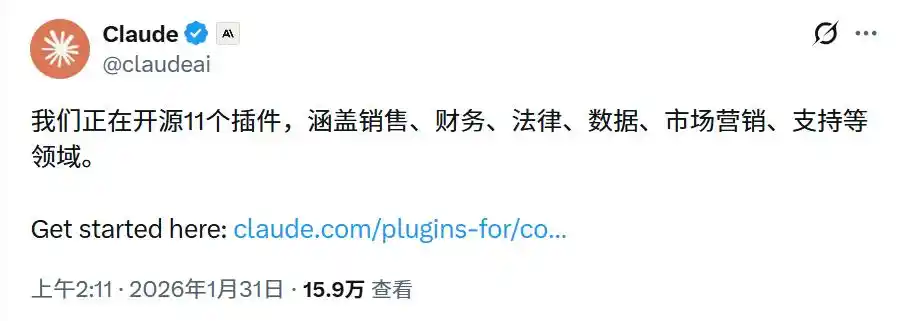
On January 30, 2026, Claude Cowork released 11 plugins, directly replacing core SaaS functions in legal, finance, CRM, marketing, etc., causing instant market panic: Within 48 hours, the global software sector lost $285 billion; nearly $1 trillion evaporated within a week.
Instead of getting caught in endless rounds of parameter escalation on general models, they are slicing the market by industry.
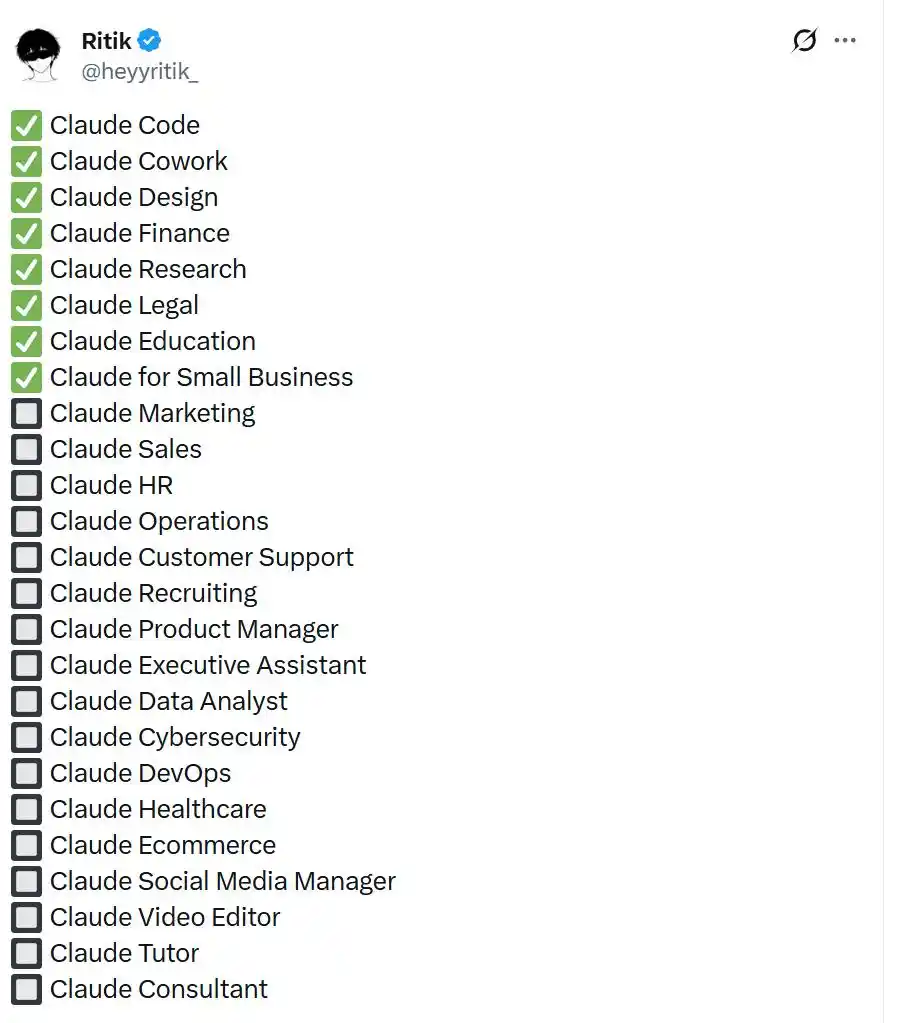
This is the aforementioned "SaaSpocalypse." This time, despite connecting traditional software, the trend of pre-built AI workflows making AaaS (Agent as a Service) mainstream is becoming increasingly evident.

From finance, legal, to the small business edition, Claude is being integrated into the existing tools and workflows of those industries. Enterprises are no longer just procuring SaaS but are procuring AI digital employees, which is also becoming an apparent phenomenon.

It can be seen that competition in general models has reached a plateau. Parameters, context windows, benchmark scores—the gap between each generation is narrowing. But penetration into industry-specific scenarios has just begun. The toolchains used in law, compliance processes in finance, and the daily operations of small businesses are completely different.

Expanding the ecosystem into different fields and permeating various industries might be one aspect of gaining a competitive edge.

An Interesting Side Note

Anthropic's CEO, Dario Amodei, previously stated that single-function SaaS companies might be consumed by AI.

Among the tools Claude has integrated this time, several are companies he mentioned. On one hand, he says they are at risk, and on the other hand, he integrates them. A relationship of both cooperation and competition is emerging between AI products and traditional SaaS.

You use my API, I become your entry point; you integrate my service, I gradually consume your interface. If Claude truly becomes the operational entry point for small businesses, will the business models of those integrated SaaS companies also change?

Software giant Salesforce has already made changes, recently announcing plans to open its API and launch "headless products"—simply put, removing the interface and exposing the underlying database for external calls.

After Claude released the 11 plugins last time, Salesforce's market value dropped by up to 26% year-to-date. Since the AI trend is unstoppable, Salesforce is adapting to it.

But who can say for sure that after software ate the world, AI won't eventually eat all SaaS?

What we see now is that because of AI, spring has come for SME owners, but the sky is falling for enterprise service software bosses.

This article is from the WeChat public account "Jingxuan AI," author: Jingxuan AI

Related Questions

QWhat is Claude for Small Business and what core problem does it aim to solve?

AClaude for Small Business is a new product from Anthropic that integrates AI directly into small businesses' daily workflows by connecting to tools like QuickBooks, PayPal, and HubSpot. It aims to solve the problem of small business owners being overloaded with administrative tasks across multiple software platforms. Instead of requiring them to learn and manually operate different SaaS applications, it allows them to give natural language instructions to automate routine operations such as payroll, invoicing, month-end closing, and marketing execution, letting them focus on core business work.

QHow does Claude for Small Business handle security and user control when performing automated tasks?

AClaude for Small Business adheres to the permissions set within each connected tool (e.g., Google Workspace). If an employee cannot see something in Gmail directly, they also cannot access it through Claude. Furthermore, before executing any action, Claude shows the user which specific tool it will interact with. By default, every step requires user approval, preventing unauthorized or unintended operations and maintaining user control.

QWhat key feature of Claude for Small Business challenges the traditional SaaS business model for small enterprises?

AIts key challenging feature is bundling AI-powered automation for 15 predefined, high-frequency business workflows (like payroll, chasing invoices, and month-end close) with deep integrations into popular business software. It offers this at a subscription cost ($20–$200/month including Claude membership) that is significantly lower than the per-seat fees of traditional SaaS suites. This makes sophisticated automation accessible and affordable for small businesses, a market traditionally underserved by SaaS vendors due to high service costs relative to revenue.

QAccording to the article, what broader industry trend does the launch of Claude for Small Business represent?

AIt represents the trend of AaaS (Agent as a Service) becoming mainstream, where businesses shift from purchasing multiple standalone SaaS applications to purchasing AI 'digital employees' or agents. These AI agents understand specific industry contexts, integrate into existing toolchains and workflows, and execute complex tasks based on natural language commands. The article suggests this trend, exemplified by Anthropic's industry-specific approaches, is moving beyond competition on generic AI model metrics and towards deep penetration into vertical business scenarios.

QHow are some traditional SaaS companies, like Salesforce, responding to the competitive threat posed by AI agents like Claude?

ASome traditional SaaS companies are adapting by opening their platforms for deeper AI integration. For example, Salesforce announced plans to open its APIs and offer a 'headless product,' which essentially removes its own user interface and exposes its core database and functionality for direct external access and integration by AI agents and other platforms. This is a strategic move to remain relevant and essential in an ecosystem where AI might become the primary user interface, transforming but not necessarily completely eliminating the role of backend SaaS services.

Related Reads

SpaceX, OpenAI, Anthropic: The Three AI Giants Racing for IPO, Which One Is Worth Betting On?

SpaceX, OpenAI, and Anthropic are poised for historic IPOs within weeks, potentially raising a combined $180 billion—a sum exceeding the entire internet bubble's fundraising. The hosts of the Limitless Podcast argue this isn't just individual company financing but an unprecedented capital concentration for AI infrastructure, driven by an insatiable need for compute, data centers, power, and chips. SpaceX's IPO is notable for reportedly changing market index rules to allow faster inclusion, potentially funneling trillions in passive retirement funds into its stock, despite its unproven space-based data center business model. In contrast, Anthropic demonstrates explosive growth, with ARR reportedly hitting $45 billion and approaching profitability, fueled by strong enterprise adoption of products like Claude Code. Google's separate $80 billion raise highlights the immense capital pressure, even for giants. The discussion acknowledges bubble risks but leans optimistic. The hosts contend the massive spending is building essential physical infrastructure for the next technological era. A key bottleneck isn't capital but the real-world limits of chip manufacturing and construction speed. As long as demand for AI compute outstrips supply, this investment cycle represents a foundational build-out rather than a purely financial bubble. All three companies are seen as foundational bets on the future, with Anthropic often cited as the most immediately compelling due to its proven revenue trajectory.

marsbit28m ago

SpaceX, OpenAI, Anthropic: The Three AI Giants Racing for IPO, Which One Is Worth Betting On?

marsbit28m ago

From 'Old Guys' to 'New Favorites': How AI Is Revaluing Old Infrastructure from Dell to Nokia?

From "Vintage Tech" to "New AI Darlings": How AI Revalues Old Infrastructure One year ago, tech giants like Dell, Nokia, Cisco, and Western Data were seen as slow-growth, low-valuation stories, far from the AI spotlight dominated by players like Nvidia. Now, these legacy tech stocks are gaining market attention, sparking debate on whether this is genuine industry revaluation or a temporary narrative. As AI moves from model parameters to real-world data centers, the market is recognizing companies with proven delivery and infrastructure capabilities. This shift marks a change in the AI investment thesis: from pure model and GPU focus to the complex systems engineering required for deployment. Companies like Dell, HPE, and Corning are being revalued not for being "sexy" AI innovators, but for their decades of accumulated expertise in supply chains, enterprise delivery, and infrastructure—assets that have become critical in the AI buildout phase. The revaluation is unfolding across three key infrastructure lines: 1. **Servers & System Integration:** Dell and HPE are emerging as crucial system integrators or "general contractors" for AI data centers, translating GPU orders into complete, deployable server racks integrated with power, cooling, and networking. 2. **Networking & Connectivity:** AI's scale demands robust high-speed connections. Corning (fiber optics), Nokia (AI-RAN, 6G), and Cisco (data center switches) are gaining importance for enabling efficient data transfer within and between AI clusters. 3. **Storage:** Beyond high-speed memory (HBM/DRAM), the AI data explosion is driving demand for high-capacity hard drives (HDDs) from companies like Western Digital and Seagate to handle training data, logs, and cold storage cost-effectively. For this revaluation to be substantive and not just a narrative, three criteria are key: 1) Concrete AI-related order and revenue growth (e.g., Dell's AI server sales), 2) Upward revisions to company financial guidance, and 3) Sustainable improvements in profit quality, not just top-line revenue spikes. In essence, AI's transition to a real construction phase is re-pricing "old assets" against "new demand." The opportunity, however, is selective. Only those legacy firms that are demonstrably integrated into the capital expenditure chains of data center and enterprise AI deployment are likely to experience a true "logic re-rating" rather than just a temporary valuation bounce.

marsbit34m ago

From 'Old Guys' to 'New Favorites': How AI Is Revaluing Old Infrastructure from Dell to Nokia?

marsbit34m ago

The Merger of Codex and ChatGPT Marks the Beginning of a Major Reshuffle in Programming Tools

OpenAI is shifting its strategic focus from ChatGPT to Codex, merging them along with the browser tool Atlas into a unified desktop super-app. This move signals an internal belief that Codex, originally a programming tool, represents the next evolution of AI more than conversational models like ChatGPT. Over the past year, Codex's weekly active users have surged past 5 million. The key distinction is that while ChatGPT answers questions, Codex executes tasks. Enterprises increasingly value this ability to get work done over simply receiving advice. Consequently, Codex is attracting professionals beyond developers, including analysts, bankers, marketers, and product managers. OpenAI's reorganization and increased investment in Codex stem from recognizing that the future of AI competition lies in execution capabilities, not just conversation. The company is launching role-specific plugins (e.g., for data analysis, sales, design) to transform Codex into a broad knowledge work platform that automates and redefines white-collar workflows. Beyond being a tool, Codex reflects OpenAI's ambition to redefine software. New features like "Sites"—which generates interactive websites from documents—and collaborative "Annotations" aim to create a paradigm where the AI understands the goal and handles the tools and steps, functioning more like a digital colleague than traditional software. The ultimate goal is a unified experience where the user cares only about the completed task.

marsbit43m ago

The Merger of Codex and ChatGPT Marks the Beginning of a Major Reshuffle in Programming Tools

marsbit43m ago

Interpreting Investment Opportunities in the Age of Great Navigation, Invesco Great Wall Fund Releases '2026 Report on Chinese Enterprises Going Global'

Invesco Great Wall Fund has released its "2026 China Corporate Globalization Report," titled "The 'Great Navigation Era' of Chinese Enterprises." The report analyzes the new trends and investment opportunities as Chinese companies expand globally, moving from simple product exports to comprehensive overseas operations involving services, branding, and local production. Driven by factors like trade friction, the pursuit of higher profit margins abroad, and policy support, globalization is becoming essential for Chinese companies. The report outlines an evolution: from early product export ("Globalization 1.0") to the current "Globalization 2.0," characterized by overseas capacity, capital goods investment, consumer brand expansion, and service exports. Chinese firms' competitive advantages are highlighted, including a vast engineer talent pool, low-cost and robust infrastructure, and complete industrial clusters. Specific sectors with significant出海 potential are identified: * **Capital Goods** (e.g., engineering machinery, power equipment): Benefiting from global demand, especially in Belt & Road markets and the AI-driven power grid upgrade cycle. * **Consumer Brands**: Transitioning from cost to brand advantage, leveraging供应链 efficiency. * **Technology & Innovation**: Including AI applications, optical modules within global tech supply chains, and new energy vehicles focusing on local production. * **Pharmaceuticals**: Chinese biotech firms are becoming preferred partners for global pharma, with potential for breakthrough drugs in areas like oncology and weight loss. The report concludes that corporate globalization represents a sustained, core theme for China's capital markets, though companies must navigate challenges like geopolitics and localization.

marsbit56m ago

Interpreting Investment Opportunities in the Age of Great Navigation, Invesco Great Wall Fund Releases '2026 Report on Chinese Enterprises Going Global'

marsbit56m ago

Trading

Spot
Futures
活动图片