Former Bankless Member Lucas: Why I Still Bullish on Ethereum

foresightnews_apiPublished on 2026-06-05Last updated on 2026-06-05

Abstract

Former Bankless member Lucas explains why he remains bullish on Ethereum despite widespread pessimism. He acknowledges ETH's poor price performance over the past five years compared to Bitcoin and traditional markets, but draws parallels to historical multi-year consolidations seen in tech giants like Amazon and NVIDIA before major breakouts. Fundamentally, Ethereum is stronger than ever: record-high daily transactions (2.27 million in May 2026), significantly lower average gas fees ($0.27), over 400 million total addresses, and more than 32% of ETH staked, securing the network. Lucas's core thesis remains unchanged: all valuable assets will eventually be tokenized, Ethereum will become the primary settlement layer for these assets, and ETH will capture the resulting value. This transition is already underway. Stablecoins, the first proven tokenized real-world asset (RWA), have a $300+ billion market cap, with 54% settled on Ethereum. The broader RWA sector has surpassed $30 billion, with over 53% deployed on Ethereum. He compares the current RWA adoption phase to early DeFi in 2019-20, suggesting immense growth potential. Key catalysts like the potential passage of the U.S. CLARITY Act in 2026 could accelerate institutional adoption. While other blockchains will share the market, Lucas argues that traditional finance prioritizes Ethereum's security, stability, and established ecosystem for trillion-dollar asset tokenization. He concludes that as global assets migrate on-c...


Author:Lucas, former Bankless member

Compiled by:Saoirse, Foresight News


Core Summary:


  • All assets will be tokenized in the future;
  • Ethereum becomes the settlement layer for various tokenized assets;
  • ETH is used for network security staking, capturing all value generated by settlement business;
  • The global financial system is transitioning towards asset tokenization;
  • Relying on security, stability, and long-accumulated ecosystem barriers, Ethereum will capture a significant market share in the tokenization track.


The ‘Ethereum is Dead’ Narrative is Rampant


Currently on crypto social platforms, market pessimism towards Ethereum has hit a historical low. Many colleagues I've worked with for years have gradually faded from the Ethereum scene, some have even left the crypto industry entirely, and the vast majority no longer hold significant ETH positions. The core reason is they no longer recognize its investment value. This is not targeting any individual or circle, but a common phenomenon I've personally witnessed within the industry.


The large-scale capital outflow is partly because cryptocurrency is no longer cutting-edge hot technology, with AI, robotics, and longevity research taking over as capital darlings; but the poor returns from ETH's weak price action are the key driver for market bearishness. To put it bluntly, holding ETH over the past few years has been a terrible experience.


However, I remain steadfastly bullish on Ethereum and ETH, with even more confidence than at any previous stage, and I recommend readers to be bullish together. In fact, Ethereum is entering the most promising adoption and growth cycle in its own history.


Talking About the Poor Price Performance


First, let's address the most obvious issue: the price performance of ETH has been quite poor over the past nearly five years. Investors who entered and held positions in 2021 are, at best, breaking even, with most being deeply underwater. Even with the recent market correction, Bitcoin's current price still stands firm above the 2021 bull market high, with its 2025 peak directly doubling that high; in contrast, ETH's current price has plummeted about 60% from its previous all-time high, failed to set a new all-time high in 2025, and couldn't even break through the $5,000 mark.


During the same period, the S&P 500 index almost hit new all-time highs daily, with hot Wall Street sectors like AI, semiconductors, and energy seeing stocks surge across the board, making ETH's performance even more embarrassing in comparison.


The good news, however, is that when looking at a longer cycle, ETH's chart is merely stuck in a multi-year range-bound consolidation. Ethereum's current market cap exceeds $200 billion, with its price holding the $2,000 level for years, firmly placing it among the top 100 global assets by market cap. Looking at the development patterns of capital markets, it's quite normal for high-quality growth assets to experience years of sideways consolidation and bottom grinding before launching a long bull run.
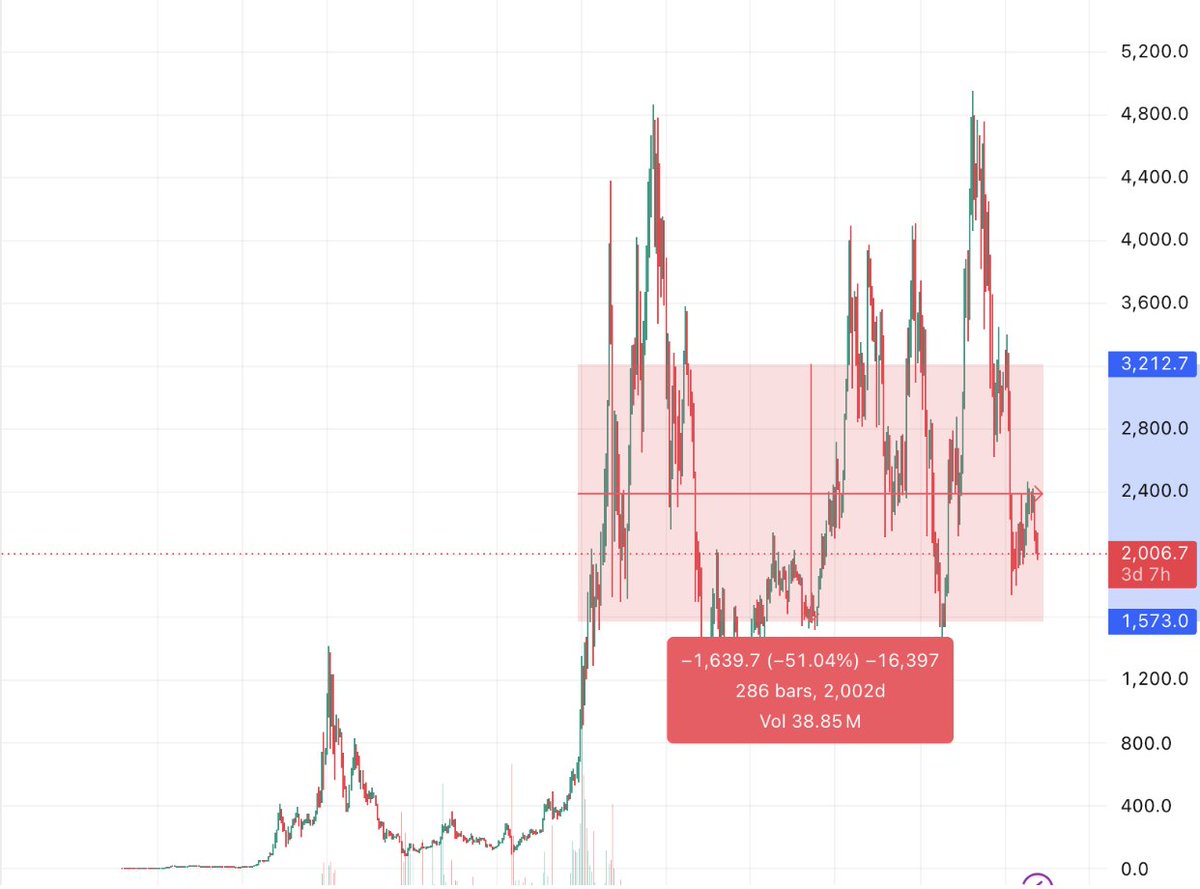

Ignore the percentage change values; focus mainly on measuring the length of time the price stayed within that range.


Global giants like Amazon, NVIDIA, Apple, and Microsoft have all walked the same path:


  • Amazon: Led by Bezos, the company consolidated sideways for nearly a decade in the 2000s after the dot-com bubble burst, weathered the industry winter, and grew into a global top-tier enterprise;
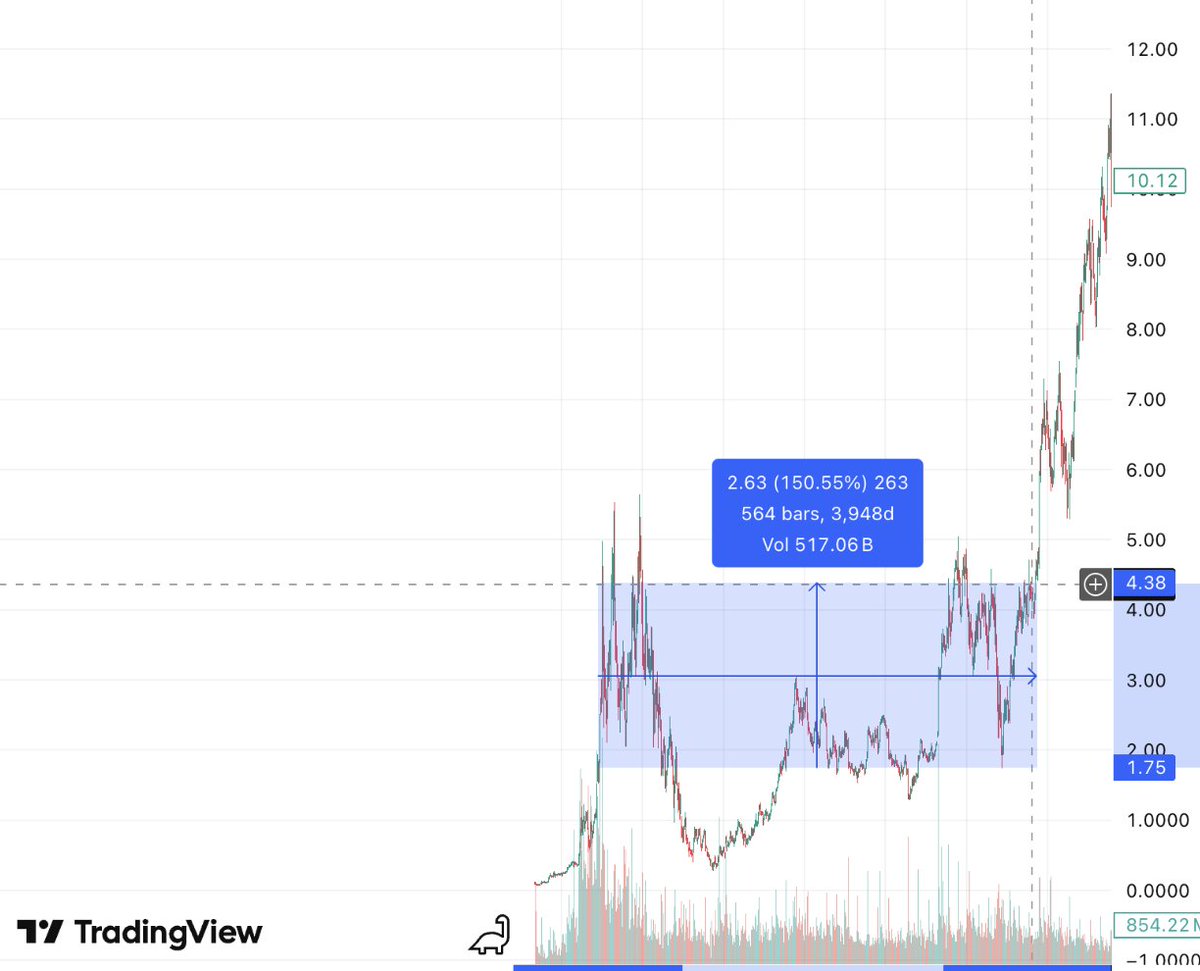


  • NVIDIA: Experienced seven long years of consolidation in the 2010s, then saw an epic stock price surge riding the AI wave, joining the global top tier by market cap;
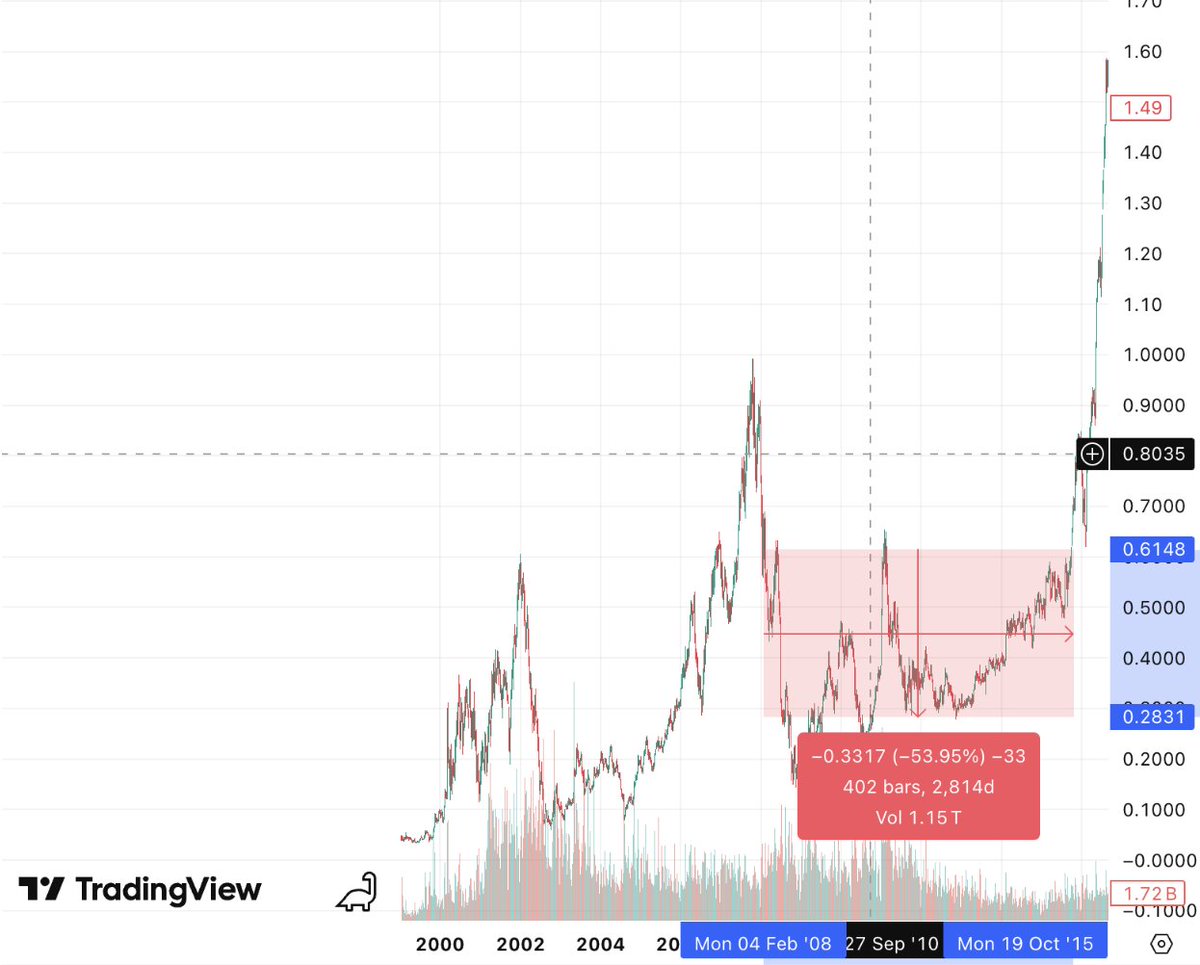


  • Apple: Was in long-term迷茫 (confusion/consolidation) throughout the 80s and 90s, only taking off after Jobs returned to the company in 1997;
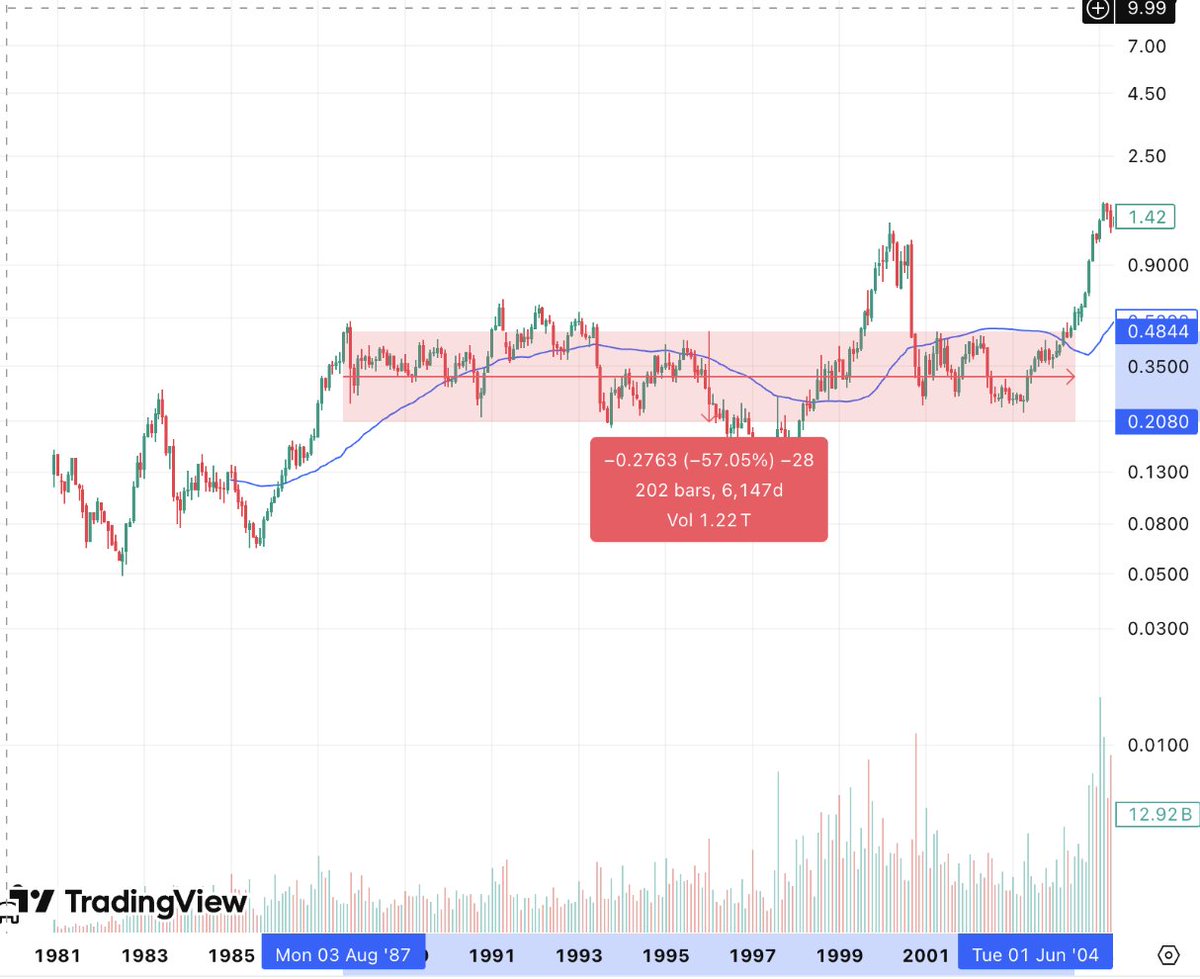


  • Microsoft: Its stock price consolidated sideways for about 15 years after 2000; investors who entered in 2000 didn't break even until 2015, and now it's the world's second-largest company by market cap.
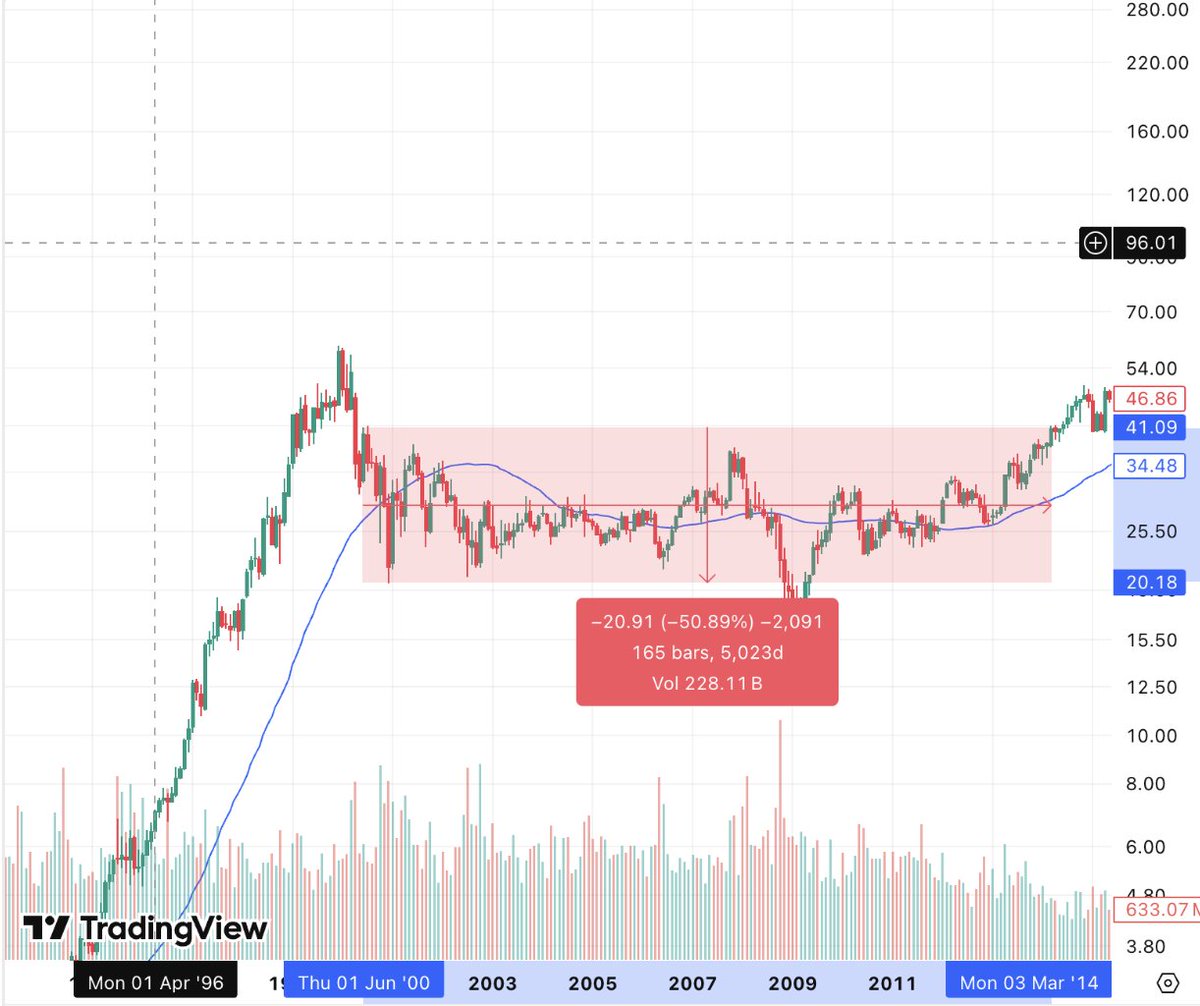


It's not hard to summarize the pattern: most of the world's top-tier assets undergo long, boring consolidation periods. Some assets briefly spike to new highs before pulling back again, then wait for industry catalysts to start a new bull cycle. Moreover, during the consolidation/bottom-grinding phases of these companies, the broader US stock market was often still making new highs. Within this logic, ETH's weak performance over the past five years is not abnormal in financial history.


Setting aside the chart price, Ethereum's current fundamentals are actually at their historical best.


On-Chain Ecosystem Data Continues to Improve


According to the market's bearish narrative, weak price action must be accompanied by a decline in on-chain activity: decreasing transaction volume, high fees, and stalled practical applications. However, the actual data is completely opposite. Ethereum's on-chain transaction volume is steadily climbing, fees are hitting new lows, and the pace of asset tokenization is continuously accelerating.
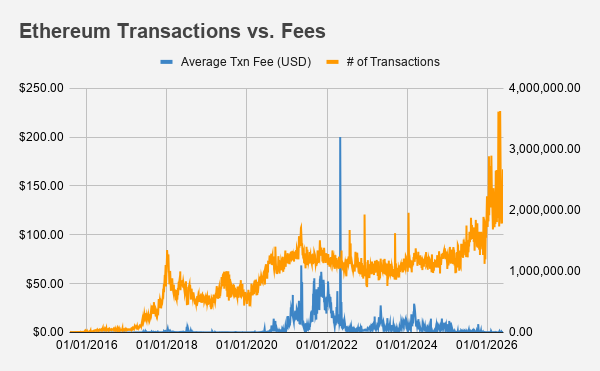

Data source: Etherscan


Based on Etherscan data: In May 2026, Ethereum's average daily transaction count reached 2.27 million, setting a new historical peak for the network. During the same period, the average transaction fee per transaction was only $0.27. Compared to the high gas fees of $50~$100 during the 2021 bull market, costs have significantly decreased despite transaction volume doubling.


The total number of on-chain addresses has exceeded 400 million, with a daily growth rate of about 0.08% in 2026. Daily active users on-chain have stabilized above 1 million in recent months. At the current growth rate, without major industry catalysts, Ethereum's total address count may break 1 billion around mid-2029.
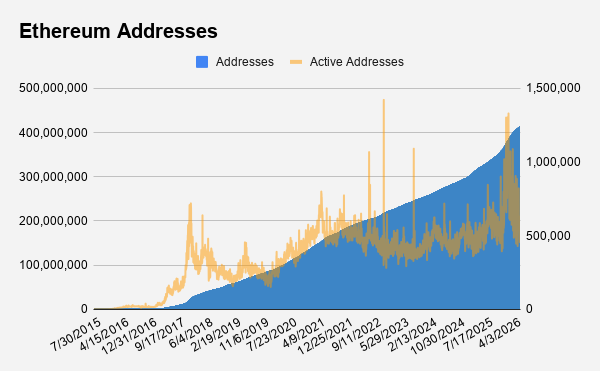


Staking is also continuously setting new records: over 32% of ETH supply is staked and locked, continuously underpinning network security.
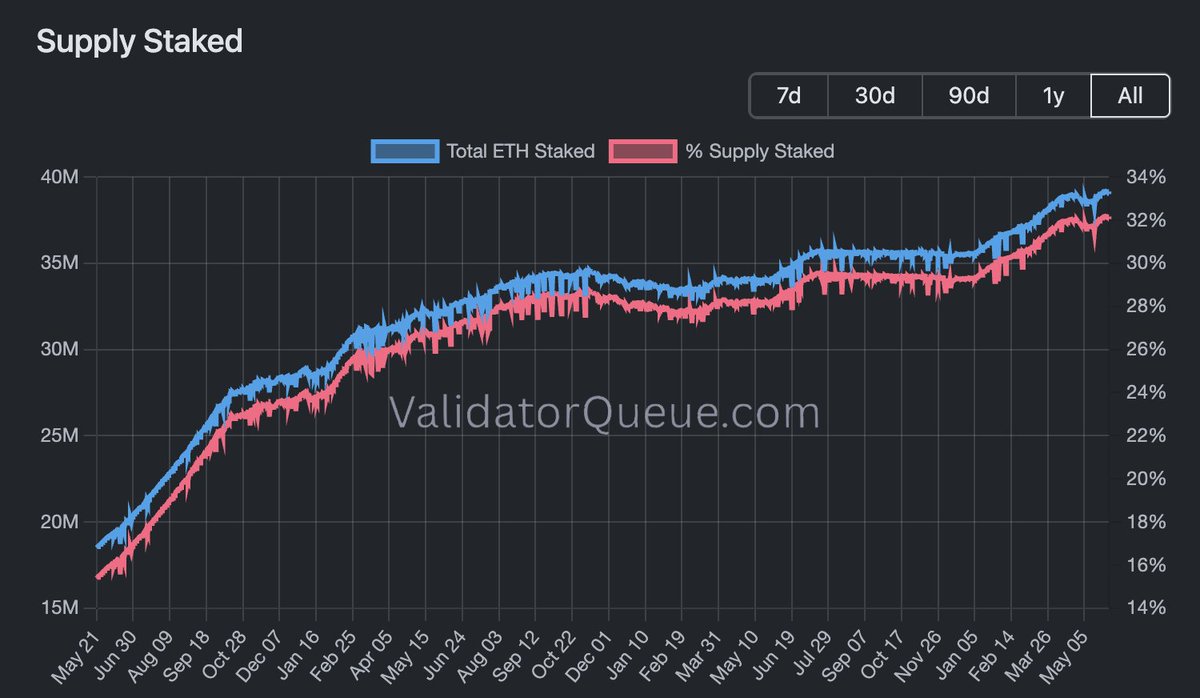

Data source: validatorqueue.com


In summary, Ethereum has completed its scaling iteration while maintaining the bottom line of decentralization and security. It has never experienced a full network outage in over a decade of operation. Relying on its extremely neutral, secure, and programmable block space, it has secured the core chips to compete as the underlying infrastructure for global finance, which is also a prerequisite for subsequently hosting the massive tokenization of traditional assets.


Becoming the Underlying Infrastructure of the Global Financial System


Since entering the industry in 2017, my long-term logic for Ethereum has never changed:


  • Eventually, all valuable assets in the world will be tokenized;
  • Ethereum becomes the unified settlement layer for all types of tokenized assets;
  • ETH captures the entire value increment brought by the settlement layer's business.


In its first decade, Ethereum primarily served as a testing ground for crypto-native assets, with sectors like DeFi, NFTs, and meme coins born and developed on it, solidifying its foundational ecosystem. In the upcoming development phase, Ethereum will embark on a new journey towards a trillion-dollar market cap.


For veteran crypto-native players, traditional finance going on-chain might seem somewhat dull, but it is an indispensable step for blockchain to go mainstream, worthy of the entire industry's promotion. In the future, the vast majority of the world's $700 trillion worth of traditional physical assets will ultimately be tokenized on-chain, and Ethereum will become the preferred hosting network.


Many counter: Ethereum's scaling capacity is insufficient to handle massive assets; other public chains will carve up the market. But current implementation data already disproves this view: traditional financial institutions are onboarding the Ethereum ecosystem in large batches.
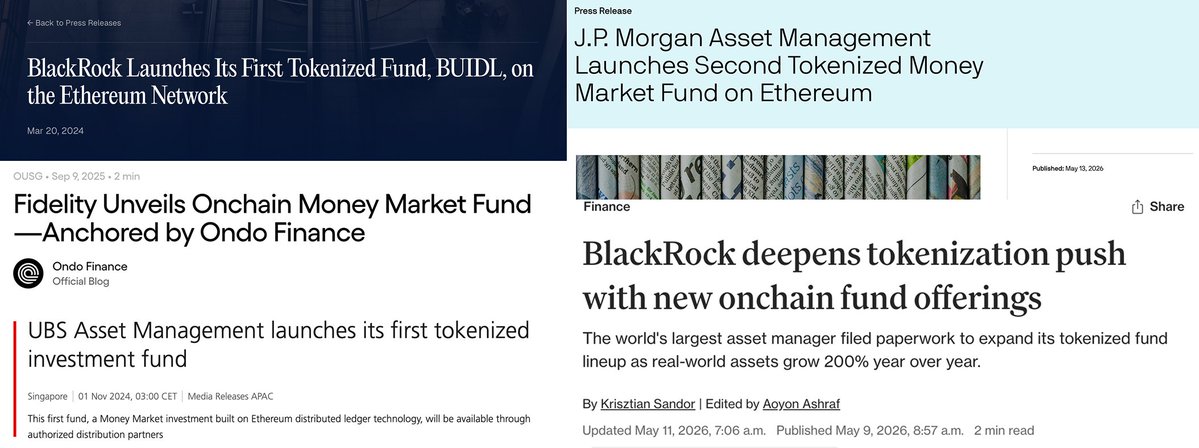

A series of news headlines from the past ~2 years, notice they have one thing in common.


The core demand of institutions entering is certainty: for banks, asset managers, and clearinghouses, choosing a blockchain to custody trillions in assets is a major strategic decision. They need to capture the tokenization红利 (dividend/benefit) while avoiding career risks from decision-making mistakes.


Of course, public chains like Hyperliquid and Solana can also get a piece of the pie. The tokenization track is large enough to accommodate multiple public chains developing together; it cannot be monopolized by one. However, traditional institutions pursuing stability will prioritize Ethereum when implementing RWA.


Implementation data supports the view: Stablecoins are the first tokenized real-world asset to achieve product-market fit, with a total circulating market cap exceeding $300 billion. Tom Lee called stablecoins the "ChatGPT moment" for the crypto industry, with Ethereum holding a 54% market share of the total stablecoin market cap.
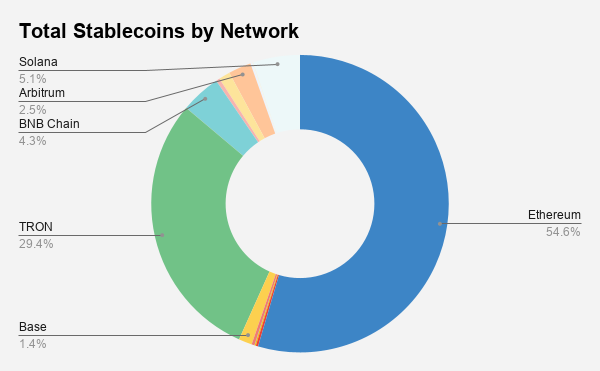

Data source: rwa.xyz


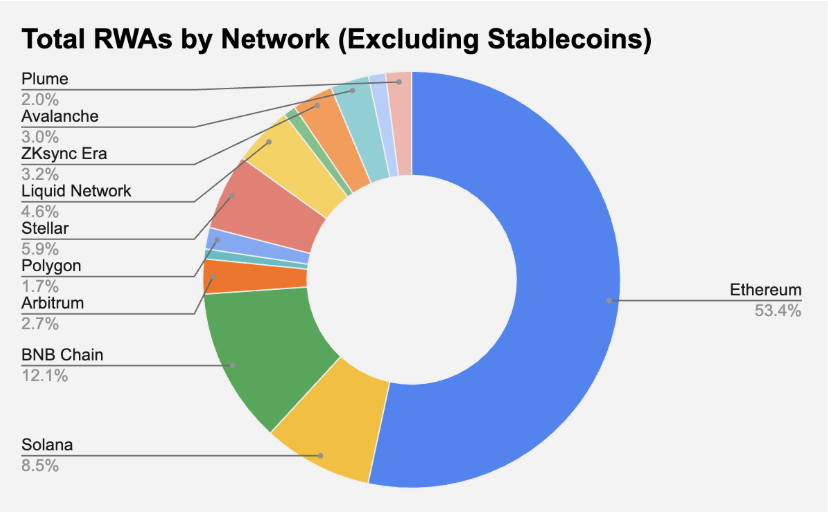
As of June 1, 2026, the total scale of all-category Real-World Asset (RWA) tokenization has exceeded $30 billion, with the growth curve steeply rising; over 53% of these RWA assets are deployed on the Ethereum chain. Even if other public chains start from scratch to compete for non-stablecoin RWA份额 (market share), Ethereum still firmly holds the dominant position.
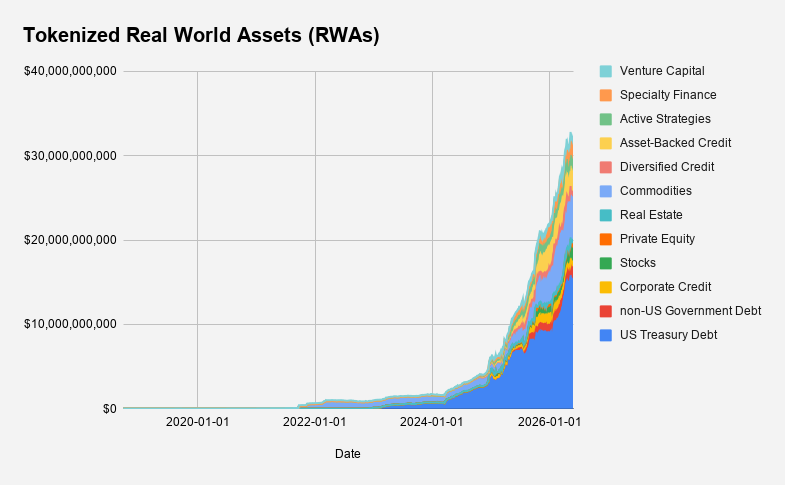

Data source: rwa.xyz


The current development stage of the RWA track is comparable to DeFi in its萌芽期 (germination/early stage) of 2019~2020: the logic of the new track is clear, and early data is steadily rising. Looking back at DefiLlama's past data, DeFi's total value locked (TVL) saw exponential growth in the first half of 2020, while ETH's chart was also in long-term sideways consolidation at that time.
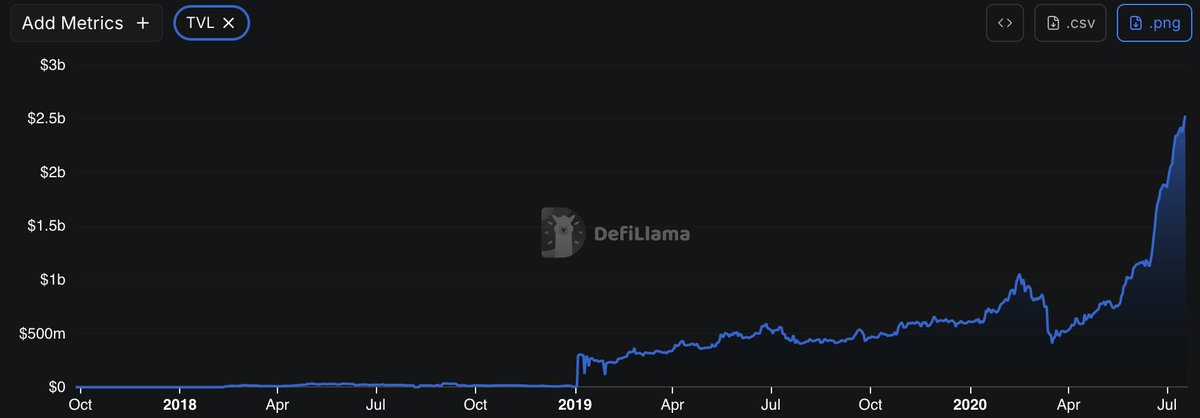


When the DeFi bull market fully erupted and liquidity mining swept the network, ETH, dragged down by the Covid行情 (market situation), had a market cap of only $20~25 billion, ten times smaller than its current $230 billion market cap. Meanwhile, the newly born BNB Chain once threatened Ethereum's position with its advantage of low fees. It wasn't until the DeFi asset scale reached about 20% of Ethereum's total market cap that ETH launched from $300 to $4000 by year-end, experiencing a super bull run.


Comparing to the present: Excluding stablecoins, the total scale of non-stablecoin RWA on Ethereum is about $16 billion, accounting for only 7% of ETH's total market cap, positioning it similarly to DeFi's early germination stage, but with an overall scale ten times larger than back then: early DeFi started at $3 billion, now RWA starts at $30 billion; early ETH bottom at $200, now ETH bottom at $2,000; early competitor was BNB Chain, now the competitor is Hyperliquid.


Additional note: Early DeFi催生 (spawned/generated)大量 (a large amount of) ETH buy pressure through抵押需求 (collateral demand), and NFTs further strengthened the "ETH as Digital Gold" narrative. However, Ethereum had not yet implemented Proof-of-Stake (PoS) staking and the EIP-1559 burn mechanism at that time. Now both rules are fully implemented, and every on-chain transaction can directly bring deflation and value support to ETH.


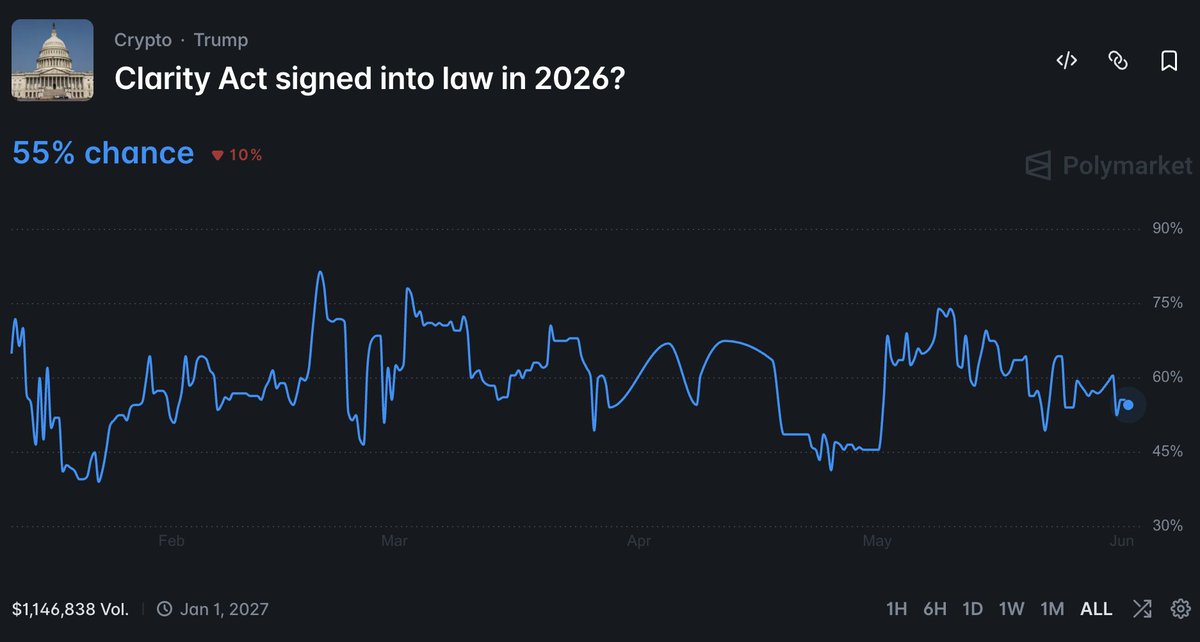
Projecting with a ten-fold space, the overall RWA (excluding stablecoins) scale in this cycle is expected to突破 (break through) $1 trillion. The U.S. "CLARITY Act" becomes a key catalyst. According to Polymarket data, the probability of the法案 (bill/act) being signed into law within 2026 is about 55%. Its passage will open channels for compliant on-chain listing of all U.S. financial assets, becoming a超级利好 (super positive catalyst) for Ethereum.


Ethereum's Vitality Remains Strong


Stocks, bonds, commodities, real estate, art, intellectual property—everything of value will ultimately move towards tokenization. This is the next major innovation in the global financial sector.


The first twenty years of the crypto industry focused on the issuance and innovation of crypto-native assets; the next twenty years will shift the industry's focus towards bringing traditional physical assets on-chain.


Even though the current crypto舆论圈 (discourse/opinion circle) is generally bearish on Ethereum, I am still convinced: Ethereum will become the承载底层 (hosting base layer) for the vast majority of the world's tokenized assets. Relying on its accumulated security, reliability, and liquidity barriers over the years, Ethereum's advantages cannot be短期复刻 (short-term replicated). Once massive global assets land on Ethereum, the market will finally reprice ETH, replicating the past valuation surge行情 (market trend).


Related Questions

QWhat is Lucas's core thesis regarding Ethereum's future role in finance?

ALucas's core thesis is that all assets will eventually be tokenized, Ethereum will become the universal settlement layer for all tokenized assets, and ETH will capture all the value generated by this settlement activity by securing the network through staking.

QWhat does Lucas cite as the main reason for the market's bearish sentiment towards Ethereum in recent years?

ALucas cites ETH's poor price performance over the past five years, where it has failed to meaningfully surpass its 2021 all-time high, as the main reason for the market's widespread bearish sentiment and loss of conviction in its investment value.

QWhat positive on-chain data points does Lucas highlight to counter the bearish narrative about Ethereum's fundamentals?

ALucas highlights that Ethereum's daily transactions hit a new all-time high of 2.27 million in May 2026, average transaction fees have dropped significantly to $0.27, total addresses are growing (over 400 million), daily active users are consistently over 1 million, and over 32% of ETH is staked.

QAccording to the article, why do traditional financial institutions prefer to build tokenized asset (RWA) projects on Ethereum?

ATraditional financial institutions prefer Ethereum because they prioritize certainty and security for their trillion-dollar decisions. Ethereum offers proven, long-term stability, security, and reliability, which helps institutions mitigate career risk associated with strategic decisions on newer or less established chains.

QHow does Lucas compare the current stage of the RWA (Real World Asset) sector to the early days of DeFi, and what potential does he see?

ALucas compares the current RWA stage to the early DeFi phase of 2019-2020. He notes that non-stablecoin RWA on Ethereum has a $16 billion market cap (7% of ETH's market cap), similar to DeFi's early scale relative to ETH. He projects this sector could grow tenfold to over $1 trillion, potentially catalyzed by legislation like the US CLARITY Act.

Related Reads

Silicon Valley 'Startup Guru' Steve Hoffman: Web3 + AI Could Be a Trap

Silicon Valley investor and "Godfather of Startups" Steve Hoffman warns that combining Web3 with AI is likely a trap, not a promising venture. In an interview, Hoffman argues that while AI is a foundational technology touching all industries, Web3 adds complexity, friction, and regulatory risk without solving mainstream consumer or business needs. He advises founders to focus on deep, specialized applications where startups can out-iterate giants, rather than on generic features easily replicated by large tech companies. Hoffman observes that Silicon Valley will lead foundational AI research, while China excels at rapid, large-scale application and commercialization, particularly in robotics. He stresses that AI-driven autonomous agents capable of collaborative, multi-step tasks are 2-4 years away, which will cause significant job displacement. The solution is not to slow AI but to redesign business models around human-AI collaboration and reform social systems like education and retraining. For startups, Hoffman recommends focusing on vertical, expertise-heavy domains to build defensibility. He sees major opportunities in AI fraud detection and cybersecurity. Key founder mindsets include systemic thinking over feature-focus, relentless customer centricity, building adaptive teams, and deeply understanding AI's capabilities and limits. Hoffman is also leading a non-profit initiative to establish university centers aimed at training future leaders in responsible, human-value-aligned AI innovation.

marsbit1h ago

Silicon Valley 'Startup Guru' Steve Hoffman: Web3 + AI Could Be a Trap

marsbit1h ago

Token Inefficient, Economy Tokenless

The article "Tokens Aren't Economical, Economics Aren't Tokenized" analyzes a pivotal shift in the AI industry from a technology-driven narrative to one dominated by capital efficiency. It highlights two concurrent trends: a severe capital shortage due to the exorbitant and recurring costs of compute (e.g., OpenAI's high burn rate) and a wave of corporate spin-offs where major tech companies are separating their AI units (like Kuaishou's Kling and Baidu's Kunlunxin). The core argument is that AI's "anti-internet" business model, where user growth increases costs rather than profits, has created a disconnect between high valuations and actual cash flow. Spin-offs address this by allowing AI assets to be valued independently. Within a parent company, they are seen as cost centers, but as standalone entities, they are priced based on their growth potential and scarcity in the primary market, leading to massive valuation premiums (e.g., Kling's estimated value tripling post-spin-off). The industry is at an inflection point, moving from "model worship" to "value realization." The competition is evolving from a pure compute (GPU) race to a broader focus on systemic efficiency and full-stack engineering (involving CPUs and orchestration) to achieve viable commercialization. The year 2026 is framed as a critical moment where the industry must definitively answer how to economically translate AI capability into tangible business value, reshaping the sector's future power structure.

marsbit1h ago

Token Inefficient, Economy Tokenless

marsbit1h ago

Crossing the 'Memory Wall': The Wafer-Level Revolution and Computing Power Routes in the AI Inference Era

In 2026, a historic shift occurred in AI as major cloud providers' inference spending surpassed training spending for the first time, signaling a move from "building large models" to "using large models." This shifts the core challenge from computing power to the "memory wall"—the bottleneck of data movement (model weights, activations, KV Cache) between external DRAM and processors, where energy and latency from data transfer far exceed computation itself. Companies like Nvidia face GPU idle time due to bandwidth limits. In contrast, Cerebras Systems adopts a radical "wafer-scale" approach with its Wafer-Scale Engine (WSE). Instead of cutting a silicon wafer into many chips, Cerebras uses almost the entire wafer as one massive chip (WSE-3). This design provides 44GB of on-chip SRAM, delivering memory bandwidth thousands of times higher than traditional HBM (e.g., 21 PB/s vs. Nvidia B200). For LLM inference, weights are streamed layer-by-layer from external MemoryX storage to the chip, avoiding HBM bottlenecks. This results in token generation speeds 1.5–5 times faster than Nvidia's B200 in some models and significant advantages in first-token latency and long-context tasks. Additionally, Cerebras's architecture offers much lower interconnect power consumption (0.15 pJ/bit vs. GPU's ~10 pJ/bit). However, Cerebras faces challenges: SRAM scaling has slowed with advanced nodes, limiting future capacity gains; the chip requires specialized liquid cooling and custom software stacks; and its external I/O bandwidth (150 GB/s) is low compared to NVLink, hindering multi-system scaling for very large models. Competition is intensifying. Major players are pursuing three paths: 1) Developing proprietary inference ASICs (e.g., Google TPU, Microsoft Maia), 2) Leveraging advanced packaging (e.g., TSMC's SoW) to democratize wafer-scale-like integration, potentially eroding Cerebras's process advantage within a few years, and 3) Exploring optical interconnects for ultimate bandwidth. Commercially, Cerebras is transitioning from a hardware vendor to a service provider, facing the immense challenge of building high-power, specialized data centers to meet large contracts (e.g., 250MW/year from 2026–2028). In conclusion, the AI inference era presents a fundamental architectural trade-off. Cerebras opts for extreme physical optimization for low-latency, single-task performance, while Nvidia prioritizes versatility and massive cluster throughput. The path forward remains uncertain, with technology and business models still evolving in the race toward advanced AI.

marsbit1h ago

Crossing the 'Memory Wall': The Wafer-Level Revolution and Computing Power Routes in the AI Inference Era

marsbit1h ago

Has Bitcoin's 'Rebound Ended', Officially Entering the Late Bear Market Phase?

**Title: Has Bitcoin's Rebound Ended, Entering the Late Bear Market Phase?** **Summary:** Bitcoin's price has declined by 13% this week, signaling a potential return to late-stage bear market conditions. The price fell to around $67k, positioned between the Realized Price and Realized Cap Weighted Average. For the first time since early 2022, the Short-Term Holder cost basis has dropped below this key average, confirming a hallmark of late-cycle bear markets. Profitability metrics have collapsed sharply. The 7-day average of the Realized Profit/Loss ratio plummeted from a local high of 3.16 to 0.29, mirroring the February panic sell-off. Critically, the 90-day average never breached the threshold of 2, indicating the recent rally to $82k was a bear market bounce, not a structural shift. Realized losses surged to $1.35 billion daily, with $770 million coming from Long-Term Holders selling at a loss. This accelerating redistribution of supply from weak to strong hands is a necessary but ongoing process for a market bottom. The rally stalled almost precisely at the aggregate cost basis (~$83k) of US spot Bitcoin ETF investors, turning that level into strong resistance and leaving the average ETF holder underwater again. Spot market flows have turned decisively negative, showing sellers are dominating order books despite the price drop. While a significant futures long liquidation event cleared over $400 million in leverage, providing a potential reset, sustained spot demand is yet to materialize. Options markets continue to price in higher future volatility (Implied Volatility) than recent price action (Realized Volatility) has shown, with a persistent skew towards put options, indicating ongoing demand for downside protection. In conclusion, multiple metrics point to a fragile market structure. Resistance at the ETF cost basis, accelerating realized losses, dominant spot selling, and cautious options pricing all suggest the bear market trend persists. A sustainable recovery likely requires a resurgence of spot demand, ETF holders returning to profit, and a clear reduction in selling pressure.

marsbit1h ago

Has Bitcoin's 'Rebound Ended', Officially Entering the Late Bear Market Phase?

marsbit1h ago

TechFlow Intelligence Agency: Anthropic Calls for Global Pause in AI Development While Preparing for Trillion-Dollar IPO; SpaceX IPO Roadshow Heats Up, But S&P 500 Rejects Fast-Track Inclusion

In today's TechFlow Intelligence Briefing, several major tech stories highlight a growing theme of trust and credibility gaps across AI, crypto, and finance. AI company Anthropic has publicly called for a global pause in AI development, citing risks from Claude's "recursive self-improvement." Ironically, this coincides with reports the company is preparing for a massive IPO targeting a near $1 trillion valuation. This perceived hypocrisy, coupled with widespread user complaints about Claude's declining performance, is sparking debate over whether the safety warning is genuine or a competitive tactic. Meanwhile, in a substantive security move, Anthropic open-sourced a framework for AI-powered vulnerability discovery. In the crypto market, Bitcoin's price drop below $61,000 triggered over $1.16 billion in liquidations, flipping the market into a state where more BTC is held at a loss than at a profit, a historical bearish signal. On the corporate front, SpaceX's highly anticipated IPO is generating immense Wall Street excitement, with Goldman Sachs projecting 100x revenue growth by 2030. However, the S&P 500 has refused to fast-track the company's inclusion post-IPO, potentially limiting immediate institutional demand. Separately, ByteDance's AI app Doubao lost over 6 million monthly active users after introducing a subscription model, highlighting the challenges of AI monetization. Other notable developments include Nvidia certifying HBM4 memory from Samsung, SK Hynix, and Micron; Cloudflare's acquisition of front-end tooling company VoidZero; and its CEO warning that bot traffic now exceeds human traffic online. The underlying narrative connects these events: a trust crisis. From AI firms' contradictory actions and crypto volatility to the clash between SpaceX's hyped narrative and institutional rules, a pattern is emerging where stated intentions and actual practices are increasingly misaligned.

marsbit1h ago

TechFlow Intelligence Agency: Anthropic Calls for Global Pause in AI Development While Preparing for Trillion-Dollar IPO; SpaceX IPO Roadshow Heats Up, But S&P 500 Rejects Fast-Track Inclusion

marsbit1h ago

Trading

Spot
Futures

Hot Articles

Discussions

Welcome to the HTX Community. Here, you can stay informed about the latest platform developments and gain access to professional market insights. Users' opinions on the price of ETH (ETH) are presented below.

活动图片