SOL struggles as Solana TVL slides and memecoin demand fades

cointelegraphPublished on 2025-12-12Last updated on 2025-12-12

Abstract

SOL, the native token of the Solana blockchain, has struggled to maintain prices above $145 amid declining network activity and reduced demand for decentralized applications. The total value locked (TVL) on Solana has dropped by over $10 billion from its September peak, while weekly DApp revenues fell from $37 million to $26 million. Memecoin demand, a key driver for Solana, has weakened significantly since October’s market crash, contributing to a 67% drop in decentralized exchange volumes. Although Solana’s transaction count increased by 6%, network fees declined by 21%. SOL’s funding rates indicate low bullish leverage demand, reflecting weakened trader confidence after a 46% price decline over three months. Despite positive developments like the Firedancer mainnet launch and new products from Kamino, a sustained recovery to previous highs remains uncertain.

Key takeaways:

  • SOL funding rates signal low bullish conviction after a 46% price drop, despite Firedancer’s launch and rising Solana network transactions.

  • Solana DApp revenues and DEX activity have weakened sharply, suggesting broader market fatigue even as Solana’s ecosystem grows.

Solana’s native token, SOL (SOL), has failed to sustain prices above $145 for the past four weeks. A decline in network activity amid reduced demand for decentralized applications has negatively impacted SOL’s outlook.

With Solana’s TVL now down more than $10 billion from its September peak, onchain metrics are flashing signs that user participation is cooling faster than expected.
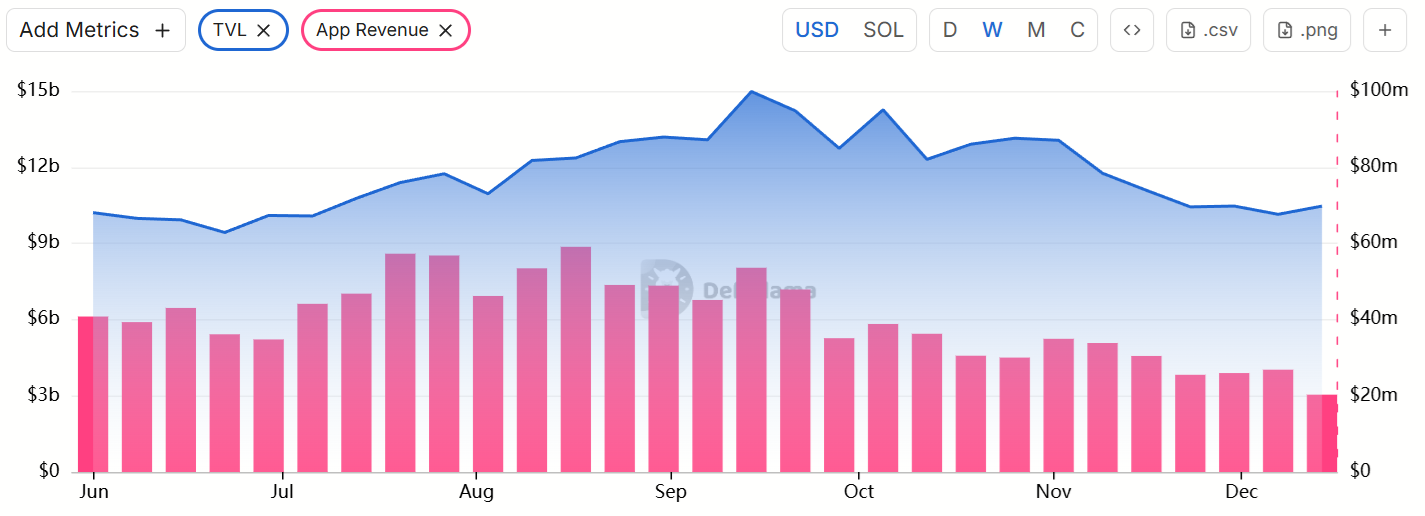
Solana TVL (left) vs. 7-day DApp revenues (right), USD. Source: DefiLlama

The total value locked (TVL) on Solana has been in decline since reaching its all-time high of $15 billion in September. Falling smart contract deposits increase the immediately available SOL supply for sale. Meanwhile, revenues from decentralized applications (DApps) on Solana dropped to $26 million per week, down from $37 million two months earlier.

Traders’ appetite for memecoins has also weakened since the cryptocurrency market flash crash on Oct. 10, an event that exposed critical flaws in leveraged positions and the overall liquidity of smaller altcoins. Regardless of whether derivatives markets amplified the move, traders became less comfortable with DEX platforms following the $19 billion liquidation event.
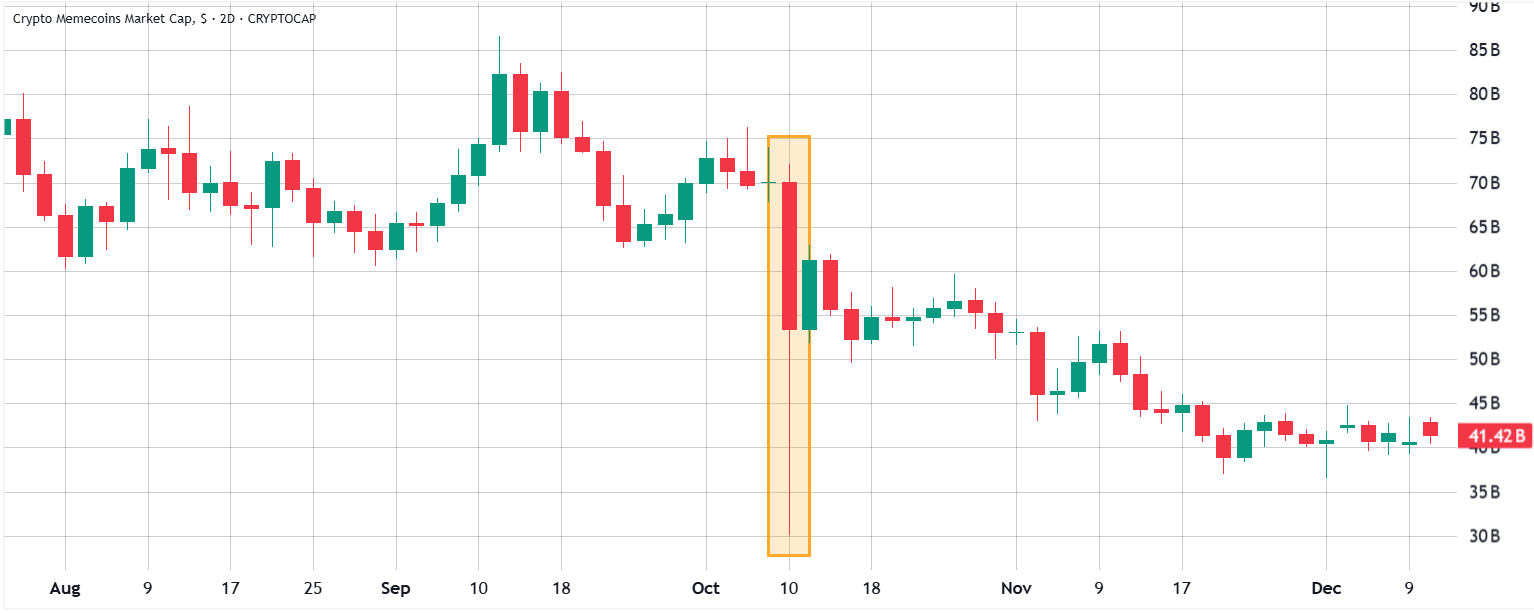
Memecoin market capitalization, USD. Source: TradingView

Memecoins have been a major driver for SOL, especially after the Official Trump (TRUMP) launch in January, which pushed decentralized exchange (DEX) volumes on Solana to $313.3 billion that month. According to DefiLlama data, this activity has since dropped by 67%, partly explaining the softer revenue trends across Solana DApps.

Still, the reduced demand for blockchain-based applications may reflect a broader market slowdown rather than a specific weakness in Solana.
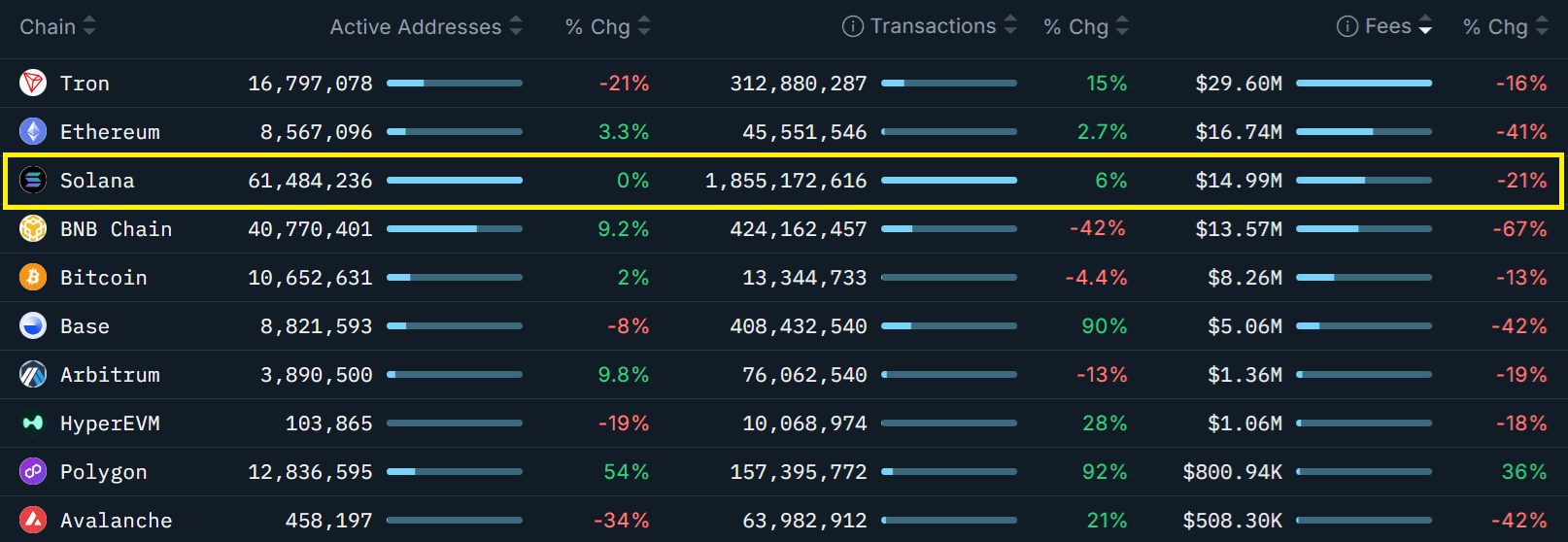
Blockchains ranked by 30-day network fees. Source: Nansen

Solana network fees fell by 21% over the past 30 days, yet competing blockchains experienced steeper declines. Fees on the BNB Chain dropped 67%, while Ethereum saw a 41% decrease over the same period, according to Nansen data. Additionally, the number of transactions on Solana increased by 6%, while activity on the BNB Chain decreased by 42%.

SOL long leverage demand vanishes

SOL perpetual futures can provide a useful gauge of traders’ sentiment, as exchanges charge either buyers (longs) or sellers (shorts) based on leverage demand. In neutral conditions, the funding rate typically ranges between 6% and 12% per year, with longs paying to keep their positions open given the cost of capital. Conversely, a negative funding rate signals broader bearish sentiment.
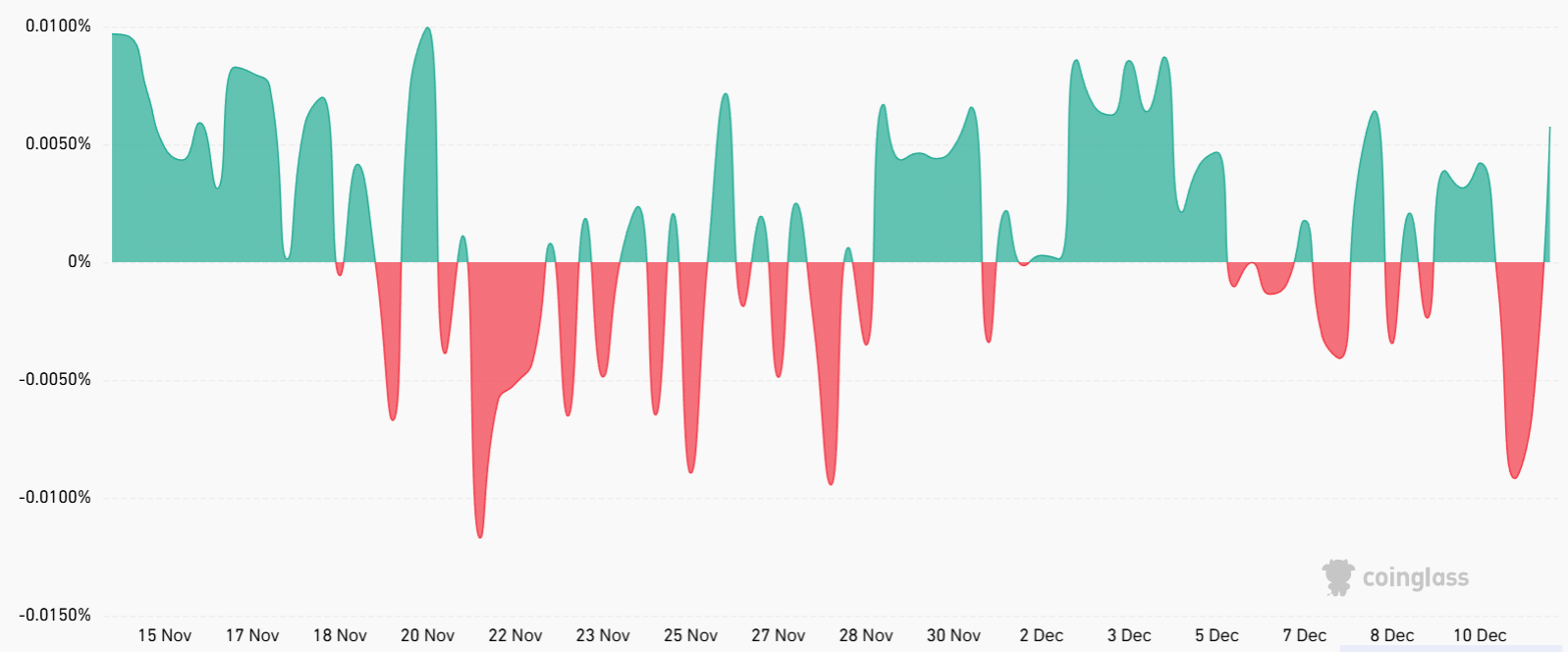
SOL perpetual futures 8-hour funding rate. Source: CoinGlass

SOL’s annualized funding rate stood at 6% on Friday, showing weak demand for bullish leverage. The unusual 11% negative reading on Thursday should not be interpreted as heavy demand for bearish positions, as market makers moved quickly to stabilize imbalances. Still, it may take time for bulls to rebuild conviction after SOL’s 46% price decline over three months.

Several recent developments in the Solana ecosystem are expected to draw renewed investor interest, including Friday’s mainnet launch of Firedancer, a new validator client designed to expand processing capacity. The project took more than three years to build under the guidance of Jump Trading, one of the industry’s top market makers. Developers reported a strong response after the validator node re-synced in under two minutes.

Related: J.P. Morgan taps Solana for Galaxy’s tokenized corporate bond issuance

Kamino, the second-largest Solana DApp by TVL, also announced new products on Friday, including fixed-rate and fixed-term borrowing, offchain collateral, private credit and an onchain Bitcoin-backed institutional credit line. Kamino’s $69 million in annualized fees and an average 10% annualized yield on deposits offer a clear indication of the ecosystem’s expansion.

Whether SOL can reclaim the $190 level last seen two months ago remains uncertain, and it is unlikely that improved validation software or expanded DApp offerings alone will restore the confidence needed to support a sustainable bullish trend.

This article is for general information purposes and is not intended to be and should not be taken as, legal, tax, investment, financial, or other advice. The views, thoughts, and opinions expressed here are the author’s alone and do not necessarily reflect or represent the views and opinions of Cointelegraph. While we strive to provide accurate and timely information, Cointelegraph does not guarantee the accuracy, completeness, or reliability of any information in this article. This article may contain forward-looking statements that are subject to risks and uncertainties. Cointelegraph will not be liable for any loss or damage arising from your reliance on this information.


Related Reads

Winter for Crypto IPOs: Consensys and Ledger Withdraw Applications

The crypto IPO window is tightening significantly in 2026, marked by prominent companies delaying or pausing their public listing plans. Following a successful 2025 "harvest year" that saw Circle, Bullish, and Gemini go public amidst a bull market, the tide has turned. Consensys, developer of MetaMask, recently postponed its IPO until at least fall 2026. Hardware wallet leader Ledger also suspended its planned US listing due to unfavorable market conditions, with Kraken having previously delayed its own plans. This shift is driven by a cooling market in 2026, characterized by a significant Bitcoin price correction, declining trading volumes, and reduced investor risk appetite for crypto stocks. The poor post-IPO performance of 2025 listings like Circle and Bullish, which saw major share price declines, has heightened investor caution. This contrasts sharply with the current AI sector, where companies like SpaceX, OpenAI, and Anthropic are commanding massive valuations and investor enthusiasm based on narratives of stable, exponential growth. Crypto companies now face pressure to transition from hype-driven models to demonstrating reliable cash flows and robust compliance. While the paused IPO plans may lead to valuation resets and affect ecosystem liquidity, they also accelerate industry consolidation toward stronger, more compliant infrastructure players. A potential recovery in Bitcoin's price and clearer regulations could reopen the IPO window in the latter half of 2026.

marsbit53m ago

Winter for Crypto IPOs: Consensys and Ledger Withdraw Applications

marsbit53m ago

ChatGPT Can Manage Your Money for You. Would You Trust It with Your Bank Account?

OpenAI has launched a personal finance tool for ChatGPT, currently in preview for US-based ChatGPT Pro users. This feature allows users to connect their bank and investment accounts (via Plaid, supporting over 12,000 institutions) directly to ChatGPT. It analyzes transactions, generates visual dashboards, and offers conversational financial advice—such as budgeting or planning for major purchases—based on the user's actual data. This move follows OpenAI's acquisitions of fintech startups Roi and Hiro Finance, signaling a strategic push into vertical "super assistant" applications, similar to its earlier health-focused feature. However, the launch has sparked significant privacy concerns. Critics question the safety of granting such sensitive financial access to an AI, especially amid ongoing lawsuits alleging OpenAI shared user chat data with third parties like Meta and Google. OpenAI emphasizes that ChatGPT only reads data (no transaction capabilities), deletes it within 30 days if disconnected, and offers opt-out options for model training. Yet, trust remains a major hurdle. The trend reflects a broader industry shift: AI companies like Anthropic and Perplexity are also targeting high-value, data-rich domains like finance and health. While technically promising, the tool operates in a regulatory gray area—it provides personalized guidance but disclaims formal financial advice or liability. Ultimately, OpenAI's challenge is convincing users to trust an AI with their most private financial information.

marsbit54m ago

ChatGPT Can Manage Your Money for You. Would You Trust It with Your Bank Account?

marsbit54m ago

Trading

Spot
Futures

Hot Articles

Discussions

Welcome to the HTX Community. Here, you can stay informed about the latest platform developments and gain access to professional market insights. Users' opinions on the price of SOL (SOL) are presented below.

活动图片