XRP Open Interest Falls to Lowest Level Since 2024: Market Reset Or Warning Signal?

bitcoinistPublished on 2026-02-04Last updated on 2026-02-04

Abstract

XRP is undergoing a significant market reset as its open interest in derivatives has dropped to approximately 902 million, the lowest level since 2024, indicating a broad unwinding of leveraged positions. This decline, observed across major exchanges like Binance, reflects a market-wide de-risking trend rather than a mere shift between platforms. The reduction in leverage suggests a move away from speculative trading, potentially leading to slower but more deliberate price action. Currently, XRP is testing critical support near $1.60 after breaking below the key $1.80 level, signaling structural weakness. Trading below major moving averages, the asset shows a bearish trend with lower highs and lower lows. While the volume remains muted, indicating a controlled unwind rather than panic selling, holding the $1.55–$1.60 zone is crucial for stabilization. A breakdown could lead to a deeper retracement toward $1.30–$1.40. Analysts are watching for a rebound in open interest alongside improving price momentum as a potential early signal of a new trend.

XRP has entered a critical phase after losing the $1.80 level and sliding toward the $1.60 zone, where price is now attempting to find short-term support. The move comes amid broader weakness across the crypto market, but XRP’s structure shows an additional layer of stress that goes beyond spot price action. According to a recent report from CryptoQuant, the derivatives side of the XRP market is undergoing a sharp contraction in leverage, signaling a meaningful shift in trader behavior.

Data shows that open interest across all XRP derivatives platforms has fallen to roughly 902 million, marking its lowest level since 2024. This is a stark contrast to conditions seen during 2025, when open interest consistently hovered between 2.5 and 3.0 billion. The magnitude of this decline suggests that leverage is being actively unwound rather than merely rotating between exchanges, pointing to a broader risk-off adjustment.
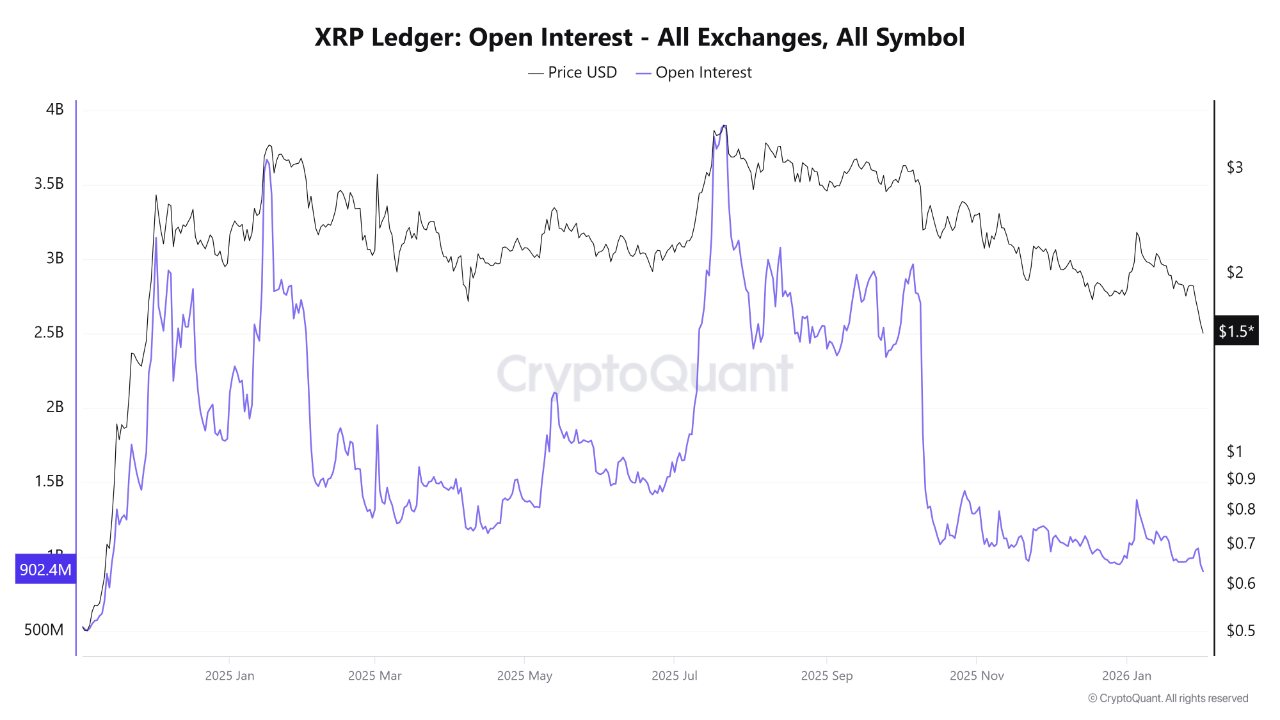
XRP Ledger Open Interest | Source: CryptoQuant

Such contractions often reflect a market that is de-risking after extended volatility. With fewer leveraged positions in play, price movements tend to become slower but more deliberate, as speculative excess is flushed out. As XRP tests the $1.60 area, analysts are closely watching whether this leverage reset lays the groundwork for stabilization—or signals deeper downside still ahead.

The report adds important color by breaking down where the leverage reduction is taking place. On Binance, open interest in XRP derivatives has fallen to around 458 million. While this figure remains above the levels observed last December, it still represents a sharp contraction from the highs seen earlier in the cycle.

Crucially, this decline on Binance mirrors what is happening across other major trading venues, reinforcing the view that the market is undergoing a broad deleveraging phase rather than a simple migration of positions between exchanges.

From a structural standpoint, this matters. When open interest compresses simultaneously across platforms, it typically reflects traders actively reducing risk and closing leveraged exposure. This kind of environment often precedes periods of price consolidation, as the market digests prior volatility and searches for a new equilibrium. In past cycles, these phases have frequently led to the formation of base structures, particularly when selling pressure fades and volatility compresses.

Looking ahead, analysts note that any recovery in open interest will be critical to monitor. A rebound in leverage that coincides with improving price momentum could serve as an early signal that a new trend is developing.

For now, however, the drop in open interest to its lowest level since 2024 points to a clear market cleanup. While this reset may appear quiet on the surface, it can provide a healthier foundation for future moves—provided risk management remains front and center in the next phase of XRP’s market evolution.

XRP Price Showing Weakness

XRP price action continues to reflect structural weakness as the asset trades decisively below its key moving averages and tests the $1.60 zone for support. The chart shows a clear transition from a prior uptrend into a sustained downtrend, marked by lower highs and lower lows since the October peak near the $3.50–$3.60 region. Momentum has steadily deteriorated, with each rebound failing below the declining short- and medium-term moving averages, signaling persistent seller control.
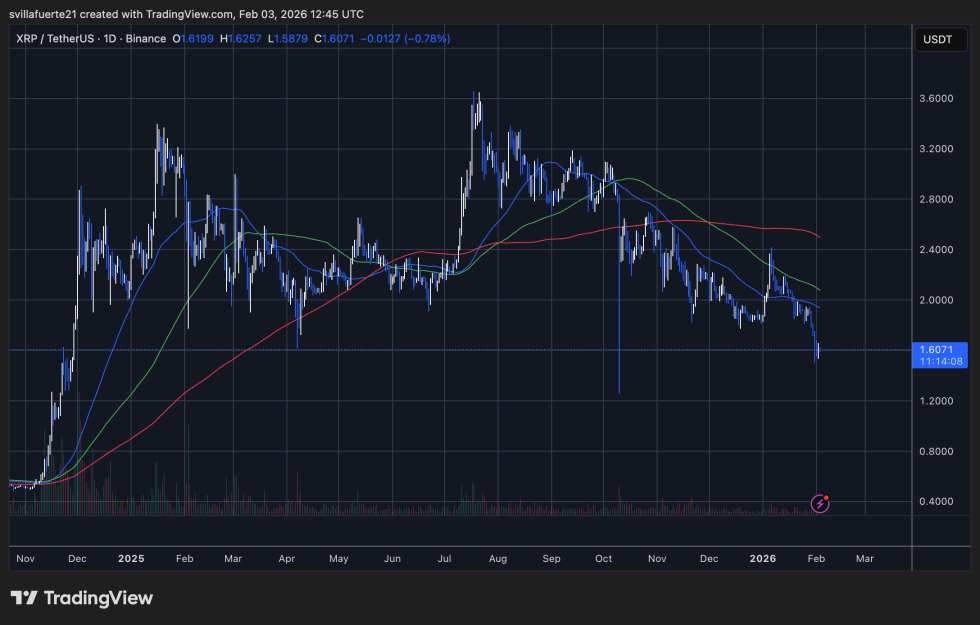
XRP testing critical demand level | Source: XRPUSDT chart on TradingView

The loss of the $1.80 level is technically significant. This zone previously acted as a consolidation base and demand area, but the clean breakdown suggests that buyers have stepped aside rather than aggressively defending the price. XRP is now trading below the 50-day and 100-day moving averages, while the 200-day moving average above continues to slope downward, reinforcing a bearish medium-term structure.

Volume remains relatively muted compared to earlier distribution phases, which aligns with the derivatives data showing a contraction in leverage rather than panic-driven liquidation. This supports the view that the current move is more of a controlled unwind than a capitulation event.

As long as price holds the $1.55–$1.60 region, XRP may attempt to stabilize and form a base. However, a failure to hold this area would expose the market to a deeper retracement toward prior demand zones near $1.30–$1.40.

Featured image from ChatGPT, chart from TradingView.com

Related Questions

QWhat is the current level of XRP open interest and why is it significant?

AXRP open interest has fallen to roughly 902 million, marking its lowest level since 2024. This is significant because it represents a sharp contraction from the 2.5-3.0 billion levels seen during 2025, indicating a broad deleveraging phase and a meaningful shift in trader behavior away from speculative excess.

QAccording to the article, what does a simultaneous decline in open interest across multiple exchanges typically indicate?

AA simultaneous decline in open interest across multiple exchanges typically indicates that traders are actively reducing risk and closing leveraged exposure, rather than simply moving positions between venues. This often reflects a broad market de-risking and can precede periods of price consolidation.

QWhat key price level did XRP lose that the article describes as 'technically significant'?

AThe article describes the loss of the $1.80 level as technically significant. This zone previously acted as a consolidation base and demand area, and its clean breakdown suggests that buyers have stepped aside rather than aggressively defending the price.

QWhat potential price levels are identified as critical support and next downside targets for XRP?

AThe $1.55–$1.60 region is identified as critical short-term support. If this area fails to hold, the article states it would expose the market to a deeper retracement toward prior demand zones near $1.30–$1.40.

QHow does the article characterize the nature of the price decline based on volume and derivatives data?

AThe article characterizes the decline as a controlled unwind rather than a capitulation event. This is supported by relatively muted volume compared to earlier distribution phases and derivatives data showing a contraction in leverage instead of panic-driven liquidations.

Related Reads

Korean Youth, Making a 'Last Stand' in an Epic Bull Market

South Korea is experiencing an unprecedented stock market boom in the first half of 2026, with the KOSPI index doubling in six months, driven primarily by tech giants Samsung Electronics and SK Hynix. This "epic bull run," tied to the semiconductor cycle, has sparked a nationwide frenzy for stock trading. The country, with a population of just over 50 million, now has over 105 million securities accounts. The article, from the perspective of a Chinese national living in Seoul, explores how this speculative fever reflects deeper societal anxieties among Korean youth. Facing stagnant wages, high costs of living, housing pressures, and rigid social stratification, many young people see the volatile market as a "last chance" to alter their predetermined life trajectories and escape financial precarity. Stories include a young office worker investing her meager savings, a couple delaying marriage due to financial pressures, and a seasoned trader navigating exclusive social circles where market information is currency. However, the boom also exposes and exacerbates existing inequalities. While some achieve windfalls, others face devastating losses, with borrowing to invest reaching record highs. The narrative contrasts the illusion of equal opportunity with the harsh reality that the ability to absorb risk is unevenly distributed. Ultimately, the market frenzy is portrayed not as a solution, but as a symptom of a generation's struggle against a system offering limited upward mobility, where daily life is a precarious balance of bills, debts, and societal expectations.

marsbit18m ago

Korean Youth, Making a 'Last Stand' in an Epic Bull Market

marsbit18m ago

Young South Koreans, Making a 'Last-Ditch Effort' in an Epic Bull Market

This article explores how an unprecedented stock market boom in South Korea during the first half of 2026, driven by the semiconductor industry, is transforming the lives of ordinary people, particularly the youth. The KOSPI index doubled in six months, fueled by giants Samsung and SK Hynix, leading to a frenzy of retail investing. With over 105 million stock accounts in a population of just over 50 million, a sense of "FOMO" (fear of missing out) is pervasive. Through the perspective of Li Yuning, a Chinese woman living in Seoul, the piece follows several young Koreans who see the market as a last chance to escape stifling economic pressures, high housing costs, and narrow social mobility. Individuals like Minji, a low-paid office worker, and Junho, saving for marriage, invest their limited savings, while experienced traders like Suhu navigate exclusive social circles. The narrative reveals that this speculative fever stems less from greed and more from deep-seated anxiety about being left behind in a society with growing wealth inequality and rigid class structures. However, the boom also exposes stark social divides. It exacerbates wealth gaps, as those with family support or existing capital fare better. The pressure to succeed is immense, with stories of devastating losses leading to personal tragedy. Ultimately, the article suggests the牛市 acts as a pressure valve and a temporary illusion of opportunity in a system where traditional paths to advancement seem increasingly closed, leaving young people to gamble on the market as a final, desperate bid for a better future.

链捕手24m ago

Young South Koreans, Making a 'Last-Ditch Effort' in an Epic Bull Market

链捕手24m ago

Doubao Charges More than GPT, While DeepSeek Slashes Prices Dramatically: Who Will Win?

The article discusses the divergent pricing strategies of two major Chinese AI companies. In May, Doubao (by ByteDance) began testing fees, with its professional tier priced higher than ChatGPT Plus. Meanwhile, DeepSeek permanently cut prices for its V4-Pro API to a quarter of the original, setting new global lows. Doubao, with high user traffic from ByteDance apps like TikTok, leads in monthly active users but faces massive compute costs from its free model. Its move to a freemium model targets heavy users, aiming to balance scale and monetization amid substantial investments. DeepSeek's price cut is attributed to architectural innovations that slash inference costs, adaptation to domestic hardware reducing dependency, and engineering optimizations. It focuses on the enterprise (B2B) market, aiming to become a leading model base. Both companies are currently unprofitable. The article contrasts their approaches with Anthropic, which is profitable by primarily serving enterprises with high-value use cases like coding and agents. It argues that sustainable AI business models require integrating AI into real workflows to deliver tangible ROI, rather than just offering chat services. DeepSeek's recent $7 billion funding round, including investments from Tencent, is noted to bolster its B2B position. The ultimate winner will be the player that successfully transforms AI into measurable returns, whether through consumer productivity ecosystems or enterprise platforms.

marsbit33m ago

Doubao Charges More than GPT, While DeepSeek Slashes Prices Dramatically: Who Will Win?

marsbit33m ago

Promised Year of Crypto IPOs? Only One Went Public in Six Months, Down 70%

The much-anticipated wave of crypto IPOs in 2026 has failed to materialize, with market conditions worsening dramatically. While SpaceX prepares for the largest IPO in history, raising $75 billion at a $1.75 trillion valuation, the crypto sector faces a frozen pipeline. The sole crypto IPO success this year, BitGo, serves as a cautionary tale. After launching on the NYSE in January at $18, its stock has plummeted approximately 70%. Other major contenders have stalled or delayed. Kraken, which secretly filed in late 2025, has put its plans on ice, seeing its valuation drop 33% to $13.3 billion. Consensys has postponed its filing until autumn at the earliest, and Bitpanda is poised to miss its self-imposed H1 deadline for a Frankfurt listing. This widespread retreat is driven by a severe liquidity crunch. Bitcoin has fallen below $60,000, with capital being diverted to AI stocks and the massive SpaceX offering. The poor performance of earlier crypto listings like Gemini and the stagnant price of Coinbase further dampen investor appetite. A key underlying pressure is the impending US midterm elections in November, which could alter the currently favorable regulatory landscape. Companies had hoped to go public during this window of policy certainty, but challenging market dynamics have overridden those plans. The transparency that comes with being a public company is now seen as a potential liability rather than a benefit in a down market. The industry's fate now hinges on a few critical watchpoints: whether Kraken restarts its process in H2, if Consensys files in the fall, and if SpaceX's debut can revitalize market liquidity. Otherwise, the promised "crypto IPO year" will likely be pushed beyond the election.

marsbit47m ago

Promised Year of Crypto IPOs? Only One Went Public in Six Months, Down 70%

marsbit47m ago

Trading

Spot
Futures

Hot Articles

What is XRP 2.0

XRP 2.0: A New Frontier in the Cryptocurrency Landscape Introduction to XRP 2.0 In the ever-evolving realm of cryptocurrency, new projects continuously emerge, vying for attention and adoption. One such promising initiative is XRP 2.0, a novel cryptocurrency project designed to leverage advanced blockchain technology and robust encryption methodologies. While the name draws parallels with Ripple’s XRP, it’s crucial to note that XRP 2.0 operates independently, focusing on enhancing transaction security, privacy, and scalability. As the digital financial landscape increasingly embraces decentralized solutions, XRP 2.0 aims to contribute meaningfully to web3 and the overall expansion of crypto projects. What is XRP 2.0? At its core, XRP 2.0 is a cryptocurrency project that aims to create a secure and decentralized digital currency ecosystem. Its foundational technology integrates sophisticated blockchain principles with cutting-edge encryption techniques. The overarching goal of XRP 2.0 is to establish itself as a reliable and efficient platform enabling swift transaction execution while prioritizing enhanced privacy protections for its users. The project is promoted as a solution to many limitations faced by existing cryptocurrencies, proposing a system that can handle a higher volume of transactions with improved speed and privacy. This versatility positions XRP 2.0 as a significant contender in a marketplace riddled with various digital currencies. Who is the Creator of XRP 2.0? The identity of the creator behind XRP 2.0 has been flagged as ‘Wilbur.’ However, comprehensive details regarding Wilbur or their associated entity remain elusive. The anonymity of many cryptocurrency creators is not an uncommon phenomenon in the industry, often designed to maintain a degree of privacy and security. Who are the Investors of XRP 2.0? As of now, specific information related to the investment foundations or organizations supporting XRP 2.0 is not publicly available. In the cryptocurrency sector, the backing by reputed investors can significantly influence a project's credibility and success, yet the transparency regarding the financial supporters of XRP 2.0 has not been established. How Does XRP 2.0 Work? XRP 2.0 stands out by employing a combination of blockchain technology and advanced encryption algorithms that ensures secure and decentralized transactions. Its innovative structure includes unique features designed to foster user engagement and broaden functionalities beyond conventional cryptocurrency transactions. Among these features, XRP 2.0 incorporates AI-powered capabilities, such as text-to-image and text-to-speech functionalities. These additions are designed to enhance the interactive experience for users, promoting broader applicability across various sectors. By bridging technological advancements with user-centered design, XRP 2.0 aims to capture the attention of a diverse range of individuals and enterprises looking to integrate cryptocurrency solutions into their operational frameworks. Timeline of XRP 2.0 Understanding XRP 2.0 requires examining the milestones that have defined its journey thus far: July 23, 2023: XRP 2.0 is introduced as a novel cryptocurrency project, aiming to revolutionize secure and decentralized transaction capabilities in the blockchain domain. September 8, 2023: The launching of another project, XRP20, occurs, marking the emergence of an ERC-20 token on the Ethereum blockchain that remains unrelated to XRP 2.0. November 13, 2023: The XRP Ledger undergoes a significant update with the release of rippled server software version 2.0.0. It is essential to note that this development is disconnected from the XRP 2.0 cryptocurrency project. Key Points About XRP 2.0 To distill the essence of XRP 2.0, several critical factors emerge: Unique Features: The inclusion of features like AI-powered text-to-image and text-to-speech further diversifies the potential applications of XRP 2.0. Blockchain Technology: The framework utilizes advanced blockchain mechanisms and encryption protocols, ensuring a secure and decentralized environment for transactions. Scalability and Privacy: XRP 2.0 prioritizes enhanced privacy protections in transaction processes and the scalability necessary to accommodate a growing user base. No Affiliation with Ripple: Importantly, despite its name, XRP 2.0 does not have any allegiance or collaboration with Ripple’s XRP, distinguishing its operational framework and objectives within the cryptocurrency ecosystem. Conclusion XRP 2.0 represents an ambitious venture into the cryptocurrency sphere, aiming to offer a combination of security, privacy, and efficiency in digital transactions. By integrating sophisticated technologies and user-friendly features, the project sets out to broaden the horizons of what cryptocurrency can achieve in today's digital economy. While the anonymity of its creator and lack of disclosed investors might raise questions for some, XRP 2.0's focus on advanced functionalities and decentralisation enhances its appeal amidst an increasingly crowded crypto market. As the cryptocurrency landscape continues to evolve, XRP 2.0 may yet emerge as a pivotal player in the expansion of secure and scalable blockchain solutions.

942 Total ViewsPublished 2024.04.01Updated 2024.12.03

What is XRP 2.0

Discussions

Welcome to the HTX Community. Here, you can stay informed about the latest platform developments and gain access to professional market insights. Users' opinions on the price of XRP (XRP) are presented below.

活动图片