Xpeng and NIO Compete on Computing Power, Li Auto Shifts Architecture

marsbitPublished on 2026-06-16Last updated on 2026-06-16

Abstract

On June 15, 2026, Li Auto unveiled details of its self-developed chip, Mahe M100, for its new L9 Livis model. CTO Xie Yan stated the goal was not just a faster chip, but a fundamentally different one, targeting the chip architecture itself. While competitors like NIO, Xpeng, and Huawei highlight TOPS (computing power) figures for their self-developed chips, Li Auto’s Mahe M100 focuses on redesigning the underlying architecture. It employs a "dynamic data flow architecture" to address memory bandwidth bottlenecks in large model inference, claiming up to 3x the effective computing power of Nvidia's Thor U for its specific workloads and a 40% reduction in latency. The chip's design was peer-reviewed and accepted at ISCA 2026. However, this performance is highly optimized for Li Auto's own VLA2.1 algorithm, meaning it may not generalize as well to other tasks. Li Auto aims to achieve full-stack in-house development with Mahe M100, covering chip, compiler, OS, AI algorithms, and domain controller—a level of vertical integration few competitors match. Beyond the chip, CEO Li Xiang introduced a new strategic narrative: the "embodied intelligent vehicle," defined as an integration of an EV, a professional driver, an AI computer, and a life assistant. This shifts competition from features like large screens to systemic AI capabilities. A key commitment was that Li Auto's Mahe VLA autonomous driving model will match Tesla's FSD V14 by Q4 2026, with specific OTA milestones set for J...

On June 15th, Li Auto detailed the specifics of its in-house developed chip, Mahe M100, during a launch event. This chip is designed for the next-generation L9 Livis. CTO Xie Yan emphasized: It's not just about creating a chip that's faster than before, but about creating a fundamentally different type of chip. This 'difference' refers to the chip architecture.

In 2026, amidst a wave of automakers developing their own chips, TOPS is the most commonly used marketing metric. The NIO Shenji NX9031, Xpeng Turing, and Huawei MDC 810 Pro all prominently feature their computational power figures. Li Auto has chosen to fundamentally alter the underlying architecture.

The Mahe M100 aims to prove that architecture is more important than raw compute numbers. But whether it's right or not still needs to be tested by the market.

01. The Divergence in Chip Development Amidst Compute Power Inflation

Developing in-house chips has become a common choice for leading domestic automakers.

The NIO Shenji NX9031 is the world's first 5nm high-performance autonomous driving chip. Its special feature is its self-developed ISP, which improves pedestrian recognition rate by 40% in low-light conditions of 1 lux at night, showing significant reinforcement at the perception layer.

Xpeng's Turing chip also demonstrates clear customization, specifically designed for Xpeng's autonomous driving large model, with plans to extend to flying cars and robots.

Huawei has taken another path, using Ascend for MDC, emphasizing complete alignment between cloud training and vehicle-side inference, "one minute of training in the cloud, one minute of following in the vehicle."

These companies' chips are variants of the von Neumann architecture: a central processing unit, with data being shuttled back and forth between computing units and memory. The more advanced the process node, the faster the data moves, but the Mahe M100 aims to change the very act of moving data itself.

02. Altering the Underlying Logic

The von Neumann architecture wasn't a problem in the era of general-purpose computing, but large model inference is a different computational paradigm. VLM inference involves large-scale matrix parallelism, not sequential instruction execution. The bottleneck is almost entirely in memory bandwidth; the overhead of data repeatedly moving in and out of memory directly consumes a significant portion of the effective computing power.

The concept of the dynamic dataflow architecture is to allow data to flow along the computational graph, eliminating the need to repeatedly store it back in memory. Li Auto claims the result is that a single Mahe M100 chip offers approximately 3 times the effective computing power of NVIDIA's Thor U, with a 40% reduction in end-to-end latency.
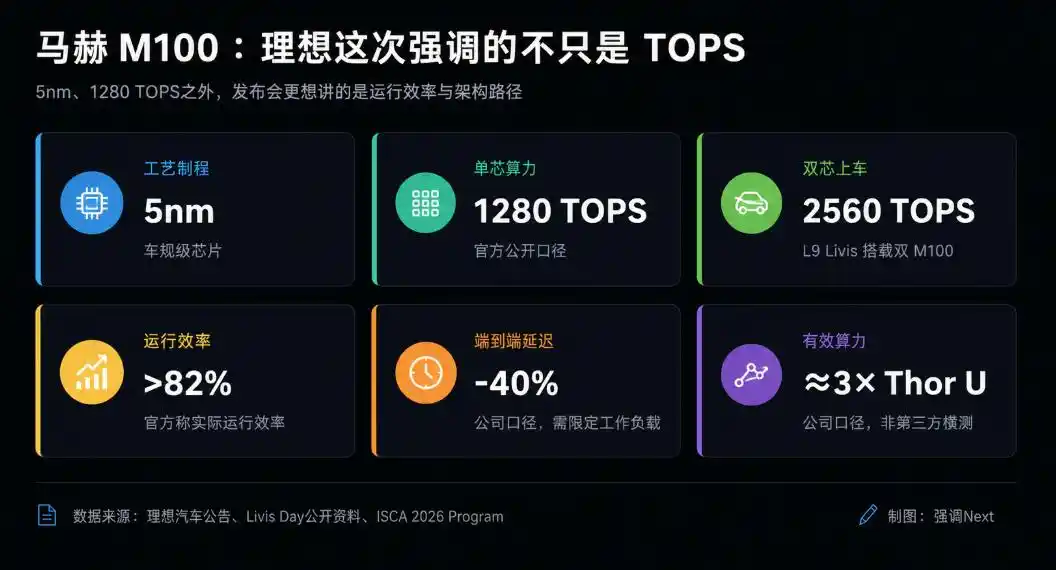
How credible is this "3 times" claim? There is one piece of external verification. The architecture paper for the Mahe M100 was accepted into the Industry Track of ISCA 2026. ISCA is a top-tier academic conference in computer architecture. Papers in the Industry Track undergo peer review, and the design details of the architecture are public. Li Auto is the first automobile manufacturer ever to be selected for this track since its establishment.

However, the 3x figure comes with its prerequisites. Effective computing power depends on the specific workload. The 3x performance achieved while running Li Auto's VLA2.1 algorithm may not hold up under a different system. The Mahe M100 is an algorithm-native chip, developed simultaneously with the model, deeply optimized for the company's own algorithms. It runs its own models best; performance on general tasks may vary.

This shares similarities with the design logic of Xpeng's Turing chip and Tesla's FSD Chip. The difference is that Tesla and Xpeng didn't make a paradigm shift at the architecture level; the Mahe M100 has made fundamental changes to the underlying logic. Whether an automaker can successfully bring a completely new architecture to reliable mass production is itself an unprecedented challenge.

With the deployment of the Mahe M100, Li Auto has achieved full-stack in-house development across chips, compilers, operating systems, AI algorithms, and domain controllers. This closed-loop system is uncommon among its peers.

NIO has its own chip but different levels of OS dependency. Xpeng develops its own chip but its compiler and OS still rely on external solutions. Huawei has a closed loop, but it is not a vehicle manufacturer. The strategic significance of Li Auto's chain lies in making it less susceptible to NVIDIA's supply chain control, keeping data within its own platform, and fully owning the optimization space for software-hardware synergy.

03. First-Mover Positioning in "Embodied AI"

The chip was only one of the stars of the launch event. Li Xiang also proposed a "Four-in-One" definition for embodied AI cars during the presentation: an electric vehicle, a professional driver, an AI computer, and a life assistant.

This marks a significant departure from Li Auto's past brand narrative.

In 2023, the L9 penetrated the 300,000 to 500,000 RMB market with its "Large Six-Seat Family SUV" positioning, followed by a generation of similarly styled models. The problem with this positioning is its low replication cost. Competitors like the AITO M9, NIO ES9, and Zeekr 9X have entered the fray. Refrigerators, screens, and large sofas have become industry standards, making it hard for any player to differentiate, leading only to price wars.

The "Embodied AI Car" shifts the competitive dimension from configurations to system capabilities. Within this framework, refrigerators and rear-seat screens are basic features. The differentiation point becomes "whose system can perceive, think, and grow." Defining a new category itself is a strategic asset; whoever articulates it first gains positioning.

Li Auto has matched this narrative with a relatively complete technological chain: the Mahe M100 computing foundation, the Mahe VLA2.1 autonomous driving large model, the Mahe Mind-Pro and Mind-Edge edge-side foundation models, and the Starlink OS for full-stack integration, with each layer having corresponding product implementations.

The launch event demonstrated features like the vehicle moving to music, a 4D racing simulator, and command-based parking – these are tangible experiences. Li Xiang also stated during the launch that autonomous driving is only the "first half" of embodied AI, with general-purpose humanoid robots being the "second half," but the specific timeline and implementation path for the second half remain unclear.

04. The Q4 Mandate

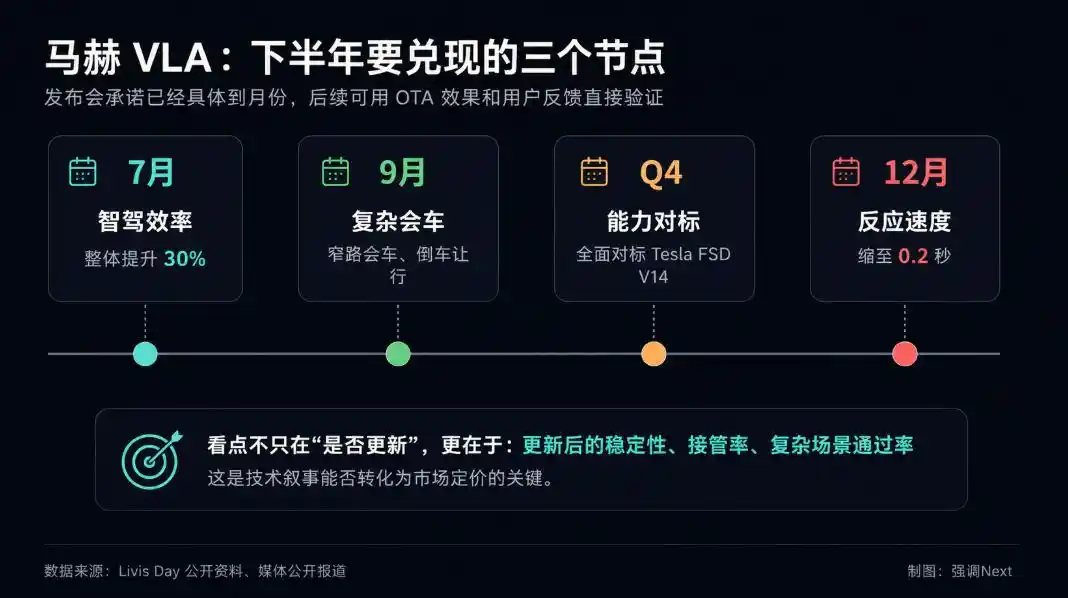
There was another crucial statement during the launch: Li Auto's autonomous driving large model, Mahe VLA, will comprehensively benchmark against Tesla's FSD V14 in Q4 of this year.

Li Xiang's consistent style is to make public commitments, using external pressure to drive internal execution. Having stated Q4 benchmarking against FSD V14, everyone will use that ruler to measure them by year-end.

In terms of technical route, Li Auto's choice is highly isomorphic to Tesla's: end-to-end + VLA large model + primarily vision-based. Huawei follows a path of lidar + multi-sensor fusion + a hybrid of rules and neural networks, offering stable short-term engineering implementation with lower compute demands. However, in the long run, if the vision-based + large model route ultimately prevails, Huawei's system may face greater switching costs. Li Auto is betting on the same technological belief as Tesla. Whether this judgment is correct will become clearer by year-end.

The OTA promises for the second half of the year are specified by month. July: a 30% improvement in autonomous driving efficiency. September: implementation of narrow-road meeting/backing-up yielding. December: vehicle response speed reduced to 0.2 seconds. Each milestone has clear technical indicators, providing data for comparison by year-end.
05. Several Data Points Beyond the Launch Event

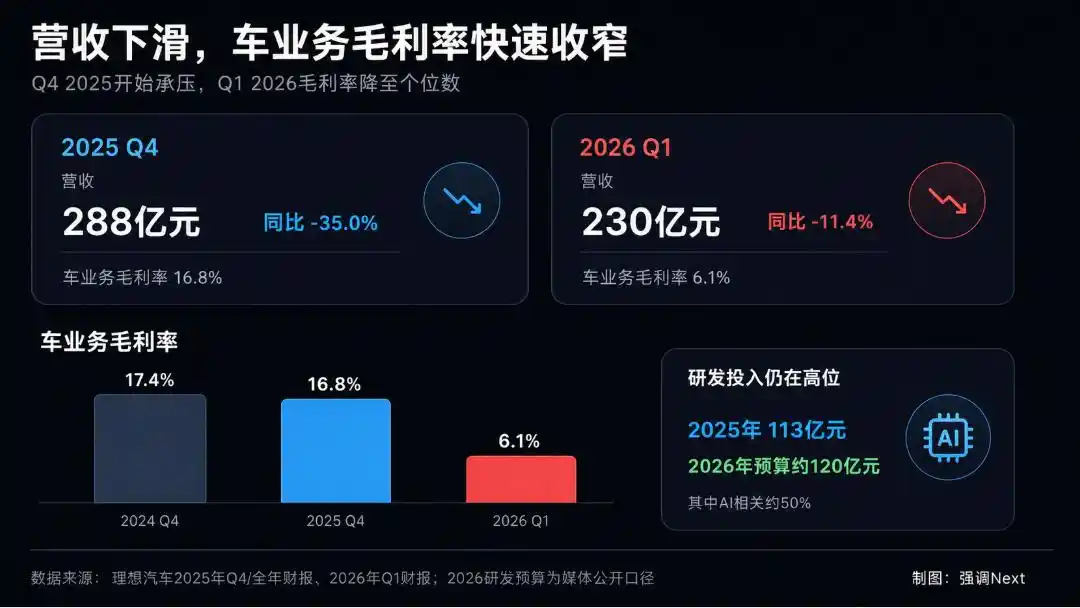
Li Auto's current financial situation is not easy. Since Q4 2025, its revenue has declined year-over-year, and automotive business gross margins have noticeably narrowed. Meanwhile, the R&D budget for 2026 remains around 12 billion RMB, with approximately 50% allocated to AI-related areas, essentially flat compared to 11.3 billion RMB and 50% in 2025. R&D investment is not decreasing, yet profitability pressure persists.
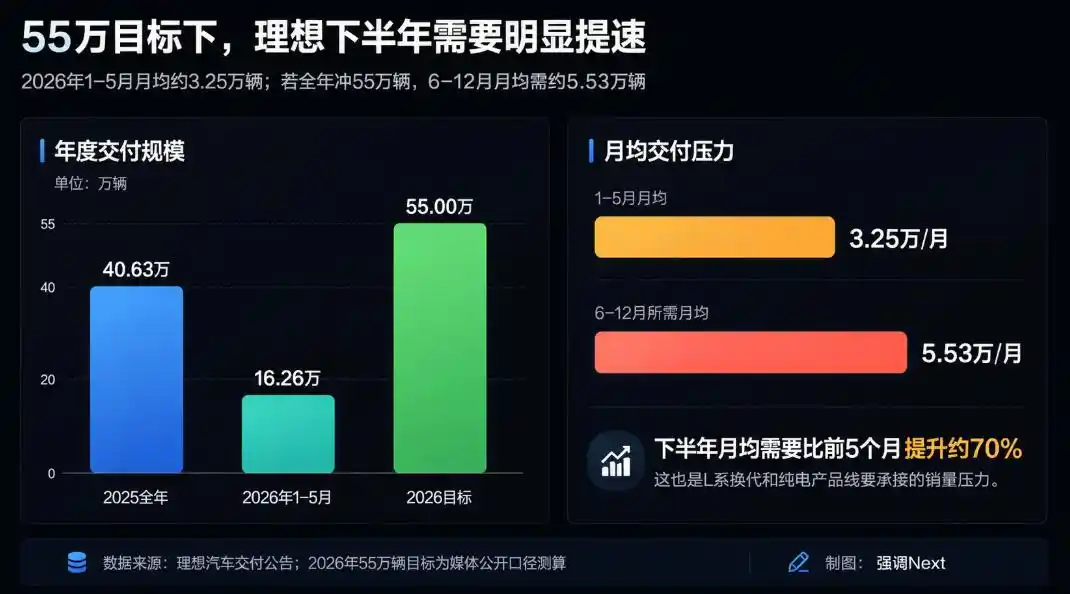
In terms of sales, Li Auto's target for 2026 is 550,000 units. Actual deliveries in 2025 were 406,000 units. May 2026 saw single-month deliveries of 33,000 units, still showing a year-over-year decline. The L9 Livis received over 10,000 non-refundable deposits within two weeks of launch, showing stable performance in the 500,000+ RMB market. However, overall delivery volume still relies on the full model changeover of the L series and the release of the pure electric product line in the second half of the year.
At the chip level, the deep binding of the Mahe M100 with its own algorithms is a design choice that brings advantages in software-hardware synergy efficiency. This also means that if future technological routes require adjustment, the switching cost would be higher than for manufacturers using third-party chip solutions. Xpeng's Turing, NIO's Shenji, and Tesla's FSD Chip face similar situations; this is an industry-wide characteristic of in-house developed, algorithm-native chips.

06. Q3 Will Reveal the Cards

The initial effects of the new L9 launch, the subsequent L8 update, and the first July OTA milestone will all be reflected in the Q3 financial report.

Xie Yan said he needed to create a completely different chip. Having the architecture paper pass peer review counts as external validation of the design concept. But the journey from design to mass production, and then to real user feedback in daily driving, is still long. The July OTA milestone is the first test; the year-end benchmarking against FSD V14 is an even more critical one.

This article is from the WeChat public account "EmphasizeNext" (ID: leo89203898), author: Yixiu, editor: Xiaobai


Related Questions

QWhat is the key design choice that differentiates Li Auto's self-developed Mach M100 chip from its competitors?

ALi Auto's Mach M100 chip adopts a dynamic dataflow architecture, moving away from the traditional von Neumann architecture. This approach focuses on reducing the data movement bottleneck (data shuttling between memory and compute units) inherent in AI model inference, aiming to improve effective computing power and lower latency, rather than just increasing raw TOPS.

QAccording to the article, what is Li Auto's strategic goal with its 'Embodied Intelligent Vehicle' concept, and how does it differ from its previous branding?

ALi Auto's strategic goal with the 'Embodied Intelligent Vehicle' concept is to shift the competitive dimension from hardware configurations (like large screens and refrigerators) to system capabilities in perception, reasoning, and growth. This differs from its previous 'family SUV' branding focused on space and comfort. The new concept aims to establish a new product category and gain a first-mover positioning in the evolving smart car market.

QWhat specific public commitment did Li Xiang make regarding Li Auto's autonomous driving technology for Q4 2026?

ALi Xiang committed that Li Auto's Mach VLA intelligent driving large model will be comprehensively benchmarked against Tesla's FSD V14 in the fourth quarter of 2026. This public commitment uses external pressure to drive internal execution, with the results being measurable by year-end.

QWhat are the potential advantages and risks associated with Li Auto's full-stack in-house development approach (chip, OS, AI algorithm, etc.)?

AAdvantages: It creates a closed-loop system that prevents supply chain constraints (e.g., from Nvidia), keeps data within its own platform, and allows for deep, autonomous software-hardware co-optimization. Risks: The chip is algorithm-native, deeply optimized for its own models. This creates high switching costs if future technology paths require significant changes, and it may not perform as well on generic tasks compared to more general-purpose chips.

QWhat financial and sales challenges does Li Auto face in 2026, according to the article?

AFinancially, Li Auto faces pressure with year-on-year revenue decline since Q4 2025 and narrowing gross margins for its vehicle business, while maintaining high R&D investment (around 12 billion RMB, 50% AI-related). Sales-wise, it aims for 550,000 deliveries in 2026, but actual 2025 deliveries were 406,000, and monthly deliveries in May were down year-on-year. It relies on the new L9 Livis and upcoming full-line model refreshes and pure-electric products to boost sales in the second half of the year.

Related Reads

After Tokenizing Assets, How to Exit?

After tokenization, a key unresolved issue is providing holders with a reliable exit mechanism, as underlying asset settlement (taking days to months) lags far behind on-chain token settlement. Three primary models for instant liquidity have emerged, differing in their capital structure and efficiency: 1. **Balance Sheet Model (e.g., Grove Basin):** A single, well-capitalized entity (like Sky) provides immediate liquidity from its own reserves. This offers simplicity and deep initial liquidity but is constrained by that single balance sheet's capacity and risk appetite, limiting scalability. 2. **Dedicated Vault Model (e.g., Upshift Clear):** Independent liquidity providers (LPs) fund separate vaults for each supported asset. This decentralizes capital sources but isolates liquidity and capital, which becomes inefficient as the number of tokenized assets grows. 3. **Shared Liquidity Layer Model (Symbiotic Liquid Lane):** Independent capital providers fund shared vaults that can support multiple tokenized assets simultaneously. Capital remains productive between redemptions (e.g., earning yield in DeFi markets). Exits are settled via a competitive RFQ market where market makers bid. The article argues that the shared layer model offers superior capital efficiency and scalability. It transforms exit liquidity from an asset-specific patch into shared market infrastructure, allowing liquidity capacity to grow with overall market participation rather than being fragmented per asset. This is particularly valuable for longer-duration assets like private credit, where reliable T+0 exits can significantly enhance their utility in DeFi.

链捕手7m ago

After Tokenizing Assets, How to Exit?

链捕手7m ago

Anthropic's Triple Moment: Code Leak, Government Confrontation, and Weaponization

This article analyzes Anthropic's recent conflicts and strategic moves following the U.S. government's emergency halt of its new Fable model, citing national security concerns over potential "jailbreaks." The author argues this incident reveals deeper tensions between AI labs, governments, and the software industry. While critics view Anthropic's safety-focused rhetoric as marketing fear, the author suggests it serves as a commercial moat masking the company's core economic imperative: moving closer to end-users and their valuable data to avoid being commoditized. The piece outlines a coming clash between frontier AI labs like Anthropic and established software companies. Labs need real-world usage data for model improvement via reinforcement learning, creating a cycle where better products attract more users and more data. This threatens software firms who, as Microsoft's Satya Nadella warns, risk having their value captured by a few dominant models. Anthropic's controversial policy changes—initially secretly degrading Fable's performance for LLM development and expanding data retention—are framed as assertions of control, justified by its safety narrative. The company's foundational belief that it alone is sufficiently concerned about superintelligent AI dangers legitimizes its actions, from resisting government demands to shaping usage policies. The author concludes that this alignment of mission, talent, and business strategy is powerful but concerning, as it concentrates immense potential power in the hands of those convinced of their own righteous understanding.

marsbit17m ago

Anthropic's Triple Moment: Code Leak, Government Confrontation, and Weaponization

marsbit17m ago

The Year of AI Applications: Saying 'Yes' While Ignoring Risks? A Comprehensive Open Source Log of Software Development's Journey

The Year of AI Applications: Blindly Saying "Yes" While Ignoring Risks? A Software Development Log Goes Fully Open Source. AI-generated code harbors risks hidden within seemingly correct programs, potentially leading to data leaks or asset loss. The open-source project "Narwhal AI Code Risks," from Peking University's Narwhal-Lab, compiles real-world cases, early warning signs, and typical risk pathways. Its goal is to help developers identify potential hazards early and avoid repeating past mistakes. In 2026, code is generated faster than ever but deployed with less scrutiny. The danger often lies not in glaring errors, but in code that appears normal—syntactically correct, passing all checks—yet introduces subtle but critical flaws like non-existent dependencies, excessive permissions, or exposed databases. A stark example is the Moonwell cbETH oracle incident. A configuration file error, where a cryptocurrency price was set to ~$1.12 instead of ~$2,200, slipped through 28 checks and a pull request signed by both AI (Claude, Copilot) and human developers. This "semantic deviation" resulted in a loss of $1.78 million. The risk is that AI can produce functionally valid code that is semantically wrong for the business context. As AI moves beyond simple code completion to modifying configurations, installing dependencies, and operating via autonomous agents, it traverses longer, less traceable paths within software engineering, blurring traditional boundaries and oversight points. The Narwhal AI Code Risks project structures information into three layers: `/cases` for documented real-world incidents, `/inferred` for early warning signals, and `/scenarios` for clear, generalized risk patterns not yet tied to specific events. This aims to create a lasting, public record to prevent collective amnesia about past AI-coding pitfalls. Risks are categorized into seven areas: Software Supply Chain (e.g., recommending fake packages), Code-Level Vulnerabilities (e.g., reintroducing path traversal bugs), Cloud & Infrastructure Misconfiguration (e.g., overly permissive settings), Agent Risks (from autonomous tool execution), Vertical Domain Risks (e.g., in finance, healthcare), Intellectual Property & Compliance issues, and Human Factors (like over-reliance on AI output). The project's core value is transforming isolated incidents into reusable knowledge—a foundational resource for developers to spot similar issues, for security researchers to build upon, for toolmakers to create detection rules, and for the community to contribute new findings. As AI integration accelerates, this open-source "logbook" serves as a crucial navigational aid, charting past errors to help future projects steer clear of the same traps.

marsbit1h ago

The Year of AI Applications: Saying 'Yes' While Ignoring Risks? A Comprehensive Open Source Log of Software Development's Journey

marsbit1h ago

The Foundation of SpaceX's Trillion-Dollar Valuation: Who is Dividing Up Musk's Annual Tens of Billions in Capital Expenditure?

SpaceX's trillion-dollar valuation is built on its three core businesses: Starlink (profitable, 60% of revenue), rockets (driving down launch costs), and AI (a major investment area). This creates a financial cycle: Starlink funds rocket development, which enables low-cost launches for AI hardware, generating future revenue. This cycle fuels annual capital expenditures of tens of billions, flowing to a vast supply chain. Suppliers are categorized by their replaceability. The first group includes irreplaceable players like NVIDIA (GPU/CUDA ecosystem), Eutelsat (critical radio spectrum), Filtronic (specialized amplifiers), Materion (strategic beryllium), and STMicroelectronics (antenna chips). The second group consists of hard-to-replace suppliers due to high switching costs, such as Honeywell (flight control), Carpenter Technology (specialty alloys), Hexcel (carbon fiber), Broadcom (data exchange), and Linde (industrial gases). The third group comprises high-volume, cost-critical suppliers for mass-produced items like Starlink terminals. Key names include Wistron NeWeb (primary manufacturer) and several A-share companies like Shenzhen Sunway (connectors), Pies New Materials (forgings), Western Superconducting (alloys), and Yingliu (castings). Other niche players include Trimble (timing), Astronics (power distribution), and CTS (thermal management). The article argues that investing in these suppliers, rather than SpaceX stock directly, offers an alternative opportunity. The rationale is threefold: procurement is just beginning to scale, SpaceX's IPO brings new transparency to its supply chain, and the situation mirrors early stages of past "super terminal" ecosystems like Apple or Tesla. While risks exist (commodity cycles, geopolitical factors, technology shifts), the core thesis is that SpaceX's massive, ongoing procurement will translate into reliable revenue for its key suppliers, regardless of its own stock price volatility.

marsbit1h ago

The Foundation of SpaceX's Trillion-Dollar Valuation: Who is Dividing Up Musk's Annual Tens of Billions in Capital Expenditure?

marsbit1h ago

Trading

Spot
Futures

Hot Articles

How to Buy HOUSE

Welcome to HTX.com! We've made purchasing Housecoin (HOUSE) simple and convenient. Follow our step-by-step guide to embark on your crypto journey.Step 1: Create Your HTX AccountUse your email or phone number to sign up for a free account on HTX. Experience a hassle-free registration journey and unlock all features.Get My AccountStep 2: Go to Buy Crypto and Choose Your Payment MethodCredit/Debit Card: Use your Visa or Mastercard to buy Housecoin (HOUSE) instantly.Balance: Use funds from your HTX account balance to trade seamlessly.Third Parties: We've added popular payment methods such as Google Pay and Apple Pay to enhance convenience.P2P: Trade directly with other users on HTX.Over-the-Counter (OTC): We offer tailor-made services and competitive exchange rates for traders.Step 3: Store Your Housecoin (HOUSE)After purchasing your Housecoin (HOUSE), store it in your HTX account. Alternatively, you can send it elsewhere via blockchain transfer or use it to trade other cryptocurrencies.Step 4: Trade Housecoin (HOUSE)Easily trade Housecoin (HOUSE) on HTX's spot market. Simply access your account, select your trading pair, execute your trades, and monitor in real-time. We offer a user-friendly experience for both beginners and seasoned traders.

4.7k Total ViewsPublished 2025.04.27Updated 2026.06.02

How to Buy HOUSE

Discussions

Welcome to the HTX Community. Here, you can stay informed about the latest platform developments and gain access to professional market insights. Users' opinions on the price of HOUSE (HOUSE) are presented below.

活动图片