Author: Jjay_dm, Wintermute OTC Trader
Compiled by: Deep Tide TechFlow
Deep Tide Guide: Wintermute is one of the world's largest crypto market makers. This market update, written on February 23, is one of the most sobering descriptions of the current crypto market situation.
It's not just about being bullish or bearish, but integrates three threads—AI repricing, deglobalization, and the Fed's ineffectiveness—into a unified framework. It clearly states that crypto assets are currently being sold as "the highest beta growth assets," and whether this trend is a short-term rotation or a true paradigm shift is the most critical question to watch in 2026.
Full Text Below:
📈 Market Update — February 23, 2026
BTC remains range-bound in the $64-67k zone after the liquidation wave, trading as a high-beta asset with price action increasingly resembling that of some blue-chip altcoins. AI disruption and slow deglobalization have triggered the core question for the crypto market in 2026, with short-term pressures persisting.
Paradigm Shift
Macro
For months, the market has been driven by micro-catalysts: individual tariff headlines, Fed official speeches, earnings data. React, reprice, reset. But this framework is breaking down. A recent article by Citrini crystallized a sentiment many investors felt but never clearly expressed into a judgment: we are in a paradigm shift.
The Fed, which dominated market moves for most of this cycle, is changing. The forces driving asset prices now are slower, harder to trade, and won't be resolved by a single policy pivot. Tariffs aren't going away, AI is disrupting entire industries in real-time, growth is slowing while inflation remains sticky. The Fed's tools are increasingly ineffective against these forces, and investors are starting to question the "Fed/Trump put" that underpinned the market—the very expectation that supported the outperformance of growth stocks and momentum strategies (crypto excepted).
Two structural trade logics are running simultaneously and reinforcing each other:
AI Repricing. The US FY2025 earnings season, combined with Anthropic's recent model release, is forcing the market to underwrite AI disruption risk industry by industry, in real time. Software moats are being reassessed, growth valuation multiples are compressing, and the intensity of hardware capex is also being questioned. The easy trade in AI appears to be over for now, replaced by a messier, more volatile situation.
Deglobalization. Trump's shift from IEEPA to Section 122 of the Trade Act following the Supreme Court ruling is the clearest signal yet: tariffs are structural, not temporary. The government will always find a mechanism. Supply chains continue to fragment, input costs remain high, and geopolitical settlement risk is now a permanent feature of asset allocation.
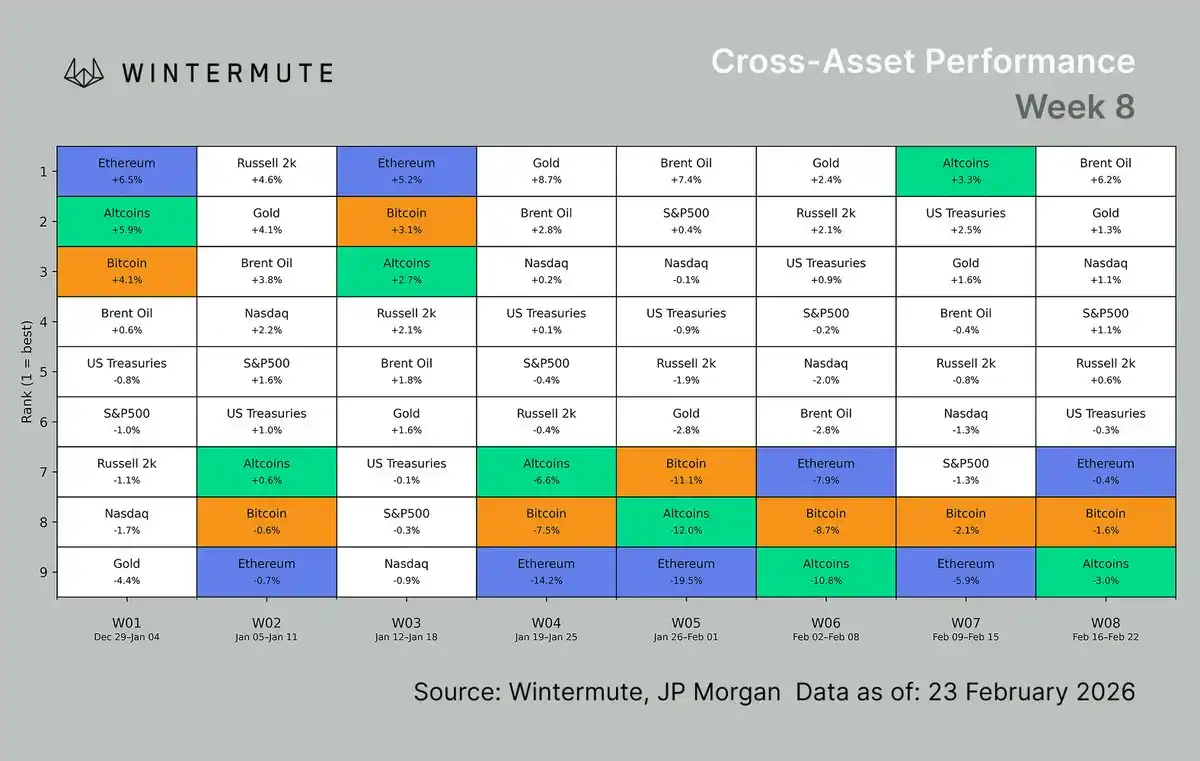
Both drivers attack the same thing: the valuation premium embedded in globally integrated, software-leveraged growth companies. The rotation is already well advanced. Gold, commodities, industrials, metals & mining, defense, and energy are outperforming. Value works, growth is being sold. There is no clarity on rates, no signal that would reverse this trend. The Fed can neither cut with sticky inflation nor hike with slowing growth—this stalemate is the entire trade.
Digital Assets
BTC has failed multiple attempts to break $70k since the liquidation cascade two weeks ago. The absence of bounce buying is more telling than the range itself. Price action is messy, liquidity is thin, the range is tightening and lacks direction. ETH broke below $1,900 this week, a level more psychologically significant than technical; the real support level to watch for ETH is around $1,600.
Institutional demand has not returned after prices stabilized—this contrasts with the situation in the previous $85-95k range, where institutional buying was quite evident. The derivatives market also confirms the lack of directional conviction and trading appetite: basis is at multi-month lows, put skew is rising and still climbing, and open interest has been declining since October.
Trading desk flow is skewed to the sell side, but a noteworthy signal emerged mid-week: high-net-worth individuals briefly showed selective willingness to buy altcoins. In an overall defensive environment, this was a small but notable spark of confidence, though it faded very quickly.
The latter part of the week became messy again; any buying willingness quickly dissipated, indicating the market isn't ready to reward early positioning. The marginal activity remains protective, not offensive.
Our Take
First slowly, then suddenly. The market feels like it's consolidating various narratives into a picture of a paradigm shift.
Right now, crypto assets are being sold as the highest-beta growth assets—falling alongside tech stocks and momentum strategies—in a world where growth asset risk premia are rising and the Fed is powerless to act. The continued net outflows from ETFs confirm this; it's the short-term reality.
But zooming out, the more interesting question is: how sticky is this paradigm? The narratives around stagflation, deglobalization, and Fed gridlock are starting to feel less like a short-term catalyst and more like a genuine repricing of the macro backdrop—a setup favoring hard assets, commodities, and value, not growth. Crypto is currently on the wrong side of this trade.
That said, we've seen this before. Over the past decade, multiple growth scare-induced shifts ultimately reversed as risk appetite returned and the market found its momentum direction again. The difference this time is the structural nature of AI repricing and deglobalization. But it's too early to call it a paradigm shift. How sticky this narrative proves to be is the most important question for crypto in 2026—and we don't have the answer yet.