Why Tokenization Took Center Stage at Davos 2026 and What It Signals for Crypto Investors

bitcoinistPublished on 2026-01-23Last updated on 2026-01-23

Abstract

At the 2026 World Economic Forum in Davos, the crypto conversation shifted from price speculation to practical integration, with tokenization of real-world assets (RWAs) taking center stage. Valued at over $22 billion, tokenization is now seen as active financial infrastructure rather than an experiment. Discussions featured central bankers, major asset managers, and executives from firms like BlackRock and BNY Mellon, who confirmed moving beyond pilots to deploying tokenized assets at scale. Ethereum hosts over 65% of these assets. Regulatory clarity, including the US GENIUS Act, was cited as key to this growth. Stablecoins are increasingly used as settlement "plumbing." For investors, this signals a structural, less speculative growth phase, with tokenization projected to reach $2-16 trillion by 2030.

At the 2026 World Economic Forum in Davos, crypto moved away from price cycles and ideological debates toward a more practical focus: how blockchain is being used inside the global financial system.

Across panels, side events, and executive interviews, tokenization of real-world assets (RWAs) emerged as the clearest signal of where crypto is heading next. With the value of tokenized assets now exceeding $22 billion, Davos framed tokenization less as an experiment and more as infrastructure in active use.

The shift was evident in both the tone and the participants. Rather than startups pitching concepts, conversations featured central bank officials, large asset managers, and executives from firms in the tokenization space. The emphasis shifted from whether blockchain belongs in finance to how quickly it can be scaled.
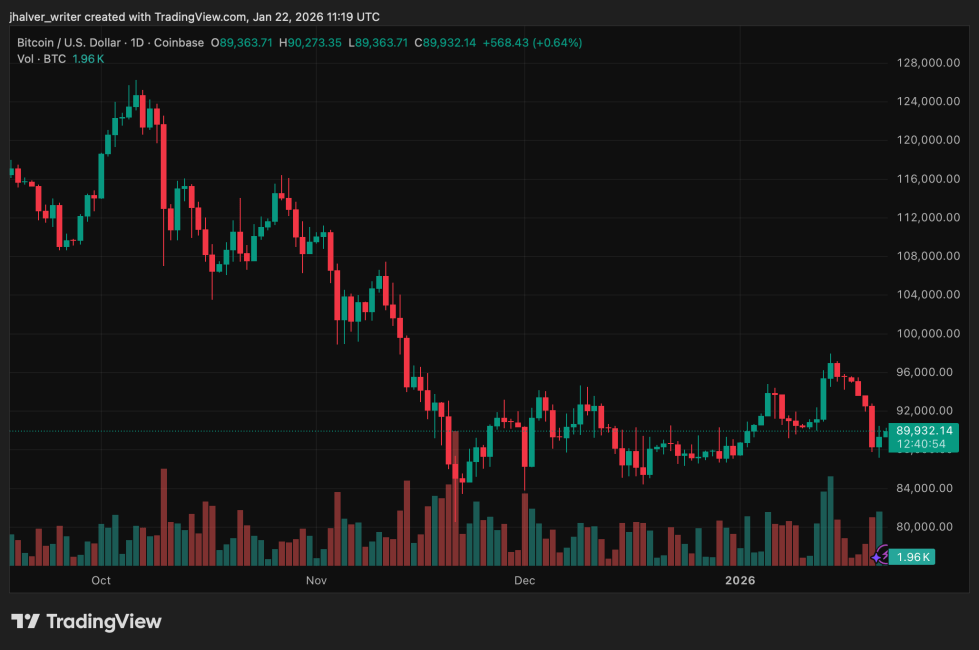
BTC's price trends sideways on the daily chart. Source: BTCUSD on Tradingview

Tokenization Moves From Concept to Financial Infrastructure

Panels such as “Is Tokenization the Future?” underlined how assets traditionally seen as illiquid, bonds, equities, funds, and real estate, are increasingly represented on-chain.

Executives from Coinbase and Ripple, alongside European Central Bank officials, described tokenization as a way to reduce settlement times, improve liquidity, and allow fractional ownership without rebuilding the financial system from scratch.

Institutions including BlackRock, BNY Mellon, and Euroclear confirmed they have moved beyond pilot programs and are deploying tokenized instruments at scale.

Data shared during the forum showed that the total value locked in tokenized RWAs has passed $22 billion, reflecting broader asset coverage and growing institutional participation. Ethereum currently hosts more than 65% of these assets, underlining its role as the main settlement layer for tokenization activity.

Regulation and Stablecoins Shape the Next Phase

Regulatory clarity was repeatedly cited as the key factor behind this momentum. Frameworks finalized in 2025 in the US and parts of Europe provided banks and custodians with clearer rules on issuance, custody, and compliance.

In Davos, US President Donald Trump reinforced this direction by pointing to the GENIUS Act, which established a federal framework for payment stablecoins.

Stablecoins were described as the “plumbing” connecting traditional finance, decentralized finance, and tokenized assets. Rather than competing with banks, they are increasingly used for settlement, treasury operations, and cross-border transfers.

What Davos 2026 Signals for Crypto Investors

For investors, Davos 2026 suggested that crypto’s next growth phase may be less speculative and more structural.

Consulting firms such as McKinsey and Boston Consulting Group estimate that tokenized assets could reach between $2 trillion and $16 trillion by 2030. The focus on regulated products, institutional adoption, and market infrastructure points to a longer-term shift.

Tokenization’s rise at Davos indicates that crypto’s role in global finance is being defined less by volatility and more by utility, an important signal for how the sector may evolve in the years ahead.

Cover image from ChatGPT, BTCUSD chart from Tradingview

Related Questions

QWhat was the main focus of crypto discussions at Davos 2026, according to the article?

AThe main focus shifted away from price cycles and ideological debates toward the practical use of blockchain in the global financial system, specifically the tokenization of real-world assets (RWAs).

QWhat evidence was presented at Davos to show that tokenization is more than just an experiment?

AThe value of tokenized assets was reported to exceed $22 billion, and institutions like BlackRock, BNY Mellon, and Euroclear confirmed they have moved beyond pilot programs and are deploying tokenized instruments at scale.

QWhich blockchain was highlighted as the main settlement layer for tokenization activity and what percentage of tokenized RWAs does it host?

AEthereum was underlined as the main settlement layer, currently hosting more than 65% of tokenized real-world assets.

QWhat key factor was repeatedly cited as crucial for the momentum behind tokenization?

ARegulatory clarity was repeatedly cited as the key factor, with frameworks finalized in 2025 in the US and parts of Europe providing clearer rules on issuance, custody, and compliance.

QWhat future market size for tokenized assets was estimated by consulting firms like McKinsey and BCG?

AConsulting firms such as McKinsey and Boston Consulting Group estimated that tokenized assets could reach between $2 trillion and $16 trillion by 2030.

Related Reads

Why Do You Always Lose Money on Polymarket? Because You're Betting on News, While the Pros Read the Rules

Why do you always lose money on Polymarket? Because you bet on news, while the pros study the rules. This article explains how top traders ("che tou") profit by meticulously analyzing market rules, not just predicting events. Polymarket, a prediction market platform, often sees disputes over event outcomes due to ambiguous rule wording. For instance, a market asking "Who will be the leader of Venezuela by the end of 2026?" was misinterpreted by many who bet on Delcy Rodríguez, assuming she held power. However, the rules specified "officially holds" as the formally appointed, sworn-in individual. Since Nicolás Maduro was still recognized as president officially, he won the market—even being in prison. To resolve such disputes, Polymarket uses a decentralized arbitration system via UMA protocol. The process involves: 1. Proposal: Anyone can propose a market outcome by staking 750 USDC, earning 5 USDC if unchallenged. 2. Dispute: A 2-hour window allows challenges with a 750 USDC stake; successful challengers earn 250 USDC. 3. Discussion: A 48-hour period on UMA Discord for evidence and debate. 4. Voting: UMA token holders vote in two 24-hour phases (blind then public). Outcomes require >65% consensus and 5M tokens voted; otherwise, four re-votes occur before Polymarket intervention. 5. Settlement: Results are final and automatic. Unlike traditional courts, Polymarket’s system lacks separation between arbitrators and stakeholders—voters often hold market positions, creating conflicts of interest. This leads to herd mentality in discussions and non-transparent outcomes without explanatory rulings, preventing precedent formation. Thus, success on Polymarket hinges on deep rule interpretation, not just event prediction, exploiting gaps between reality and contractual wording.

marsbit2h ago

Why Do You Always Lose Money on Polymarket? Because You're Betting on News, While the Pros Read the Rules

marsbit2h ago

DeepSeek Funding: Liang Wenfeng's 'Realist' Pivot

DeepSeek, a leading Chinese AI company, has initiated its first external funding round, aiming to raise at least $300 million at a valuation of no less than $10 billion. This move marks a significant shift from its founder Liang Wenfeng’s previous idealistic stance of rejecting external capital to maintain independence. Despite strong financial backing from its parent company, quantitative trading firm幻方量化 (Huanfang Quant), which provided an estimated $700 million in revenue in 2025 alone, DeepSeek faces mounting challenges. Key issues include a 15-month gap in major model updates, delays in its flagship V4 release, and the loss of several core researchers to competitors offering significantly higher compensation. The company is also undergoing a strategic pivot by migrating its infrastructure from NVIDIA’s CUDA to Huawei’s Ascend platform, a move aligned with China’s push for technological self-reliance amid U.S. export controls. However, DeepSeek lags behind rivals like智谱AI and MiniMax—both now publicly listed—in areas such as product ecosystem, multimodal capabilities, and commercialization. The funding round, though relatively small in scale, is seen as a way to establish a market-validated valuation anchor, making employee stock options more competitive and facilitating talent retention. It also signals DeepSeek’s transition from a pure research-oriented organization to a commercially-driven player in the global AI ecosystem.

marsbit3h ago

DeepSeek Funding: Liang Wenfeng's 'Realist' Pivot

marsbit3h ago

Trading

Spot
Futures
活动图片