White House Says Major Bitcoin Reserve Announcement Is Coming

bitcoinistPublished on 2026-04-28Last updated on 2026-04-28

The White House is preparing a major announcement on the US Strategic Bitcoin Reserve, according to crypto advisor Patrick Witt, who said the administration has made what he described as a “breakthrough” on the executive-branch side of the policy.

US Strategic Bitcoin Reserve May Get An Update Soon

Speaking Monday at the Bitcoin 2026 conference in Las Vegas, Witt said the government has been working through the legal and operational details needed to formalize how federally held Bitcoin should be protected and treated on the balance sheet. His comments point to a near-term policy move from the administration, even as lawmakers continue working on legislation to codify the reserve in statute.

“The President signed the Strategic Bitcoin Reserve Executive Order last year, and we’ve gone to work in figuring out exactly the machinations necessary and legal interpretations that we need to get that right and solidify that and protect the digital assets, but specifically Bitcoin, that we have on the government balance sheet,” Witt said. “So in the next few weeks, we’ll be making a big announcement. I think we have a bit of a breakthrough there, and obviously that needs to be followed up with legislation.”

The executive order, signed on March 6, 2025, established the Strategic BTC Reserve and a separate US Digital Asset Stockpile. It directed that forfeited government Bitcoin placed into the reserve “shall not be sold” and called for Treasury and Commerce to develop budget-neutral strategies for acquiring additional Bitcoin without imposing incremental taxpayer costs.

That structure is central to why Witt framed the coming announcement as a step forward, but not the final stage. The administration can move on custody, agency coordination and legal interpretation through executive authority, but a more durable reserve policy would likely require Congress to act.

“Senator Lummis’ Bitcoin Act over in the House, Representative Begich has talked about the ARMA Act that he has put together, so we need to codify it,” Witt said. “But in the meantime, we do believe we’re going to be able to take a big step forward from the executive branch side in the next few weeks.”

The legislative track is also moving. On another panel, Rep. Nick Begich said legislation to establish a US strategic Bitcoin reserve is set to be reintroduced in the next few weeks under a new name: the American Reserves Modernization Act, or ARMA.

Begich said the proposal builds on the Bitcoin Act originally introduced by Sen. Cynthia Lummis in the 118th Congress and reintroduced in the Senate in the current 119th Congress. Begich said his office has been working with Lummis’ team and the House Financial Services Committee on revisions aimed at improving the bill’s path through Congress. Begich and Lummis previously introduced the BITCOIN Act of 2025 in March 2025, describing it as legislation to establish a Strategic BTC Reserve in law.

“And why the renaming? Because it’s so important for people both in Congress and across the nation to understand what we’re actually trying to do,” Begich said. “We’re trying to make sure that Bitcoin is treated like the reserve asset that it is. We want to make sure that we have a place to store our Bitcoin, that that Bitcoin is going to be held for a long period of time, that it’s going to be prevented from being attached, right?”

Begich said the goal is to prevent the reserve from becoming another short-term political instrument. In his description, ARMA would identify where BTC is held across government agencies, place it into responsible custody, and restrict the ability to lend against it or subject it to shifting reserves policy.

At press time, BTC traded at $76,941.
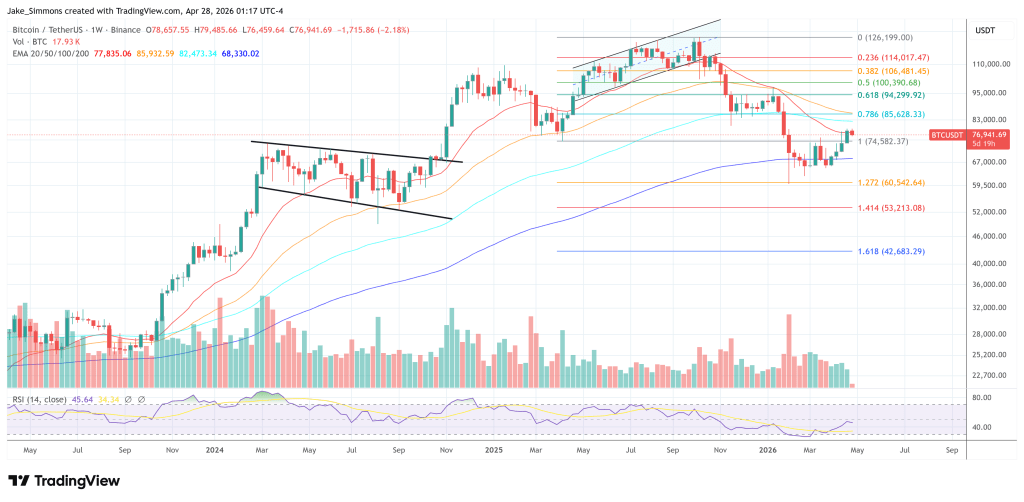
BTC faces the 20-week EMA, 1-week chart | Source: BTCUSDT on TradingView.com

Trending Cryptos

Related Reads

The "Impossible Triad" Is Fundamentally a Pseudo-Problem

The article argues that blockchain's fundamental limitation is not the scalability trilemma (decentralization, scalability, security), which has been largely solved, but the lack of **privacy** and, until recently, clear **legitimacy**. Blockchain is described as a slow, expensive, globally shared computer whose core value is censorship resistance and verifiability. While ideal for native digital assets like money (e.g., stablecoins), its default transparency acts as a **tax**, exposing all transactions and enabling MEV extraction, which deters serious institutional capital. Simultaneously, its permissionless nature created regulatory ambiguity. The piece contends that **privacy** is the missing critical feature. It rejects the false choice between total transparency and complete anonymity. Modern cryptography (like zero-knowledge proofs) enables **compliant privacy**: users can prove facts (solvency, KYC status, compliance) without revealing the underlying sensitive data (specific holdings, identities). This preserves auditability for regulators and eliminates the leak of financial information. With recent regulatory progress (e.g., the GENIUS Act) addressing legitimacy, adding default, provably compliant privacy becomes a pure upgrade. It transforms blockchain from a costly, public ledger into a confidential settlement layer, finally bridging the gap to mainstream institutional and individual adoption of on-chain finance.

链捕手11h ago

The "Impossible Triad" Is Fundamentally a Pseudo-Problem

链捕手11h ago

Optical Chips: Collective Capacity Expansion

The global optical chip industry is experiencing a massive wave of expansion driven by surging AI data center demand. Major players across the US, Japan, Europe, and China are aggressively investing to ramp up production capacity. In the US, Coherent is expanding its 6-inch Indium Phosphide (InP) semiconductor fab in Texas, supported by CHIPS Act funding and a $2 billion strategic investment from NVIDIA. Lumentum is building a new factory for InP optical devices, and Nokia is scaling its advanced photonic chip packaging and testing capabilities. NVIDIA's investments aim to secure future supply of critical lasers and optical interconnect products for AI infrastructure. Japan's JX Advanced Metals, a leading InP substrate supplier, plans a multi-billion yen investment to increase its capacity 7-10 times, strengthening its grip on the crucial upstream materials market. In Europe, IQE and Tower Semiconductor settled a patent dispute and signed a multi-year InP epitaxial wafer supply agreement, highlighting that next-generation silicon photonics platforms will integrate high-performance InP components. STMicroelectronics and Sivers Semiconductors are also expanding silicon photonics production and partnerships. China is rapidly building out its domestic supply chain. Dongshan Precision's subsidiary, Source Photonics, announced a $12 billion project to expand optical chip and module production. Companies like Sanan Optoelectronics and Yunnan Germanium are scaling up InP chip manufacturing and substrate production, moving towards vertical integration from materials to modules. While debate continues around the exact future architecture—whether CPO (Co-Packaged Optics), NPO, or pluggables will dominate—analysts like Morgan Stanley argue the underlying driver is unchangeable: the explosive growth in bandwidth demand. This will inevitably increase the volume of optical engines, lasers, and related content per GPU, regardless of the final technical path. The competition for "more light" in the AI era has intensified into a global, full-chain capacity race.

marsbit13h ago

Optical Chips: Collective Capacity Expansion

marsbit13h ago

Trading

Spot
Futures

Hot Articles

How to Buy HOUSE

Welcome to HTX.com! We've made purchasing Housecoin (HOUSE) simple and convenient. Follow our step-by-step guide to embark on your crypto journey.Step 1: Create Your HTX AccountUse your email or phone number to sign up for a free account on HTX. Experience a hassle-free registration journey and unlock all features.Get My AccountStep 2: Go to Buy Crypto and Choose Your Payment MethodCredit/Debit Card: Use your Visa or Mastercard to buy Housecoin (HOUSE) instantly.Balance: Use funds from your HTX account balance to trade seamlessly.Third Parties: We've added popular payment methods such as Google Pay and Apple Pay to enhance convenience.P2P: Trade directly with other users on HTX.Over-the-Counter (OTC): We offer tailor-made services and competitive exchange rates for traders.Step 3: Store Your Housecoin (HOUSE)After purchasing your Housecoin (HOUSE), store it in your HTX account. Alternatively, you can send it elsewhere via blockchain transfer or use it to trade other cryptocurrencies.Step 4: Trade Housecoin (HOUSE)Easily trade Housecoin (HOUSE) on HTX's spot market. Simply access your account, select your trading pair, execute your trades, and monitor in real-time. We offer a user-friendly experience for both beginners and seasoned traders.

4.7k Total ViewsPublished 2025.04.27Updated 2026.06.02

How to Buy HOUSE

Discussions

Welcome to the HTX Community. Here, you can stay informed about the latest platform developments and gain access to professional market insights. Users' opinions on the price of HOUSE (HOUSE) are presented below.

活动图片