What Happens When Two Miners Find a Block in the Same Second? How the 'Orphan Race' Unfolds

cryptonews.ruPublished on 2026-07-29Last updated on 2026-07-29

Abstract

Bitcoin mining is a race without a real-time referee. A newly mined block must physically propagate across the global peer-to-peer network before consensus is reached on the chain's tip. This takes seconds, sometimes longer on congested connections. If a second miner finds a valid block before learning of a competing one, they build on their last-known version and broadcast their own block. For a short time, two equally valid blocks exist at the same height, creating a temporary chain split. The network resolves this not by voting or timestamps, but by Proof-of-Work: the chain that accumulates the most work becomes canonical. Blocks on the losing side are "orphaned" or "stale." Their miners lose the block reward and fees, though unconfirmed transactions return to the mempool. Usually, a single subsequent block resolves the tie. A notable two-block reorganization occurred on March 24, 2026. Antpool and Foundry USA mined competing versions of block 941,881 seconds apart. ViaBTC extended Antpool's chain, while Foundry extended its own, creating a one-block split. Foundry then pulled ahead by mining six consecutive blocks, making its chain the heaviest. All nodes switched to Foundry's chain, orphaning blocks from Antpool and ViaBTC. While such multi-block reorganizations are rare, the underlying race condition is common. Analysis shows about 9.2% of block intervals in a sample period were under 60 seconds, each representing a potential short-lived race. Fast relay networks hav...

Bitcoin mining is a race with no referee watching the finish line in real time. A new block must physically propagate (i.e., 'hop' from node to node) across the global network before all participants agree on where the current tip of the chain is. This process takes a few seconds, and over a congested connection—sometimes longer.

If a second miner finds its own valid block before the first block has reached it, it continues working on the last version it saw (usually the previous block) and broadcasts its own competing block. For a short period of time, two equally valid blocks exist at the same height, each with its own set of confirmed transactions and its own proposal for what comes next.

Neither block is 'incorrect,' as both satisfy all protocol rules; the only thing separating them is timing and which nodes randomly learned about which one first. Roughly half the network ultimately mines on one candidate, the other part mines on the other, and Bitcoin briefly has two honest, simultaneous versions of itself.

How a Tie Is Actually Resolved

Bitcoin resolves this issue not through voting, authority, or who technically found their block first. It resolves it the same way it resolves everything else: the chain that accumulates more proof-of-work becomes the one all nodes switch to, and the block(s) from the other side are discarded.

'Discarding' does not mean that history has been rewritten or destroyed, but means that this block, called an 'orphan' or 'stale' block, ceases to be part of the chain recognized by everyone. Any transactions within it that were not also confirmed on the winning side simply return to the mempool to be included in a future block.

In most cases, the situation is resolved after just one additional block appears, and no one outside of circles connected to mining infrastructure even notices. A genuine two-block race (where the tie somehow persists through an entire extra round, preventing either side from pulling ahead) happens so rarely that it makes news headlines when it does, precisely because it requires the odds of a coin toss to come out the same twice in a row.

The March 2026 Case: When the Coin Toss Repeated

This is exactly what happened on March 24, 2026. After Antpool and Foundry USA each released their version of block 941,881 with a twelve-second interval, ViaBTC continued AntPool's chain with block 941,882, while Foundry, working on its own fork, also continued its version. For one block, the network was genuinely split in half between two valid chains. Then Foundry pulled ahead, mining blocks 941,883 through 941,886 consecutively (six blocks in a row on its branch), until its chain became, in the words of one Bitcoin developer monitoring the event, 'the heaviest by a wide margin.'

All nodes switched to Foundry's version, and the blocks mined by AntPool and ViaBTC became 'orphans'; their miners lost the block reward and fees for that work, although the transactions themselves returned to the mempool and were reconfirmed shortly thereafter.
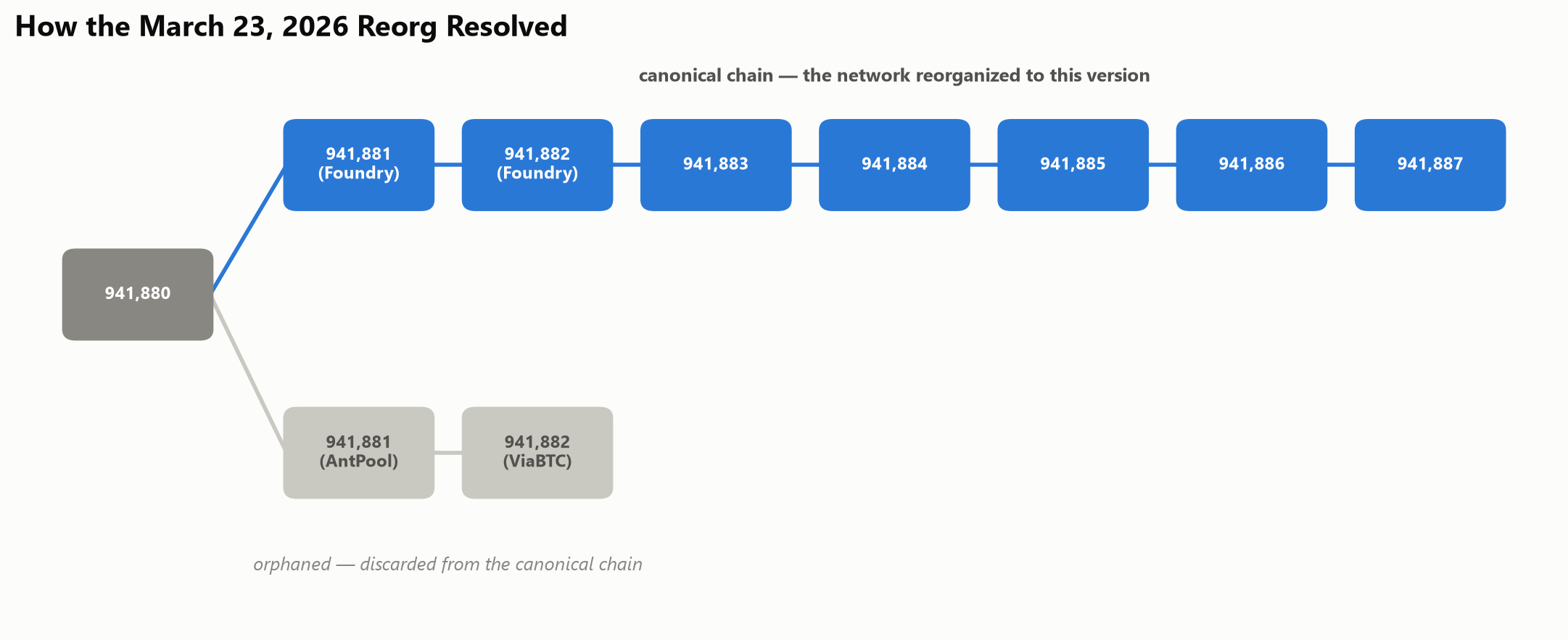
Diagram of the reorganization during simultaneous block mining.

Bitcoin analyst b10c, who first publicly highlighted this event, called it a 'fairly rare case of a two-block fork/reorganization between Foundry and AntPool+ViaBTC.' 'Rare' is true, but the event also drew attention to a less pleasant trend: for a pool that already controls a significant share of the network's hash rate, stringing six blocks together is easier than it is for others. Coverage of the event noted that shrinking margins are squeezing out smaller miners and leading to a concentration of hash power in fewer, larger pools.

A more concentrated network doesn't make one-block races more common, but it noticeably increases the chances of a well-resourced pool winning any particular race (and stringing together the subsequent blocks that finish it) compared to the chances of a smaller miner.
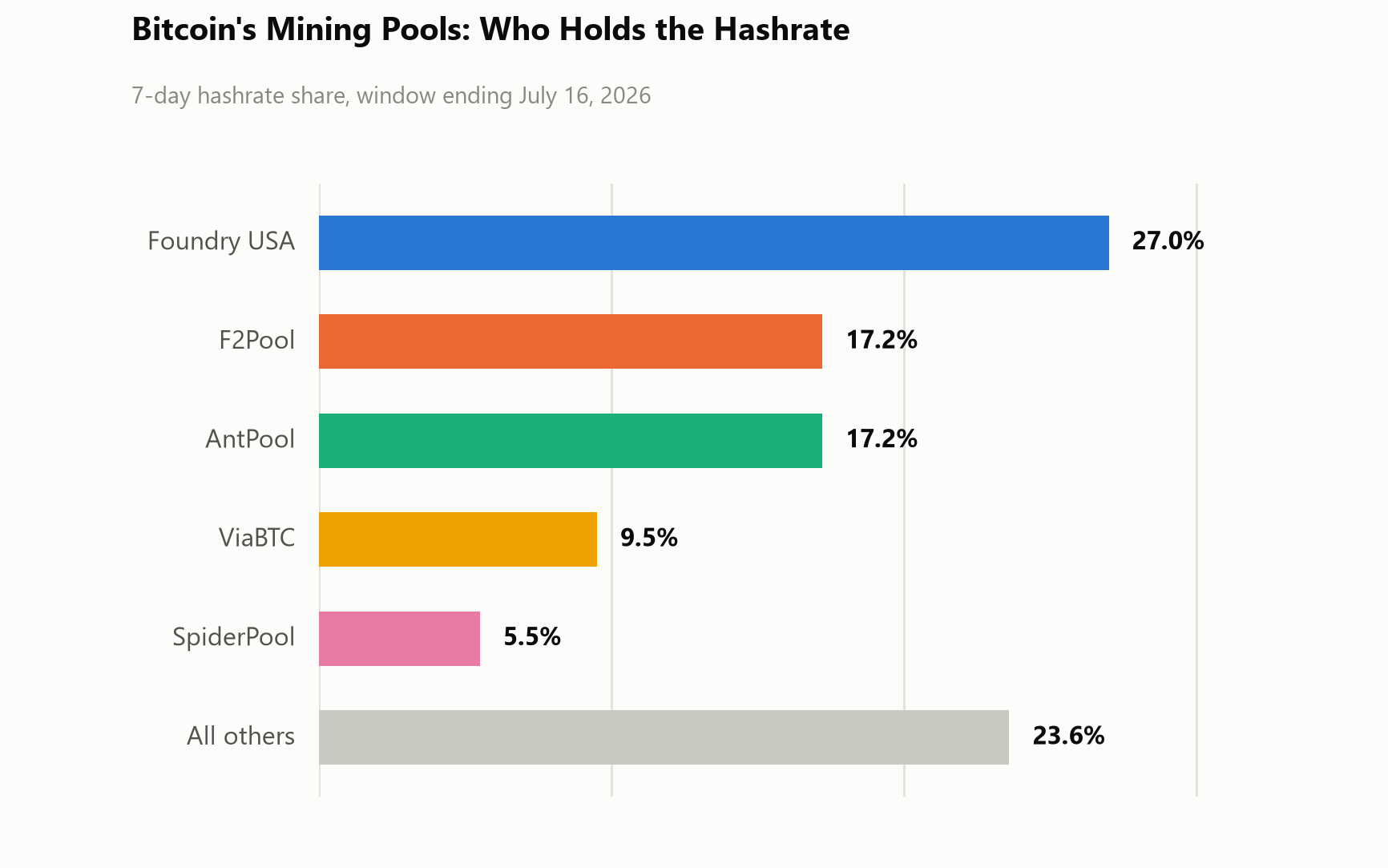
Hashrate controllers, main entities, recorded July 16, 2026.

The Boring Version Is Normal, and That's the Point

Two-block reorganizations are the exception; the underlying condition of a race is not. Looking at real block timestamps directly from mempool.space for the three days preceding the reorganization (heights 941,452 to 941,887), 40 of the 435 intervals between successive blocks (about 9.2%) were within 60 seconds of each other, including one pair with only a 5-second difference. Each of these cases where the difference was minimal is a moment when a genuine race condition existed in the network, albeit briefly.
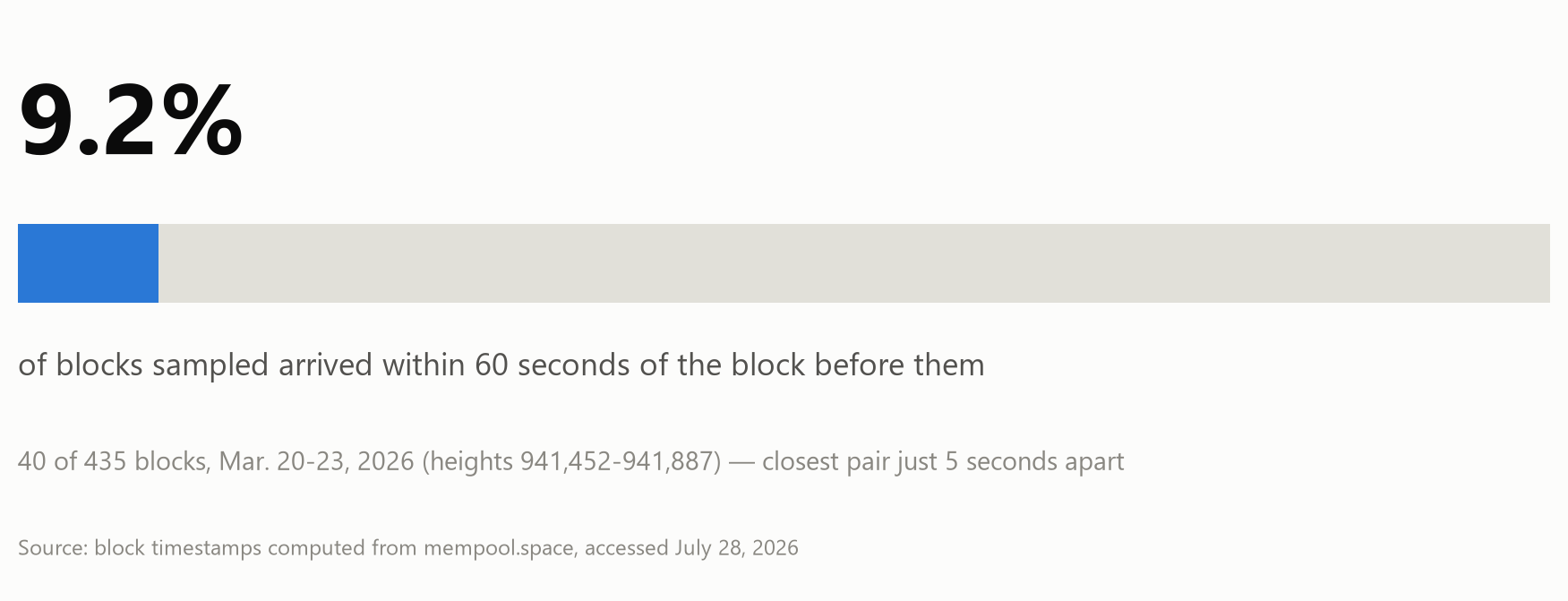
Nearly all of them are resolved within that same block, unnoticed, because the next miner finding a block in the overwhelming majority of cases simply continues working on the fork that reached them first, and the probability of two ties in a row is extremely low. The compact relay of blocks and specialized low-latency relay networks like FIBRE, now used by most major pools, have reduced the propagation delays that cause races compared to Bitcoin's early years (which is why a race that persists through two full blocks, as happened with AntPool and Foundry, is rare enough to be news, not commonplace).

end-content

Trending Cryptos

Related Questions

QWhat happens in the Bitcoin network when two miners find a valid block at nearly the same time?

ATwo equally valid blocks exist at the same height for a short period. The network splits temporarily, with some nodes building on one block and others on the second. This creates two competing, honest versions of the chain.

QHow does Bitcoin ultimately resolve a tie between two competing blocks?

ABitcoin resolves it through the proof-of-work rule. Nodes will eventually switch to the chain that accumulates the most proof-of-work. The block(s) on the shorter, losing chain become 'orphaned' or 'stale' and are discarded from the consensus chain.

QWhat is an 'orphaned' or 'stale' block, and what happens to the transactions inside it?

AAn orphaned or stale block is a valid block that is not part of the ultimately accepted longest chain. Its block reward and fees are forfeited by its miner. However, the transactions within it return to the mempool and can be included in a future block.

QWhat was significant about the event that occurred on March 24, 2026, involving Antpool and Foundry USA?

AIt was a rare two-block reorganization (fork). After both mined competing blocks at height 941,881, the tie persisted for another block (941,882) before Foundry USA pulled ahead by mining several consecutive blocks. This caused the blocks from Antpool and ViaBTC to be orphaned.

QAccording to the article, what trend does the March 2026 event highlight as a less pleasant consequence?

AIt highlights the trend of hash power concentration. Larger mining pools with significant network share have a higher chance of winning such races and extending their chain, which can marginalize smaller miners and lead to greater centralization of mining power.

Related Reads

Frequent Trading Halts in the Korean Stock Market: Is a Global Financial Crisis Really Coming?

**Title: Frequent Circuit Breakers in South Korean Stock Market: Is a Global Financial Crisis Imminent?** This article examines the recent spate of trading halts in South Korea's stock market as a potential early warning sign for broader global financial instability. The author argues that due to its highly open and liquid capital markets with significant foreign ownership, South Korea often acts as the world's "spare cash pool." International institutions tend to sell their highly liquid Korean holdings first during global liquidity crunches to raise capital for domestic needs, irrespective of Korea's own economic fundamentals. Historically, Korean market stress preceded major crises like the 1997 Asian Financial Crisis, the 2000 Dot-com crash, the 2008 Global Financial Crisis, and the 2020 pandemic crash. The current trigger involves a semiconductor bubble and high domestic leverage, but the core issue is global capital withdrawal signaling tightening liquidity. Whether this evolves into a full-blown crisis hinges on the US Federal Reserve. If the Fed can and will intervene with supportive policies (like rate cuts), a crisis might be averted as in 2020. If not, contagion could spread. For individual investors, the key takeaway is not predicting the crisis but preparing for volatility. Recommendations include: avoiding high leverage, maintaining a significant cash reserve (e.g., 40%) for buying opportunities during market declines, and holding core long-term positions (e.g., 60% in indices like S&P 500 and Nasdaq 100). The author advocates for consistent investment through strategies like dollar-cost averaging, emphasizing that staying invested over decades has historically yielded positive returns despite high valuations or periodic crashes. The conclusion is to stay in the market, manage risk, and have dry powder ready instead of attempting to time the market perfectly.

marsbit6m ago

Frequent Trading Halts in the Korean Stock Market: Is a Global Financial Crisis Really Coming?

marsbit6m ago

Ethereum Startup EthSystems Bets on Privacy as Key to Luring Banks to Public Blockchains

EthSystems, a startup spun out of the Ethereum Foundation, posits that privacy, not scalability, is the primary barrier preventing financial institutions from adopting public blockchains. The company builds privacy infrastructure for banks, asset managers, and governments looking to use Ethereum for tokenized assets, stablecoins, and other financial applications. Unlike projects creating new blockchains, EthSystems helps institutions deploy privacy technologies directly on Ethereum, keeping transaction data confidential while settling on the mainnet. Co-founder Mo Jaleel explains that financial institutions require control over who sees transaction data, not necessarily anonymity. While competitors like Canton Network and protocols like Aztec also work on private transactions for enterprises, EthSystems differentiates itself by advising on architecture, building custom infrastructure, and publishing open-source research. It aims to collaborate with existing privacy projects rather than rebuild the entire stack. The decision to become a commercial entity stemmed from institutional demand for production-ready solutions, which the team couldn't fulfill within the non-profit Ethereum Foundation. According to Jaleel, operating as a business facilitates funding and participation in large institutions' procurement processes. He notes a shift in client conversations from experimental innovation teams to core business units now seeking to place real assets and financial flows on-chain. EthSystems argues that the key to bridging public blockchains and institutional needs lies in cryptography and privacy.

cryptonews.ru14m ago

Ethereum Startup EthSystems Bets on Privacy as Key to Luring Banks to Public Blockchains

cryptonews.ru14m ago

Russia Establishes New Rules for Digital Depository Ahead of Cryptocurrency System Deployment

Russia is creating new rules for digital depositaries ahead of the launch of its cryptocurrency system. The proposals will extend existing securities market regulations—covering trading, custody, record-keeping, and disclosure—to digital assets. Within this framework, regulated "digital depositaries" will be established to register holdings of cryptocurrency and other digital assets. Their capital requirements will range from 50 million rubles ($570,000) to 250 million rubles ($2.8 million), depending on services provided. Settlement depositaries require the highest capital (250 million rubles), with lower thresholds for firms controlling crypto addresses or using foreign depositaries (100 million rubles) and for other digital depositaries (50 million rubles). Assets counted toward capital must be liquid and meet the central bank's credit quality standards. These rules will also apply to operators of electronic platforms trading digital financial assets. The Bank of Russia will maintain registers for these depositaries, crypto exchange operators, and issuers of digital financial assets. The regulations are based on a digital assets bill passed by parliament in July, with the full crypto system expected by September. The proposals are currently open for public feedback. This announcement follows the European Union's latest sanctions package targeting 14 crypto firms.

cryptonews.ru16m ago

Russia Establishes New Rules for Digital Depository Ahead of Cryptocurrency System Deployment

cryptonews.ru16m ago

Trading

Spot

Hot Articles

What is $BITCOIN

DIGITAL GOLD ($BITCOIN): A Comprehensive Analysis Introduction to DIGITAL GOLD ($BITCOIN) DIGITAL GOLD ($BITCOIN) is a blockchain-based project operating on the Solana network, which aims to combine the characteristics of traditional precious metals with the innovation of decentralized technologies. While it shares a name with Bitcoin, often referred to as “digital gold” due to its perception as a store of value, DIGITAL GOLD is a separate token designed to create a unique ecosystem within the Web3 landscape. Its goal is to position itself as a viable alternative digital asset, although specifics regarding its applications and functionalities are still developing. What is DIGITAL GOLD ($BITCOIN)? DIGITAL GOLD ($BITCOIN) is a cryptocurrency token explicitly designed for use on the Solana blockchain. In contrast to Bitcoin, which provides a widely recognized value storage role, this token appears to focus on broader applications and characteristics. Notable aspects include: Blockchain Infrastructure: The token is built on the Solana blockchain, known for its capacity to handle high-speed and low-cost transactions. Supply Dynamics: DIGITAL GOLD has a maximum supply capped at 100 quadrillion tokens (100P $BITCOIN), although details regarding its circulating supply are currently undisclosed. Utility: While precise functionalities are not explicitly outlined, there are indications that the token could be utilized for various applications, potentially involving decentralized applications (dApps) or asset tokenization strategies. Who is the Creator of DIGITAL GOLD ($BITCOIN)? At present, the identity of the creators and development team behind DIGITAL GOLD ($BITCOIN) remains unknown. This situation is typical among many innovative projects within the blockchain space, particularly those aligning with decentralized finance and meme coin phenomena. While such anonymity may foster a community-driven culture, it intensifies concerns about governance and accountability. Who are the Investors of DIGITAL GOLD ($BITCOIN)? The available information indicates that DIGITAL GOLD ($BITCOIN) does not have any known institutional backers or prominent venture capital investments. The project seems to operate on a peer-to-peer model focused on community support and adoption rather than traditional funding routes. Its activity and liquidity are primarily situated on decentralized exchanges (DEXs), such as PumpSwap, rather than established centralized trading platforms, further highlighting its grassroots approach. How DIGITAL GOLD ($BITCOIN) Works The operational mechanics of DIGITAL GOLD ($BITCOIN) can be elaborated on based on its blockchain design and network attributes: Consensus Mechanism: By leveraging Solana’s unique proof-of-history (PoH) combined with a proof-of-stake (PoS) model, the project ensures efficient transaction validation contributing to the network's high performance. Tokenomics: While specific deflationary mechanisms have not been extensively detailed, the vast maximum token supply implies that it may cater to microtransactions or niche use cases that are still to be defined. Interoperability: There exists the potential for integration with Solana’s broader ecosystem, including various decentralized finance (DeFi) platforms. However, the details regarding specific integrations remain unspecified. Timeline of Key Events Here is a timeline that highlights significant milestones concerning DIGITAL GOLD ($BITCOIN): 2023: The initial deployment of the token occurs on the Solana blockchain, marked by its contract address. 2024: DIGITAL GOLD gains visibility as it becomes available for trading on decentralized exchanges like PumpSwap, allowing users to trade it against SOL. 2025: The project witnesses sporadic trading activity and potential interest in community-led engagements, although no noteworthy partnerships or technical advancements have been documented as of yet. Critical Analysis Strengths Scalability: The underlying Solana infrastructure supports high transaction volumes, which could enhance the utility of $BITCOIN in various transaction scenarios. Accessibility: The potential low trading price per token could attract retail investors, facilitating wider participation due to fractional ownership opportunities. Risks Lack of Transparency: The absence of publicly known backers, developers, or an audit process may yield skepticism regarding the project's sustainability and trustworthiness. Market Volatility: The trading activity is heavily reliant on speculative behavior, which can result in significant price volatility and uncertainty for investors. Conclusion DIGITAL GOLD ($BITCOIN) emerges as an intriguing yet ambiguous project within the rapidly evolving Solana ecosystem. While it attempts to leverage the “digital gold” narrative, its departure from Bitcoin's established role as a store of value underscores the need for a clearer differentiation of its intended utility and governance structure. Future acceptance and adoption will likely depend on addressing the current opacity and defining its operational and economic strategies more explicitly. Note: This report encompasses synthesised information available as of October 2023, and developments may have transpired beyond the research period.

1.1k Total ViewsPublished 2025.05.13Updated 2025.05.13

What is $BITCOIN

Discussions

Welcome to the HTX Community. Here, you can stay informed about the latest platform developments and gain access to professional market insights. Users' opinions on the price of BTC (BTC) are presented below.

活动图片