Vitalik Wrote a Proposal Teaching You How to Stealthily Use AI Large Models

比推Published on 2026-03-13Last updated on 2026-03-13

Abstract

Vitalik Buterin and Ethereum Foundation's AI lead Davide Crapis co-authored a proposal titled "ZK API Usage Credits," which introduces a method for anonymously accessing AI models like ChatGPT using zero-knowledge proofs. Instead of requiring users to register and link personal information, the proposal suggests depositing funds (e.g., 100 USDC) into a smart contract. Users can then generate a zero-knowledge proof to verify they are on an encrypted whitelist and have sufficient balance—without revealing their identity. This approach aims to protect user privacy while preventing abuse. Although still in the research phase and facing skepticism, the proposal reflects Vitalik's broader focus on privacy and Ethereum's potential role in providing a tamper-proof data layer in the AI era, where verification and anonymity may become increasingly critical.

Author: Deep Tide TechFlow

Original Title: Vitalik Wrote a Proposal Teaching You How to Stealthily Use AI Large Models


Everyone is talking about AI, and the crypto space seems much quieter on the timeline.

Meanwhile, ETH has been hovering around 2000 for almost two months. What Vitalik says or does doesn't seem to attract much attention anymore.

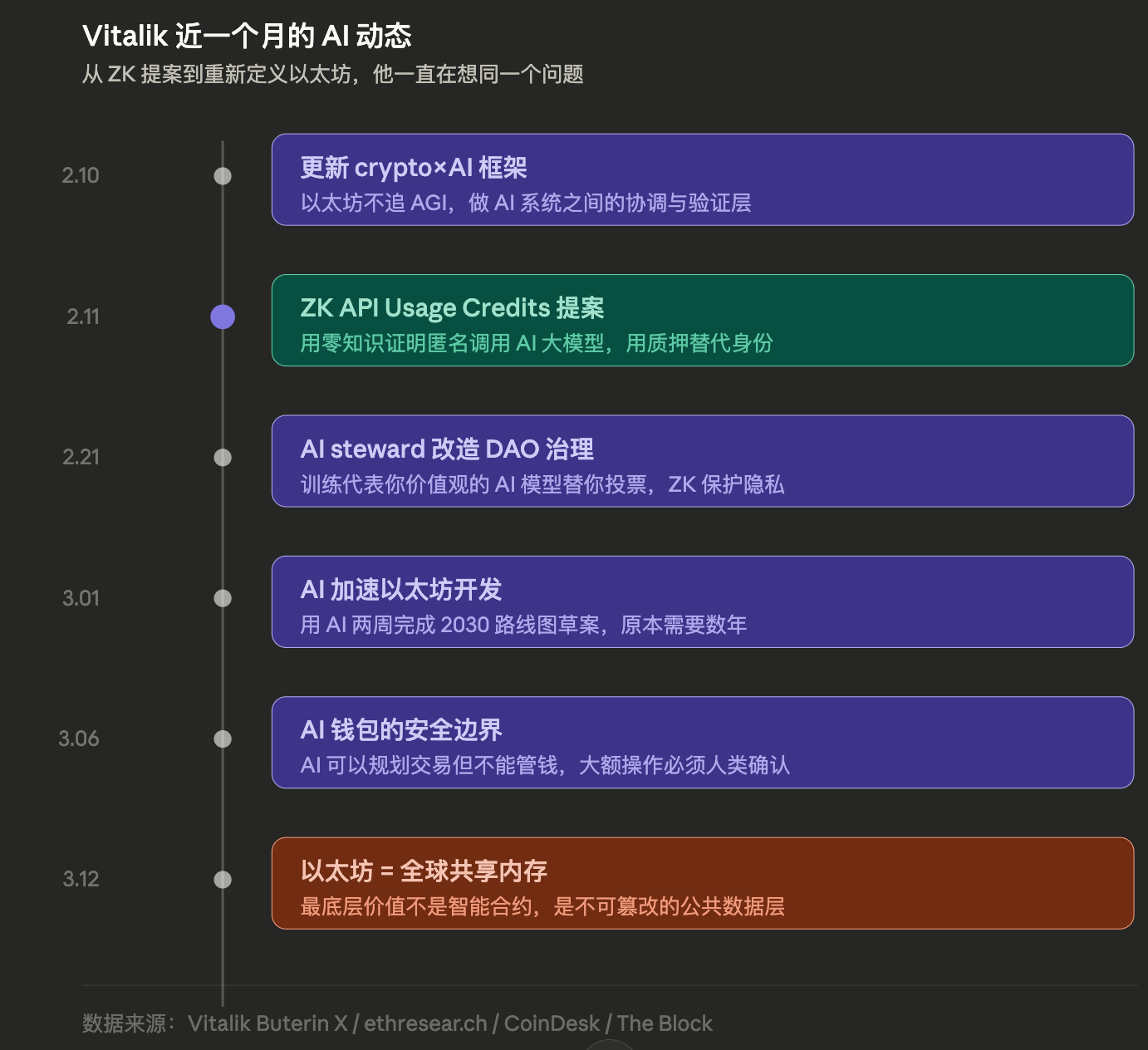
However, I recently checked his X (Twitter) and found that AI has influenced more than just us. Over the past month, a significant portion of his posts have been about AI, and they've even reached the level of technical proposals.

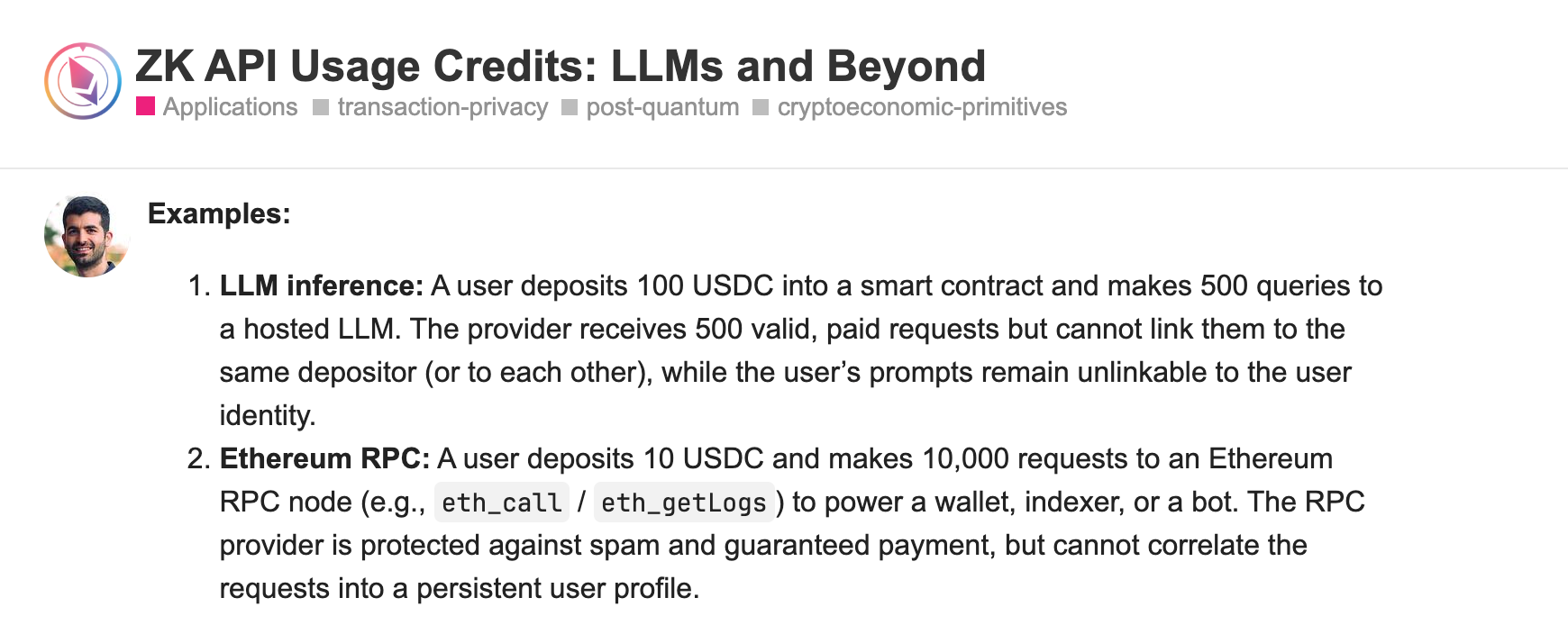
Among them, the most noteworthy is a proposal co-authored with Davide Crapis, the AI lead at the Ethereum Foundation, published on ethresear.ch on February 11th, titled "ZK API Usage Credits."

In a nutshell, it's about using zero-knowledge proofs to let you anonymously call AI large models.

Right now, whether you use ChatGPT or call Claude's API, there's only one way to pay:

Register an account, bind an email, bind a credit card.

Every conversation you have, every prompt you send, the platform knows it's from you. What you asked, when you asked it, how many times you asked—all tied to your real identity.

Vitalik and Crapis's proposal offers another path.

  1. The user deposits a sum of money into a smart contract, say 100 USDC.

  2. The contract registers this deposit into an encrypted on-chain list. After that, every time you call the API, you don't need to reveal your identity; you just generate a zero-knowledge proof.

  3. This proof does two things for the service provider: it proves you're on the list, and it proves your balance is sufficient. But the proof itself doesn't reveal which specific entry on the list you are.

The service provider gets paid and can prevent abuse, but never knows who you are.

You can interpret this proposal as Vitalik believing that in the AI era, users shouldn't have to surrender their identity just to use an AI tool.

This proposal is still in the research phase, far from implementation, and large model manufacturers might not agree to such a method. The comments section of the proposal is also full of rebuttals and skepticism, arguing that AI model companies will always find a way to know your real identity.

But the author believes the significance of this proposal isn't entirely about whether it can be implemented.

Privacy is something Vitalik has worked on for a decade. From early support for Tornado Cash to promoting zero-knowledge proofs as a core technical roadmap for Ethereum, this thread has never been broken. It's just that in the past few years, privacy in the crypto industry's narrative lacked a big enough story to carry it.

AI has filled that story. When you talk to a large model more than anyone else every day, privacy becomes a real demand.

Vitalik Embraces AI

From February until now, a significant portion of what Vitalik has posted on X has been related to AI, with a density that suggests it's more than just casual chat.

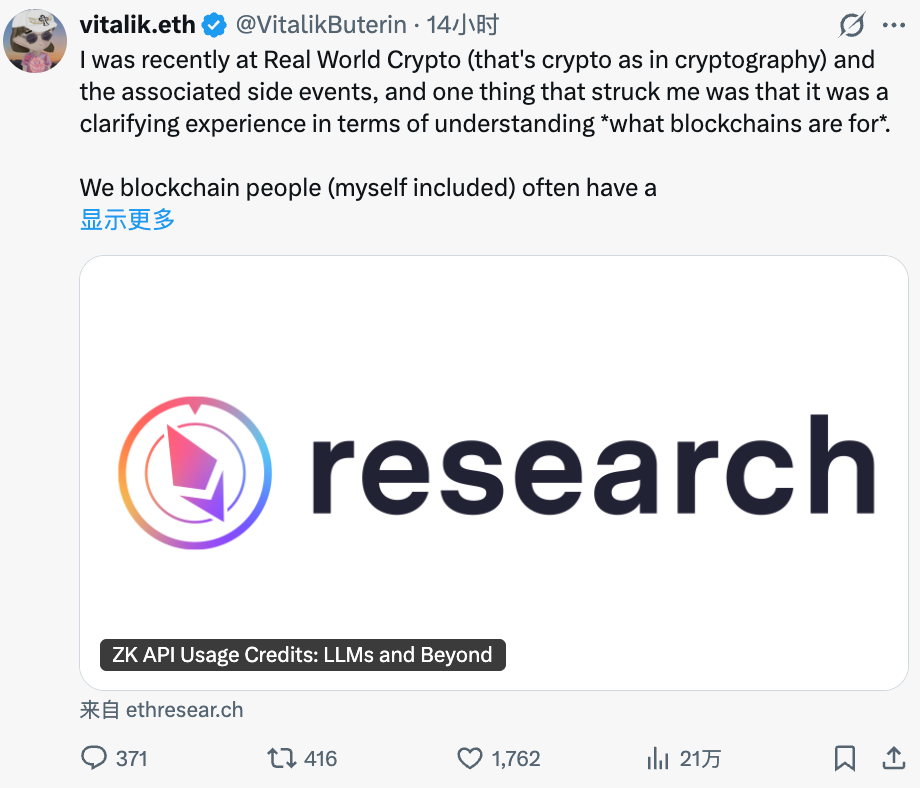
Yesterday he posted a long thread saying he recently attended a cryptography conference where people cared about privacy, cared about open source, cared about censorship resistance... but had no affection for blockchain.

Among that crowd, he conducted a thought experiment:

Forget "we are the Ethereum community," start from scratch and think about where Ethereum is actually most useful.

His conclusion is that Ethereum's most fundamental value is as a bulletin board. A place where anyone can write, anyone can read, and no one can change or delete anything.

In the context of AI, this might be the most important thing Vitalik has said in the last couple of years.

We are entering an era of infinitely cheap generation. Text, images, videos, identities—AI can mass-produce them all. When everything can be forged, what becomes scarce?

These questions ultimately point to the same place: a public, persistent, irreversible data layer. And an unchangeable record is exactly what Ethereum can provide.

Over the past two years, the skepticism Ethereum has faced can be summed up in one sentence: What do you still have that others can't replace?

Looking at it now, Vitalik hasn't answered that question directly.

However, the Ethereum Foundation has done a few low-key things over the past year: formed a 50-person privacy team, established a nearly 50-person privacy research cluster, released the Kohaku privacy framework, specifically appointed an AI lead; the 2026 roadmap lists institutional-grade privacy and faster transaction confirmation as top priorities.

Looking back at his intensive output this month, it's mostly been discussions about Ethereum's privacy and efficiency issues in the context of AI.

I think Vitalik is betting on one thing: the more powerful AI becomes, the more rigid the demand for privacy and verification infrastructure will be. Whether Ethereum can meet this demand is another matter, but he has clearly chosen his table.

ETH is still hovering around 2000. Most people still aren't paying much attention to what he's been saying lately.

But perhaps in a few years, looking back, this might be the time we should have been paying attention.


Twitter:https://twitter.com/BitpushNewsCN

BitPush TG Discussion Group:https://t.me/BitPushCommunity

BitPush TG Subscription: https://t.me/bitpush

Original link:https://www.bitpush.news/articles/7619566

Related Questions

QWhat is the main idea of Vitalik Buterin's proposal 'ZK API Usage Credits'?

AThe main idea is to use zero-knowledge proofs to allow users to anonymously call AI large language model APIs. Users deposit funds into a smart contract, which registers them on an encrypted on-chain list. They can then generate a zero-knowledge proof to show they are on the list and have sufficient balance without revealing their identity.

QHow does the proposed system protect user privacy when using AI models?

AThe system protects privacy by allowing users to generate a zero-knowledge proof that verifies they are on the approved list and have enough funds, without disclosing which specific user they are. The service provider receives payment and can prevent abuse but never learns the user's identity.

QWhy does Vitalik Buterin believe privacy is crucial in the AI era?

AVitalik believes that as AI becomes more integrated into daily life and people interact more with models than with humans, privacy becomes a genuine and critical need. Users should not have to surrender their identity just to use an AI tool.

QWhat role does Ethereum play in Vitalik's vision for the future?

AVitalik sees Ethereum's core value as providing a public, persistent, and immutable data layer—a bulletin board that anyone can write to and read from, but no one can alter or delete. This becomes essential in an AI era where content and identities can be easily forged, creating demand for verifiable and tamper-proof records.

QWhat actions has the Ethereum Foundation taken recently regarding AI and privacy?

AThe Ethereum Foundation has formed a 50-person privacy team, established a nearly 50-person privacy research cluster, released the Kohaku privacy framework, and appointed an AI lead. Their 2026 roadmap prioritizes institutional-grade privacy and faster transaction confirmations.

Related Reads

Stock Trading Has Become 'Crypto Trading', Welcome Back to the Native Home

"Stock Trading Becomes 'Coin Trading': A Market's Bizarre Reversal" The global stock market, particularly in tech sectors, is undergoing a radical transformation, increasingly mirroring the volatile, narrative-driven mechanics of the cryptocurrency world. This shift was starkly illustrated by the dramatic crash of South Korea's KOSPI index in July 2026, where leveraged ETFs tied to stocks like SK Hynix triggered massive, rapid liquidations, devastating hundreds of thousands of retail investors, many of them young. This "crypto-fication" of equities began as disillusioned cryptocurrency traders migrated to stock markets, bringing with them their speculative playbook: chasing high-beta narratives like AI and semiconductor cycles, relying on social media for investment cues, and employing heavy leverage. Ironically, while these traders sought the perceived safety of stocks with fundamentals, their methods turned parts of the equity market—especially in Korea, the US, and Japan—into arenas of extreme speculation. Stocks like SK Hynix experienced price collapses ("halving") in just over a month, a pace even faster than Bitcoin's historical crashes. The core of this change is the primacy of narrative over traditional valuation. Complex company analysis is reduced to viral slogans about AI's infinite demand, driving concentrated inflows into thematic sectors. This is amplified by leverage, particularly through risky single-stock leveraged ETFs, which create vicious cycles of forced selling during downturns. Meanwhile, social media algorithms promote stories of overnight riches, drawing in inexperienced investors. In a paradoxical twist, Bitcoin, through institutional adoption and ETFs, is becoming relatively more stable, with its volatility now sometimes lower than major tech stocks. The market has reached an absurd crossover: stocks are acting like speculative crypto assets, while crypto strives for the legitimacy of traditional finance. The article concludes that this represents a "degeneration" of market rationality, where trading a story's heat has supplanted investing in future profits, leaving a trail of financial wreckage in its wake.

marsbit1m ago

Stock Trading Has Become 'Crypto Trading', Welcome Back to the Native Home

marsbit1m ago

Santander Bank Announces It Holds a $4.3 Million Position in U.S. Spot Bitcoin ETFs

Spanish banking giant Banco Santander disclosed in regulatory filings that it holds approximately $4.3 million in US spot Bitcoin ETFs. While this amount is small relative to the bank's over $1 trillion in assets under management, it signifies a growing trend of traditional financial institutions increasing Bitcoin exposure through regulated channels. Santander, scoring around 35% on a 2026 Bitcoin Adoption Index for banks, is categorized at a "medium level" of integration, similar to Société Générale but behind more crypto-focused firms. The bank's interest in cryptocurrencies is not new; CEO Ana Botín has discussed Bitcoin-related products since 2021. Santander has been developing crypto custody and digital asset services across Europe for years, with its digital arm, Openbank, beginning to offer crypto trading in Germany in September 2025, with plans to expand to Spain. This investment comes as institutional crypto adoption accelerates in Europe. Santander is actively involved in crypto custody initiatives across the continent and appears to be positioning itself to strengthen its role in the sector, especially as regulations like MiCA become clearer. The industry is watching whether the bank's medium integration level reflects caution or structural limitations, as banks with higher adoption may gain an edge in attracting crypto-interested wealthy clients.

cryptonews.ru7m ago

Santander Bank Announces It Holds a $4.3 Million Position in U.S. Spot Bitcoin ETFs

cryptonews.ru7m ago

Cardano Price Forecast for August 2026: Will ADA Triangle Breakout Happen Before or After the CLARITY Act Deadline?

Cardano (ADA) is trading at $0.1642, testing the apex of a symmetrical triangle pattern on the daily chart, which signals an impending directional move. Technical analysis identifies key resistance at the 20-day EMA ($0.1650) and the triangle's upper trendline. A breakout above could target the 50-day EMA at $0.1732, with a cup-and-handle pattern potentially forming. Support lies at the SuperTrend indicator ($0.1536) and the June low of $0.1386. Historically, August has been a weak month for ADA, with a median return of -12.8%. A weekly forecast outlines a volatile month influenced by the imminent August 8th deadline for the U.S. CLARITY Act vote, potential SEC regulatory action, and renewed geopolitical tensions following Iran's missile strike. Key bullish catalysts include the potential passage of the CLARITY Act and a major upgrade integrating Cardano's developer documentation and tools into AI coding assistants like Claude, which could significantly boost developer adoption. On-chain data also shows whale accumulation, a potential Wyckoff accumulation signal. The price forecast presents two scenarios: a bullish breakout above $0.1650 targeting $0.17-$0.1732 if the CLARITY Act passes and AI integration fuels momentum, or a bearish break below $0.1536 toward $0.1386 if the bill fails, seasonal weakness persists, and risk appetite diminishes.

cryptonews.ru26m ago

Cardano Price Forecast for August 2026: Will ADA Triangle Breakout Happen Before or After the CLARITY Act Deadline?

cryptonews.ru26m ago

Trading

Spot
活动图片